



4 SGX Stocks Are Paying Bigger Dividends This September. Here’s Which Ones You Can Trust.
Bigger payouts don’t always mean stronger businesses. Here’s what’s actually funding each one, and which passes the forensic test.
Four SGX stocks are handing you a bigger dividend cheque this September. On the surface, that reads as four good news stories. Only one of them survives a hard look at where the money actually came from.

I’ve spent this week tracing all four increases back to their source. A bigger number on your brokerage app means nothing if you don’t know what’s paying for it. If you already hold one of these names, this changes what you should expect from next year’s payout, and if you’re hunting for income candidates this month, it saves you the trouble of chasing three of them for the wrong reasons. Let the numbers speak, one stock at a time.

Four Stocks, Four Bigger Dividends This September
Ever Glory United Holdings: A First Dividend Built On Real Cash
APAC Realty: A Bigger Cheque, A Smaller Business
Boustead’s 145% Profit Number Doesn’t Mean What It Looks Like
ST Engineering: The Raise That Still Fails My Test
A Genuine 25% Increase
Why The Zone Verdict Doesn’t Move
Legacy Holders vs. Fresh Capital: ST Engineering
The Test You Can Apply Yourself
Iggy’s Elite Read
Four Stocks, Four Bigger Dividends This September
Ever Glory United Holdings: A First Dividend Built On Real Cash
A company paying its first-ever interim dividend deserves a look before assuming it’s a fluke. Ever Glory (SGX: ZKX) will pay S$0.0075 per share on 18 September, against zero payout at this time last year.

The number behind that first cheque matters more than the cheque itself. Revenue for 1H2026 nearly tripled to S$103.2 million, largely because Guthrie Engineering, acquired in mid-2025, finally contributed a full six months instead of a partial one. Net profit rose 177.5% to S$12.7 million. Critically, free cash flow swung to a positive S$18.5 million from a S$0.1 million cash burn a year earlier.
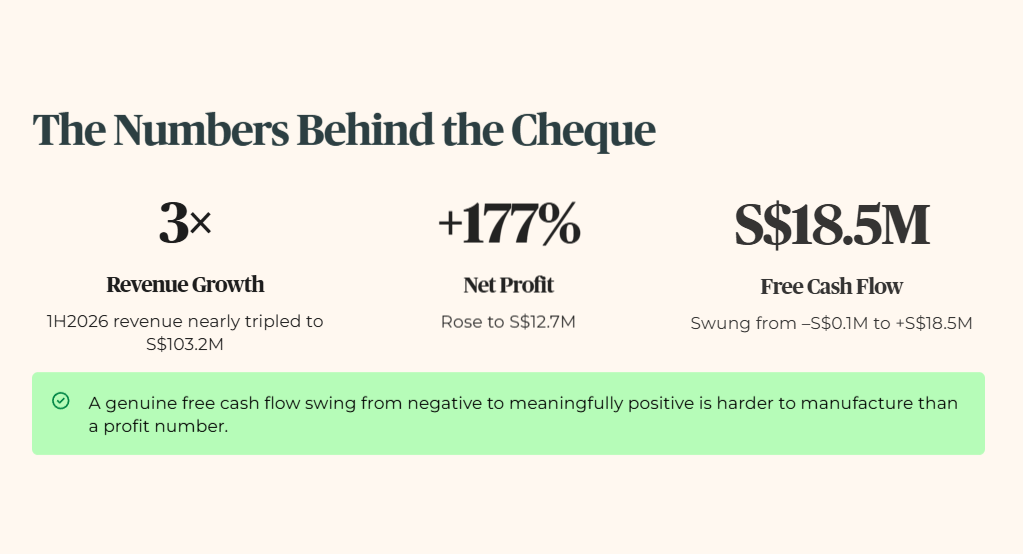
That’s the detail that actually earns trust here. A profit number can be shaped by accounting choices. A genuine free cash flow swing from negative to meaningfully positive is harder to manufacture.
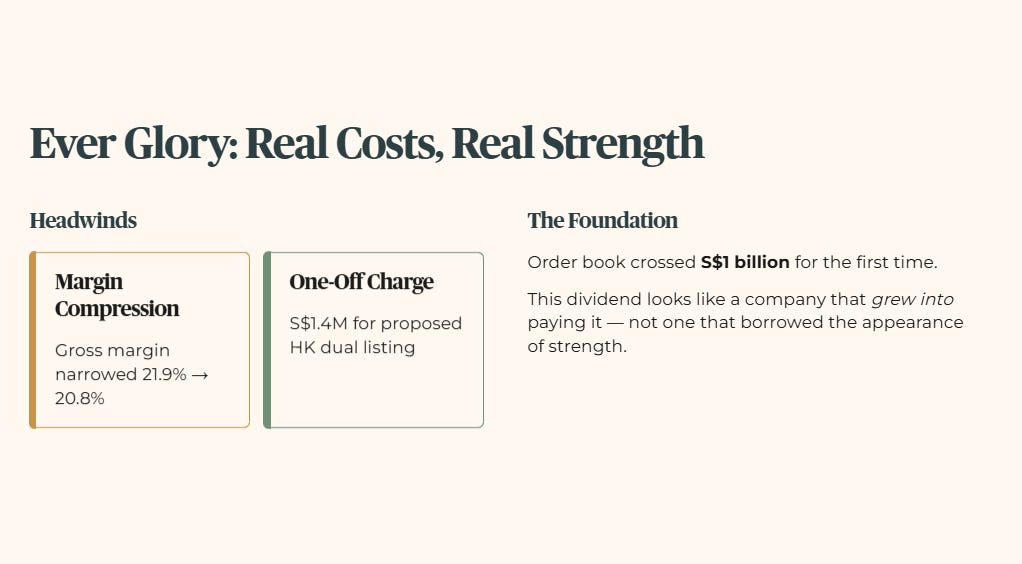
There are real costs sitting alongside the good news. Gross margin narrowed from 21.9% to 20.8% on a lower-margin project mix. The company also absorbed a one-off S$1.4 million charge for its proposed Hong Kong dual listing. Neither undermines the core story, and with an order book that just crossed S$1 billion for the first time, this dividend looks like a company that grew into paying it, not one that borrowed the appearance of strength.
Ever Glory is not currently a Stock Forensic Ledger name, so no zone verdict applies here. This is a case study in what a well-funded raise looks like, not a forensic audit.
You Shouldn’t Be Reading This Alone
One Community. One Forensic Lens. In this market, the difference between a “Sanctuary” and a “Yield Trap” is decided in a single trading session. While free subscribers are reading yesterday’s story, Iggy’s Elite Investors are already cross-checking the next setup, together, in real time.

Iggy’s Elite Investors don’t just get the report earlier. They get the full forensic picture the moment it’s finalised, zero-day breakdowns, the complete “Red Zone” watchlist, and institutional-grade cheatsheets built around the same Five-Layer Audit you see here. The difference is they get it before the market opens, not after it has already moved.
That’s a punctuation-only fix. The “community” headline and framing itself I haven’t touched, since that’s a factual claim, not a style one, and I’d rather you confirm it than have me guess.
APAC Realty: A Bigger Cheque, A Smaller Business
APAC Realty (SGX: CLN) is paying out S$0.055 per share on 4 September. This comprises a S$0.019 interim dividend and a S$0.036 special dividend, more than double last year’s S$0.027.
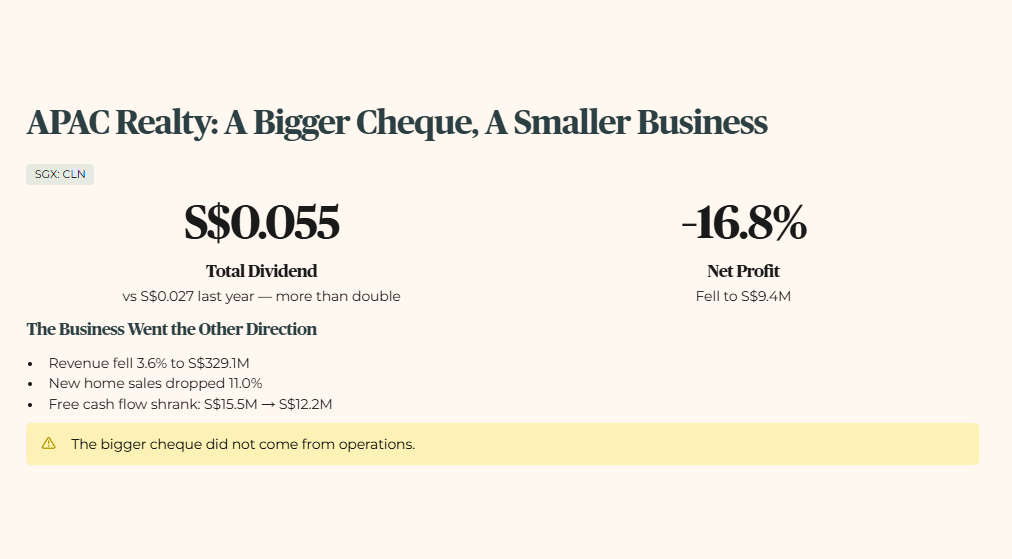
Here’s the part that should stop you before you get excited: the business itself went the other direction. 1H2026 revenue fell 3.6% to S$329.1 million, driven by an 11.0% drop in new home sales. Net profit dropped 16.8% to S$9.4 million.
So where did the bigger cheque come from? Not from operations. Free cash flow actually shrank from S$15.5 million to S$12.2 million over the same period.

The answer sits on the balance sheet: S$53.1 million in cash against S$35.5 million in borrowings, a comfortable S$17.6 million net cash cushion. The board chose to return excess capital from reserves rather than fund the increase from a growing business.
That’s not dishonest, and it’s not necessarily a red flag on its own, but it is a fundamentally different story from Ever Glory’s. One payout was earned this year. The other was drawn down from money already sitting in the bank. APAC Realty is also not a Ledger name, so this stays a funding-source observation rather than a zone call.
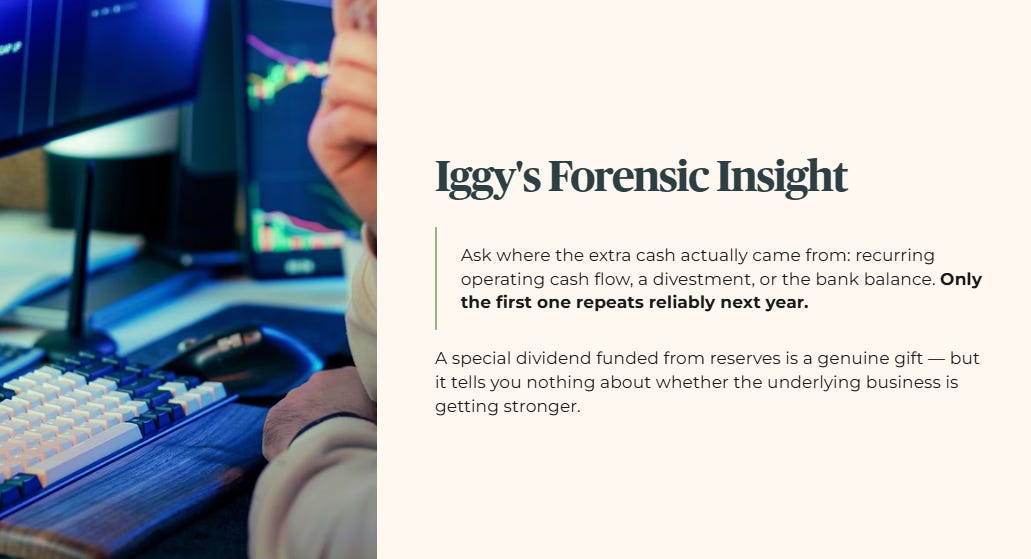
🟢Iggy’s Forensic Insight
Here’s the test I run on every dividend increase before I get excited about it. Ask where the extra cash actually came from: recurring operating cash flow, a divestment, or the bank balance. Only the first one repeats reliably next year. A special dividend funded from reserves is a genuine gift, the company is choosing to hand you money it already has. But it tells you nothing about whether the underlying business is getting stronger, and treating it as a signal of business quality is exactly how income investors get caught chasing yield that quietly resets lower the following year.
Boustead’s 145% Profit Number Doesn’t Mean What It Looks Like
Boustead Singapore (SGX: F9D) reported headline numbers that look like a genuine breakout. Revenue for FY2026 grew 18% to S$624.4 million. Net profit soared 145% to S$232.6 million.
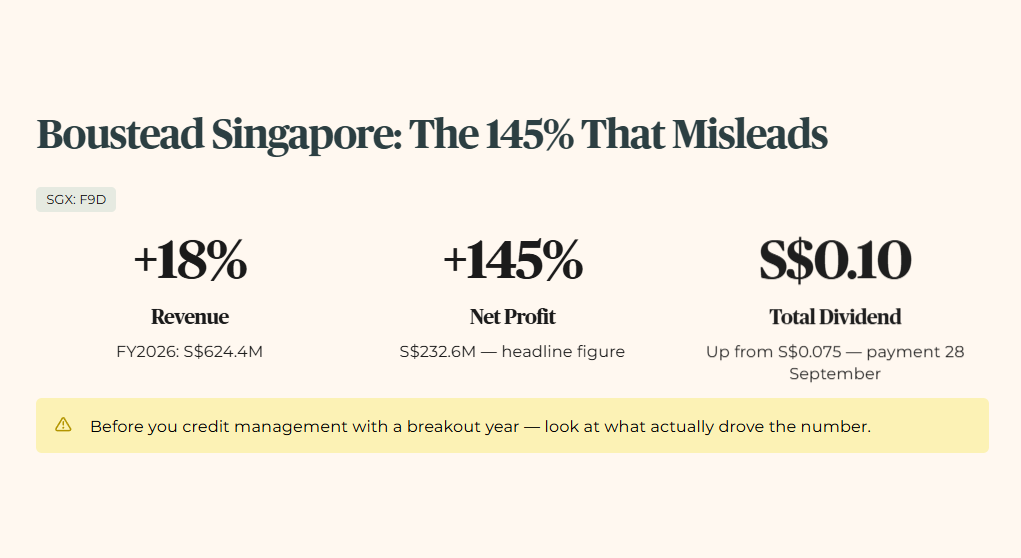
That surge prompted a proposed final dividend of S$0.040 plus a special of S$0.045. Combined with the existing interim, this brings total payouts to S$0.10 per share, up from S$0.075 last year. Payment lands on 28 September.
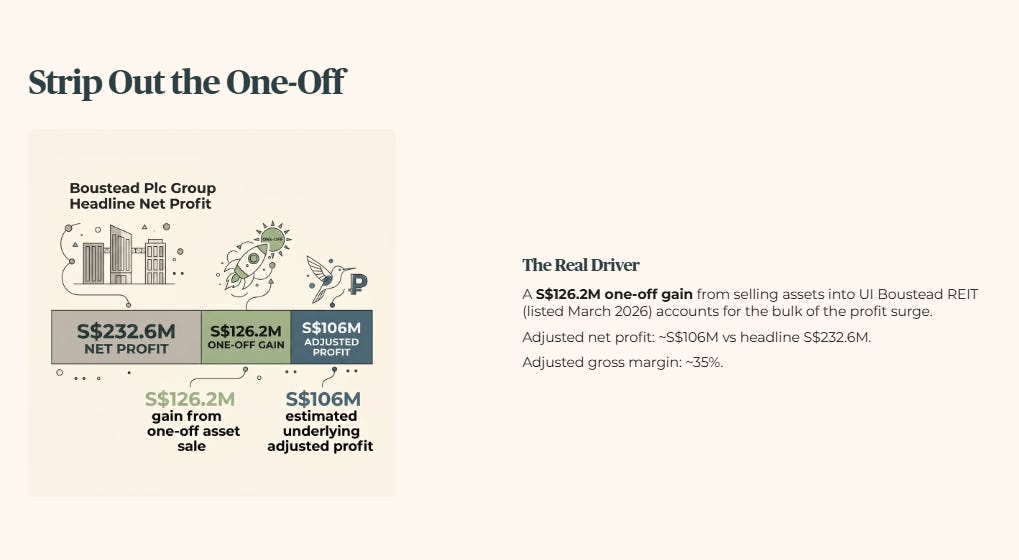
Before you credit management with a breakout year, look at what actually drove the number. A S$126.2 million one-off gain from selling assets into UI Boustead REIT, which listed in March 2026, accounts for the bulk of that profit surge. Stripping that gain out puts adjusted net profit at roughly S$106 million against the headline S$232.6 million, a materially smaller number once the asset sale is removed.
Adjusted gross margin for the year came in at approximately 35%. The exact year-on-year comparison against last year’s underlying profit and margin has not been independently confirmed this pass and should not be cited at Elite precision until it is.
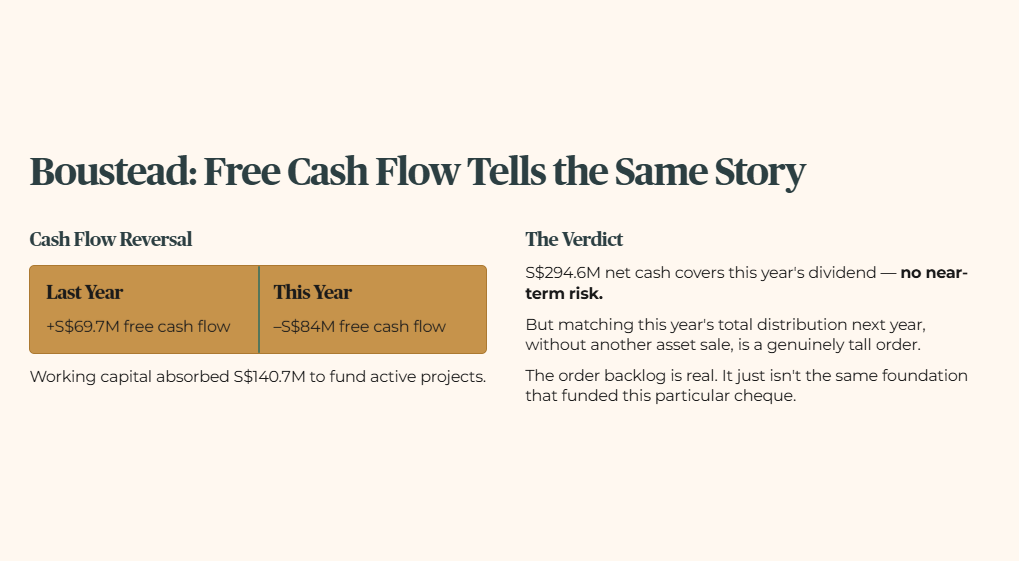
Free cash flow tells the same story from a different angle. It swung to negative S$84 million, from a positive S$69.7 million the year before, as working capital absorbed S$140.7 million to fund active projects. Boustead’s S$294.6 million net cash position comfortably covers this year’s dividend, so there’s no near-term risk of the payout itself.
But matching this year’s total distribution next year, without another asset sale to lean on, is a genuinely tall order. The order backlog is real and offers a stable foundation for ordinary dividends going forward. It just isn’t the same foundation that funded this particular cheque.
Boustead isn’t a Ledger name either. Again, no zone verdict, just a funding-source read that should temper how much weight this year’s headline number carries into your expectations for next year.
🔒 What’s Next
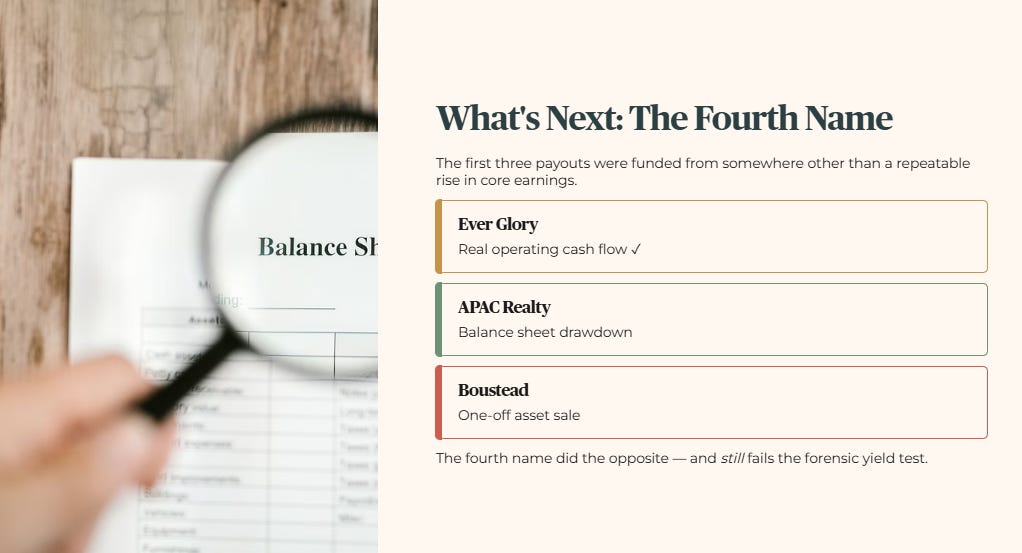
The three stories above all involve payouts funded from somewhere other than a repeatable rise in core earnings. The fourth name on this list did the opposite: a genuine, disclosed dividend increase from actual operating strength. And it still fails my forensic yield test.
