



Owning The Business Isn’t The Same As Being Paid By It
I read a piece this week naming five “core” Singapore dividend stocks. Good businesses, all of them. But two names on that list pay you less today than you might assume from the word “core.” That gap is worth sitting with before you buy anything for the label alone.
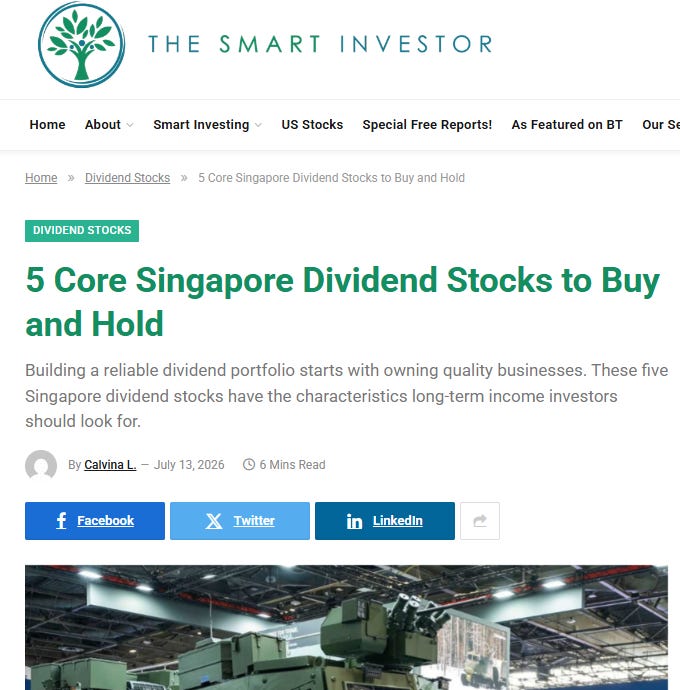
I’ll be honest, when I first saw the headline “5 Core Singapore Dividend Stocks to Buy and Hold,” my first thought wasn’t about the stocks. It was about my own portfolio, and whether I actually check what something pays me, or whether I just trust the name on the label. So let’s sit with these two for a bit, because they’re a genuinely useful pair to think through together.

What The Smart Investor Got Right
DBS: A Great Result, A Smaller Cheque Than It Sounds
Angela’s Observation
SGX: The Raise Is Real, But Read The Base It’s Rising From
Angela’s Observation
The Other Three: Quality Without The Same Gap
The Actual Point
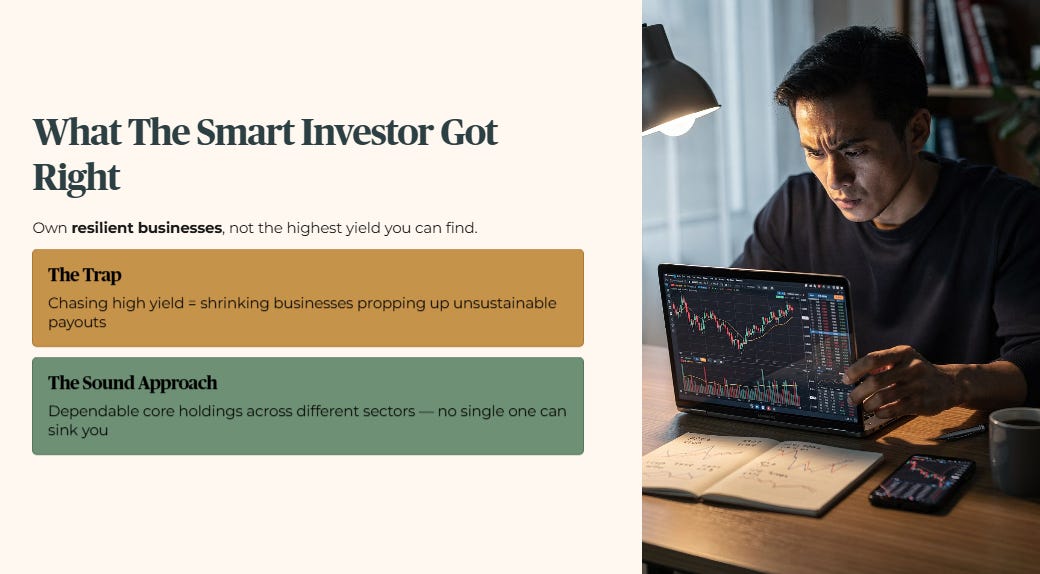
What The Smart Investor Got Right
The Smart Investor put together a list of five names built around a sensible idea: own resilient businesses, not the highest yield you can find. The reasoning behind the list is worth taking seriously on its own terms. Chasing the highest starting yield you can find is how people end up owning companies with shrinking businesses propping up an unsustainable payout, and building a portfolio around a handful of dependable core holdings, spread across different sectors so no single one can sink you, is genuinely sound long-term thinking.
I’ve made that mistake myself in my early investing days, buying something purely because the yield number looked exciting, only to watch the business quietly deteriorate under the payout. So the underlying philosophy here isn’t the issue.
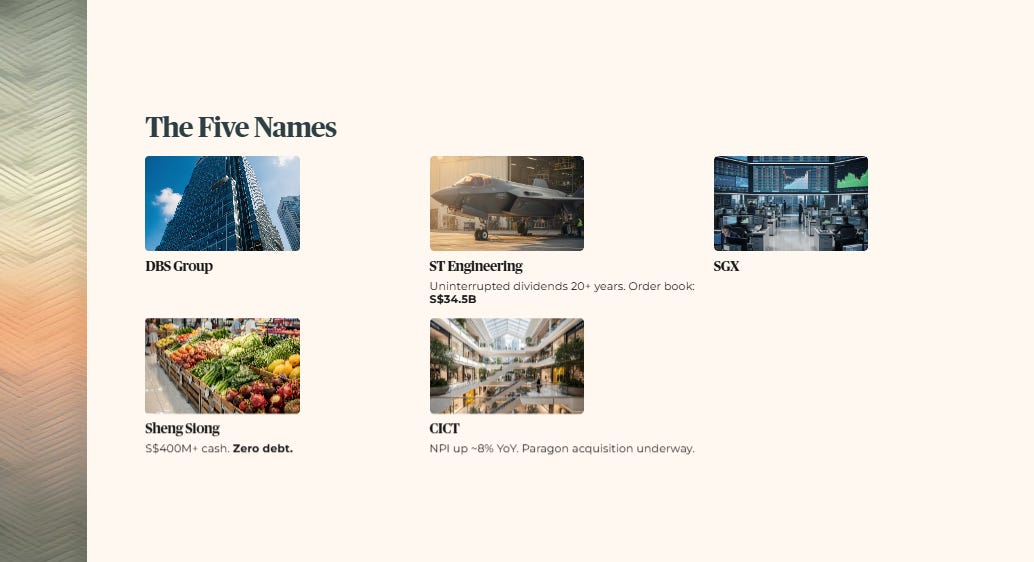
DBS Group, Singapore Technologies Engineering, Singapore Exchange, Sheng Siong, and CapitaLand Integrated Commercial Trust (CICT) all made the cut, and honestly, I don’t disagree with the quality of any of them. STE has paid uninterrupted dividends for over twenty years without a single cut, which in a world of shifting defence budgets and aircraft maintenance contracts is genuinely remarkable, and its order book alone stood at thirty-four and a half billion dollars as of March. Sheng Siong is sitting on over four hundred million dollars in cash with zero debt, funding new store openings out of its own cash flow rather than borrowing for growth. CICT just grew its net property income by close to eight percent year on year and is scaling up a landmark acquisition of Paragon, partly funded by selling a smaller asset at a premium to its own valuation. These are not shaky companies, not by any reasonable measure.
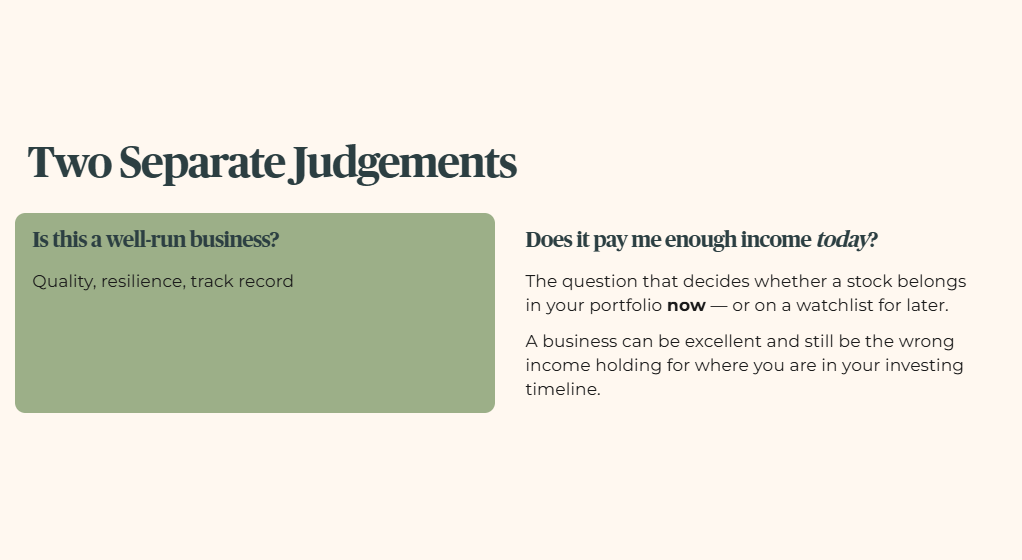
But there’s a difference between “this is a well-run business” and “this pays me enough income today,” and the article, fairly, wasn’t trying to answer the second question. That’s the one I keep coming back to, especially with my own CPF and SRS money in mind, because for someone actually drawing down retirement savings this year, that second question is the one that decides whether a stock belongs in the portfolio right now or belongs on a watchlist for later. A business can be excellent and still not be the right income holding for where you personally are in your own investing timeline. Those are two separate judgments, and it’s easy to let a headline collapse them into one.
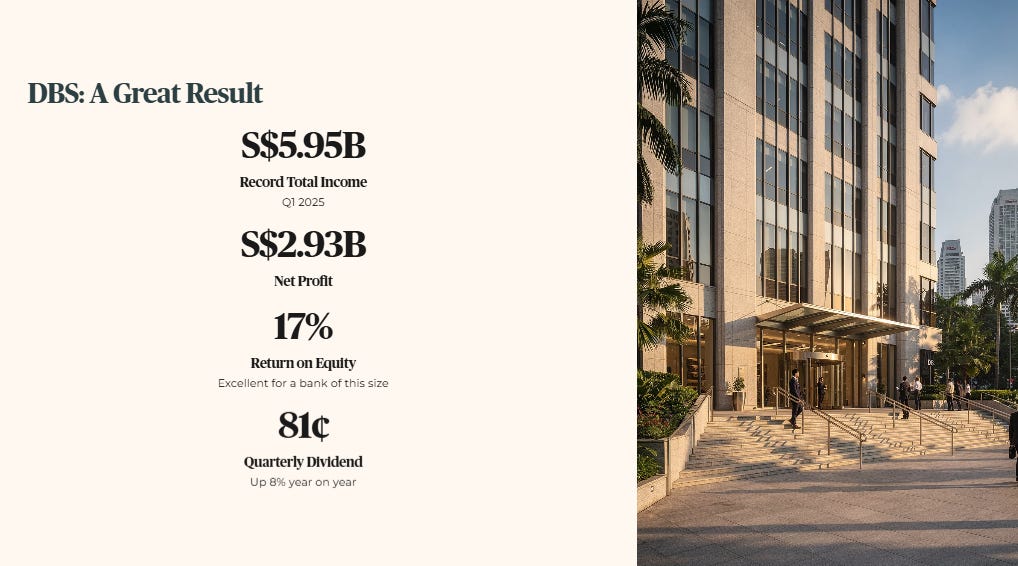
DBS: A Great Result, A Smaller Cheque Than It Sounds
DBS had a genuinely strong first quarter. Record total income of S$5.95 billion. Net profit up to S$2.93 billion. Return on equity holding at seventeen percent, which for a bank of that size is excellent. The board raised the quarterly dividend to eighty-one cents a share, up eight percent from a year earlier. All of that is real, and all of it is good news for DBS as a business.
Here’s where I slow down though. That eighty-one cents is actually two things stitched together: sixty-six cents of ordinary dividend, and fifteen cents of what the bank calls a Capital Return dividend, a separate programme distinct from the regular payout. When I add up DBS’s trailing ordinary dividends against where the share price sits today, around S$73.94, the ordinary income alone comes out to a bit over three percent of what you’d pay to own the shares. Add the Capital Return portion on top and it climbs to just over four percent.
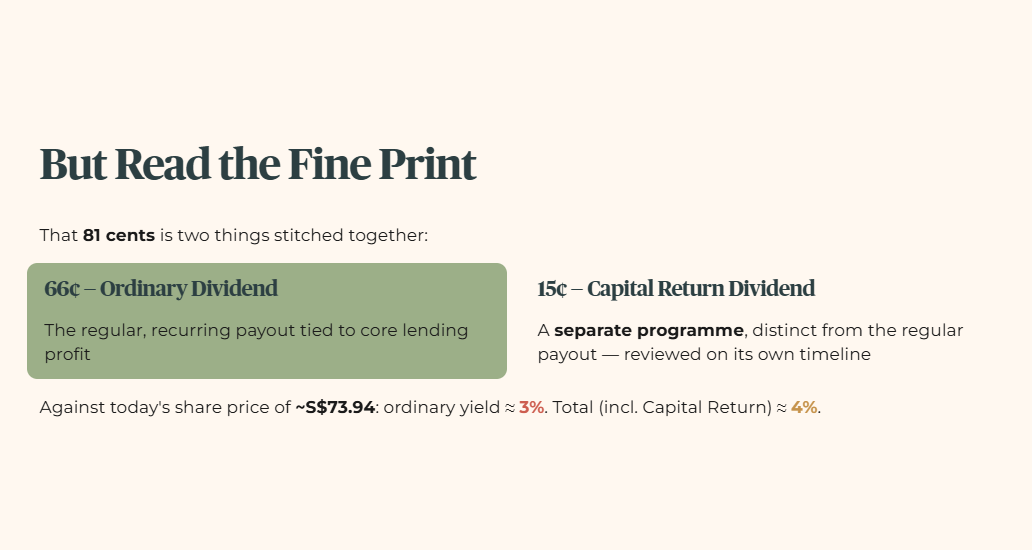
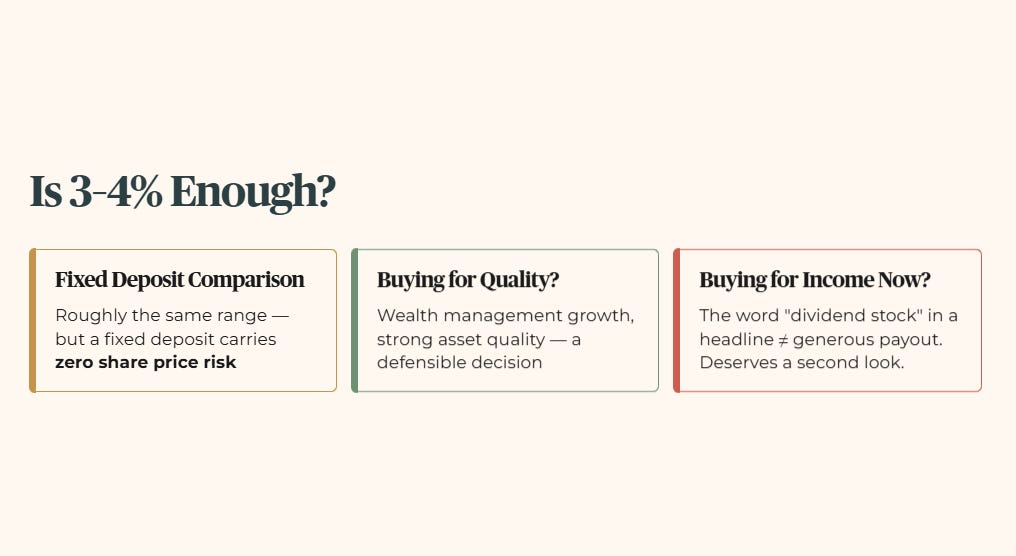
Now, three to four percent isn’t nothing. But it’s roughly what my own fixed deposit pays these days, and my fixed deposit doesn’t come with share price risk attached. If I’m buying DBS purely for the quality of the franchise, the wealth management growth, the strong asset quality, that’s one decision, and a defensible one. If I’m buying it specifically because I need retirement income right now and the word “dividend stock” in a headline made me assume it pays generously, that’s a different decision, and I think it deserves a second look before the trade goes through.
There’s also a question worth sitting with about that Capital Return portion specifically. A programme like that is a genuine, board-confirmed commitment, not a rumour or a one-off surprise, so it’s fair to count it when you’re looking at total income today. But it’s still a distinct thing from the ordinary dividend, funded differently and reviewed on its own timeline, and a bank can choose to slow or end a capital return programme in a way that’s harder to do with an ordinary payout tied to core lending profit.
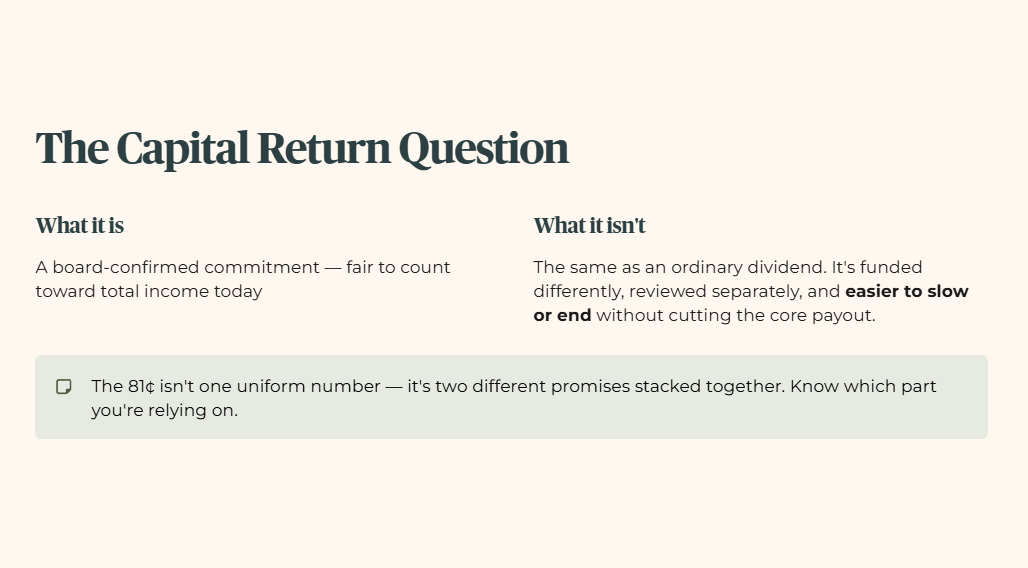
None of that makes DBS a bad holding. It just means the eighty-one cents this quarter isn’t one uniform number, it’s two different promises stacked together, and it’s worth knowing which part you’re actually relying on before you build a retirement drawdown plan around it.
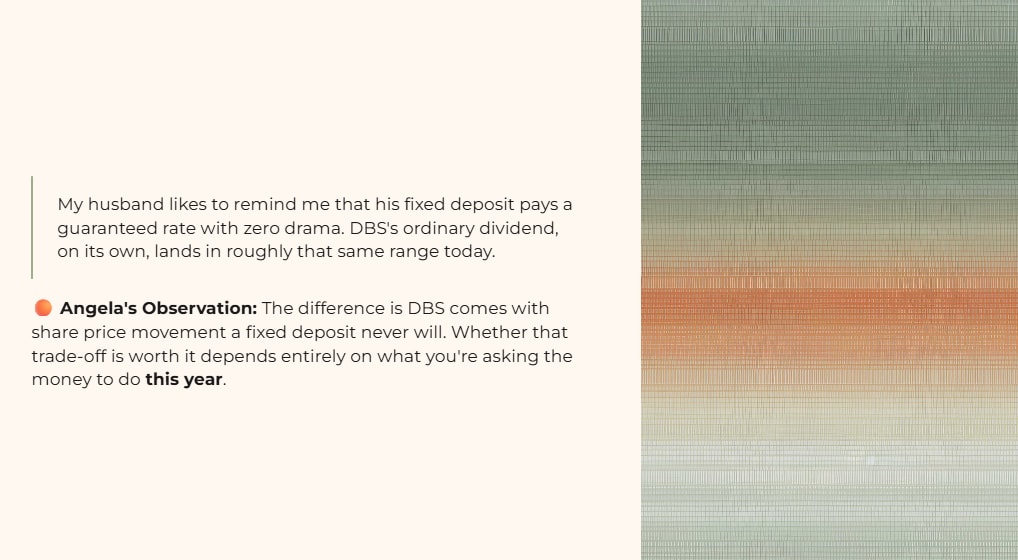
🟠 Angela’s Observation
My husband likes to remind me that his fixed deposit at the bank pays a guaranteed rate with zero drama. DBS’s ordinary dividend, on its own, lands in roughly that same range today. The difference is DBS comes with share price movement, both up and down, that a fixed deposit never will.
I don’t think that makes DBS the wrong holding, I think it makes the comparison worth actually running before you assume the word “dividend” means the same thing here as it does on a bank statement. Whether that trade-off is worth it depends entirely on what you’re actually asking the money to do for you this year.
SGX: The Raise Is Real, But Read The Base It’s Rising From
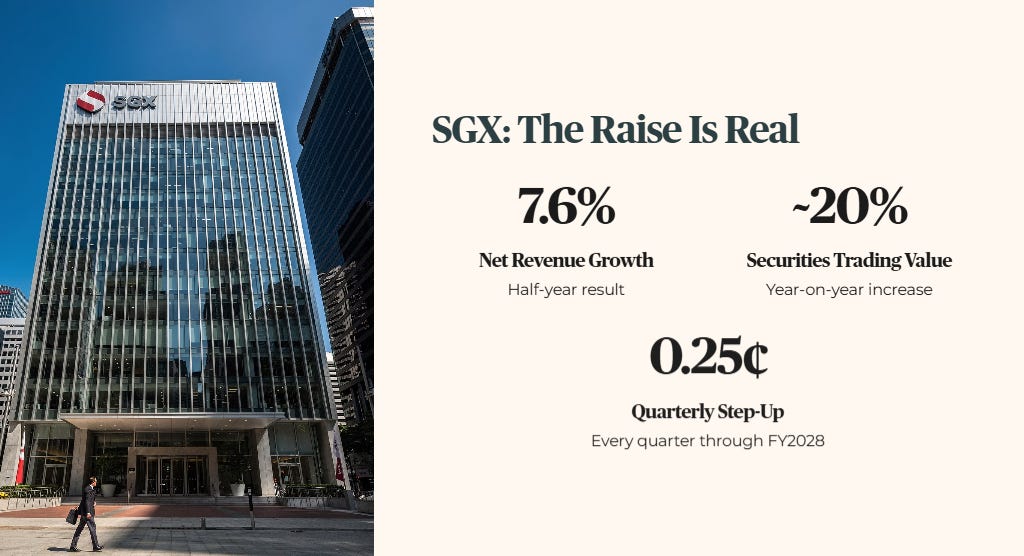
SGX told a genuinely encouraging story too. Net revenue up 7.6% for the half year. Securities trading value up close to twenty percent. And management has committed to raising the quarterly dividend by a quarter of a cent every quarter through the end of the 2028 financial year, which is the kind of steady, disciplined capital return policy that income investors like to see.
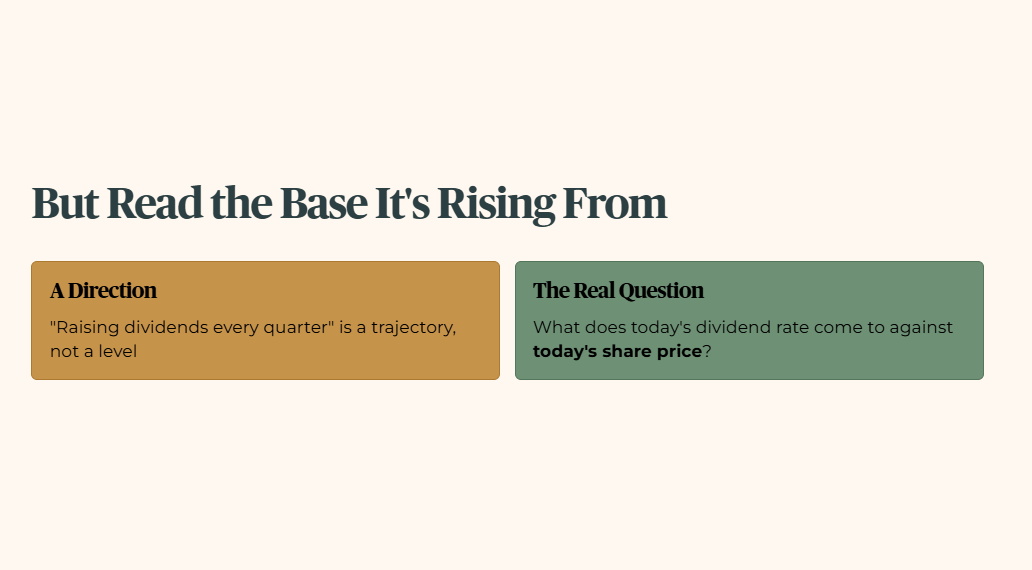
But a quarterly step-up is a direction, not a level. Before I’d treat SGX as an income holding rather than a growth-and-quality holding, I’d want to actually sit down and work out what today’s dividend rate comes to against today’s share price, not assume that “raising dividends every quarter” automatically means “pays well right now.” Those are two separate questions, and the second one is the one that actually matters if you’re counting on the payout to cover something specific, like a monthly expense or a drawdown target.
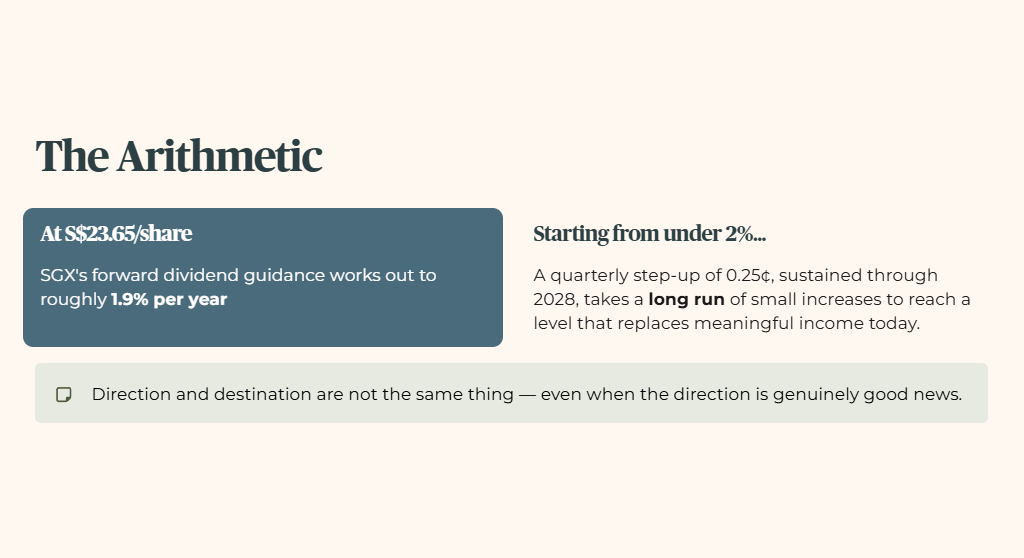
So I did the arithmetic. At S$23.65 a share, the close as of 24 July, SGX’s own forward dividend guidance works out to roughly one point nine percent a year. That’s a genuinely different number from the twenty-one and three quarter cents the article quoted for the first half alone, which on its own can read like more than it actually annualises to. A quarterly step-up of a quarter of a cent, sustained through 2028, is a real and disciplined commitment. But starting from under two percent, it takes a long run of those small increases to reach a level that would actually replace meaningful income today.
The forward yield math is now on the table, the next section applies that same calculation lens across the rest of the ‘core’ list to show which names genuinely clear an income portfolio’s hurdle and which quietly fall short.
