




7 Retirement Checks Worth Doing Before You Need Them, Starting With the S$220,400 Number
CPF Board figures show more members setting aside their retirement sums each year up to 2025. These seven checks cover what comes after that day.
In 2025, 56% of active CPF members turning 55 set aside the Full Retirement Sum in cash. In 2021 the figure was 47%. Add the members who set aside the Basic Retirement Sum and own a property, and 72% of active members met the Required Retirement Sum in 2025, up from 65% four years earlier.
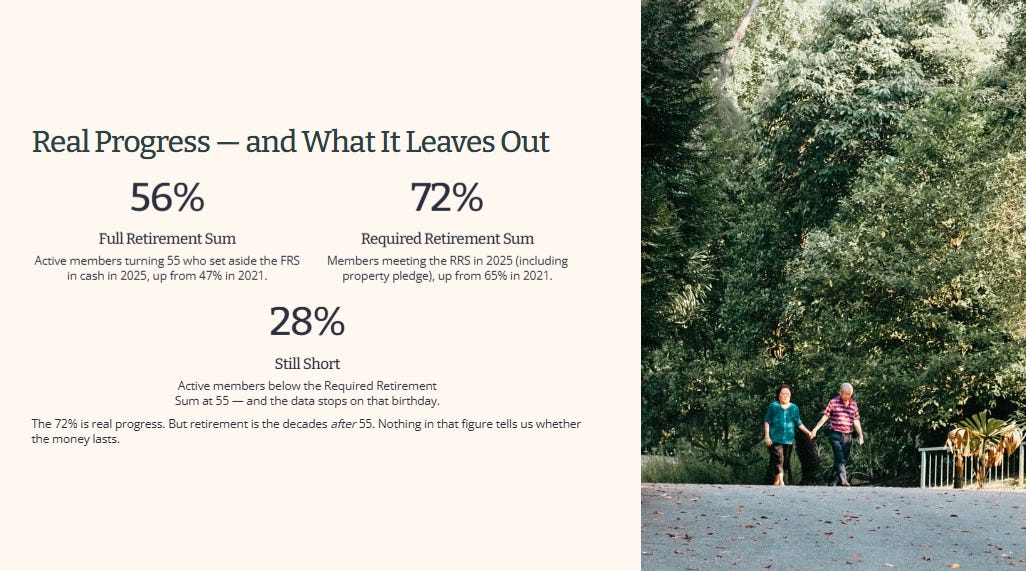
That is real progress, and I want to say so before anything else. It also leaves 28% of active members below the Required Retirement Sum at 55, and the statistic stops on the birthday. Retirement is the decades after it. Nothing in the 72% tells me whether the money lasts, or what happens to it when prices rise, when markets fall in the wrong year, or when someone else needs help.
What This Piece Does
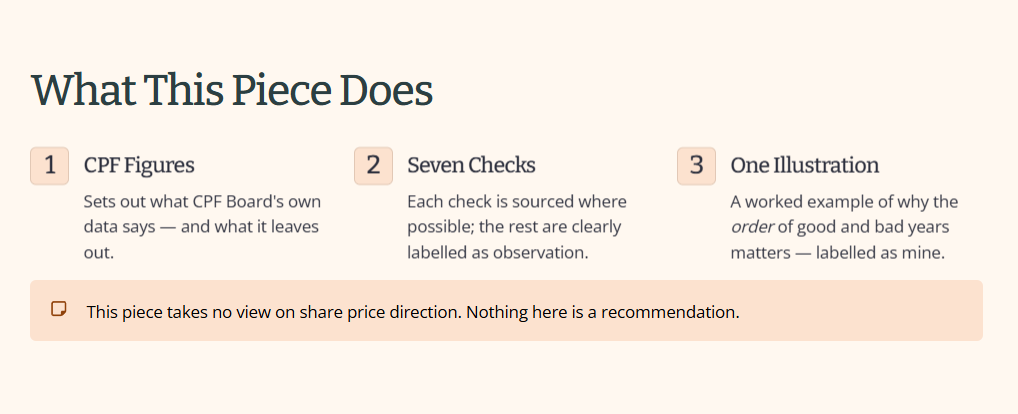
It sets out what CPF Board’s own figures say about members reaching their retirement sums, and what those figures leave out.
It goes through seven checks, giving a source wherever I could find one and labelling the rest as my own observation.
It works through one illustration, labelled as mine, of why the order of good and bad years matters.
This piece takes no view on share price direction. Nothing here is a recommendation.

What the CPF Figures Say, and Where They Stop
Check 1: Lifestyle Inflation
Check 2: What the CPF Sums Actually Pay
Check 3: The Emergency Fund
Check 4: Inflation and the Payout That Stays the Same
Angela’s Observation
Check 5: Chasing a High Payout
Check 6: Support With No Ceiling
Check 7: The First Three Years
But the Statistic Is Improving
Angela’s Observation
The Seven Checks, to Take With Yo
What the CPF Figures Say, and Where They Stop
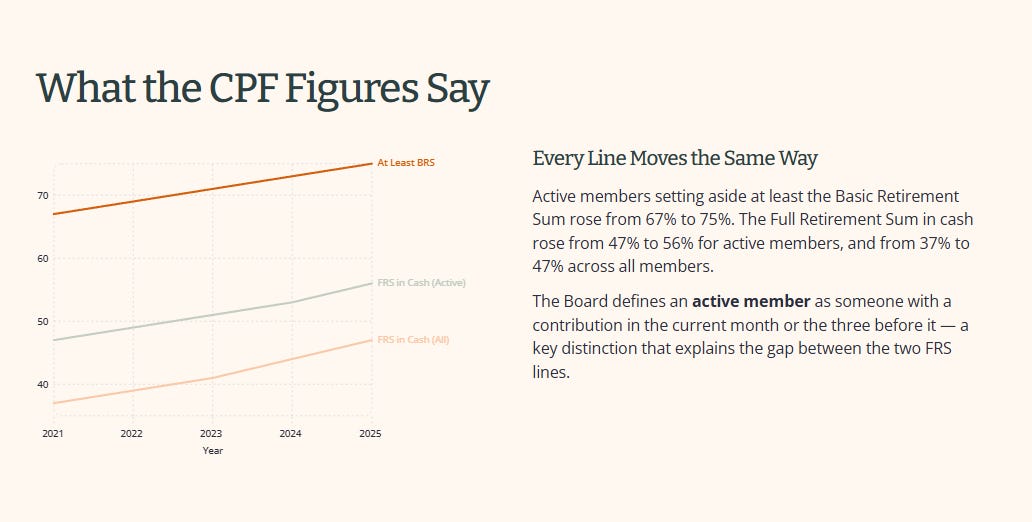
The Board’s table covers 2021 to 2025, and every line moves in the same direction. Active members who set aside at least the Basic Retirement Sum rose from 67% to 75%. Those who set aside the Full Retirement Sum in cash rose from 47% to 56%. Across all members, including people not currently contributing, the Full Retirement Sum figure rose from 37% to 47%, which is lower because that group includes people with no recent contributions. The Board defines an active member as someone with a contribution in the current month or the three before it.
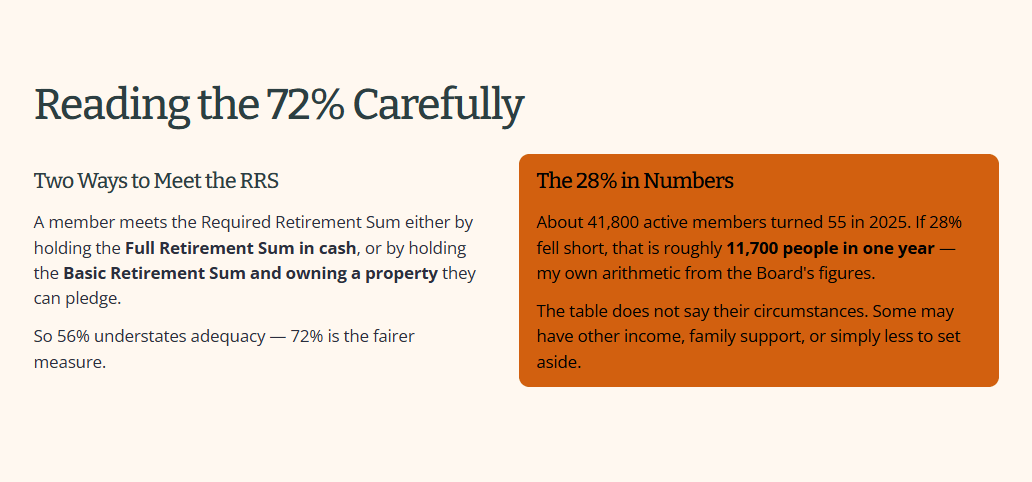
The Required Retirement Sum figure needs a careful reading. A member meets it either by holding the Full Retirement Sum in cash, or by holding the Basic Retirement Sum and owning a property. So the 56% understates adequacy, because a member with a property can pledge it, and the 72% is the fairer measure.
About 41,800 active members turned 55 in 2025. If 28% of them fell short of the Required Retirement Sum, that is roughly 11,700 people in one year, which is my own arithmetic from the Board’s figures. I do not know their circumstances, and the table does not say. Some may have other income, some may have family to rely on, and some may simply have had less to set aside.
What I keep returning to is that the table measures one day. It can tell me whether someone reached a number at 55. It cannot tell me what they were spending, what they were earning on the rest, or who was relying on them. Those are the things the seven checks below try to ask.
Check 1: Lifestyle Inflation
I could not find a published figure for how much a typical household’s spending rises after a raise, so this check is observation only. What I notice is that the target for retirement is set by spending, not by income. If monthly spending rises each time income does, the number the savings have to support rises with it, and the savings rate may not.
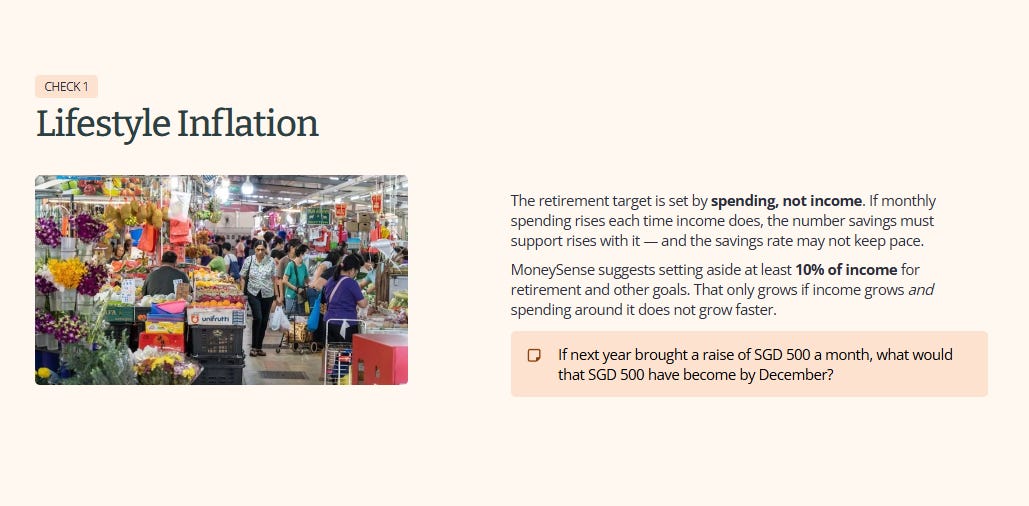
MoneySense, the MAS-backed financial education site, suggests in its current Basic Financial Planning Guide setting aside at least 10% of income for retirement and other goals. That is a rule of thumb, not a requirement, and it is a share of income, so it only grows if the income it applies to grows and the spending around it does not grow faster.
The question I would ask is simple. If next year brought a raise of SGD 500 a month, what would that SGD 500 have become by December?
Check 2: What the CPF Sums Actually Pay
CPF Board’s 2026 retirement sums, for members turning 55 this year, are SGD 110,200 for the Basic Retirement Sum, SGD 220,400 for the Full Retirement Sum and SGD 440,800 for the Enhanced Retirement Sum. The Board’s estimates of the monthly payout from age 65 are about SGD 950, SGD 1,780 and SGD 3,440, for a male member on the CPF LIFE Standard Plan, with payouts starting at 65.
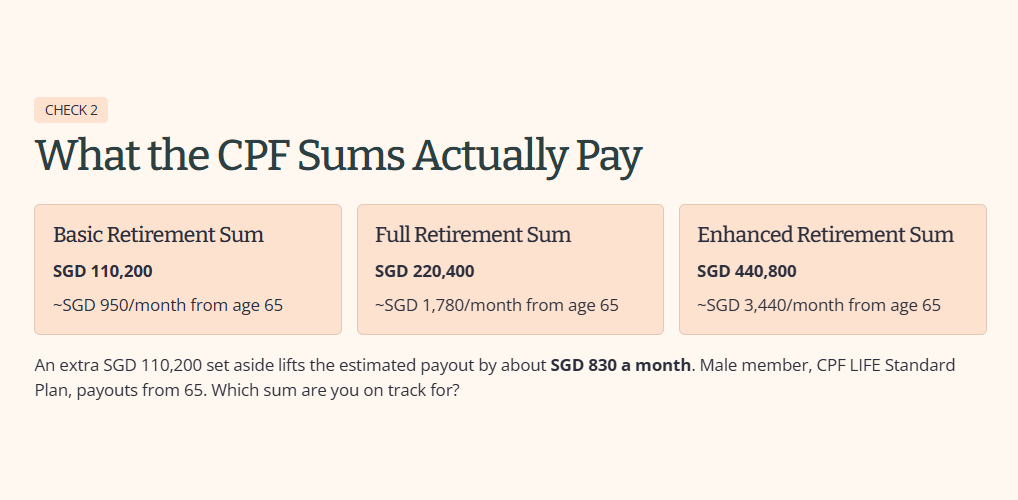
Between the first two, an extra SGD 110,200 set aside lifts the estimated payout by about SGD 830 a month. I find it useful to see that as a number, because the sums on their own sound abstract and the payout is what arrives at the letterbox.
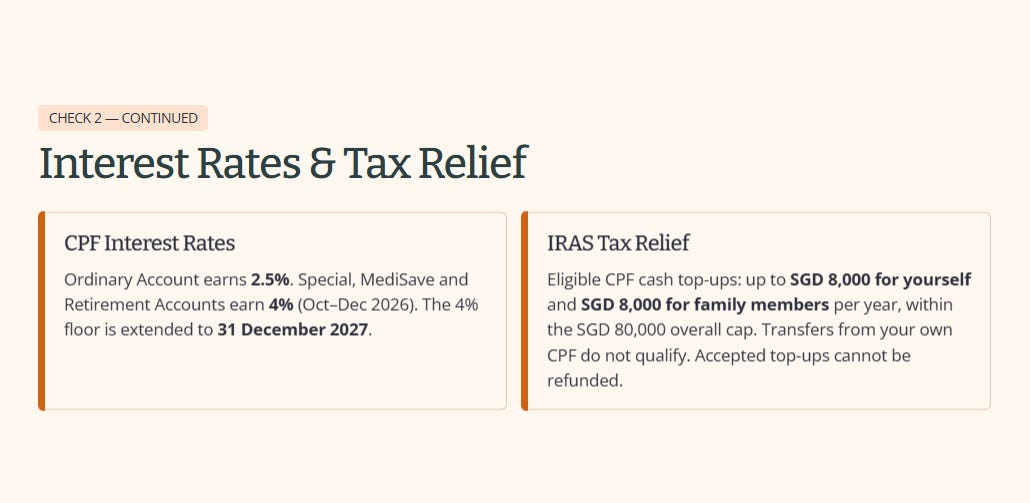
On interest, the Ordinary Account earns 2.5% and the Special, MediSave and Retirement Accounts earn 4% for October to December 2026. The Government has extended the 4% floor on those three accounts to 31 December 2027. On tax, IRAS gives relief for eligible CPF cash top-ups of up to SGD 16,000 a year, which is SGD 8,000 for yourself and SGD 8,000 for family members, inside the SGD 80,000 overall cap on personal reliefs. Transfers from your own CPF accounts do not qualify, and IRAS notes that accepted cash top-ups cannot be refunded.
My daughter asked me last week whether topping up her own CPF is worth thinking about this early. I told her I could explain the rules but not decide for her. Which sum are you on track for, and do you know what the difference means in monthly terms?
Check 3: The Emergency Fund
MoneySense’s planning guide says to set aside at least three to six months of expenses. Again a rule of thumb, but it is the one the MAS-backed guidance uses, so it is a fair place to start.
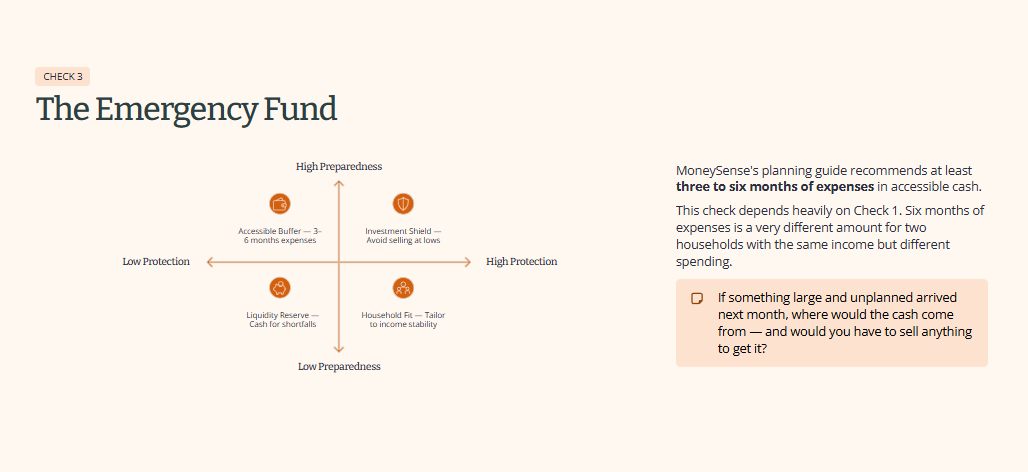
What strikes me is how much this check depends on Check 1. Six months of expenses is a different amount for two households with the same income and different spending. After retirement it also does a second job. Cash in reach means no need to sell investments in a month when prices are down, and Check 7 shows why that matters more than it sounds.
If something large and unplanned arrived next month, where would the cash come from, and would you have to sell anything to get it?
Check 4: Inflation and the Payout That Stays the Same
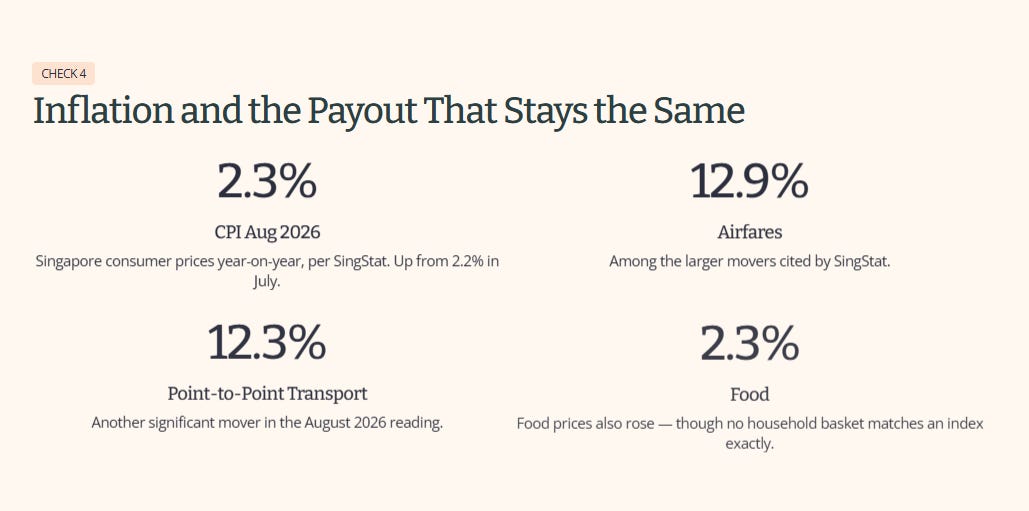
Singapore’s consumer prices were 2.3% higher in August 2026 than a year earlier, according to SingStat, up from 2.2% in July. SingStat named airfares, up 12.9%, and point-to-point transport, up 12.3%, among the larger movers, with food up 2.3%. I do not have a wet market basket to compare against the index, and what I notice is that no household’s basket matches an index exactly. The fish I buy may rise faster or slower than the number on the page.
Here is an illustration of mine, not a forecast. Suppose a payout of SGD 1,780 a month stayed at the same dollar amount and prices rose 2.3% a year, a single month’s reading held constant. After 10 years it would buy what about SGD 1,418 buys today. After 20 years, about SGD 1,130. The CPF Board’s estimates are for a male member on the Standard Plan, and CPF LIFE has other plan choices that I have not compared here.
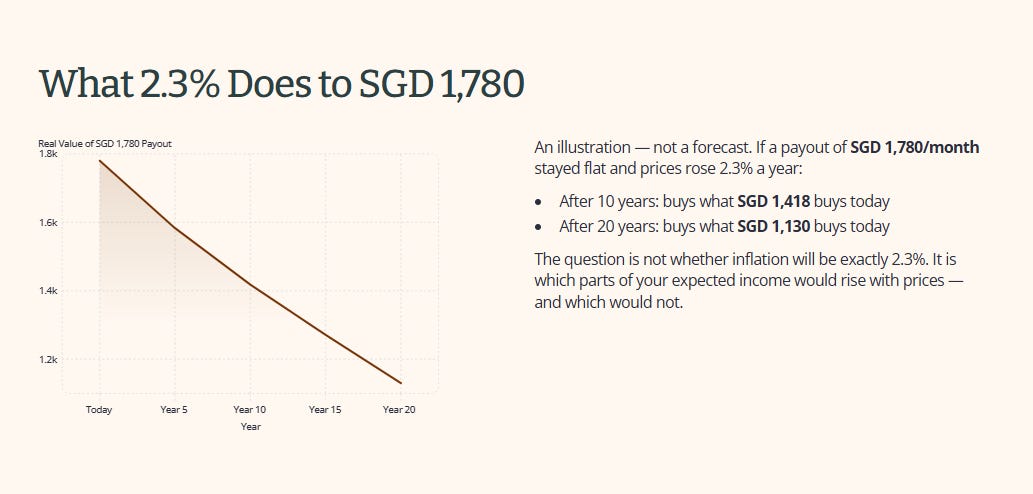
The question this raises for me is not whether inflation will be 2.3%. It is which parts of the income I expect would rise with prices, and which parts would not.
🟠 Angela’s Observation
Looking back at these four checks, the numbers that held my attention were the small ones. SGD 830 a month between two sums, SGD 1,130 against SGD 1,780 after twenty years. They feel manageable one at a time. What I am less sure about is whether anyone looks at all four together, because each sits in a different place: the spending in a bank app, the CPF in a Board statement, the cash in a savings account, the prices in a newspaper. If you laid all four on one page, which would you find you had never actually written down?
The Red Flags Were Always There
The Warning Signs Were Never Hidden. In this market, the difference between a “Sanctuary” and a “Yield Trap” usually isn’t hidden information, it’s a set of numbers sitting in the same filings everyone can access: the gearing ratio, the occupancy rate, the debt maturity schedule. The red flags are always there. The question is whether you have a framework built to actually read them, or whether you’re taking the headline yield at face value.
Paid Members don’t stop at the headline yield. They get the full forensic breakdown, every time: the gearing ratios, the occupancy gaps, the debt overhang, laid out in full rather than summarised into a number. The complete Red Zone watchlist. Forensic cheatsheets built to flag the landmines dressed up as opportunities.

With the YouTube/Substack Combo at S$12/month, you’re not paying to move faster than the market. You’re paying to see the reasoning the headline yield leaves out.
🔒 What’s Next
The SGD 1,780 payout estimate is only part of how most retirements are funded. Below the line are the last three checks, which cover the money you manage yourself and the people who may depend on it, and a gap of about SGD 96,000 that appears in one illustration from timing alone.
