



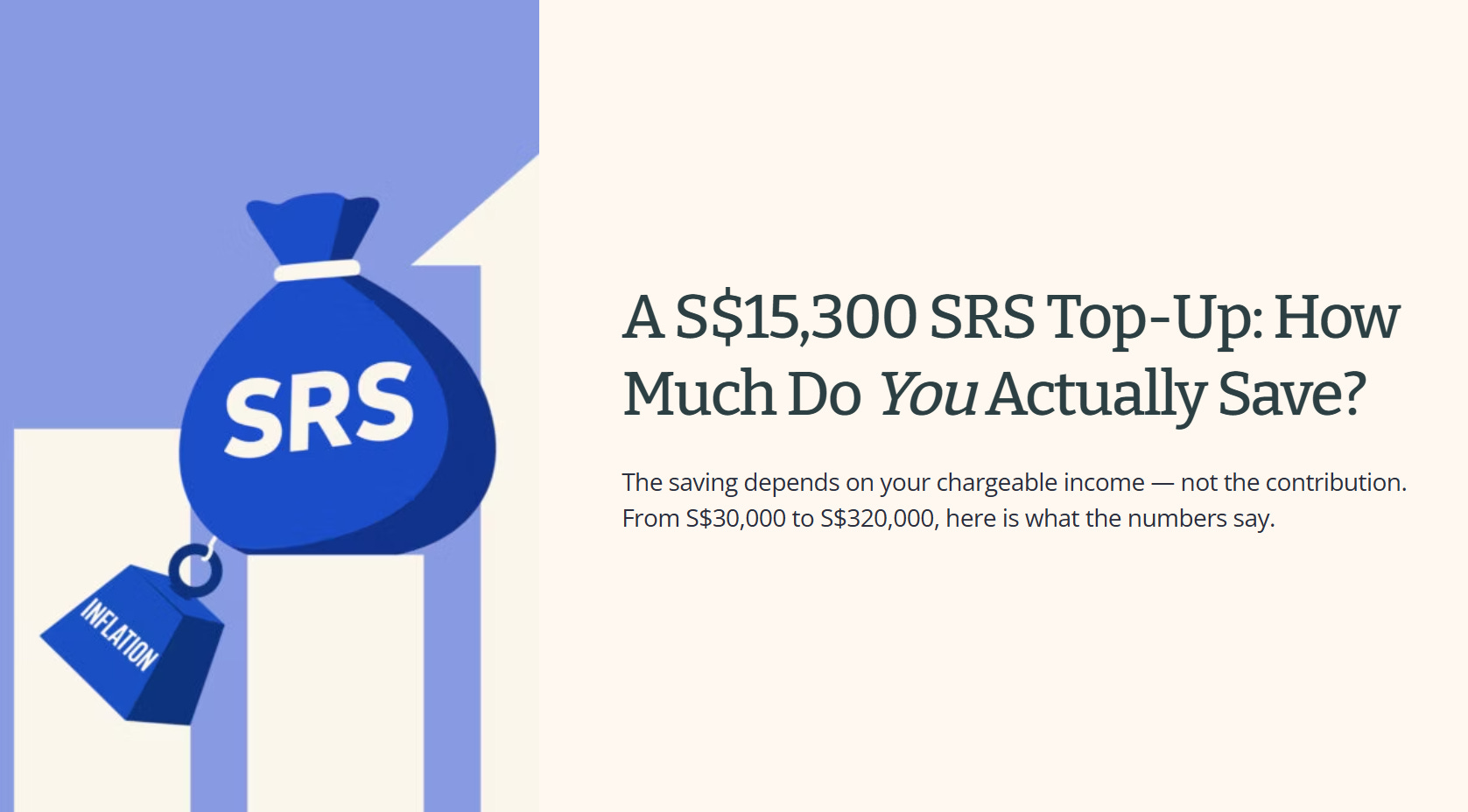
A S$15,300 SRS Top-Up Saves S$456 at One Income and S$3,060 at Another. Which One Is Yours?
The saving from an SRS top-up depends on your chargeable income, not on the contribution. Here is the table from SGD 30,000 to SGD 320,000, what IRAS says happens when you withdraw, and what the cash inside the account earns while it waits.
Two readers each put SGD 15,300 into an SRS account this year. One sees a tax bill that is SGD 456 lower, and the other sees one that is SGD 3,060 lower. The contribution is identical, so the gap comes from a number most of us have never looked up.
If you have an SRS account, you probably opened it because a bank officer, a colleague or a video told you it saves tax. That is true, and I have said it myself. What the one-line version leaves out is that the saving is not a single figure. It moves with your chargeable income, and it is worth knowing where you sit before you decide how much to put in. I read the IRAS rate table, the IRAS pages on SRS contributions and withdrawals, and the MAS T-bill pages line by line, because each page answers a different half of the question.
What This Piece Does
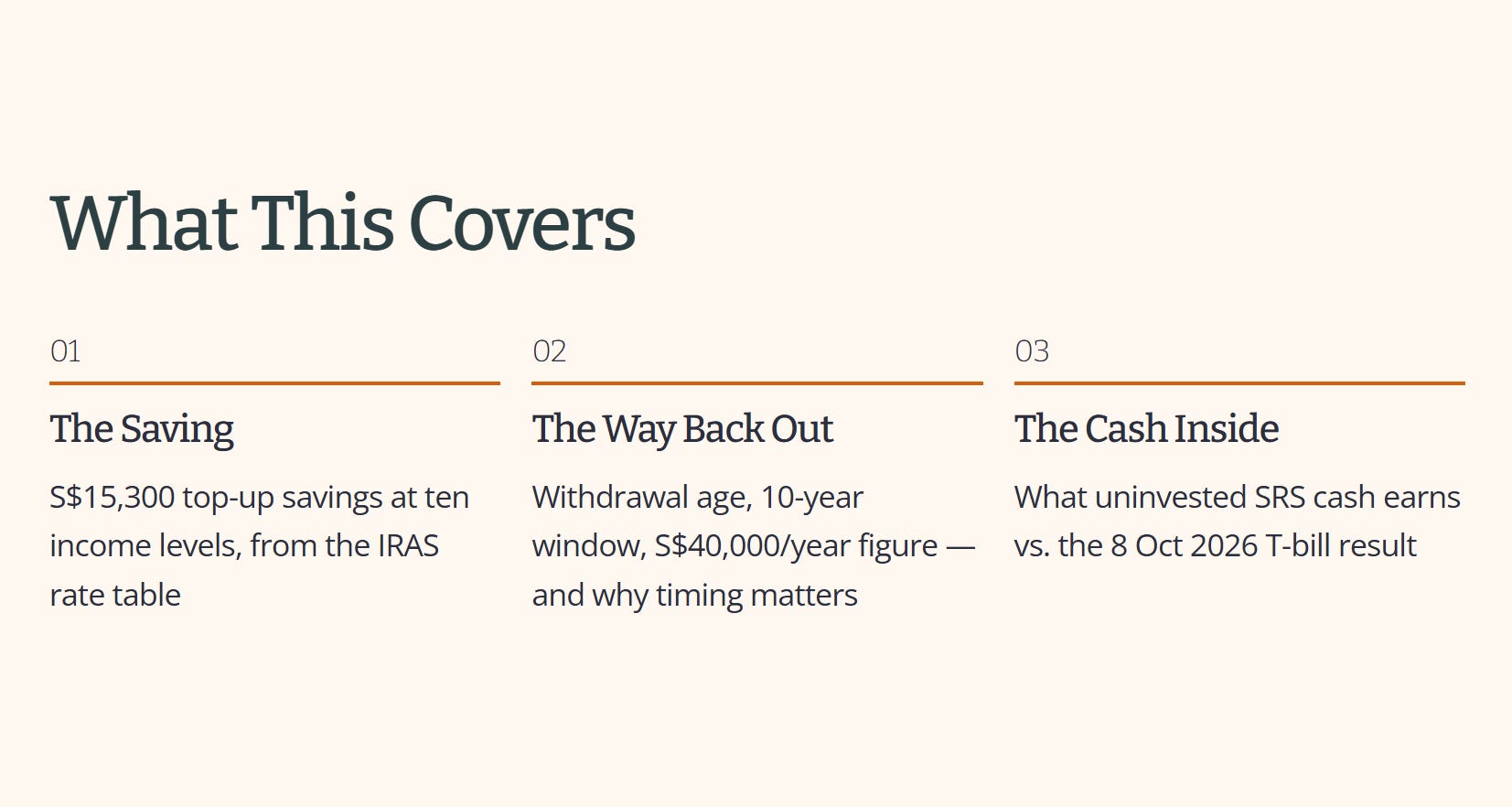
The saving. What a SGD 15,300 top-up saves at ten levels of chargeable income, worked out from the IRAS rate table.
The way back out. What IRAS sets for the withdrawal age, the 10-year window and the SGD 40,000 a year figure, and why the timing of withdrawals matters.
The cash inside. What uninvested SRS cash earns, and how that compares with the 8 October 2026 T-bill result published by MAS.

What This Piece Does
How the Relief Works
The Same SGD 15,300 at Ten Incomes
Iggy’s Insight
What Comes Out: The Rules IRAS Sets
What the Cash Earns While It Waits
Iggy’s Insight
What’s Next
Three Readers at the Exit
When the Window Closes
What the Idle Cash Costs
Checks Before Topping Up
Iggy’s Elite Read
How the Relief Works
An SRS contribution is a deduction from your chargeable income, which is your taxable income after other reliefs. It is not a credit against the tax bill.
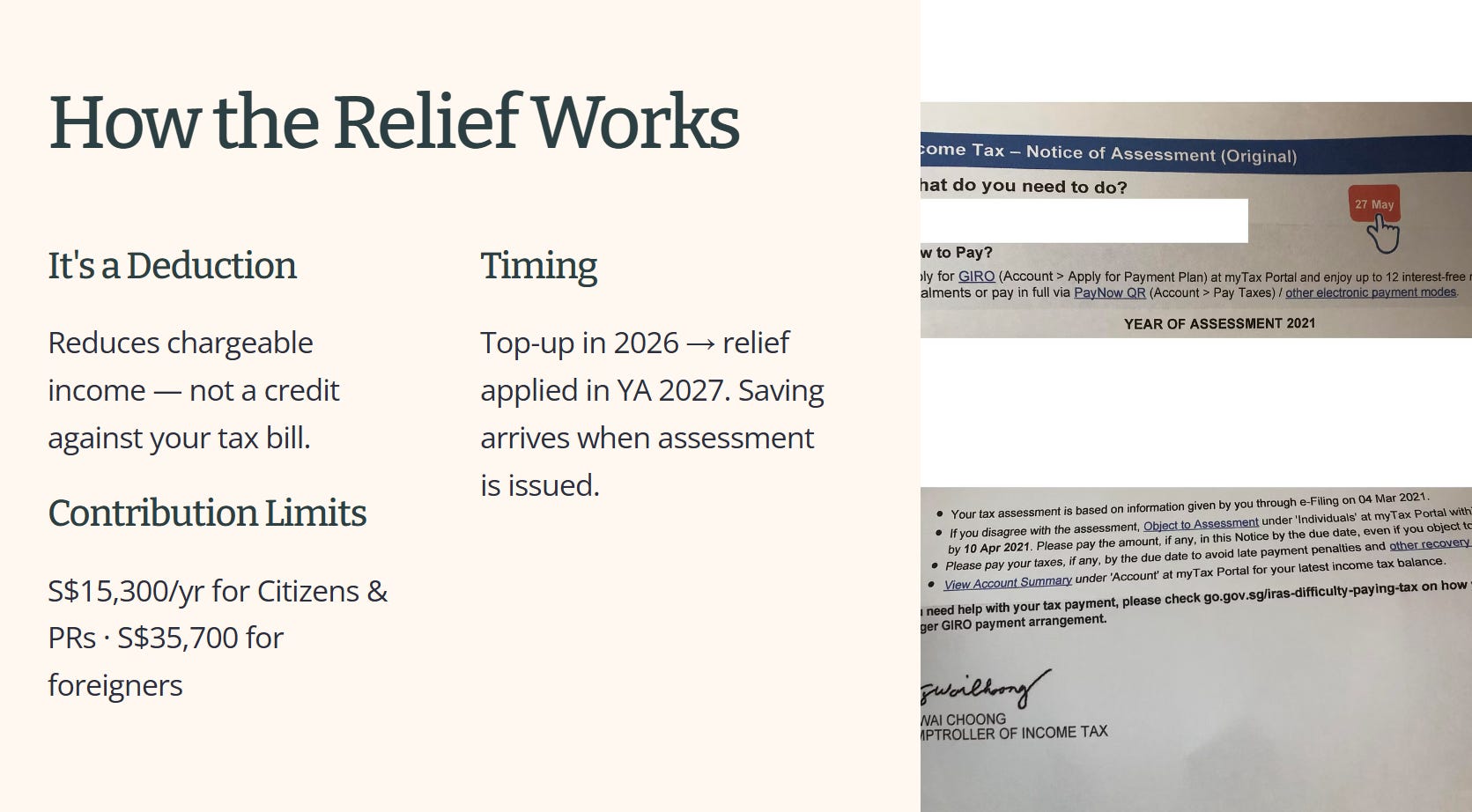
IRAS allows contributions in cash up to SGD 15,300 a year for Singapore Citizens and PRs, and SGD 35,700 for foreigners. The relief is given in the Year of Assessment after the year you contribute, so a top-up made in 2026 reduces the tax assessed for YA 2027, and the saving arrives when that assessment is issued.
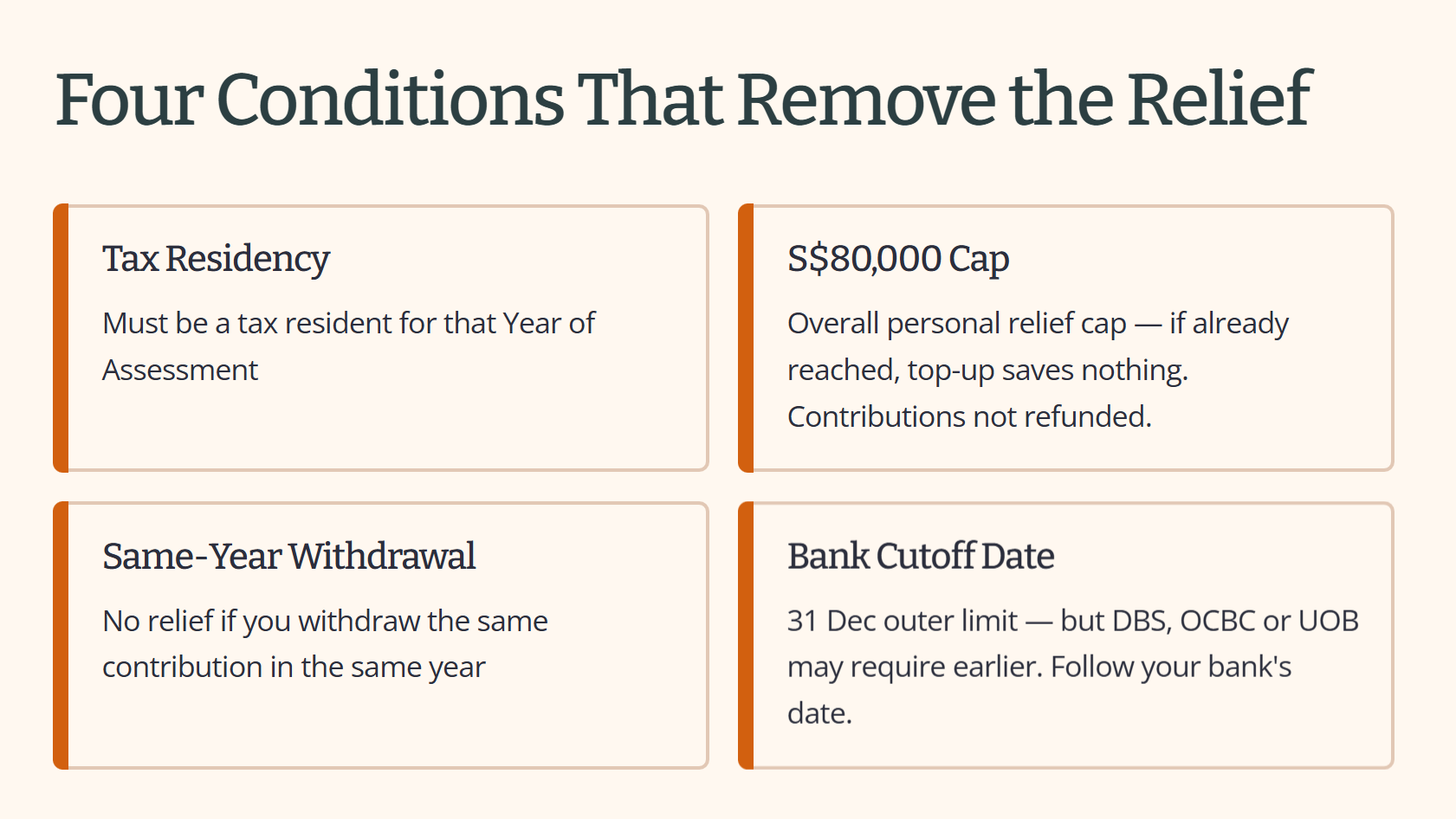
Four conditions can remove the relief for the year. Relief is given only to people who are tax residents for that Year of Assessment. IRAS applies an overall cap of SGD 80,000 on all personal reliefs together, so if you have already reached it, a top-up saves nothing, and contributions are not refunded. There is no relief if you withdraw the same contribution in the same year. And the contribution must be in by 31 December of the year, or earlier if your SRS bank sets an earlier cutoff, so the date to follow is the one DBS, OCBC or UOB gives you.
The Same SGD 15,300 at Ten Incomes
The saving equals the tax you pay on your income without the top-up, minus the tax you pay with it. I calculated it for each level below using the IRAS resident rates for YA 2024 onwards. The figures are gross tax before any rebate, rounded to the nearest dollar (two rows sit exactly on 50 cents), and the income column is chargeable income before the top-up.
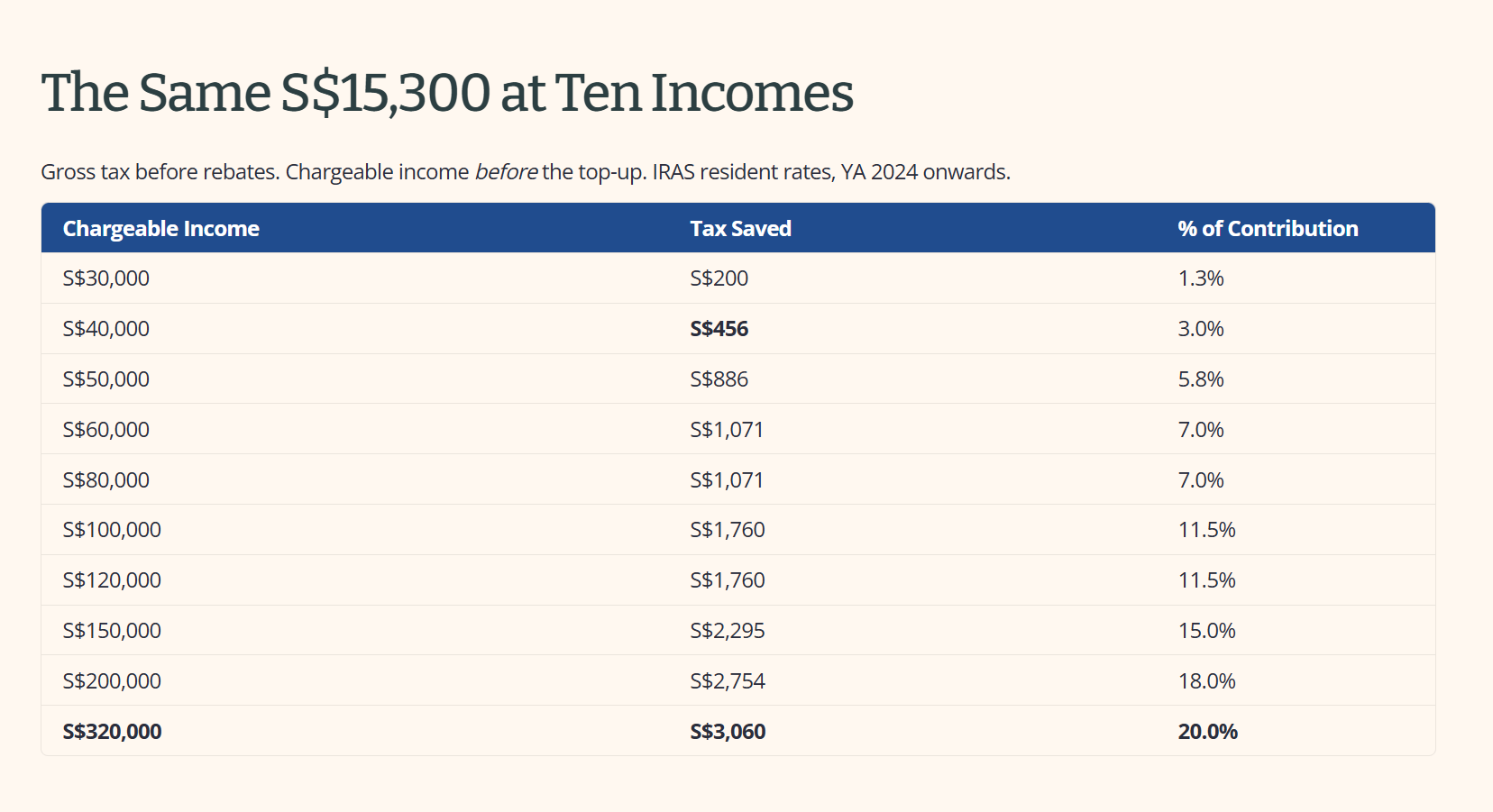
Two patterns sit in the table. At SGD 60,000 and SGD 80,000 the saving is the same SGD 1,071, because the whole SGD 15,300 comes out of the 7% band in both cases. At SGD 40,000 and SGD 50,000 the contribution straddles two bands, so the saving is a blend of 2%, 3.5% and 7%. Below SGD 20,000 of chargeable income there is no tax to reduce, so there is no saving at all.
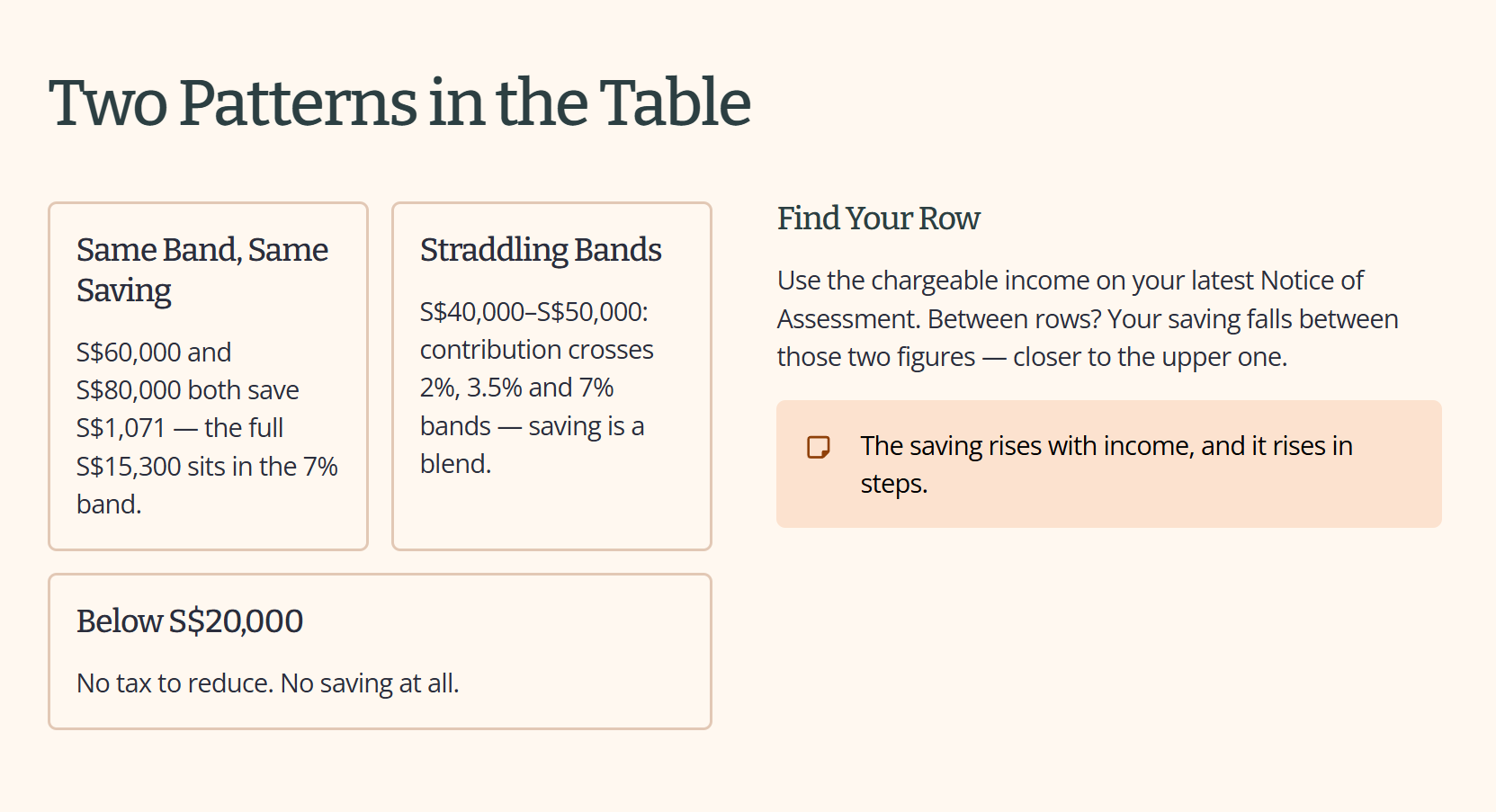
To find your own row, use the chargeable income printed on your latest Notice of Assessment. If it reads SGD 55,000, you fall between the SGD 50,000 and SGD 60,000 rows, and a saving between SGD 886 and SGD 1,071 is the range to expect, closer to the upper figure. If you cannot find the number, the table still tells you the shape of the answer: the saving rises with income, and it rises in steps.
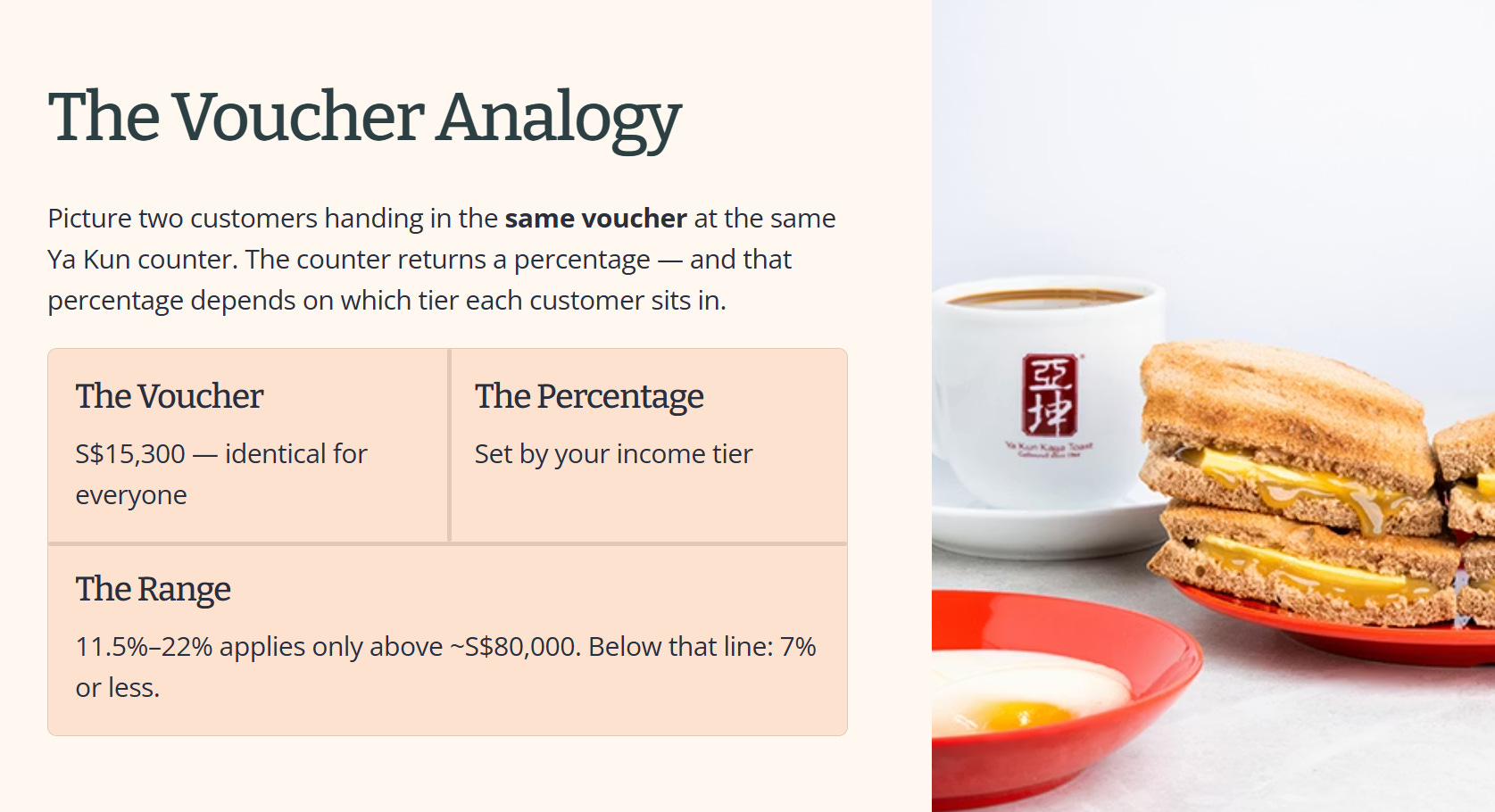
Picture two customers at the same Ya Kun counter handing in the same voucher, and the counter returning a percentage that depends on which tier each customer sits in. The voucher is the same SGD 15,300, and the percentage is set by your tier.
In my December 2025 video I described the range as 11.5% to 22%. That range describes the upper half of the table. It starts at about SGD 80,000 of chargeable income, and below that line the saving is 7% or less.
💡 Insight Callout
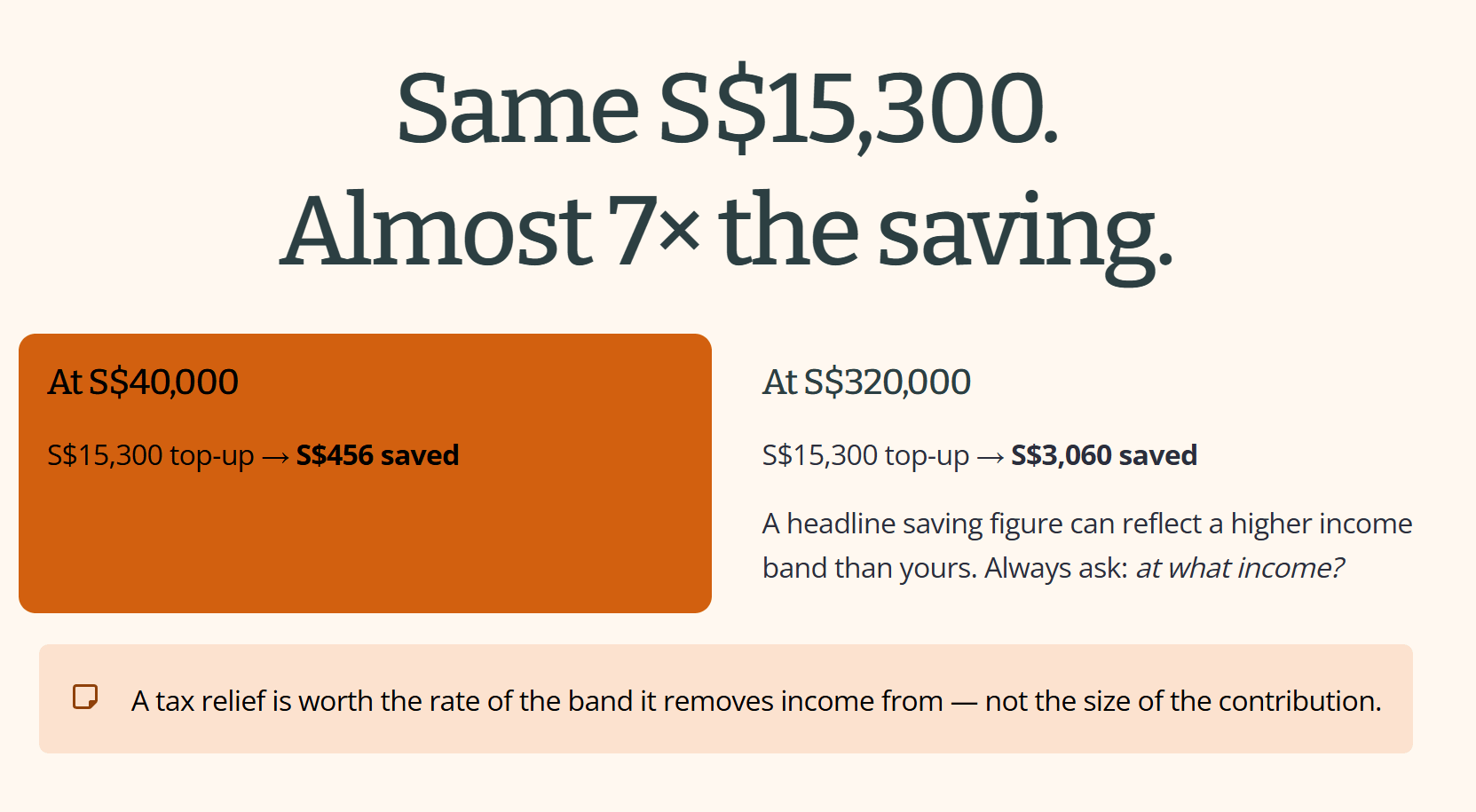
A tax relief is worth the rate of the band it removes income from, not the size of the contribution. At SGD 40,000 of chargeable income a full SGD 15,300 top-up returns SGD 456. At SGD 320,000 the same top-up returns SGD 3,060, which is almost seven times as much for the same cash committed. When someone says an SRS top-up saves tax, the useful reply is the question that decides the answer: at what income. A headline saving figure can reflect a higher income band than yours, and your own row may be several rows lower.
What Comes Out: The Rules IRAS Sets
The saving is the entry half of the decision. The exit half has rules of its own, and I took them from the IRAS page on SRS withdrawals.
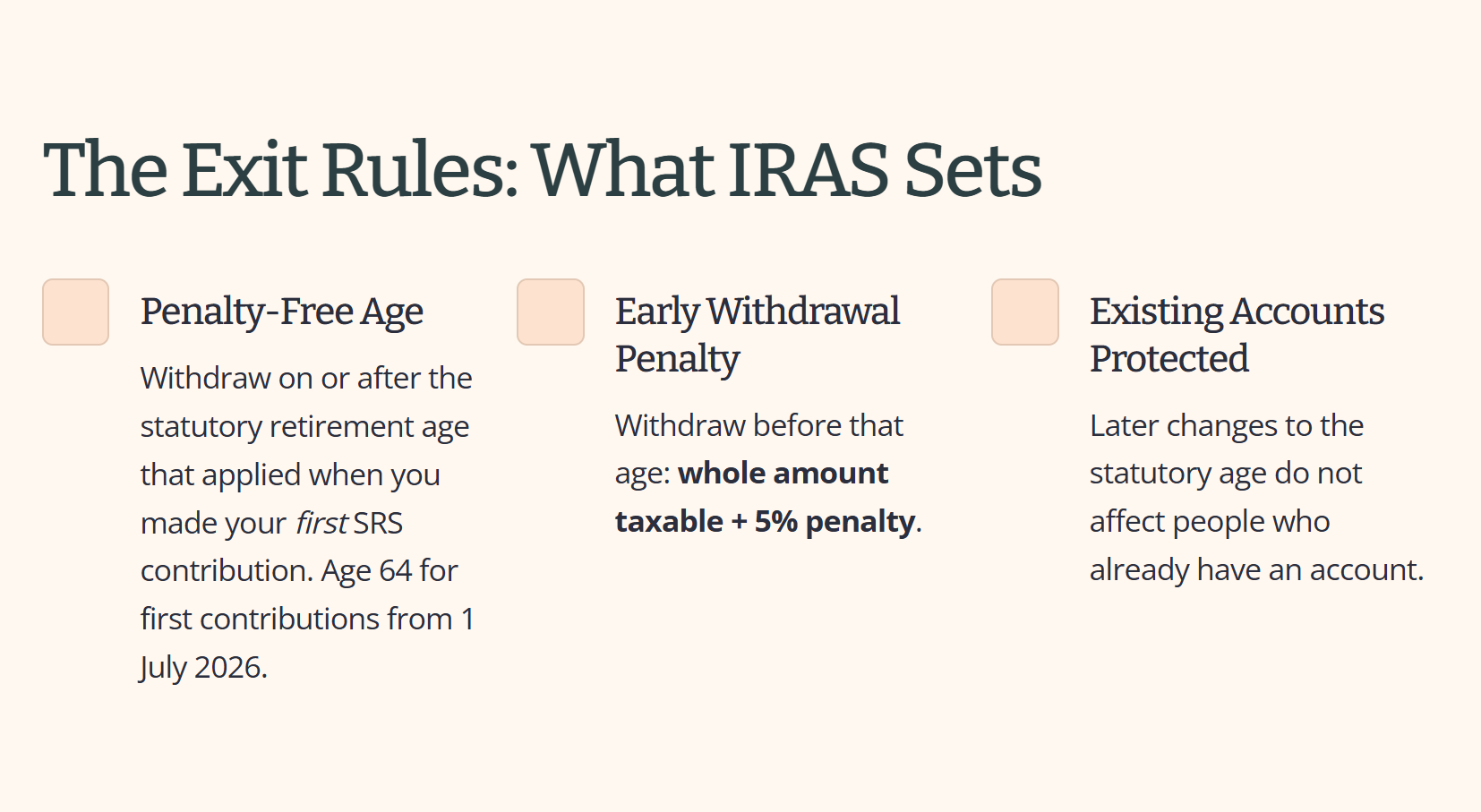
You can make penalty-free withdrawals on or after the statutory retirement age that applied when you made your first SRS contribution. The age that applies to you depends on when you first contributed. It is 64 for first contributions from 1 July 2026, and IRAS says later changes to the statutory age do not affect people who already have an account. If you withdraw earlier, the whole amount is taxable and a 5% penalty applies.
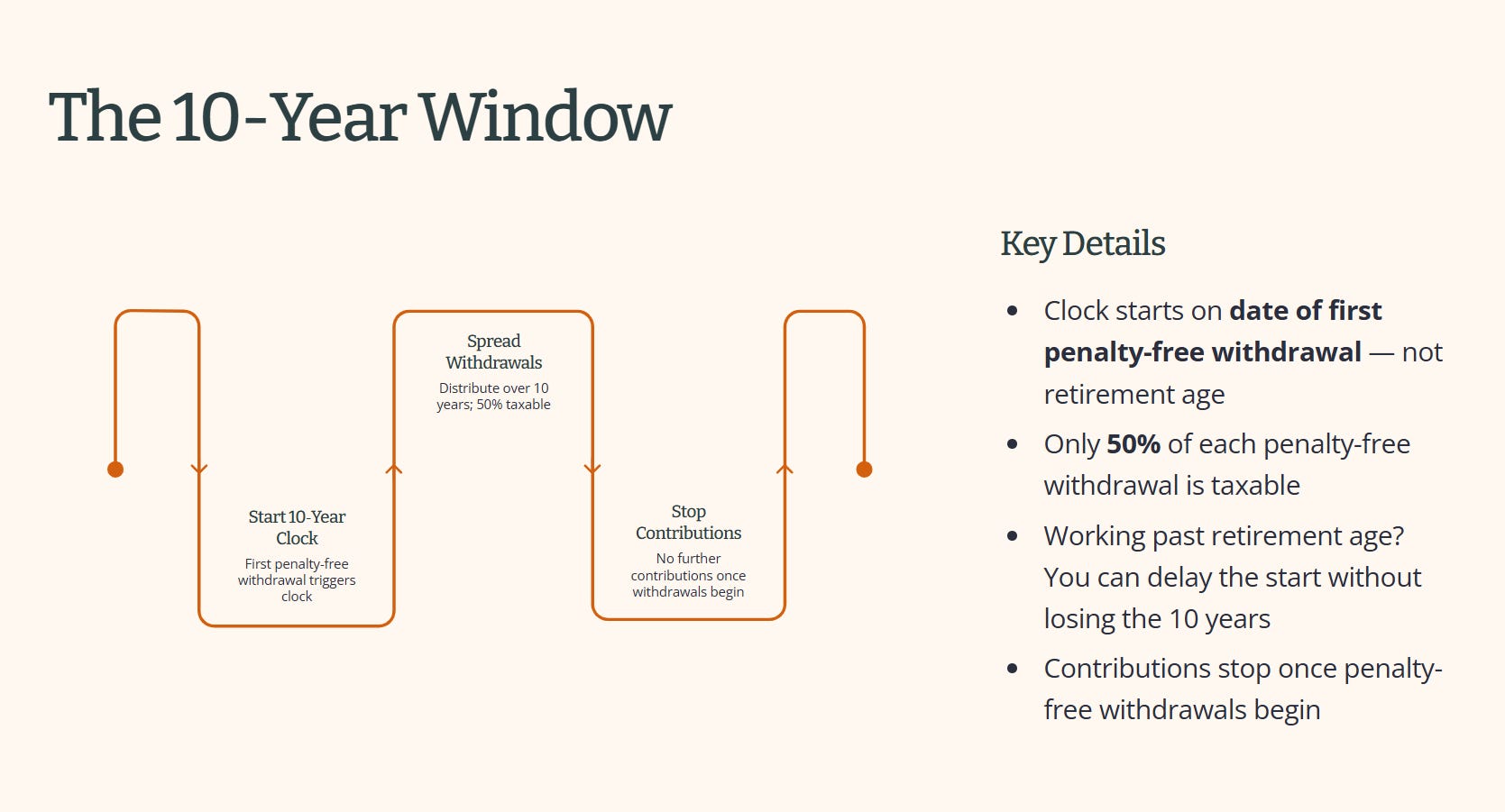
The 10-year withdrawal period starts on the date of your first penalty-free withdrawal, not on your retirement age. That gives you some control over when the clock begins, and it means a reader who keeps working past the retirement age can delay the start without losing the 10 years. Only 50% of each penalty-free withdrawal is taxed, at your rates, in the Year of Assessment after the year you withdraw. Contributions can no longer be made once you start withdrawing at or after that age, or on medical grounds.
IRAS also gives one figure that matters more than the others. A member with no other taxable income and relief can withdraw up to SGD 40,000 a year this way, because 50% of SGD 40,000 is SGD 20,000 and the tax on the first SGD 20,000 of chargeable income is nil. Over 10 years that is SGD 400,000, as an illustration under current rates. IRAS states that spreading withdrawals generally results in greater tax savings.
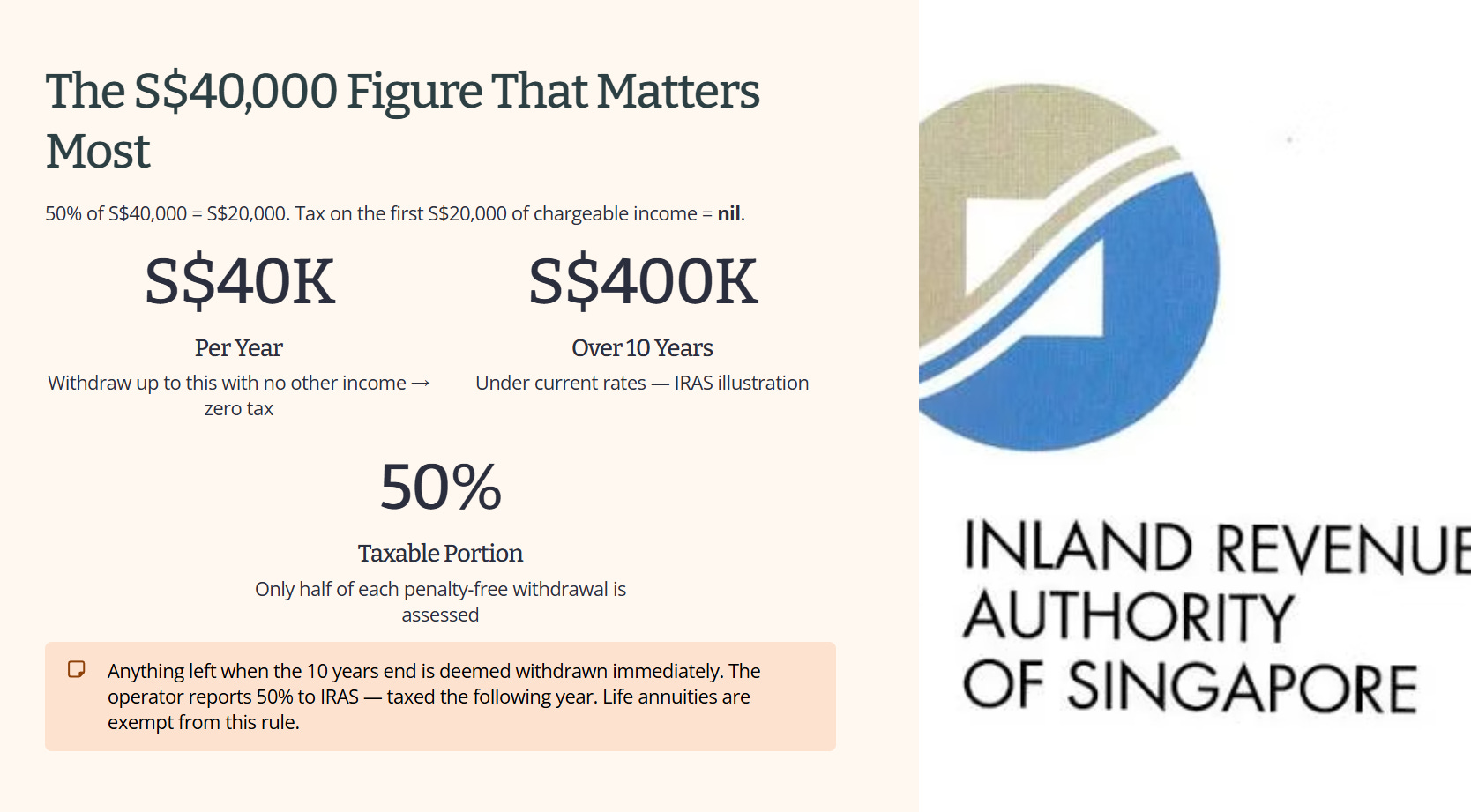
Anything left in the account when the 10 years end is deemed withdrawn immediately afterwards. The operator reports 50% of that balance to IRAS, and it is taxed in the following year. Life annuities are an exception to the 10-year rule. You may leave the money with the operator after that, and later investment returns are taxed like any other investment.
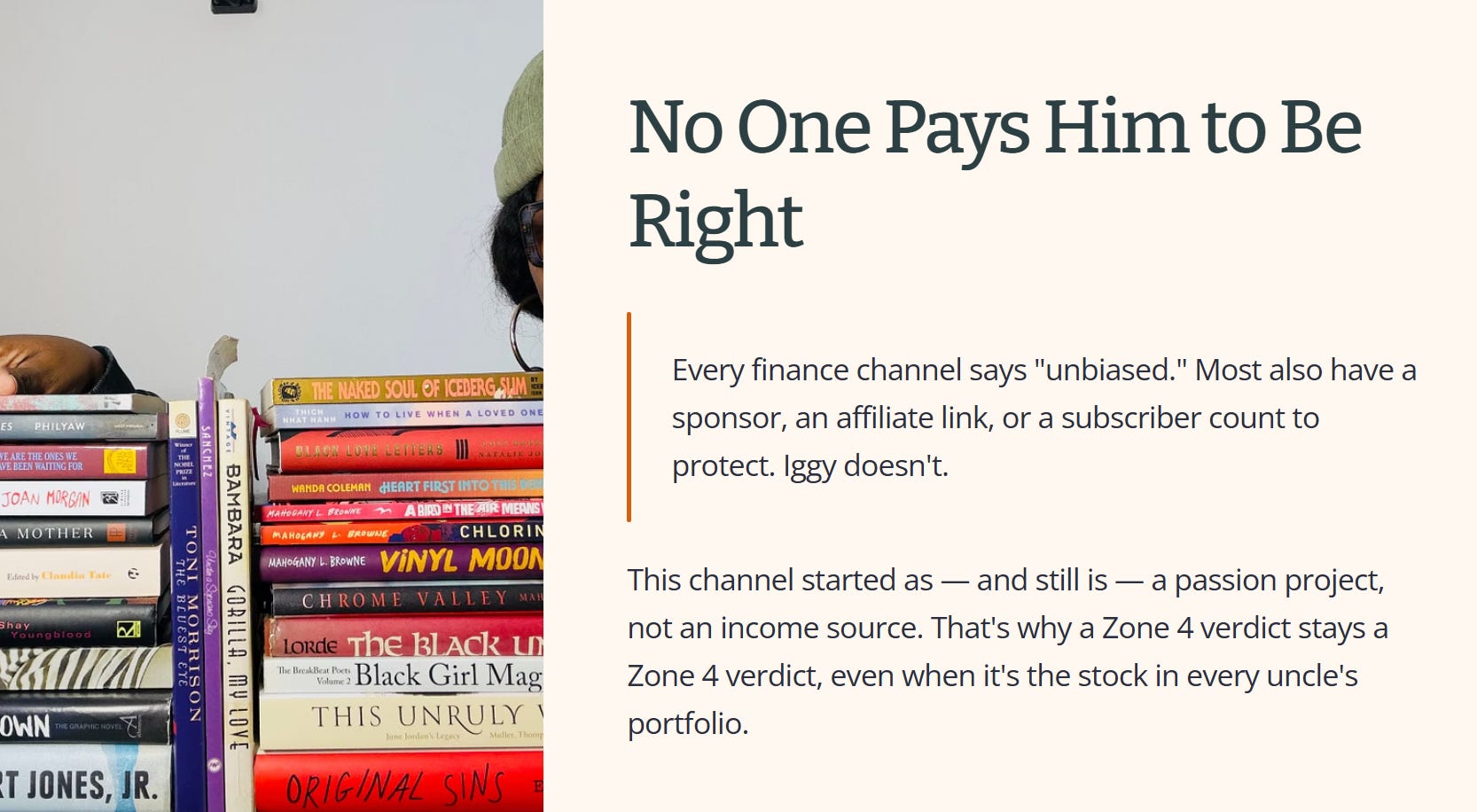
No One Pays Him To Be Right
Every finance channel says “unbiased.” Most of them also have a sponsor, an affiliate link, or a subscriber count to protect deciding what gets softened. Iggy doesn’t. This channel started as, and still is, a passion project, not an income source.
That’s not a slogan, it’s the actual reason a Zone 4 verdict stays a Zone 4 verdict even when it’s the stock in every uncle’s portfolio.
YouTube/Substack Combo members aren’t paying for faster access to opinions that were always going to be diplomatic anyway. You’re paying for the version of this analysis that exists because it doesn’t need to please anyone: full-length videos, the complete Red Zone watchlist, and institutional-grade cheatsheets built without a single sponsor’s name attached to the verdict.
For S$12/month, you’re not just getting the report first. You’re the reason it’s still honest.
What the Cash Earns While It Waits
The interest on idle SRS cash is small. As read on their pages on 9 October 2026, DBS states that the rate on SRS funds is fixed at 0.05% a year, and OCBC says cash in the account earns 0.05% a year. Rates can change, so check the current one. I did not find a cash rate on UOB’s SRS page, so check your own statement.
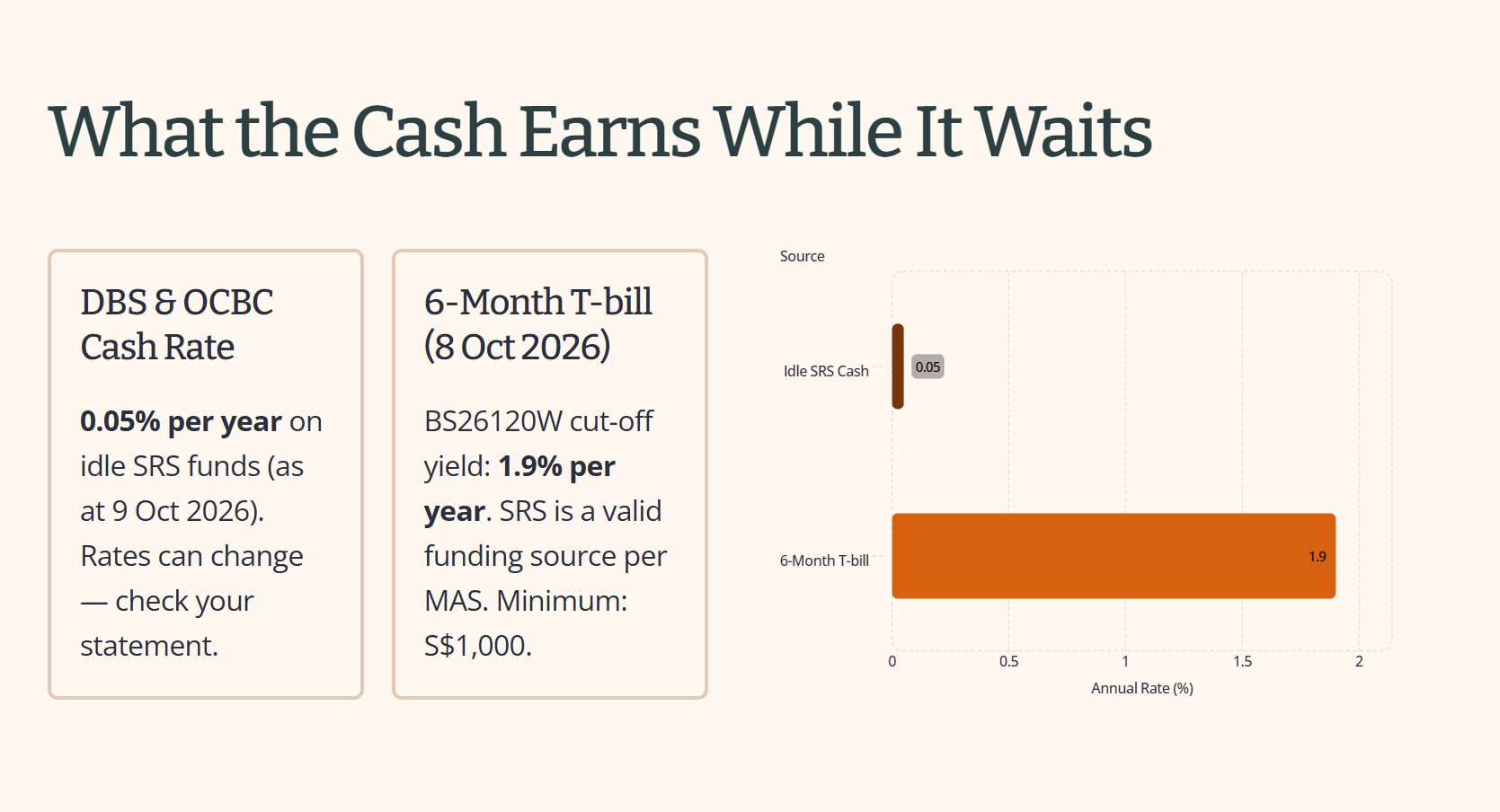
You do not have to leave the cash idle. The MAS T-bill FAQ lists SRS as a funding source for T-bill applications. Funds are earmarked when you apply and deducted within one to three business days after the auction. On 8 October 2026 the 6-month T-bill (BS26120W) cleared at a cut-off yield of 1.9% a year, according to the MAS auction page. The minimum denomination is SGD 1,000. Both rates can be earned inside the same SRS account, which is why the relief and the cash are two separate decisions.
💡 Insight Callout
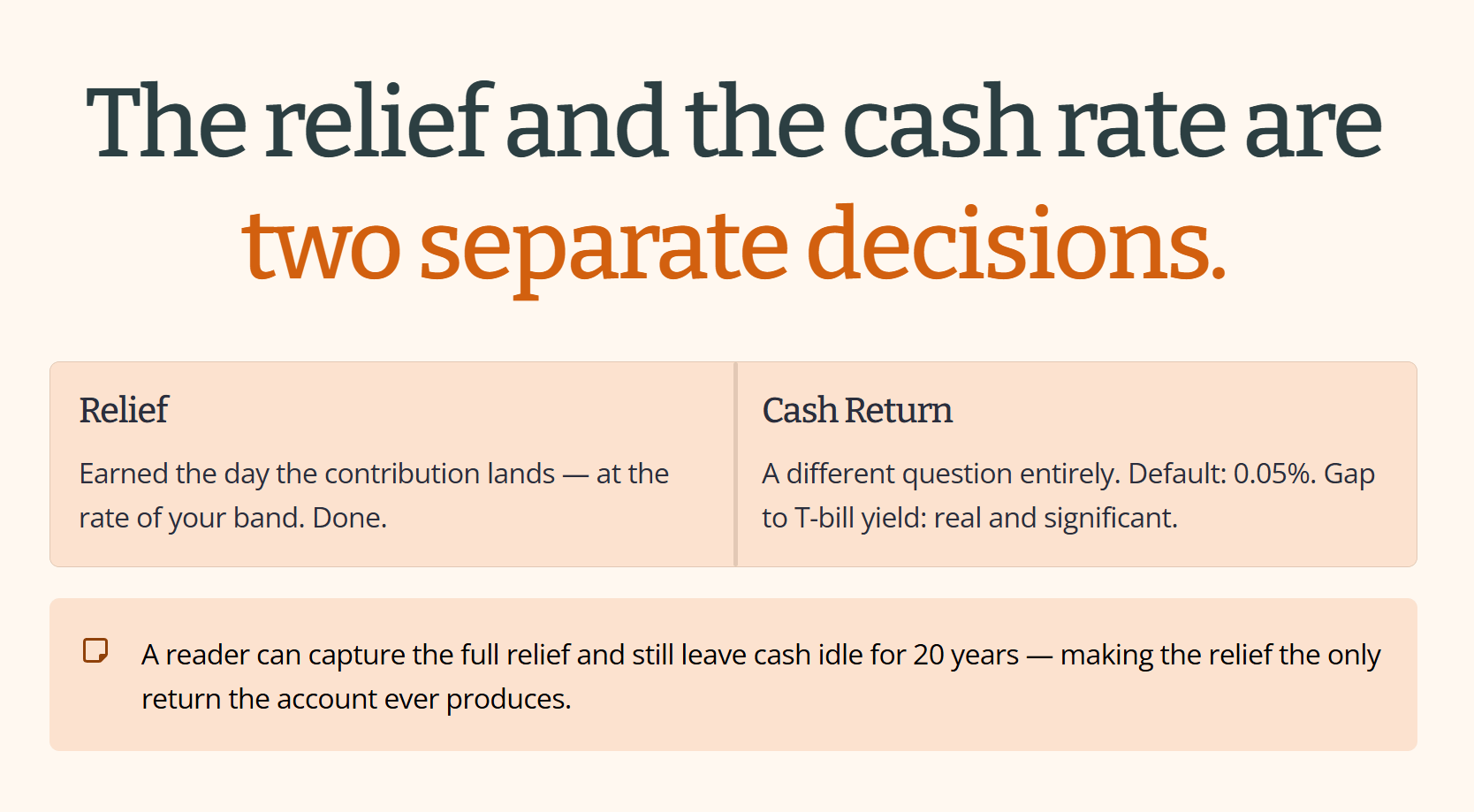
The relief and the cash rate are separate decisions that people often merge. The relief is earned the day the contribution lands, at the rate of your band. What the money does afterwards is a different question, and by default it earns 0.05%. A reader can capture the full relief and still leave the cash idle for 20 years, which turns the relief into the only return the account ever produces. The saving is real, and so is the gap between 0.05% and the yield on offer elsewhere in the same account.
🔒 What’s Next
A saving of SGD 1,071 at SGD 60,000 of chargeable income is only the entry side, so the next section puts the same SGD 15,300 through the withdrawal rules for three readers and shows where the answer changes.
