



A17U and Sasseur Both Yield Near 6-9%. The Reason One Worries Me and the Other Doesn’t.
One fails three balance sheet gates. The other passes every gate and still carries a risk no ratio can catch.
Four REIT names came across my screen this week, all clearing my yield hurdle with real margin. If yield alone decided things, I’d have four buys. It doesn’t, and by the end of this piece you’ll see why the one REIT that passes every single test I run is the one I’m sizing smallest.
I’m Iggy. I run the numbers on SGX names so retirees managing CPF and SRS money don’t have to guess whether a headline yield is worth trusting.
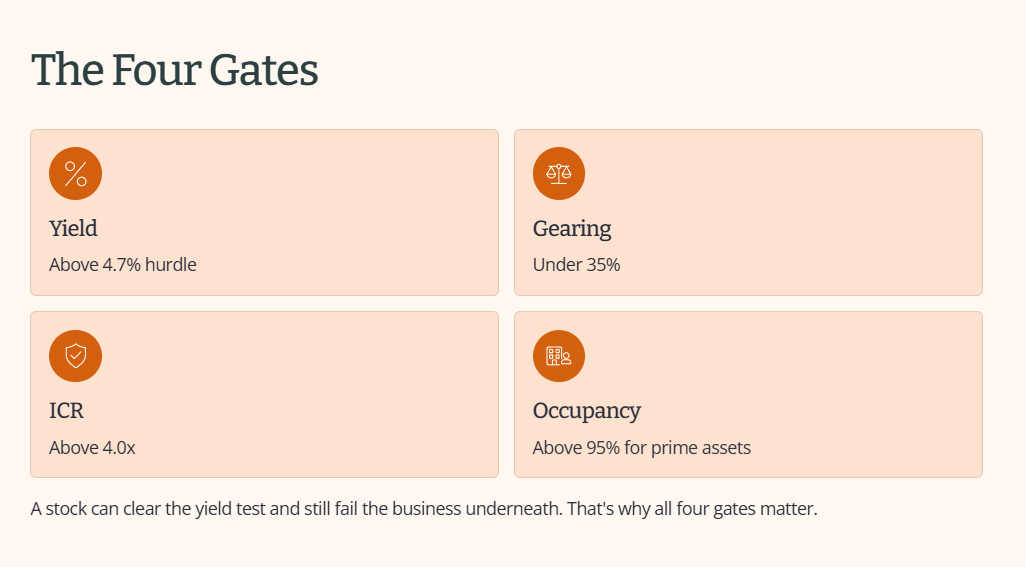
Here’s the checklist I run on every income name before I touch it: yield against my 4.7% hurdle, gearing under 35%, interest coverage above 4.0x, occupancy above 95% for prime assets. Four gates, and a stock can clear the yield test completely while still failing the business underneath it. That’s the entire point of running all four rather than stopping at the number that looks good.

The Screen
Keppel DC REIT: One Facility, One Miss
Iggy’s Forensic Zone: Zone 4, Caution
AIMS APAC REIT: A Real Coverage Problem Behind a Clean Balance Sheet
Iggy’s Forensic Zone: Zone 4-, Caution
CapitaLand Ascendas REIT: Three Gates, One Story
Iggy’s Forensic Zone: Zone 4-, Caution
Iggy’s Insight: Notice the pattern across these three names
What’s Next
Sasseur REIT: Zero Gates Failed, One Risk No Ratio Sees
Iggy’s Forensic Zone: Zone 1, Fortress (Provisional)
Iggy’s Insight: The obvious question here is whether a REIT this clean on paper
Iggy’s Take
Iggy’s Elite Read
The Screen
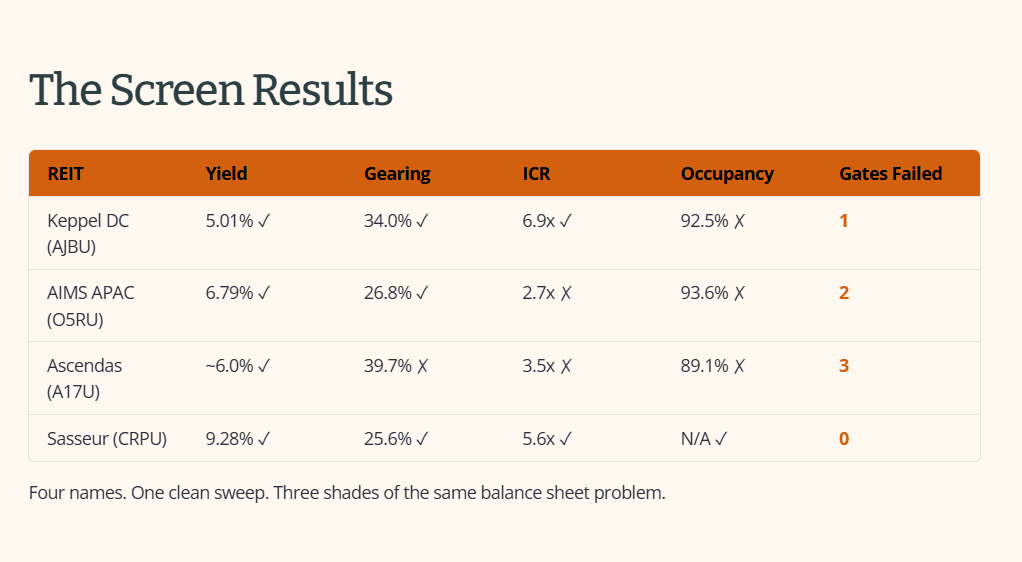
Four names, one clean sweep, three shades of the same balance sheet problem. Let’s start with the mildest case and work up.
Keppel DC REIT: One Facility, One Miss
Everything here passes with room to spare except one number. Gearing sits comfortably inside the ceiling, down from 35.1% the quarter before. Interest coverage, at 6.9x, is the strongest of anything on this list, not close. The single failing gate is occupancy, at 92.5% against my 95% floor for prime assets, and the entire miss traces back to one facility in Cardiff that came off contract.
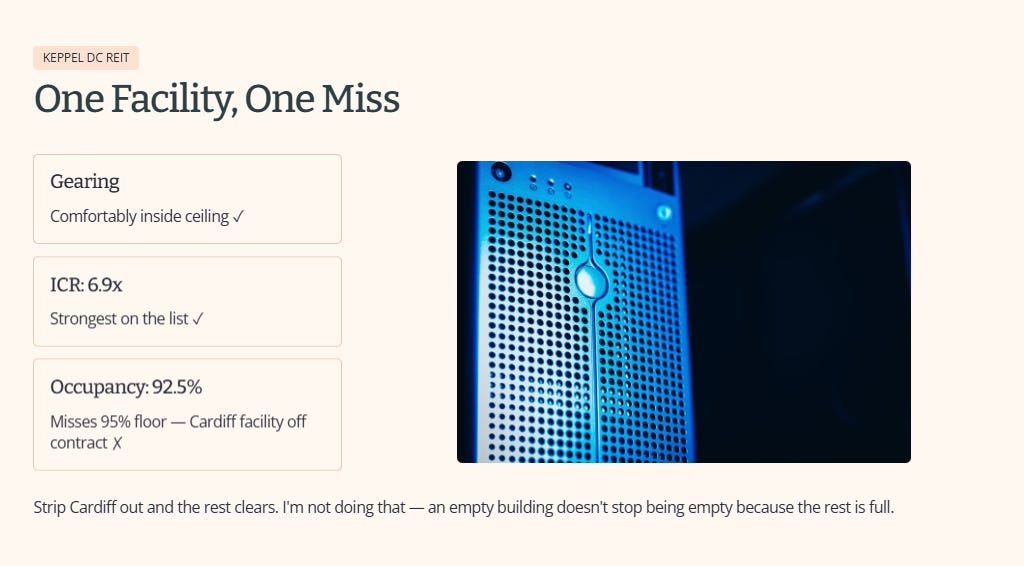
Strip Cardiff out and the rest of the portfolio clears my occupancy bar without issue. I’m not doing that, though, and here’s why: a REIT’s occupancy figure is supposed to tell you what share of its actual, current assets is earning rent. An empty building doesn’t stop being empty just because the rest of the portfolio is full. Management says re-leasing is underway, with no confirmed timeline yet.
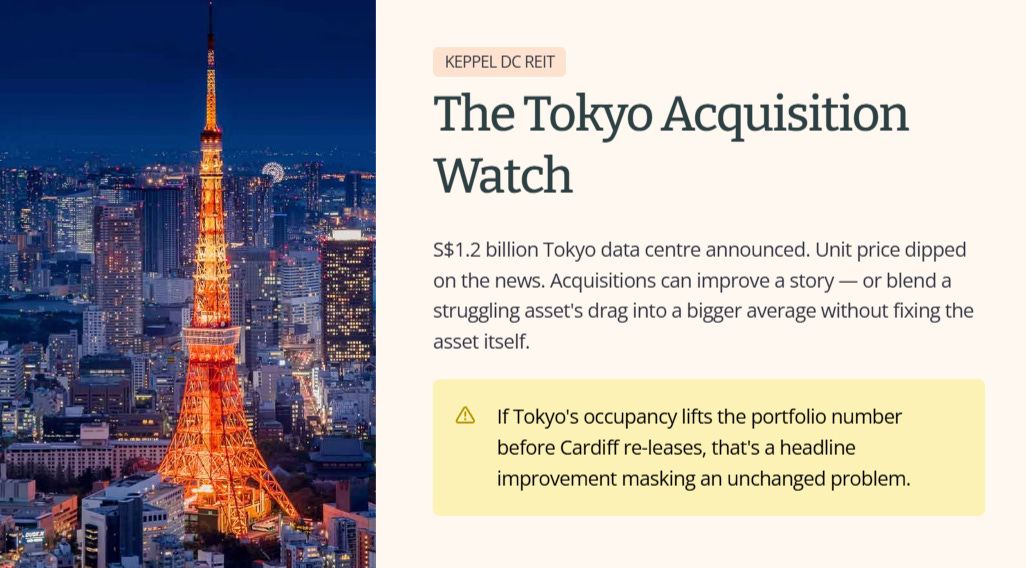
There’s a second thread worth watching here that has nothing to do with the current gate failure. Keppel DC just announced a S$1.2 billion Tokyo data centre acquisition, and the unit price actually dipped on the news, trading down to a low before settling. Acquisitions like this can genuinely improve a REIT’s story, more scale, more diversification, more income. But they can also do something less honest: blend a struggling asset’s drag into a bigger portfolio average without that asset itself ever getting fixed. If Tokyo’s occupancy shows up fully leased at next results and the portfolio-wide number climbs as a result, that improvement means nothing for Cardiff specifically unless Cardiff’s own occupancy has moved. I’ll be watching for exactly that distinction, not just the headline number.
Iggy’s Forensic Zone: Zone 4, Caution (Growth Read: fortress-clean coverage and gearing, a single vacant facility is the sole constraint)
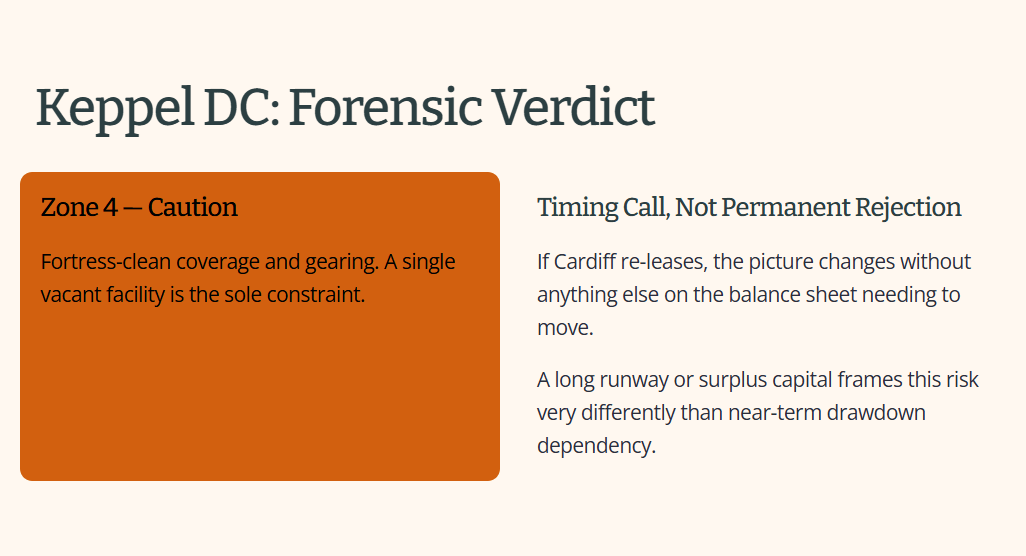
If your retirement runway is genuinely long, or this capital sits well beyond what you need for drawdown, a single-asset vacancy on an otherwise fortress balance sheet is a different risk than a REIT failing multiple gates at once. That’s a description of how this framework calibrates risk, not a suggestion that this particular demographic should buy it. A Zone 4 verdict here is a timing call, not a permanent rejection. If Cardiff re-leases, the picture changes without anything else on the balance sheet needing to move.

That’s the gentlest miss on this list. The next one trades a single clean weak spot for two.
AIMS APAC REIT: A Real Coverage Problem Behind a Clean Balance Sheet
Gearing here is actually the lowest of the three balance-sheet-failure names, 26.8%, nowhere close to the ceiling. That’s the good news. The bad news is interest coverage, confirmed from AIMS’s own results at 2.7x, well under my 4.0x floor. This isn’t a rounding-error miss. It’s a shortfall wide enough that even a generous reading of the coverage basis doesn’t rescue it, and worth being precise about what that basis actually is: AIMS calculates it as trailing adjusted EBITDA divided by interest expense, borrowing fees, and hybrid security distributions combined.
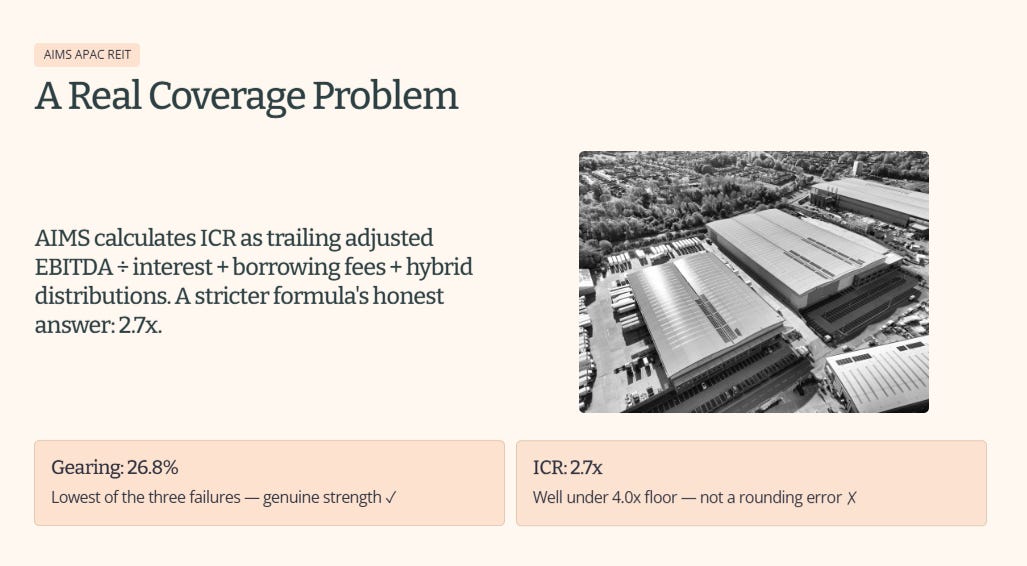
Folding hybrid distributions into the interest burden is a more conservative approach than a plain EBITDA-to-cash-interest number would give you, which means 2.7x isn’t even a flattering read of a stricter formula, it’s a stricter formula’s honest answer.
Occupancy adds a second failing gate at 93.6%, a narrow miss against the 95% floor, though narrow enough that it isn’t the driving concern here. A separate figure exists showing 96.8% if you count leases that are signed but not yet contributing rent. I’m not using that number. A signed lease that hasn’t started paying isn’t income yet, and a REIT’s current occupancy should reflect what’s actually filling the building today, not what’s promised to fill it next quarter.
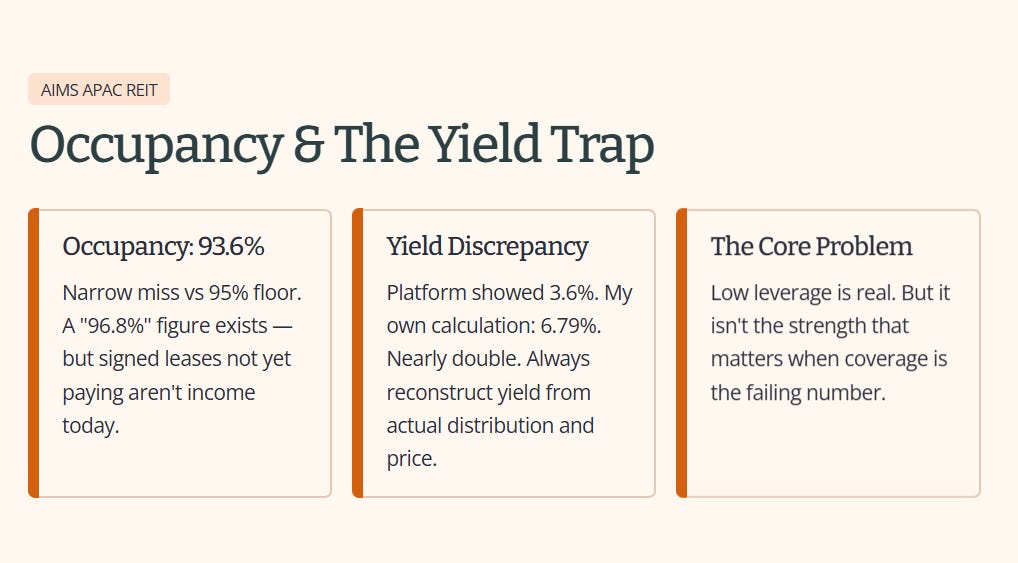
The headline yield on AIMS is worth a pause of its own, separate from the gate failures. The trading platform I use for pricing shows a dividend yield of 3.6% for this name. A straightforward calculation using the REIT’s own reported annual distribution against the current price gives 6.79%, nearly double that. These aren’t close enough to be a rounding difference, they’re likely measuring entirely different things, and I’ve now seen this same gap on more than one name this month. My working rule going forward: don’t trust a platform’s labelled yield field at face value, reconstruct it from the actual distribution and price yourself.
A REIT can carry very little debt relative to its assets and still struggle to service what debt it has if the income backing it doesn’t stretch far enough, and that’s the exact shape of AIMS’s problem. Low leverage is a real strength. It just isn’t the strength that matters most when the number failing is coverage.
Iggy’s Forensic Zone: Zone 4-, Caution (Growth Read: low leverage is a genuine strength, interest coverage below my floor is the primary constraint)
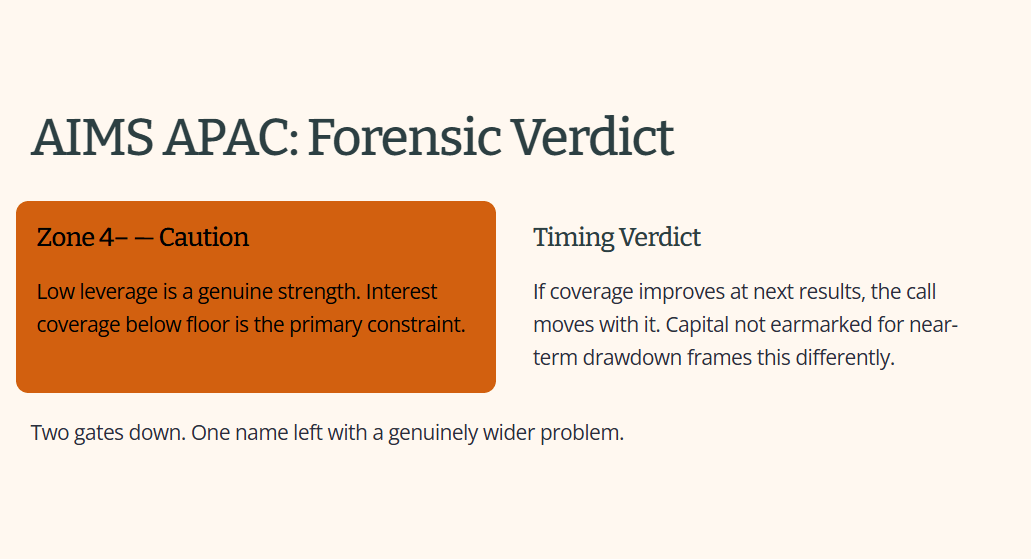
The same time-horizon and capital-surplus framing applies here as with Keppel DC. A reader with room to absorb volatility, or capital that isn’t earmarked for near-term drawdown, may reasonably tolerate a coverage-driven caution flag differently than a reader relying on this income now. This describes the framework’s calibration, it isn’t advice tailored to any one reader’s situation. This is a timing verdict. If interest coverage improves at the next results, the call moves with it.
Two gates down. One name left with a genuinely wider problem.
No One Pays Him To Be Right
The Verdict Doesn’t Change Because The Bill Needs Paying. Every finance channel says “unbiased.” Most of them also have a sponsor, an affiliate link, or a subscriber count to protect deciding what gets softened. Iggy doesn’t. This channel started as, and still is, a passion project, not an income source. That’s not a slogan, it’s the actual reason a Zone 4 verdict stays a Zone 4 verdict even when the stock is one half of Singapore holds.
Iggy’s Elite Investors aren’t paying for faster access to opinions that were always going to be diplomatic anyway. You’re paying for the version of this analysis that exists because it doesn’t need to please anyone, zero-day forensic breakdowns, the complete “Red Zone” watchlist, and institutional-grade cheatsheets built without a single sponsor’s name attached to the verdict.
For S$12/month, less than two kopi and kaya toast sets at Raffles Place, you’re not just getting the report first. You’re the reason it’s still honest.
CapitaLand Ascendas REIT: Three Gates, One Story
This is the name that pattern-matches most closely with a REIT I’ve already flagged as a caution case elsewhere in my coverage. Gearing at 39.7% breaches my ceiling by close to 5 percentage points, a genuine improvement from 42.0% the quarter before, following a S$900 million equity raise and debt repayment. That’s real deleveraging, and it deserves credit as a direction. It’s still a hard gate failure today, and my framework grades where a business stands now, not where it’s headed.
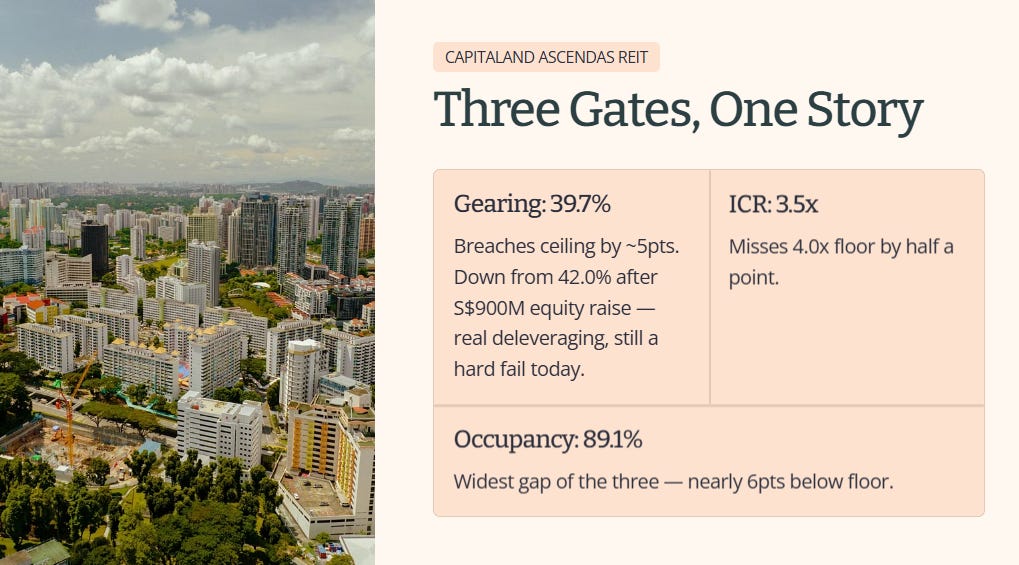
Interest coverage at 3.5x misses my floor by half a point. The company’s own results don’t spell out exactly how that figure is built, so I can’t confirm it sits on the same basis as the ratio I’d calculate myself, but the margin is close enough that the exact methodology barely changes the verdict either way.
Occupancy at 89.1% misses by close to 6 percentage points, the widest gap of the three names failing this gate. Part of that miss comes from two buildings, one in Singapore and one in the US, that only finished construction this year and haven’t leased up yet. Exclude those two and the figure improves to 90.3%. I’m still using 89.1% as the governing number, for the same reason Cardiff’s vacancy stays in Keppel DC’s occupancy figure: an unleased building is real vacancy today, regardless of why it’s empty or how recently it was built. The 90.3% is useful context for understanding why the miss happened. It doesn’t replace what’s actually true about the portfolio right now.

Three hard gates failing at once, on a REIT carrying a well-covered valuation narrative and a Buy rating from at least one broker I’ve seen, built around the stock trading at a discount to its underlying asset value. Yield alone, sitting near 6%, tells you nothing about any of this. This is the exact trap the yield-first approach walks straight into: a headline number that looks attractive sitting on top of a balance sheet that can’t fully support it yet.
Iggy’s Forensic Zone: Zone 4-, Caution (Growth Read: genuine deleveraging is underway, but gearing, coverage, and occupancy all still miss simultaneously)
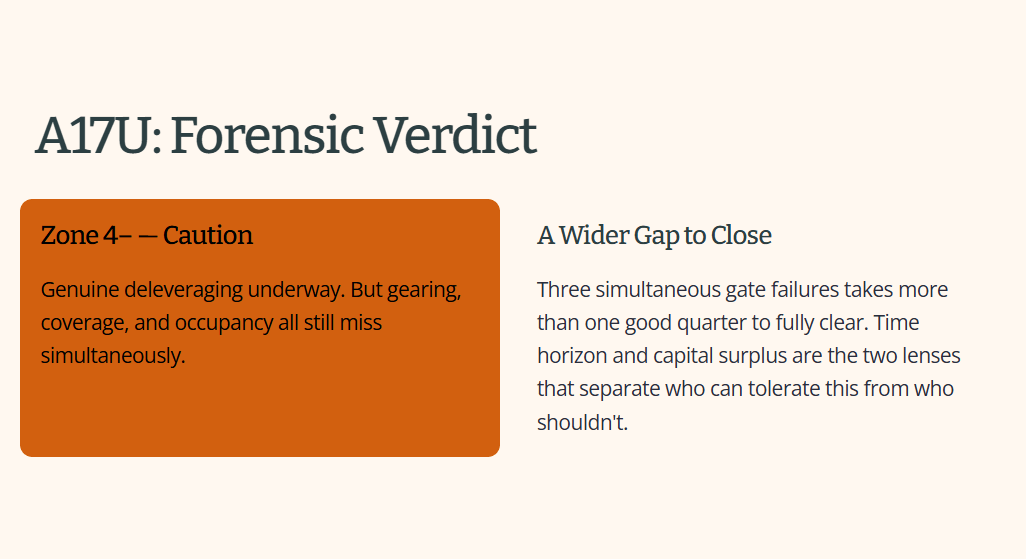
Same substance as above, scaled to a compound case: time horizon and capital surplus are the two lenses this framework uses to separate a reader who might reasonably tolerate this from one who shouldn’t be relying on it for near-term income. Three simultaneous gate failures is a timing verdict, not a permanent rejection, but it’s a wider gap to close than a single-gate miss, and it will take more than one good quarter to fully clear.
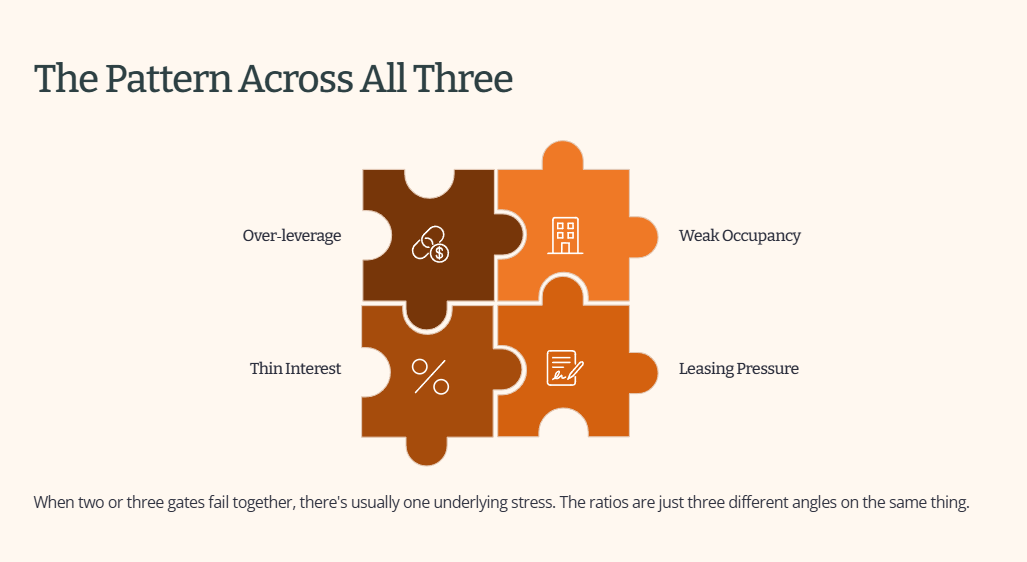
🟢 Iggy’s Insight: Notice the pattern across these three names. Gearing, coverage, and occupancy don’t fail together by accident, they’re often the same underlying stress showing up in three places. A REIT that’s over-leveraged tends to also carry thinner coverage, because more debt means more interest to service from the same income base. And a portfolio under leasing pressure often shows up as weaker occupancy at the same time revenue growth slows, which is what strains coverage in the first place. When you see two or three gates fail together, don’t treat them as three separate problems needing three separate explanations. Usually there’s one underlying stress, and the three ratios are just three different angles on the same thing. That’s also why a single-gate miss, like Keppel DC’s, tends to be a more contained story than a three-gate miss like this one.
🔒 What’s Next
Three REITs just failed my balance sheet gates by different margins while clearing yield cleanly. The fourth clears every single gate, and that’s exactly what should make you pause before assuming it’s the safe pick of the four.
