


Why the AI Trade Behind This Stock Doesn’t Change the Verdict for Retirement Money
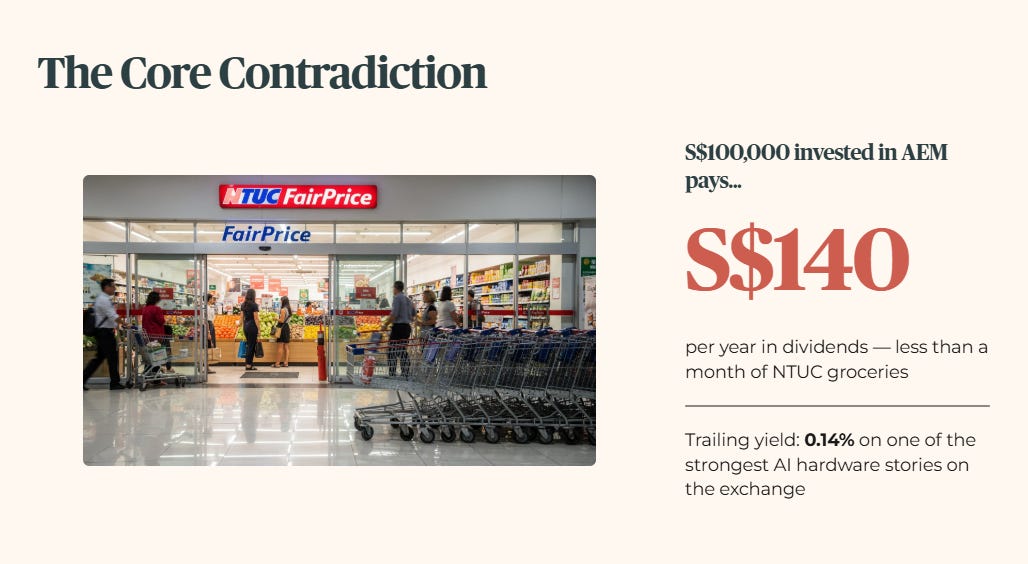
Zero point one four percent. That is the entire trailing dividend yield on AEM Holdings right now, on a stock riding one of the strongest AI hardware stories on the whole exchange. Put S$100,000 into it today and the dividend alone pays you S$140 a year, less than a month of NTUC groceries for most households.
That contrast, fortress balance sheet on one side, near-zero income on the other, is exactly the kind of split decision my forensic framework was built to make cleanly. There is the investor still years from drawing down retirement capital, who can treat this as a growth position and simply ignore the dividend line entirely. And there is the investor already living off portfolio income, for whom “the balance sheet is excellent” is not the same question as “will this pay my bills.” Both readers deserve the same numbers. They will use them differently, and that is fine.
Before the tables, one thing needs saying plainly. AEM’s Zone 5, Red Zone verdict below is not a statement about the business falling apart. It is purely a yield structure verdict. That distinction matters, so let’s get into why.

The Case For AEM: Three Things Working In Its Favour
The Case Against AEM: Three Things That Should Give You Pause
What This Means For Your Wallet
Financial Health Checklist
Dividend Trajectory
You Shouldn’t Be Reading This Alone
Valuation Note (Peer Comparison Not Supplied)
🟢Iggy’s Insight Box #1
🟢Iggy’s Insight Box #2
Iggy’s Forensic Zone: Zone 5, Red Zone
Iggy’s Forensic Disclaimer
The Case For AEM: Three Things Working In Its Favour
Good #1: The balance sheet is genuinely close to bulletproof.
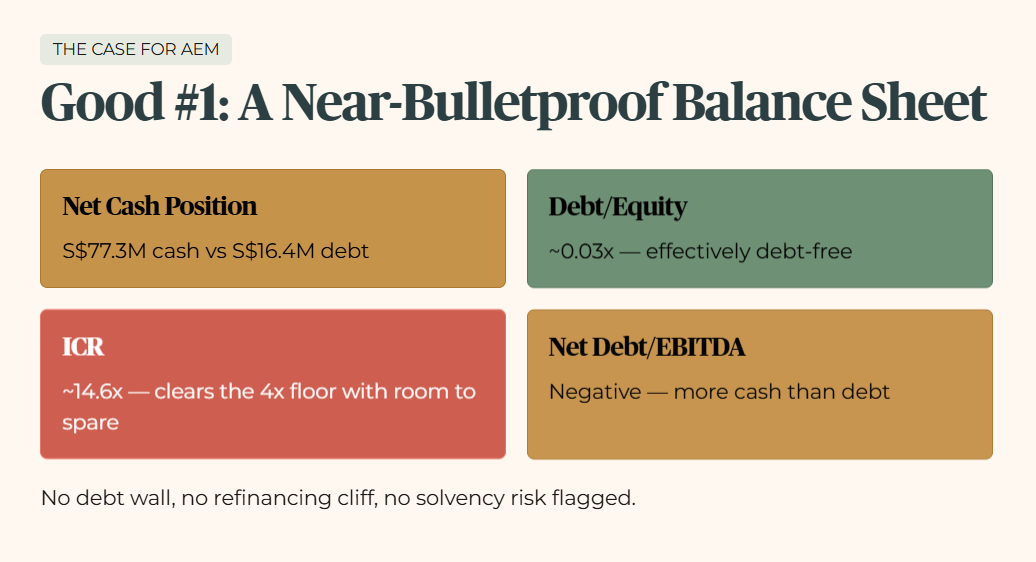
AEM sits on a net cash position. Loans and borrowings of S$16.4 million sit against cash and equivalents of S$77.3 million as at FY2025 year end, a debt to equity ratio of roughly 0.03 times, about as light as a Singapore-listed industrial name gets. Interest cover, or ICR (interest coverage ratio, how many times a company’s earnings can pay its interest bill), comes in at approximately 14.6 times on the house’s conservative measure, comfortably clearing my 4x floor with room to spare.
Net Debt/EBITDA (a company’s debt load measured against its cash earnings, my gearing check for non-banking names) is actually negative here, since the company holds more cash than debt. There is no debt wall to worry about, no refinancing cliff, nothing this framework typically flags as a solvency risk.
Good #2: The AI-driven top line is real and accelerating, not just a narrative.
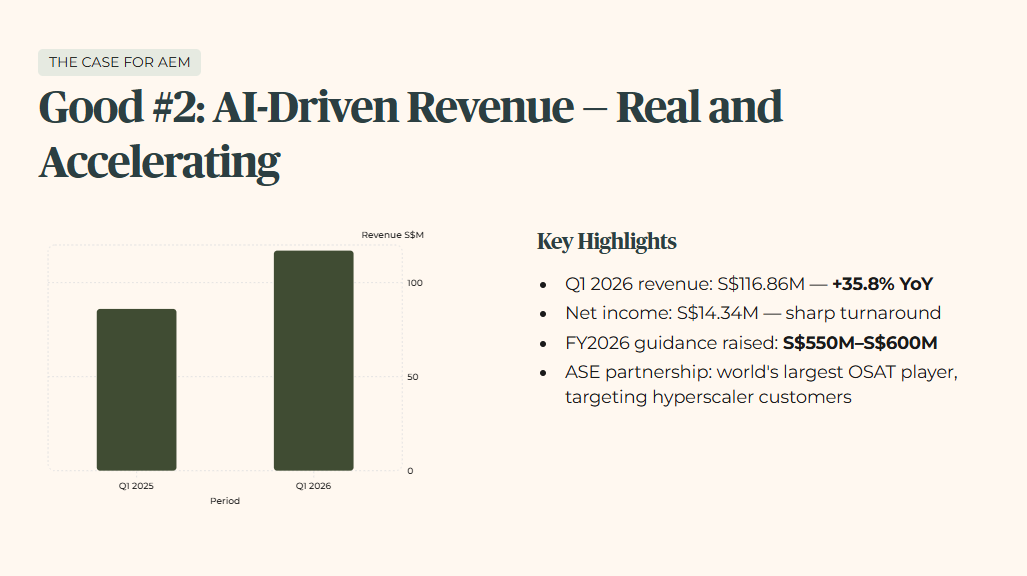
According to Longbridge’s coverage of AEM’s Q1 2026 results, revenue climbed 35.8% year on year to S$116.86 million, with net income of S$14.34 million marking a sharp turnaround from the softer years before it. Longbridge also reports that management has raised full-year 2026 revenue guidance to a range of S$550 million to S$600 million, and that AEM has struck a partnership with ASE, the world’s largest outsourced semiconductor assembly and test player, aimed at next-generation AI test solutions and broader access to hyperscaler customers. If that guidance holds, this is not a company coasting on a single good quarter. It is one whose core testing business is genuinely levered to the AI capex cycle right now.
Good #3: The re-rating has institutional backing, not just retail enthusiasm.
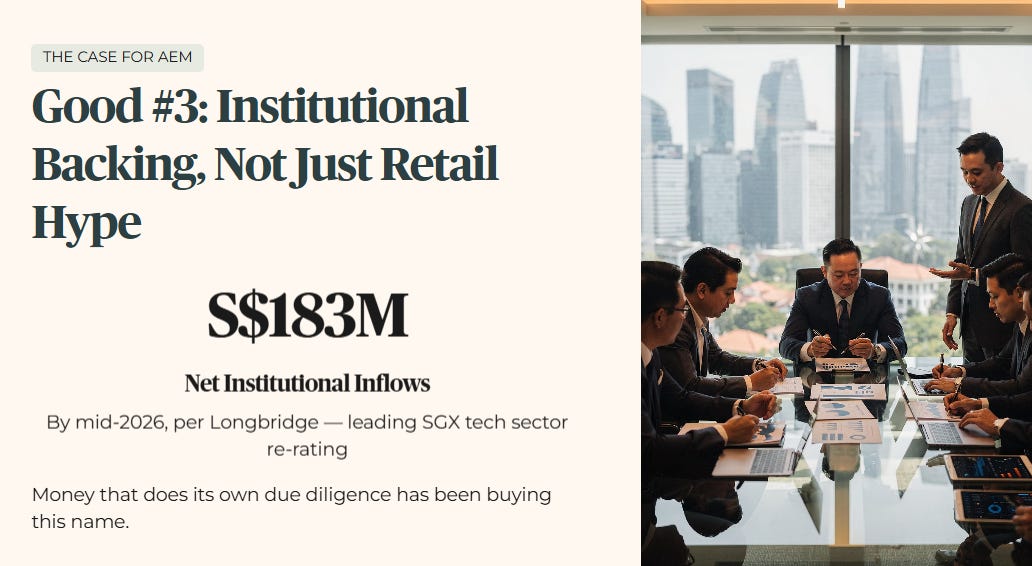
Longbridge’s own sector reporting put AEM at the centre of roughly S$183 million in net institutional inflows by mid-2026, describing it as leading the Singapore technology sector’s valuation re-rating over that period. I’m citing that figure to Longbridge specifically rather than asserting it as my own finding, since a claim like “institutional accumulation” needs a named source before it gets repeated as fact. With that source attached, it’s a fair data point: money that does its own due diligence has been buying this name, not just retail investors chasing an AI headline.
The Case Against AEM: Three Things That Should Give You Pause
Bad #1: The dividend fails every income test this framework runs, decisively.
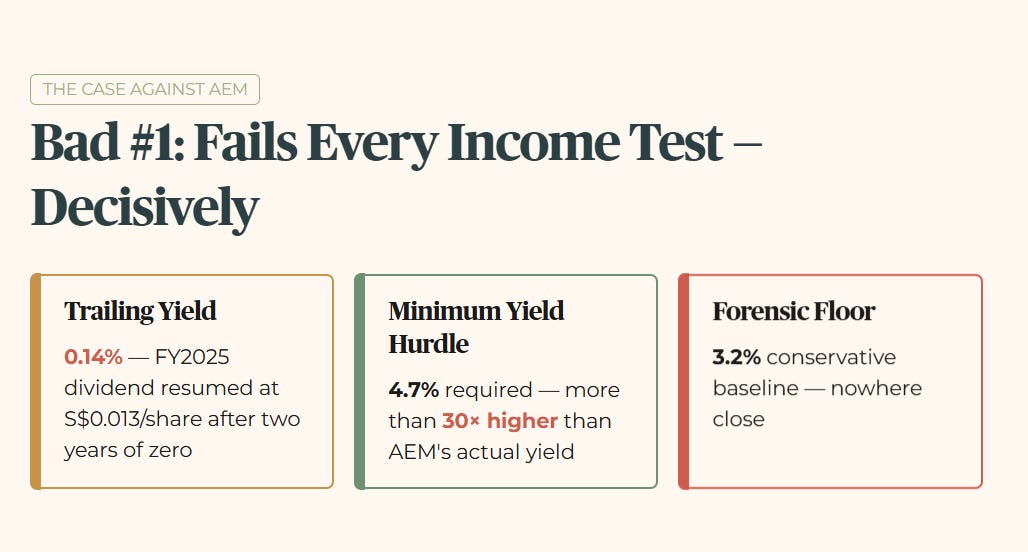
AEM paid nothing in FY2023 or FY2024. The FY2025 final dividend resumed at 1.3 Singapore cents per share, tax-exempt, paid 22 May 2026, a level materially below the prior cycle’s S$0.103 per share. At the current S$9.03 share price, that works out to a trailing yield of 0.14%. My Minimum Yield Hurdle (the income floor I require before any stock qualifies for a retirement portfolio, currently 4.7% per annum) sits more than 30 times higher than what this stock actually pays. Even the Forensic Floor (my conservative baseline yield benchmark of 3.2%, deliberately set against the highest-quality guaranteed SGD rate in the system rather than an easy comparison) is nowhere close.
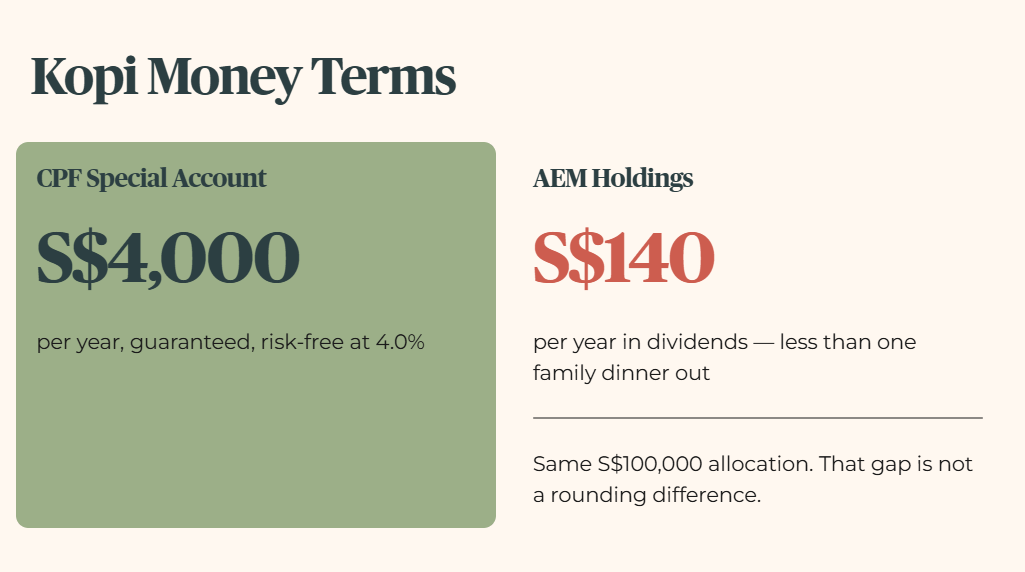
Let’s put this in kopi money terms, since a percentage on its own doesn’t always land. Against CPF Special Account’s risk-free 4.0%, a S$100,000 allocation to CPF SA earns roughly S$4,000 a year in guaranteed interest, money you can count on regardless of what the stock market does. The same S$100,000 in AEM earns S$140 in dividends a year, less than the cost of a single family dinner out. That gap is not a rounding difference. It is the entire reason this stock cannot function as retirement income, regardless of how good the underlying business is.
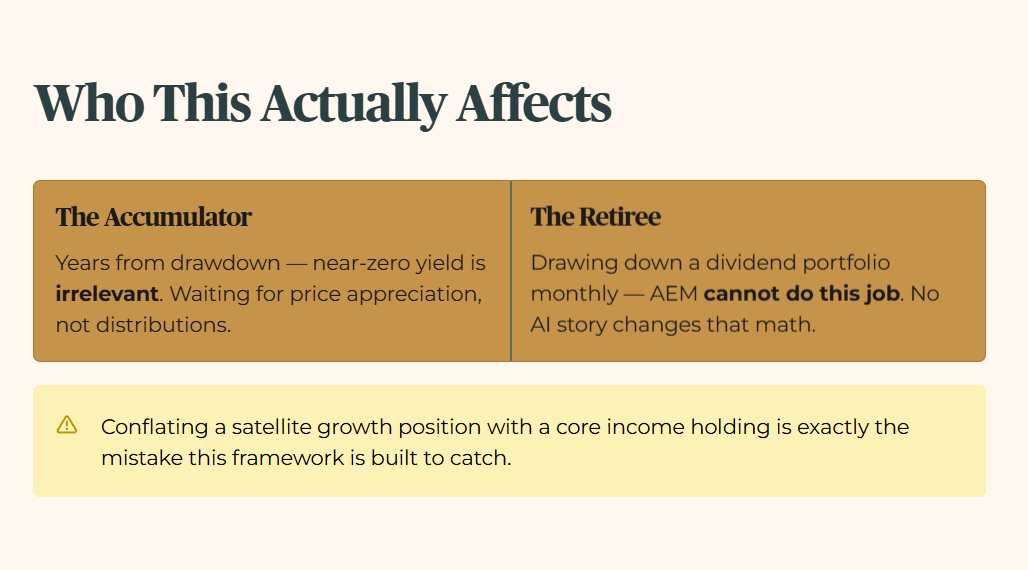
This matters more for some readers than others, and it’s worth being direct about why. If you’re still years from touching this money, a near-zero yield is simply irrelevant to your plan, you’re not living off the distribution, you’re waiting for the share price to do the work instead. But if you are the retiree in Marine Parade drawing down a SGX dividend portfolio to cover monthly expenses, AEM cannot be one of the names doing that job for you.
Owning it as a small satellite growth position funded by capital you’ve already set aside for that purpose is a completely different decision from owning it as a core income holding, and conflating the two is exactly the mistake this framework is built to catch before it costs someone their retirement runway.
The yield failure and valuation premium you have just seen are enough to disqualify AEM from any retirement-income lineup under this framework, and the next section walks through the forensic gates that turn those soft flags into a hard Zone 5, Red Zone verdict.
