Why Singapore Investors Should Care About US AI Stocks
For Singapore investors, US AI stocks offer exposure to the world’s most innovative technology companies—opportunities that simply don’t exist in our local market. While our Straits Times Index is dominated by banks, REITs, and telecom operators, the cutting edge of artificial intelligence innovation is happening across the Pacific. The good news? Accessing these opportunities has never been easier through local brokers like Tiger Brokers, MooMoo, and Saxo Markets.
But investing in US stocks isn’t without considerations. Singapore investors face SGD/USD currency risk—your returns can be enhanced or diminished by exchange rate movements. Additionally, US estate tax applies to foreigners holding US securities exceeding USD $60,000 at death, making estate planning essential for larger portfolios. Despite these factors, the growth potential and diversification benefits often make US AI stocks a compelling addition to a well-rounded portfolio.
The Magnificent Seven Is Dead. Long Live the AI Elite
Nearly three years after ChatGPT revolutionized global finance, Wall Street faces an uncomfortable truth: the Magnificent Seven, that celebrated septet of technology titans, no longer represents the real winners of the artificial intelligence revolution. While investors poured trillions into Apple, Microsoft, Nvidia, Alphabet, Amazon, Meta, and Tesla since early 2023, a quiet transformation has been reshaping the landscape of AI investing.
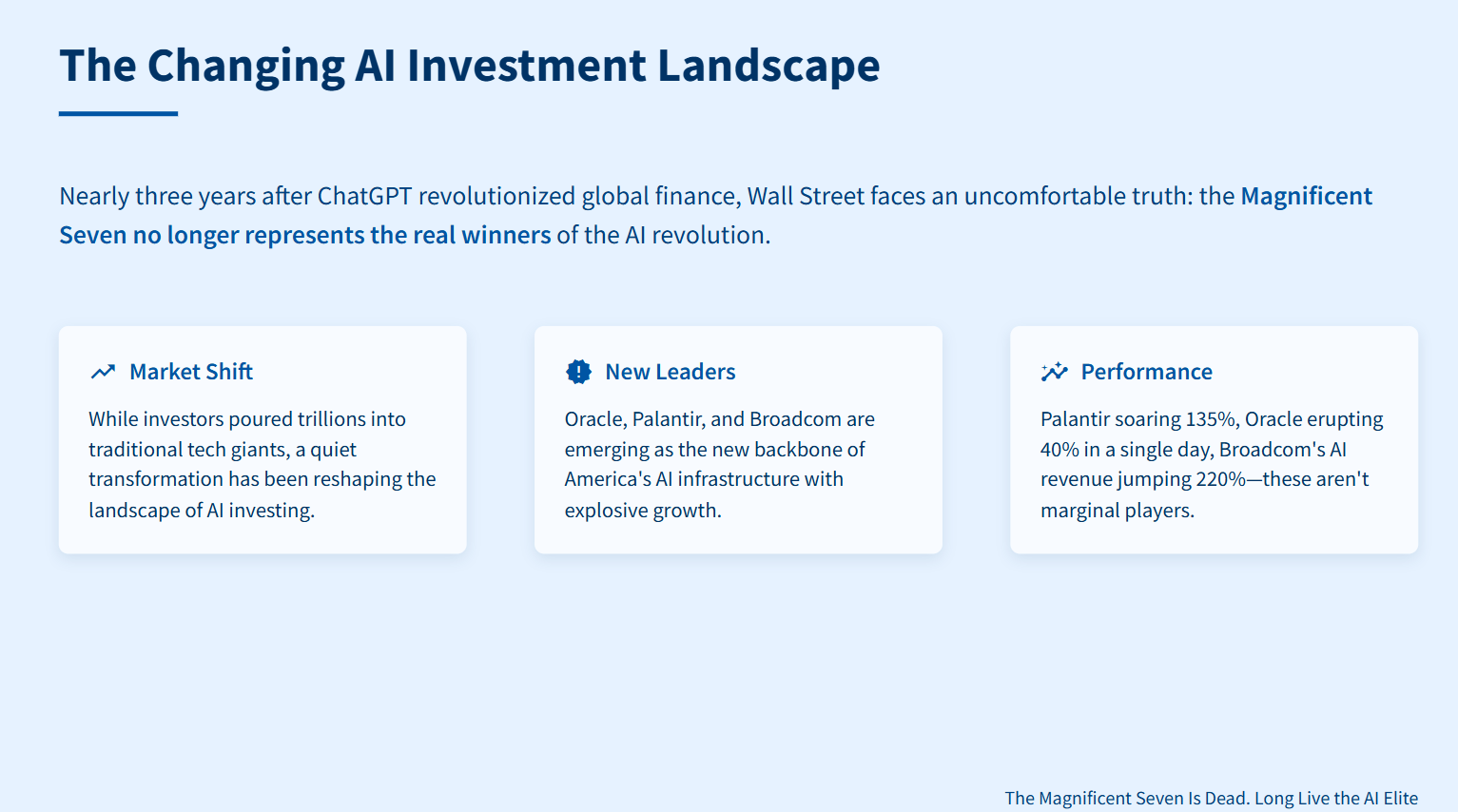
The numbers tell a compelling story of disruption and opportunity. Oracle’s stock erupted 40% in a single day after announcing a staggering $455 billion contract backlog—think of it as securing more business than Singapore’s entire GDP. Palantir has become the top performer in the tech-heavy Nasdaq 100, soaring 135% in 2025 on explosive demand for its AI software platforms. Meanwhile, Broadcom’s custom AI chip business has propelled the company to a 111% gain in 2024, with AI-related revenue jumping 220%. These aren’t marginal players riding coattails—they’re becoming the backbone of America’s AI infrastructure.
The Great Rotation Begins
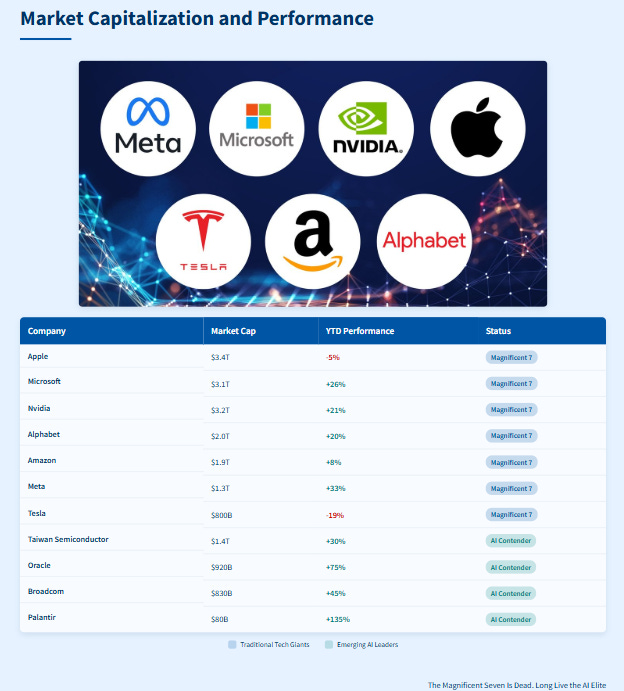
Market capitalizations and year-to-date performance comparison between the traditional Magnificent Seven and emerging AI stock contenders, highlighting the shifting dynamics in technology leadership.
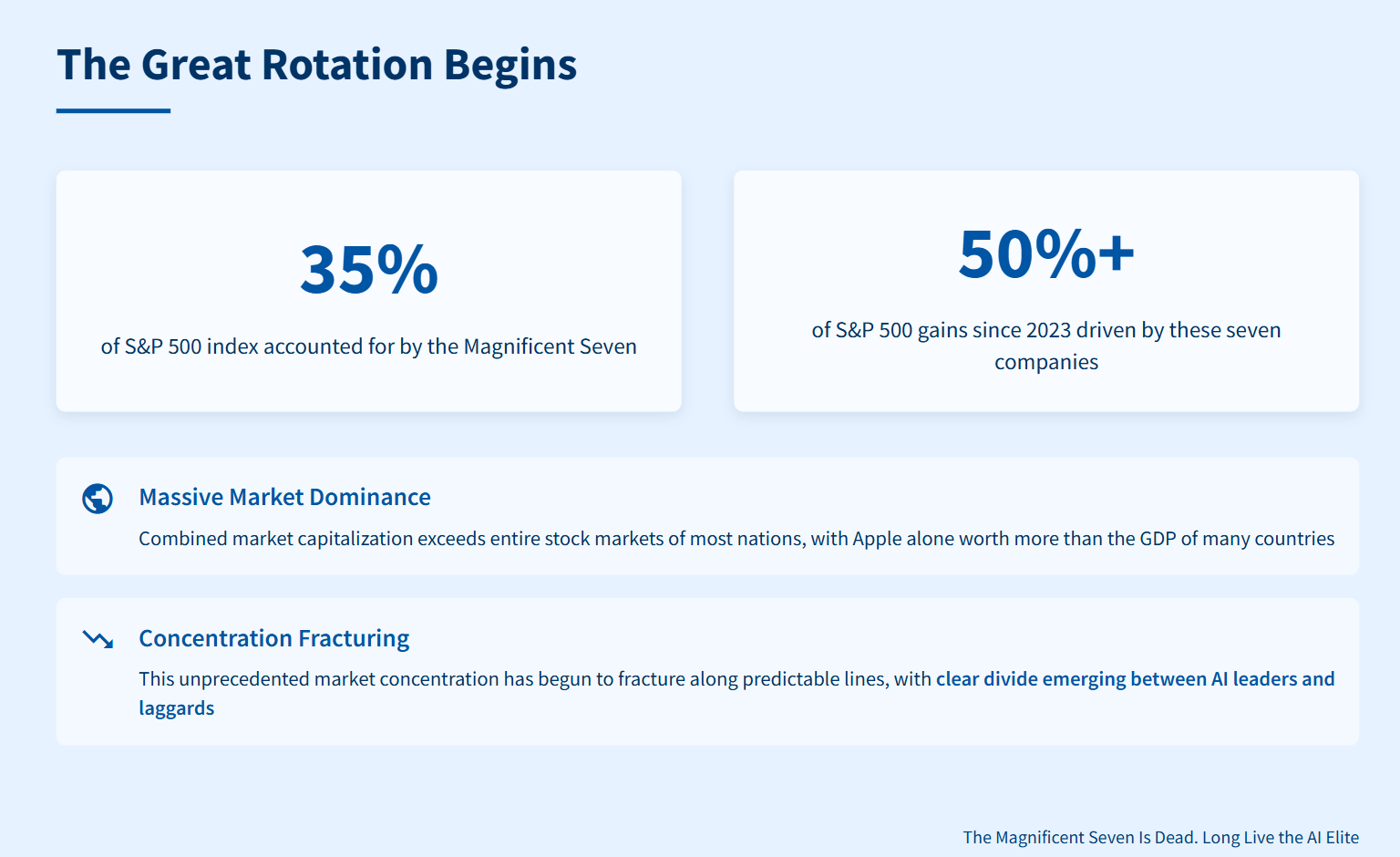
The original Magnificent Seven commanded attention through sheer market dominance, accounting for nearly 35% of the S&P 500 index and driving more than half its gains since 2023. Their combined market capitalization exceeds the entire stock markets of most nations, with Apple alone worth more than the GDP of many countries. Yet this concentration has begun to fracture along predictable lines.
Within the group, a clear divide has emerged between AI leaders and AI laggards. Nvidia, Microsoft, Meta, and Alphabet have surged between 20% and 33% this year, powered by genuine artificial intelligence revenue growth and strategic positioning. These companies have invested billions in AI infrastructure, formed critical partnerships, and demonstrated measurable returns from their AI initiatives.
Conversely, Apple and Tesla have stumbled badly. Apple shares have declined 5% in 2025, making it the only Magnificent Seven member posting negative returns. The iPhone maker’s delayed entry into AI markets has left investors questioning whether the company can maintain its premium valuation without a clear artificial intelligence strategy. Tesla faces similar challenges, with electric vehicle sales declining and AI promises from autonomous driving remaining largely unfulfilled.