Anthropic Lost $42 Billion. Only About $8 Billion Came From Running the Business.
How to Read a $42 Billion Loss: A Masterclass Using Anthropic’s Reported Prospectus
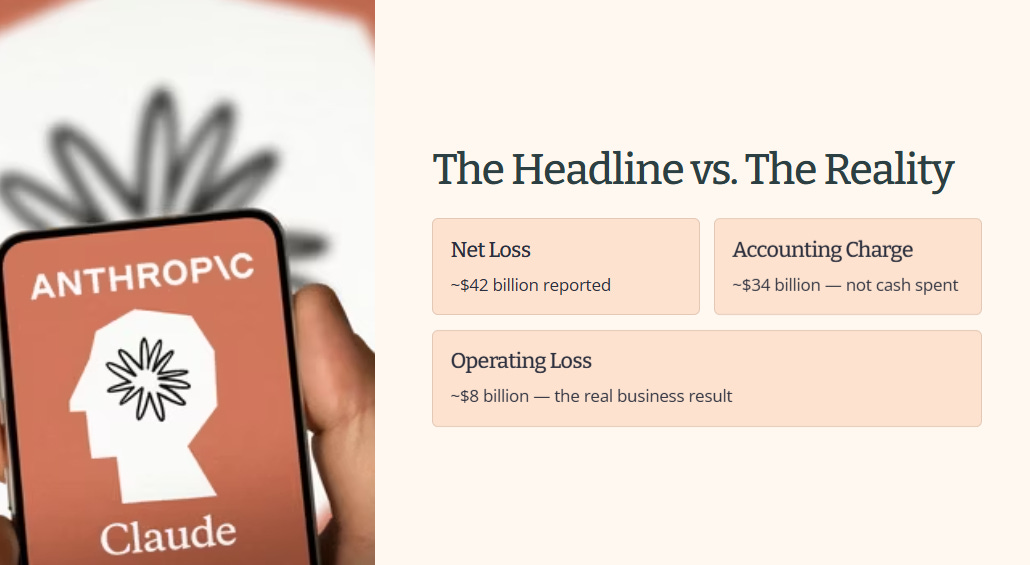
Anthropic reported a net loss of nearly $42 billion for 2025. Roughly $34 billion of that was an accounting charge, not money spent running the business. The loss from operations was about $8 billion, and the gap between those two numbers is the most useful thing an ordinary investor can learn from this prospectus.

You cannot buy Anthropic on the SGX, and nobody outside its existing backers can buy it anywhere yet. But the next big prospectus to reach investors, whether it is a US giant or a Singapore contractor, will be built the same way and will hide the same traps in its headline. If you want dividends, this is a lesson in reading a company that has no dividend to test. If you are willing to look at growth stories, it is a lesson in reading one without being dazzled by the biggest number on the page.

What We Know, and What We Don’t
One Headline, Two Very Different Numbers
The charge that came from a valuation, not a purchase
The number that came from operations
Three Questions for Any Loss-Making Prospectus
Where to Find Each Answer
What SpaceX’s June IPO Already Showed
Putting Commitments and Cash on One Basis
Who Is Paying, and Can They Leave?
What the Valuation Arithmetic Says, and What It Doesn’t
The Obvious Objection
Running the Same Questions on Deluge
Iggy’s Elite Read
What We Know, and What We Don’t

Everything in this piece comes from one source. Reuters reported on 28 September that it had seen Anthropic’s IPO prospectus, and the figures below are the ones Reuters relayed. I have not seen the filing itself, it does not appear to be public, and Anthropic declined to comment to Reuters. That means every number here is a reported number, not a confirmed one, and a final prospectus could differ.
One Headline, Two Very Different Numbers
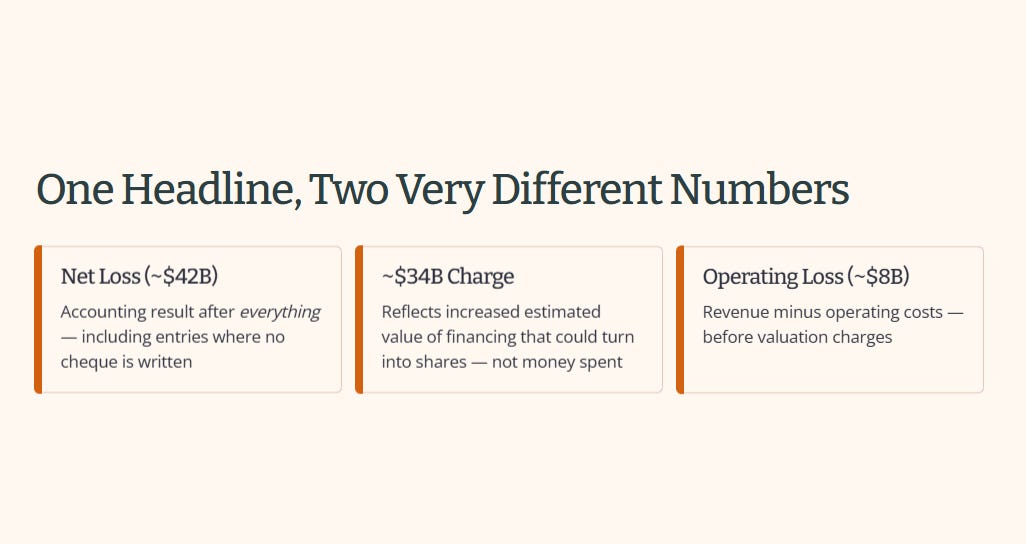
Start with what the headline hides. A net loss is the accounting result after everything is counted, including entries where no cheque is written. An operating loss is narrower: the result after the business’s revenue and its operating costs are counted, before items like this valuation charge. Reuters reports a net loss of nearly $42 billion for 2025. About $34 billion of it was a charge reflecting an increase in the estimated value of financing that could eventually turn into Anthropic shares. Reuters describes that as an accounting charge, not money the company spent running its business.
The charge that came from a valuation, not a purchase
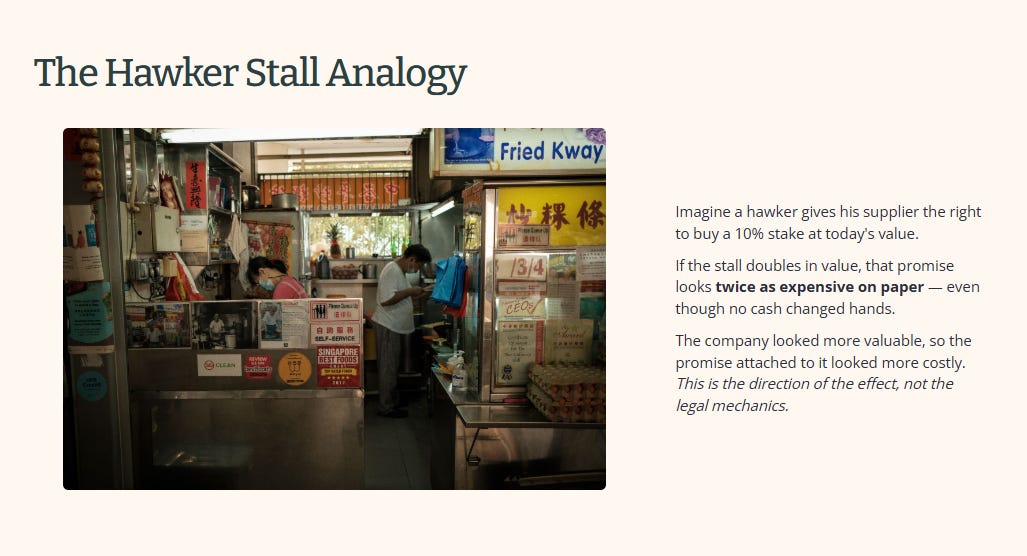
Here is a rough way to picture it. Suppose a hawker gave his supplier the right to buy a 10% stake in his stall at today’s value. If the stall becomes famous and worth double, that right is now worth double, and the stall’s books would show the promise as a bigger cost, even though he has not paid the supplier a cent. Anthropic’s financing is far more complicated than that, and I am using the stall only to show the direction of the effect. The company looked more valuable, so the promise attached to it looked more expensive on paper. This is not a description of the legal or accounting mechanics, and not every rise in value creates a cost like this. It depends on how the financing is structured.
The number that came from operations
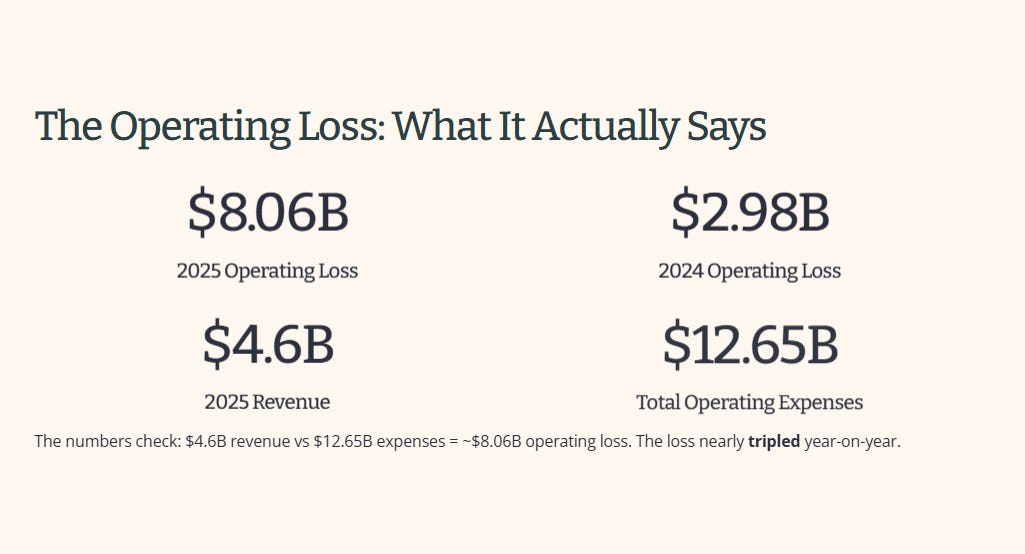
Take that charge out and you are left with the operating loss, which Reuters puts at $8.06 billion for 2025, up from $2.98 billion in 2024. That is almost three times the year before, so it is not a small number and it is not a reassuring one. It is a different number with a different meaning. It says the business spent about $8 billion more than it earned to run itself.
The reported figures are consistent with each other. Revenue of nearly $4.6 billion against total operating expenses of $12.65 billion leaves about $8.06 billion, which matches the reported operating loss. That checks the numbers against one another, not against the filing. Reuters adds that the operating figure excludes writedowns of various liabilities, mostly tied to earlier fundraising, so the $34 billion charge may not be the only item separating the two loss figures.
🟡 Insight Callout
A net loss answers one question: did the accounting say the company lost money? An operating loss answers another: did the business spend more than it earned? A prospectus can answer the first loudly while the second stays quiet. Here the first is nearly $42 billion and the second is about $8 billion. The gap is a charge tied to how financing that could turn into shares is valued, and that value rises when the company looks more valuable. A loss that grows because the company looks more valuable is not the same as a loss that grows because costs outrun revenue. One is a change in a valuation. The other is money the business spent.
That is the loss on its own terms. Here is the method for reading everything a prospectus says after the loss.
You Don’t Need The Jargon To Get The Edge
Not everyone wants to read balance sheets for fun. Sometimes you just want to know what’s actually happening with your money, in plain English, without doing the digging yourself. That’s the idea behind Paid Membership.

Members get the complete forensic reasoning behind every zone verdict, not just the zone number and label. The full Red Zone watchlist, the forensic cheatsheets, every walkthrough, laid out in plain language instead of compressed into a one-line verdict.
With the YouTube/Substack Combo at S$12/month, less than 2 kopi and kaya toast sets at Raffles Place, you get the reasoning behind the number, explained the way you’d want a friend to explain it, not just the headline everyone else stops at.
Three Questions for Any Loss-Making Prospectus
I ask three questions of any prospectus that shows a loss. They work on a US technology giant and on a Singapore contractor alike, and Anthropic is only the worked example.
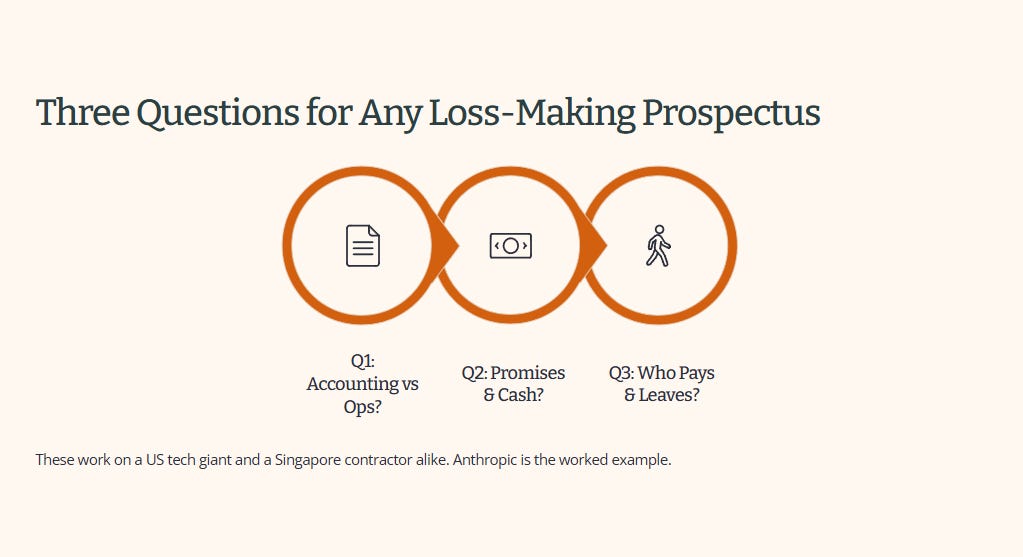
Question 1: How much of the loss is accounting, and how much is operations?
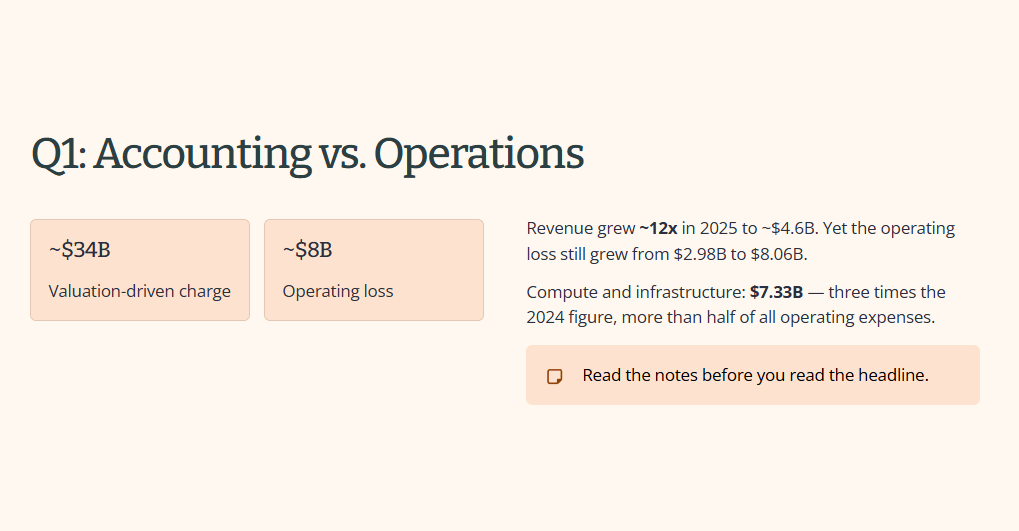
We have just answered this one. About $34 billion of the net loss was a valuation-driven charge, and about $8 billion was the operating loss. It comes first because the two numbers can point in different directions. A company can post a huge net loss because it looks more valuable, or a small one because it looks less. The operating loss is harder to move with accounting.
One more point belongs here. Reuters reports that revenue grew about twelve-fold in 2025 to nearly $4.6 billion, so 2024 revenue was well under half a billion dollars. Yet the operating loss still grew from $2.98 billion to $8.06 billion. Since the loss widened by about $5.1 billion, operating expenses must have risen by about $5.1 billion more than revenue did. Reuters reports compute and infrastructure at $7.33 billion, three times the 2024 figure and more than half of the $12.65 billion in total operating expenses.
In a real prospectus, the operating loss usually sits on the income statement under a line called operating loss or loss from operations. The notes that follow often explain any large non-cash items, and a charge like the $34 billion one is the kind of thing to look for there. Read the notes before you read the headline.
Question 2: What has the company promised to pay, and how much cash does it hold?
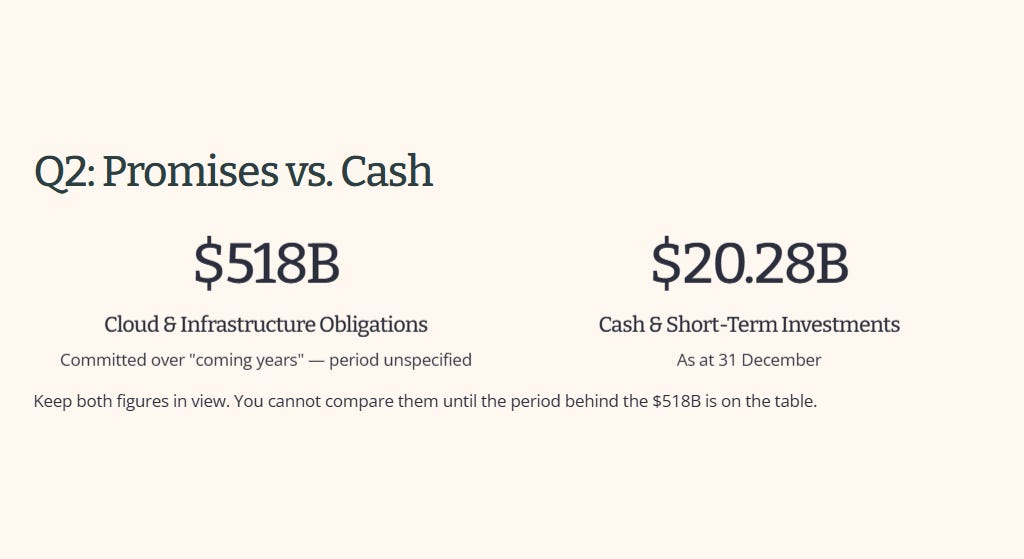
Reuters reports that Anthropic plans to spend $518 billion on cloud, computing and infrastructure obligations in coming years, and does not specify the period. Against that, Reuters reports the prospectus shows cash, cash equivalents and short-term investments of $20.28 billion as of 31 December. Cash, cash equivalents and short-term investments means money in the bank plus holdings that can be turned into cash quickly. Obligations are what a company has agreed to pay, usually over several years. Keep both figures in view. I will come back to how to compare them.
Question 3: Who is paying, and can they leave?

Reuters reports that nearly a quarter of Anthropic’s 2025 revenue came from two customers. It also reports that the company warned many of its largest clients are not locked into long-term contracts and could cut or stop spending. Customer concentration simply means how much of the revenue depends on a few buyers. The question to ask is what happens to revenue if one of them leaves. I am stating the facts here and leaving the reading of them for later.
Where to Find Each Answer
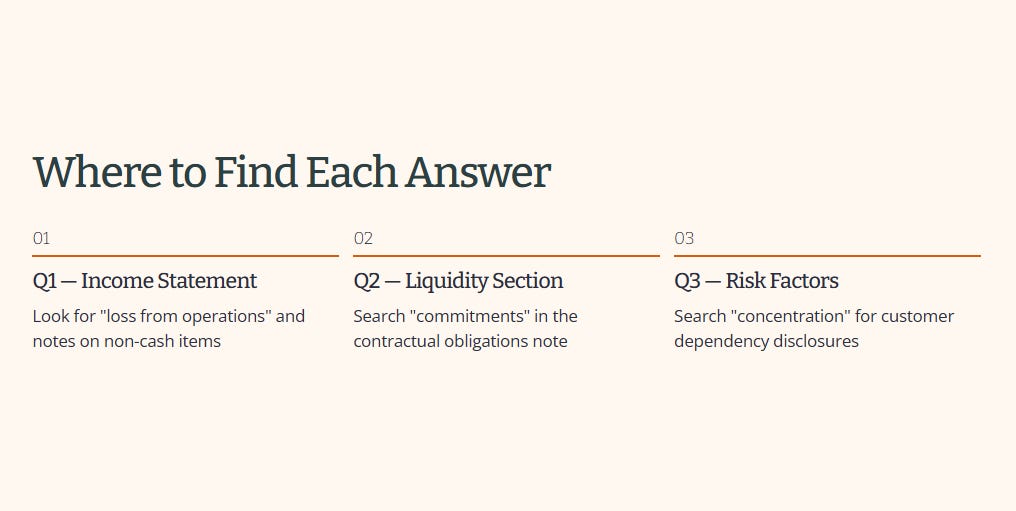
These are typical locations, not a map of the Anthropic filing, which I have not seen. In most prospectuses, Question 1 is answered by the income statement and the notes to the financial statements. Question 2 is answered in the section on liquidity and capital resources and in the note listing contractual commitments. Question 3 is answered in the risk factors and in the note on customer concentration. Section names vary from one prospectus to the next, so search for the words “commitments”, “concentration” and “non-cash” if the headings do not match.
Those are the three questions. Before I use them on price, look at what SpaceX’s June listing did to the people who bought it.
What SpaceX’s June IPO Already Showed
There is a recent reference point for how the market treats a giant listing. Reuters notes that SpaceX listed in June at a valuation of $1.77 trillion. Its shares were sold at $135, opened at $160 on 12 June, a 19% jump on the debut, and traded around $147 when Reuters reported on 28 September.

Look at what that means for two different buyers. Someone allocated shares at the $135 offer price is up about 9% at $147. Someone who bought at the $160 debut price is down about 8%. Many retail investors, in Singapore or elsewhere, end up buying once shares are already trading, so the offer price on the prospectus and the price you can actually pay can be two very different numbers. Reuters says the performance could give investors pause on lofty valuations for high-growth companies. I draw no prediction from one example. It is one data point about the gap between the price in the filing and the price on your screen.
🔒 What’s Next
The $518 billion of commitments and the $20.28 billion of cash sit side by side above, but they are not measured over the same period. The next section works through how different assumed periods change the arithmetic.