A fresh forensic screen finds two hard-gate failures behind CapitaLand Ascendas REIT’s growth story, here’s what Zone 4 actually means for your money.
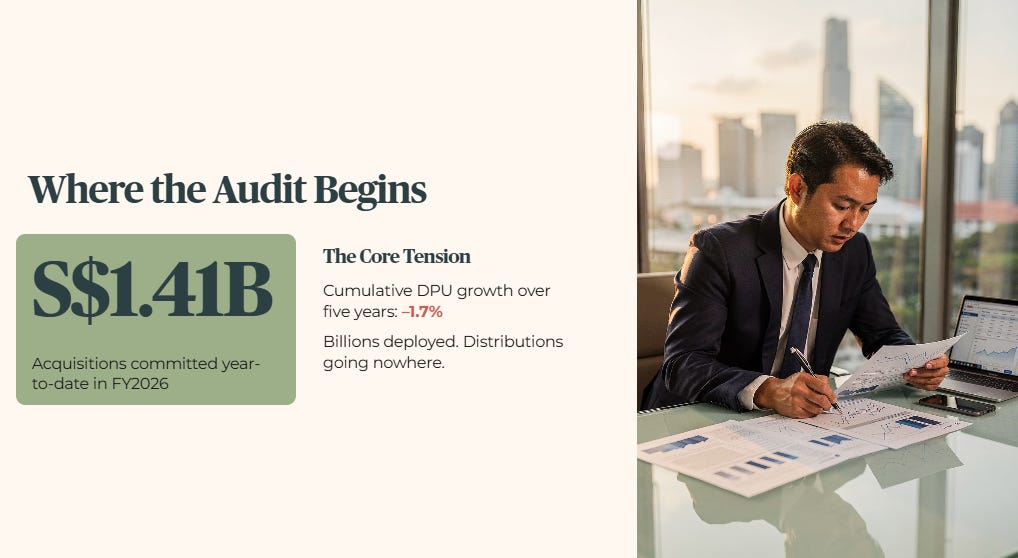
S$1.41 billion. That is the total outlay CapitaLand Ascendas REIT (SGX: A17U) has committed to acquisitions year-to-date in FY2026. Over the last five years, cumulative Distribution Per Unit growth stands at negative 1.7%. That gap, billions deployed, distributions going nowhere, is where this audit begins.
The Investing Iguana’s Substack is a reader-supported publication. To receive new posts and support my work, consider becoming a free or paid subscriber.
Section 1: The Analyst’s Case
Section 2: Iggy’s Forensic Screen
Section 3: The Dividend Trajectory
Section 4: The Forensic Gap
🟢 Iggy’s Insight Box 1
Section 5: What To Watch Next
🟢 Iggy’s Insight Box 2
Closing: The Forensic Stance
The Warm Entry Beat
CLAR is asking unitholders to trust that this time is different, that the S$1.41 billion currently being deployed into logistics and data centre assets will finally translate acquisition growth into DPU growth, after five straight years where it hasn’t. Whether you’re still building toward retirement or already drawing down CPF and SRS income, that is the exact question this piece exists to test, not RHB’s growth story in isolation, but whether the balance sheet behind it can actually support the wait.
Section 1: The Analyst’s Case
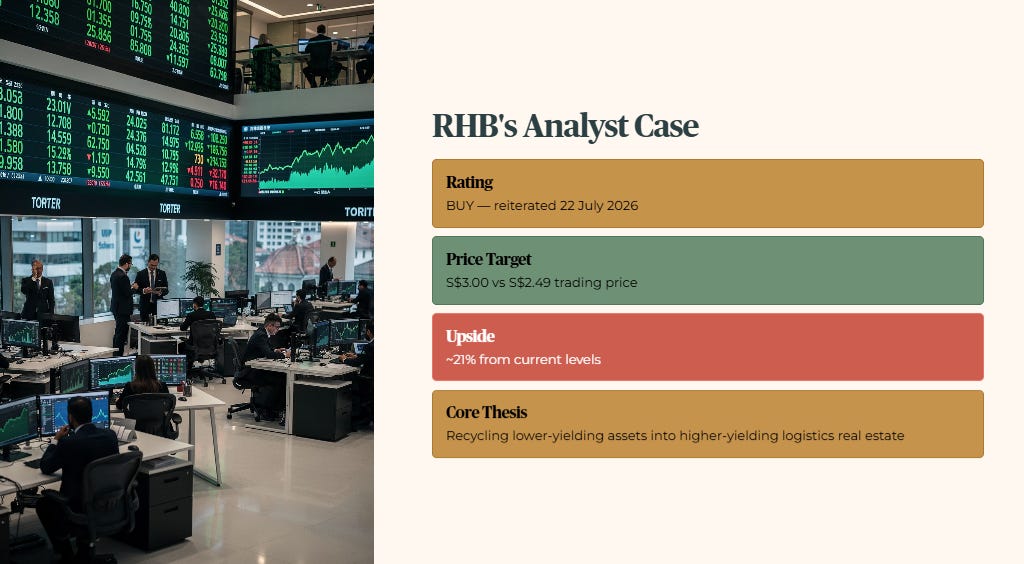
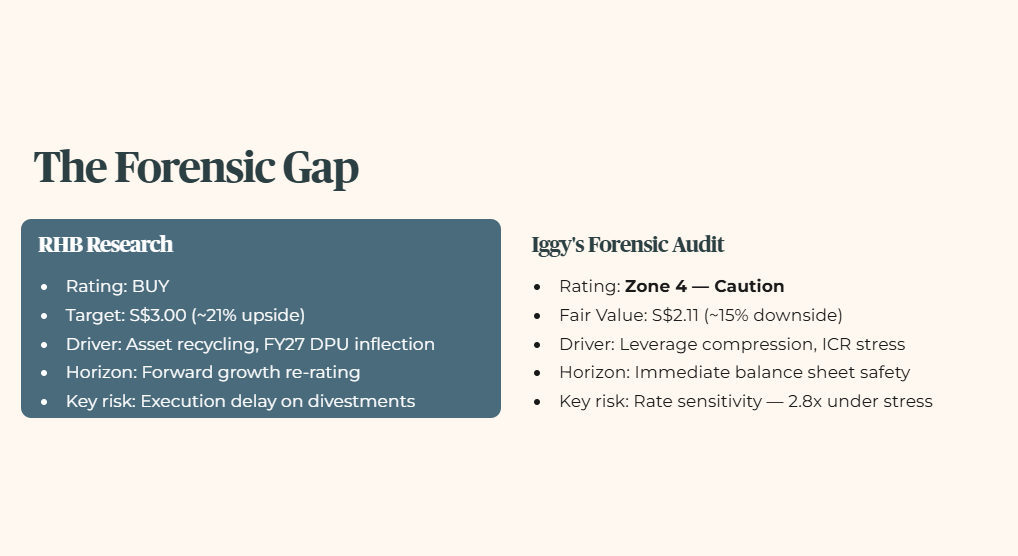
RHB Research reiterated its BUY rating on CapitaLand Ascendas REIT (CLAR) on 22 July 2026, maintaining a price target of S$3.00. That represents approximately 21% upside from the prevailing S$2.49 trading price.
The core sell-side thesis centres on an aggressive portfolio revamp, recycling lower-yielding assets into higher-yielding logistics real estate.
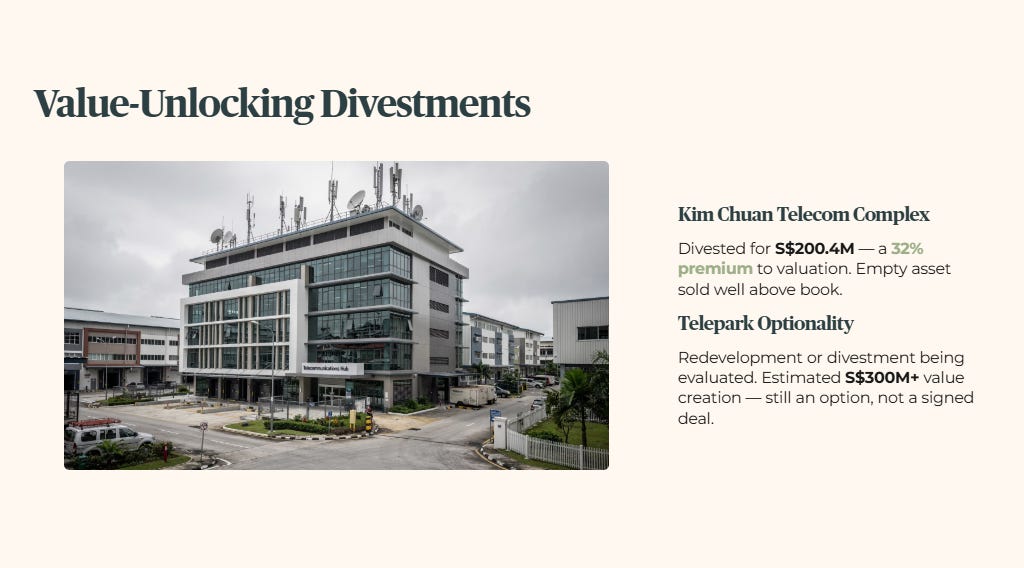
Value-Unlocking Divestments: RHB highlights the divestment of the Kim Chuan Telecommunications Complex for S$200.4 million at a 32% premium to valuation, following Singtel’s vacancy of the property in April. This is a genuinely clean win on its own terms, an empty asset that was actively dragging on DPU gets sold well above book, freeing capital for redeployment rather than sitting idle.
RHB further flags optionality at Telepark, where management is evaluating redevelopment at a higher plot ratio or a divestment or joint development with the sponsor, estimating S$300 million or more in value creation potential if that plays out. Worth noting this second figure is still an estimate on an option, not a signed transaction, so it belongs in the thesis as upside potential rather than confirmed value.
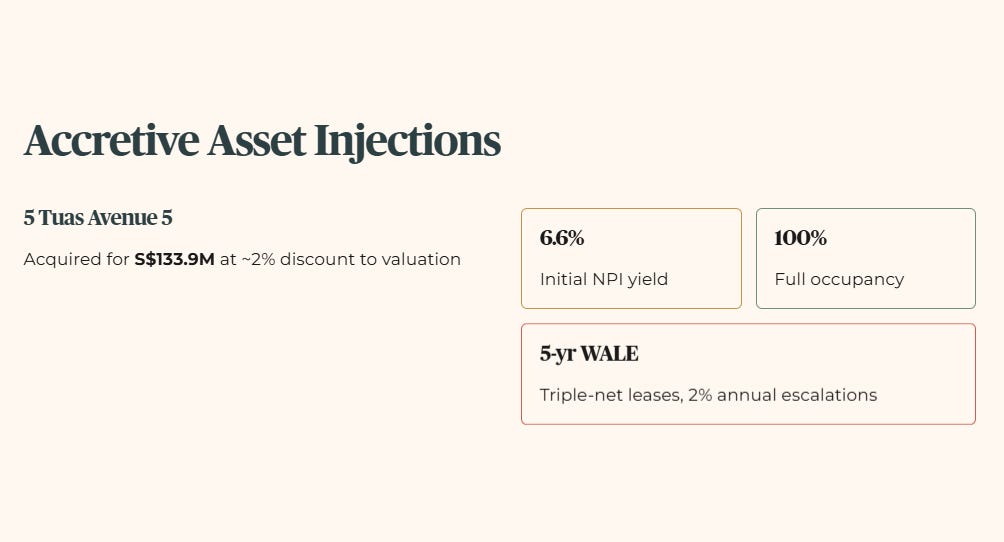
Accretive Asset Injections: Capital recycled from divestments is being redeployed into prime industrial assets. RHB points to the acquisition of 5 Tuas Avenue 5 for S$133.9 million at an approximate 2% discount to valuation. The asset carries a 6.6% initial Net Property Income yield, full occupancy, and a 5-year Weighted Average Lease Expiry with triple-net leases and 2% annual rental escalations built in, a genuinely well-structured acquisition on the metrics disclosed.
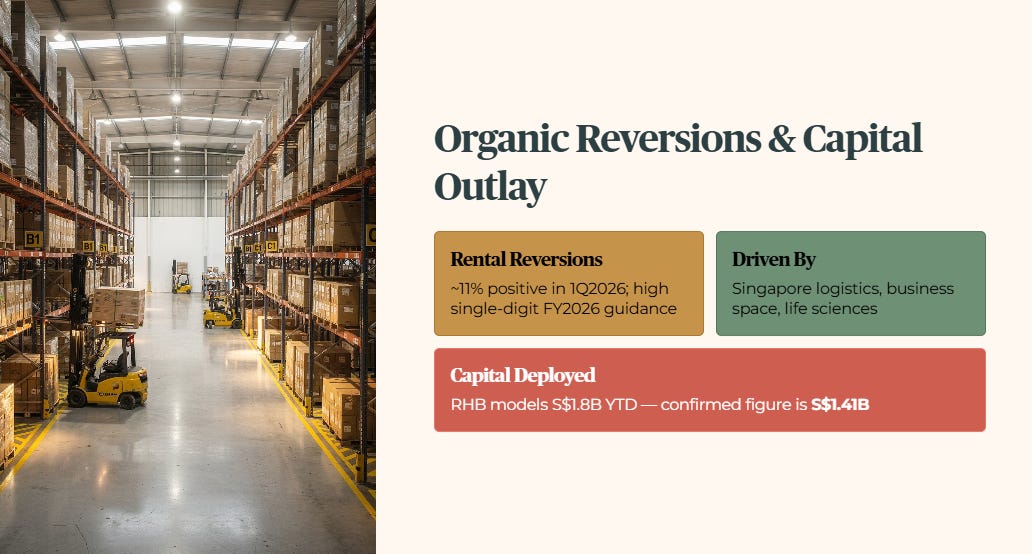
Strong Organic Reversions: RHB notes positive rental reversions of approximately 11% in 1Q2026, with full-year FY2026 guidance pointing toward high single-digit reversions across the portfolio, driven mainly by Singapore logistics, business space, and life sciences segments.
Capital Outlay and Valuation Embed: RHB models a total year-to-date capital deployment of S$1.8 billion. Worth flagging directly, CLAR’s own disclosed transaction total for the specific deals named in this note comes to S$1.41 billion, not S$1.8 billion. The larger figure may roll in additional transactions beyond what RHB’s note specifies, but it doesn’t reconcile against the primary disclosure available here, so treat S$1.41 billion as the confirmed number. The target price embeds a 6% ESG premium alongside an estimated 6% FY2026F forward yield.
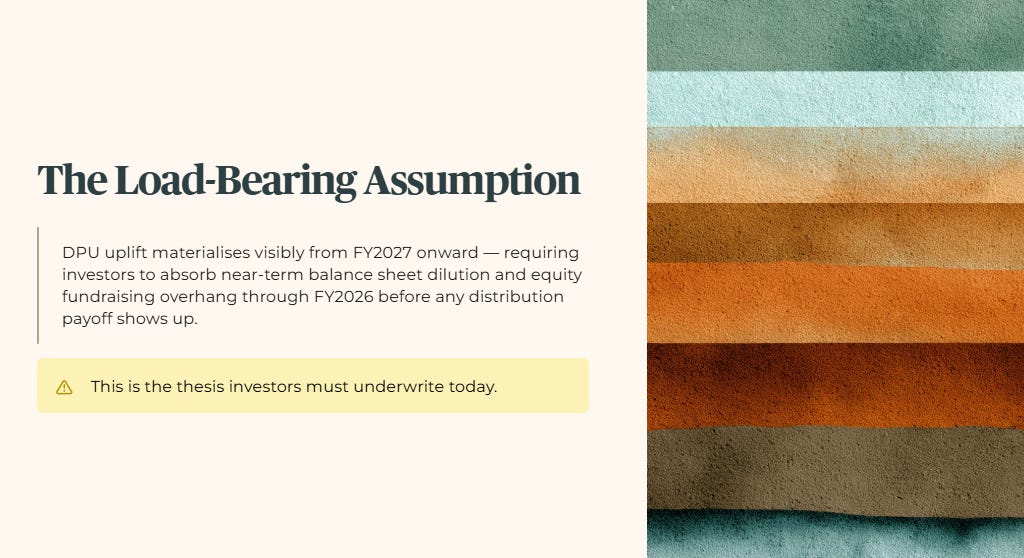
THE LOAD-BEARING ASSUMPTION: DPU uplift materialises visibly from FY2027 onward. This requires investors to absorb near-term balance sheet dilution and equity fundraising overhang through FY2026, before any distribution payoff shows up.
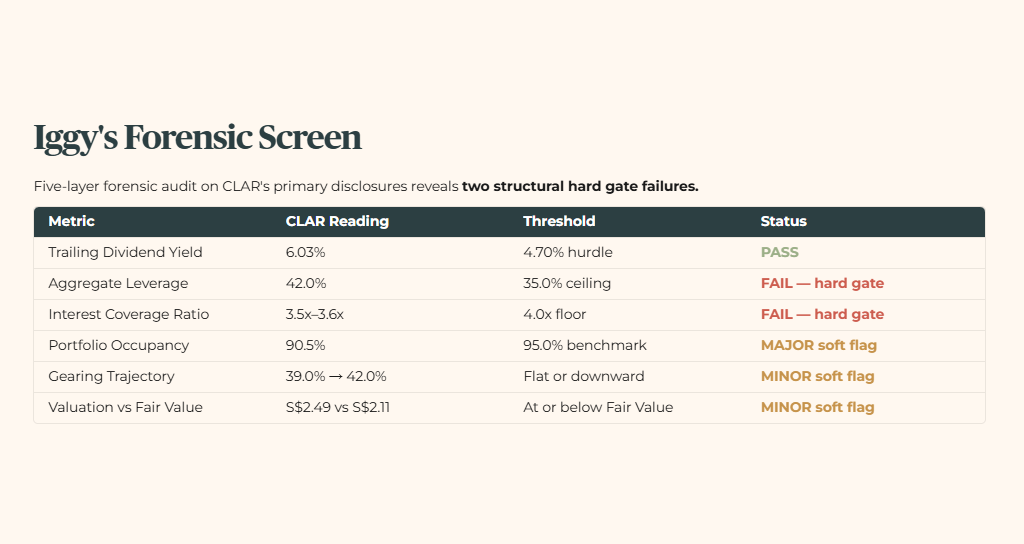
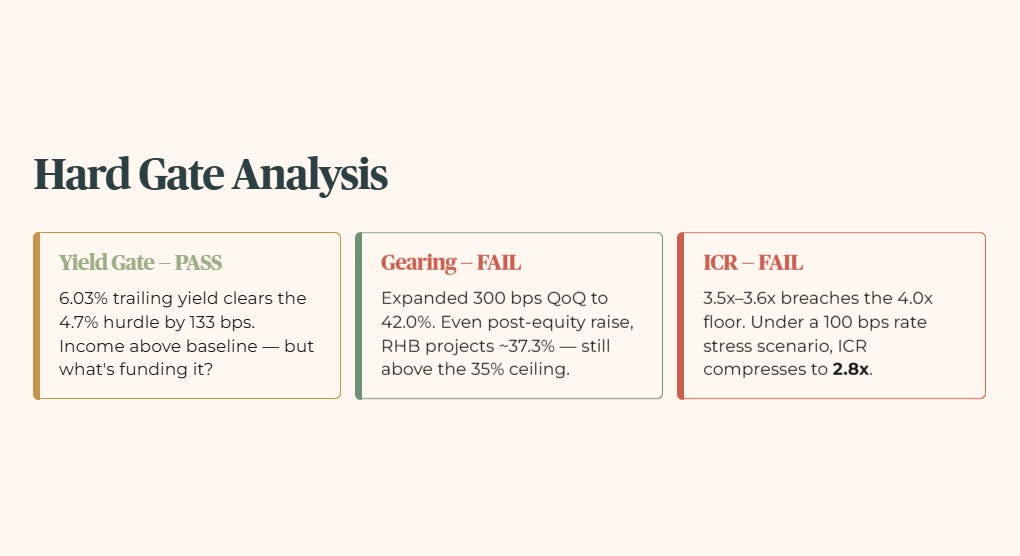
Applying the five-layer forensic audit to CLAR’s primary disclosures reveals a balance sheet carrying two structural hard gate failures.
Yield Gate, PASS: Trailing DPU of 15.005 cents on a S$2.49 unit price provides a 6.03% trailing yield, clearing the 4.7% hurdle by 133 basis points. For a retiree drawing income, the yield itself is above the baseline requirement, this is not a piece about weak income, it’s a piece about what’s funding it.
Gearing Ceiling, FAIL: Aggregate leverage expanded 300 basis points quarter-on-quarter, from 39.0% at FY2025 year-end to 42.0% as at 1Q2026. This breaches the 35% hard ceiling outright. Even under RHB’s own equity fundraising projection, post-raise leverage falls only to approximately 37.3%, still above the ceiling, just less far above it.
Interest Coverage Ratio, FAIL: Disclosed ICR stands at 3.5x to 3.6x, using CLAR’s own methodology of income available for distribution over net finance costs. This breaches the 4.0x floor. Under CLAR’s own disclosed stress scenario, a 100 basis point interest rate increase compresses coverage to 2.8x, a level with materially less buffer to absorb any further cost-of-debt pressure.
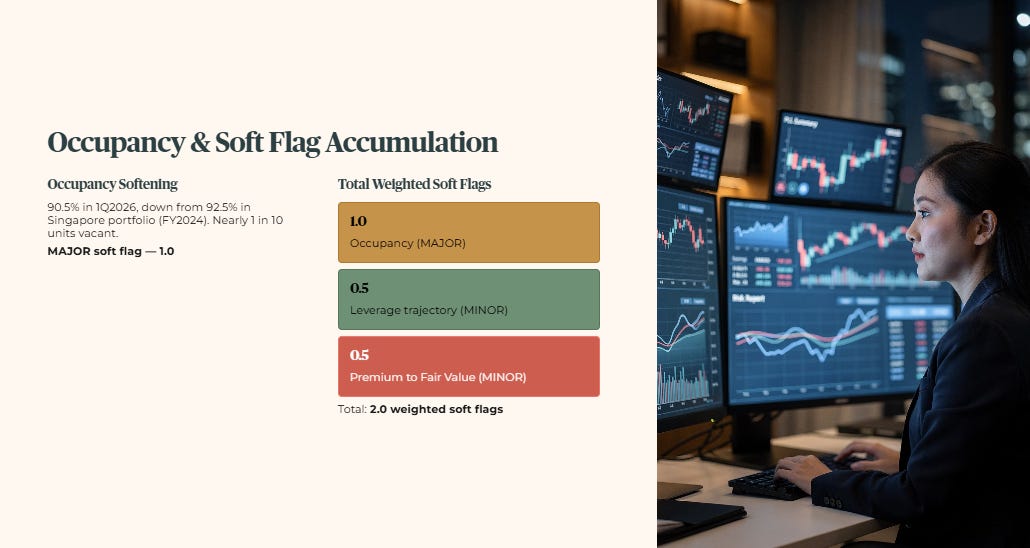
Occupancy Quality, MAJOR soft flag, 1.0: Portfolio occupancy softened to 90.5% in 1Q2026, down from 90.9% at FY2025 year-end and down from 92.5% in the Singapore portfolio specifically during FY2024. When close to one in ten units of a Singapore-anchored industrial REIT sits vacant, rental income durability, not just headline yield, needs a second look.
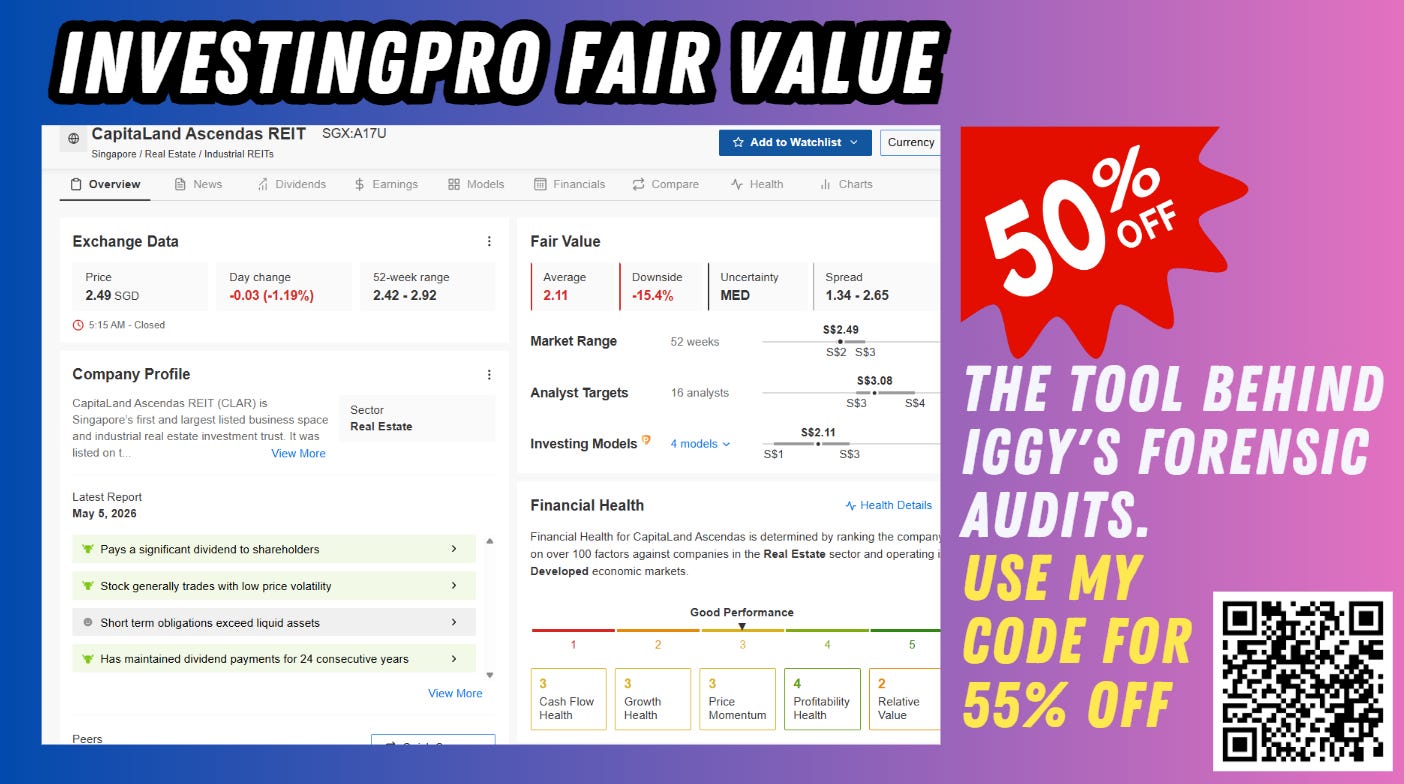
Soft Flag Accumulation: Combining occupancy softening (MAJOR, 1.0), upward leverage trajectory (MINOR, 0.5), and trading at roughly an 18% premium to InvestingPro’s own Fair Value of S$2.11 (MINOR, 0.5) totals 2.0 weighted soft flags.
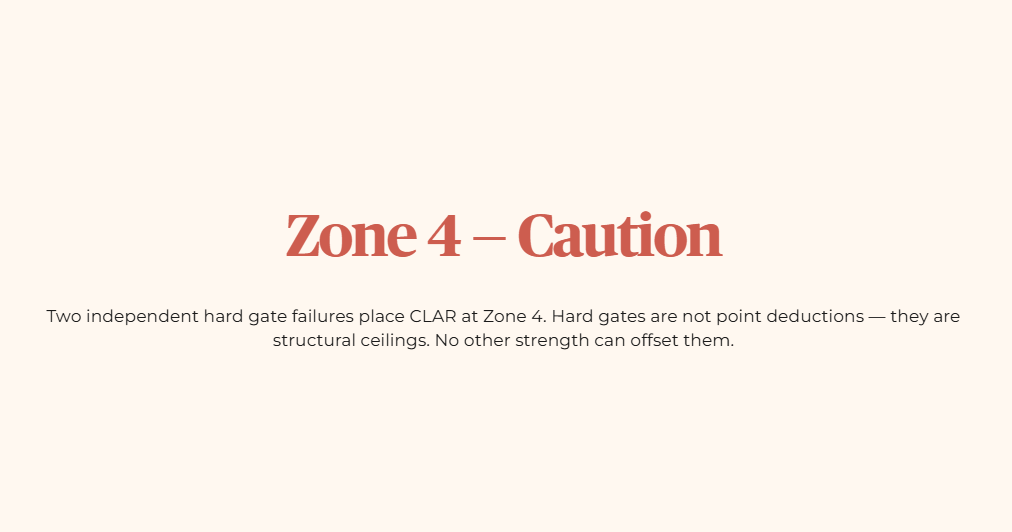
Regardless of soft flag count, the two independent hard gate failures place CLAR at Zone 4, Caution, on their own. That is what a hard gate failure means in this framework, it isn’t a point deduction that can be offset by other strengths, it’s a structural ceiling on how confident this framework can be in the balance sheet right now.
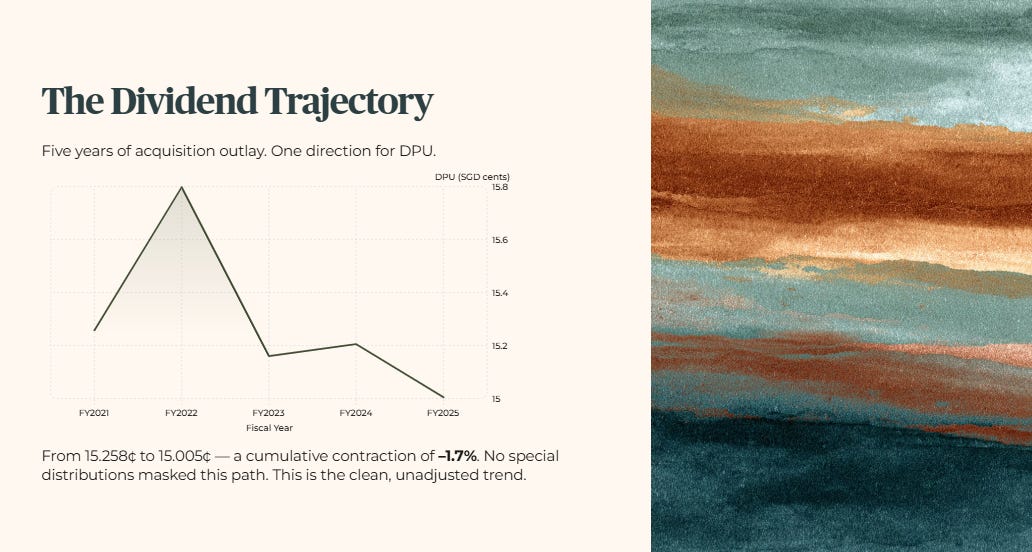
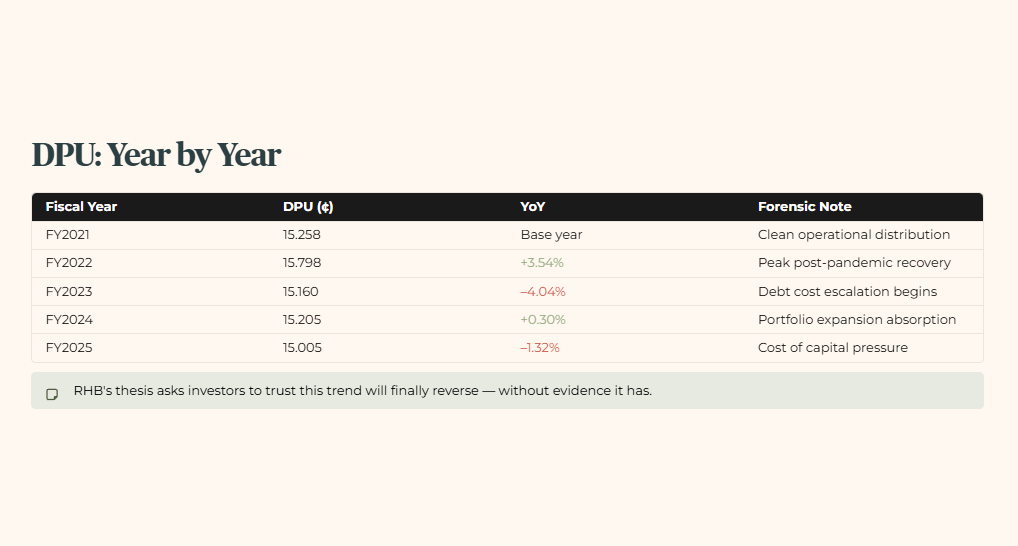
The historical distribution record is where the core tension in RHB’s thesis becomes visible.
Over a five-year window characterised by billions in acquisition outlay, CLAR’s DPU moved from 15.258 cents to 15.005 cents, a cumulative contraction of roughly 1.7%. Primary filings confirm no special or one-off distributions masked this path in any year, this is the clean, unadjusted trend. Distributable growth has historically lagged portfolio expansion for this REIT. That is exactly what RHB’s forward inflection thesis is now asking investors to trust will finally change, without yet showing evidence that it has.
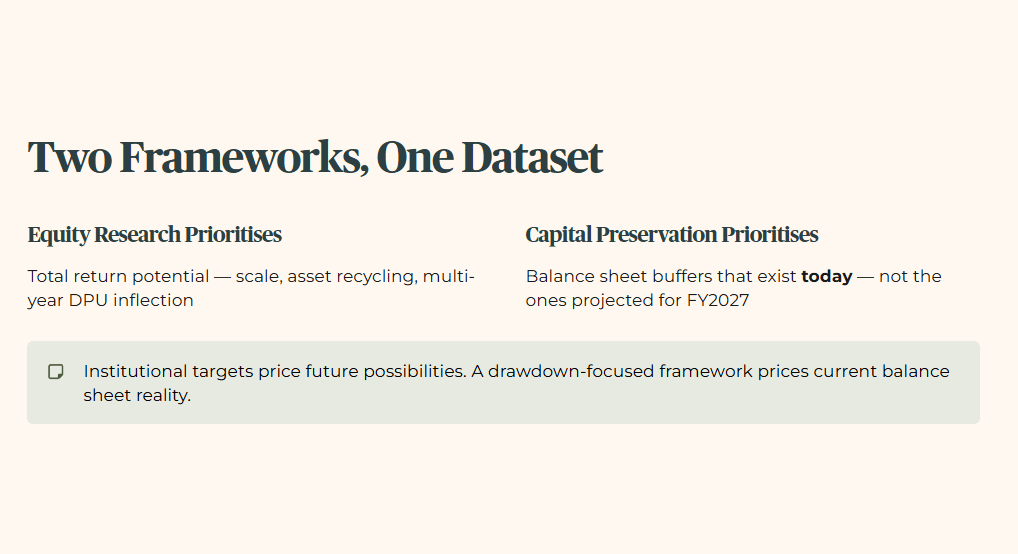
The gap between a S$3.00 institutional target and a S$2.11 Fair Value reflects two different jobs being done with the same numbers. Equity research prioritises total return potential driven by scale, asset recycling, and multi-year DPU inflection. A capital-preservation framework prioritises the balance sheet buffers that exist today, not the ones projected for FY2027.
🟢 Iggy’s Insight Box 1
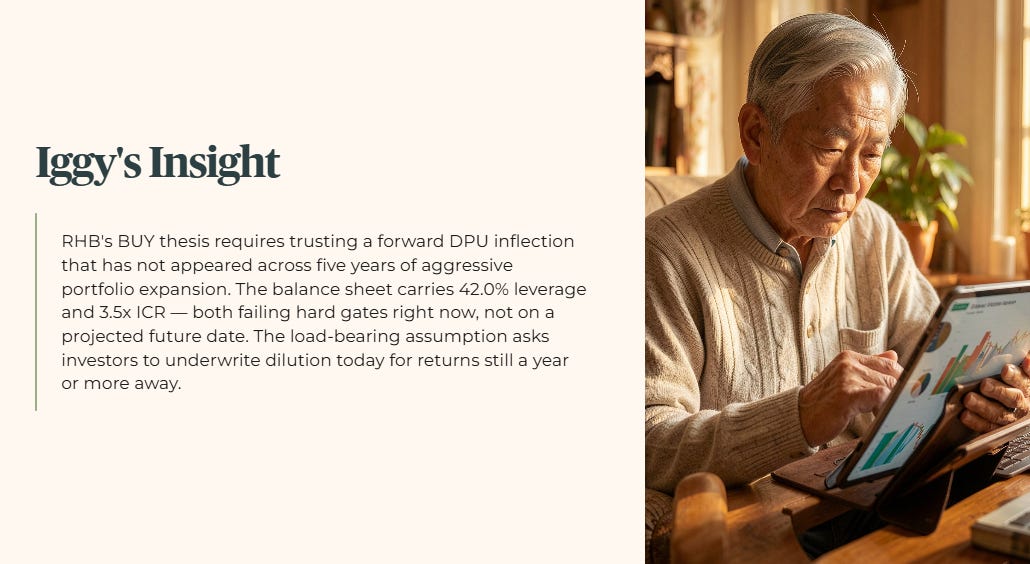
The divergence between RHB’s S$3.00 target and InvestingPro’s S$2.11 Fair Value is not simply a debate over optimism versus pessimism. RHB’s BUY thesis requires trusting a forward DPU inflection that has not appeared across five years of aggressive portfolio expansion.
Meanwhile, the balance sheet carries aggregate leverage of 42.0% and interest coverage of 3.5x, both failing hard gates right now, not on a projected future date. Institutional targets price future possibilities. A drawdown-focused framework prices current balance sheet reality. The load-bearing assumption asks investors to underwrite dilution today for returns that are still, by RHB’s own timeline, a year or more away.
The load-bearing assumption only makes sense when you overlay that 6.03% yield against a 42.0% leverage stack and 3.5x interest coverage, and that is exactly where the next section takes the forensic screen.
Continue reading this post for free, courtesy of The Investing Iguana.