



CapitaLand Ascendas REIT’s Income Grew 8.6%. Its Dividend Per Unit Grew 0.1%. Here’s the Gap.
Two readers can look at the same 15.01 cents a year and see different things: one who has held the units for years, and one looking at the trust for the first time. Here is what each should check in the results before drawing a conclusion.
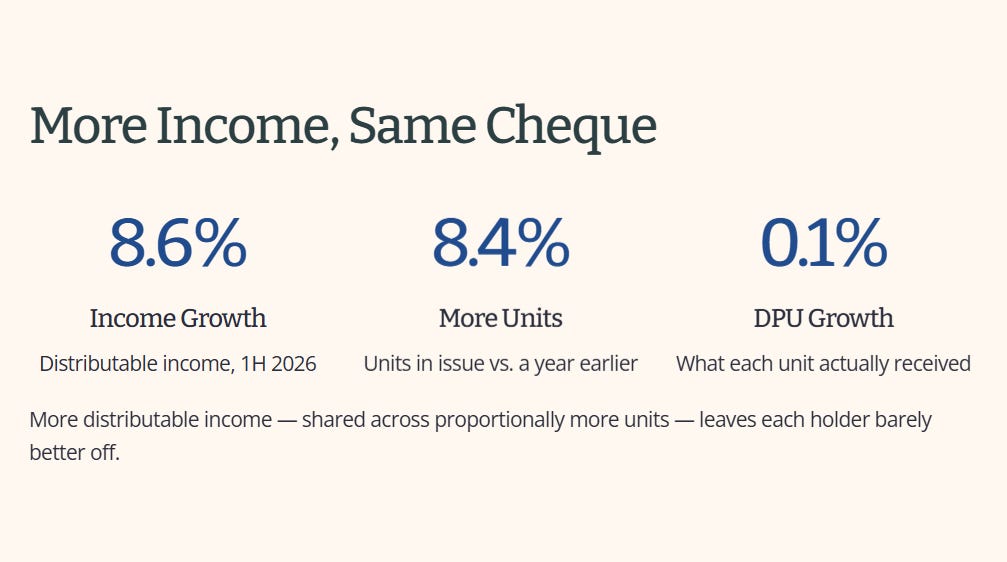
CapitaLand Ascendas REIT had about 8.4% more units in issue at 30 June 2026 than a year earlier. Its distributable income grew 8.6% over the same period, which left each unit with a dividend 0.1% higher. If you own units, your payment barely moved, even though the trust had more distributable income in total.
If you already own CapitaLand Ascendas REIT, the 3.732 cents paid on 8 September is the figure this piece starts from, and you may be asking whether the SGD 900 million equity fund raising has made a difference to your payment. If you are looking at the trust for the first time, you see a yield near 6.8% at the 7 October 2026 price, which is close to its 52-week low, and you may be asking what sits behind both. I read the results announcement, the distribution history and the InvestingPro data line by line, because the two numbers in the title sit in different tables.
What This Piece Does
The gap. Why income rose 8.6% while each unit’s dividend rose 0.1%, using the trust’s own figures and seven half-years of payments.
The arithmetic. The trailing yield at the 7 October 2026 price, and how far it sits from my 4.7% Minimum Yield Hurdle.
What each reader should check. The balance sheet behind the yield, and what a long-time holder and a first-time reader should each look for in the next result.
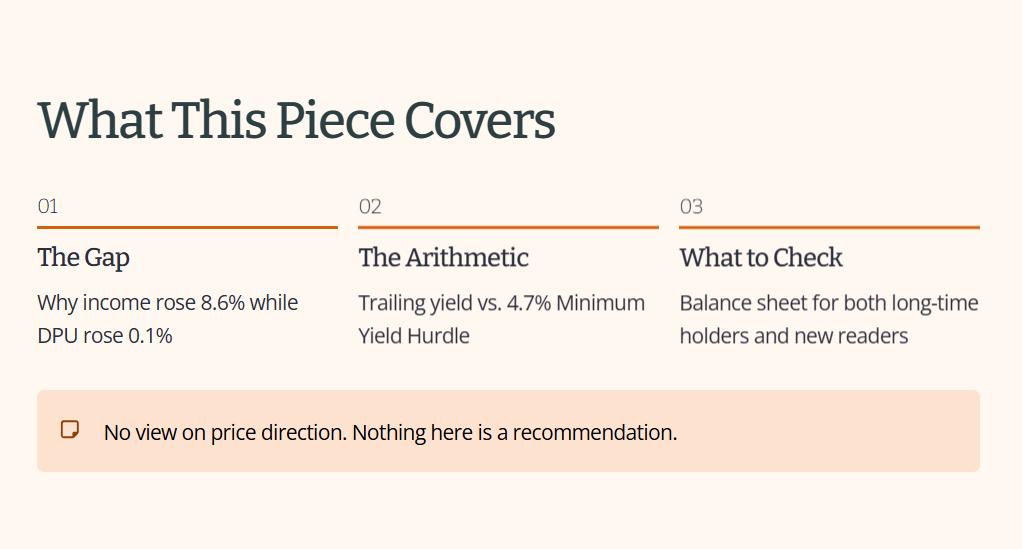
I have no view on where CapitaLand Ascendas REIT’s unit price goes next, and nothing here is a recommendation.

Income Up 8.6%, Dividend Up 0.1%
Seven Half-Years in One Table
From 15.01 Cents to a 6.79% Yield
Iggy’s Forensic Zone: Zone 4-, Caution, at the 7 October 2026 price (Growth Read: the distribution yield is not the constraint here)
Legacy Holders vs. Fresh Capital
The Balance Sheet Behind the Yield
Leverage: 39.7% against a 35% ceiling
Occupancy: 89.1% against a 95% floor
Interest cover: 3.5 times against a 4.0 times floor
Debt terms
What the Fair Value and Analyst Numbers Say
Why the Minus Is Hard to Remove
Iggy’s Elite Read
Income Up 8.6%, Dividend Up 0.1%
Here is the half year ended 30 June 2026 against the same half of 2025, from the trust’s 5 August 2026 results announcement and presentation.
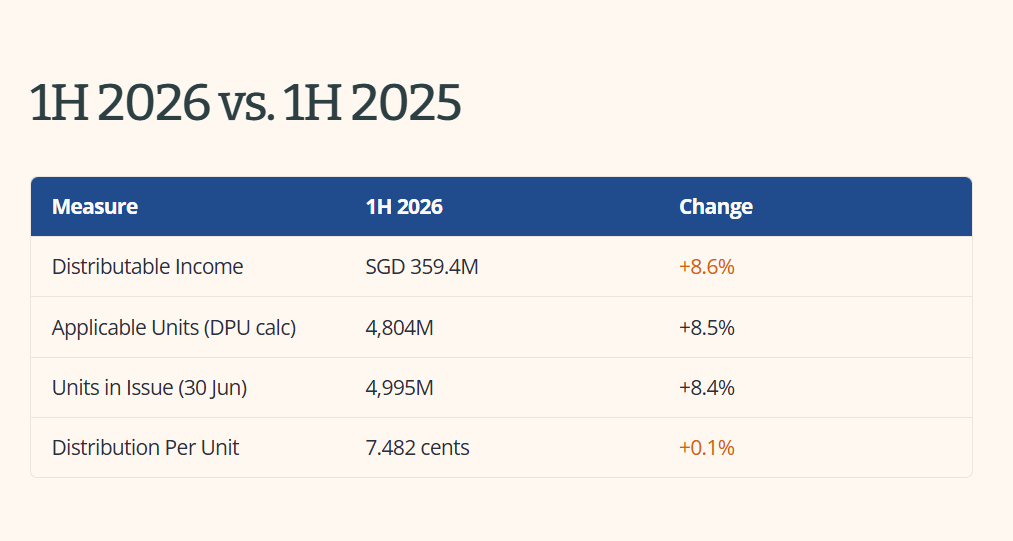
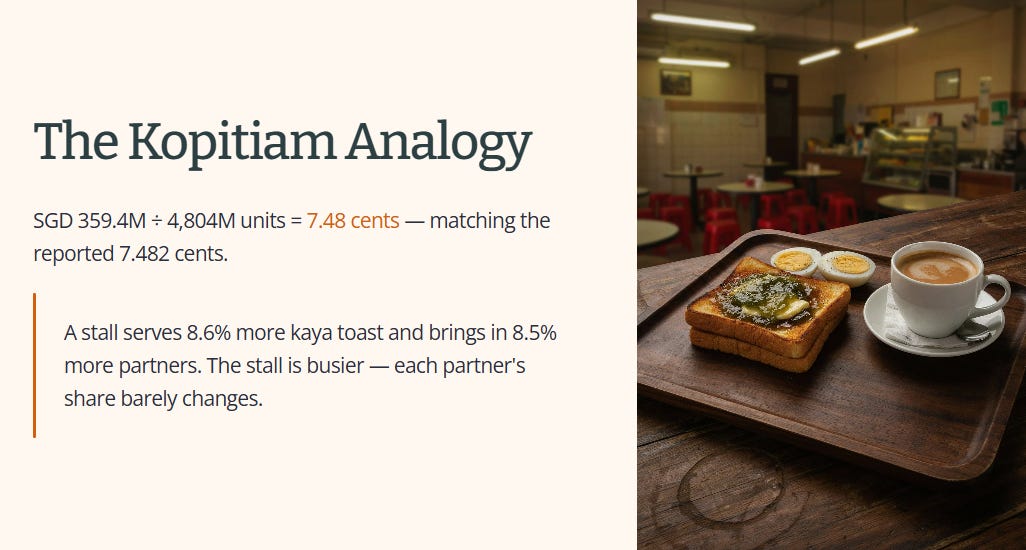
Distributable income is the amount a REIT makes available for distribution after the adjustments in its distribution calculation. Divide it by the applicable units, which is the unit count the trust uses for the half, and you get the distribution per unit, usually shortened to DPU. SGD 359.4 million divided by 4,804 million applicable units is about 7.48 cents, in line with the reported 7.482 cents.
Picture a kopitiam stall that serves 8.6% more kaya toast in a year, and in the same year brings in new partners until it has 8.5% more of them sharing the profit. The stall is busier and its takings are higher, and each partner’s share barely changes.
The presentation attributes the larger unit base mainly to equity fund raisings in 1H 2026 and 1H 2025, including a SGD 900 million equity fund raising. In the same half the trust completed four acquisitions worth about SGD 1.1 billion, at initial net property income yields of 4.3% to 7.4% before transaction costs, and announced two more worth about SGD 0.6 billion for completion in the second half of 2026.
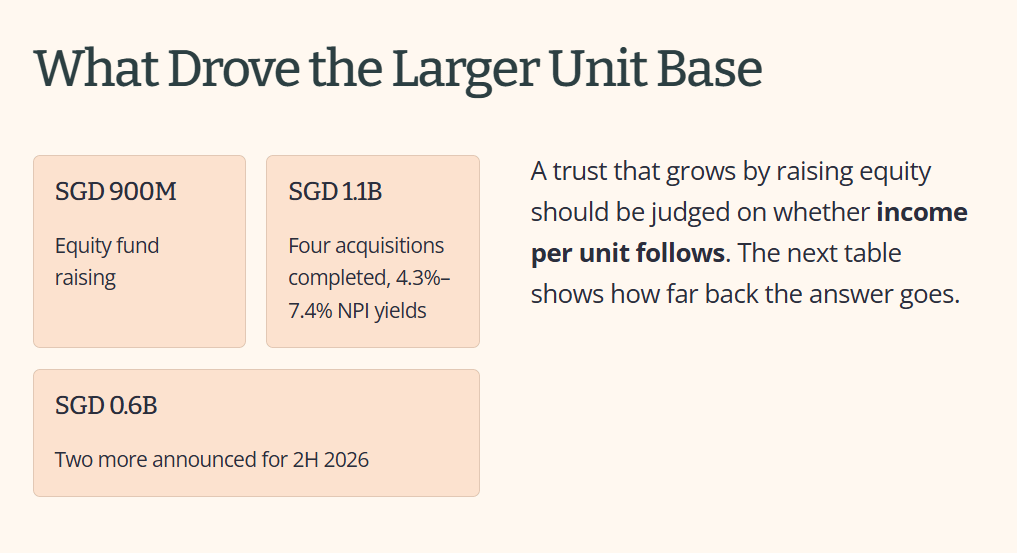
None of that is a criticism. A trust that grows by raising equity should be judged on whether income per unit follows, and the next table shows how far back the answer goes.
Seven Half-Years in One Table
In some halves, including 1H 2026, part of the distribution was paid early as an advanced distribution. To compare like with like, I added up every instalment for each half-year from the distribution history.
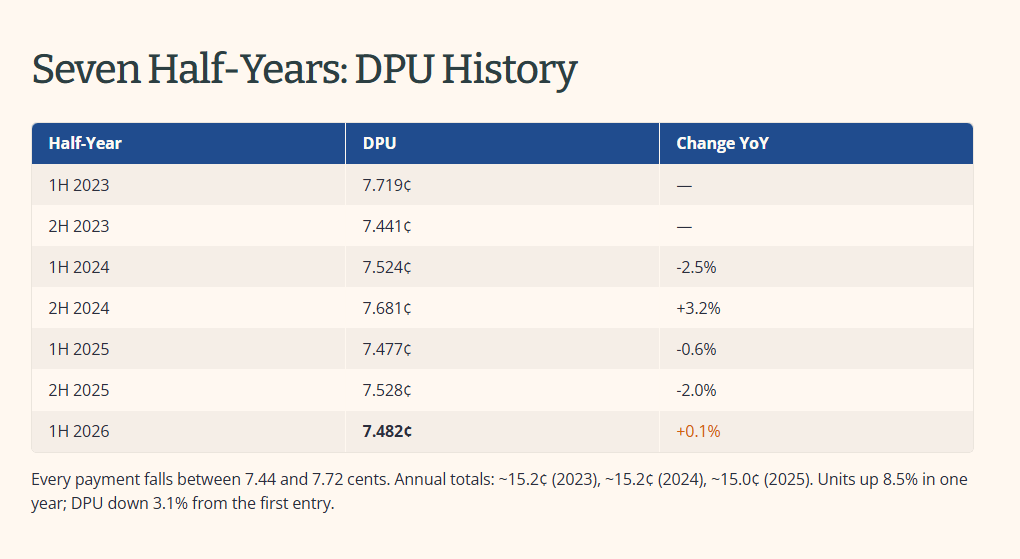
Seven half-year payments, and every one falls between 7.44 and 7.72 cents. Added up by financial year, which runs January to December, that is about 15.2 cents for 2023, about 15.2 cents for 2024 and about 15.0 cents for 2025. The latest half-year payment of 7.482 cents is 3.1% below the first one in the table, and the units sharing the distribution rose 8.5% over the last year alone.
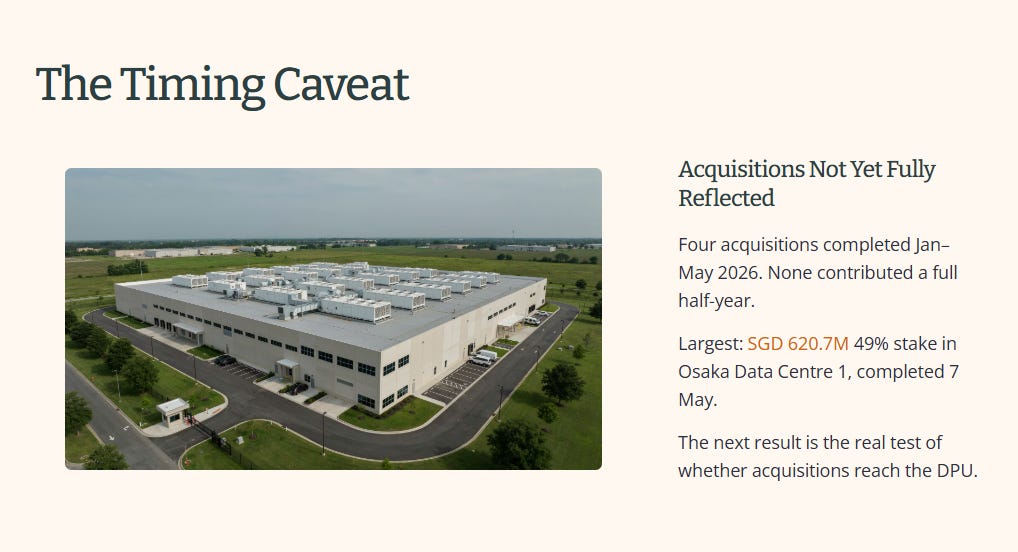
The fair objection is timing. The four acquisitions completed between 29 January and 7 May 2026, so none of them contributed a full half-year of income, and the largest, a SGD 620.7 million 49% interest in Osaka Data Centre 1, completed on 7 May. Part of their effect is therefore still to arrive. The next result will be a further test of whether the acquisitions are reaching the distribution per unit, which I come back to at the end.
The payment history is the first half of the answer. The second half is what that payment yields at the 7 October 2026 price.
A Quick Note Before the Verdict
You aren’t here for the kopi tips or the hype. You’re here because you want the forensic truth before you commit a single dollar of your capital. That says something about the kind of investor you are.

Here’s the uncomfortable truth about independent publishing: reach isn’t guaranteed by quality alone, it’s built by readers who subscribe and share. Every forensic investor who reads without subscribing is invisible to the numbers that decide whether this keeps reaching people.
If this analysis has ever helped you spot a risk or work out a margin of safety, subscribe for free and pass it to one person who’d get value from it. Not for me. So that data-driven SGX analysis keeps finding the people who actually want it, instead of getting buried under the noise.
From 15.01 Cents to a 6.79% Yield
A trailing yield divides the last 12 months of distributions by the unit price. The last three instalments were 7.528 cents paid on 13 March 2026 for the second half of 2025, 3.750 cents paid on 30 April 2026 as the advanced distribution for 1 January to 1 April 2026, and 3.732 cents paid on 8 September 2026 for the rest of the first half. That adds to 15.01 cents. At SGD 2.21, the InvestingPro quote on 7 October 2026, the trailing yield is 6.79%.
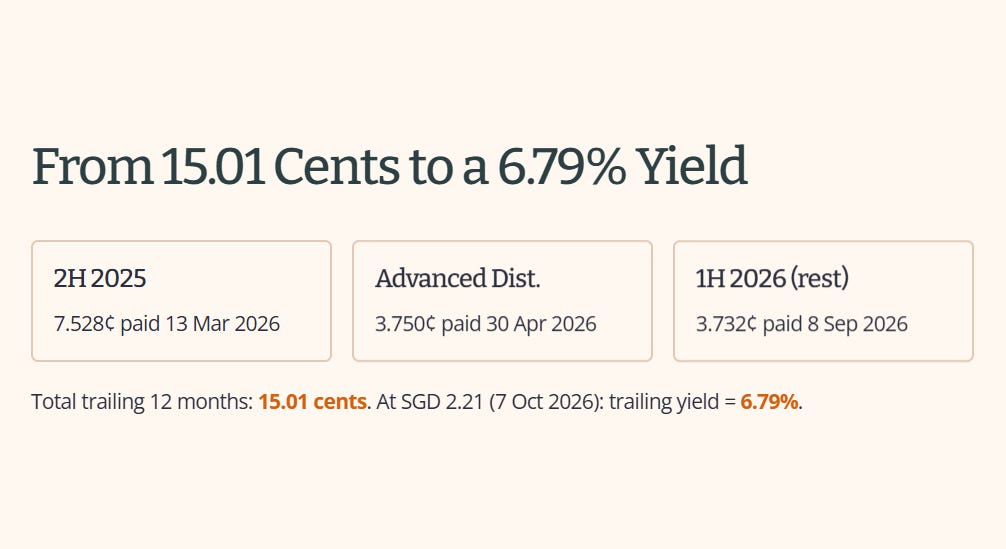
The Forensic Floor is 3.2% and the Minimum Yield Hurdle is 4.7%. At 6.79% CapitaLand Ascendas REIT clears both, and sits about 209 basis points above the Hurdle. In money terms, SGD 10,000 placed in the units at SGD 2.21 gets about 4,525 units and would have received about SGD 679 based on the last 12 months of distributions. At 4.7% the same SGD 10,000 would receive SGD 470, so on those distributions the units clear the Hurdle by about SGD 209.
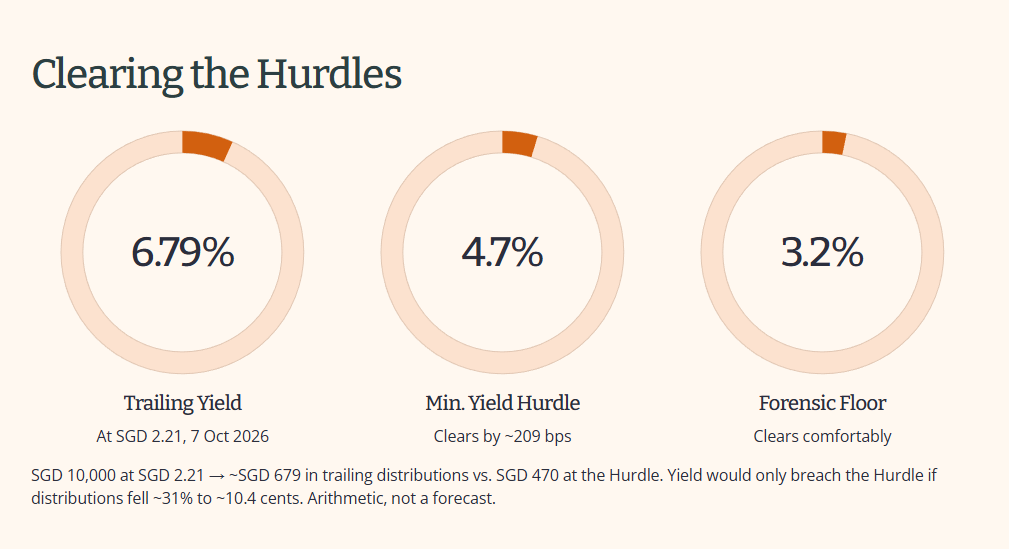
Annualising the first-half payment, as the trust’s 5 August 2026 announcement does, gives 14.96 cents and a yield of 6.77% at SGD 2.21. I use the trailing figure because it is built only from payments already made. There is also plenty of room on this test. At the 7 October 2026 price of SGD 2.21, the yield would reach the Hurdle only if trailing distributions fell to about 10.4 cents, which is about 31% below 15.01 cents. That is arithmetic, not a forecast.
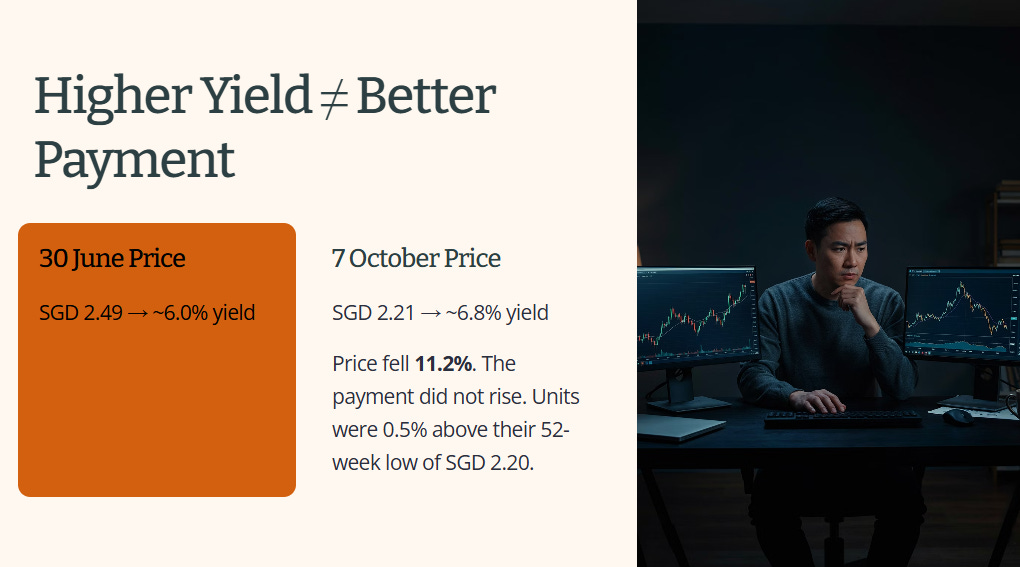
Now the part that matters for anyone comparing this yield with an earlier figure. On 30 June the price was SGD 2.49, and the trust’s own annualised yield was about 6.0%. At SGD 2.21 on 7 October 2026 it is about 6.8%. The payment did not rise to produce that. The price fell 11.2%, and a yield rises when the price falls, even if the payment stays exactly where it was. A higher yield on a screen can mean a better payment or a lower price, and here it is the lower price. InvestingPro showed the units 0.5% above their 52-week low of SGD 2.20 on 7 October 2026, in a range that runs up to SGD 2.92.
Iggy’s Forensic Zone: Zone 4-, Caution, at the 7 October 2026 price (Growth Read: the distribution yield is not the constraint here).
A word on the minus. It means that more than one test is failing, or that one test is failing by a wide margin. Which tests, and by how much, is below the line. The yield is not one of them.
💡 Insight Callout
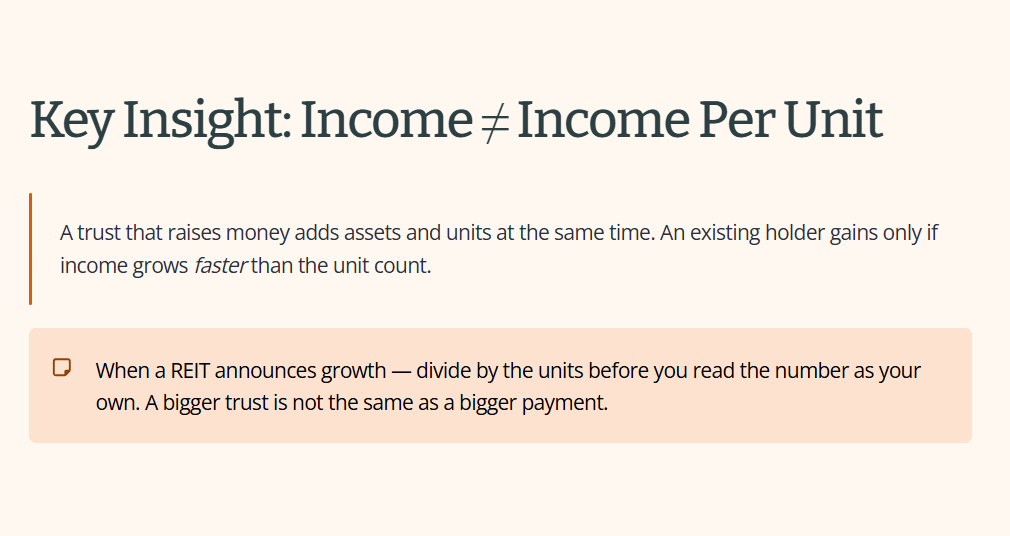
Income and income per unit are not the same number. CapitaLand Ascendas REIT’s distributable income rose 8.6% and the units sharing its distribution rose 8.5%, so the dividend each unit received rose 0.1%. A trust that raises money from investors adds assets and adds units at the same time, and an existing holder gains only if income grows faster than the unit count. When a REIT announces growth, divide by the units before you read the number as your own. A bigger trust is not the same thing as a bigger payment, and the division is where the difference shows.
Legacy Holders vs. Fresh Capital
Suppose a holder’s cost was SGD 2.80 a unit, a round figure for illustration. On the last 12 months’ 15.01 cents, the yield on cost is 5.36%, against 6.79% for a reader paying the 7 October 2026 price of SGD 2.21. The payment per unit is identical. What differs is the price paid.
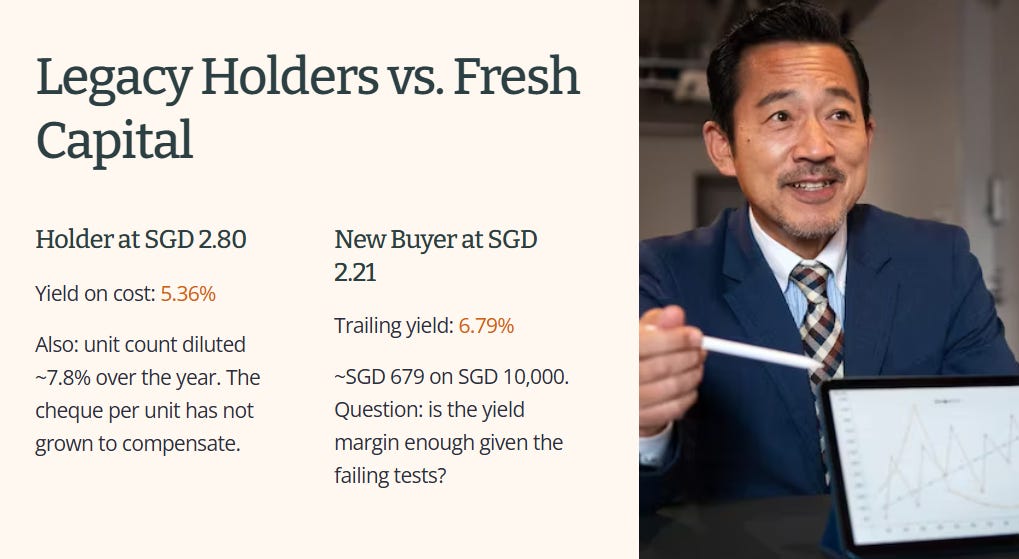
A holder carries a second number that the yield does not show. At 30 June 2025 the trust had 4,606 million units in issue, and at 30 June 2026 it had 4,995 million. A holder who did not add to their position owns a percentage of the trust that is about 7.8% lower than a year earlier, and the cheque per unit has not grown to make up for it.
A reader committing new money sees a different question. At the 7 October 2026 price of SGD 2.21 the same 15.01 cents yields 6.79%, about SGD 679 on SGD 10,000 based on the last 12 months, and the question is whether that yield margin is enough given the tests the trust does not pass, which I set out below the line. That is a judgment each reader has to make for themselves.
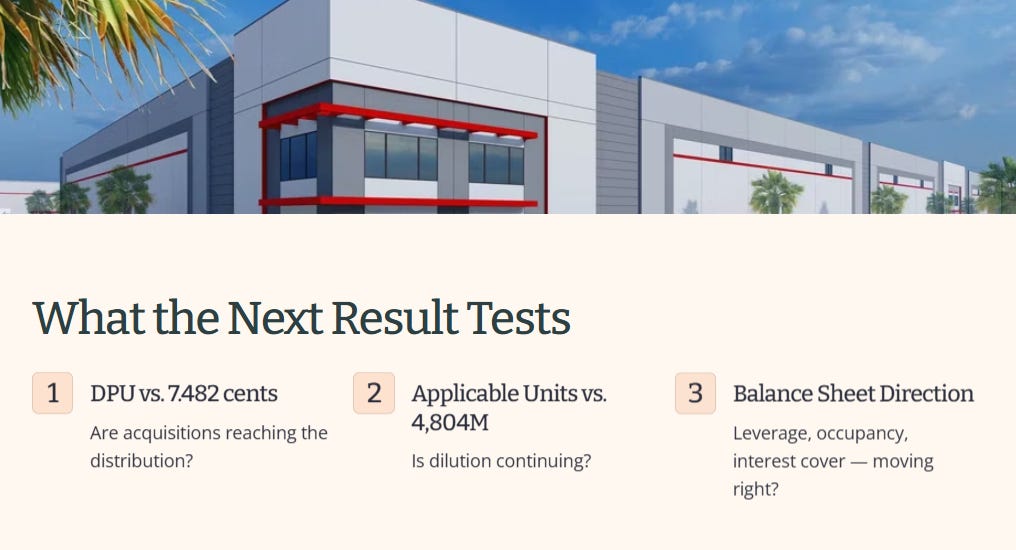
The next result puts three numbers on the table for both readers: the distribution per unit against 7.482 cents, the applicable units against 4,804 million, and one balance sheet figure that I set out below the line. The holder reads them as a test of whether the raise is reaching the cheque. The new reader reads them as a test of whether the balance sheet is moving in the right direction.
💡 Insight Callout
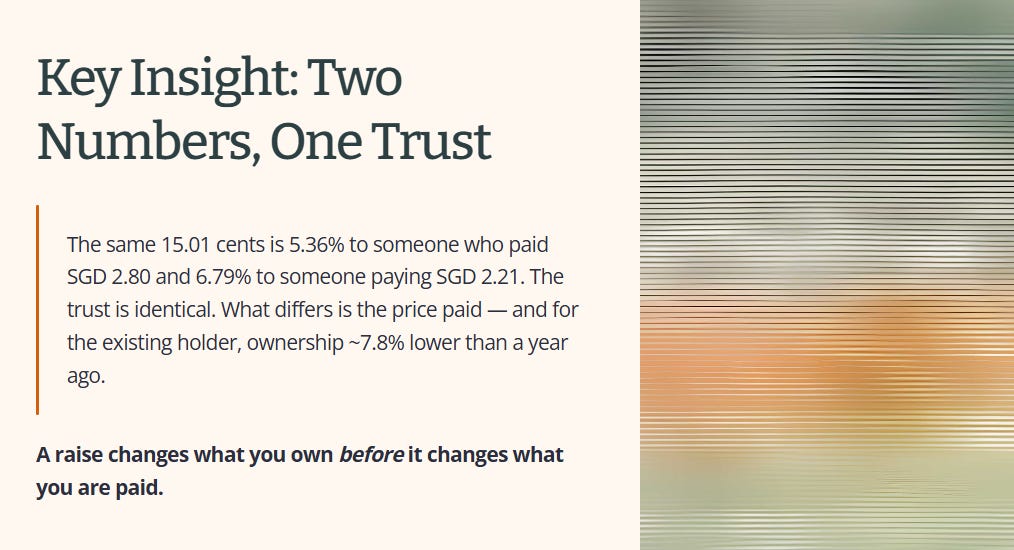
The same 15.01 cents is a 5.36% yield to someone who paid SGD 2.80 and 6.79% to someone paying SGD 2.21. The trust is identical in both cases. What differs is the price paid, and for the existing holder, a second number the yield does not show: a percentage ownership of the trust about 7.8% lower than a year ago. A raise changes what you own before it changes what you are paid. The yield tells you what the cheque is worth at the price you pay, and the unit count tells you whether your share of the next one is shrinking.
🔒 What’s Next
The yield clears my Hurdle by about 209 basis points and the verdict still carries a minus, so the next section sets out the balance sheet figures behind it.
