


Hey there, Singapore investors! Iggy the Investing Iguana here with your daily dose of SGX market action. Today’s digest brings some exciting moves across the board—from Keppel REIT’s bold retail expansion into Sydney to OUE REIT’s impressive green financing success, plus a currency twist that’s got the Singapore dollar showing serious muscle against the yen.
Before we dive in, a quick reminder of what Iggy brings to the table: I’m ranking among Singapore’s most-watched finance creators, breaking down complex market moves into simple, actionable insights. My focus? Helping retail investors like you navigate Singapore stocks and REITs with confidence, backed by global economic context and real-world portfolio strategy.
Market Overview
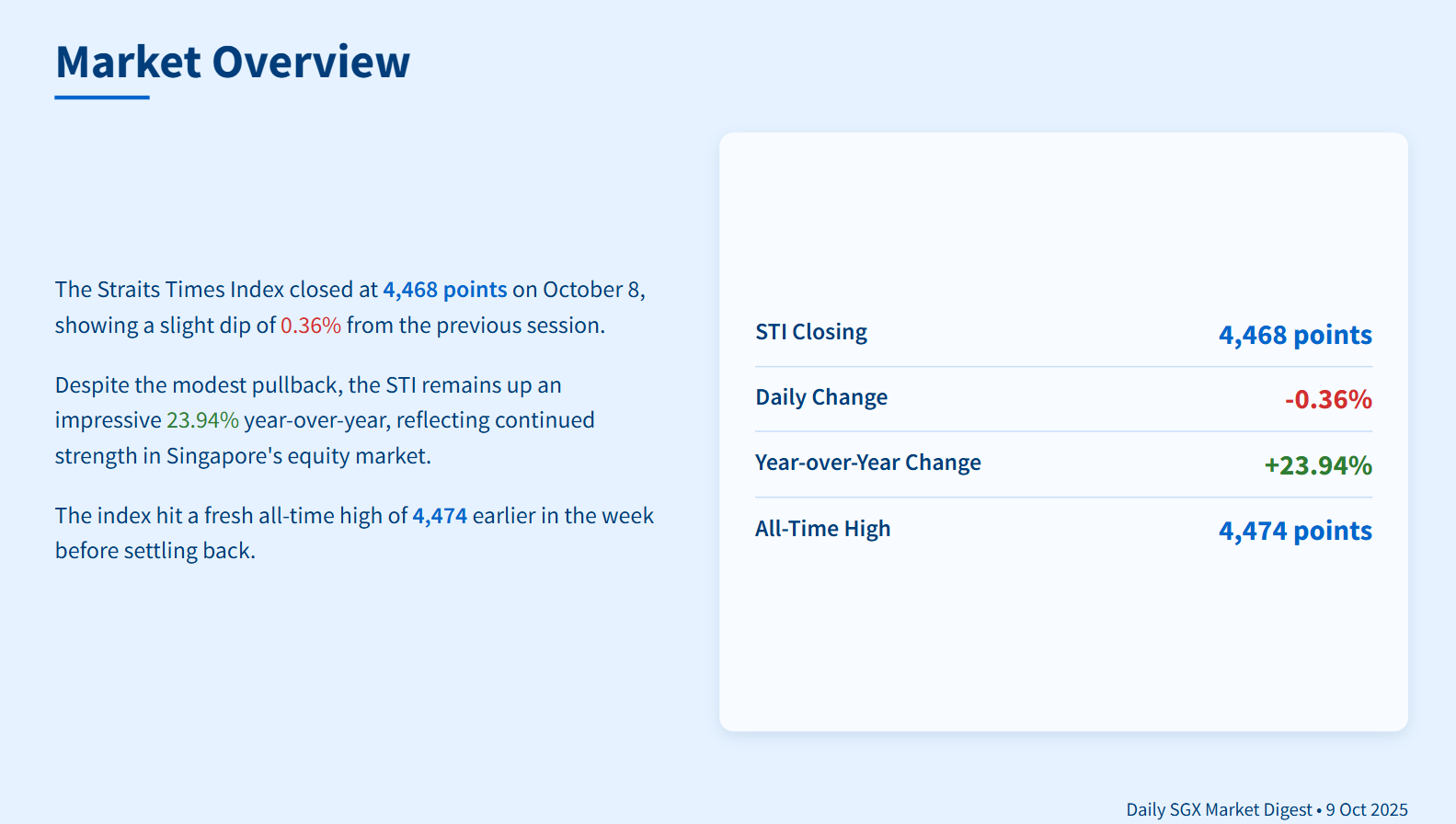
The Straits Times Index closed at 4,468 points on October 8, showing a slight dip of 0.36% from the previous session. Regional markets turned cautious as investors digested profit-taking and awaited key US economic data. Despite the modest pullback, the STI remains up an impressive 23.94% year-over-year, reflecting continued strength in Singapore’s equity market. The index hit a fresh all-time high of 4,474 earlier in the week before settling back.
Keppel REIT: Retail Expansion Down Under
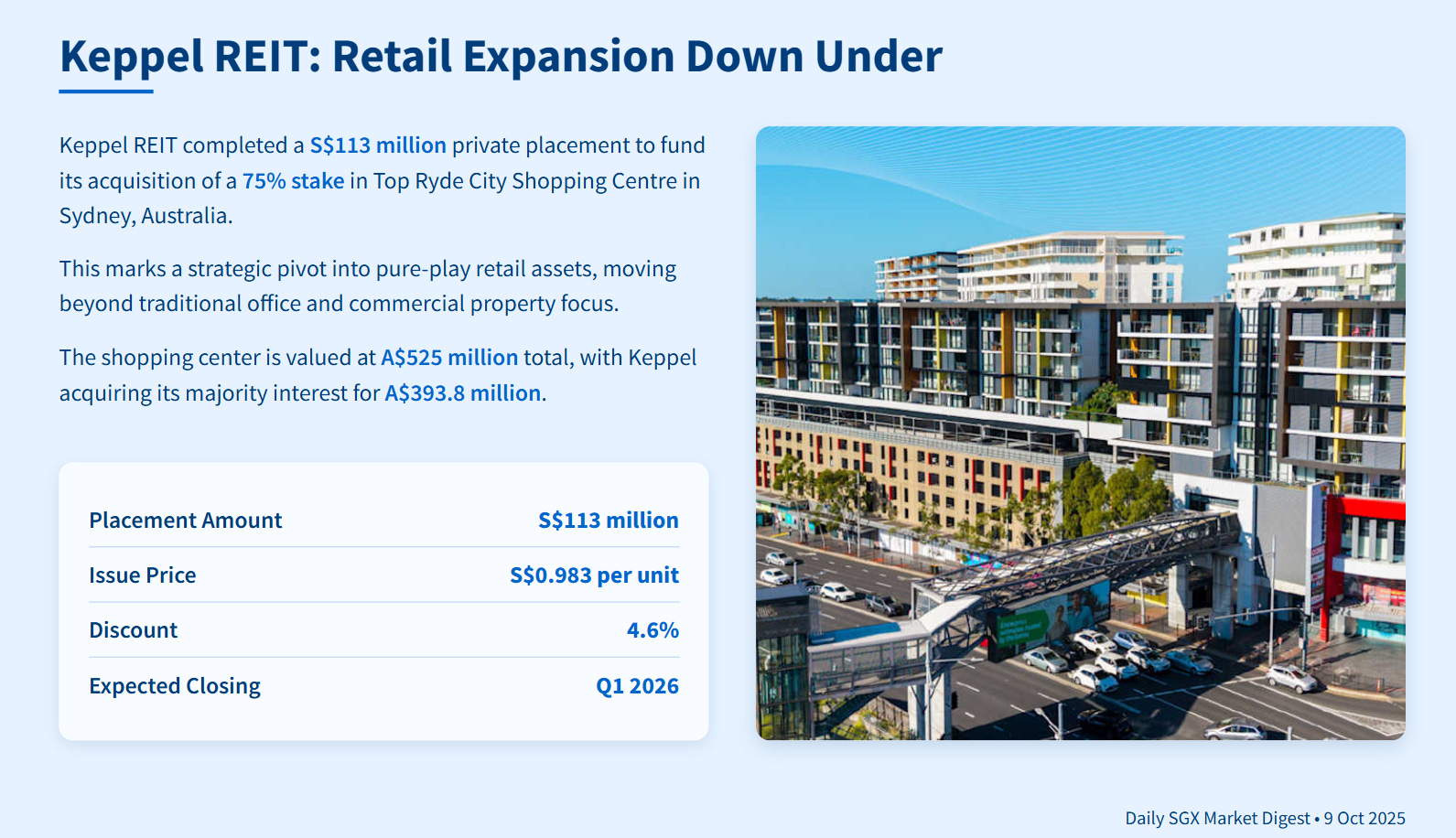
Keppel REIT wrapped up a significant S$113 million private placement on October 8 to fund its acquisition of a 75% stake in Top Ryde City Shopping Centre in Sydney, Australia. The issue price landed at S$0.983 per unit, representing a 4.6% discount to the volume-weighted average price. This marks Keppel REIT’s strategic pivot into pure-play retail assets, moving beyond its traditional office and commercial property focus. The shopping center, located in Sydney’s Ryde suburb, is valued at A$525 million total, with Keppel acquiring its majority interest for A$393.8 million. The deal is expected to close by Q1 2026. Trading in the new units begins October 17, while the counter resumed trading on October 9 after a brief halt.
Iggy’s Take: This is a bold diversification play that addresses a critical gap in Keppel REIT’s portfolio. Suburban Australian retail has shown resilience, particularly properties anchored by non-discretionary retailers like supermarkets and discount chains. Top Ryde City fits this defensive profile perfectly—it’s not a luxury mall vulnerable to online shopping disruption. The 4.6% placement discount is reasonable for institutional raises, though existing unitholders will see short-term dilution. Watch the distribution per unit (DPU) impact closely. If management delivers on their DPU-accretive promise, this could boost yield appeal. The Australian retail market offers higher yields than Singapore commercial property right now, which makes geographic diversification attractive. For current holders, this adds portfolio resilience. For new investors, wait to see how the units trade post-listing before jumping in—the discount might create temporary pressure.
OUE REIT: Green Financing Triumph
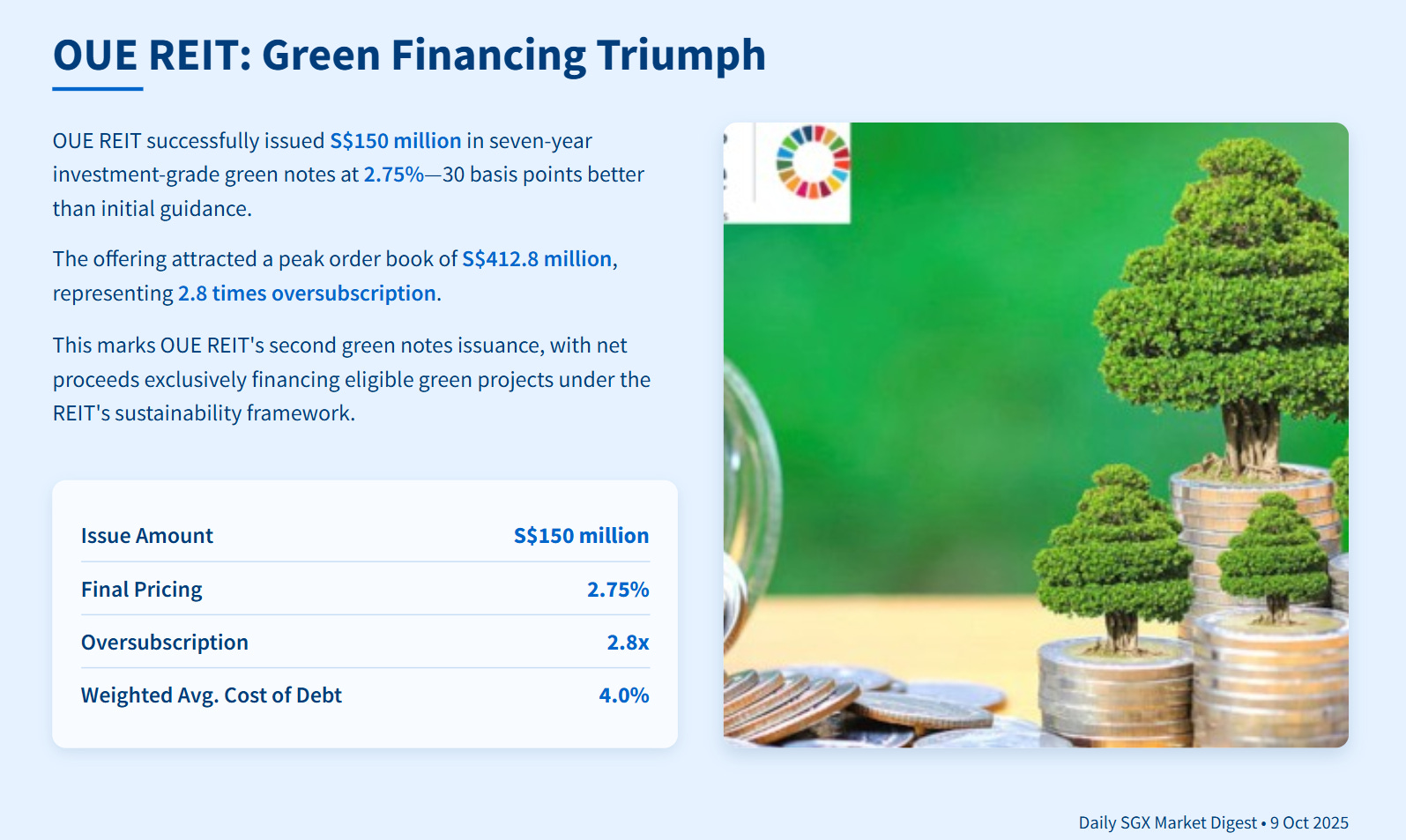
OUE REIT’s subsidiary OUE REIT Treasury successfully issued S$150 million in seven-year investment-grade green notes on October 8, with strong investor appetite pushing the final pricing to 2.75%—a full 30 basis points better than initial guidance of 3.05%. The offering attracted a peak order book of S$412.8 million, representing 2.8 times oversubscription. Institutional investors snapped up 80% of the allocation. This marks OUE REIT’s second green notes issuance, following a similar deal in September 2024. The new notes achieved a remarkable 115 basis points compression compared to last year’s seven-year offering. Net proceeds will exclusively finance eligible green projects under the REIT’s sustainability framework. The notes carry a BBB- rating from S&P Global Ratings and will list on SGX on October 9. On a pro forma basis, OUE REIT’s weighted average cost of debt drops to 4.0% from 4.2%, while average debt maturity extends to 3.6 years from 2.7 years.
Iggy’s Take: This is textbook smart capital management. OUE REIT not only locked in lower financing costs but also extended debt maturity at a time when interest rate uncertainty remains high. The 30 basis points pricing improvement shows genuine market confidence in the REIT’s credit quality and green credentials. Here’s why this matters for unitholders: lower borrowing costs translate directly to better distribution potential. The extension of debt maturity to 3.6 years also reduces near-term refinancing risk—only 16.2% of debt now comes due in 2026. That’s breathing room. The 2.8 times oversubscription tells me institutional money still sees value in Singapore commercial REITs, despite office sector headwinds. For investors weighing OUE REIT, this strengthens the balance sheet story. It’s not flashy, but solid capital structure work like this protects distributions during tough times. If you’re yield-focused and want defensive office exposure with improving financial metrics, OUE REIT deserves a closer look.
Singapore Dollar Surges Against Yen
The Singapore dollar strengthened to 117.78 against the Japanese yen on October 8, marking its strongest level in over a year. The yen has weakened dramatically since early October, falling from around 114 to the current level in just over a week. This represents significant depreciation for the Japanese currency, which had briefly strengthened to around 108 levels in mid-2024. The move comes amid Japan’s political transition, with the Liberal Democratic Party selecting new leadership on October 4. Currency markets are reacting to policy uncertainty as Japan’s incoming prime minister faces coalition tensions and economic challenges including stagnant wages and US trade pressures.
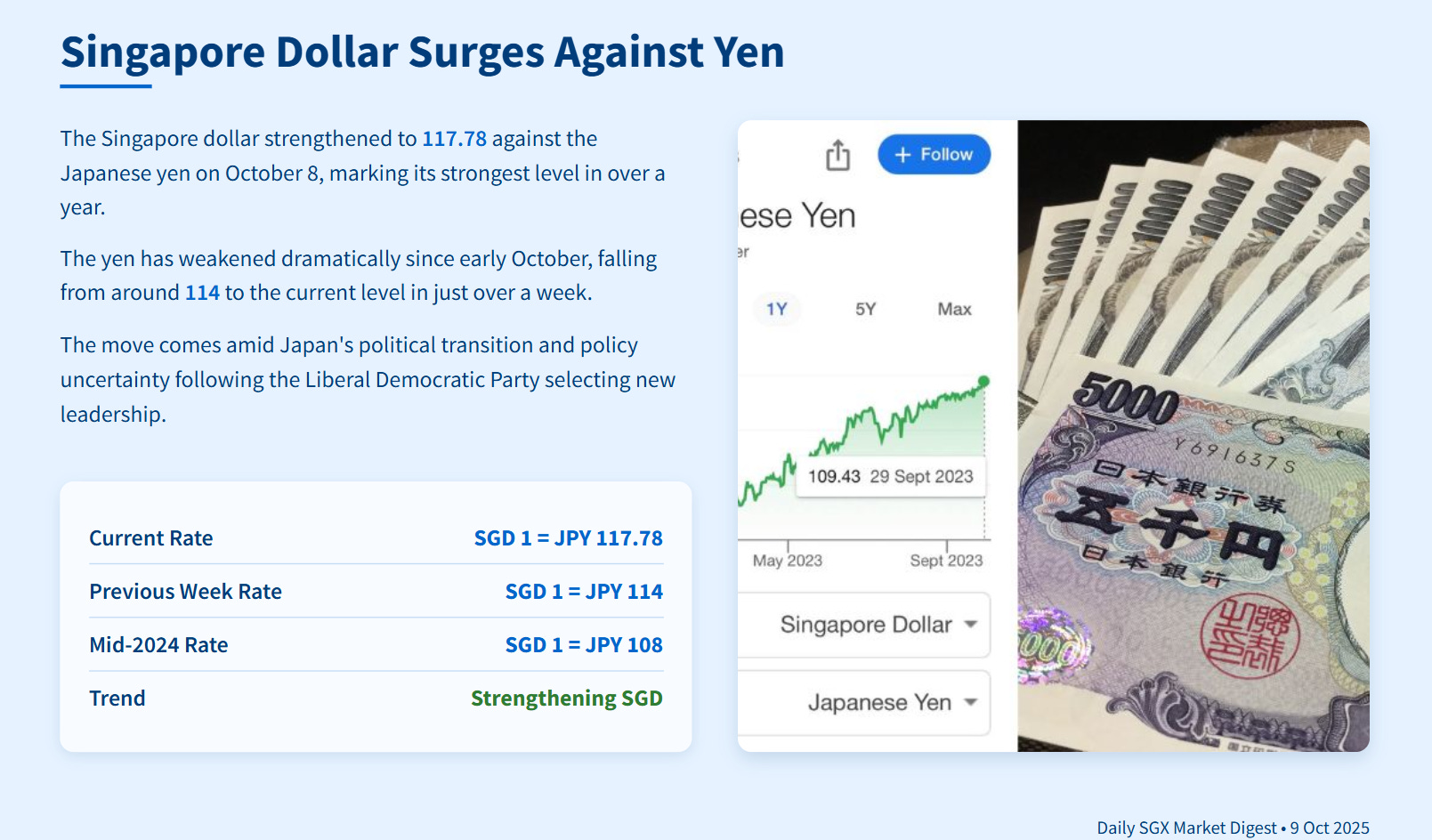
Iggy’s Take: Currency moves like this create both opportunities and risks for Singapore investors. If you hold Japanese stocks or Japan-focused funds in yen terms, you’re taking a hit on currency conversion when bringing returns back to Singapore dollars. The yen’s weakness reflects deeper concerns about Japan’s political instability—the country just elected its fifth leader in five years. That’s not confidence-inspiring for currency strength. For Singapore investors, this strengthens the case for regional diversification beyond Japan right now. However, savvy traders might see opportunity: a weak yen makes Japanese exports more competitive and could boost earnings for export-heavy Japanese companies. If you’re bullish on Japan’s economic recovery long-term, the current exchange rate offers a more attractive entry point—just be prepared for continued volatility. For most retail investors focused on Singapore markets, this currency move is a reminder to always consider forex risk when investing overseas. Keep most of your core holdings in SGD-denominated assets like Singapore REITs and local equities.
Iggy’s Daily Market Take
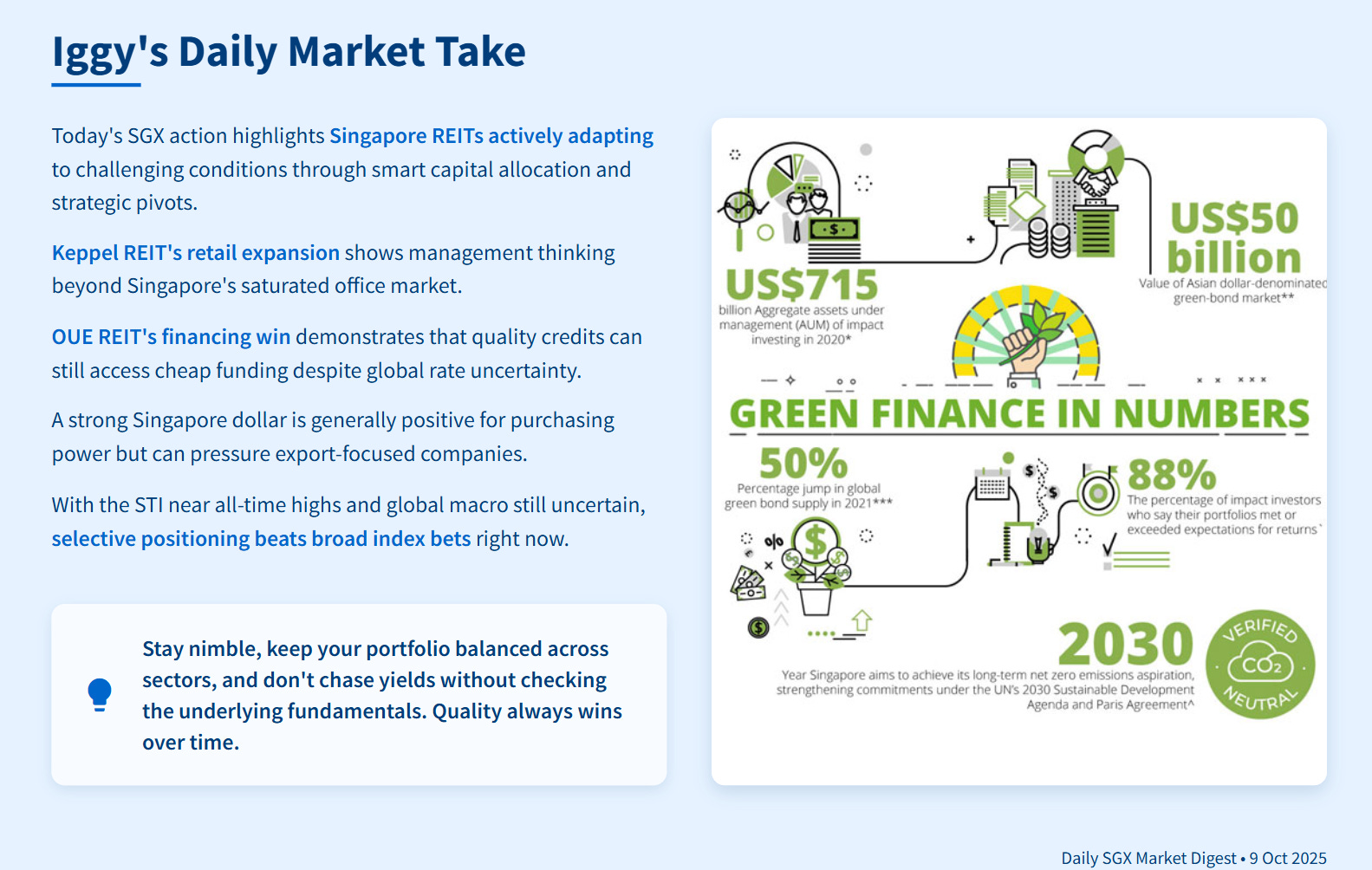
Today’s SGX action highlights a theme I’ve been tracking: Singapore REITs are actively adapting to challenging conditions through smart capital allocation and strategic pivots. Keppel REIT’s retail expansion shows management thinking beyond Singapore’s saturated office market. OUE REIT’s financing win demonstrates that quality credits can still access cheap funding despite global rate uncertainty.
The currency angle adds another layer. A strong Singapore dollar is generally positive for our purchasing power and imported goods costs, but it can pressure export-focused companies. For REIT investors, it’s largely neutral—most lease income is in SGD anyway.
Looking ahead, watch how these placement units trade and whether DPU forecasts hold up. The market remains in “show me” mode—investors want proof that acquisitions and refinancings translate to better distributions. With the STI near all-time highs and global macro still uncertain, selective positioning beats broad index bets right now.
Stay nimble, keep your portfolio balanced across sectors, and don’t chase yields without checking the underlying fundamentals. Quality always wins over time.

Disclaimer: This analysis is provided for educational and informational purposes only and should not be construed as personalized financial advice or investment recommendations. The content presented represents general market observations and strategic frameworks that may not be suitable for all investors’ individual circumstances, risk tolerance, or investment objectives. All investment decisions carry inherent risks, including the potential for significant financial losses, and past performance does not guarantee future results. Iggy the Investing Iguana, The Investing Iguana channel, and associated content creators do not accept any responsibility or liability for any financial losses, damages, or adverse outcomes that may result from the use of this information or any investment decisions made based on the content provided. Readers are strongly advised to conduct their own due diligence, consult with qualified financial advisors, and carefully consider their personal financial situation before making any investment decisions. The Singapore stock market, like all financial markets, involves substantial risk and volatility that could result in the loss of your invested capital.