Economists Expected a Third Tightening. MAS Held the Slope. What Changes for Your T-Bills, SSBs and S-REITs
The decision was about the Singapore dollar, not about interest rates. What T-bill, SSB and S-REIT holders can reasonably take from it.
All ten economists in a published Reuters poll expected MAS to tighten again on 14 October, and it did not. The easy lesson is that policy has softened, and the statement does not say that. The harder lesson is about what MAS controls and what it never did.
Two kinds of reader will open this. One keeps cash in T-bills and Singapore Savings Bonds, the other holds S-REIT units for the payout, and many of us are both. I read the full statement before writing anything, because headlines about a “hold” flatten what it actually says. Here is what I found, and where I stopped being able to find anything.
What This Piece Does
It explains what MAS decided in plain words: what the slope is, what stayed the same, and what “unchanged” does not mean.
It sets out what the decision leaves open for T-bill and SSB holders, with the latest auction and issue figures and their dates.
It separates what the statement says about S-REITs from what people assume it says, through borrowing costs and the currency.
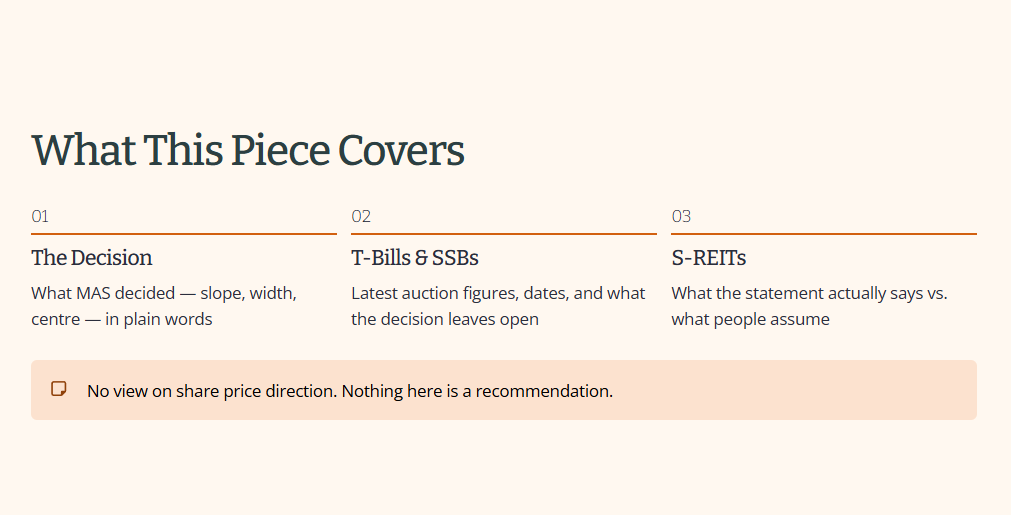
I take no view on share price direction, and nothing here is a recommendation.
This Angela-based article is free to read on Substack and Longbridge, published in conjunction with my feature in Longbridge Bridgers’ Stories EP02.

What This Piece Does
What MAS Decided on 14 October
The statement in plain words
Why so many expected more
The Growth and Inflation Numbers
Growth: strong, but slightly slower than the quarter before
Inflation: slightly elevated, then easing
🟠 Angela’s Observation
What It Means for T-Bill and SSB Holders
MAS does not set the T-bill yield
The November SSB, with dates
No One Pays Him To Be Right
What It Means for S-REIT Holders
Two channels, and only one is in the statement
🟠 Angela’s Observation
What I Am Watching Next, Without Predicting
What MAS Decided on 14 October
The statement in plain words
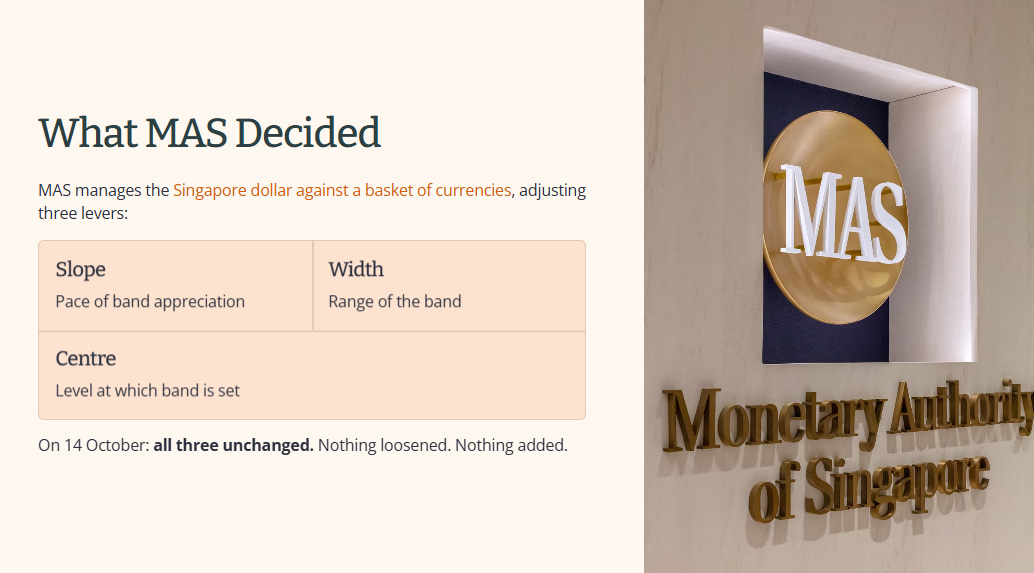
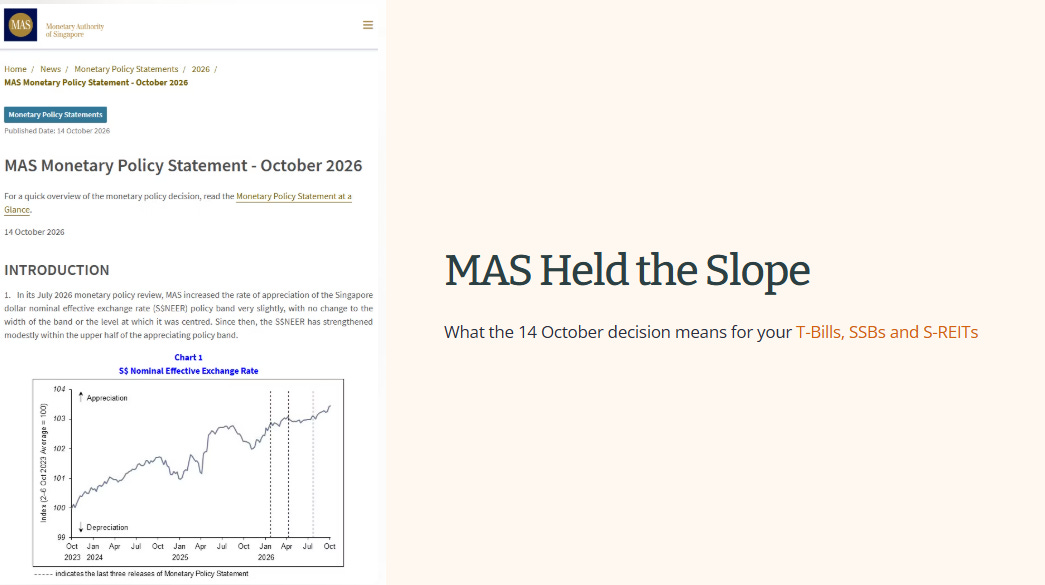
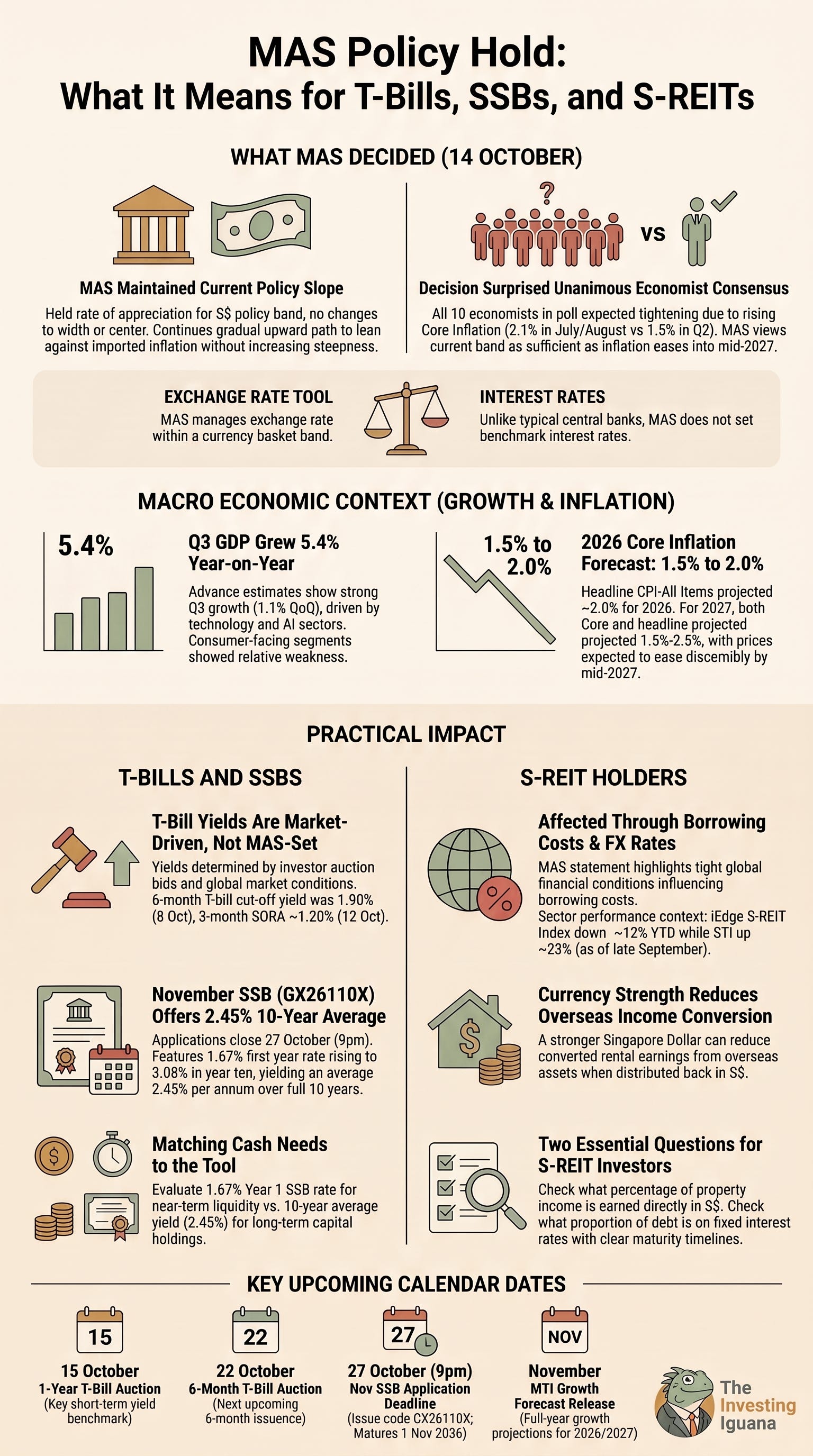
MAS does not set an interest rate the way many central banks do. It manages the Singapore dollar against a basket of its trading partners’ currencies, inside a band, and it can adjust three things: the slope, which is the pace at which the band is allowed to rise; the width of the band; and the level at which the band is centred. On 14 October MAS said it would “maintain the rate of appreciation of the policy band,” with no change to the width or the centre. In plain words, nothing was loosened and nothing was added.
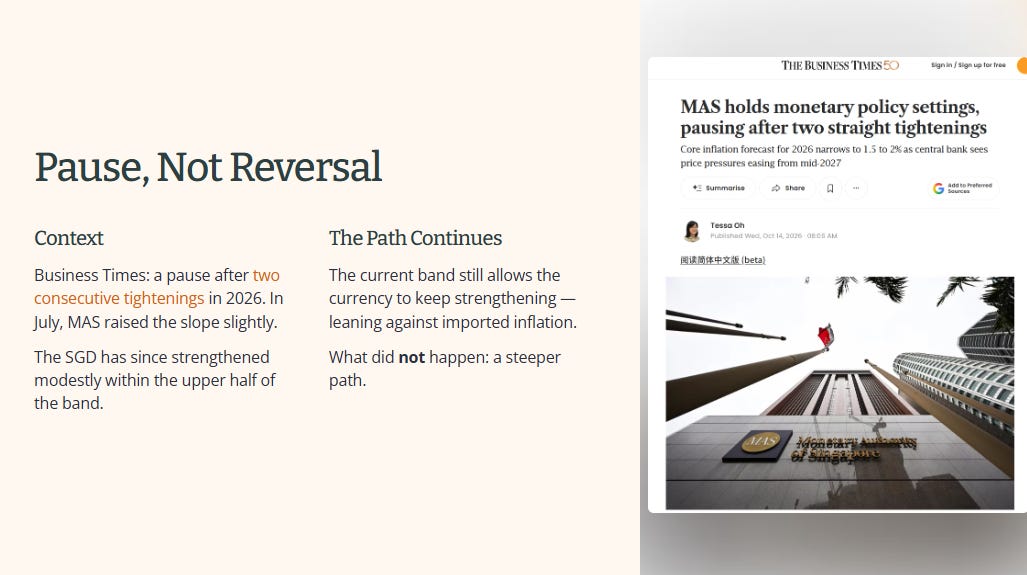
Business Times described this as a pause after two consecutive tightenings this year. In July, MAS had raised the slope very slightly, and the statement notes that the Singapore dollar has since strengthened modestly within the upper half of the band. It also says the current band will let the currency keep strengthening, to lean against imported inflation. So the upward path continues. What did not happen is a steeper path.
That raises a fair question. If the path is the same as before, why did so many forecasters expect a steeper one?
Why so many expected more
CNA reported that all 10 economists in a Reuters poll, published on 9 October, expected tightening. That is a small sample, so I read it as a sign of the mood and not as a precise measure of it.
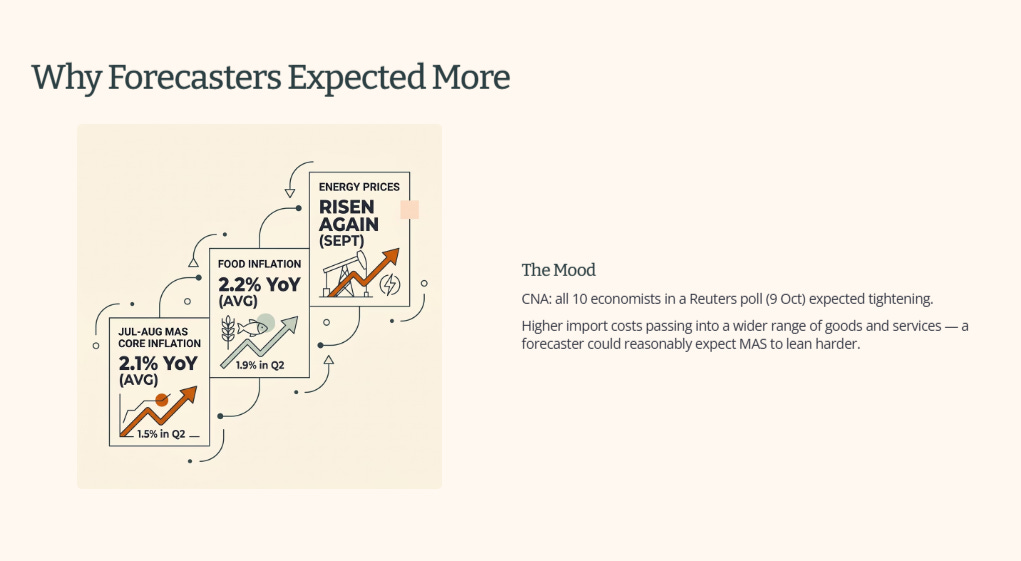
The reason is in the inflation numbers. MAS Core Inflation, which leaves out accommodation and private transport, averaged 2.1% year on year in July and August, up from 1.5% in the second quarter. Higher import costs were passing into a wider range of goods and services, and food inflation averaged 2.2% over the same two months, up from 1.9%. The statement adds that energy prices have risen again since September and are expected to stay high in the near term. A forecaster looking at that sequence could reasonably expect MAS to lean harder.
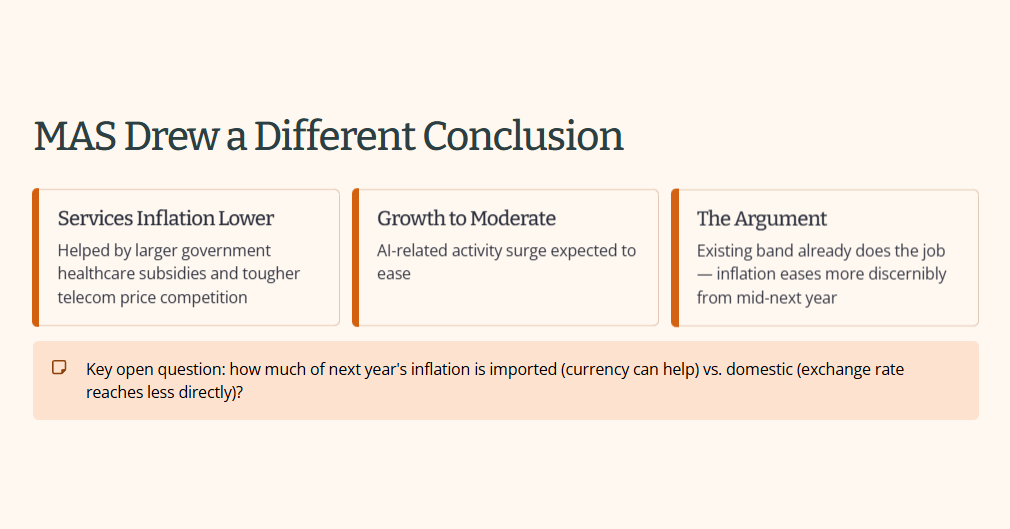
MAS looked at the same data and drew a different conclusion. It expects inflation to stay slightly elevated in the coming quarters and then ease more discernibly from the middle of next year. It points out that services inflation came in lower than projected, helped by larger government healthcare subsidies and tougher price competition among telecom providers. It also expects growth to moderate as the current surge in AI-related activity eases. Its argument, in short, is that the existing band already does the job.
I am not saying MAS is right. I am describing the argument the statement makes. The question I keep coming back to is how much of next year’s inflation is imported, which a stronger currency can lean against, and how much is domestic, which the exchange rate reaches much less directly.
The Growth and Inflation Numbers
Growth: strong, but slightly slower than the quarter before
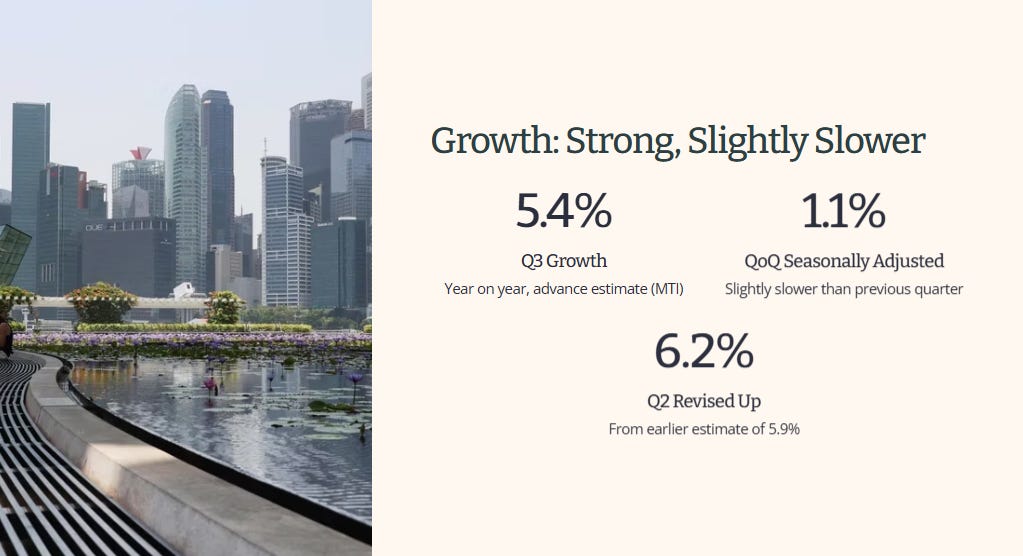
The advance estimate from the Ministry of Energy, Trade & Industry, as reported in the MAS statement, puts third-quarter growth at 5.4% year on year. On a quarter-on-quarter basis, adjusted for seasons, growth was 1.1%, which the statement calls a slightly slower pace than the previous quarter. Business Times reports that the second quarter was revised up to 6.2% from 5.9%, so if you saw 5.9% earlier this month, that was the earlier estimate.
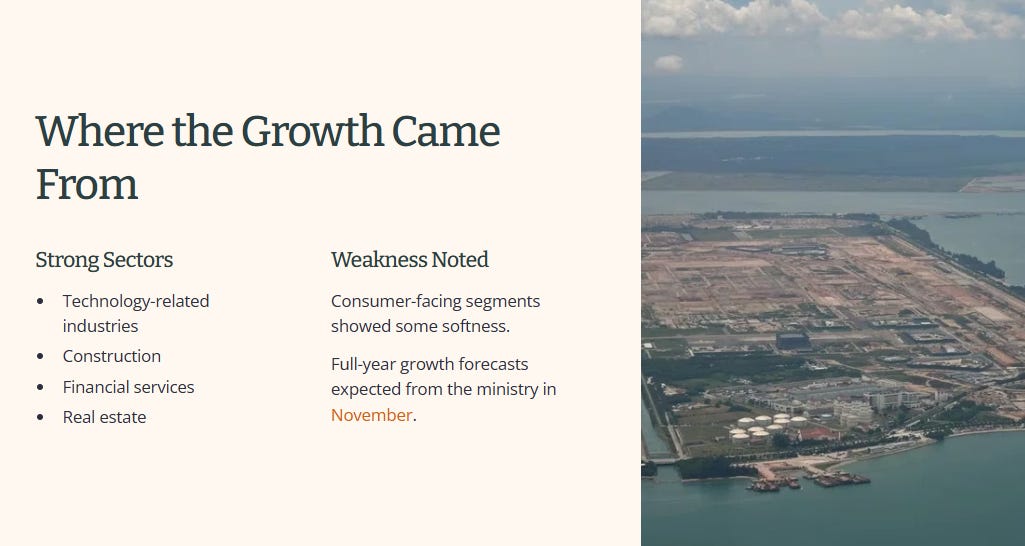
The strength came mainly from technology-related sectors. The statement says construction, financial services and real estate were firm, and it also notes some weakness in consumer-facing segments. The ministry is expected to announce its full-year growth forecasts in November, so I will not quote a full-year figure here.
Inflation: slightly elevated, then easing
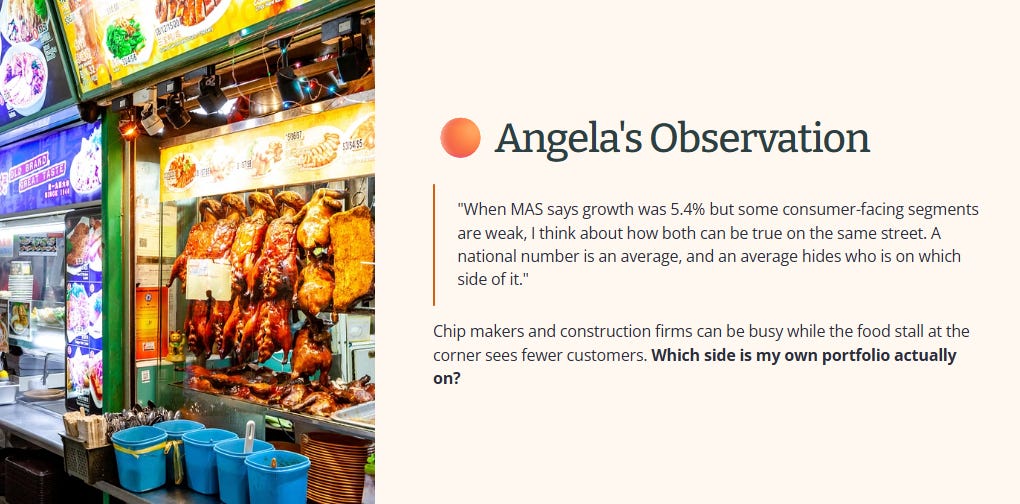
For 2026 as a whole, MAS forecasts MAS Core Inflation to average 1.5% to 2.0%, and headline inflation, which it calls CPI-All Items, at around 2.0%. For 2027 it projects both measures at 1.5% to 2.5%. It also says the risks to inflation remain tilted to the upside, for example if energy or food prices surge by more than expected. On the other side, it says a higher-than-expected rise in interest rates, or a sharper pullback in AI-related investment, could drag on growth and therefore on inflation.
🟠 Angela’s Observation
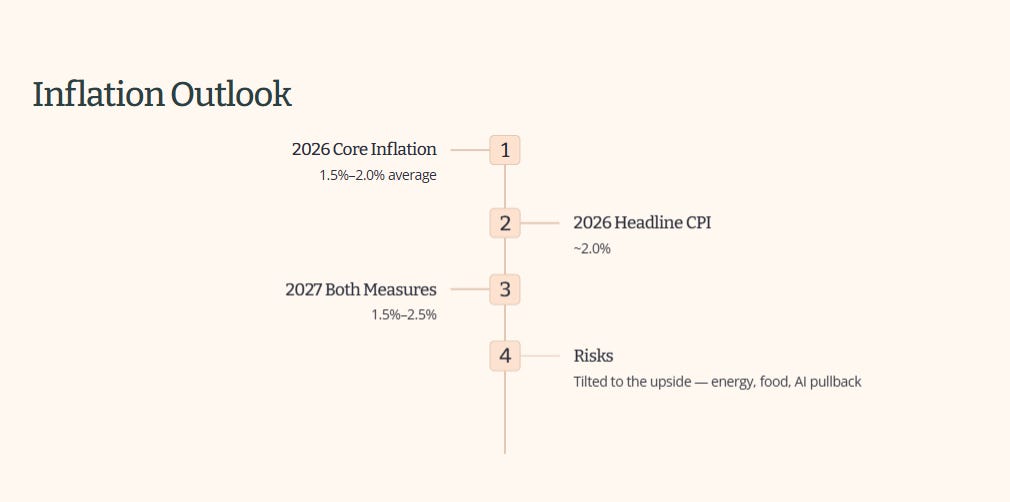
When MAS says growth was 5.4% but some consumer-facing segments are weak, I think about how both can be true on the same street. The chip makers and construction firms can be busy while the food stall at the corner sees fewer customers. A national number is an average, and an average hides who is on which side of it. I am glad the statement names the weakness instead of leaving it out. What I do not know is how much of the strength reaches ordinary households. If the growth is in chips and building sites and the softness is at the neighbourhood food court, which side is my own portfolio actually on?
What It Means for T-Bill and SSB Holders
MAS does not set the T-bill yield
A T-bill’s yield is set at auction, by the bids investors submit, and not by MAS. Think of the MAS statement as the weather forecast and the auction as the price of vegetables that morning: the two are related, but the price is set by who turns up and what they bid.
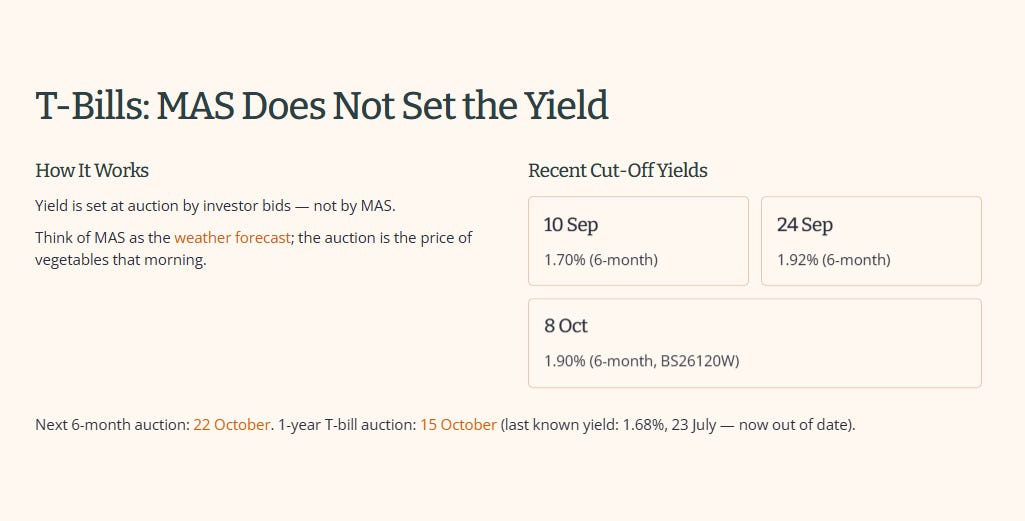
At the 6-month auction on 8 October (issue BS26120W), the cut-off yield was 1.90%, slightly below 1.92% on 24 September, which came after 1.70% on 10 September. Those figures are from Beansprout’s auction reports, not from the MAS results page, so treat them as secondary. The 8 October auction took place before the MAS statement. The next 6-month auction is on 22 October.
The 1-year T-bill is auctioned on 15 October. The last 1-year cut-off yield I have is 1.68% from 23 July, which is now out of date, and I will add the 15 October result at the bottom of this article once it is out.
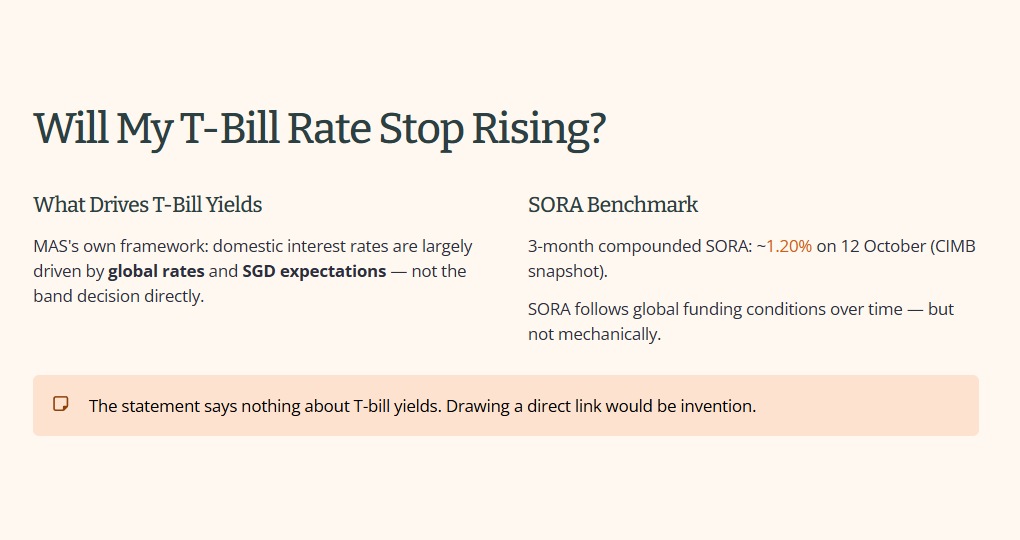
Here is the pushback I expect: if MAS held, will my T-bill rate stop rising? The statement says nothing about T-bill yields, and I would be inventing a link if I drew one. MAS’s published description of its framework says domestic interest rates are largely driven by global rates and by what the market expects the Singapore dollar to do. The 3-month compounded SORA, a benchmark that many floating-rate loans reference, was about 1.20% on 12 October according to CIMB’s rate snapshot. SORA tends to follow global funding conditions over time, but not mechanically, and I will not put a size or a timeline on it.
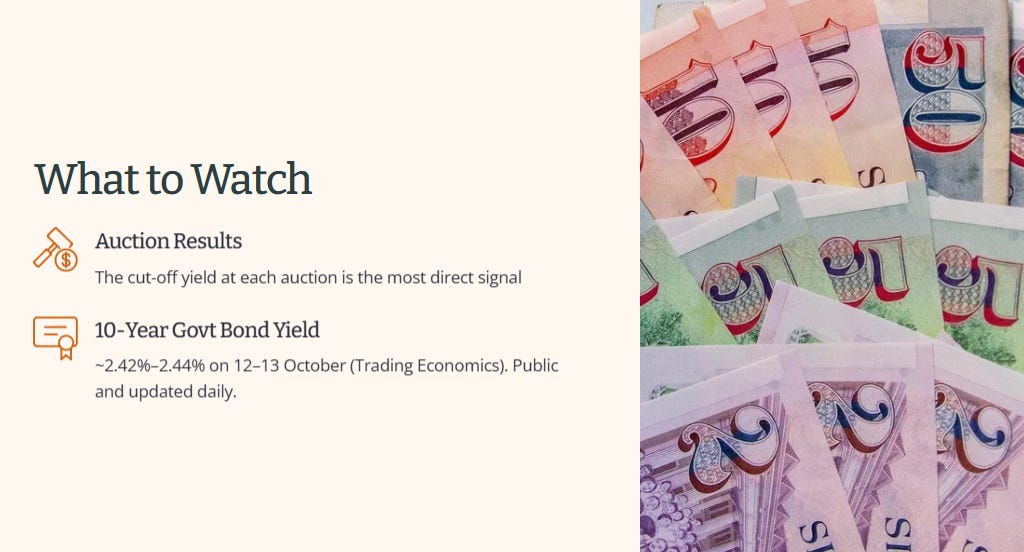
My working answer to what a T-bill holder should watch is the auction results themselves and the 10-year government bond yield. According to Trading Economics, that yield was around 2.42% to 2.44% on 12 and 13 October. It is public and updated daily, so check it on the day you read this.
The November SSB, with dates
MAS’s application page confirms that the November Singapore Savings Bond, issue code GX26110X, is open until 9pm on 27 October, will be issued on 2 November and matures on 1 November 2036. Some websites give 25 October as the deadline, so use MAS’s date. The rates come from Little Big Red Dot, a secondary source, and I have not seen them on a MAS page: 1.67% in the first year, rising each year to 3.08% in year ten, which averages 2.45% a year if held for the full ten years.
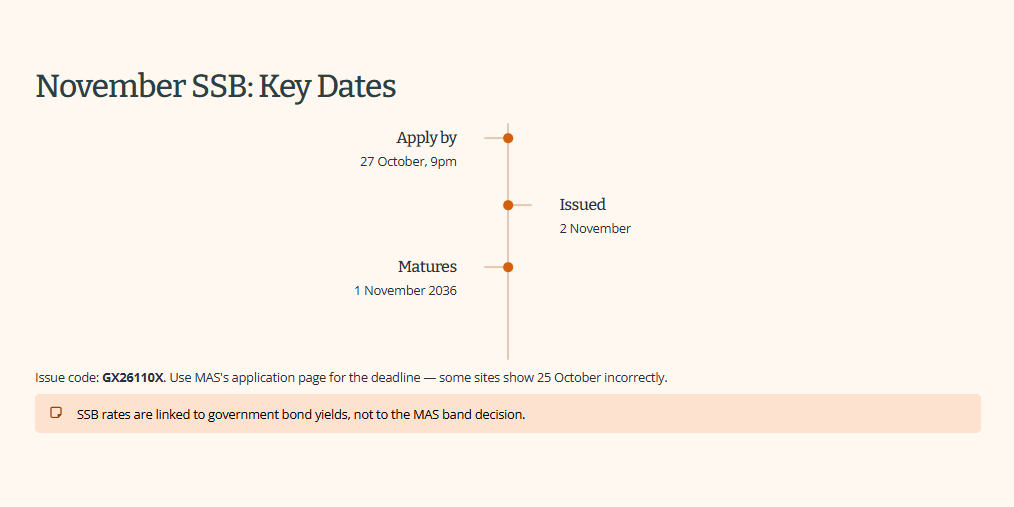
SSB rates are linked to government bond yields, not to the MAS band decision.
Two numbers are easy to mix up. The first-year rate of 1.67% sits below the 1.90% 6-month T-bill cut-off on 8 October, while the ten-year average of 2.45% sits above it. They are different tools. The T-bill matures in six months, while the SSB can be redeemed in any month with no penalty, with interest accrued to that point. Each figure is as of its own date, and neither will be the same next month.
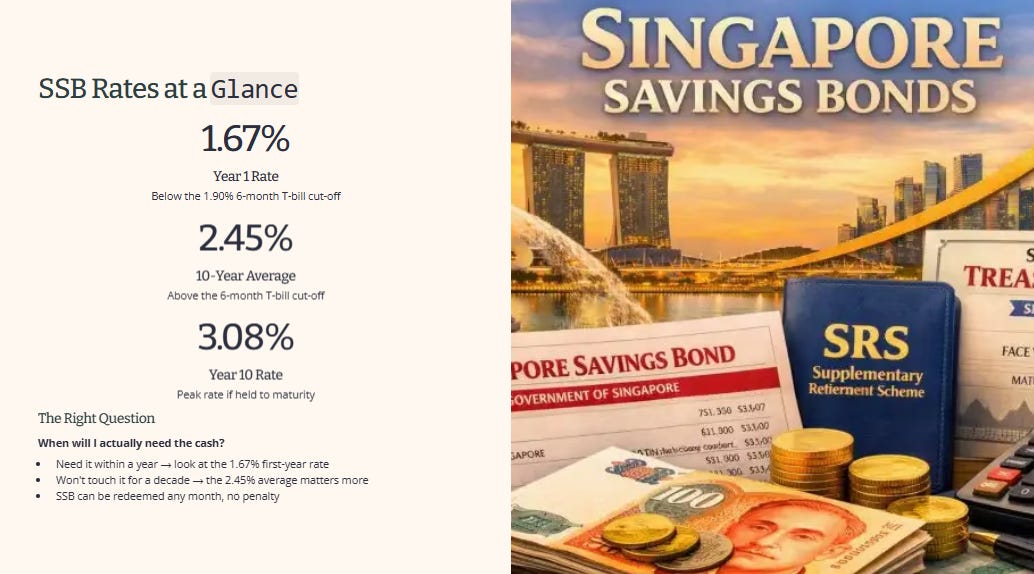
For money I might need within the year, the first-year rate is the one I would look at. For money I will not touch for a decade, the average matters more. So the question I would ask first is when I will actually need the cash.
No One Pays Him To Be Right
Every finance channel says “unbiased.” Most of them also have a sponsor, an affiliate link, or a subscriber count to protect deciding what gets softened. Iggy doesn’t. This channel started as, and still is, a passion project, not an income source.
That’s not a slogan, it’s the actual reason a Zone 4 verdict stays a Zone 4 verdict even when it’s the stock in every uncle’s portfolio.
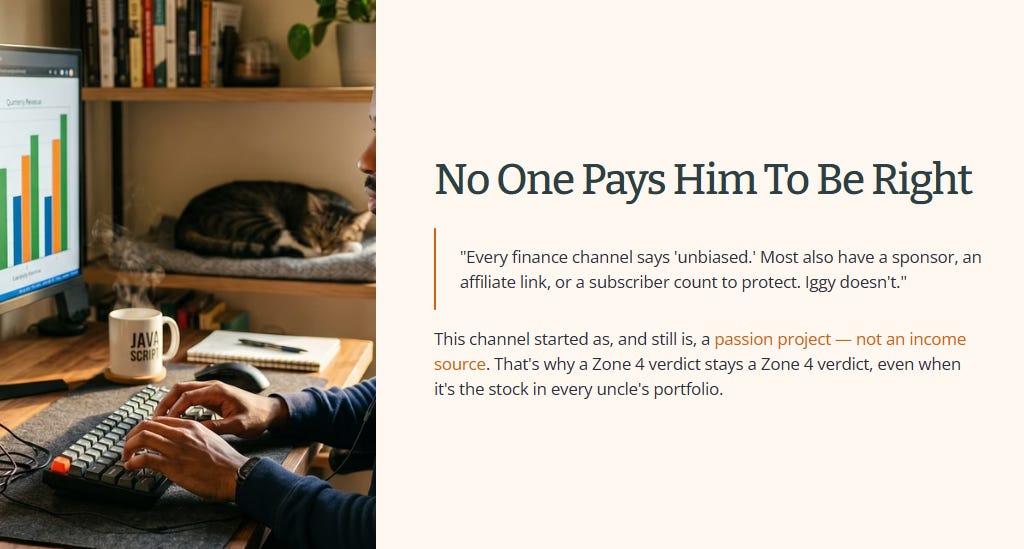
YouTube/Substack Combo members aren’t paying for faster access to opinions that were always going to be diplomatic anyway. You’re paying for the version of this analysis that exists because it doesn’t need to please anyone: full-length videos, the complete Red Zone watchlist, and institutional-grade cheatsheets built without a single sponsor’s name attached to the verdict.
For S$12/month, you’re not just getting the report first. You’re the reason it’s still honest.
What It Means for S-REIT Holders
Two channels, and only one is in the statement
There are two ways a decision like this could reach S-REIT units. One runs through interest rates and borrowing costs, the other through the currency.
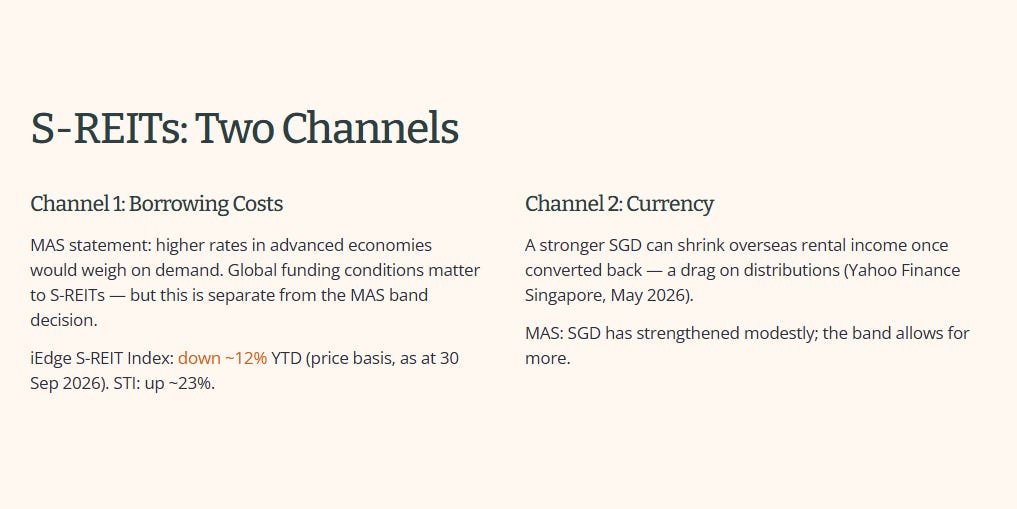
On interest rates, the statement’s own wording is about the world, not about MAS. It says higher interest rates in the advanced economies, where inflation remains elevated, would weigh on demand, and it expects global financial conditions to tighten. S-REITs borrow, so global funding conditions matter to them.
But that is a different thing from the MAS decision, and I have not found a sector-wide figure, from a named source, for how much S-REIT debt is fixed-rate and how much comes up for renewal soon. So I will not quote one. For context only, The Smart Investor reported that, as at 30 September 2026, the iEdge S-REIT Index was down about 12% so far this year on a price basis, while the STI was up about 23%. Those figures are two weeks old, so read them as background and not as current performance.
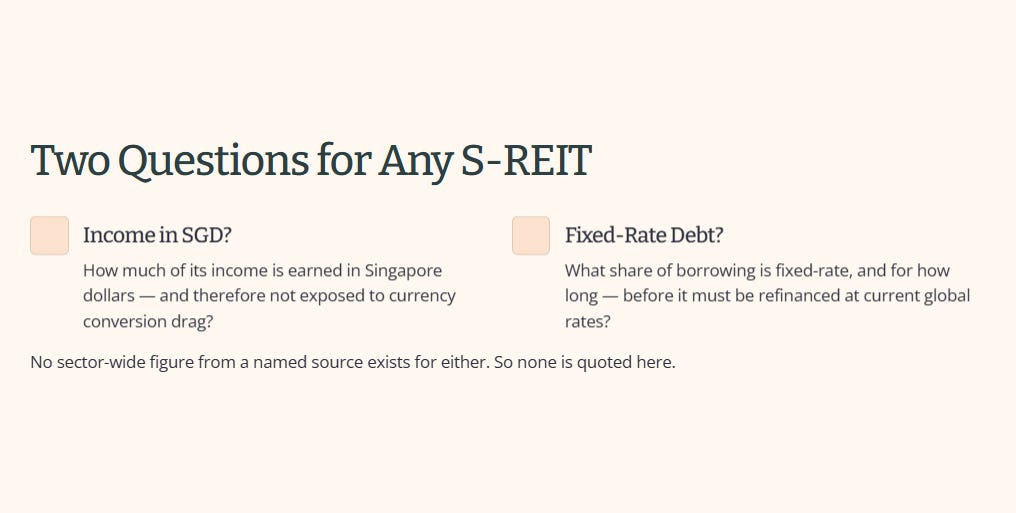
On the currency, In a May 2026 article, Yahoo Finance Singapore noted that a stronger Singapore dollar can shrink overseas rental income once it is converted back, which can be a drag on distributions. That is commentary, not a MAS or SGX figure. What the MAS statement adds is that the Singapore dollar has strengthened modestly and that the band allows for more. The measure MAS manages is a basket, so it need not move by the same amount against each currency in which a REIT earns income. I have not found a source that sizes the effect for the sector, so I will not size it either, and I am not naming any REIT.
That leaves two questions I would ask of any S-REIT on its next results day. How much of its income is earned in Singapore dollars? And what share of its borrowing is fixed-rate, and for how long?
🟠 Angela’s Observation
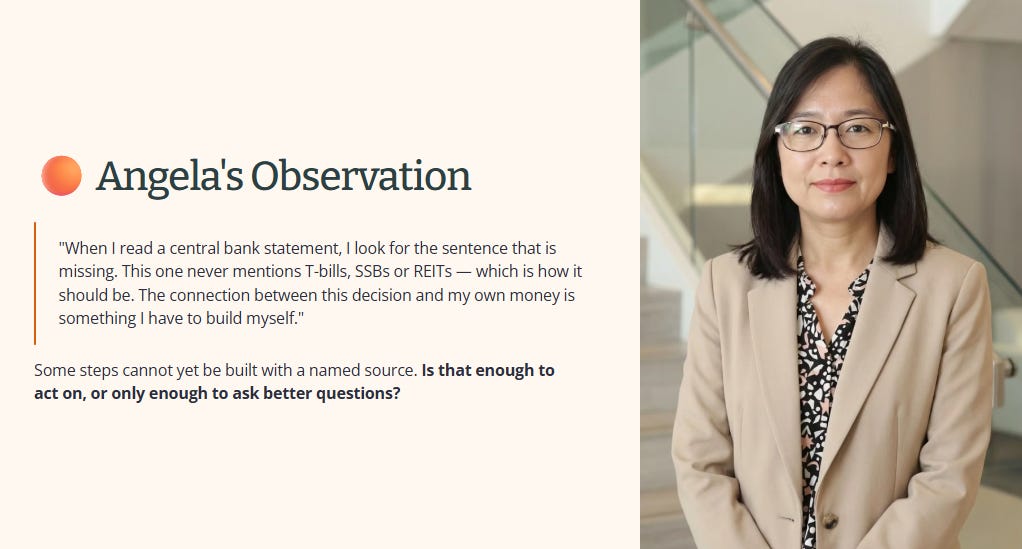
When I read a central bank statement, I look for the sentence that is missing. This one never mentions T-bills, SSBs or REITs, which is how it should be, because MAS is managing a currency and not my savings. That means the connection between this decision and my own money is something I have to build myself, and some of the steps I cannot yet build with a named source. I would rather say so than hand over a neat story. What I can say is that I now know two questions to ask the next time a REIT reports. Is that enough to act on, or only enough to ask better questions?
What I Am Watching Next, Without Predicting
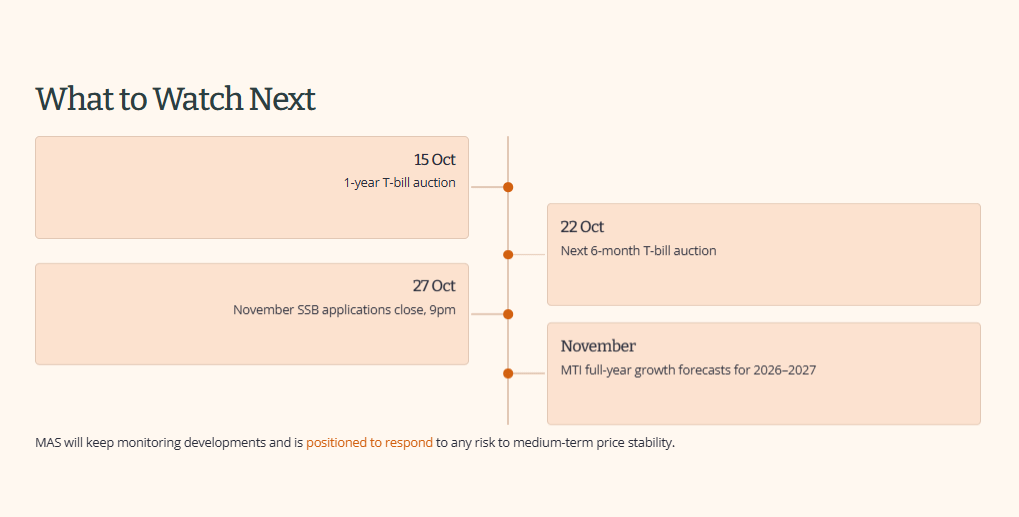
Four dates are on the calendar. The 1-year T-bill auction is on 15 October, and the next 6-month auction is on 22 October. Applications for the November SSB close at 9pm on 27 October. In November, the ministry is expected to announce its growth forecasts for 2026 and 2027. I am not going to guess what MAS will do next. The statement says only that MAS will keep monitoring developments and is positioned to respond to any risk to medium-term price stability.
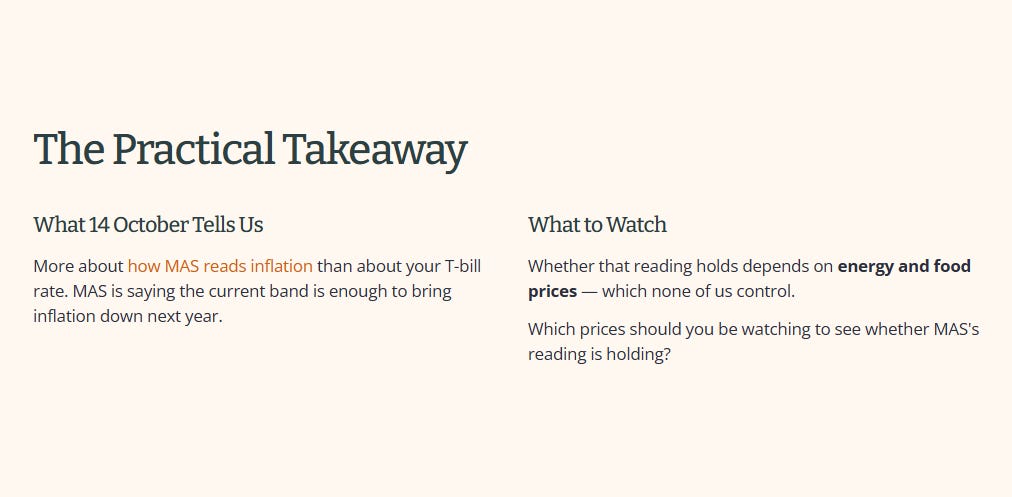
My tentative view is that 14 October tells me more about how MAS reads inflation than about my own T-bill rate. MAS is saying the current band is enough to bring inflation down next year. Whether that reading holds depends on energy and food prices, which none of us control. So the question I am left with is a practical one: which prices should I be watching to see whether MAS’s reading is holding?
(Source) Where the figures come from. The policy wording, growth and inflation figures and forecasts come from the MAS Monetary Policy Statement of 14 October 2026. The economist poll is from CNA, and the second-quarter revision is from Business Times. T-bill results are from Beansprout, SSB rates from Little Big Red Dot, and SSB dates from MAS’s application page for GX26110X. The 10-year yield is from Trading Economics, SORA is from CIMB’s rate snapshot, S-REIT index performance is from The Smart Investor, and the currency point is from Yahoo Finance Singapore (27 May 2026). Everything except the MAS statement and the MAS application page is secondary, and every rate is as of the date given.
Get everything, full-length videos and full Substack analysis on both platforms, full Red Zone watchlist, forensic cheatsheets, with the YouTube/Substack Combo, S$12/month.
YOUR FORENSIC VERDICT, ONE PAGE.
The full audit is above. This is the Iggy Forensic Audit distilled to one A4 page — every number that matters, every flag that triggered, one clear verdict. Save it, print it, pull it out when this stock crosses your radar again, or when you need to refer to these data points for your retirement planning.

Iggy’s Forensic Disclaimer
This content is produced for educational and informational purposes only. I am not a financial advisor. I am a retail investor who applies forensic analysis to my own portfolio and shares that process publicly. Nothing here constitutes a recommendation to buy, sell, or hold any security, and no specific target prices or personalised financial advice are offered.
Stocks assessed under Iggy’s Forensic Yield Standard are benchmarked against a 4.7% minimum yield hurdle. Stocks flagged as Growth Watch fall below this threshold but demonstrate clean balance sheet metrics and an identifiable growth catalyst. These carry a materially different risk profile and are not suitable as yield replacements for income-dependent investors.
All data is sourced from public filings and verified sources. Where data is unverified, it is explicitly flagged. All investments carry risk, including the potential loss of principal, and past performance is not indicative of future results. If you are making investment decisions involving CPF, SRS, or personal capital, please conduct your own due diligence or consult a MAS-licensed financial adviser before committing funds.