



DBS and UOB Report This Week. What the Payout Rests On, and What It Cannot Tell You 🦖
Both banks last declared a dividend with their results in August. Here is what those releases say the payout was, what it rested on, and what to check when the new numbers arrive.
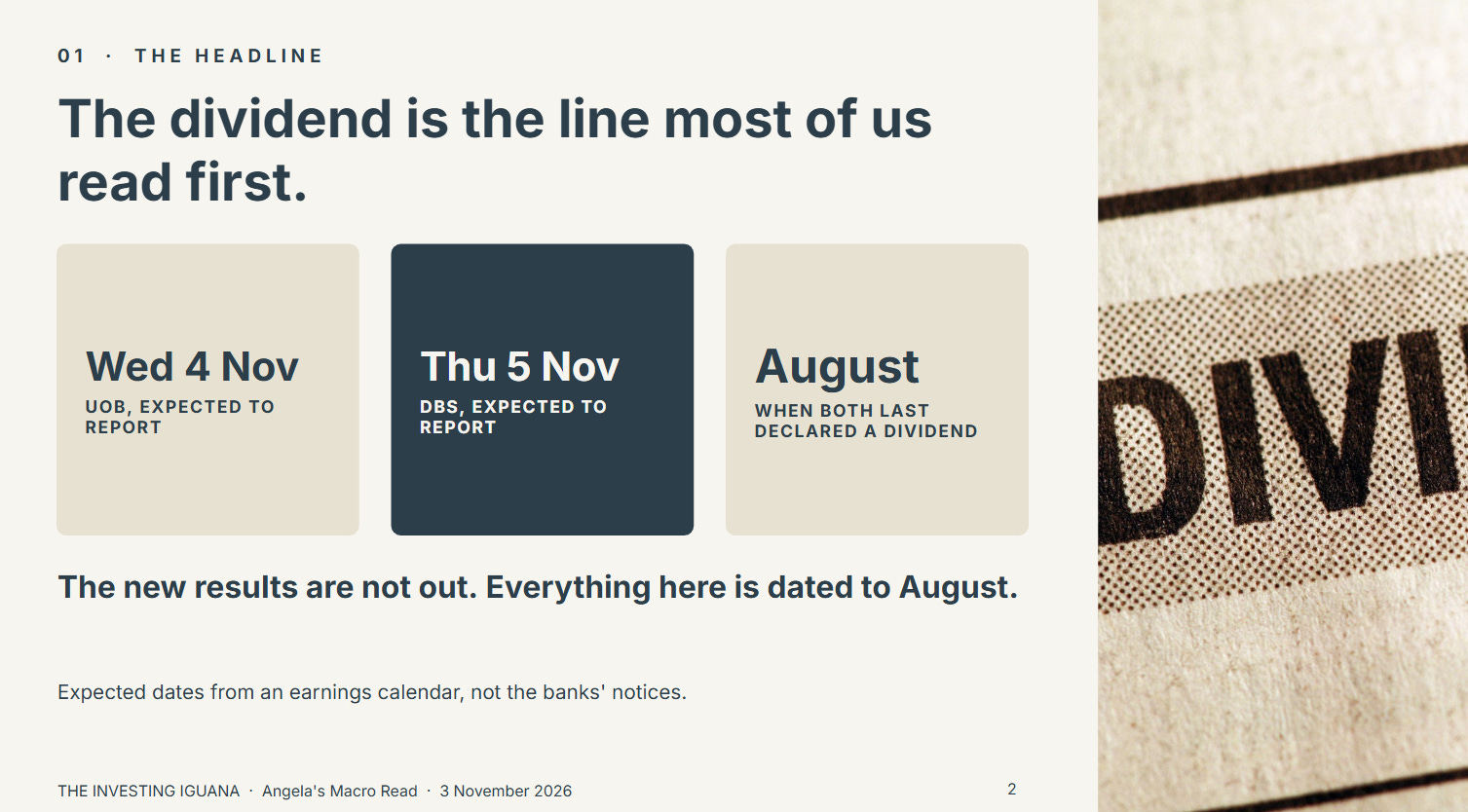
DBS and UOB are due to report this week, and for many Singapore households the first thing they will look for is one line: the dividend. It is the line that arrives in your CDP statement and your bank account, and it is the one that tends to be read on its own. Is it higher or lower than last time, and does that mean anything?
I am not a bank analyst, and I take no view on whether anyone should own either bank, add to it or leave it alone. I read the two documents the banks published with their last results: DBS’s performance summary and dividend announcement for the first half and second quarter ended 30 June 2026, dated 6 August 2026, and UOB’s announcement and condensed interim financial statements for the first half ended 30 June 2026. Those are the latest results I have. This week’s results are not out as I write, so everything below is dated to August, and some of it may change by the end of the week. If you own either bank, or a fund that does, the practical question is what the last payout was and what it rested on, and that is the question I try to answer, as far as the documents allow.
What This Piece Does
It sets out what each bank’s August release says about the dividend, in the bank’s own words.
It works through three questions: what the last payout actually was, what it rested on, and what to check when the new results arrive.
It uses made-up numbers wherever I need an example, and it says so each time.
Nothing here is advice on your own holdings, and no example is your figure. The whole piece is free.

What the August Releases Say, in Order
DBS
UOB
What the two releases do not say
Question 1: What Was the Last Payout, Exactly?
Two banks, two shapes
What UOB paid earlier in the year
The objection
🟠 Angela’s Observation
Question 2: What Does the Payout Rest On?
Earnings
Capital
Asset quality
A made-up illustration
Dividend against profit
The objection
🟠 Angela’s Observation
Keep Reading, Free
Question 3: What Should You Check When the Results Arrive?
Which period is the dividend for?
What is it compared with?
Did the capital ratio move?
Did the margin and the problem-loan ratio move?
What I am watching next, without predicting
🟠 Angela’s Observation
Sources
What the August Releases Say, in Order
DBS
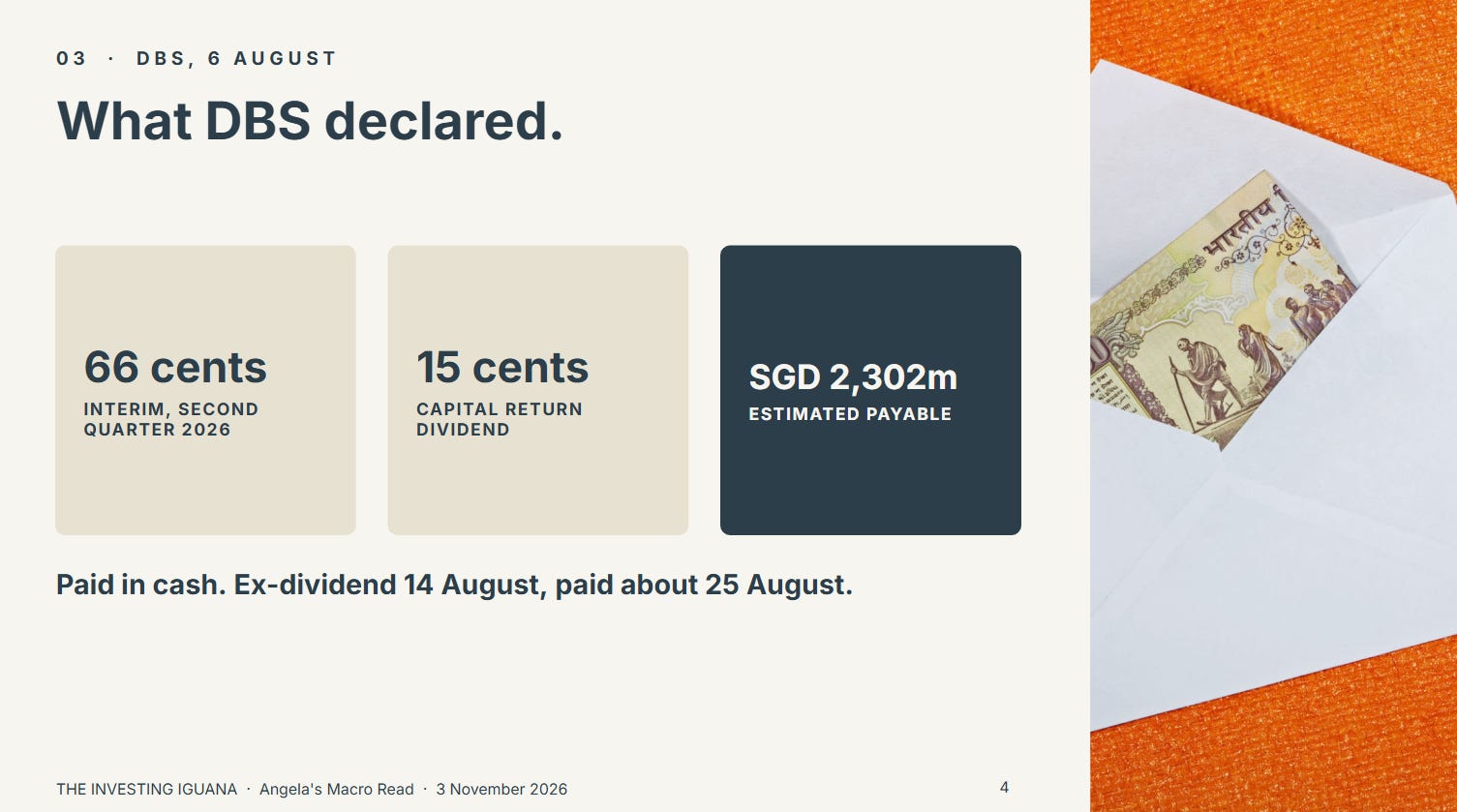
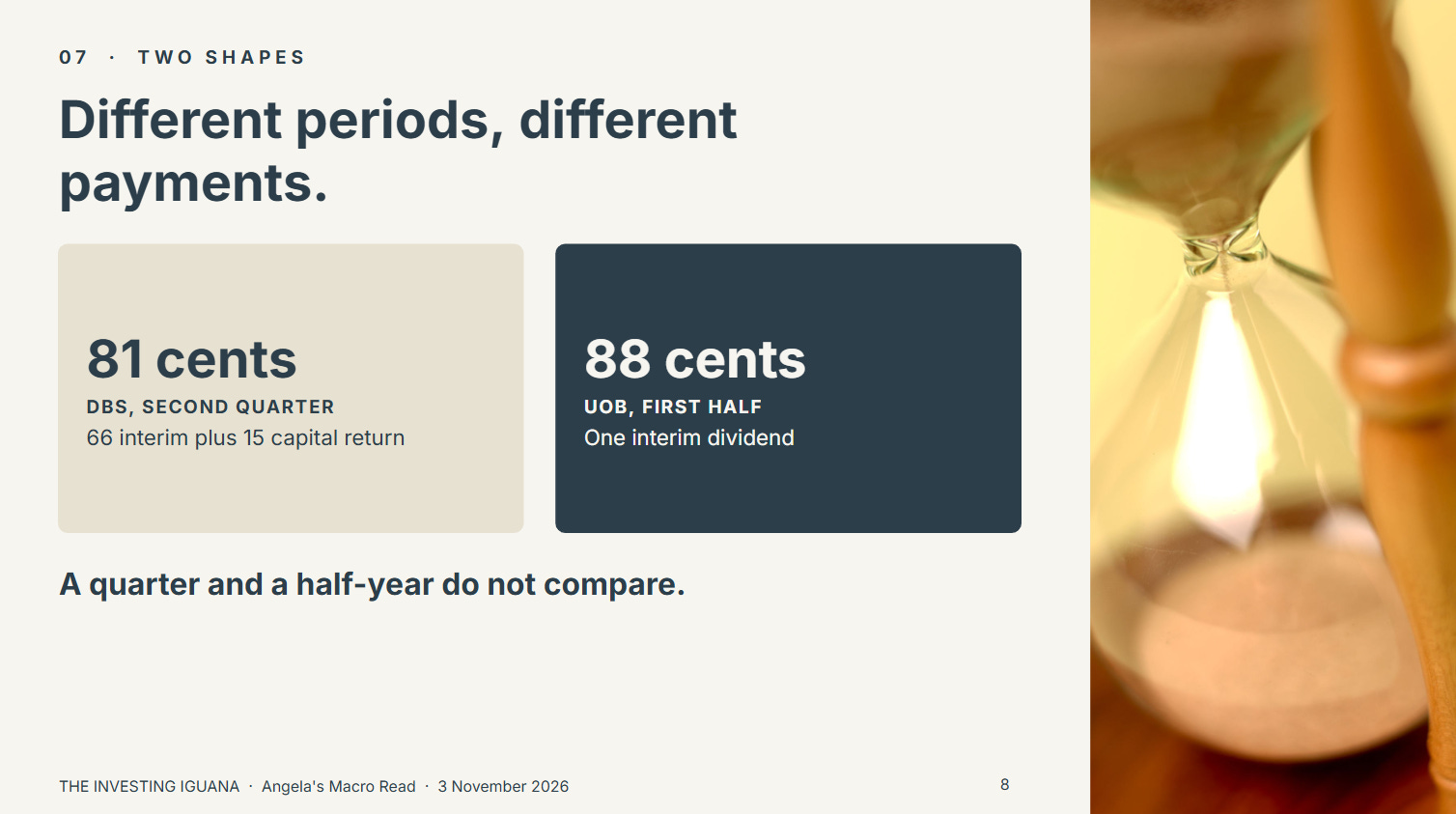
On 6 August 2026, the DBS Board declared two dividends for each ordinary share: an interim one-tier tax-exempt dividend of 66 cents for the second quarter of 2026, and a one-tier tax-exempt capital return dividend of 15 cents. The estimated amount payable was SGD 2,302 million. The scrip dividend scheme was not applied, so shareholders were paid in cash. The shares went ex-dividend on 14 August, and payment was on or about 25 August.
UOB
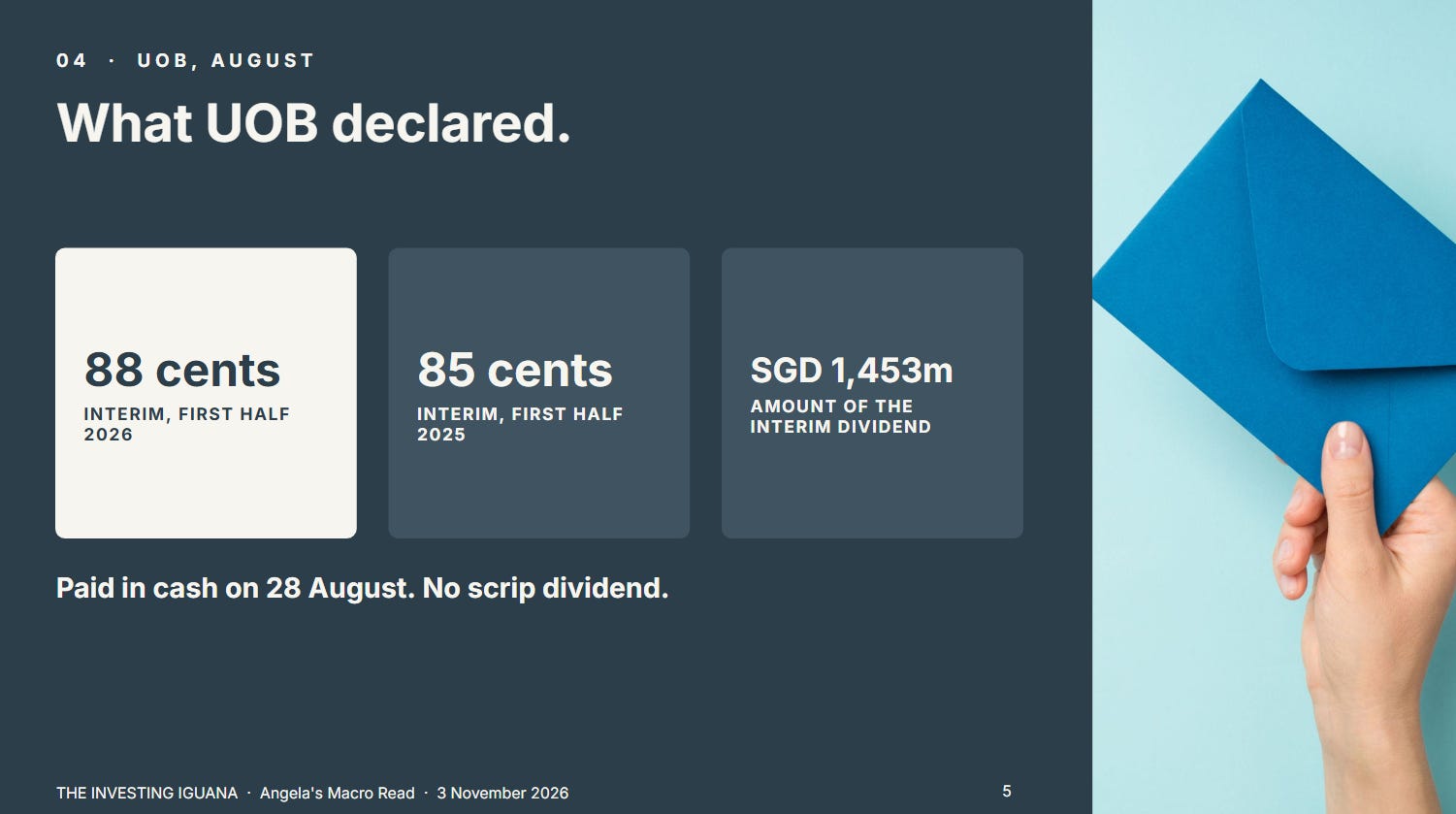
UOB declared an interim one-tier tax-exempt dividend of 88 cents per ordinary share, against 85 cents for the first half of 2025, in respect of the financial year ending 31 December 2026. It was paid in cash on 28 August, and the scrip dividend scheme was not applied. The financial statements put the interim dividend at SGD 1,453 million.
What the two releases do not say
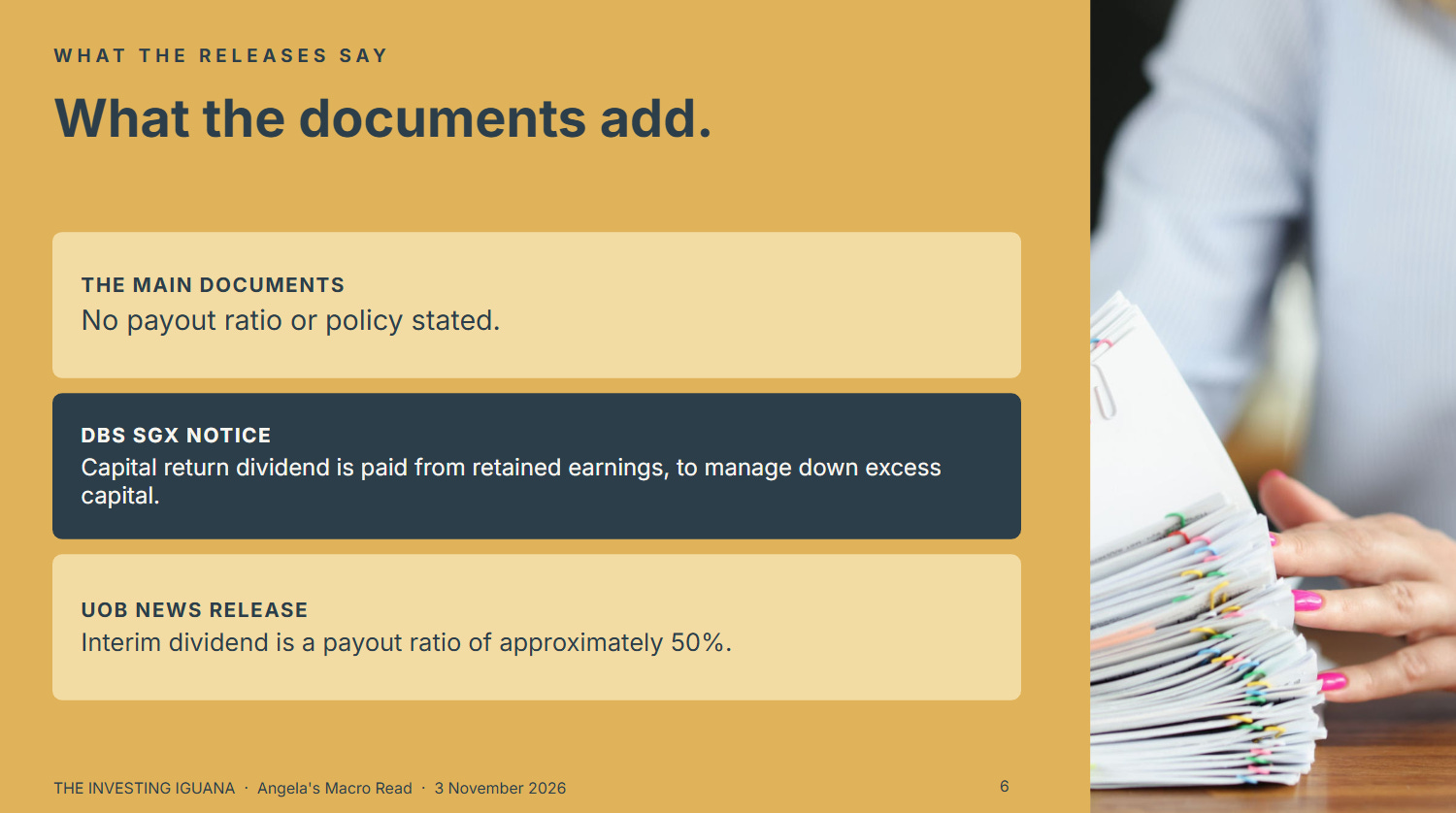
Neither document states a payout ratio or a payout policy. The DBS announcement does not explain what the capital return dividend is or how its size is set. The UOB statements show the dividend and the amount, and they do not say how the amount is chosen. I will not fill that gap from memory. Anything in this piece about what a payout “rests on” is my reading of the numbers the banks published, and I say so where it matters.
Question 1: What Was the Last Payout, Exactly?
Two banks, two shapes
The two payouts are not built the same way. DBS declared a quarterly interim dividend and a separate capital return dividend, 81 cents in total for the second quarter. UOB declared a half-year interim dividend of 88 cents. Those two numbers measure different periods, so setting 81 cents beside 88 cents tells you very little. I will not compare them as if they were the same thing.
What UOB paid earlier in the year
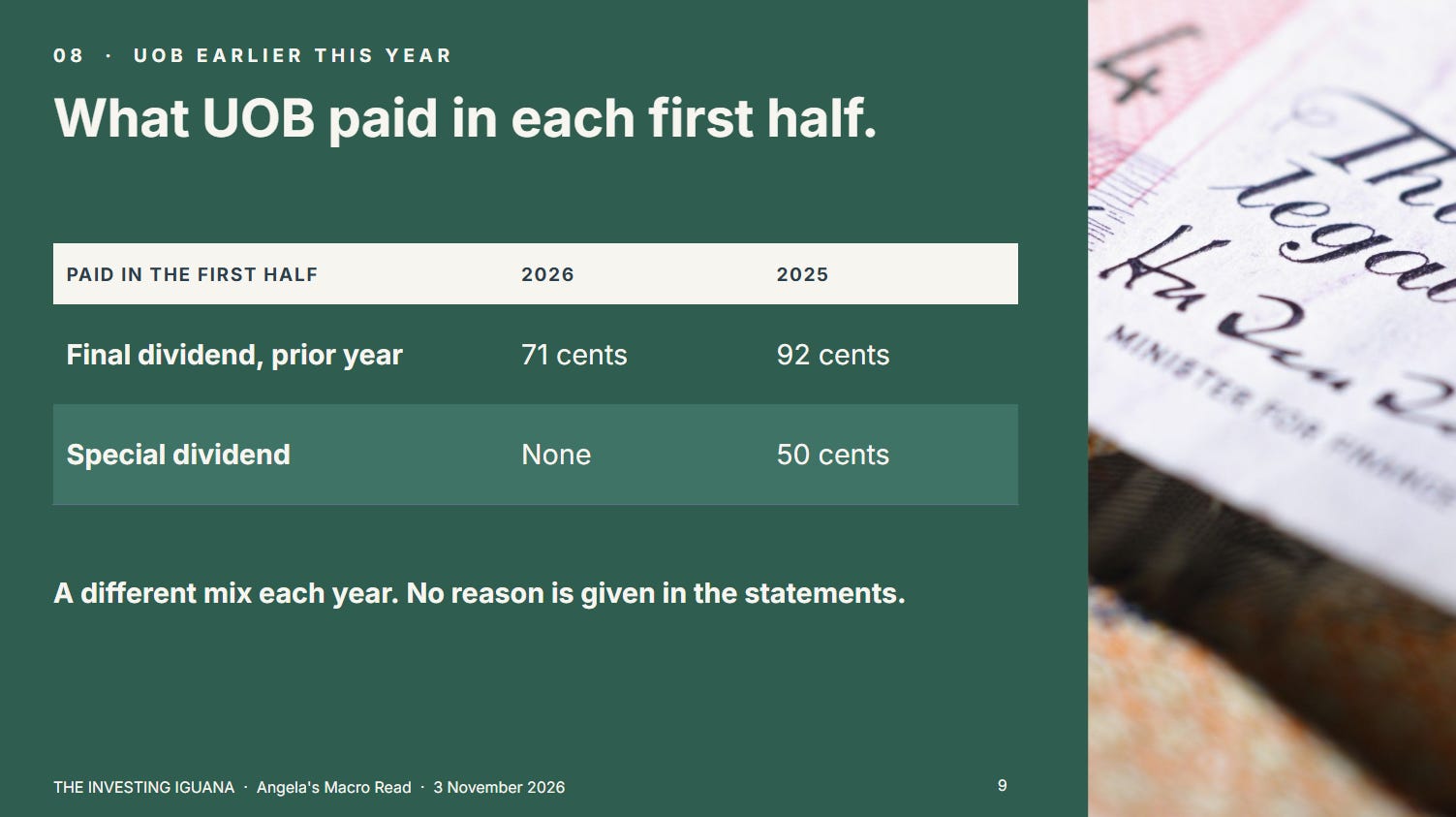
The UOB financial statements add one more fact. In the first half of 2026 UOB paid its final dividend for 2025, at 71 cents per share, against a final of 92 cents paid in the first half of 2025. The same note shows a special dividend of 50 cents paid in the first half of 2025, and none in the first half of 2026. I read that as a different mix of payments in each year. I did not find a statement of why, and I cannot say whether a special dividend will return.
The objection
The objection I expect is fair: if the interim dividend is up from 85 cents to 88 cents, a rise of about 3.5% on my arithmetic, what is the problem? There may be none. The point is narrower. The interim dividend is one part of what the bank pays in a year, and a rise in one part can sit beside a fall in another. If you are counting on the dividend for household expenses, the figure to track is what arrives across the whole year, not one line in one release.
🟠 Angela’s Observation
A neighbour of mine in Tampines keeps her dividend vouchers in a plastic folder, and she told me she reads two lines only, the amount and the payment date. She has never read the line that says what the payment was for. For a long time I did the same. It works well while the amount is steady, and it fails the first time the amount changes and you cannot tell why. Which line on my own statement do I skip?
Question 2: What Does the Payout Rest On?
Earnings
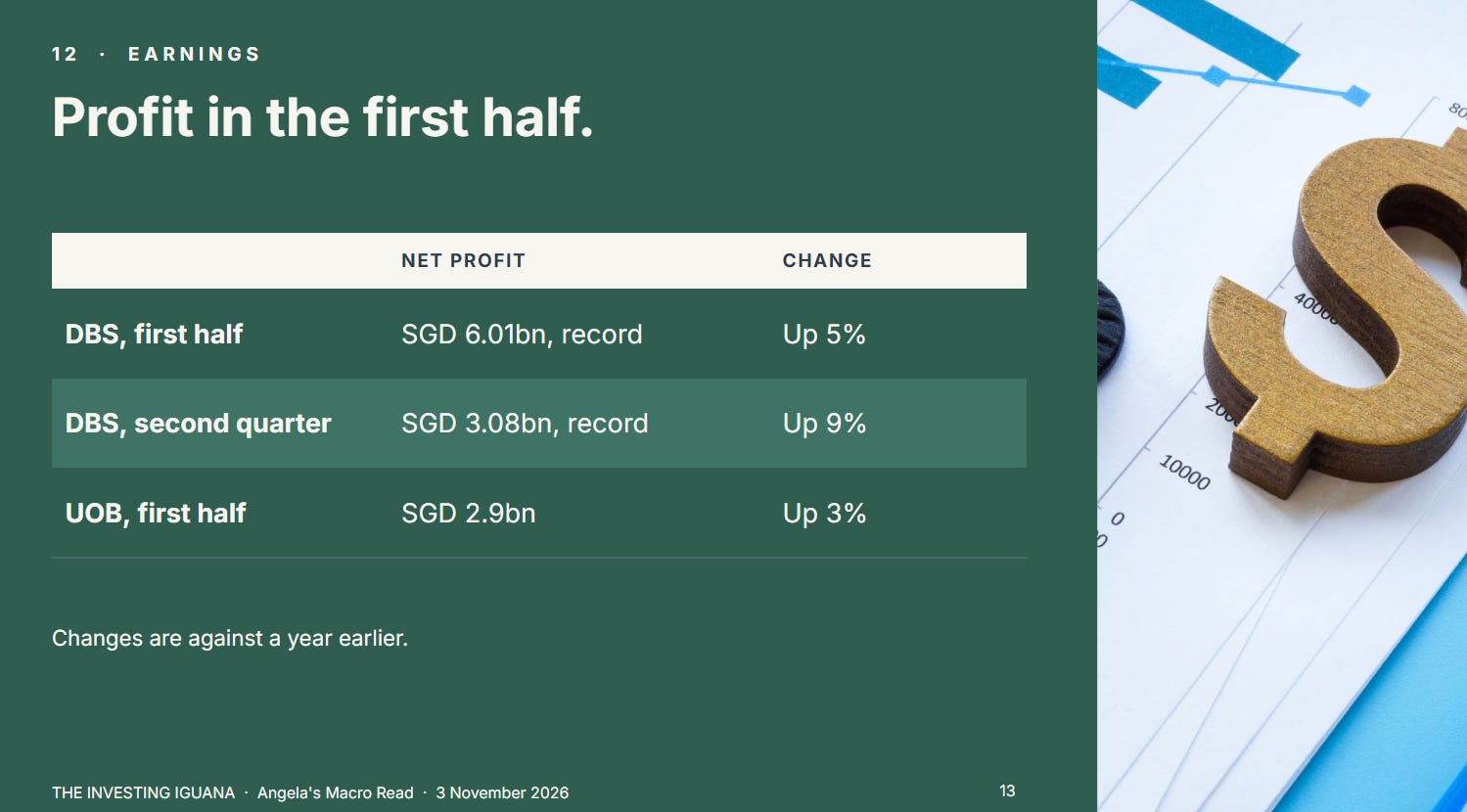
DBS reported first-half net profit up 5% to a record SGD 6.01 billion. For the second quarter alone, net profit rose 9% from a year ago to SGD 3.08 billion, a record. UOB reported first-half net profit up 3% to SGD 2.9 billion.
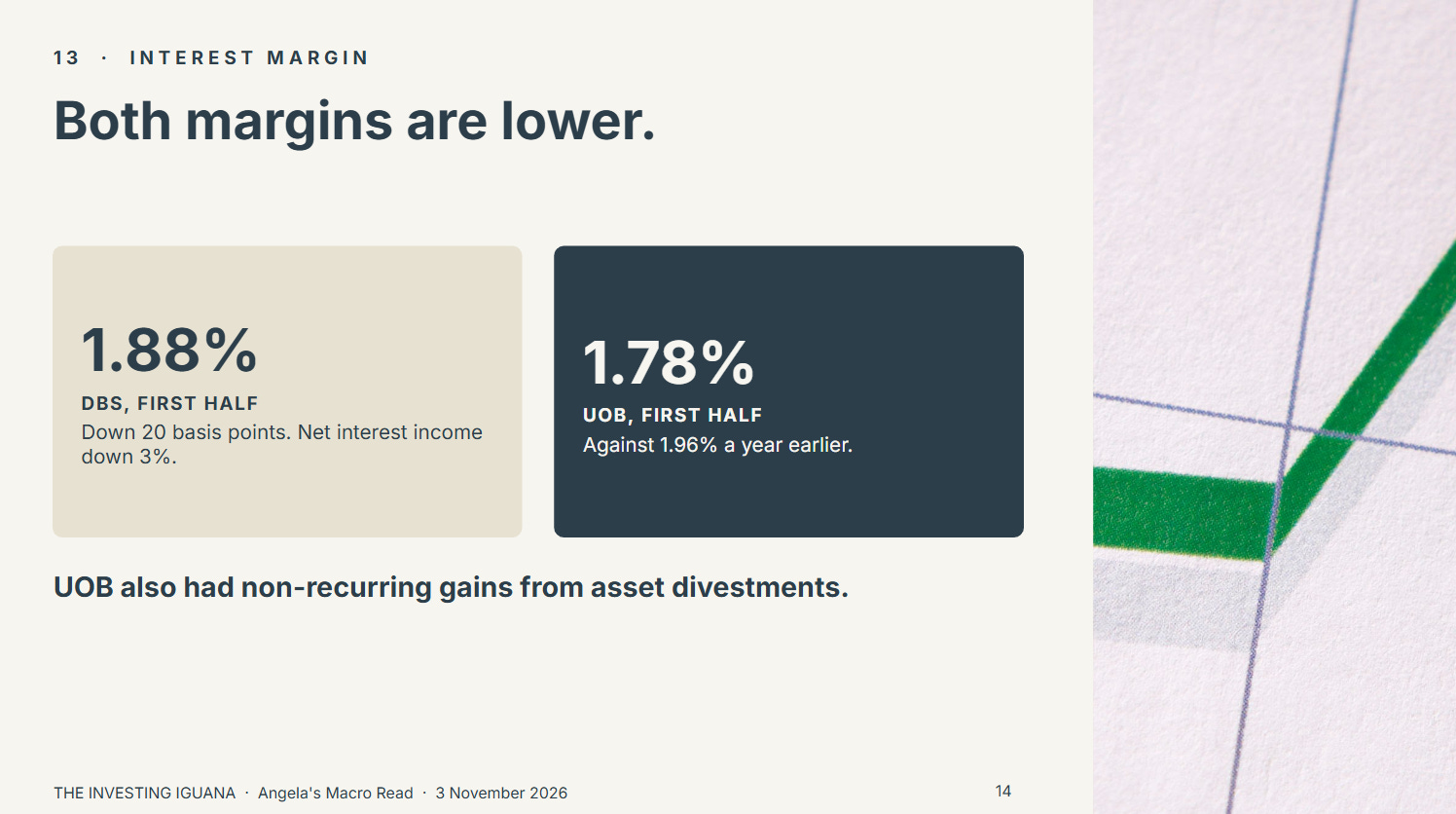
Both banks described pressure on the interest they earn. DBS’s group net interest margin was 1.88% for the half, 20 basis points lower than a year earlier, and net interest income fell 3% to SGD 7.08 billion; DBS says hedging and balance sheet growth softened the effect. UOB’s net interest margin was 1.78%, against 1.96% a year earlier, and net interest income was 3% lower at SGD 4.6 billion. UOB also says other non-interest income was supported by non-recurring gains from asset divestments. If a dividend rests on profit, it also rests on any part of that profit that does not repeat.
Capital
The documents also show how much capital each bank held at 30 June, which is before the August dividends were paid. DBS’s reported Common Equity Tier 1 ratio was 16.6% at 30 June, and its fully phased-in figure, which assumes the Basel III output floor of 72.5% applies in full from 1 January 2029, was 14.6%. DBS lists the minimum including buffers at 9.2%. UOB’s ratio was 15.4%, and UOB says it held that level despite distributing its 2025 final dividends. UOB states the minimum as 6.5% plus a 2.5% conservation buffer and a countercyclical buffer of up to 2.5%.
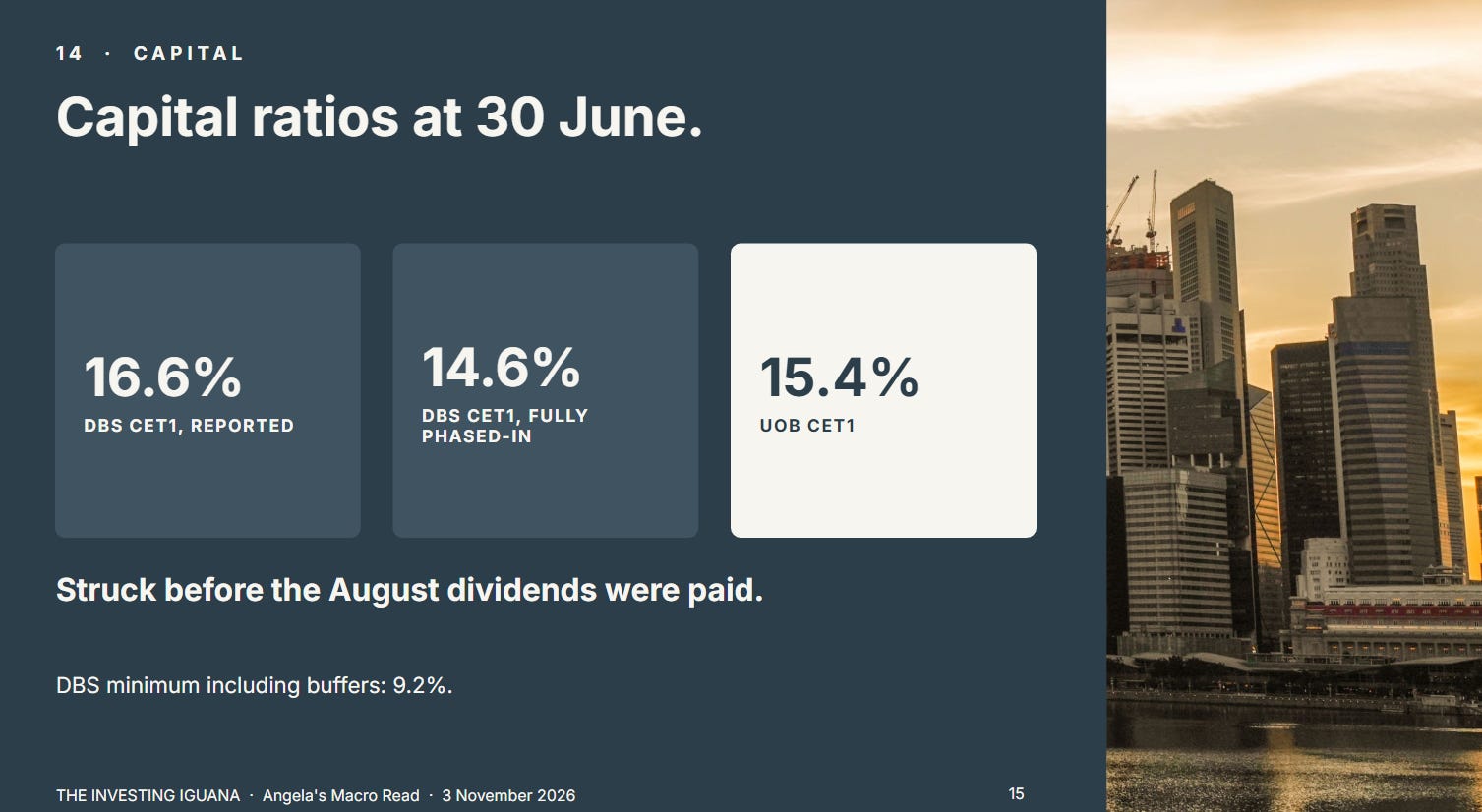
I did not find a statement in either document that links the dividend to the capital ratio. What the ratios tell you is how far each bank sat above the minimum on 30 June. They do not tell you what the Board will do.
Asset quality
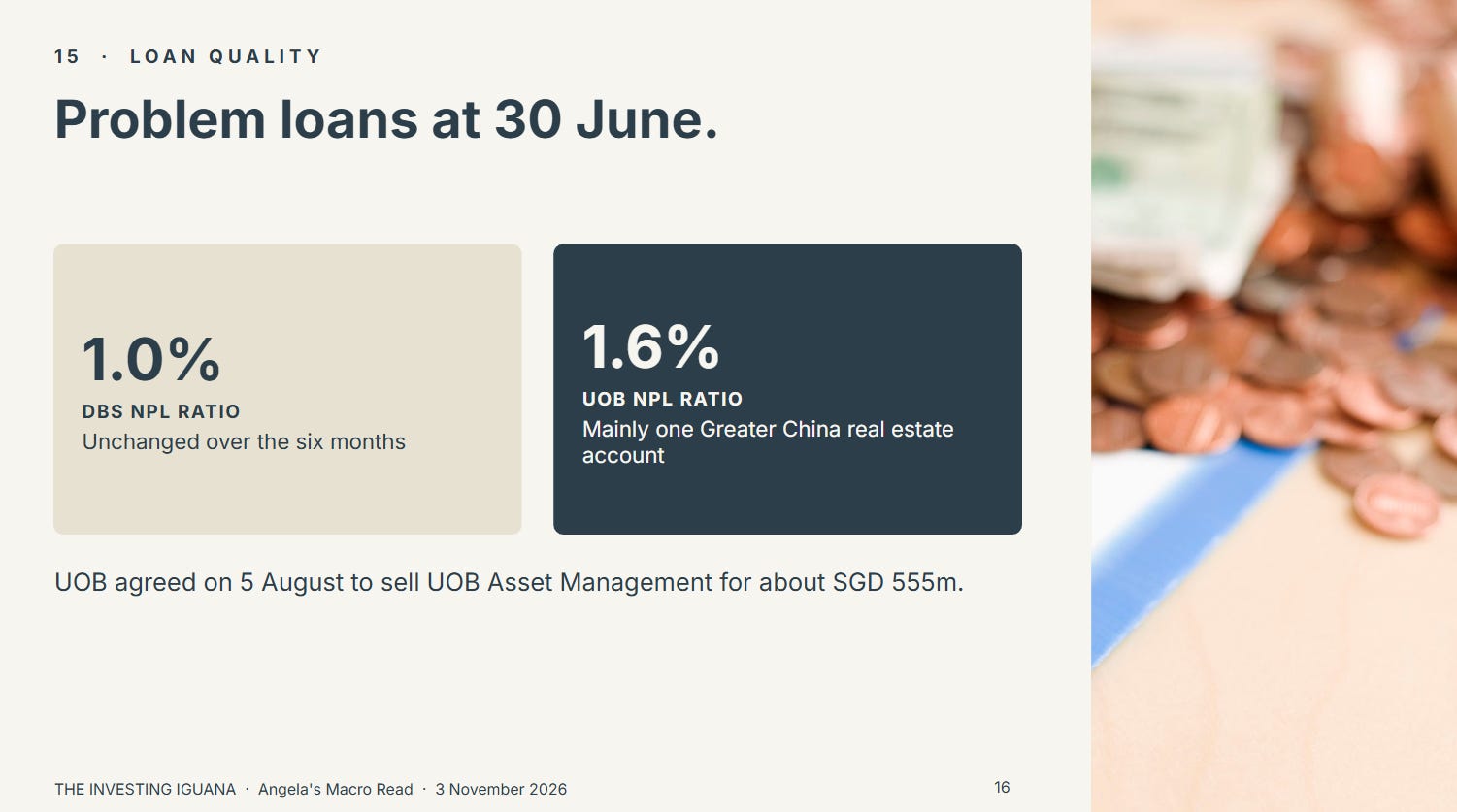
DBS reported a non-performing loan ratio of 1.0%, unchanged over the six months. UOB’s was 1.6% at 30 June, and UOB says the new non-performing assets came mainly from a single real estate account in Greater China. UOB also reported that on 5 August it agreed to sell UOB Asset Management for about SGD 555 million, subject to adjustments. The statements do not say how that sale relates to the dividend, and I will not suggest it does.
What the Paid Half Adds
The free half shows what each bank declared in August and what its earnings, capital and loan figures were. The paid half sets each payout beside the profit it was declared with, using the banks’ own figures and labelled arithmetic, and explains why the two ratios cannot simply be compared. It shows with a made-up example how the books-closing date decides who is paid, and it turns all of this into four checks for the day the new results arrive, with the figures I will be watching. The extra is depth, nothing else.
The Substack Only Plan, US$8/month, gives the full written analysis, portfolio walkthroughs and analyst cheatsheets.
The YouTube Only Plan, S$5/month, gives the full-length Members Edition video.
The YouTube/Substack Combo, S$12/month, gives all of it.
🔒 What’s Next
The next section sets each bank’s August payout beside the profit it was declared against, and explains why the two ratios cannot simply be set side by side.
