



Business Update or Full Results? How to Read What an SGX Company Publishes 🦖
Keppel and CICT both updated the market on 29 October without a full set of results. Here is what to check in any Singapore company release, and what each kind of document leaves for later.
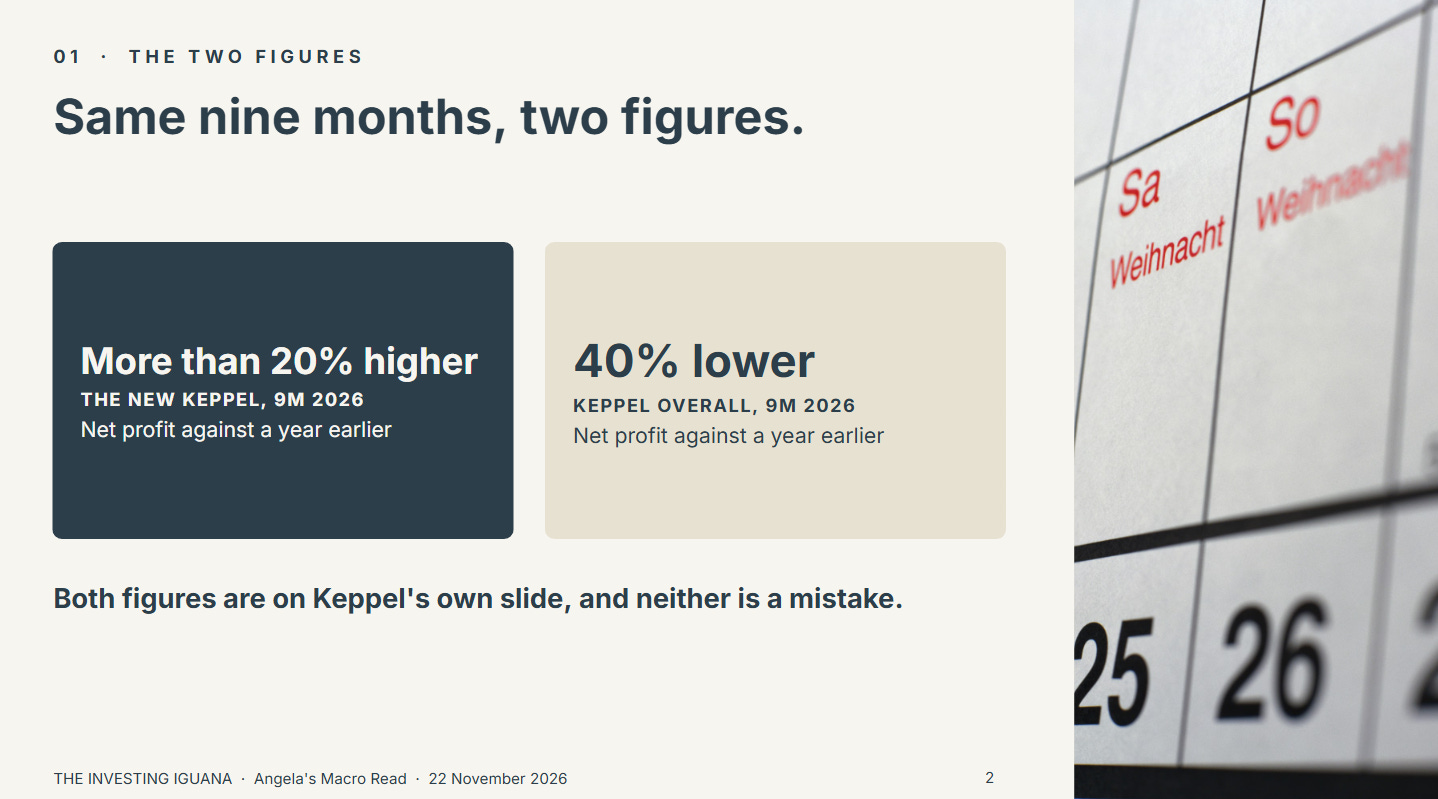
More than 20% higher, and 40% lower. Keppel’s presentation for the nine months to September 2026 gives both figures for the same period, on the same slide, and neither is a mistake.
One figure is for what Keppel calls the New Keppel. The other is Keppel’s overall net profit, which includes the non-core portfolio it is selling down. The slide puts the New Keppel first. Anyone who reads only the first line leaves with one version of the nine months, and anyone who reads only the second leaves with the opposite one.
I used to be the second kind of reader and, before that, the first kind. For years I treated a results page as a single verdict from the company, delivered in its first sentence. What I had not understood is that a company chooses what goes into that first sentence, that the document usually shows the other figures a few lines below, and that some documents are not results at all.
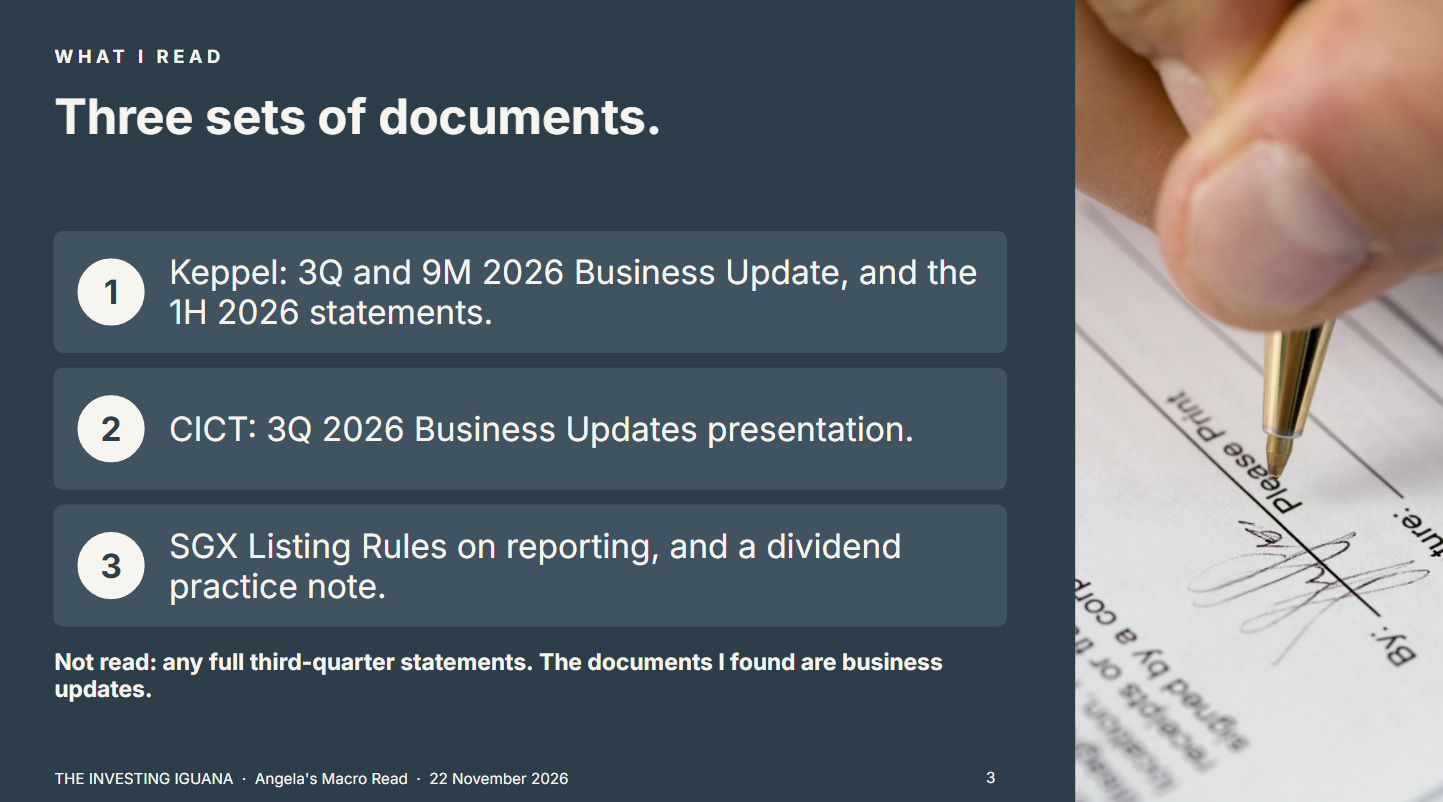
I am not an analyst, and I take no view on what any share price will do or whether anyone should own any share. I read Keppel’s media release and 3Q & 9M 2026 Business Update presentation of 29 October 2026, Keppel’s first-half 2026 results with its condensed financial statements, and CICT’s 3Q 2026 Business Updates presentation of 29 October 2026. I also read the SGX Listing Rules on reporting frequency, and the Reuters and Beansprout reports on the analyst estimates for UOB’s third quarter.
I have not read any full third-quarter financial statements for Keppel or CICT, because the documents I found are business updates, and that difference is one of the things this piece is about.
What This Piece Does
It sets out what SGX requires a company to publish and when, so you can tell a set of results from a business update.
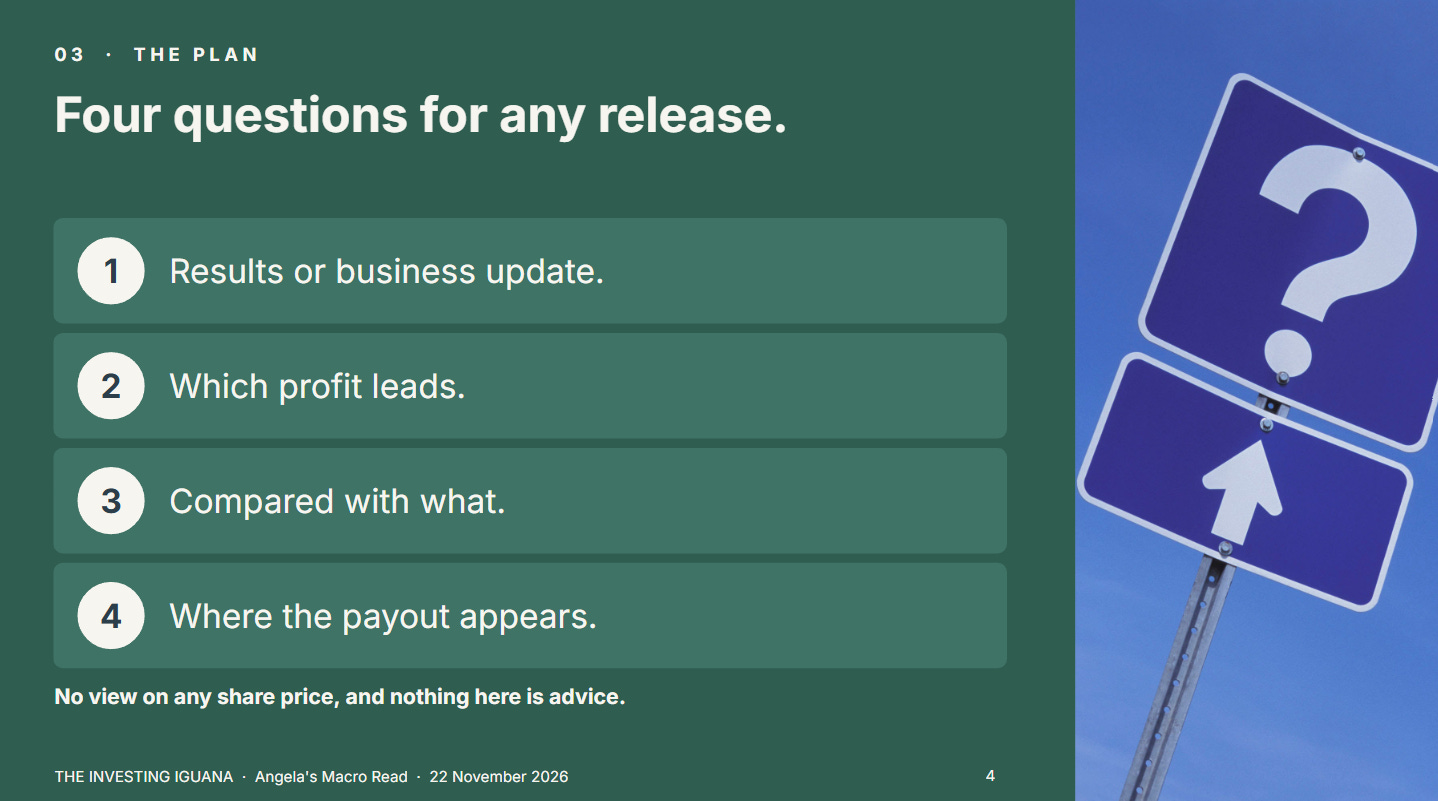
It puts four questions to Keppel’s and CICT’s documents of 29 October, and shows the same four questions working on any release.
It says what those two documents leave for the full-year results.
The whole piece is free to read. It takes no view on any share price, and nothing here is a recommendation.

What SGX Requires, and What It Does Not
Question One: Is This Results, or a Business Update?
Angela’s Observation
Question Two: Which Profit Is the Headline Profit?
Question Three: Compared With What?
Question Four: Where Does the Payout Appear?
Angela’s Observation
An Objection Worth Answering
Four Questions for Any Release
Iggy’s Forensic Read
Sources
What SGX Requires, and What It Does Not
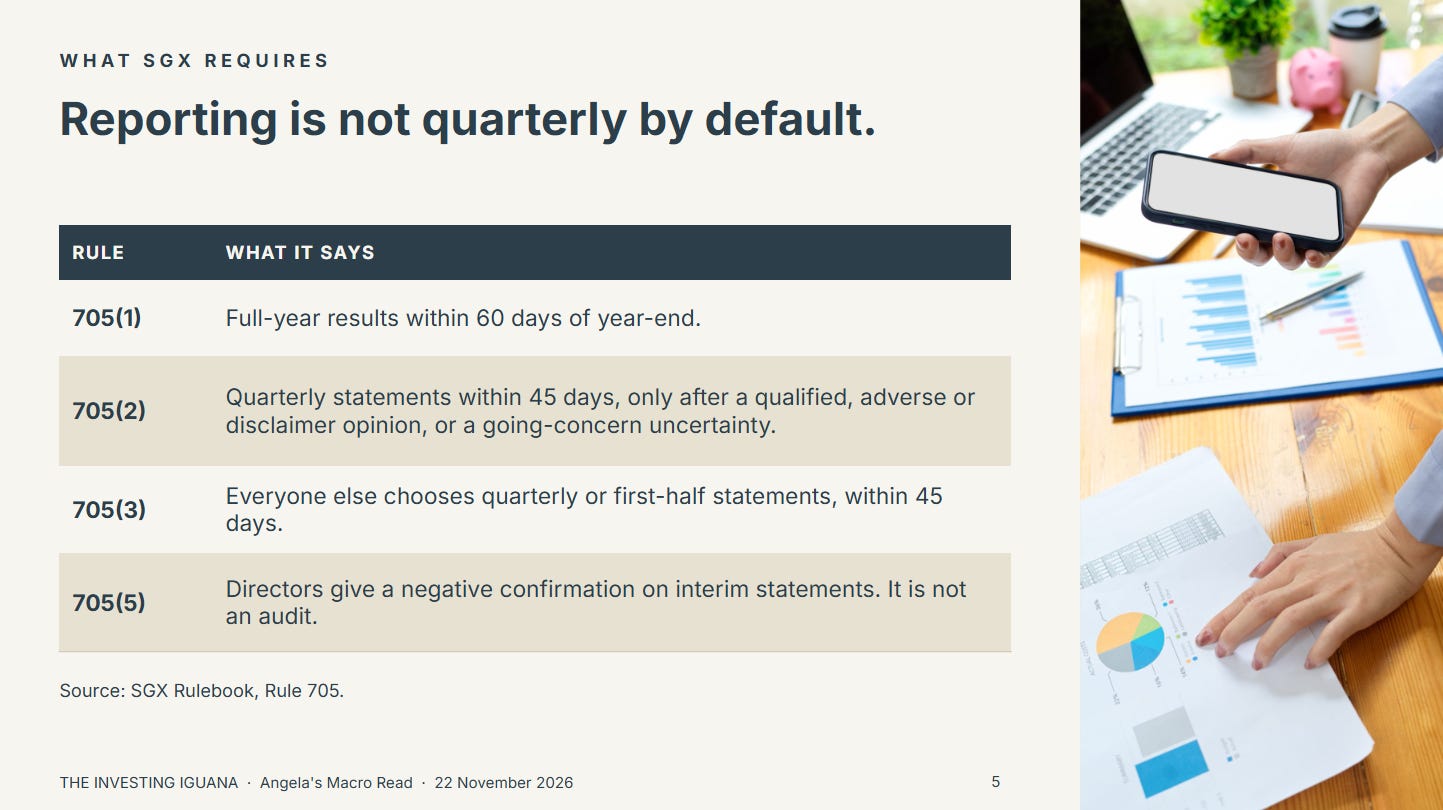
A company listed in Singapore is not required to publish a full set of results every quarter. Under SGX Listing Rule 705(1), a company announces its full-year results within 60 days of its financial year-end. Rule 705(2) makes quarterly statements for each of the first three quarters mandatory, within 45 days of quarter-end, only in one situation: where the auditors have issued a qualified, adverse or disclaimer opinion, or have flagged a material uncertainty about whether the company can continue as a going concern. Every other company, under Rule 705(3), chooses between announcing quarterly statements and announcing its first-half statements, in either case within 45 days. Where a company issues interim statements, Rule 705(5) asks the directors for a negative confirmation, which is a statement that nothing has come to their attention that would make the figures false or misleading. That is not an audit.
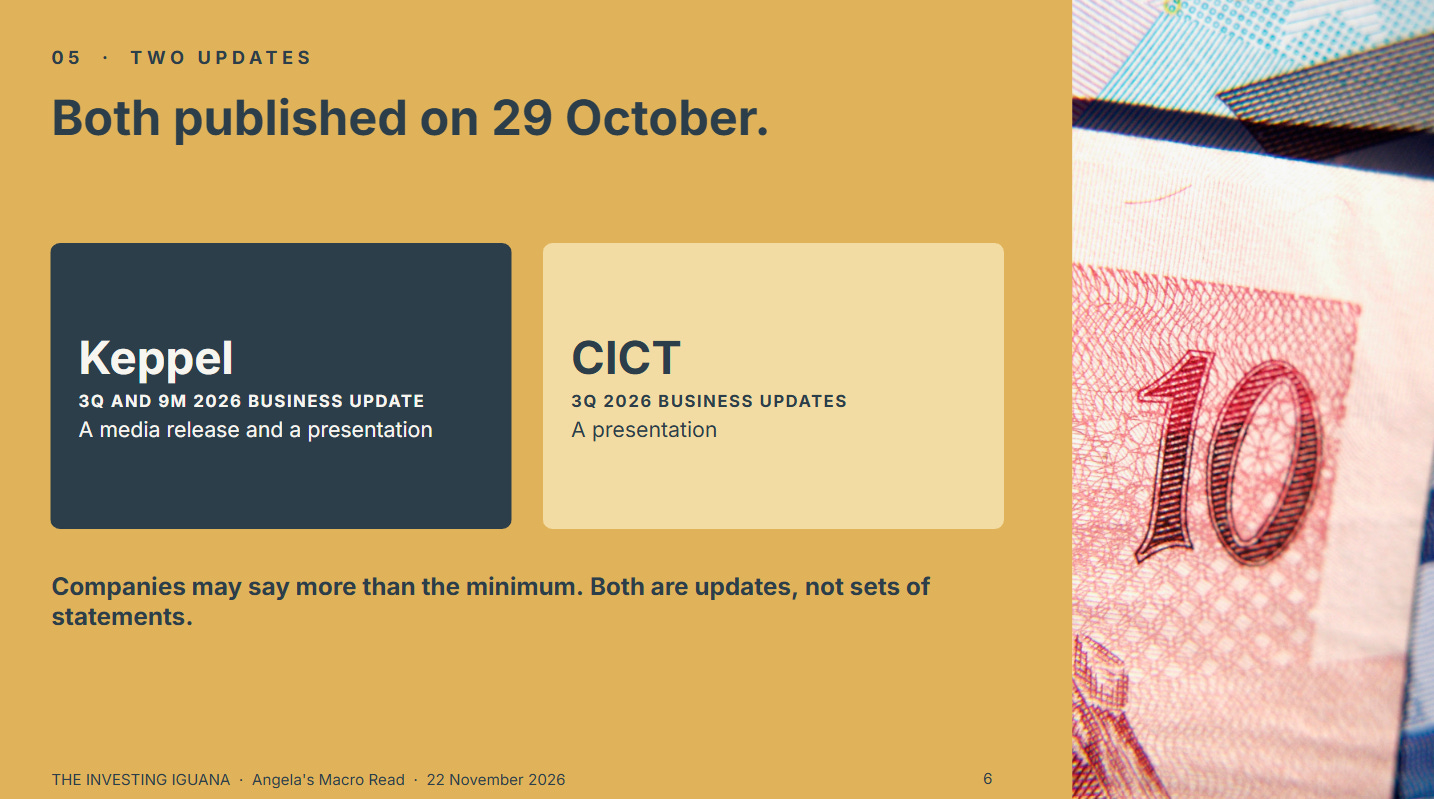
Two consequences follow. A company can choose to say more than the minimum, and many do. Keppel and CICT both published material on 29 October without a full set of third-quarter results, in documents they call business updates. Rule 703 separately requires a company to disclose material information when it arises, so a business update sits beside that duty without being a replacement for statements.
The second consequence is about payouts. SGX Rule 704(25) stops a company announcing a dividend after a period-end unless the financial statements accompany it. SGX Practice Note 7.7 allows quarterly dividends to be announced without the results if three conditions are met. The issuer must have a committed policy to announce dividends quarterly, communicated to shareholders. For each first- or third-quarter dividend, it must confirm that it will still have sufficient financial resources to meet its liabilities as they fall due after paying. And a corporation must confirm that it complies with section 403 of the Companies Act, or the equivalent where it is incorporated. In practice this means a company or trust with such a policy can report half-yearly and still announce dividends in between. Whether a given company does so is something to read in its own announcements.
None of this is unusual, and none of it is hidden. It only means that when a document arrives on the day of a quarter-end, the first job is to ask what kind of document it is.
Question One: Is This Results, or a Business Update?
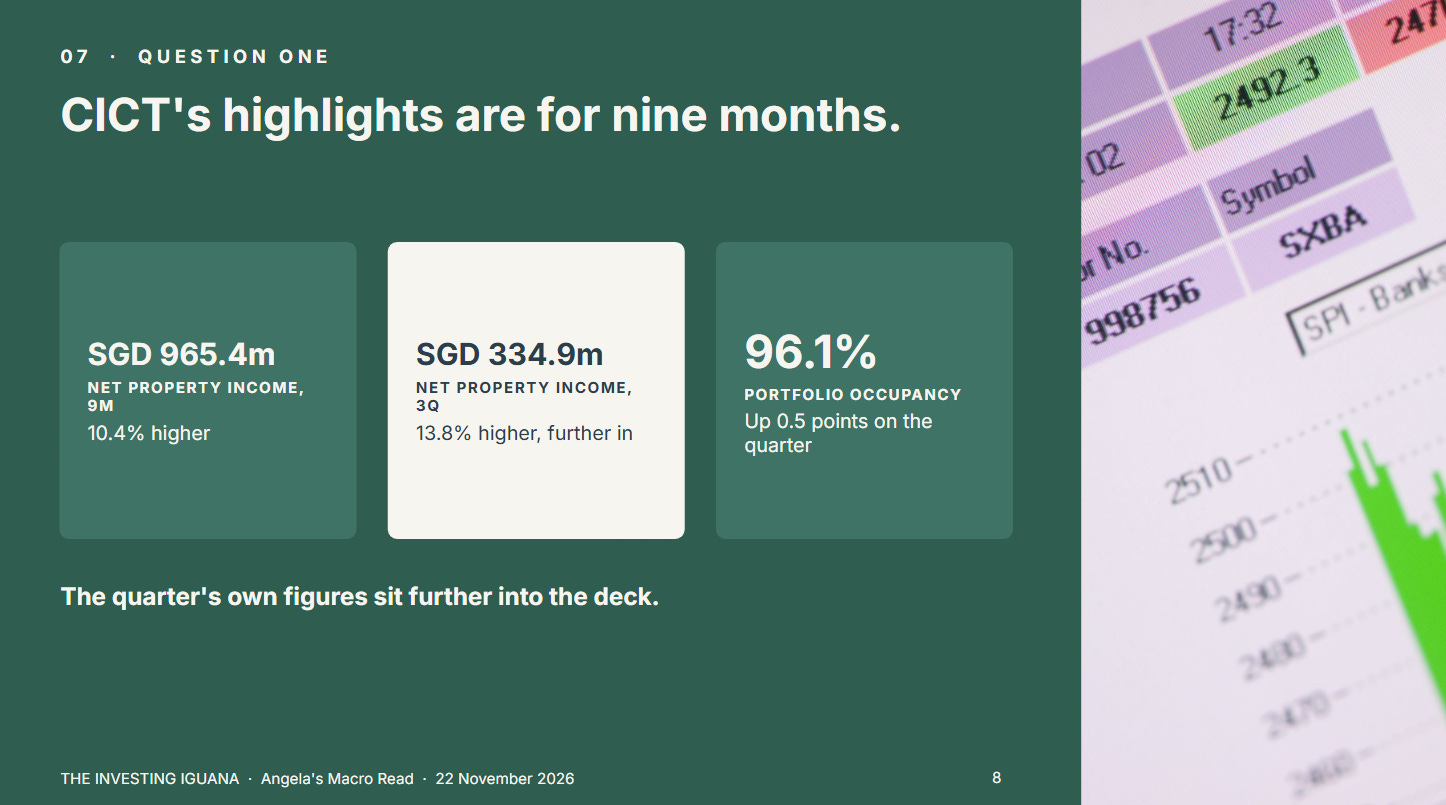
Keppel’s first-half 2026 results were published with condensed financial statements. They show the income statement, the segment table, the balance sheet and the notes. Keppel’s third-quarter document is different in kind. It is a media release and a presentation, headed 3Q & 9M 2026 Business Update. It reports percentages, deal volumes, funds under management and operating highlights. In the pages I read, it does not contain a full income statement. The nine-month profit appears as a change against last year, written in words on a slide, and not as a line in a statement.
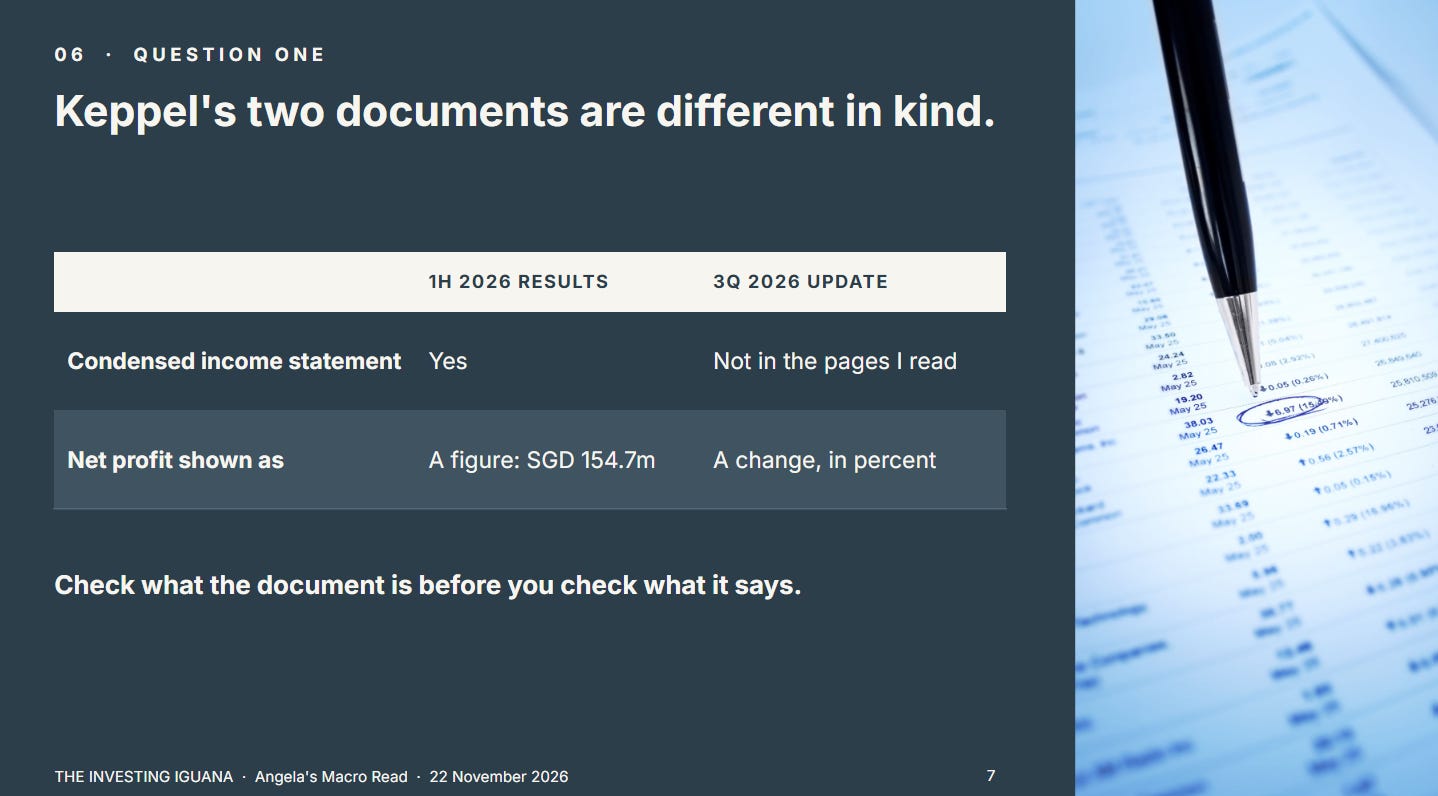
CICT’s document is also a presentation, titled 3Q 2026 Business Updates. Its highlights slide is about the nine months and not the quarter. It shows net property income of SGD 965.4 million for the nine months, 10.4% higher than a year earlier, portfolio occupancy of 96.1%, a weighted average lease expiry of 3.1 years, and aggregate leverage of 39.7%. The quarter’s own figures sit further in: gross revenue of SGD 464.5 million, 15.0% higher than the third quarter of 2025, and net property income of SGD 334.9 million, 13.8% higher.
The reading habit I would suggest costs nothing. Find the document’s title, then find whether there is a statement of profit or loss, a balance sheet and a cash flow statement behind the numbers. If there is not, the slide percentages are the company’s summary of the quarter. They may be accurate and useful. They are not the statements that the full-year audit will cover.
🟠 Angela’s Observation
A neighbour of mine once asked whether “business update” meant the company had made money, and I realised I had been giving the same answer to myself for years. I had been treating the name on the document as though it were the result. Reading Keppel’s and CICT’s documents side by side with their earlier half-year statements made the difference visible for the first time, because the earlier ones had a statement and these did not. When I open a company release, how often do I check what the document is before I check what it says?
If you are reading this as a free subscriber, thank you. If you are not yet one, the second half of this piece covers the lead number, the comparison base and where the payout appears, and subscribing to the free list is how you keep reading it.