



A Tax Relief and a Matching Grant for the Same CPF Top-Up to a Parent: Why You Cannot Claim Both 🦖
The first SGD 2,000 can earn a grant or a tax relief, not both. Who qualifies for which, and what each one is worth in dollars before the 31 December cut-off.
Take a hypothetical family. Two brothers each plan to put SGD 2,000 into their mother’s Retirement Account before the year ends, and each expects the tax relief that CPF advertises for top-ups to a parent. If their mother qualifies for the Matched Retirement Savings Scheme, the first SGD 2,000 to reach her account is matched by the Government, and the matched dollars earn no tax relief. So one brother’s SGD 2,000 would bring a grant for his mother and no relief for him. The other brother’s SGD 2,000 would bring relief and no grant.
I am using an invented family because the rule is easier to see on two names than in a list of conditions. It is the question I would want answered before 31 December: when the same top-up could earn either a tax relief or a Government grant, which one does it earn, and what decides that?
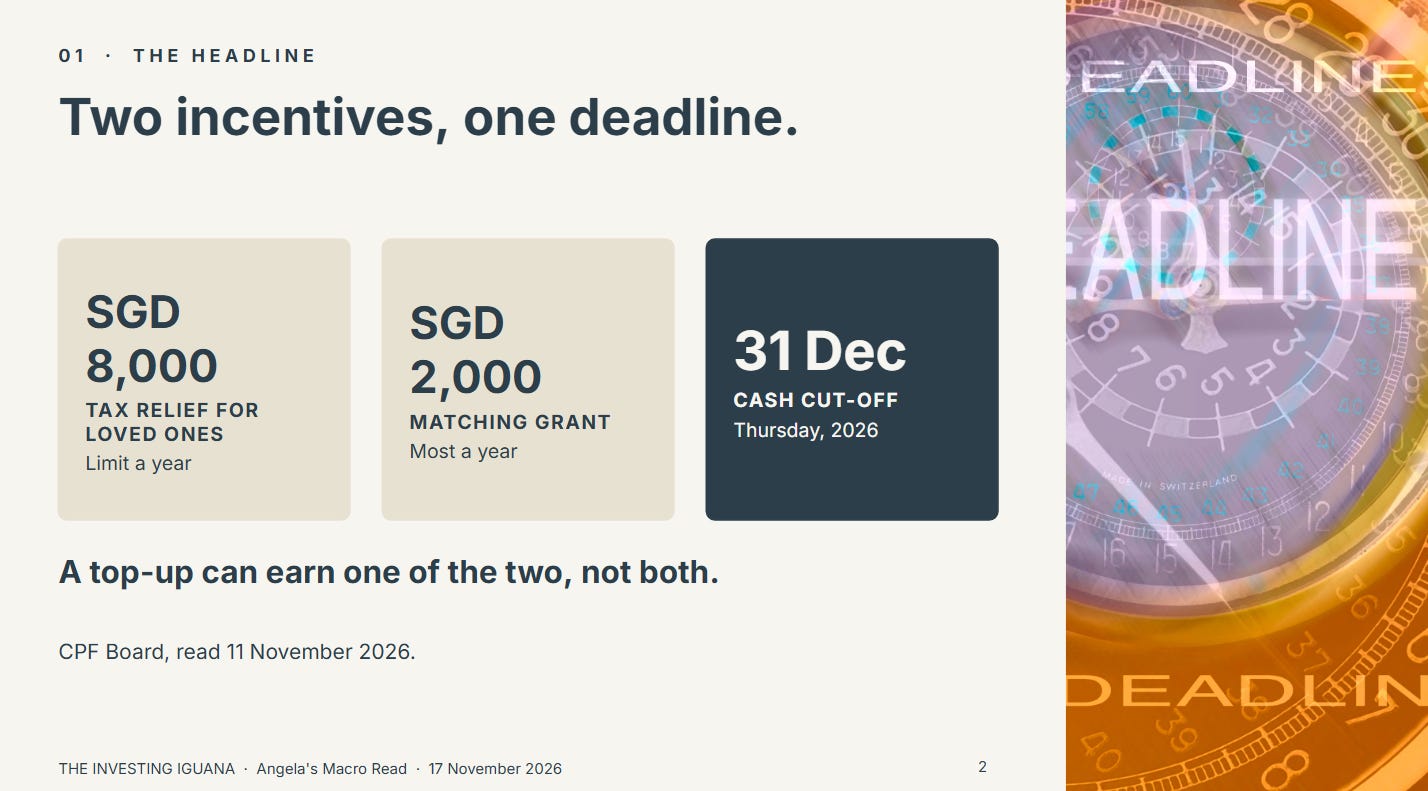
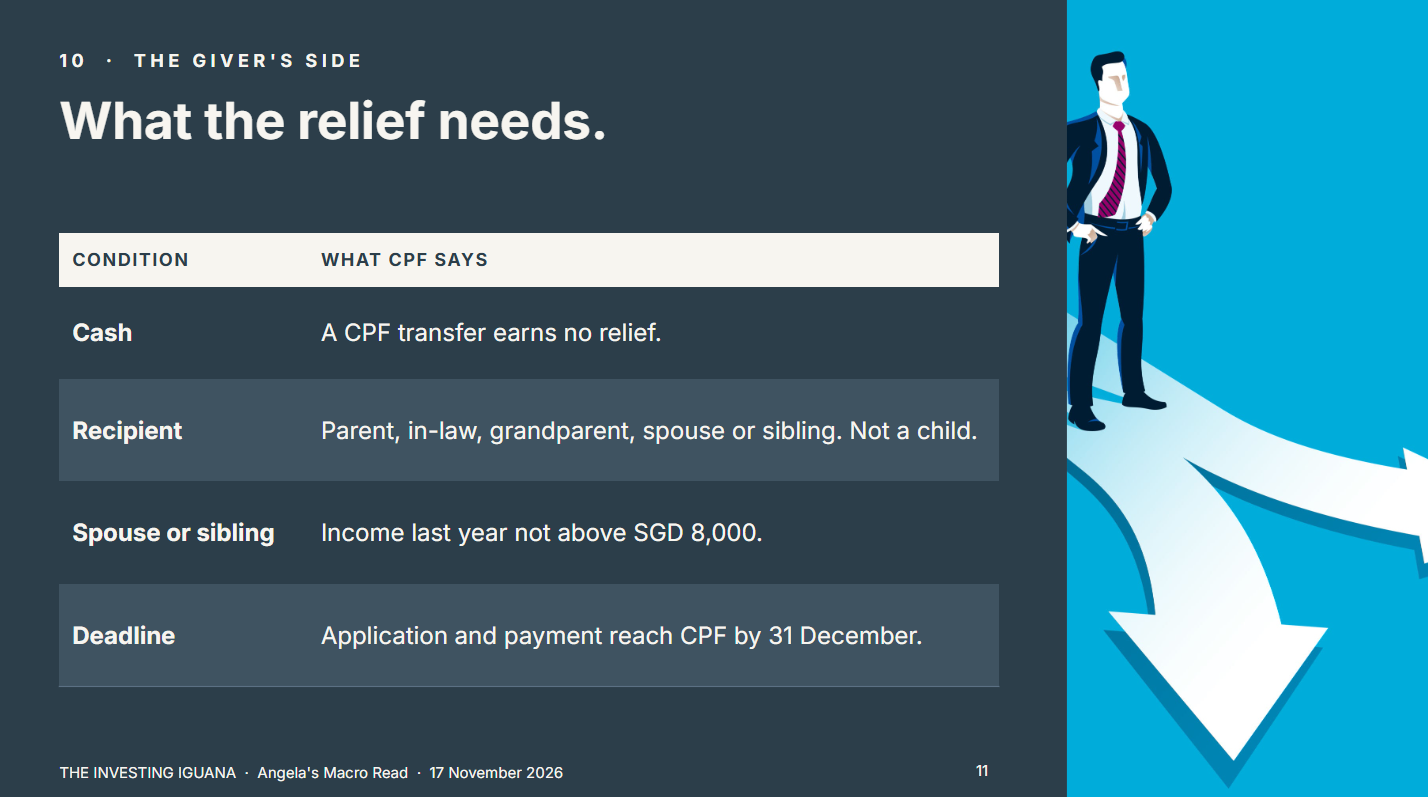
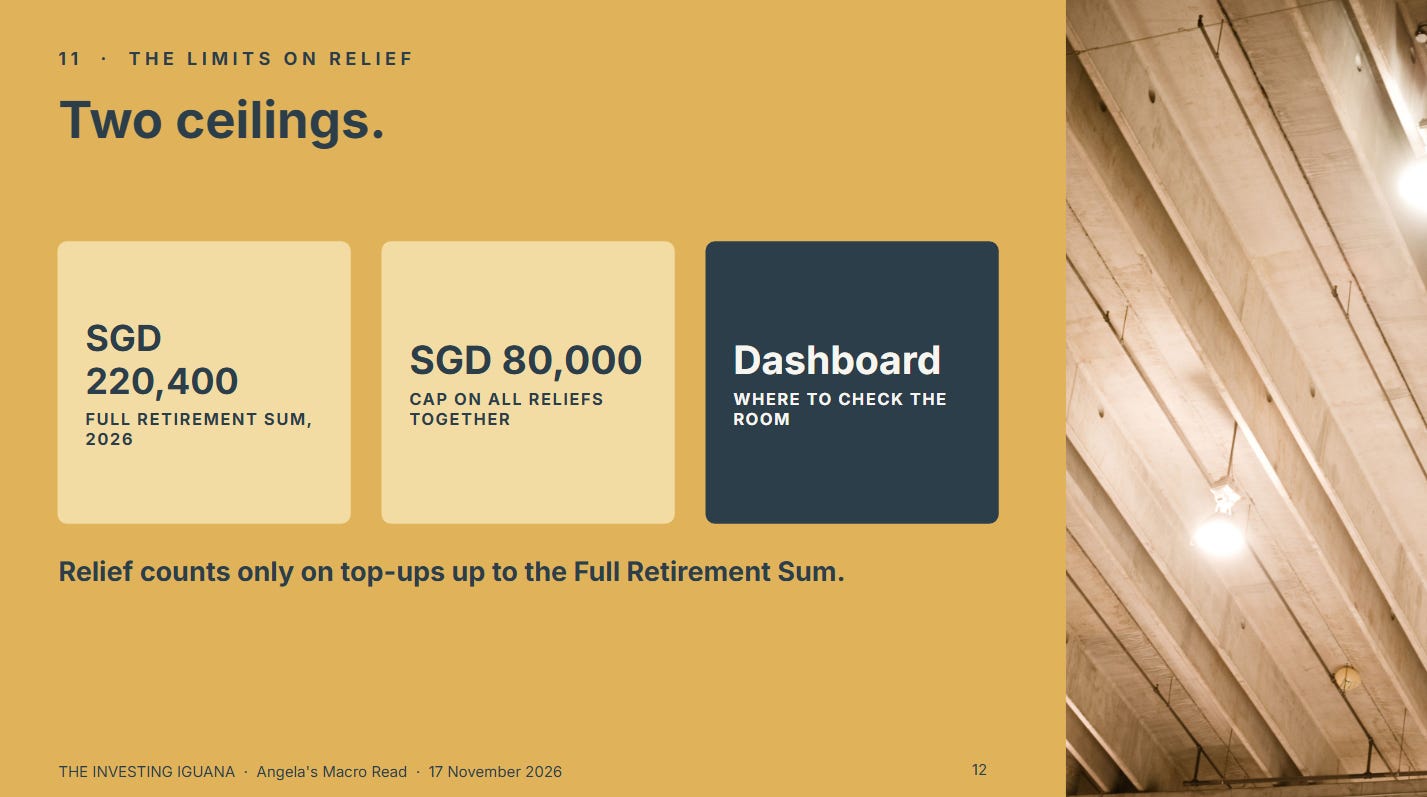
The deadline is Thursday 31 December 2026. CPF says a top-up application and payment must reach it by that date to count for tax relief in the next assessment, and says the matching grant goes to members who have received cash top-ups by 31 December 2026, credited at the beginning of 2027. The date differs by payment type: CPF says a one-time cash top-up (for example by PayNow) counts up to 31 December, while a recurring GIRO top-up had to be submitted by 31 October to earn this year’s grant, so that date has already passed. A giver can claim tax relief of up to SGD 8,000 a year for cash top-ups to their own accounts and a further SGD 8,000 for cash top-ups to loved ones. The matching grant is up to SGD 2,000 a year for each eligible recipient.
This piece does not say whether anyone should top up, or how much. That depends on a family’s cash, tax position and plans, and I am not an adviser. It sets out how the two incentives interact, so that a reader can see which one a particular top-up would earn.
What This Piece Does
It sets the tax relief and the matching grant side by side and explains the rule that decides which one a top-up earns.
It lists what the giver and the recipient each have to meet, using CPF’s own pages.
It works out the dollars: what a family top-up earns in grant and in tax saved at three tax rates, including the case of several siblings topping up the same parent, using my own arithmetic.
The first two parts are free to read. The third, the dollar arithmetic and the sibling case, is in the members’ half. This piece takes no view on any product. Nothing here is a recommendation.

Question 1: Which Incentive Does a Family Top-Up Earn?
Two incentives, two different beneficiaries
The rule that stops one top-up earning both
Angela’s Observation
Question 2: Who Has to Qualify for What?
The giver’s side: tax relief
The recipient’s side: the grant
A second matched scheme, and what this piece leaves out
What the tables do not say
Question 3: What Does a Family Top-Up Earn in Dollars?
Five top-ups, two kinds of parent
When siblings top up the same parent
The other side of the arithmetic
Angela’s Observation
What I Am Watching Next, Without Predicting
Iggy’s Forensic Read
Sources
Iggy’s Forensic Disclaimer
Question 1: Which Incentive Does a Family Top-Up Earn?
Two incentives, two different beneficiaries
The tax relief and the matching grant are both attached to cash top-ups, but they reward different people.
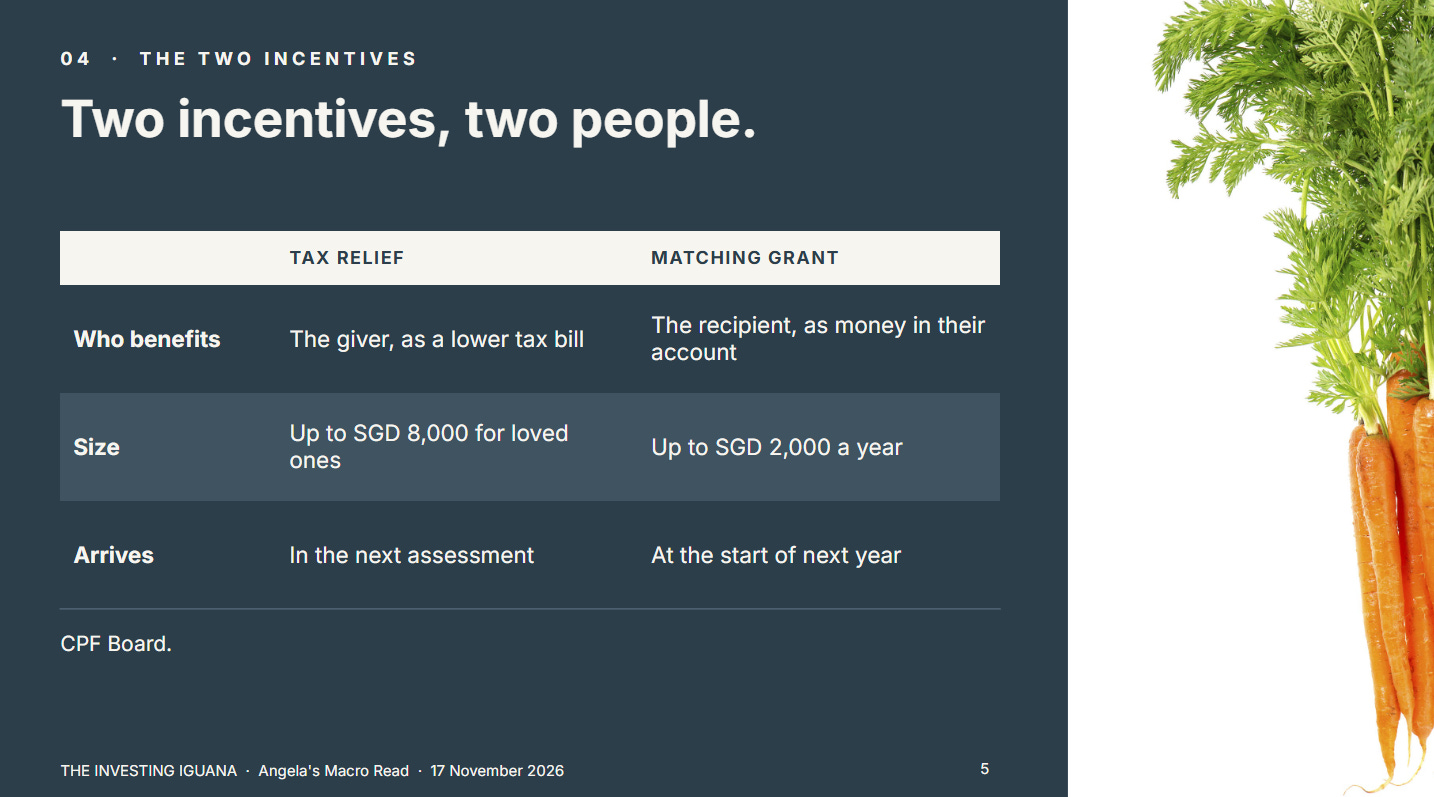
CPF’s list of loved ones for tax relief does not include children. Its own page says top-ups to a child’s account get no tax relief.
The rule that stops one top-up earning both
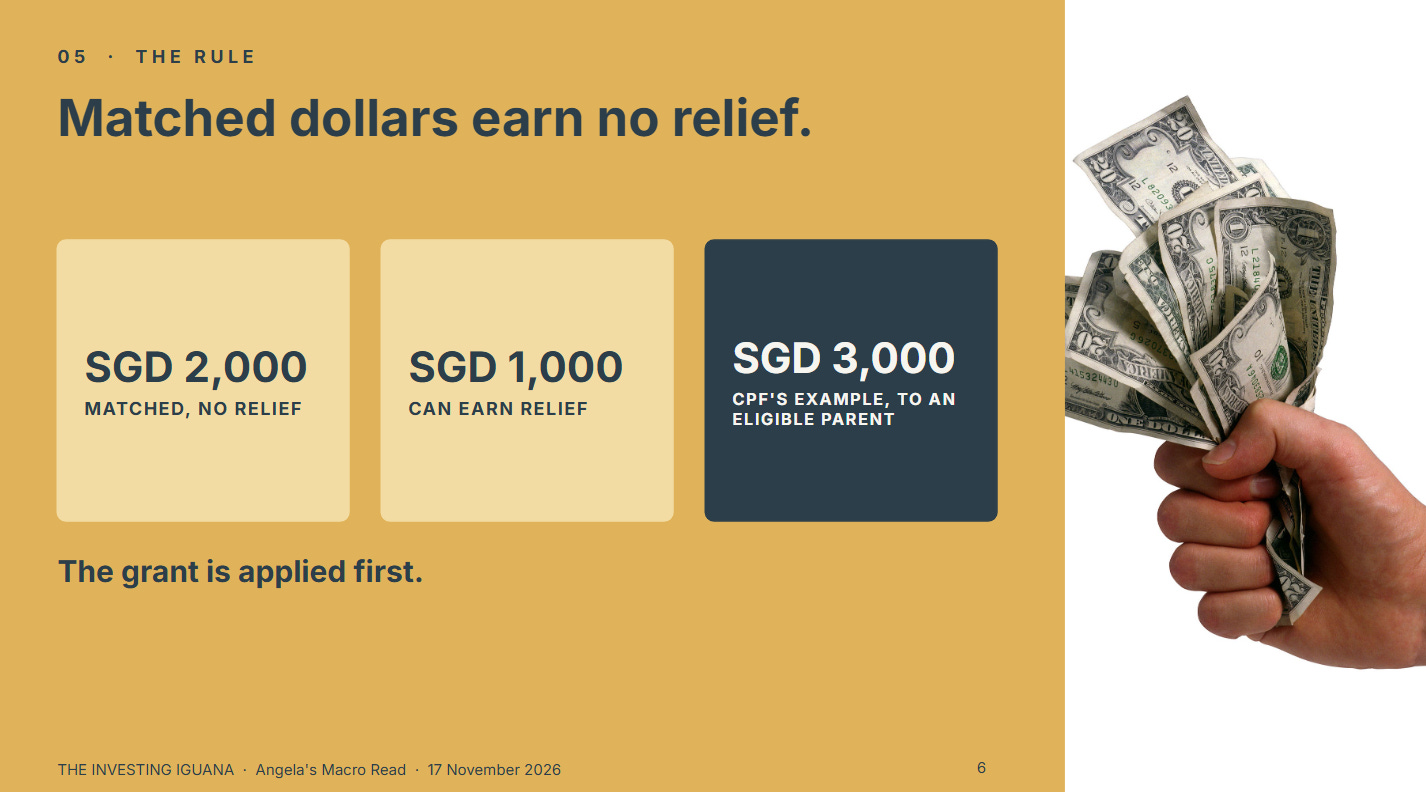
CPF states it plainly: cash top-ups that attract the matching grant do not qualify for tax relief. In practice that means the grant is applied first. CPF’s own example is a SGD 3,000 top-up to an eligible parent. The first SGD 2,000 is matched and earns no relief. The remaining SGD 1,000 can qualify for relief.
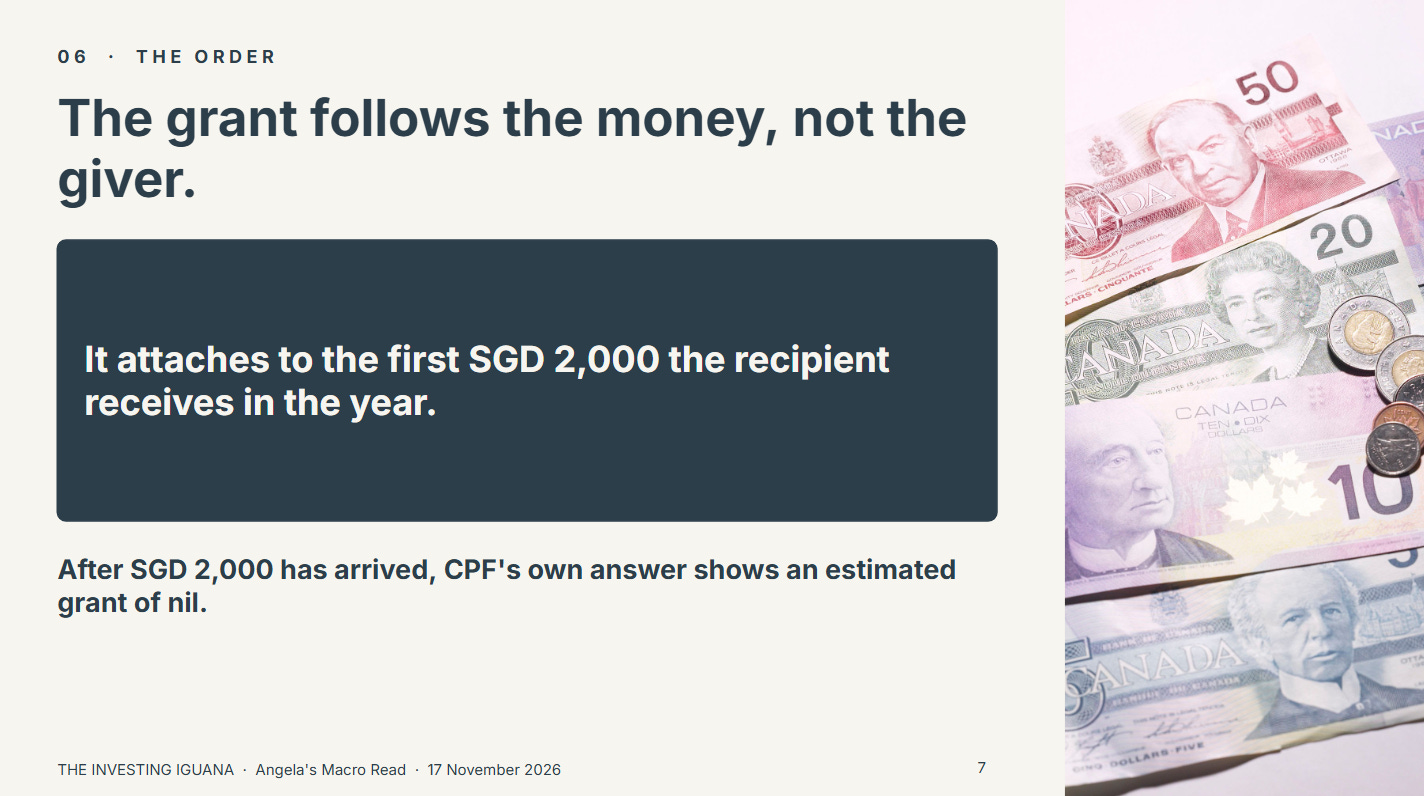
The order matters, and it is not only about one giver. In a CPF answer on Ask.gov.sg, a SGD 3,000 top-up to an eligible recipient who has already received SGD 2,000 of cash top-ups that year is shown with an estimated grant of nil. So the grant attaches to the first SGD 2,000 the recipient receives in the year. It does not attach to a particular giver, and it is capped for the recipient, not for each person who tops up.
For a parent who does not meet the grant’s conditions, none of this applies. A top-up to that parent can earn tax relief for the giver, up to the limits in the next section, and no grant.
🟠 Angela’s Observation
The word “matched” sounds like a bonus added to what I put in. In the rule it is also a substitute: the dollars the Government matches are the dollars that no longer earn me a tax relief. The two incentives are not stacked, they are sorted, and the sorting is done by who the recipient is and when the money arrives. When I say a top-up looks attractive, whose benefit am I counting, mine as the giver or my parent’s as the recipient, and have I checked which of the two the rule gives me?
Question 2: Who Has to Qualify for What?
The giver’s side: tax relief
These are the conditions for relief on a top-up to a loved one, from CPF’s pages.
On the Full Retirement Sum, CPF’s page says relief is only given up to that figure, and that the Retirement dashboard shows how much a member can top up. I read that as meaning a recipient whose balance is already near SGD 220,400 leaves little room that counts for relief. I would check the dashboard and not rely on my reading.
The recipient’s side: the grant
The matching grant is assessed by CPF, not claimed. These are the conditions for 2026 on CPF’s news release, last updated on 17 September 2026.
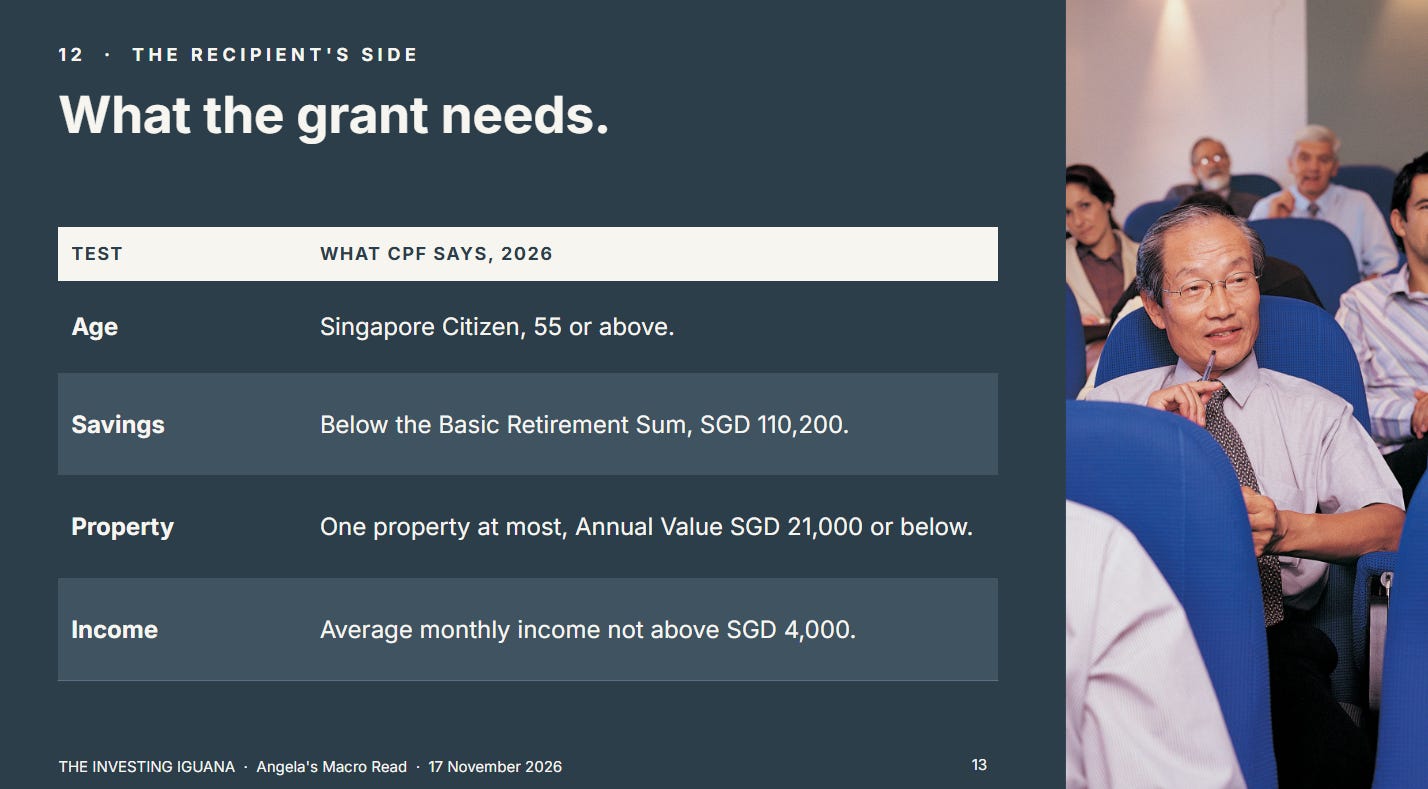
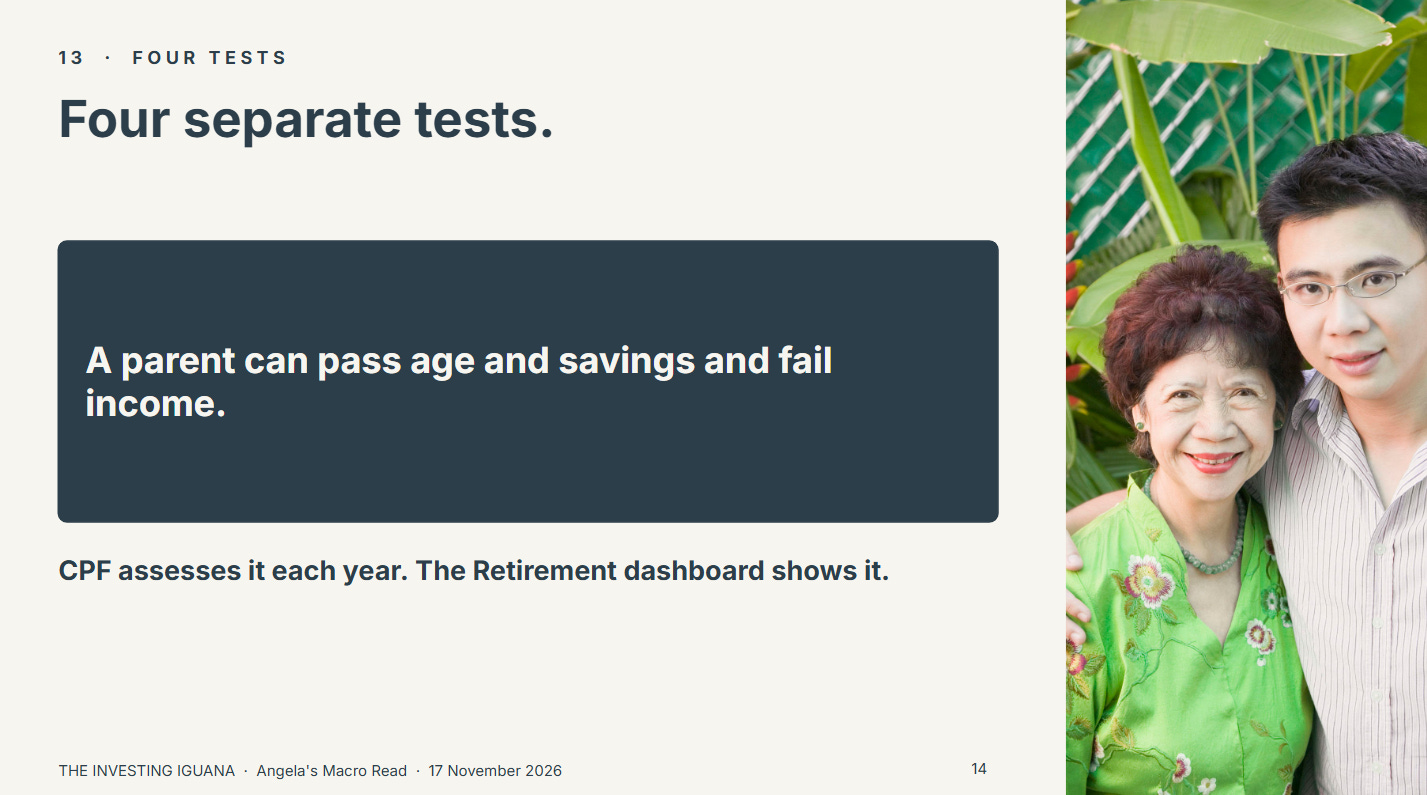
These are four separate tests, and a parent can pass the age and savings tests and fail the income test. CPF assesses eligibility automatically each year and notifies members who qualify. The Retirement dashboard shows a member’s eligibility at any time, and CPF says a giver can use it to check a loved one’s.
A second matched scheme, and what this piece leaves out
There is also a Matched MediSave Scheme, a five-year pilot from 2026 to 2030. It matches up to SGD 1,000 a year on cash top-ups to the MediSave Account of Singapore Citizens aged 55 to 70 whose MediSave savings are below SGD 39,500 in 2026. The same rule applies: matched top-ups do not qualify for tax relief.
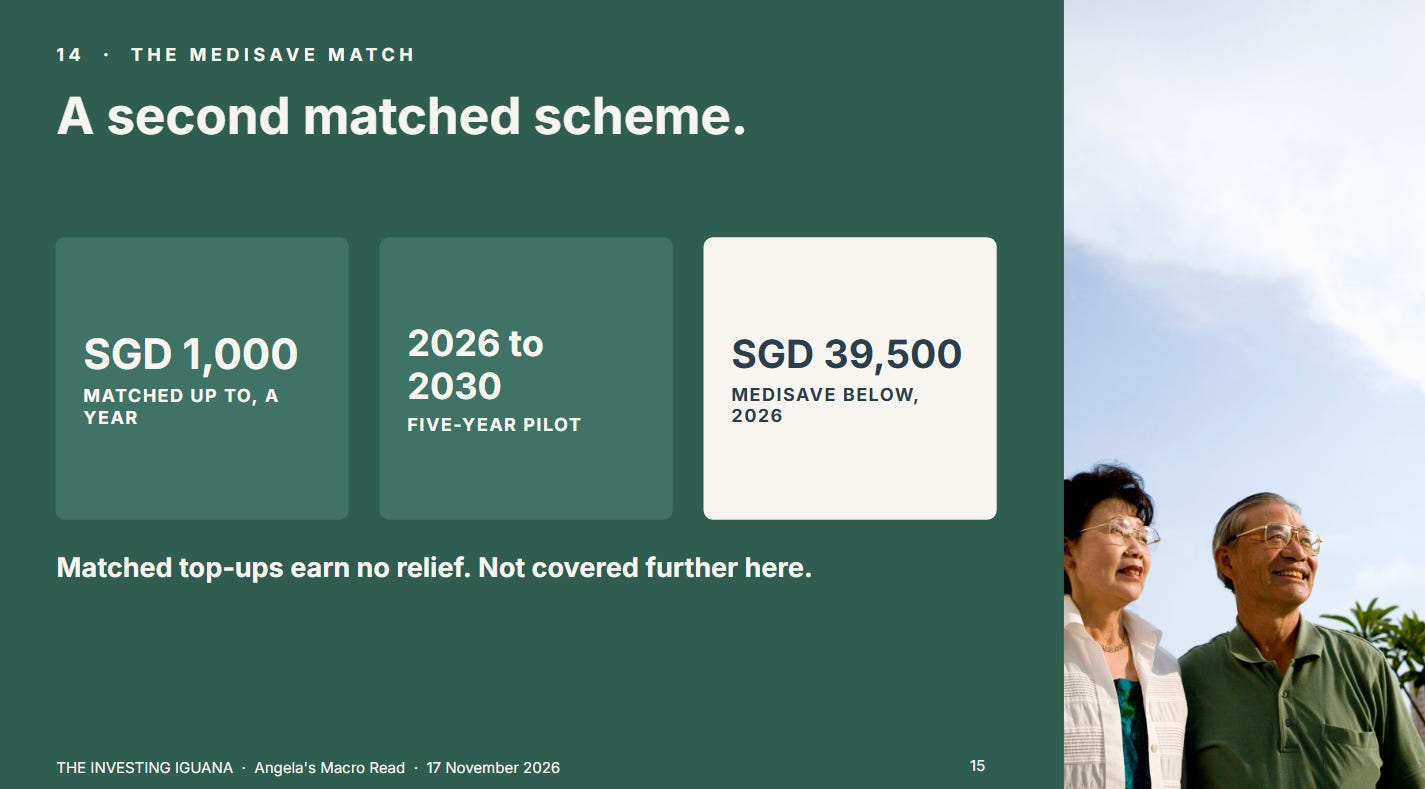
CPF’s page on this scheme gives the relief rule: the first SGD 1,000 of cash top-ups to an eligible recipient in the year attracts the grant and no relief, and top-ups beyond that can qualify for relief within the same SGD 8,000 limit for loved ones. CPF’s example is a SGD 3,000 top-up to an eligible loved one, which earns a SGD 1,000 grant and relief on the remaining SGD 2,000. That is a different split from the retirement scheme, where the grant is SGD 2,000. I go no further into MediSave top-ups here.
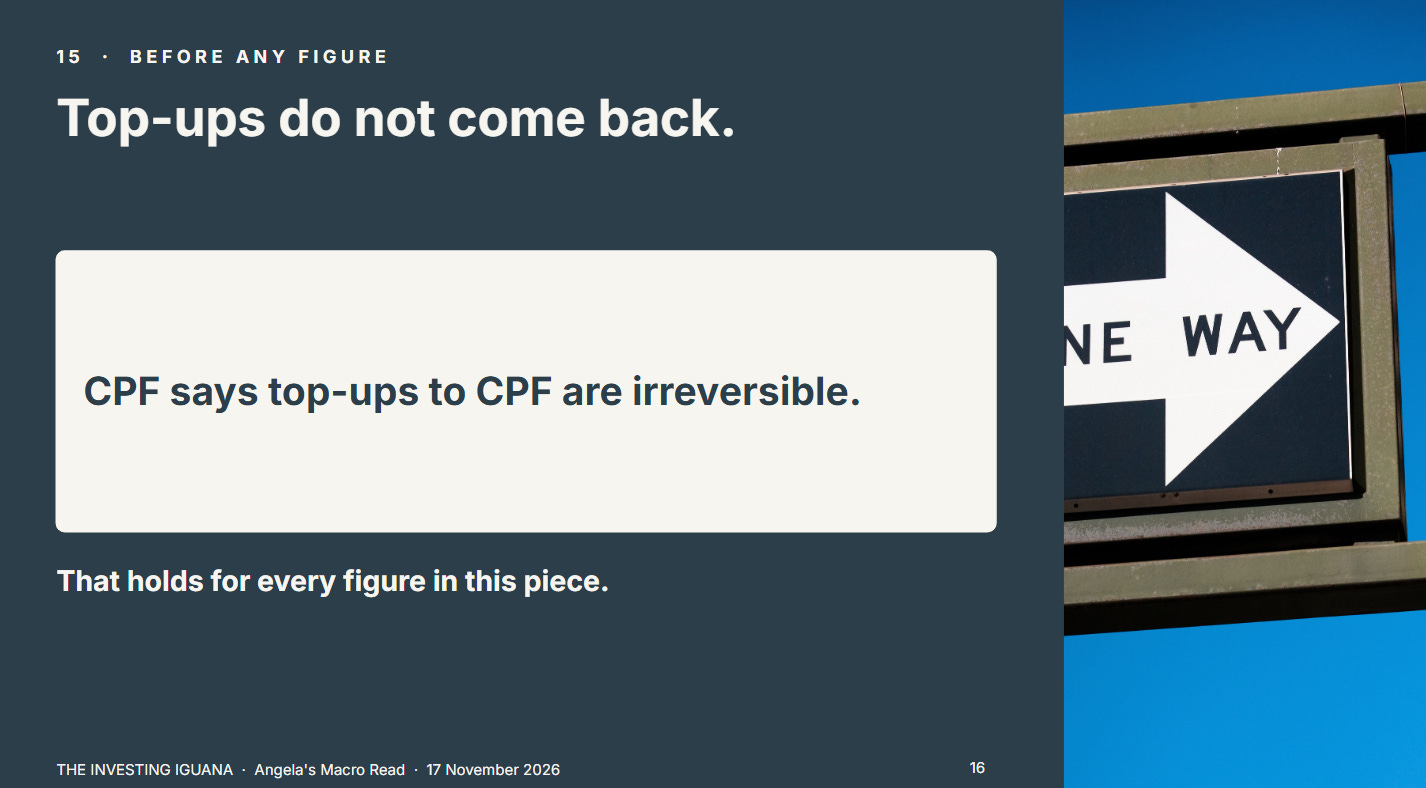
Top-ups to CPF are irreversible, according to CPF’s own article on topping up loved ones. That is a fact about every figure in this piece. The money does not come back if a family’s plans change.
What the tables do not say
They do not say whether any particular parent qualifies for the grant, or whether a particular giver pays enough tax for relief to be worth anything. A giver whose chargeable income is at or below SGD 20,000 pays no tax at the first band, so relief saves them nothing. The tables also do not say what a family should do. The obvious objection is that all this is a reason to ask CPF directly and not to read an article. I agree, and the dashboard is where the answer for a specific parent is. What the article can do is show what to ask.
What the Paid Half Adds
The free half sets out the two incentives, the rule that sorts a top-up between them, and what each side has to meet. The paid half adds the part that takes the most work to build: what a family top-up earns in dollars, as grant and as tax saved, for five different top-ups at three tax rates, and what happens when several siblings top up the same parent in the same year. The extra is depth, nothing else. There are three ways in.
The Substack Only Plan, US$8/month, gives the full written analysis, portfolio walkthroughs and analyst cheatsheets.
The YouTube Only Plan, S$5/month, gives the full-length Members Edition video.
The YouTube/Substack Combo, S$12/month, gives all of it.
🔒 What’s Next
The next section puts five top-ups into dollars, then shows what happens to the grant and the relief when three siblings each top up the same parent.
