



Seatrium Won SGD 1.7 Billion of Orders. Its Net Order Book Is Down SGD 5.6 Billion Since December
The 19 November update gives no revenue, profit or dividend. Here is what its order book table shows: gross against net, by delivery year, by stage of completion and by customer.
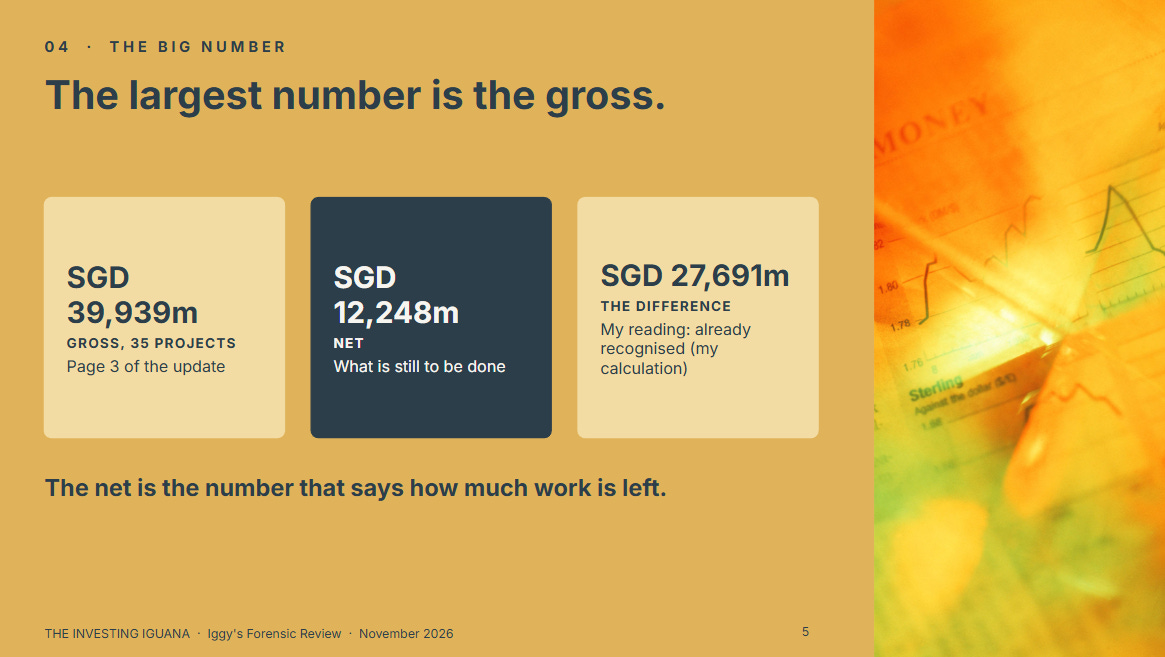
SGD 39,939 million is the largest number in Seatrium’s third-quarter update. It sits at the bottom of the gross column in the order book table on page 3, and it is the number a quick reader carries away. The number beside it is SGD 12,248 million, and that is the one that says how much work is still to be done. The difference is SGD 27,691 million, which I read as the part of those 35 projects the company has already recognised as revenue.
Seatrium published the update on Thursday 19 November 2026. It has no revenue figure, no profit figure, no cash or debt figure and no dividend. What it has is an order book table, a list of new contracts and a sentence saying that underlying profit for the year should be materially higher than last year. This piece reads the table, because the table is where the numbers are.
If you own Seatrium, the update tells you the company says execution is on track and new orders are picking up, and its table shows a net order book smaller than it was in December. If you are looking at the stock for the first time, a gross number close to SGD 40 billion looks like years of work ahead. Which reading holds depends on the net column. I am not telling either of you what to do. I am setting out what the company reported, what it did not, and which numbers I can check.
What This Piece Does
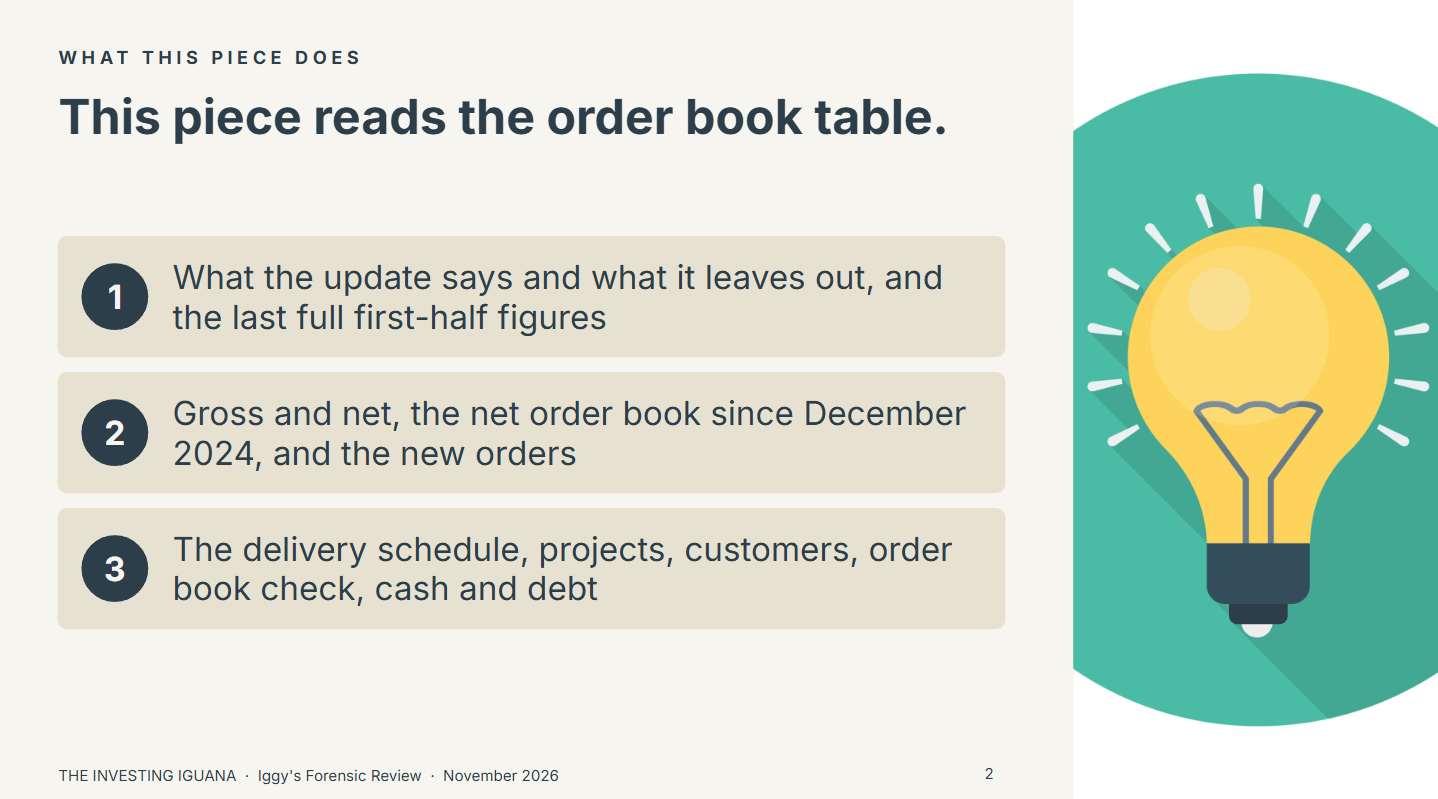
It sets out what the update says and what it leaves out, and what the company last reported in full for the first half.
It explains gross and net order book, shows how the net order book has moved since December 2024, and lists the new orders.
It reads the delivery schedule, the stage of completion and the customer mix in the table, checks how the order book moved, and sets out the first-half cash flow and debt.
The first part is free, including the order book trend, the new orders, the meaning of “underlying” profit and the dividend and buyback facts. The delivery ladder against the company’s 2028 target, the stage-of-completion and customer counts, the order book bridge, the cash flow and debt figures, and the closing read are in the paid half.
I do not assign a rating to Seatrium in this piece. The update has no balance sheet and no new dividend, and my framework needs both. No view on share price direction. Nothing here is a recommendation.
Table of Contents
What the Update Says, and What It Leaves Out
Gross and Net: SGD 39.9 Billion Against SGD 12.2 Billion
🦖 Iggy’s Insights
The Net Order Book Since December 2024
🦖 Iggy’s Insights
The New Orders
What “Underlying” Means for FY2026
The Dividend and the Buyback
What the Paid Half Adds
The Delivery Ladder
🦖 Iggy’s Insights
How Far Along the Projects Are
Who the Projects Are For
Checking the Order Book Bridge
What the Last Full Results Show About Cash
Debt and Interest at 30 June
What I Would Compare Next
🦖 Iggy’s Forensic Read
Sources
What the Update Says, and What It Leaves Out
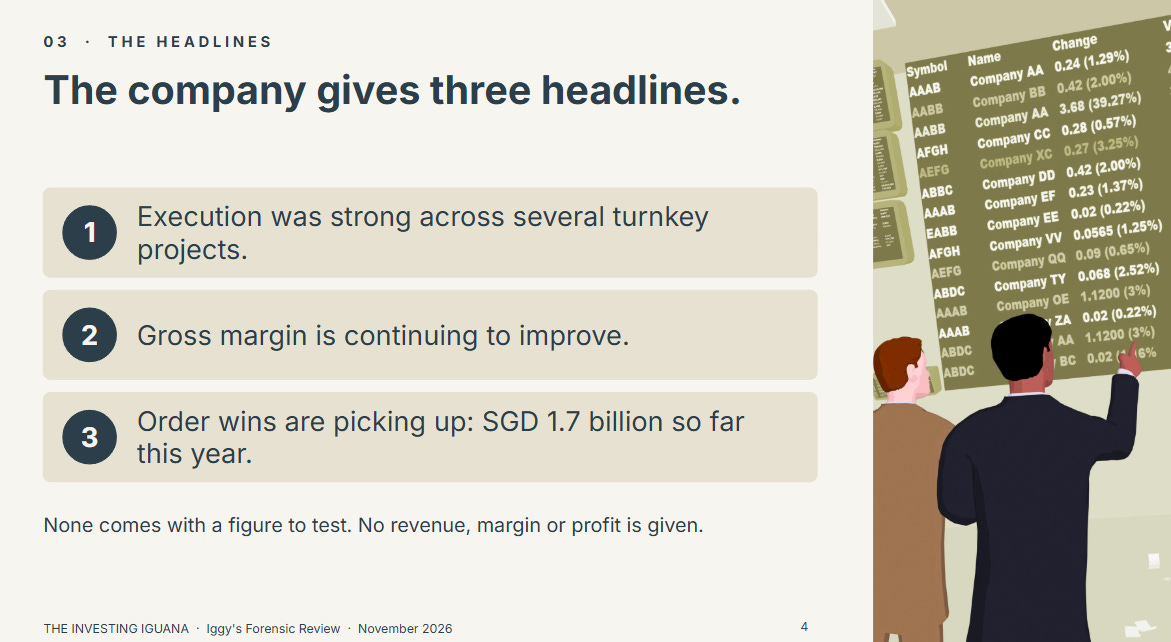
The company gives three headlines. Execution was strong across several turnkey projects, with revenue “maintaining a steady run rate”. Gross margin continued to improve, which it attributes to project mix, cost discipline and savings from divesting non-core businesses. And order wins picked up: SGD 1.7 billion of new orders so far this year, and a net order book of SGD 12.2 billion across 35 projects, with deliveries through 2033.
Three operational details stand out. The company delivered an offshore substation for the Revolution Wind farm and a floating production unit for the Sparta development. It completed what it calls the first dual sailaway of two floating production, storage and offloading vessels, P-80 and P-82. And it says recurring annualised cost savings above SGD 50 million from completed divestments are on track.
None of that comes with a number you can test. The update gives no revenue, no gross margin, no net profit, no cash, no debt and no dividend. “Run rate” and “continuing to improve” are the company’s words, and the base each one is measured against is not in the document.
The company calls this a business update for the third quarter, and it is a different thing from a full set of results. It does not need to carry financial statements, and this one does not. That does not make it a document to skip. It makes it one to read for what it says, and to be exact about what it cannot answer.
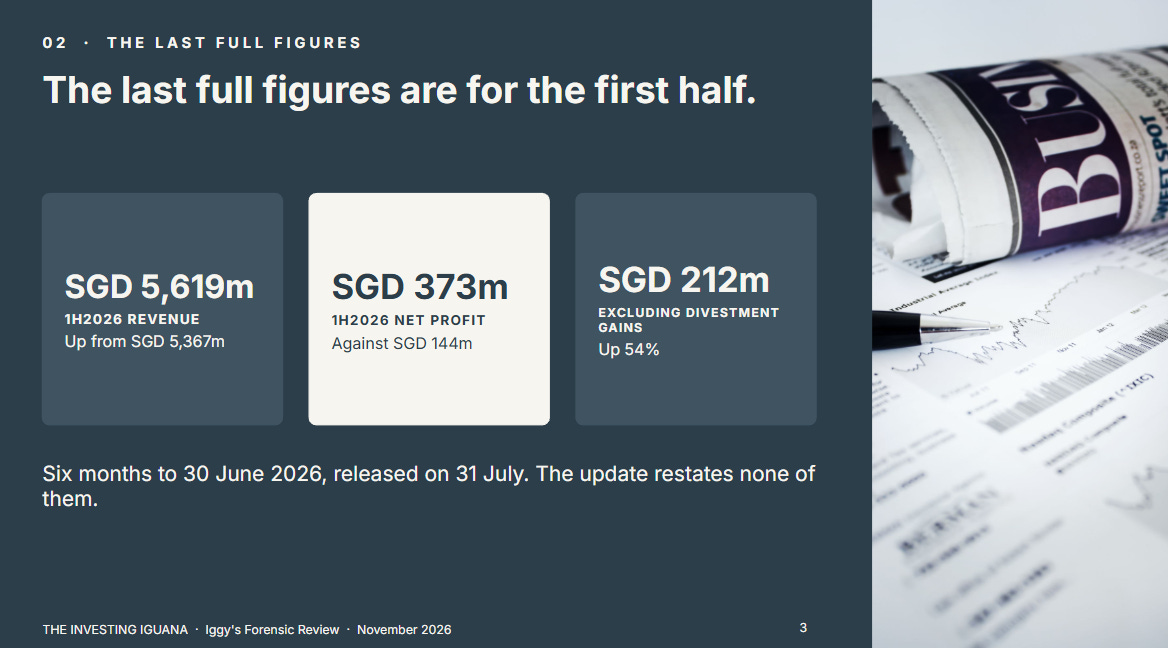
The last full set of figures is for the first half, released on 31 July 2026. Revenue was SGD 5,619 million, up from SGD 5,367 million. Gross profit was SGD 482 million, a gross margin of 8.6% against 7.4%. Net profit was SGD 373 million against SGD 144 million, and the company says net profit excluding divestment gains was SGD 212 million, up 54%. Those are the numbers to compare the third-quarter update with, and the update does not restate any of them.
Gross and Net: SGD 39.9 Billion Against SGD 12.2 Billion
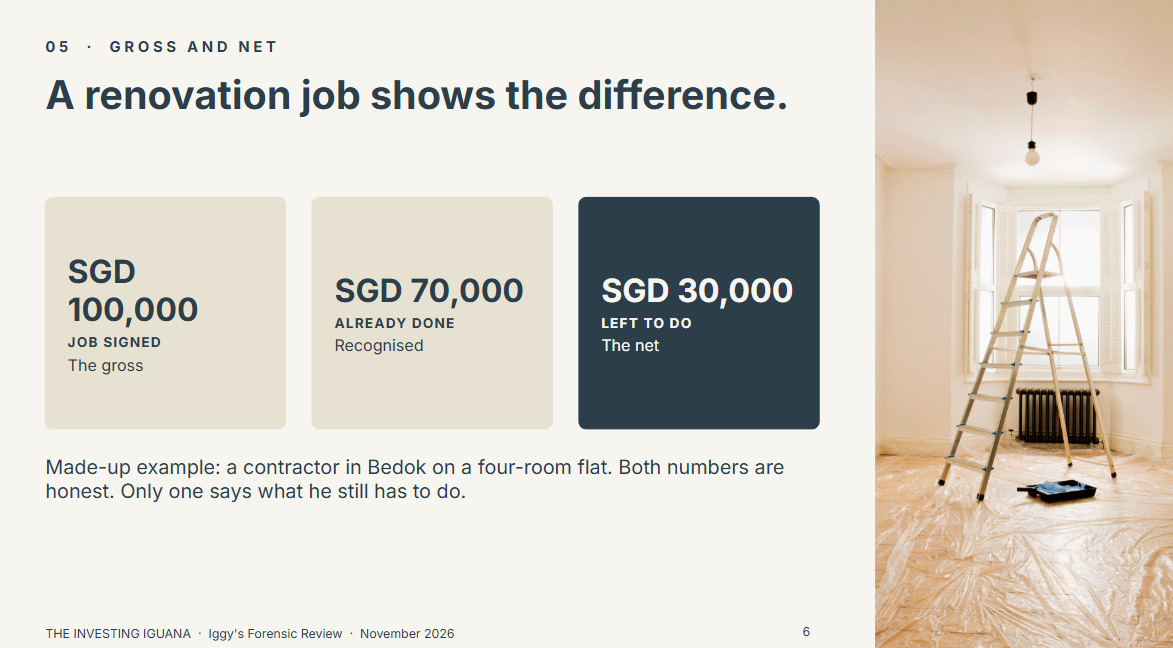
Imagine a renovation contractor in Bedok who signs a SGD 100,000 job on a four-room flat. When he has finished SGD 70,000 of the work, he has SGD 30,000 of work left to do. If he tells you he has SGD 100,000 of jobs on hand, he is quoting the gross. If he tells you SGD 30,000, he is quoting what is left. Both numbers are honest, and only one tells you what he still has to do. (An invented example, to show the shape of the problem.)
Seatrium shows both columns. The update labels them gross and net and does not define either, so here is how I read them. The company’s FY2025 results release defines the net order book as the remaining contract value yet to be recognised as revenue. Its first-quarter 2023 update paired a net order book with a total original contract sum. On that reading, the gross column is the original contract value and the net column is what remains.
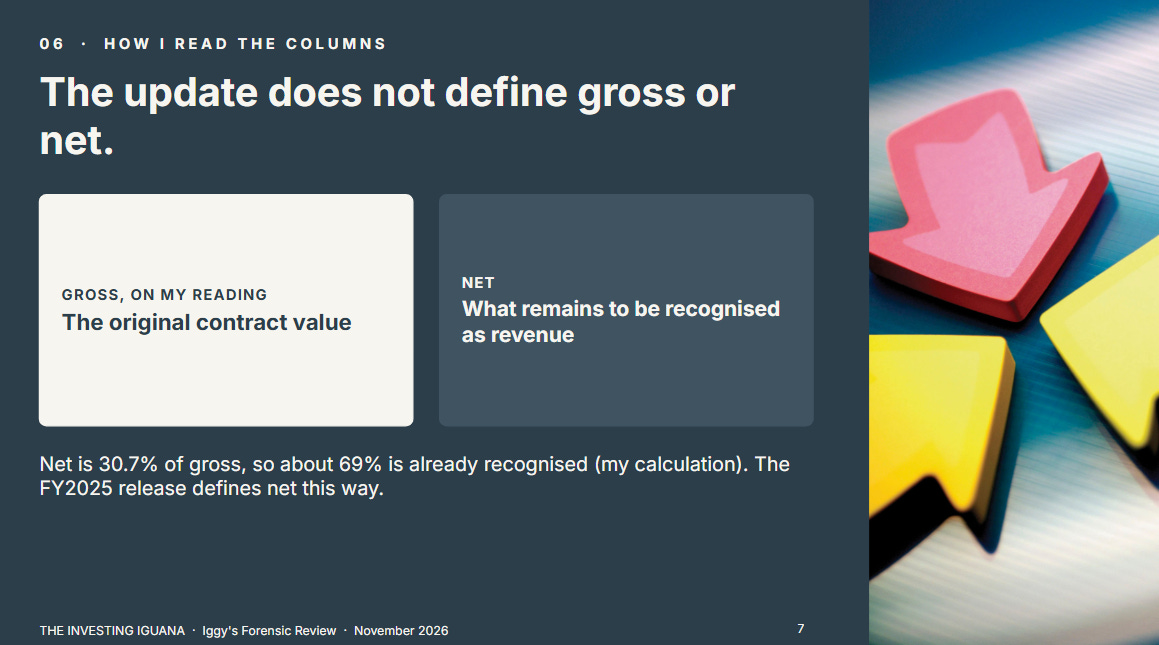
The table’s total row shows 35 projects, a gross of SGD 39,939 million and a net of SGD 12,248 million. The net figure is 30.7% of the gross, which means about 69% of the contract value across these projects has already been recognised, my arithmetic. The footnote says the table includes the year-to-date order wins and major upgrade and conversion orders that take more than 12 months to complete. The table also splits both columns by delivery year, and the paid half reads that split.
🦖 Iggy’s Insights
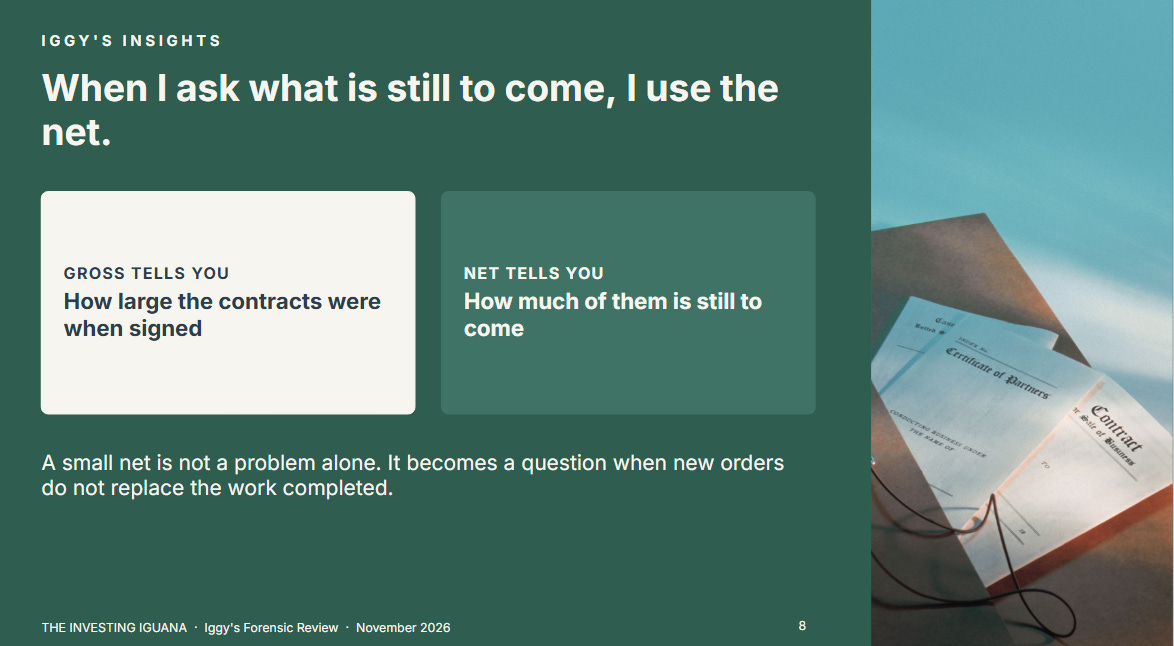
A gross order book and a net order book answer different questions. Gross says how large the contracts were when they were signed. Net says how much of them is still to come. A net figure well below the gross is not a problem in itself, because it can mean the work is nearly done. It becomes a question only when new orders do not replace the work as it is completed. When I ask what is still to come, I use the net.
The Net Order Book Since December 2024
Here is the net order book at the dates the company reported it.
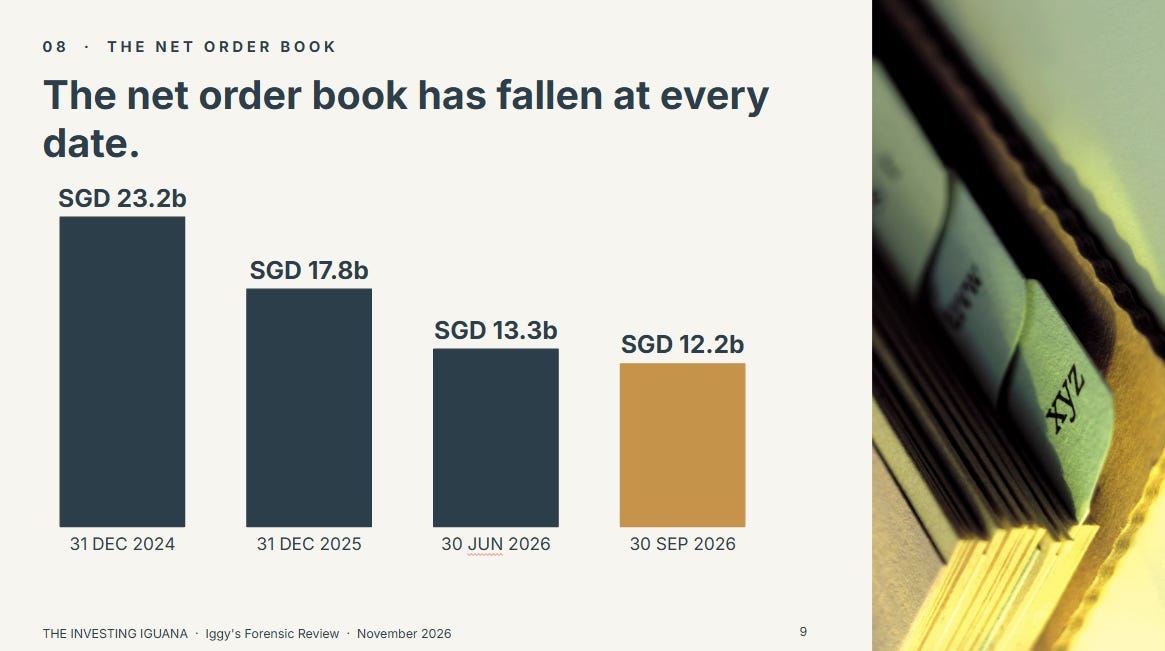
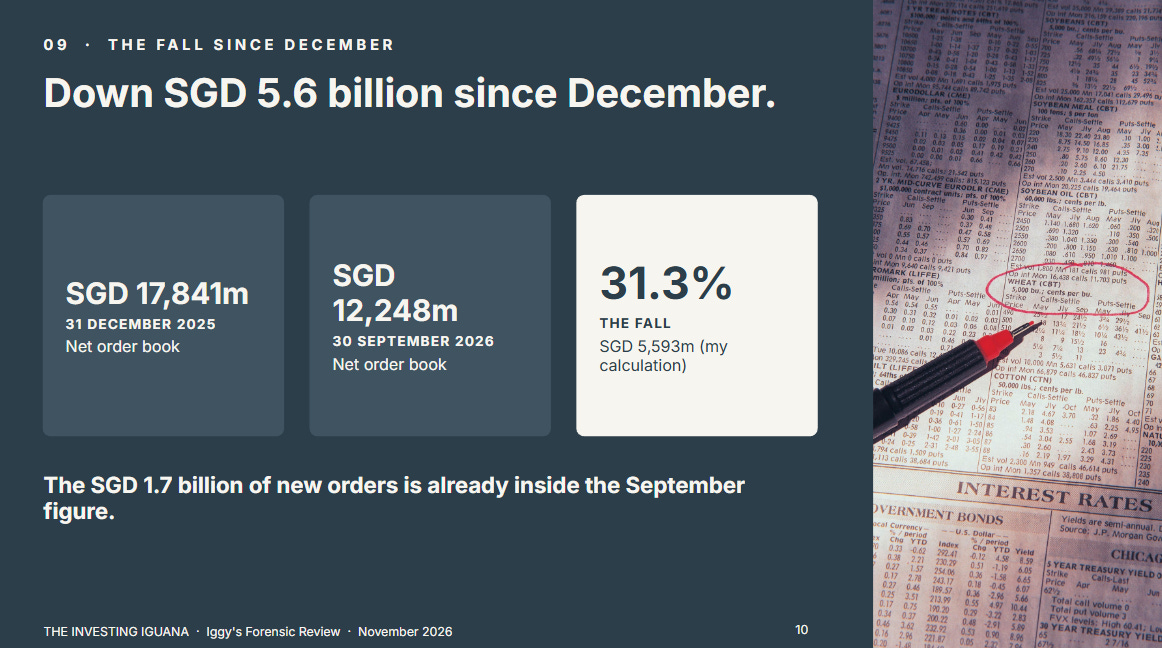
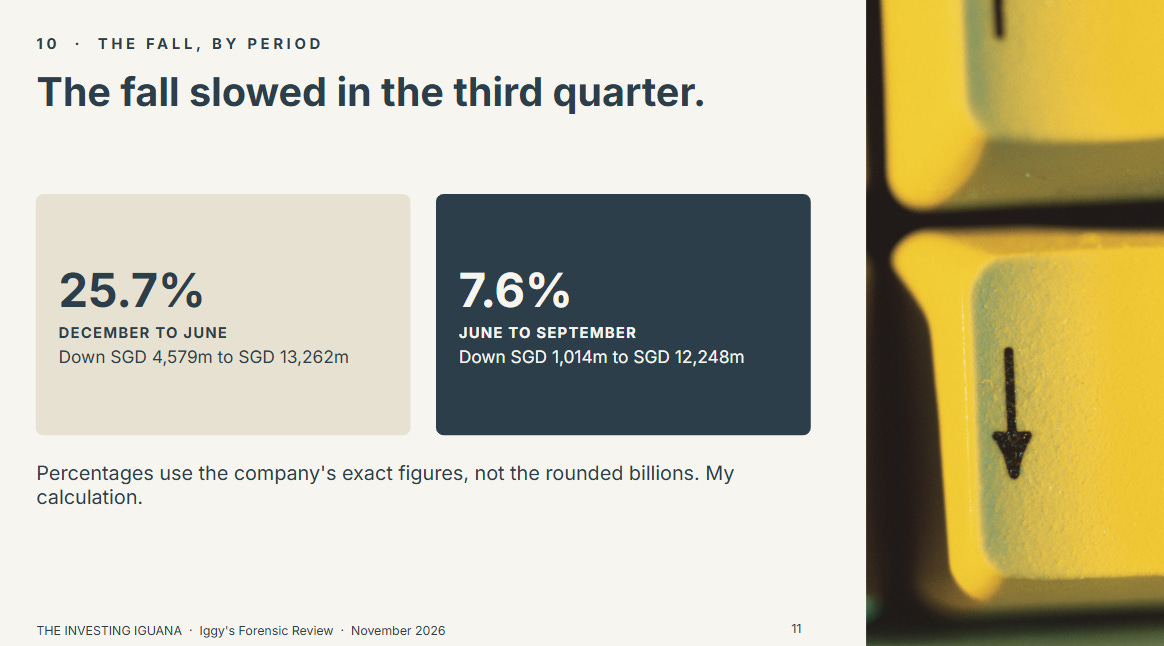
From 31 December 2025 to 30 September 2026 the net order book fell by SGD 5,593 million, or 31.3%, my arithmetic on SGD 17,841 million and SGD 12,248 million. The September figure already includes the SGD 1.7 billion of new orders won this year, so the wins are not on top of it. The fall is what is left after the company recognised revenue and signed new work.
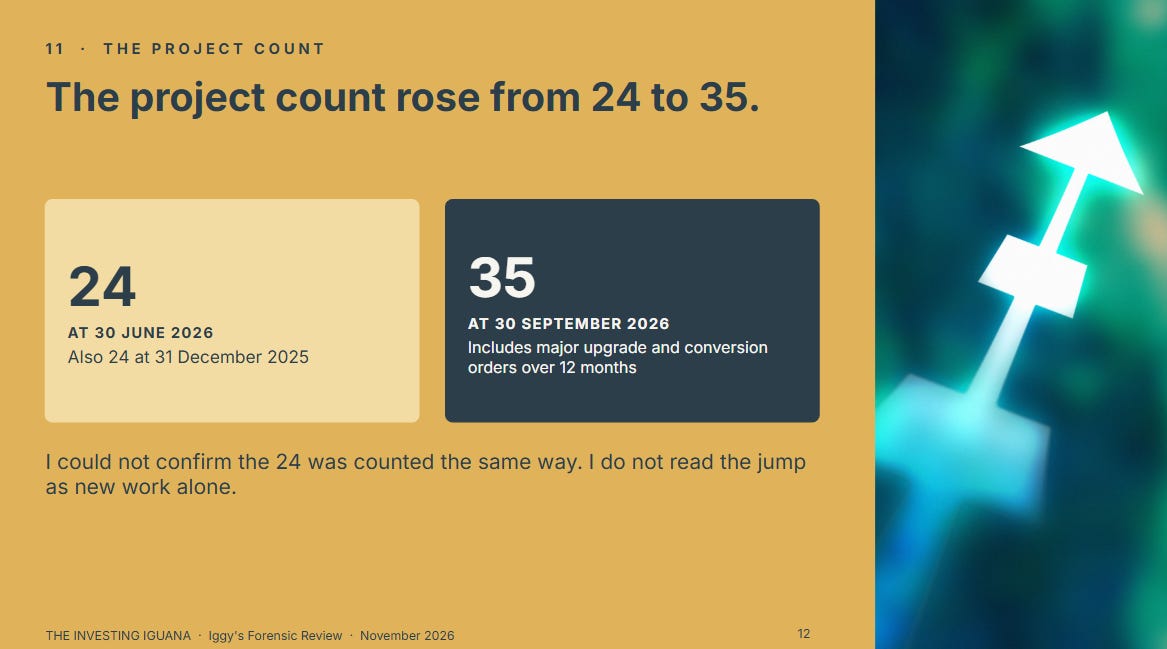
One caution on the project count. The company reported 24 projects at both 31 December 2025 and 30 June 2026, and 35 at 30 September. The update’s footnote says the table includes major upgrade and conversion orders that take more than 12 months to complete. I could not tell from the half-year press release whether the 24 was counted the same way, so I do not read the jump to 35 as new work alone.
Deliveries “through 2033” describes the latest delivery date in the book. It does not say how much revenue each year carries, because one project delivering in 2033 can sit beside many delivering in 2027.
The update gives no revenue, so I cannot divide the order book by the quarter’s sales. A rough comparison uses the first half. The net order book at 31 December 2025 was about 1.55 times FY2025 revenue of SGD 11.5 billion, and the company described it as more than 1.5 times. At 30 September 2026 the net order book is about 1.1 times first-half revenue doubled, which is SGD 11.2 billion. That doubling is my assumption and not a company figure.
🦖 Iggy’s Insights
An order book falls when a company delivers faster than it signs. That happens at the end of a large build cycle, and it is not on its own a sign of trouble. It does make replenishment the question. The company says in the update that the timing of final investment decisions is outside its control. I read that as a plain statement of how this business works: the customer decides when, and the yard cannot bring the date forward.
The New Orders
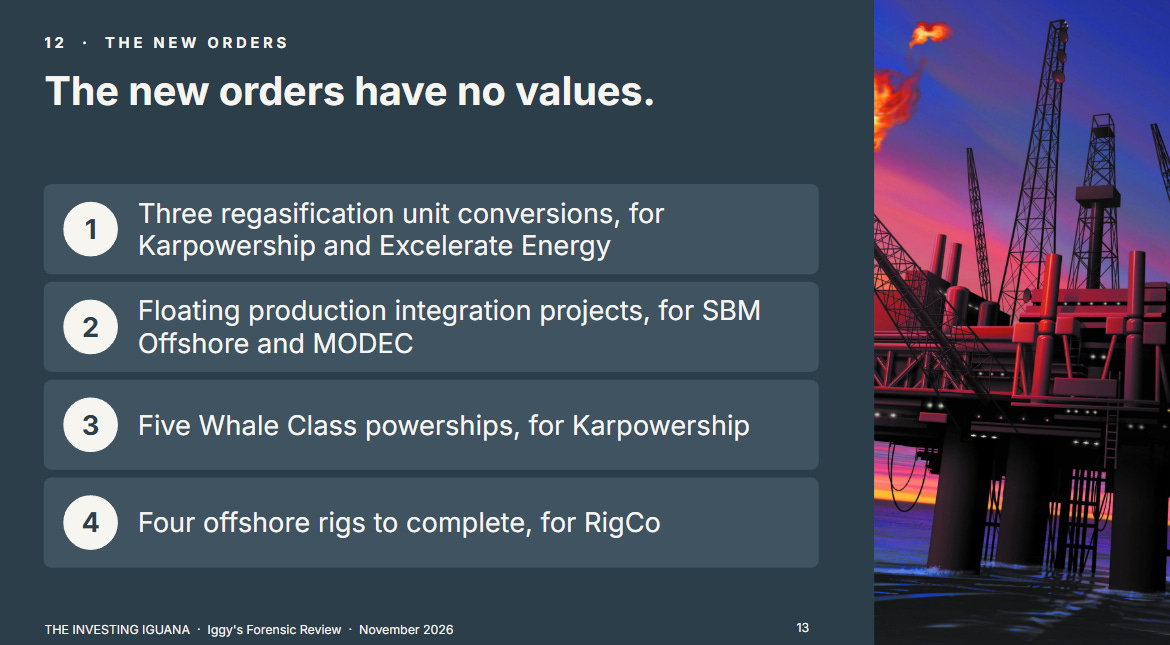
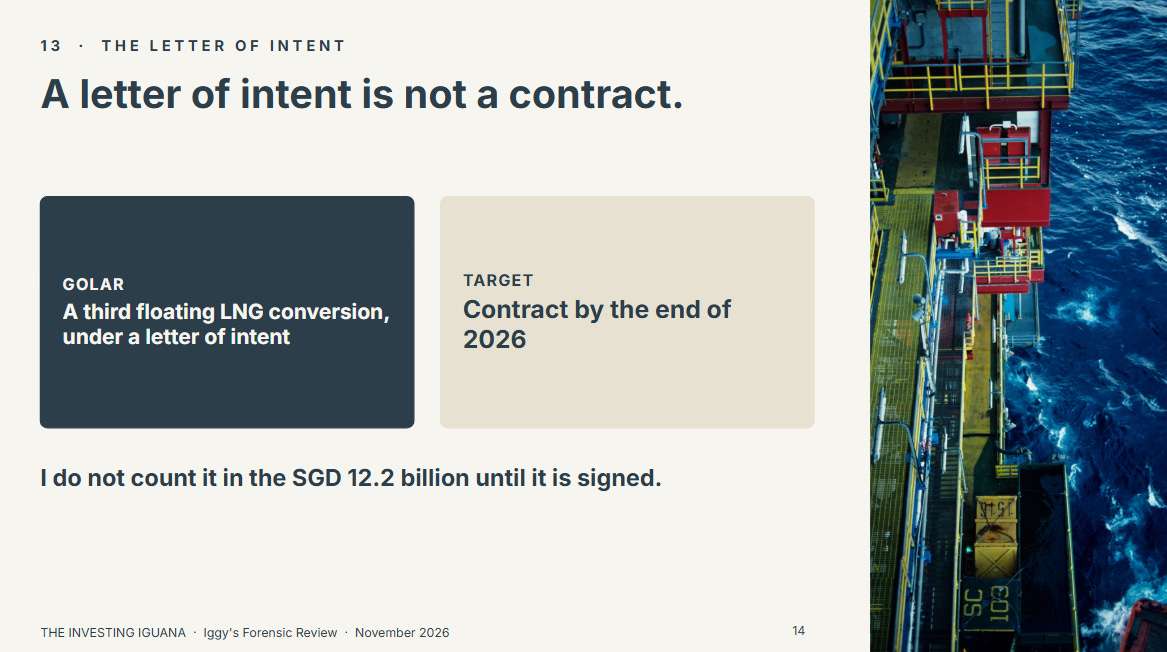
The update lists the wins without values. Three floating storage and regasification unit conversions for two customers, Karpowership and Excelerate Energy. Floating production vessel integration projects for SBM Offshore and MODEC. The conversion and integration of five Whale Class powerships for Karpowership. The completion of four offshore rigs for a customer the update calls RigCo. And a letter of intent with Golar for a third floating liquefied natural gas conversion, which the company still targets to finalise as a contract by the end of 2026.
The letter of intent is not a contract. Until it is signed, I treat it as a statement of direction and not as part of the SGD 12.2 billion. The update also reports the renewal of a multi-year arrangement with Carnival Corporation for repairs and upgrades, with no value attached.
The company says it pursues projects that meet criteria including a risk-adjusted project margin in the mid-teens and progressive milestone payment terms. That is a target for new work. The 8.6% gross margin in the first half is a group measure over all projects, including older ones. They are different measures, and the update does not link them.
Progressive milestone payment terms mean the customer pays in stages as the work reaches set points, and not in one sum at delivery. For a shipyard that matters because it spends on steel, equipment and labour long before delivery, and the payment terms decide how much of that spending the customer funds along the way. The update names the term and gives no detail on the terms of any contract.
What “Underlying” Means for FY2026
The outlook says the company expects its underlying FY2026 net profit to be materially higher than FY2025. The footnote defines underlying as excluding one-off items such as divestment gains and legal and corporate claims.
Neither side of that comparison has a number in the update. FY2025 net profit was SGD 323.6 million as reported. The first half of 2026 shows how much the definition matters: reported net profit was SGD 373 million and the company’s figure excluding divestment gains was SGD 212 million, a gap of about SGD 161 million, my arithmetic. The presentation puts the pre-tax divestment gains at SGD 172 million.
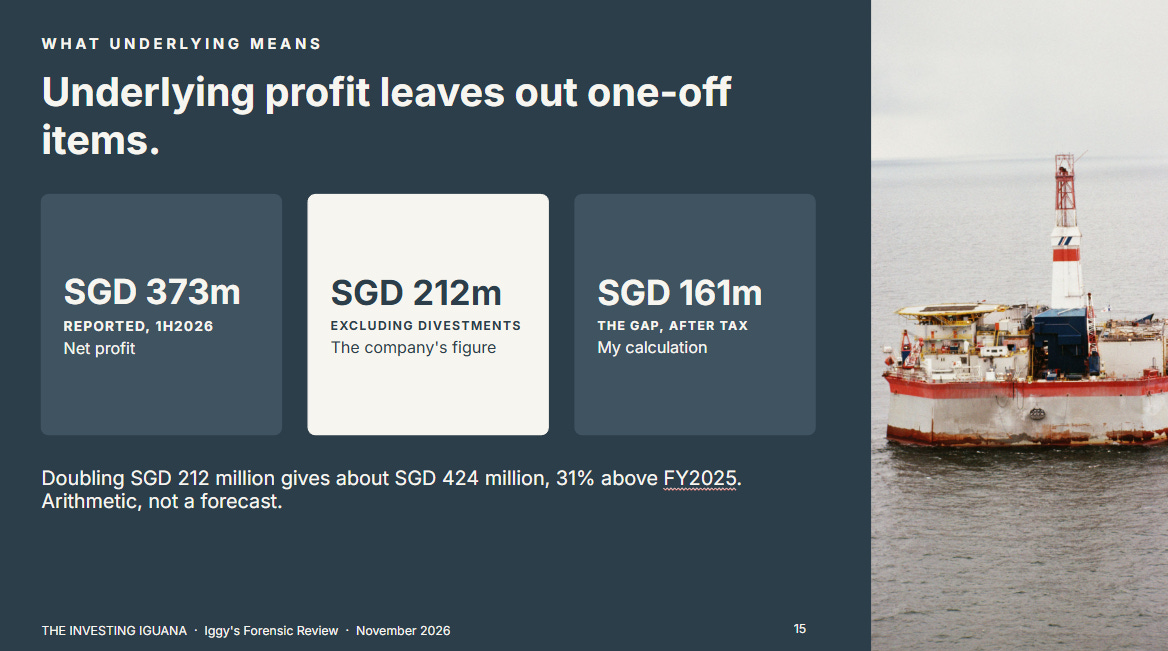
On a crude basis, doubling first-half underlying profit gives about SGD 424 million, which is 31% above SGD 323.6 million. That is arithmetic and not a forecast. It assumes a second half that matches the first, and the company does not define “materially”. The update does not say whether the FY2025 base it compares against is the reported figure or an underlying one.
Legal and corporate claims are part of what the definition leaves out. The interim statements record a penalty of USD 57 million, about SGD 73 million, under a Singapore deferred prosecution agreement, paid in May 2026. The company’s cash flow figures in the presentation exclude a SGD 73 million one-off legacy settlement, which matches that amount in size.
The Dividend and the Buyback
Seatrium proposed a final dividend of 3.0 cents for FY2025, double the 1.5 cents for FY2024, subject to approval at the annual general meeting on 22 April 2026. The interim statements show SGD 101.7 million paid out in the first half at 3.0 cents a share. That is roughly what 3.0 cents costs on the 3,383.8 million shares in issue, excluding treasury shares, at 30 June, my arithmetic.
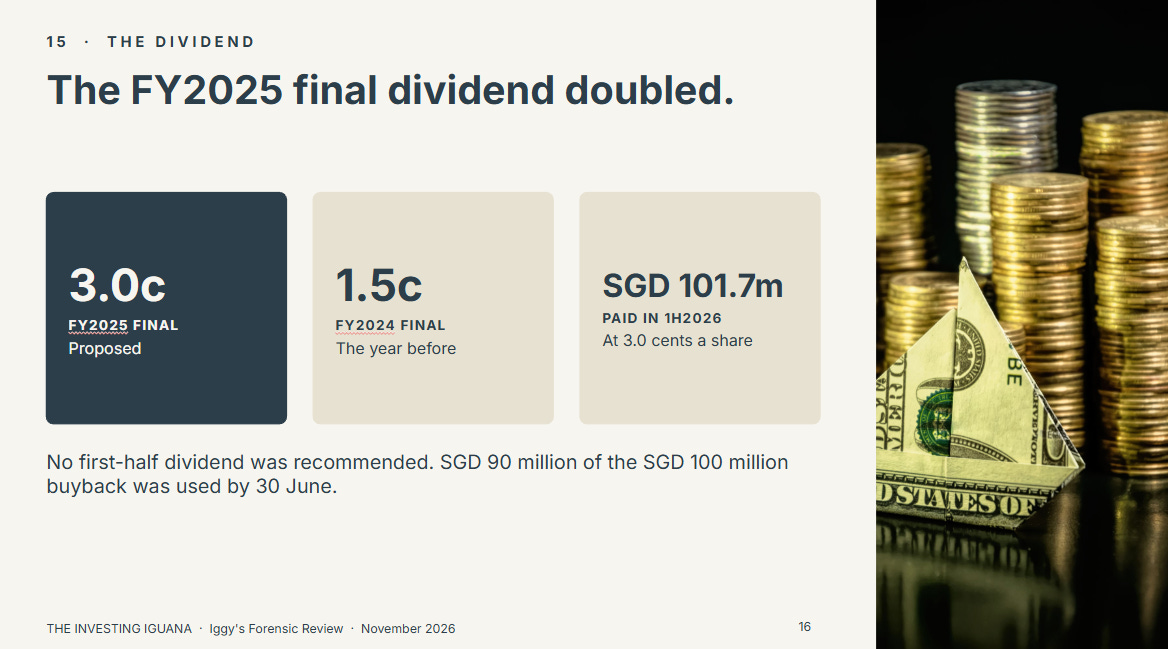
The same statements say no dividend was recommended for the first half of 2026, and the third-quarter update says nothing on dividends. The company also has a SGD 100 million share buyback programme launched in May 2024. The presentation says SGD 90 million had been repurchased by 30 June 2026.
I do not set the dividend against a share price in this piece. The update carries no price and no new dividend, so a yield would rest on a figure the company did not report this quarter.
What the Paid Half Adds
The free half has told you what the update says and omits, how gross and net differ, how the net order book has moved since December 2024, what was won, and what “underlying” profit means. What it has not shown is what the order book says about the years ahead. The paid half sets the delivery schedule against the company’s 2028 targets, shows how far along the 35 projects are and who they are for, checks how the order book moved against reported revenue, and reads the first-half cash flow and debt that the update does not repeat.
The Substack plan, USD 8 a month, gives you the full written analysis, the portfolio walkthroughs and the analyst cheatsheets. The YouTube plan, SGD 5 a month, gives you the full-length Members Edition video. The YouTube/Substack Combo, SGD 12 a month, gives you all of it.
🔒 What’s Next
Only SGD 1,230 million of the net order book is for delivery in 2027, and the paid section sets that against the SGD 10 to 12 billion of annual revenue the company targets for FY2028.
