


First Resources Fell 6.9% in One Day. What the Company, the Government and the Filings Each Say
A palm oil producer named in the haze inquiry, an interim dividend raised 77.8%, and a balance sheet that reads differently depending on the ratio.
Singapore’s Senior Minister has said that First Resources’ statement on fires and firefighting is not enough without evidence. The company says it expects no material financial impact. Both statements are on the record, and the filings show which parts of each have actually been documented.
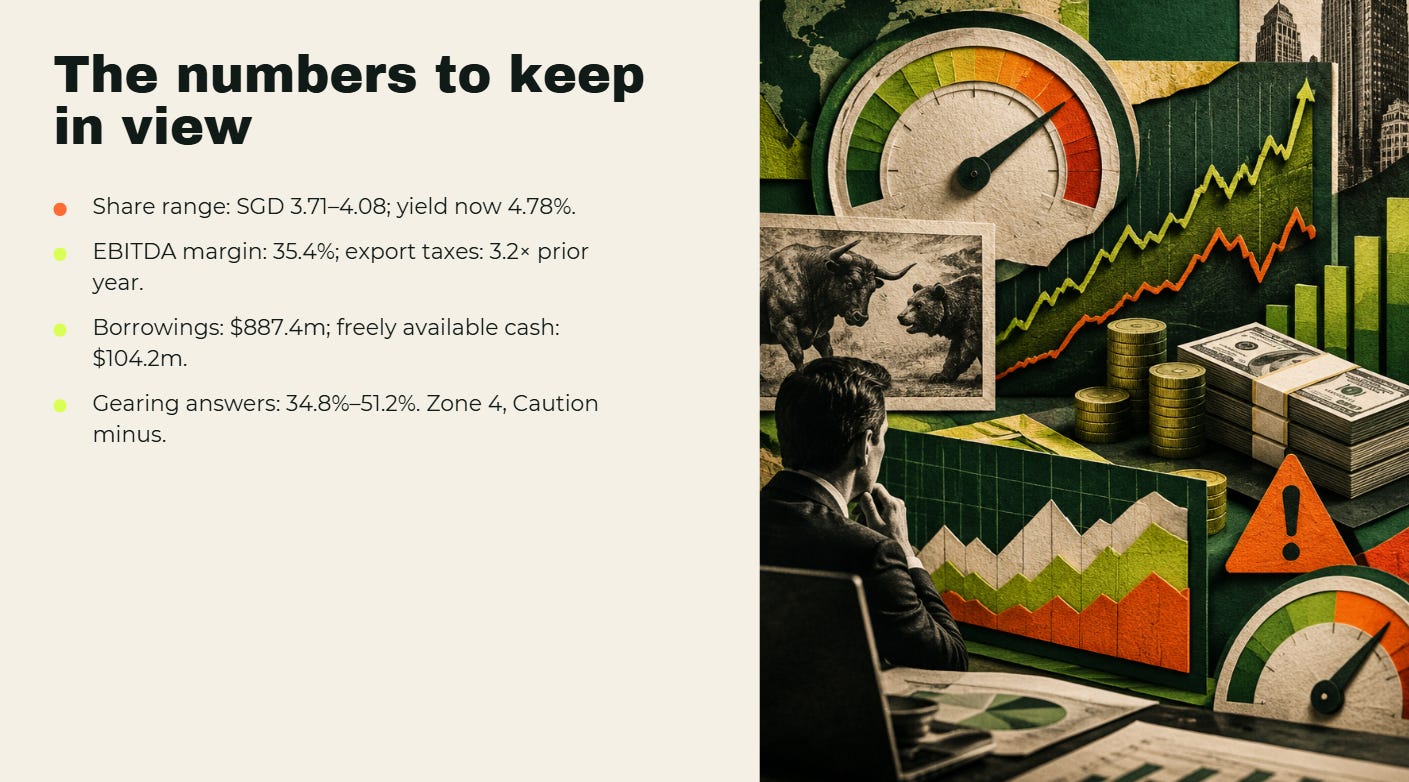
If you own First Resources, the week of 12 October has been uncomfortable, with the shares closing at SGD 3.80 on 16 October, down 6.9% in a day. If you are thinking about it for the first time, the same fall changed what the shares cost against the dividend. I am not telling either of you what to do. I am laying out what each party has said, in their own documents and with dates, and what the numbers say next to it.
What This Piece Does
It sets out what Greenpeace, First Resources, Singapore’s agencies and the company’s Indonesian subsidiary have each said, in date order, and what none of them has yet shown.
It shows the first-half results, where the growth came from, and where it did not.
It shows how First Resources tests against my thresholds, what the balance sheet can absorb if financing tightens, and what to compare when the company next reports on 13 November.
The first part is free. The balance sheet, the five gearing answers, the comparison with Wilmar and the closing read are in the paid half.
No view on share price direction. Nothing here is a recommendation.

What This Piece Does
What Each Document Says
What the First-Half Results Show
Iggy’s Insights
Where First Resources Sits on My Framework
The Share Price Moved. The Dividend Did Not.
The Dividend Record
What the Paid Half Adds
What the Balance Sheet Can Absorb
Gearing Has Five Answers
Where the Tests Land
Iggy’s Insights
Legacy Holders vs. Fresh Capital
Iggy’s Forensic Read
What I Would Compare on 13 November
What Each Document Says
Start with the dates, because the order matters.
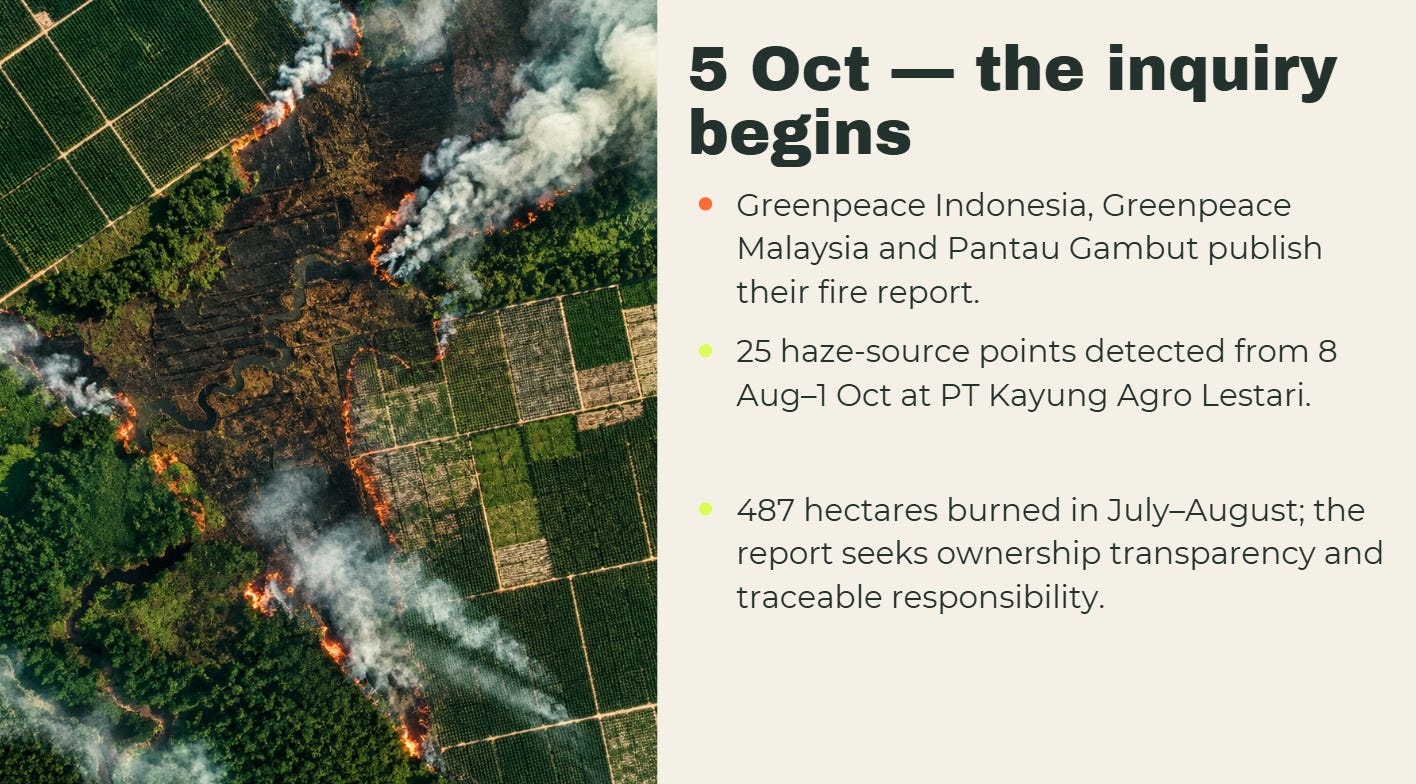
On 5 October, Greenpeace Indonesia, Greenpeace Malaysia and the Indonesian group Pantau Gambut published a report on forest and peatland fires. Using satellite detections from 8 August to 1 October, it ranks the 20 oil palm concessions with the most haze source points, which are satellite-detected smoke locations. One of the 20 is PT Kayung Agro Lestari, which First Resources confirms is its subsidiary. The report records 25 haze source points there over seven days, from 8 August to 10 September, and about 487 hectares burned in July and August, based on burned-area data it cites from a mapping service. It also lists a second concession it records as falling under First Resources, with 10 points over six days. The report says its aim in naming regional links is not to generalise that foreign companies cause the fires, but to push for ownership transparency and tracing of responsibility.
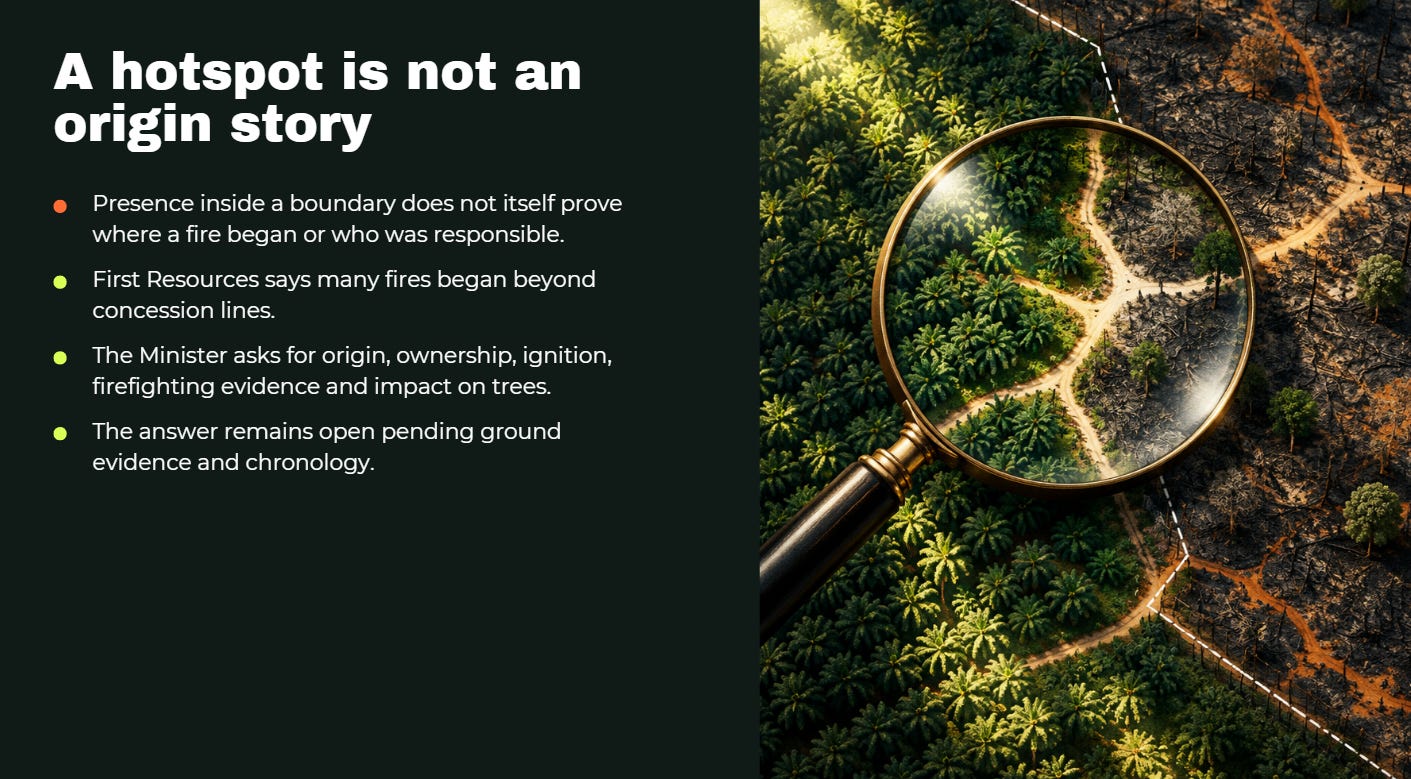
On 15 October, First Resources filed its first statement on the exchange. Its position is that a hotspot in or near a concession does not by itself show where a fire began, who is responsible, or whether fire was used on purpose. It says many hotspots near its West Kalimantan concessions began outside its boundaries, that in some cases fires from outside spread into areas it manages, and that this year’s El Nino drought raised the risk. A fuller response dated 16 October adds detail on its monitoring and on the subsidiary Greenpeace named. In it, the company says the fires and haze caused some disruption to its plantation operations, that it does not expect a material operational or financial impact, and that hotspots in West Kalimantan have fallen sharply in recent weeks. These are the company’s statements. The authorities have not confirmed them.
On 16 October the shares fell as much as 9.1% to SGD 3.71 and closed at SGD 3.80. In the same 48 hours the Prime Minister said Singapore was looking into which companies may be responsible, and the National Environment Agency sent preventive measure notices under the Transboundary Haze Pollution Act to seven Indonesian companies. Three more followed on 19 October. A notice requires a company to deploy firefighters, stop any burning and submit a plan of action. It is not a finding that the company caused the haze. First Resources is not among the ten companies named, and I have not found a public statement linking any of them to it. I am not attributing the share price fall to any single event.
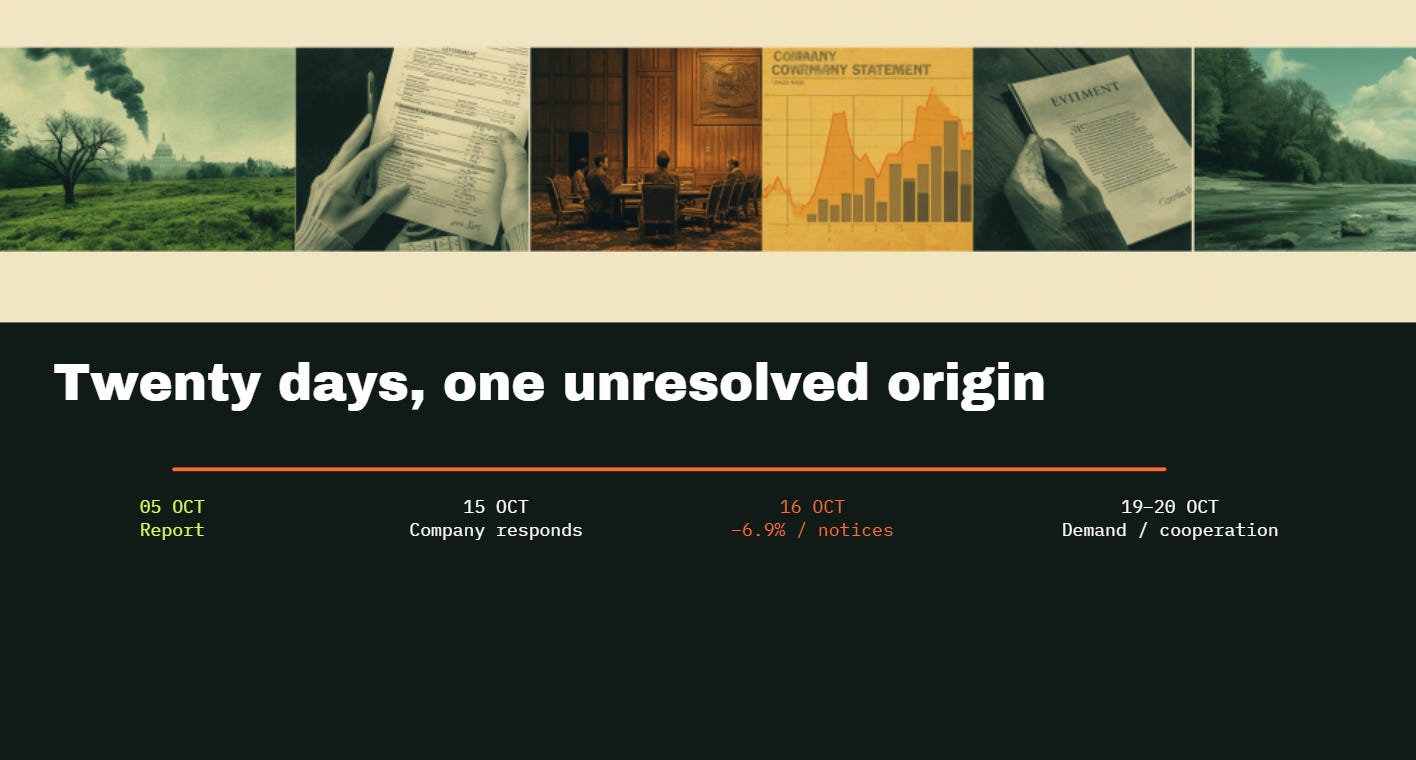
Think of an HDB block after a fire in one unit. The management office asks four things: where it started, whose unit it is, who was inside, and what they did to put it out. On 19 October the Senior Minister put close to those questions to First Resources. He said some fires or smoke-source points seem to be associated with First Resources, Bumitama Agri and First Borneo Plantations, and that the Government will ask them more questions. He said the company’s statement on zero burning and firefighting was not enough, and that it must show where the fires started, who owns the land, who started them, what it did to stop them, and whether the fires burned only old trees or productive ones. He also said the Government will weigh all the evidence fairly and act on the facts. SGX has asked seven listed agricultural companies about their operations and possible links to the haze, and he said banks that lent to these companies have asked them questions too. Singapore is considering legal, regulatory and economic measures, including the companies’ access to financing and their standing with investors.
On 20 October the company replied that it will cooperate fully, welcomes evidence-based verification, and is confident an objective review will show it does not clear land by fire, directly or indirectly. The reply adds no new facts, hectare figures or hotspot counts. The shares closed at SGD 3.74 that day, down 4.83% from SGD 3.93 at the close on 19 October.
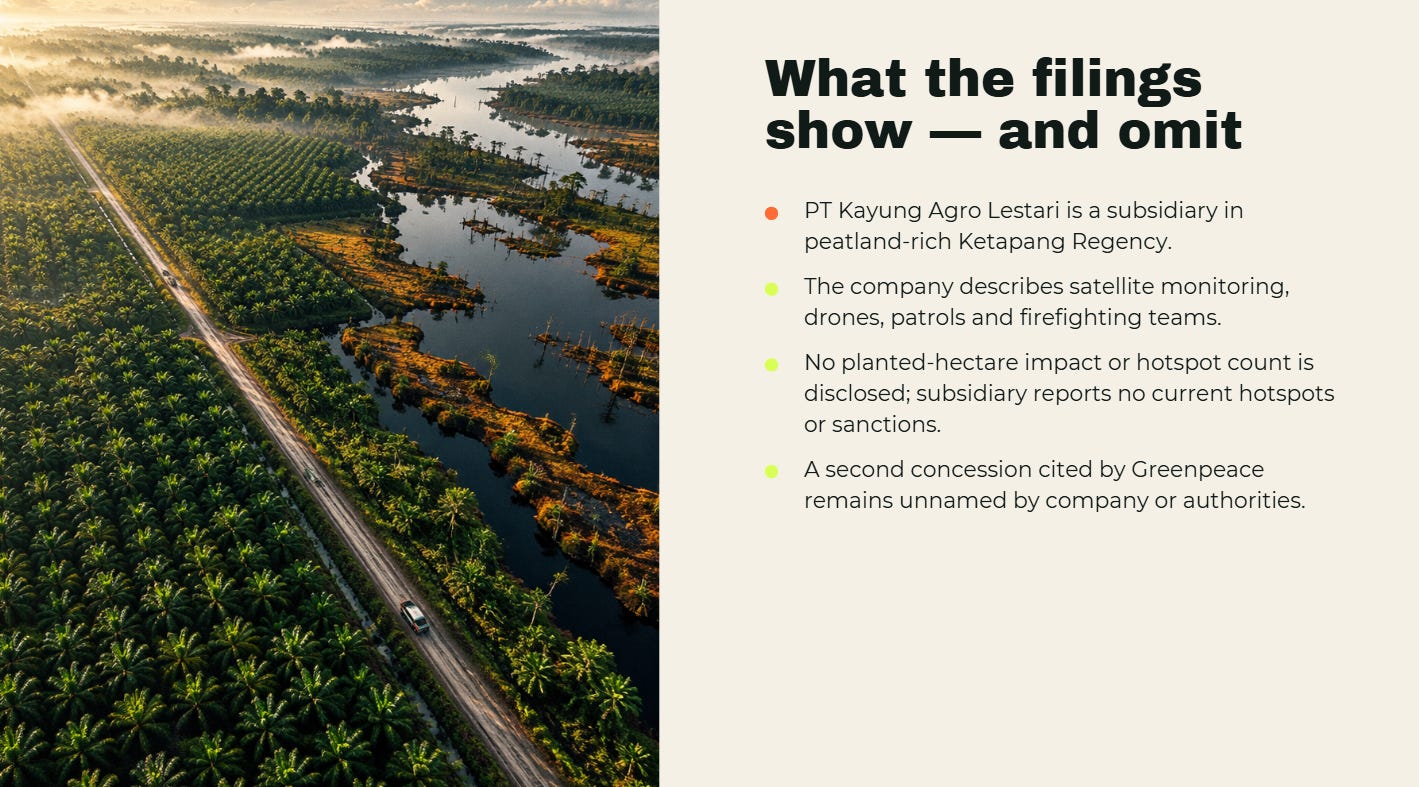
Here is what the filings answer. On ownership, the company says PT Kayung Agro Lestari is its subsidiary, in peatland-rich Ketapang Regency, with no replanting planned and so no land clearing. On action, it describes daily satellite monitoring, drones, patrols and firefighting teams. On where the fires started, it says many began outside its boundaries. It gives no figure for planted hectares affected and no hotspot count. Its listed Indonesian subsidiary told the Indonesia Stock Exchange on 16 October that no hotspots were being detected in its West Kalimantan operating area at that date, and that no administrative sanctions had been imposed on it or its subsidiaries. Greenpeace’s second concession is not named in the company statements I read. I have not found a public statement by an Indonesian authority naming the company.
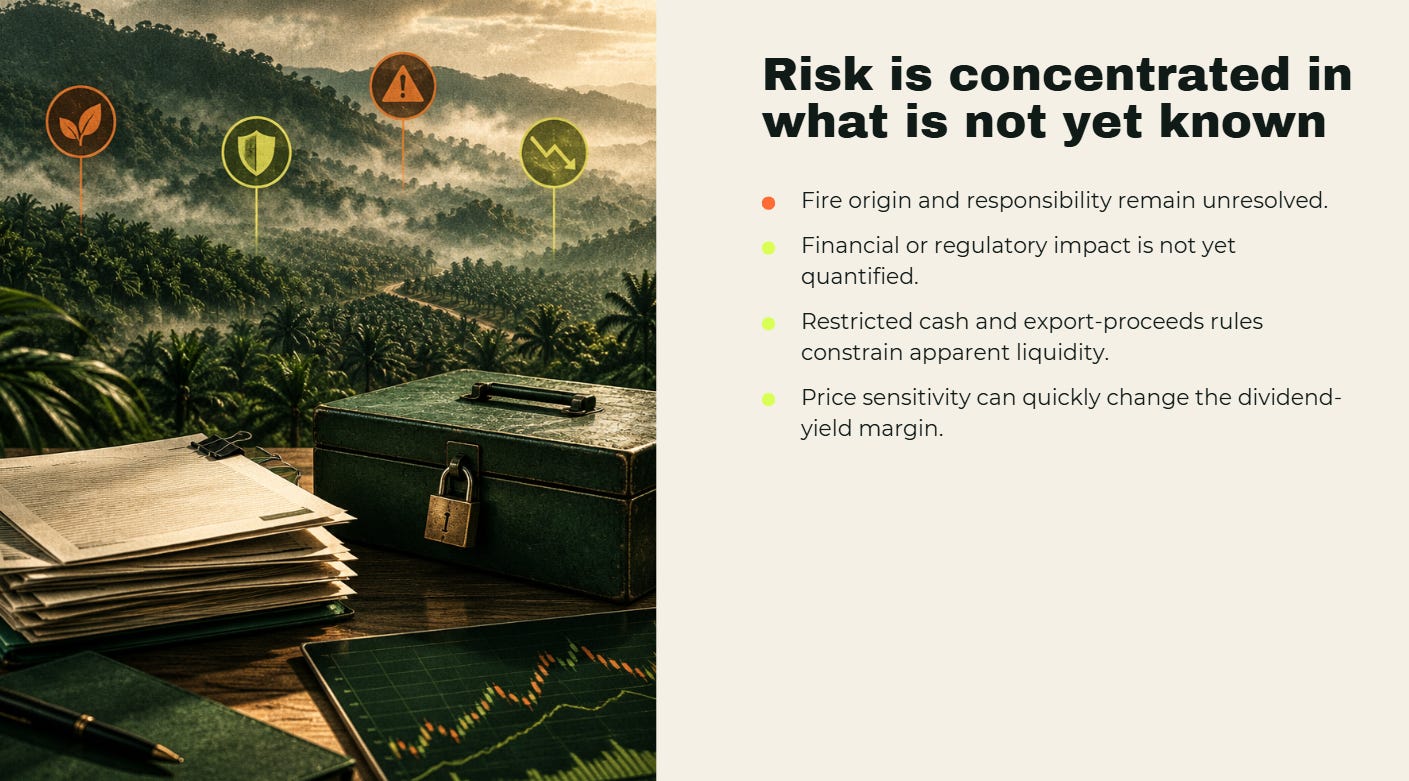
A reader will say: “The company says the fires came from outside. Why not take it at its word?” I report it as the company’s account, because that is what it is. It may be right. It is also the part the Minister says needs evidence. A hotspot inside a boundary is not proof of where a fire began, and a statement that fires came from outside is not proof that they did. Until someone shows the chronology and the evidence from the ground, the accurate reading is that the question is open.
What the First-Half Results Show
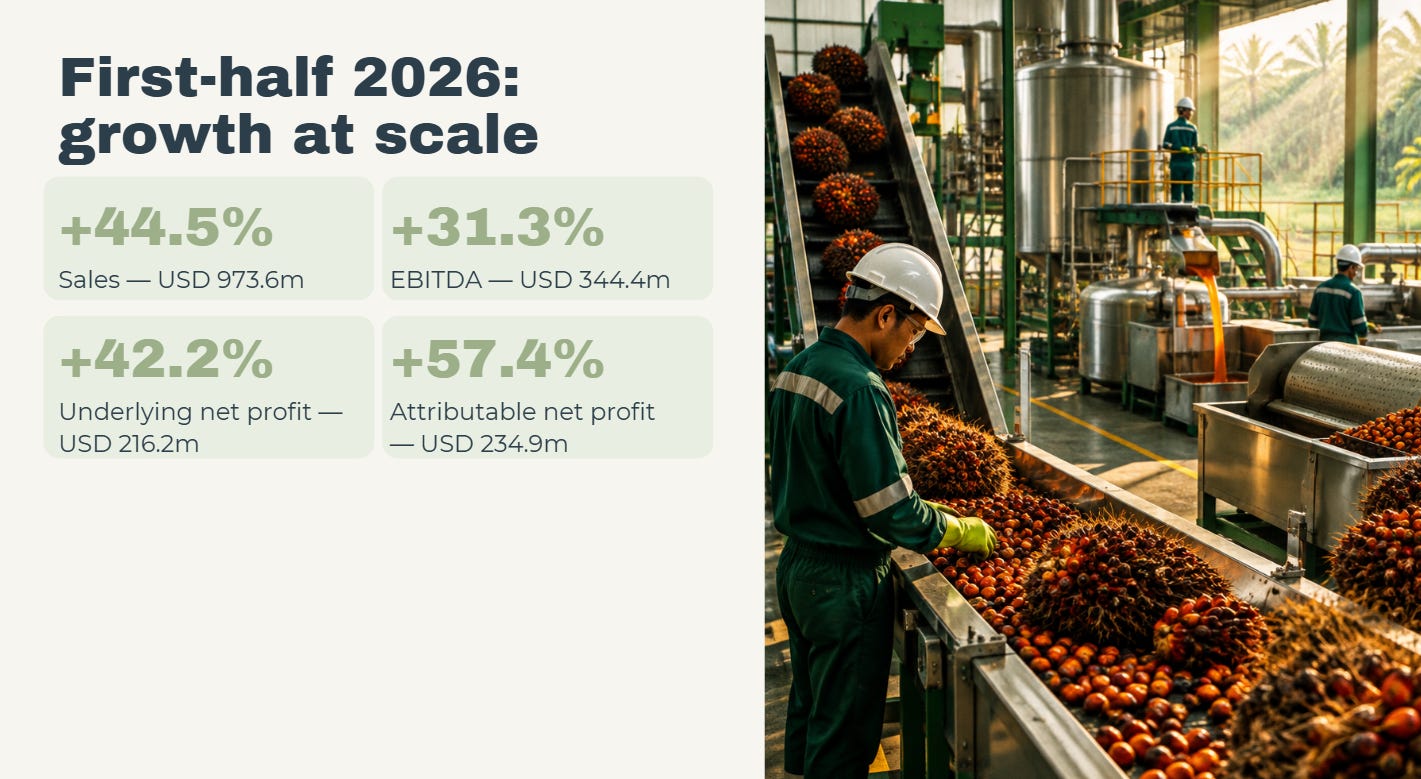
The company’s half-year results were filed on 14 August, two months before any of this, and they say nothing about fires or haze. For the six months to 30 June 2026, sales rose 44.5% to USD 973.6 million, EBITDA rose 31.3% to USD 344.4 million, and underlying net profit rose 42.2% to USD 216.2 million. Net profit attributable to shareholders was USD 234.9 million, up 57.4%.
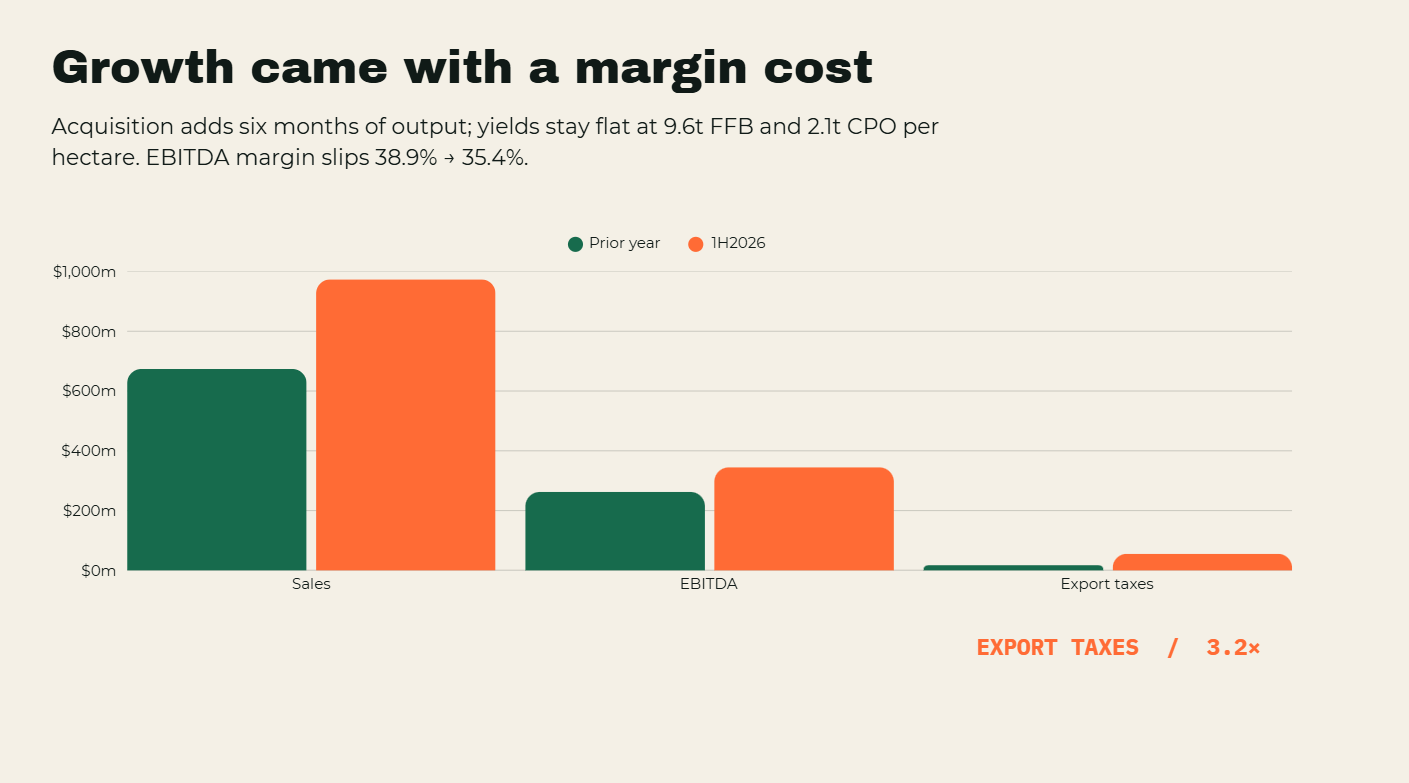
Part of that growth is timing. The company bouht Austindo Nusantara Jaya in May 2025, so this half holds six months of its output against two months a year earlier. On a like-for-like basis the yields were flat, at 9.6 tonnes of fresh fruit bunches and 2.1 tonnes of crude palm oil per hectare. The EBITDA margin slipped to 35.4% from 38.9%. Export taxes in selling costs rose to USD 55.5 million from USD 17.2 million, about 3.2 times, which is my arithmetic from the statements.
🦖 Iggy’s Insights
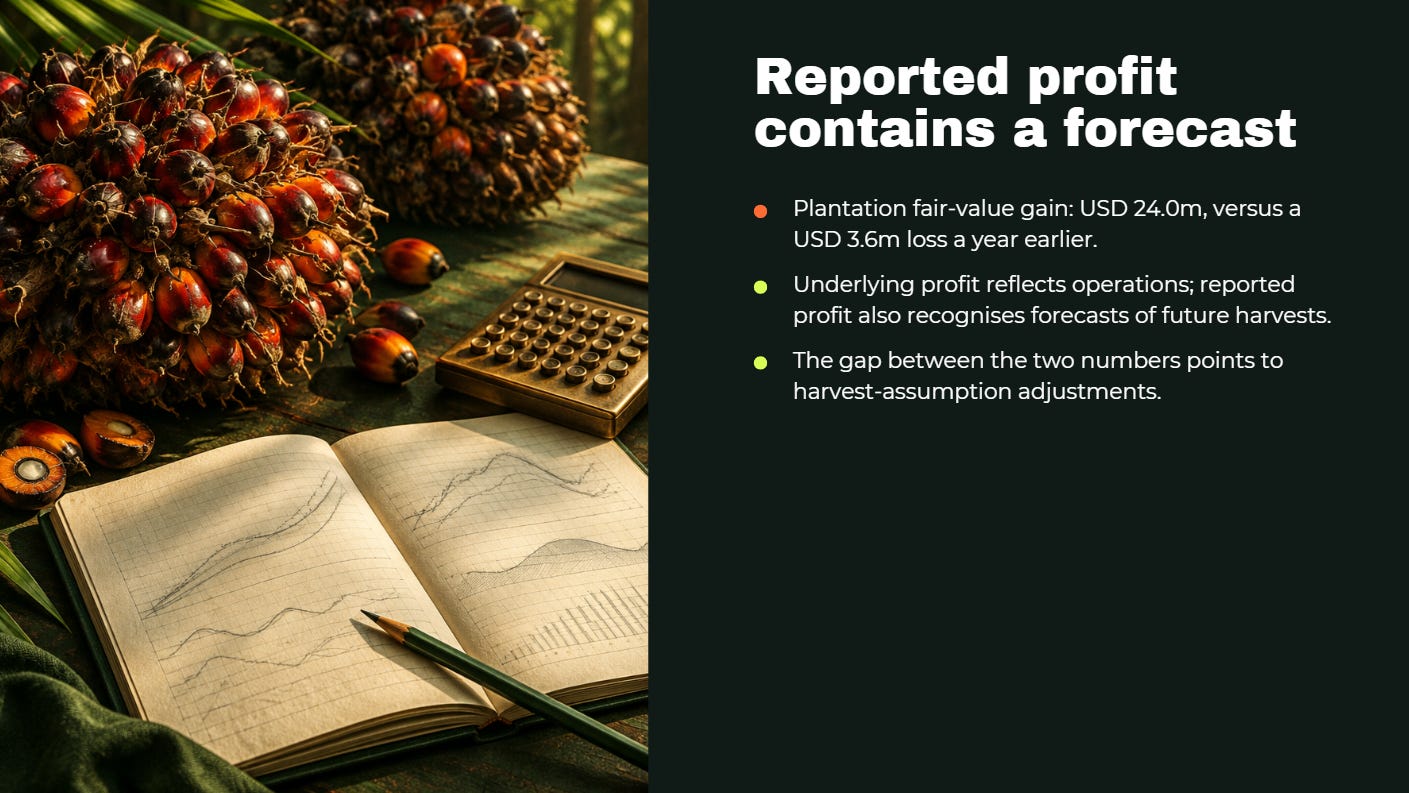
A plantation company books a gain when it expects to harvest more fruit from the trees it already owns. This half the gain was USD 24.0 million, against a USD 3.6 million loss a year earlier. It is the reason net profit of USD 234.9 million sits above the underlying USD 216.2 million. The company reports both numbers. The gain is an estimate of future harvests, not cash received, so it can reverse when the estimate changes. When a plantation shows two profit numbers, the underlying one is closer to what the operations earned. Read the gap between them as a forecast.
Where First Resources Sits on My Framework
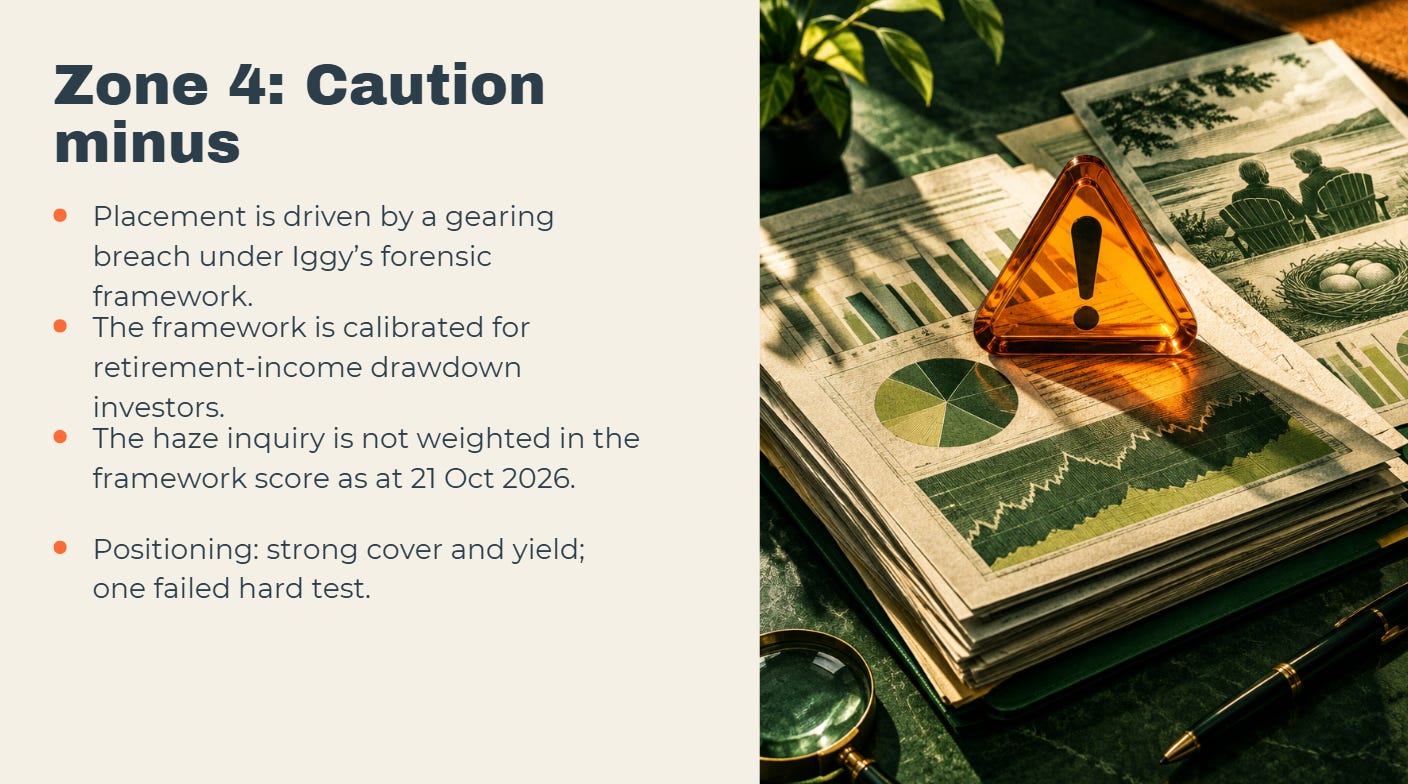
Iggy’s Forensic Zone: Zone 4, Caution - (Growth Read: a profitable producer with comfortable interest cover, gearing against owners’ equity is the primary constraint)
The zone is as at 21 October 2026 and will be recalculated against the price on the day I next cite it. Zone 4 describes how my framework is calibrated. It is not an instruction to anyone. The framework is built around a reader drawing income in retirement, so it applies fixed tests to every company. Two kinds of reader may reasonably apply a different standard: someone with many years before drawdown, who can sit through the swings the framework is built to flag, and someone using money beyond what retirement income needs. The haze inquiry is not a test in the framework and carries no weight in the zone. It is a risk I describe in the text. The paid section shows which test sets the label, and by how much.
The Share Price Moved. The Dividend Did Not.
The company’s two most recent dividends are a final of SGD 0.102 a share, with an ex-date of 6 May 2026, and an interim of SGD 0.08, with an ex-date of 26 August. Together that is SGD 0.182 a share, the trailing ordinary dividend. There were no specials.
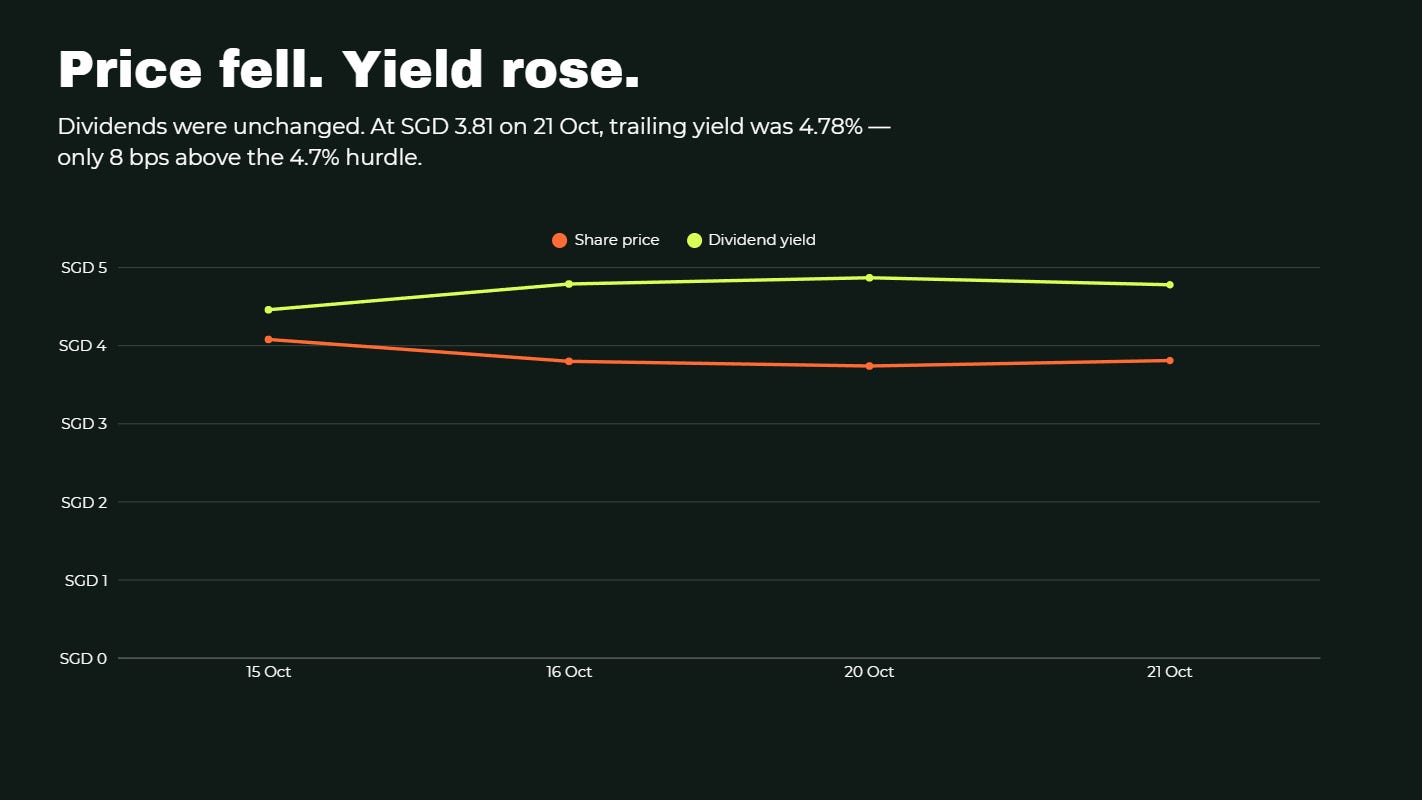
At about SGD 4.08, the close on 15 October, that is a yield of 4.46%, a miss of about 24 basis points against my 4.7% hurdle. At SGD 3.80 on 16 October it is 4.79%. At SGD 3.74 on 20 October it is 4.87%. At SGD 3.81, a delayed InvestingPro quote on 21 October, it is 4.78%, which clears the hurdle by about 8 basis points. The 15 October close is derived from the reported moves on the 16th, so treat it as approximate. The yield equals 4.7% at about SGD 3.87, only 1.6% above the 21 October price.
Nothing about the dividend changed between those dates. The yield crossed the hurdle because the price fell. That is a different thing from a company paying more, and it can reverse as quickly. A reader who sees “yield clears the hurdle” should also see that the margin is a few cents of share price.
The Dividend Record
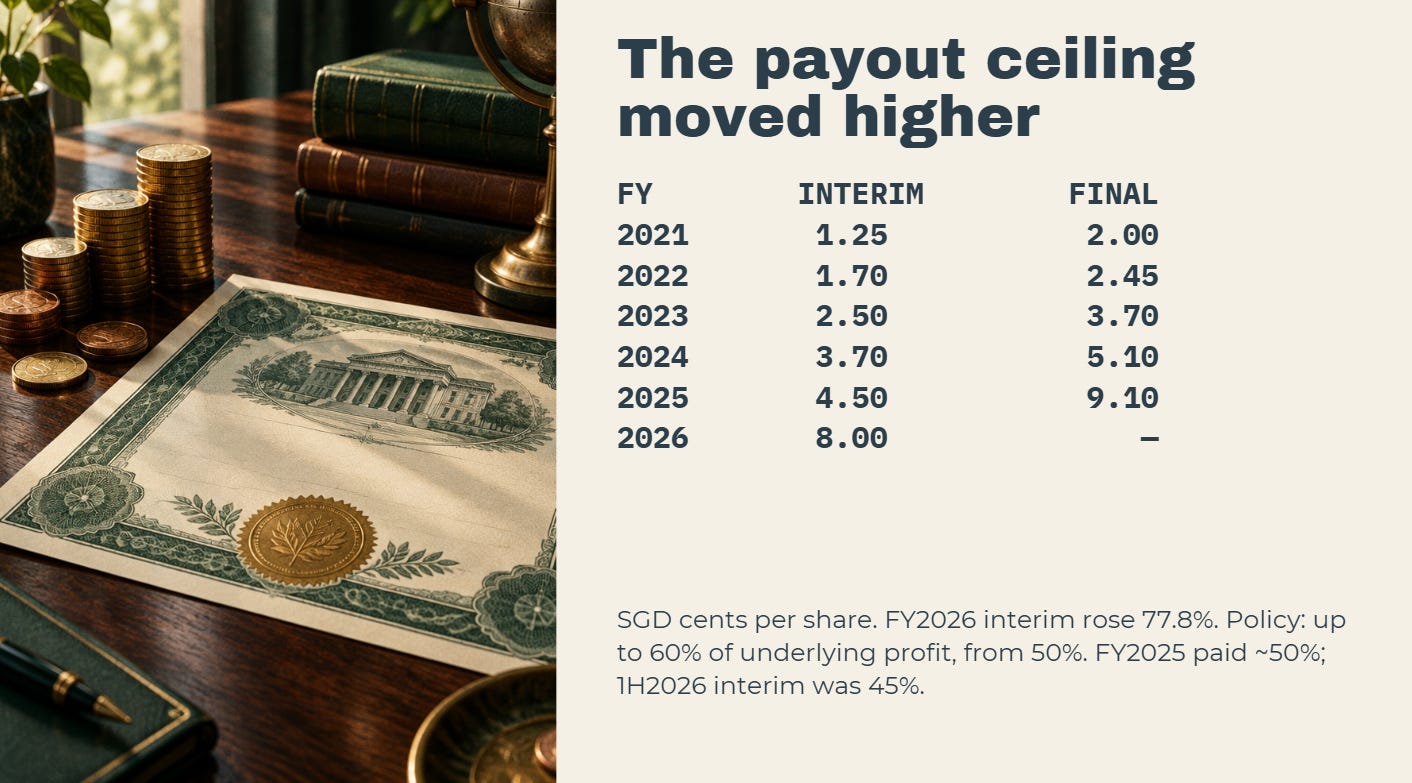
Source: company FY2025 results presentation and 1H2026 results. The payment follows profit. It fell 57% from FY2022 to FY2023 and has since risen. The company’s policy was a payout of up to 50% of underlying net profit, and it raised that to up to 60% from FY2026. The FY2025 total was about 50%, and the 1H2026 interim was 45% of interim underlying net profit.
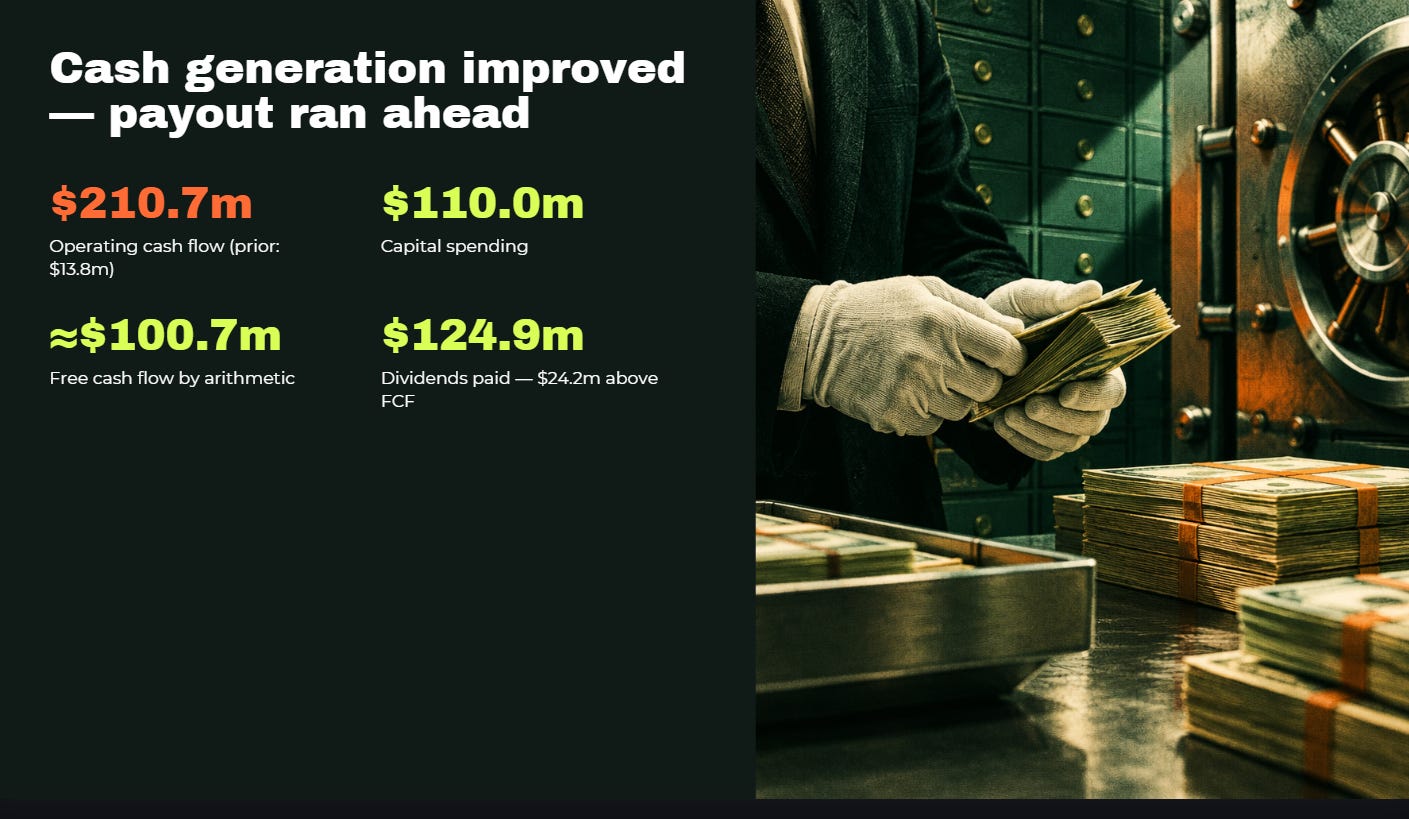
Now the cash side. Operating cash flow in the half was USD 210.7 million, against USD 13.8 million a year earlier. Capital spending on bearer plants and property, plant and equipment was USD 110.0 million, which leaves free cash flow of about USD 100.7 million by my arithmetic. Dividends paid in the half were USD 124.9 million, the FY2025 final, so they exceeded that free cash flow by about USD 24.2 million. One half is a short window, and the company says its peak crop season falls in the second half. It is a figure to watch.
What the Paid Half Adds
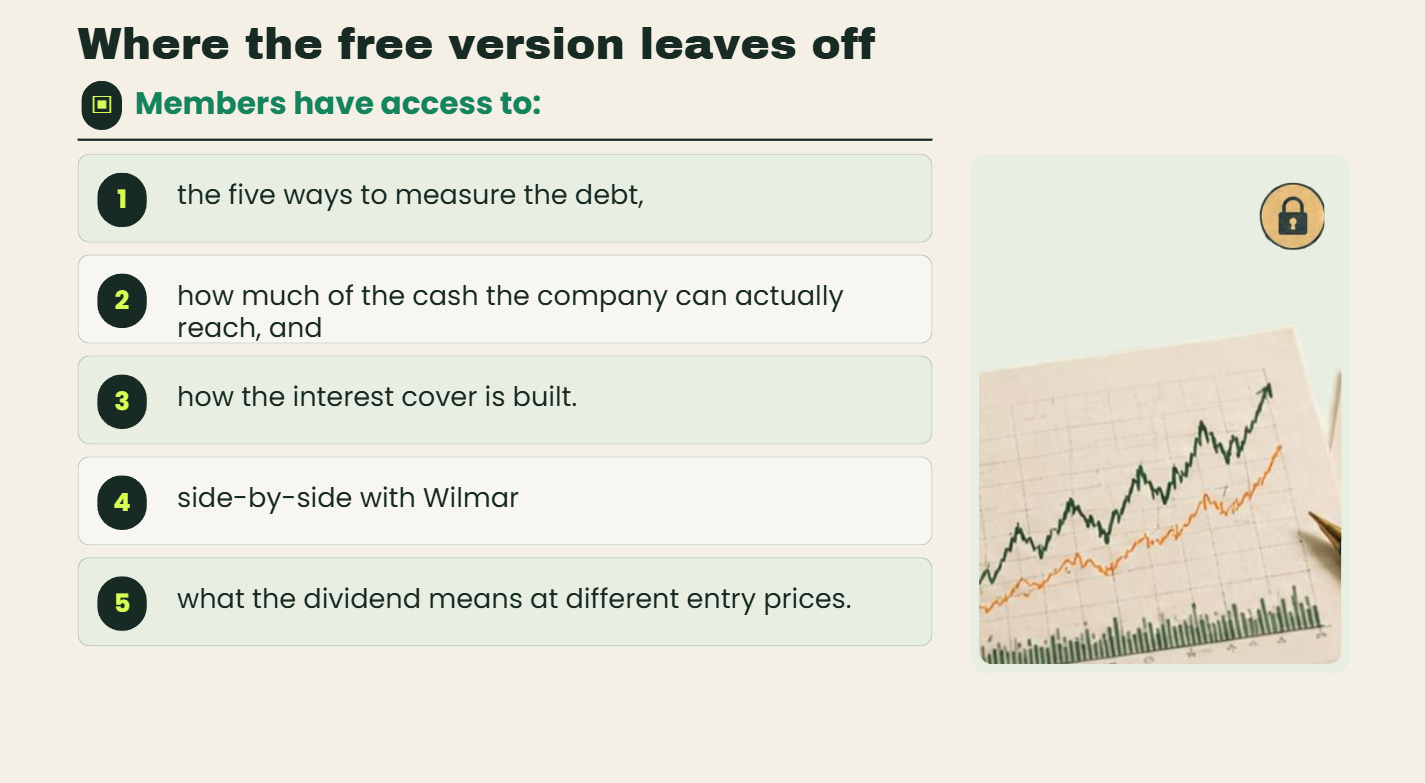
The free half has told you what each side has said, what the results show and where First Resources sits on my framework. What it has not shown is why the zone is what it is. The paid half sets out how much debt the company carries on each of the five ways to measure it, how much of its cash it can actually reach, how the interest cover is built, and which single test sets the label and by how much. It also puts First Resources beside Wilmar on the same tests and works through what the dividend record means for someone who bought at a different price.
The Substack plan, US$8 a month, gives you the full written analysis, the portfolio walkthroughs and the analyst cheatsheets. The YouTube plan, S$5 a month, gives you the full-length Members Edition video. The YouTube/Substack Combo, S$12 a month, gives you all of it.

🔒 What’s Next
The company says it expects no material financial impact, and the paid section tests that statement against its debt, its interest bill and the cash it can actually reach, then shows which of my tests the zone above rests on.
