



Gearing Is a Snapshot, Interest Cover Is a Running Cost. A REIT Can Pass One and Fail the Other 🦖
MAS sets the legal minimums at 1.5 times interest cover and 50% gearing. A made-up trust shows how a REIT can pass one test and fail the other, and why my floors sit well above the rules.
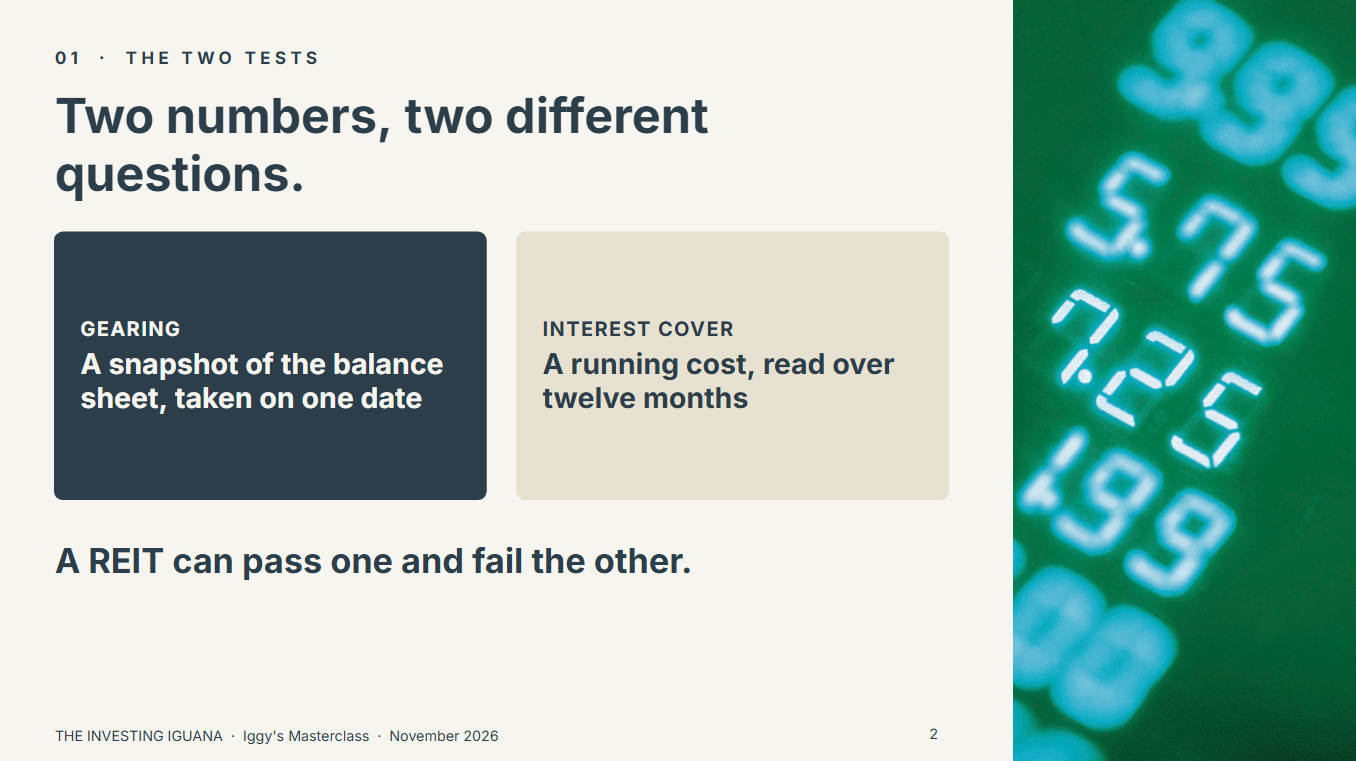
It is tempting to treat MAS’s limits of 50% gearing and 1.5 times interest cover as the line between a safe REIT and a risky one. They are the line between compliant and not compliant. A trust can clear both and still have too little room for a bad year.
Whether you already own a REIT or are still looking at one, gearing and interest cover are the first two ratios worth reading on any results page. I read them together because each one gives way in a different kind of year. Keep a REIT’s latest results page open beside this piece if you can, because the ratios make more sense with real numbers next to them.
What This Piece Does
The two ratios. What gearing measures, what interest cover measures, and why they move for different reasons.
A made-up pair of trusts. How each one passes one of my tests and fails the other, and what a bad year does to both.
My floors. Why my interest cover floor sits at 4.0 times and my gearing ceiling at 35%, with the arithmetic.
The whole piece is free. No view on share price direction, nothing here is a recommendation.

What This Piece Does
Two Ratios That Measure Different Things
What MAS Requires, and What It Leaves Open
A Made-Up Pair of Trusts
Iggy’s Insights
Now Stress Each One Two Ways
Iggy’s Insights
Why My Floors Are 4.0 Times and 35%
Reading Both Together
Iggy’s Forensic Read
Two Ratios That Measure Different Things
Gearing is total debt divided by total assets. MAS calls it aggregate leverage. A REIT with SGD 2,000 million of properties and SGD 640 million of debt has gearing of 32%. The number is a snapshot, taken on one date, and it depends on two things: how much the REIT has borrowed, and what the valuers say the properties are worth that day.
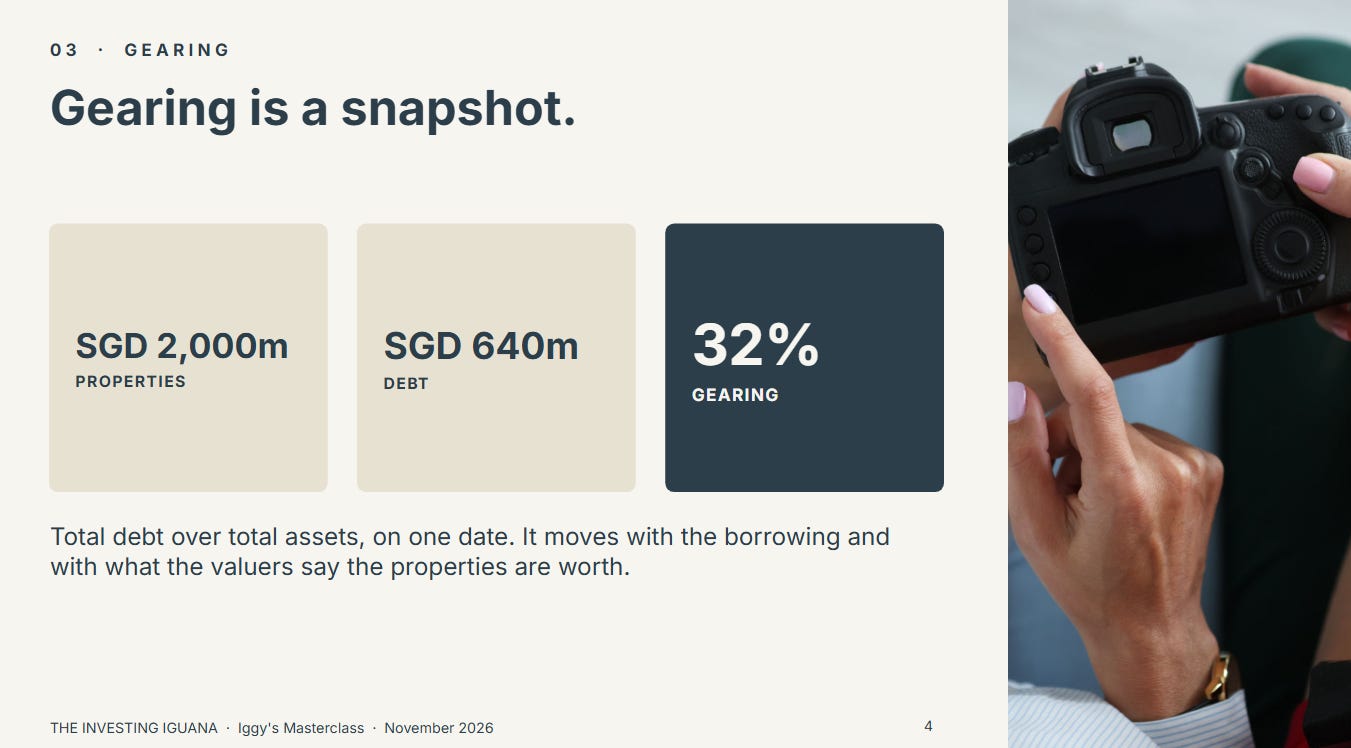
That second part is the one people miss. A REIT can borrow nothing new and see its gearing rise, simply because a valuer marked the portfolio down.
Think of your own flat. If the bank’s valuation of your HDB flat falls, you still owe exactly the same loan, and the ratio of loan to value looks worse even though you have not missed a single instalment. Gearing works the same way, only the flat is a portfolio of offices, malls or data centres.

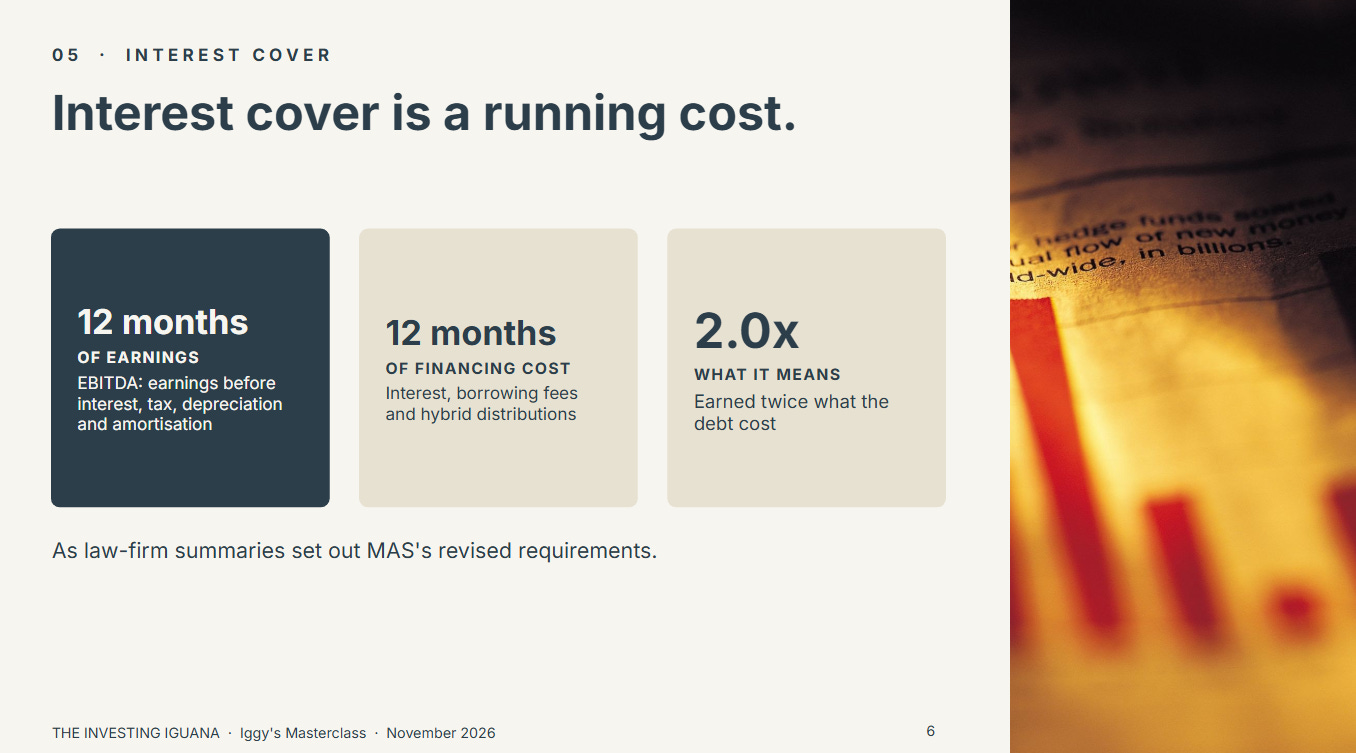
Interest cover is a different kind of number. It is a year of earnings divided by a year of financing cost. Under the definition in MAS’s revised requirements, as law-firm summaries set it out, the top line is the trailing twelve months of earnings before interest, tax, depreciation and amortisation, leaving out the effects of fair value changes of derivatives and investment properties, and foreign exchange translation. The bottom line is the trailing twelve months of interest expense, borrowing-related fees and distributions on hybrid securities. A cover of 2.0 times means the REIT earned twice what its debt cost it over that year.
Gearing looks at the balance sheet. Interest cover looks at the income statement. Gearing moves when valuations move. Interest cover moves when earnings fall or when debt is refinanced at a higher rate, and because it looks back over twelve months, a rate rise shows up slowly, quarter by quarter, as old cheap loans mature and new dearer ones replace them.
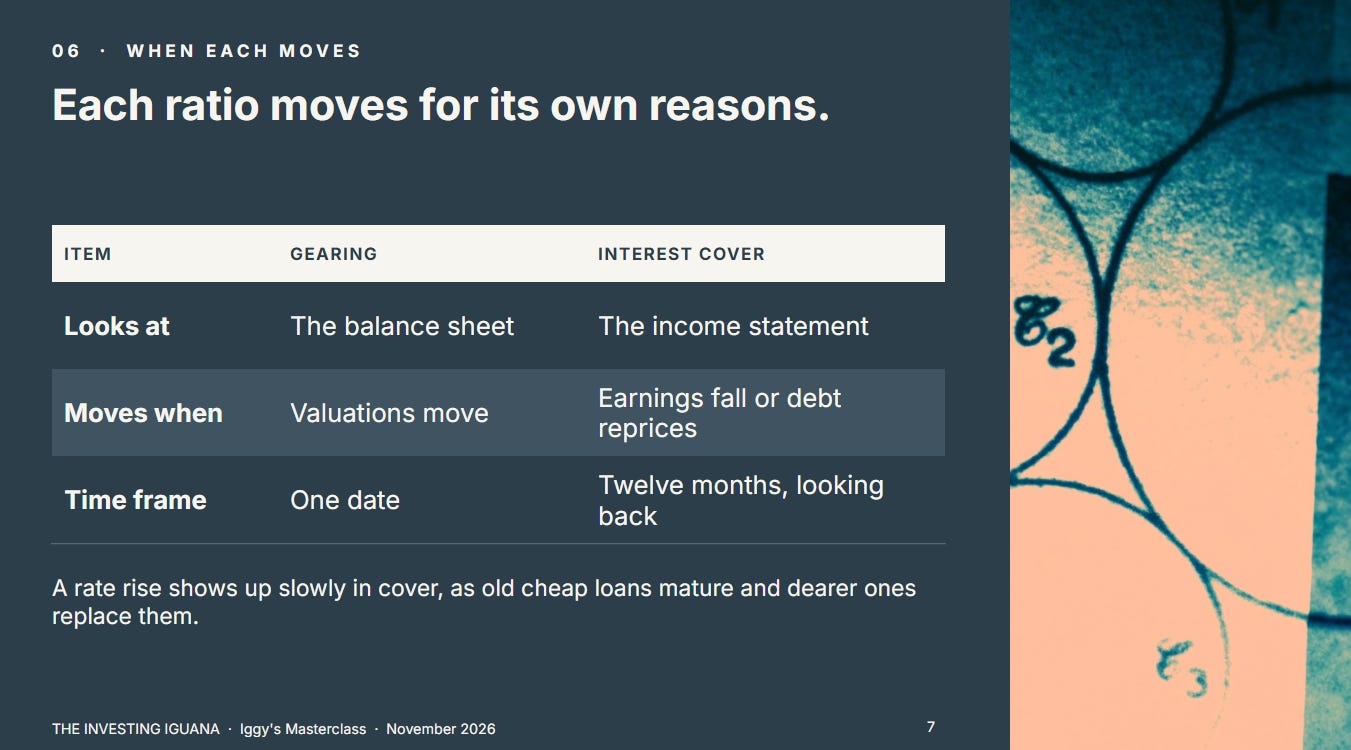
That is the first reason one ratio can look fine while the other does not. The next section shows what MAS asks for, and the part it leaves to the reader.
What MAS Requires, and What It Leaves Open
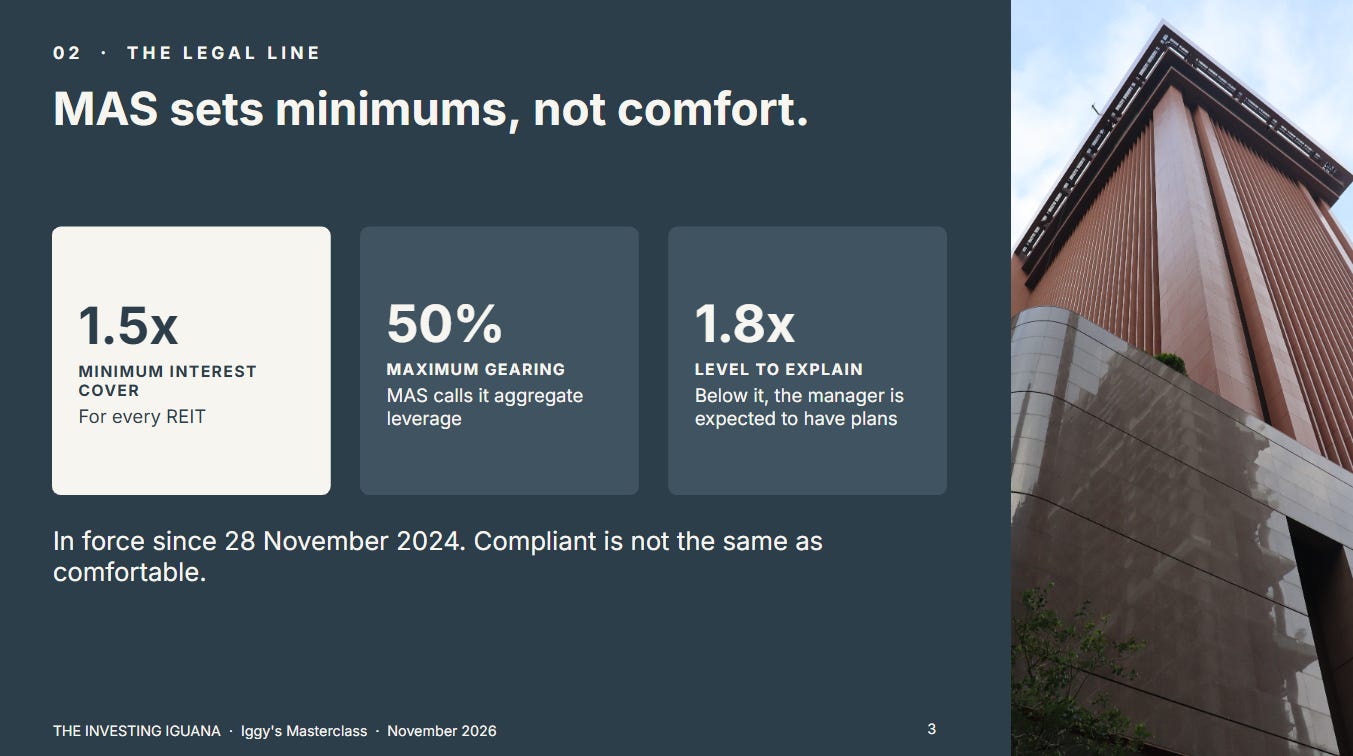
MAS’s revised requirements for REITs took effect on 28 November 2024. They apply a minimum interest cover of 1.5 times and a single aggregate leverage limit of 50% to every REIT. Before that, the stricter 2.5 times cover applied only to REITs that wanted to lift leverage from 45% to 50%.
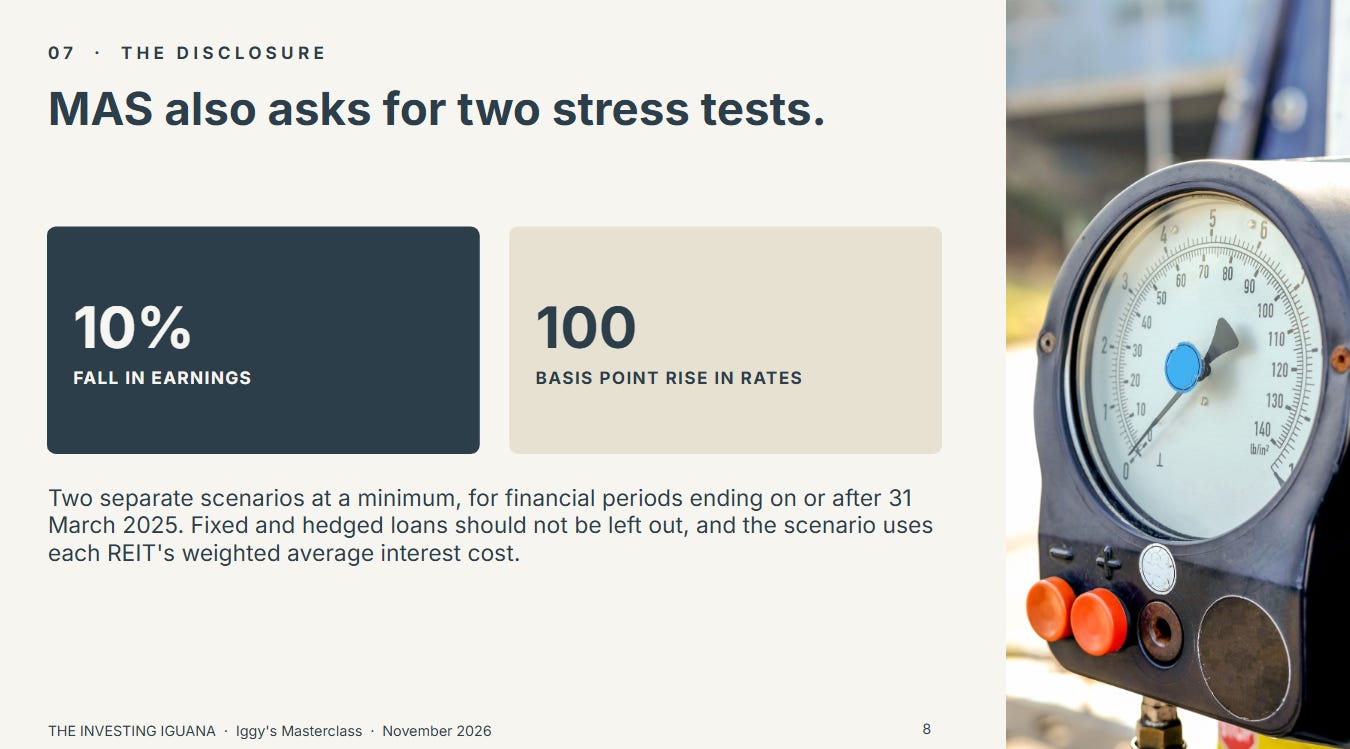
MAS added disclosure on top, applying to financial periods ending on or after 31 March 2025. REIT managers must say how they intend to manage leverage and interest cover, and they must show how interest cover responds to changes in earnings and interest rates.
MAS asks for two separate scenarios at a minimum: a 10% fall in earnings, and a 100 basis point rise in rates. Where interest cover has fallen below 1.8 times, the manager is expected to take steps or have plans in place to improve it. In its response to feedback, as Allen & Gledhill summarise it, MAS clarified that loans with fixed interest rates, or hedged into fixed rates, should not be left out of the rate scenario, because leaving them out would understate the effect of rate moves, especially as those loans or hedges near maturity. The scenario should use each REIT’s weighted average interest cost.
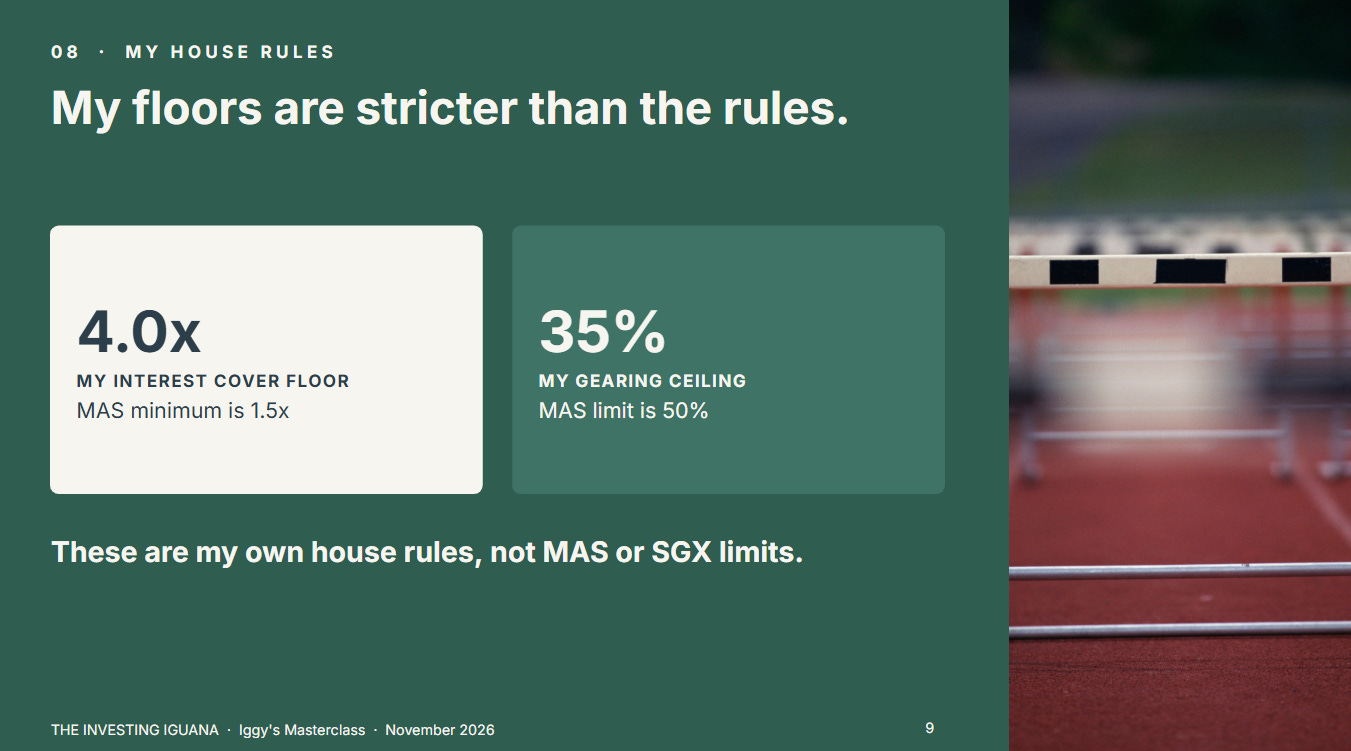
Read that carefully. The 1.5 times and the 50% are legal minimums. The 1.8 times is a level at which the manager is expected to explain itself. None of them says a REIT is comfortable. They say it is allowed to keep operating. My own floors are stricter and are my own house rules, not MAS or SGX limits.
Keep Reading, Free
The next section puts numbers on all of this with two made-up trusts, then runs both through a bad year. Subscribe free to Iggy’s Substack and you can read the rest of this piece without paying. The paid pieces apply the same tests to named SGX REITs, and the tiers are listed on the subscribe page.