Editor’s Note: This post has been updated on October 19, 2025, to reflect the latest market movements, including gold’s surge past $4,350. We have also streamlined the analysis to more clearly connect the core global drivers—from Fed policy to central bank buying—directly to your local CPF and SRS portfolio strategies.
Welcome back, everyone! This is Iggy, The Investing Iguana, and today we’re diving into a story that’s taking the global finance world by storm—gold breaking through the $4,000 mark and even surging past $4,350 as of this writing
But as always, we’re going deep, connecting what’s happening internationally to what matters right here in Singapore. Why should you care as an SG investor? Because gold’s meteoric rise isn’t just about Wall Street hedge funds—the ripple effects are showing up in our CPF statements, SRS portfolios, and even SGX-listed gold ETFs.
Stick with me to the end for my own personal take on what Singaporeans should do next if you’re eyeing your retirement nest egg.
In This Article:

• Gold’s Meteoric Rise: Not Just Another Milestone
• Driver 1: The Macro Policy Pivot (The Fed & The Dollar)
• Driver 2: The “Big Money” Flows (Central Banks & ETFs)
• ETF Renaissance Signals Investor Sentiment Shift
• Dollar Weakness Creates Favorable Dynamics
• Driver 3: The “Fear & Momentum” Trade
• My Personal Take & Actionable Recommendations
Gold’s Meteoric Rise: Not Just Another Milestone
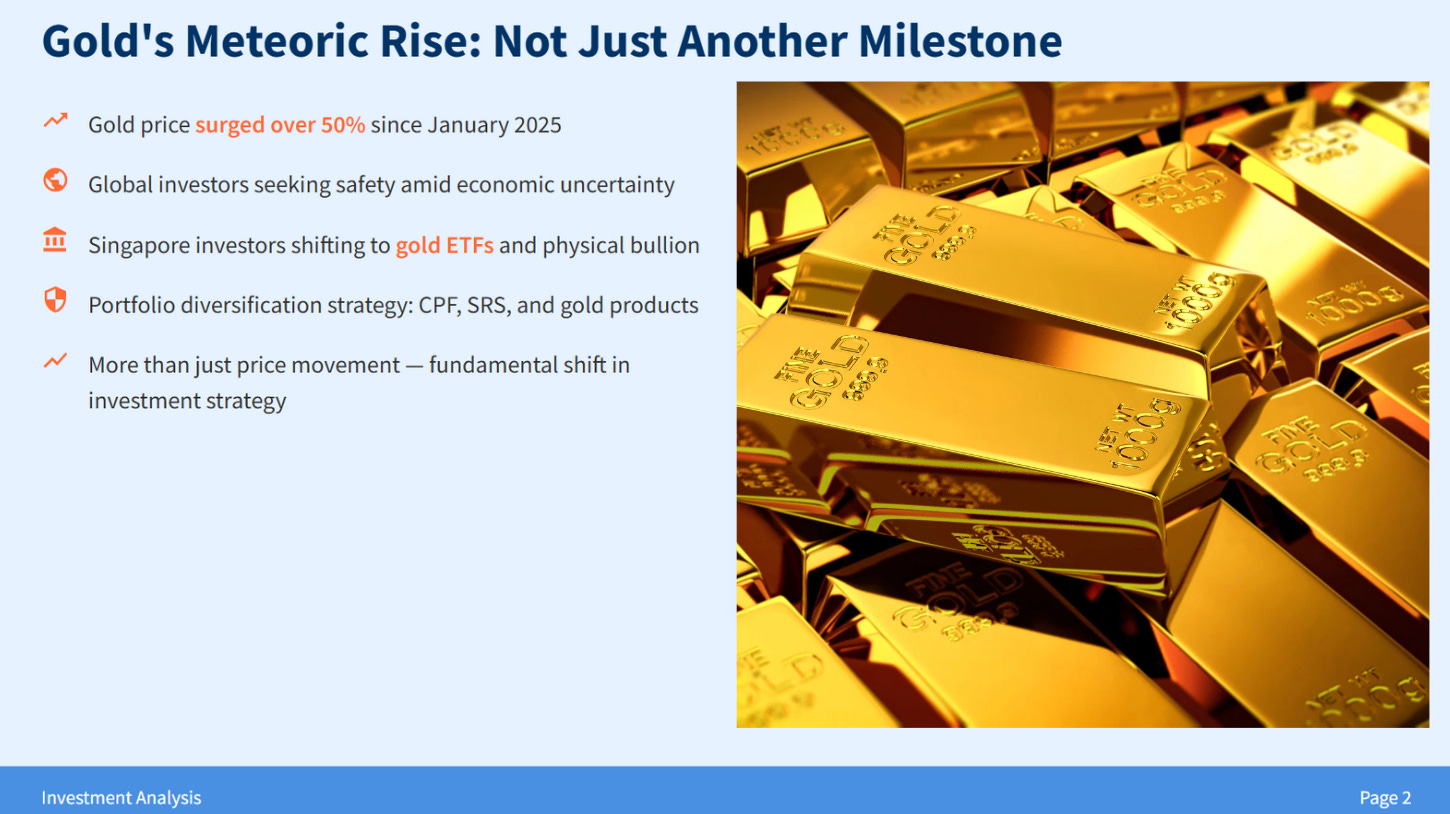
Let’s start at the very top. Gold soaring past $4,000 an ounce is more than just financial trivia—it signals a big shift in how investors everywhere, including us here, are bracing for turbulence. In Singapore, it’s a bit like seeing cash deposits in local banks suddenly outpace blue-chip stocks. Why? When things get shaky, people reach for what feels secure. For locals, that means topping up CPF for the guaranteed returns, diversifying with SRS, or even getting into gold-backed ETFs on SGX.
Now, gold’s price didn’t just creep up this year—it rocketed, climbing over fifty percent since January. For those who remember the last time gold moved like this, it felt like watching the MAS tighten monetary policy during a US Fed crisis, only now, the drivers are more complex. Not just panic buying—this is about fundamental changes in how nations, institutions, and even Singaporean investors are thinking about safety and opportunity. There’s been rising geopolitical tension, uncertainties in global trade, and what market pros call “FOMO”—fear of missing out. Just look at how first-time local investors are jumping onto gold ETFs and physical bullion, sometimes even swapping out of REITs during periods of SORA rate cuts.
Driver 1: The Macro Policy Pivot (The Fed & The Dollar)
The single biggest driver for gold is the massive policy pivot from the US Federal Reserve. These two factors—interest rates and the US dollar—are deeply connected, and both are flashing green for gold.
First, the Fed has clearly signaled it is moving from hiking to cutting interest rates. For Singaporean investors, this is a familiar story. When the Fed eases, the “opportunity cost” of holding a non-yielding asset like gold plummets. Why hold cash in a fixed deposit or SRS bond fund for a tiny yield when the central bank is actively trying to lower rates? This dynamic makes gold shine.
Second, this policy pivot has directly weakened the US dollar. The DXY index fell 10% between January and June, which acts like a discount for global gold buyers. For us in Singapore, even when looking at SGD-denominated gold products, a weaker USD provides a powerful tailwind for the underlying asset.
These two forces—falling rates and a falling dollar—create a perfect storm for gold. The tables below show how these policy shifts are building momentum.
Table: Recent Fed Rate Moves and Gold Price Momentum
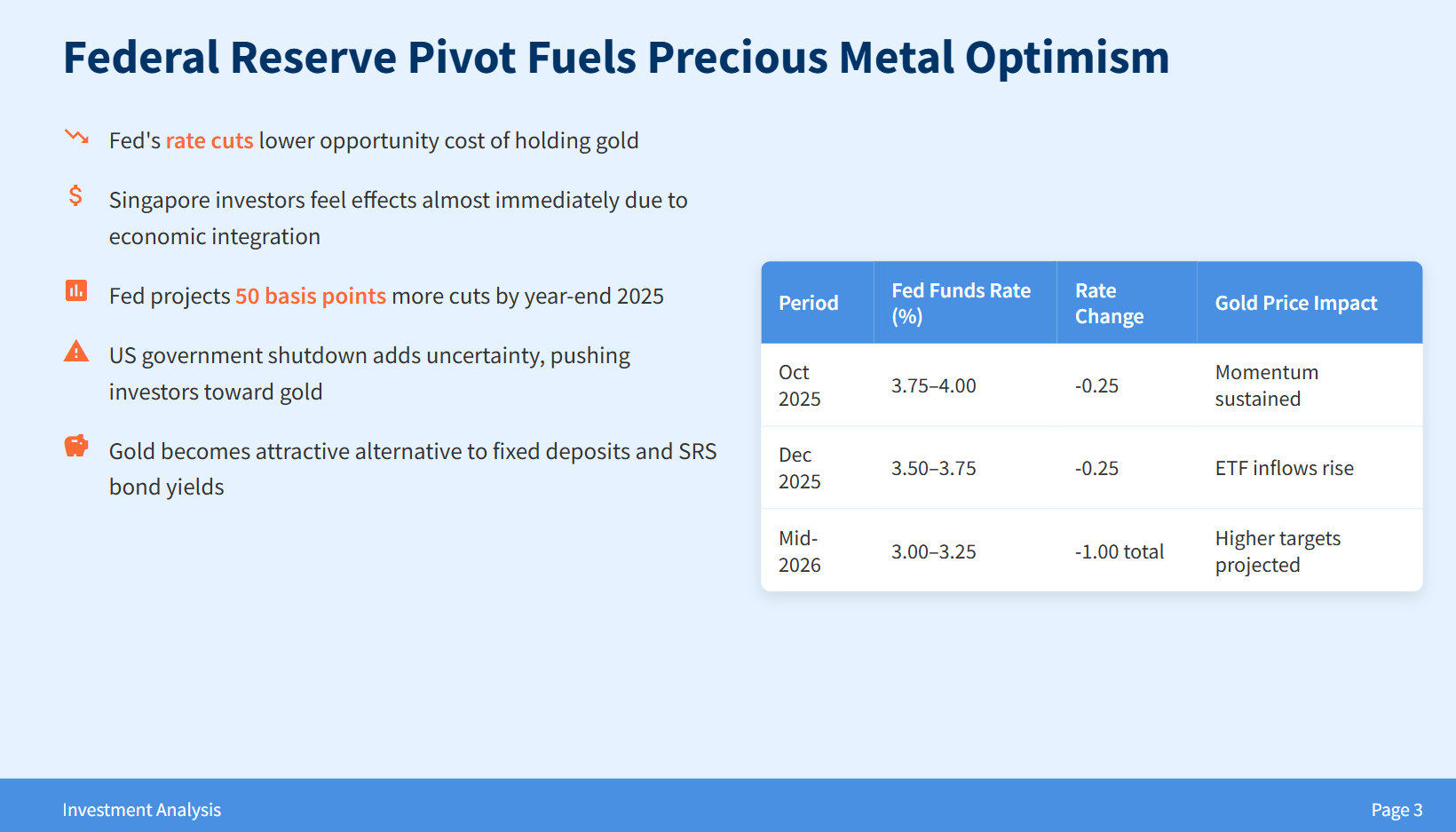
Caption: A clear pivot by the US Fed toward easing has reduced the opportunity cost of holding non-yielding gold.
Recent economic projections from the Fed show growing concern about unemployment. The central bank expects to cut rates by another 50 basis points by year-end 2025, then go further in 2026. When major central banks ease, gold becomes more attractive, and that trickles into portfolio strategies for even CPF and SRS account holders here.
The ongoing US government shutdown also influences sentiment. With key economic releases suspended and uncertainty growing, Fed officials may lean toward more aggressive easing. Each week of shutdown slices up to 0.2 percentage points off US GDP growth—a key reason why gold keeps looking better.
Driver 2: The “Big Money” Flows (Central Banks & ETFs)
It’s not just policy shaping the market; the actual flow of “big money” provides a powerful price floor. This demand is coming from two major sources: official state institutions and private investors.
First, central banks worldwide are on an historic buying spree, grabbing gold “as if it were kopi at lunchtime.” In 2023, official institutions bought a near-record 1,000 tonnes. For SG/MY investors, it’s notable that regional players like Thailand and Indonesia are part of this trend. Why? They are hedging against geopolitical risk and the vulnerability of foreign reserves (like the US dollar) to sanctions. This official buying creates a steady, massive source of demand.
This institutional search for a tangible store of value is mirrored in the private market, particularly through Gold ETFs. We’re seeing a renaissance in demand here in the Asia-Pacific, with SGX-listed gold ETF inflows picking up. Crucially, this doesn’t look like fast-money speculation. It signals a shift toward patient, diversified portfolios—a mindset that CPF and SRS holders know well. With local retail buying for gold bullion and ETFs more than doubling, it’s clear that both the world’s largest institutions and individual Singaporean investors are reaching the same conclusion.
Table: Major Central Bank Gold Purchases
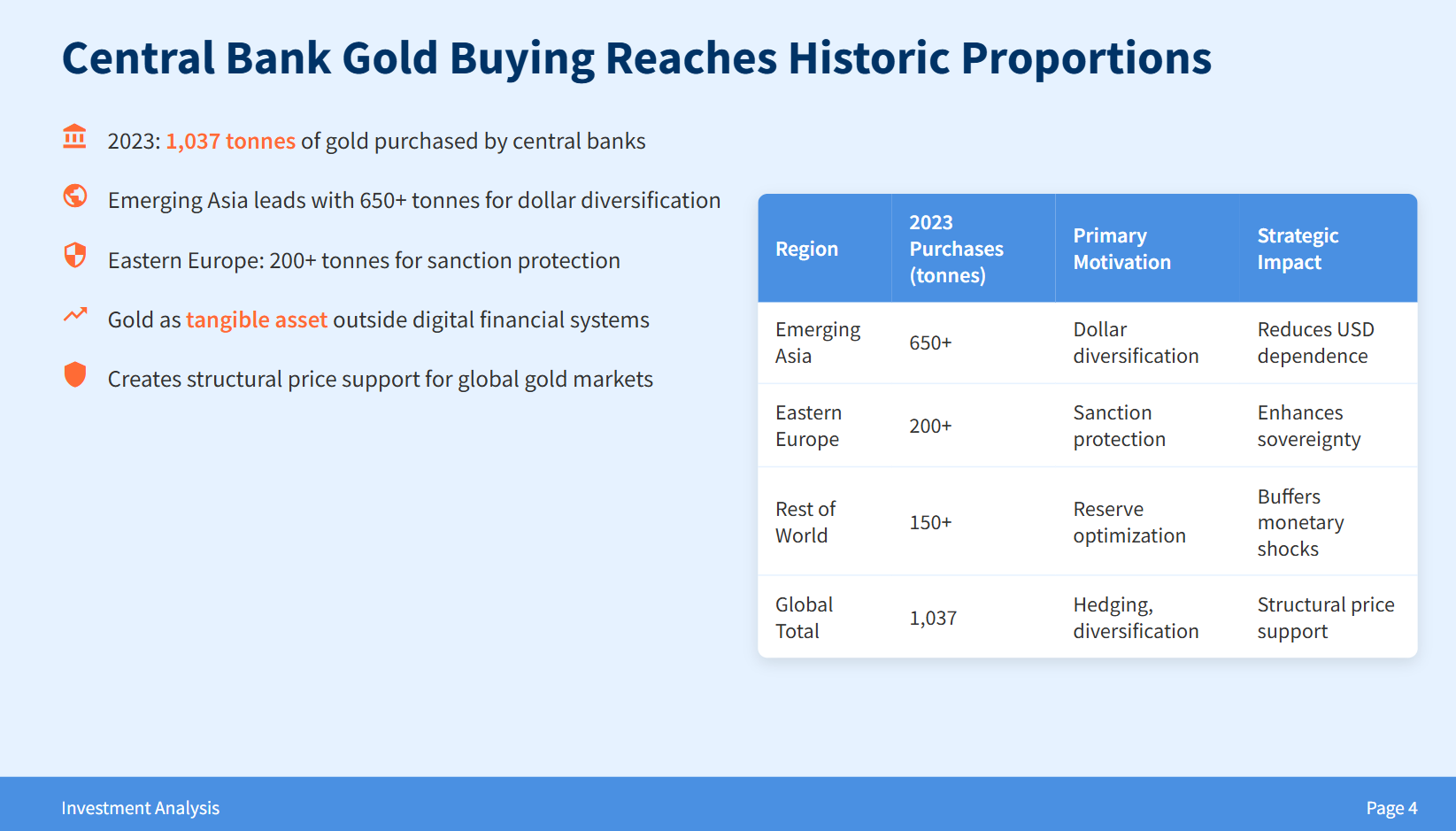
Caption: Record central bank buying, driven by geopolitical hedging, provides a strong “floor” for the gold price.
Central banks in these segments are seeking safety from currency volatility and geopolitics. Their consistent buying provides a floor under gold prices, and it’s why local investors are watching gold’s role as a “store of value” for portfolio safety.
The 2022 freeze on Russian assets made headlines. That moment showed how international reserves—even huge ones—can be vulnerable to policy risk. Gold remains a tangible, physical asset outside those digital crosshairs.
ETF Renaissance Signals Investor Sentiment Shift
Speaking of ETFs—there’s been a revival in demand for gold-anchored funds, especially in Asia-Pacific. On SGX, gold ETF inflows picked up recently, echoing the global trend. In September alone, ETF inflows worldwide hit peak levels not seen in three years. The difference now is that this demand seems sustainable—not just fast-money speculation, but patient, diversified portfolios—much like what CPF or SRS holders value over time.
Table: Global Gold ETF Flows, Sept 2025
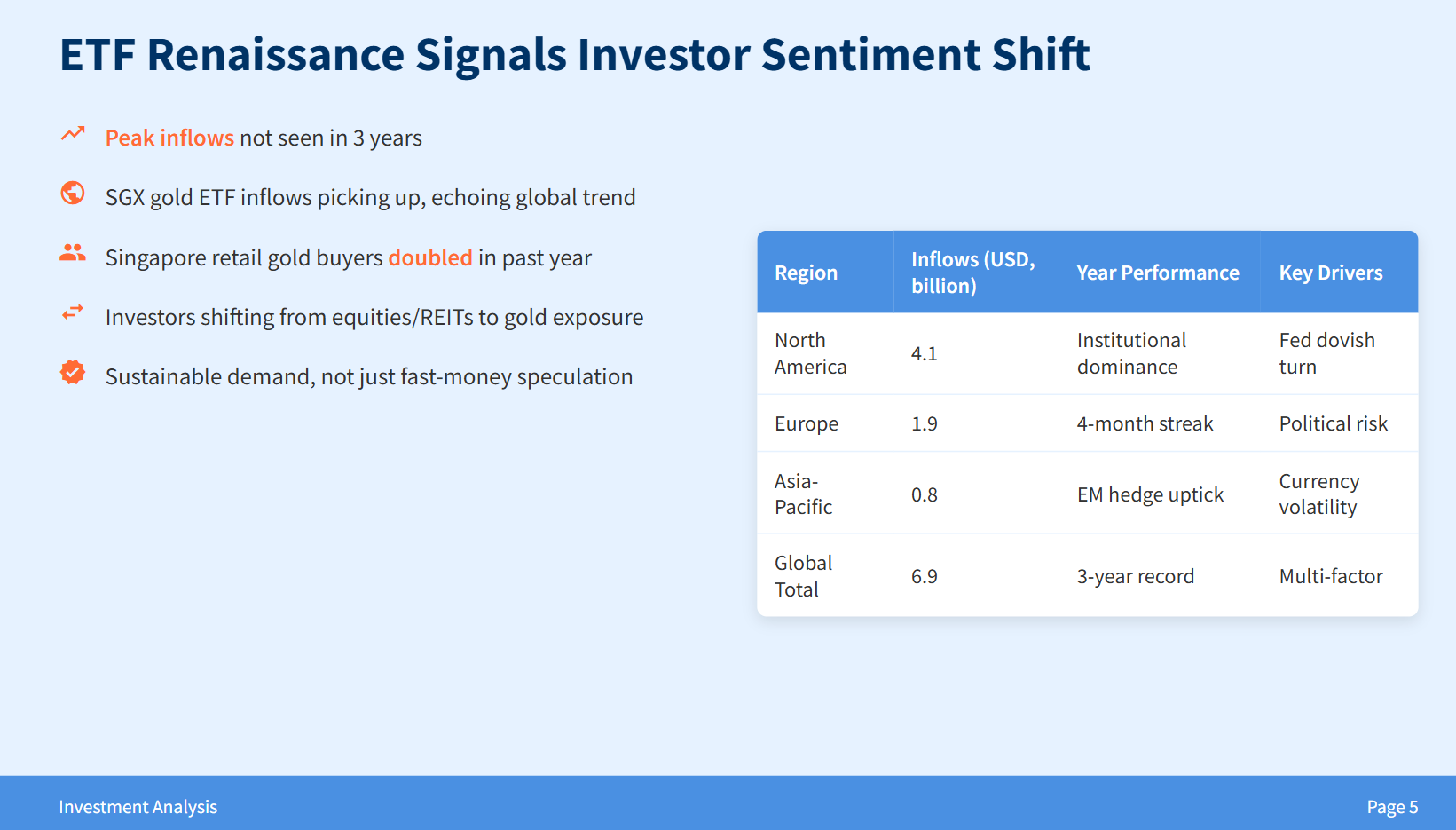
ETF inflows show both institutional power and growing retail confidence. As global risk picks up, investors of all stripes increase their gold exposure for stability.
Retail investor activity has jumped, too. In Singapore, new gold ETF and bullion buyers have more than doubled compared to a year ago. This isn’t just panic reacting—it’s portfolio diversification in action. Many are shifting a slice of their investments out of pure equities or REITs, or even exploring gold exposure with SRS.
Dollar Weakness Creates Favorable Dynamics
The US dollar’s recent tumble gave gold yet another leg up. Between January and June, the DXY index fell 10%, making gold cheaper for global buyers. Singapore traders know that when the US dollar drops, gold becomes more attractive—even for buyers just focused on SGD-denominated products. Just as currency plays can push up the cost of imported goods, they lift gold demand when the dollar is weak.
Table: Dollar/Government Policy and Gold
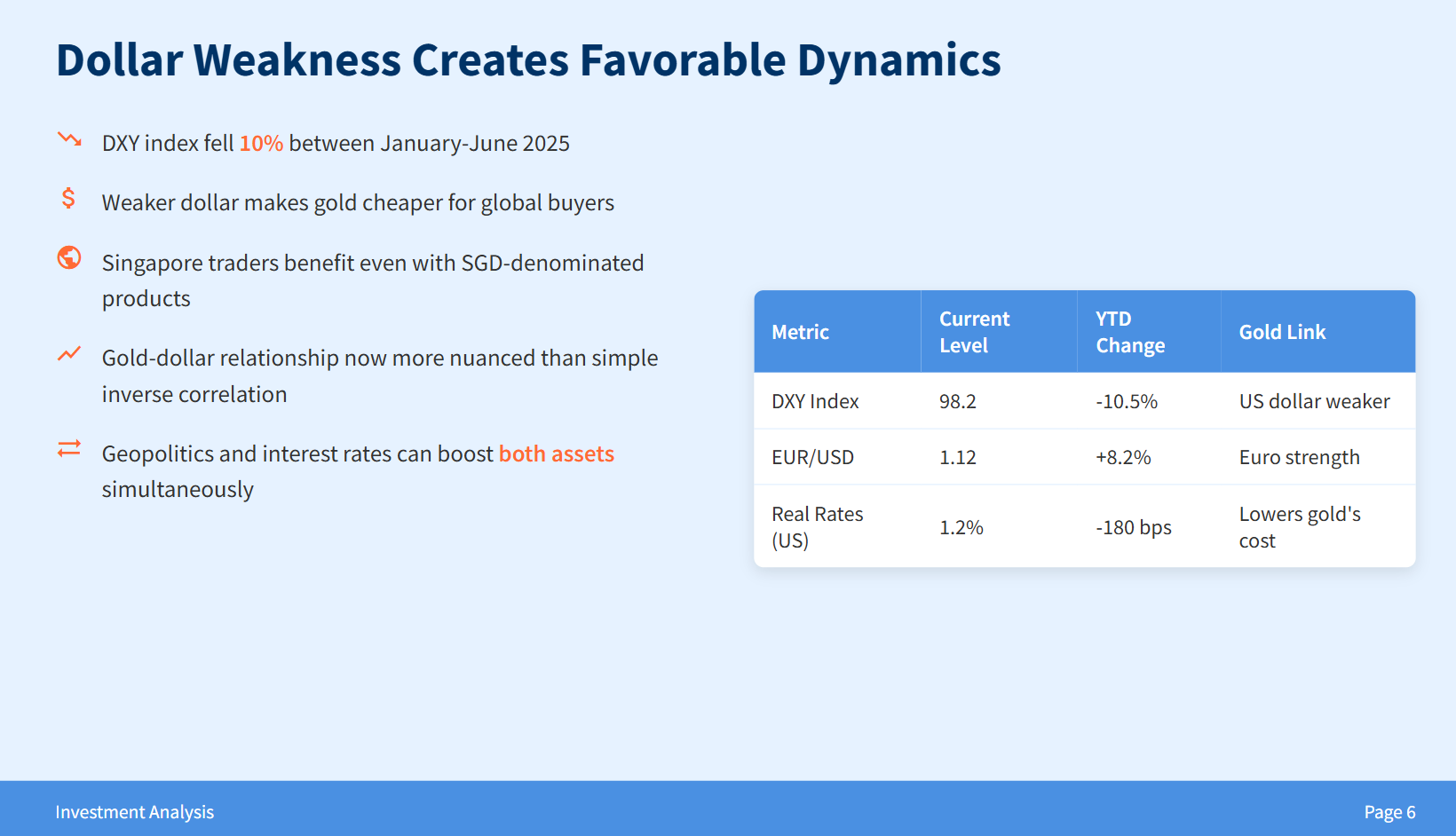
This table illustrates how the weakening dollar and falling real interest rates create more upside for gold, even in local markets.
Gold-dollars linkage used to be simple. Now, it’s all nuance. Geopolitics, interest rates, and fiscal troubles pull at both assets, sometimes even boosting them together when markets get nervous. That’s the story playing out now.
Driver 3: The “Fear & Momentum” Trade
Finally, the entire rally is being supercharged by a classic “fear and momentum” trade.
The “fear” comes from persistent geopolitical and fiscal uncertainty. Ongoing global tensions and endless debates about US fiscal stability have investors on edge. This has brought the “debasement trade”—hedging against the long-term loss of purchasing power in fiat currencies like the US dollar—back in a big way. With global government debt at staggering levels, gold’s appeal as a tangible, sovereign-neutral asset is undeniable. It’s the go-to anchor when financial seas get rough.
The “momentum” is the market’s validation of this fear. This isn’t just a panic-driven spike; it’s a structural trend now being confirmed by major institutional forecasts. Big investment banks are updating their models, with price targets now stretching toward $4,900 or even $5,000 by the end of 2026. This shows that analysts believe the underlying forces from central banks, ETF buyers, and cautious households are here to stay.
Table: Why Gold Works as a Safe Haven
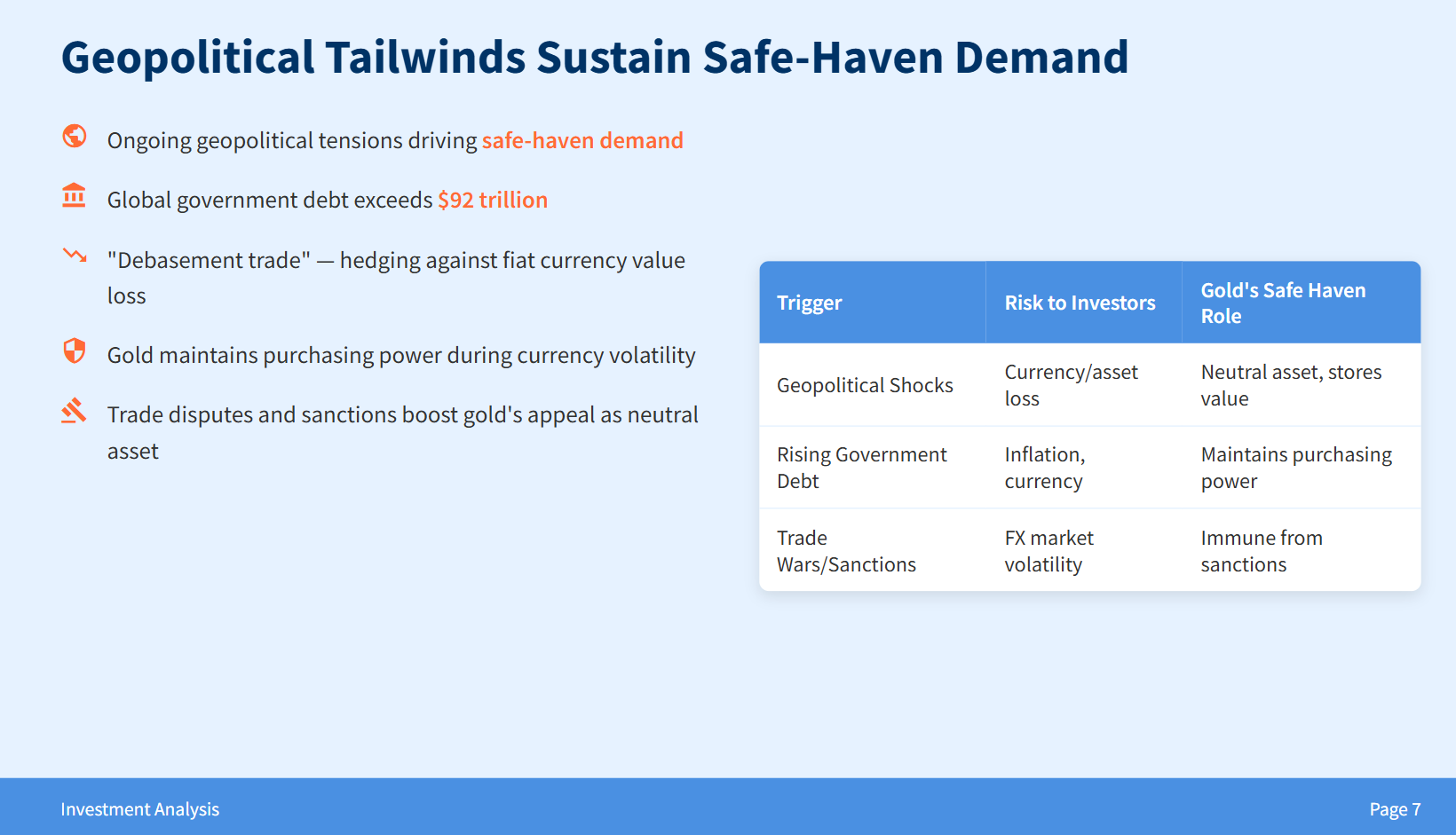
Caption: Gold serves as a unique anchor, hedging against currency debasement, inflation, and geopolitical shocks.
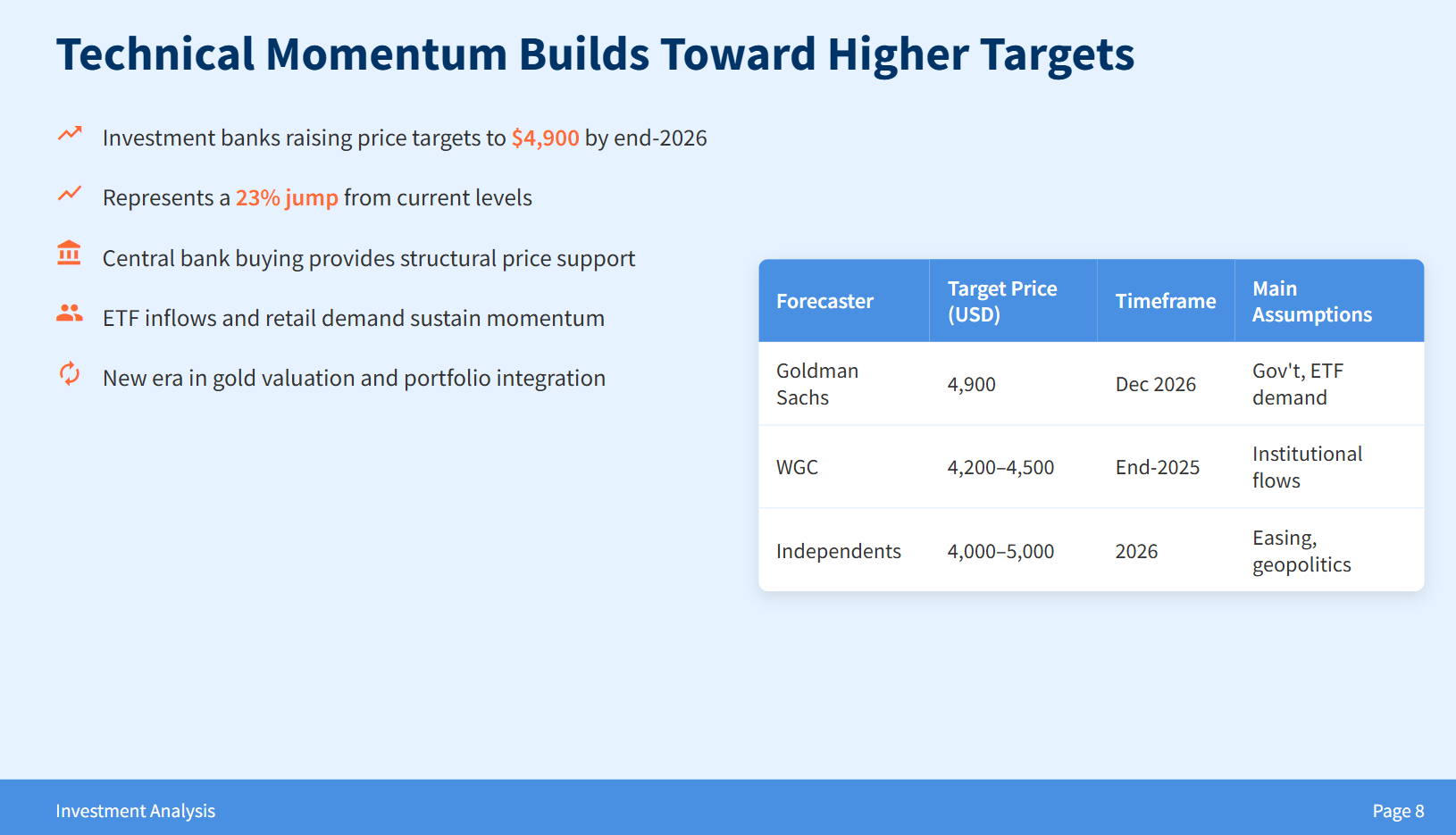
Caption: Major banks are aligned, forecasting significant further upside as the new structural drivers for gold take hold.
Diverging policies and political fights make gold appealing for those who want to sleep better at night. Trade disputes, tariff threats, and worries over central bank independence turn gold into an anchor when financial seas get rough.