
Oiltek PE 104x Valuation Reset Alert | SGX Weekly Gainers & Losers 19 Apr 2026 |
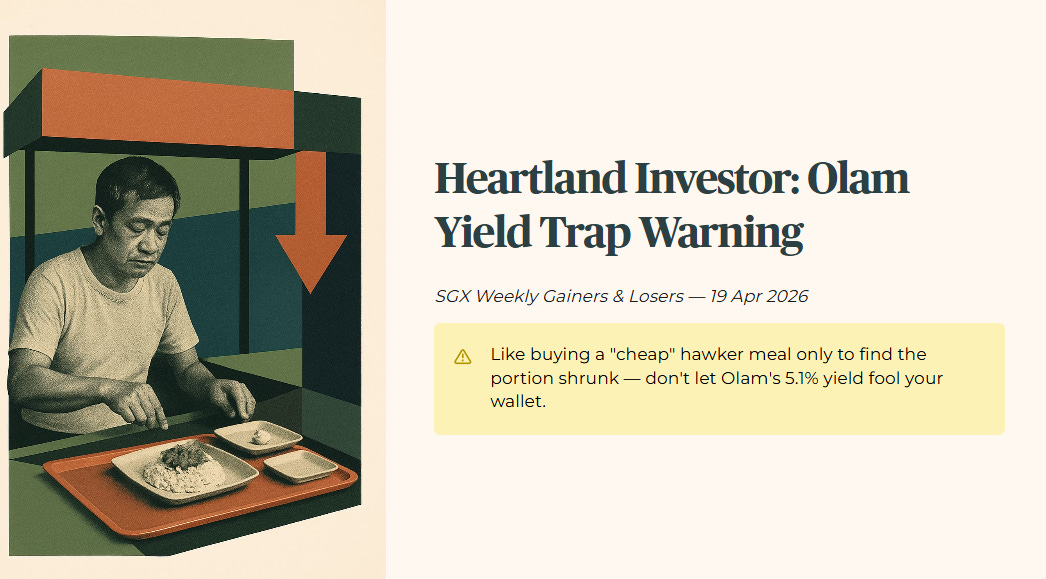
Like buying a "cheap" hawker meal only to find the portion shrunk—don't let Olam's 5.1% yield fool your wallet.
The Macro Pulse
The Straits Times Index closed the week at 4,997.93, sitting in a protracted consolidation phase exactly 1,002.07 points from the psychological 6,000-point milestone. Broader market turnover reached 1.8 billion securities traded, reflecting selective institutional flight to liquidity ahead of the US-Iran ceasefire expiration. The single macro driver dictating this rotation is severe compression in short-term risk-free rates. The 6-month T-Bill yield dropped to 1.47% at the April 9 MAS auction, forcing institutional capital out of structural risk sectors and directly into high-yield banking sanctuaries.
In This Article:
This Weeks Forensic Movers The Gainers Yield Trap Alert
Iggys Insight Oiltek International HQU
This Weeks Forensic Warnings The Losers Gearing Alert
Iggys Insight Olam Group VC2
The Forensic Yield Spread Monitor
The Macro Connector
Iggys Weekly Verdict
Iggys Forensic Compliance Standards Standard Disclaimer
This Week’s Forensic Movers — The Gainers — YIELD TRAP ALERT
Oiltek International (HQU)
Oiltek entered into a transformational RM1.4 billion Heads of Agreement with Bioseaga Industries to construct a Sustainable Aviation Fuel production facility in Sabah, Malaysia. This single infrastructure contract is five times larger than the company’s entire S$350 million order book recorded in February 2026, representing an acceleration well above its three-year historical baseline. Against an industrial benchmark like Seatrium, which fails our gateway checks on leverage alone, Oiltek passes the initial fortress threshold by keeping total debt below a 10% ceiling.
Stress-testing a 10% timeline delay on the Sabah facility, a highly probable trigger given current global supply chain disruptions, the market’s trailing P/E of 104.01x implies an immediate and severe equity contraction. For a 55-year-old heartland investor allocating S$10,000 to secure retirement cash flow, a 1.4% yield starves your CPF timeline entirely. This is an alpha momentum play, not an income sanctuary.
Iggy’s Insight: Oiltek International (HQU)
Oiltek presents the sharpest forensic contradiction on the local bourse this week. The balance sheet is genuinely clean. The valuation is genuinely terrifying. A trailing P/E of 104.01x means the market has already priced in two years of flawless execution before the first turbine turns. One delayed shipment, one cost overrun, one regulatory hiccup in Sabah, and that premium collapses without warning. A clean balance sheet does not insulate you from a valuation reset. If you are holding this for retirement income at 1.4%, you are not investing. You are speculating on management perfection.
Geo Energy Resources (RE4)
Geo Energy received approval for an S$18.4 million private placement at S$0.525 while achieving 80% completion on its MBJ hauling road project. The company carries a 59.4% debt-to-equity ratio against our 35% fortress ceiling, indicating that heavy capital is being continuously recycled into infrastructure rather than shareholder distributions. The confirmed 1.34% yield is structurally useless for income mandates, exposing your capital to construction delay risk without compensating you adequately for the leverage carried.
Yangzijiang Shipbuilding (BS6)
The maritime manufacturing giant closed higher at S$4.09 on record institutional demand for green-methanol and LNG-ready vessels. The fortress balance sheet remains solid. The 2.93% yield, however, fails to clear our mandatory 4.7% sanctuary hurdle. That gap forces a yield-seeking investor to sacrifice the minimum risk premium we require, explicitly marking this counter as a cyclical growth allocation rather than a reliable cash flow generator.
This Week’s Forensic Warnings — The Losers — GEARING ALERT
Olam Group (VC2)
Olam Group confirmed that its Group CEO, Group CFO, and Chairman will all step down simultaneously in April 2026. The agricultural giant reported a 414% year-on-year net profit spike to S$444 million, but this was entirely engineered by a one-off Saudi divestment gain masking a 47% collapse in core revenue against its three-year historical average.
Against regional agricultural peers like Wilmar International, Olam fails our fortress parameters entirely, carrying a 221.2% debt-to-equity ratio. Stress-testing a 10% upward move in regional borrowing rates will instantly consume the engineered cash flow and force aggressive capital preservation measures. A retail investor relying on the confirmed 5.1% payout to cover monthly household expenses is sitting on a mirage built on borrowed time. This is a confirmed yield trap.
Iggy’s Insight: Olam Group (VC2)
Olam is executing a controlled structural implosion wrapped in a divestment narrative. The simultaneous departure of the founding CEO, CFO, and Chairman is not routine succession planning. It is a complete reset of institutional confidence in the original high-leverage growth model. A 414% profit spike built on a one-off Saudi sale, layered on top of a 221.2% debt-to-equity ratio, is not a recovery signal. It is a one-time event that flatters the headline while the core business shrinks. When the divestment cash runs out, that 5.1% yield has nothing structural supporting it. The debt wall does not negotiate.
Seatrium (5E2)
Seatrium declined 1.6% to close at S$2.42, maintaining an Altman Z-Score of 1.2 amid broad profit-taking ahead of regional geopolitical deadlines. Gross gearing sits at 42.9% debt-to-equity, comfortably breaching our 35% fortress ceiling. This price contraction validates our active restructuring fatigue thesis. The counter provides zero yield while exposing retirement capital to unacceptable institutional volatility and ongoing refinancing risk.
UltraGreen.ai (ULG)
The medical AI player dropped to US$1.36 as institutional investors de-risked ahead of the upcoming Annual General Meeting. The 1% debt-to-equity ratio is a genuine forensic fortress anomaly in the mid-cap tech space. The absence of any dividend payout, however, creates a capital allocation void. An income investor holding this counter receives zero cash flow to offset core inflation, rendering it structurally incompatible with any immediate retirement funding mandate.
The Forensic Yield Spread Monitor
For this audit, I apply a conservative floor of 3.2%. We audit for the storm, not just the sunny day. While the T-Bill sits at 1.47%, I do not lower my standards to match a temporary market dip. My floor remains at 3.2% to ensure sanctuary assets can withstand a return to long-term average interest rates. The minimum yield hurdle is 4.7% — that is the 3.2% floor plus 150 basis points of mandatory risk premium.
The extreme spread between our regional banking anchors and the collapsing risk-free rate isolates the financial sector as the only viable cash flow sanctuary this week.
The Macro Connector
This week’s movers broadcast a clear sector rotation signal: the Yield Sanctuary Squeeze. Institutional capital is aggressively moving out of structural risk anomalies and into high-yield financial fortresses. And let’s be honest, they are not wrong. The broader market is paying an extreme premium for zero-debt industrial growth while brutally punishing endless corporate restructuring cycles. We are witnessing a systemic rejection of high-leverage business models in an environment that demands absolute cash flow certainty. The forward risk is a sudden, violent valuation collapse in these zero-yield engineering anomalies if regional energy catalysts fail to materialise exactly on schedule.
The Window Is Already Open
The Window Closes Fast. In this market, the difference between a “Sanctuary” and a “Yield Trap” is decided in a single trading session. By the time this analysis reaches you as a free subscriber, the entry window Iggy identified has already opened — and often closed.
Iggy’s Elite Investors don’t just get the report earlier. They get it when the numbers still matter — zero-day forensic breakdowns, the full “Red Zone” watchlist, and institutional-grade cheatsheets at the moment the setup is live, not after the market has already priced it in.
For S$9/month — less than a kopi and kaya toast set at Raffles Place — you stop being the Exit Liquidity and start being the Analyst.
Iggy’s Weekly Verdict
The single most critical forensic observation for your retirement architecture this week is the extreme spread exploding between the 1.47% T-Bill and DBS at 6.39%. That is a 492 basis point gap. When the risk-free rate collapses this sharply, the premium placed on genuine, distributable banking yield becomes an institutional magnet. While retail participants remain dangerously distracted by aggressive price momentum in mid-cap engineering plays carrying 104x multiples, smart capital is quietly securing substantial cash payouts regardless of regional rate headwinds. This dynamic directly confirms our Wealth Management Hegemony thesis from the operational log. Do not get blinded by capital appreciation in companies carrying a suffocating debt load or a negligible yield. The sanctuary gap has rarely been this wide.
For my own portfolio construction, I am tracking the yield spread between regional banking anchors and the 1.47% T-Bill. This is a personal forensic boundary, not a recommendation.
Iggy’s Forensic Compliance Standards — Standard Disclaimer
This content is produced for educational and informational purposes only. I am not a financial advisor — I am a retail investor who applies forensic analysis to my own portfolio and shares that process publicly. Nothing here constitutes a recommendation to buy, sell, or hold any security, and no specific target prices or personalised financial advice are offered. All data is sourced from public filings and verified sources; where data is unverified it is explicitly flagged. All investments carry risk, including the potential loss of principal, and past performance is not indicative of future results. If you are making investment decisions involving CPF, SRS, or personal capital, please conduct your own due diligence or consult a MAS-licensed financial adviser before committing funds.


