


Editor’s Note: This post has been updated on October 19, 2025, to improve its clarity and structure. We’ve tightened the introduction and consolidated the concluding lessons to make the analysis sharper and more actionable for our readers.
When “sure-win” tips start making the rounds, even seasoned investors are at risk. The story of Singapore’s penny stock crash is a wake-up call—a sharp reminder that trusting the wrong people, ignoring the warning signs, and chasing quick wins can explode your portfolio overnight. This is not just a tale of greed and gullibility—it’s a crash course in spotting danger before it’s too late, building smarter habits, and protecting yourself from financial disaster.
In This Article:

• The Pain of Penny Stock Temptation
• Iggy’s Take:
• Anatomy of a Scam: The BAL Stock Conspiracy
• Iggy’s Take:
• What Really Happened: The Courtroom Revelations
• Iggy’s Take:
• Why Did Investors Follow? The Psychology of Penny Stock Mania
• Iggy’s Take:
• Regulatory Response: How Singapore Changed the Game
• Iggy’s Take:
• Iggy’s Lessons: From Scandal to Smart Investing
The Pain of Penny Stock Temptation
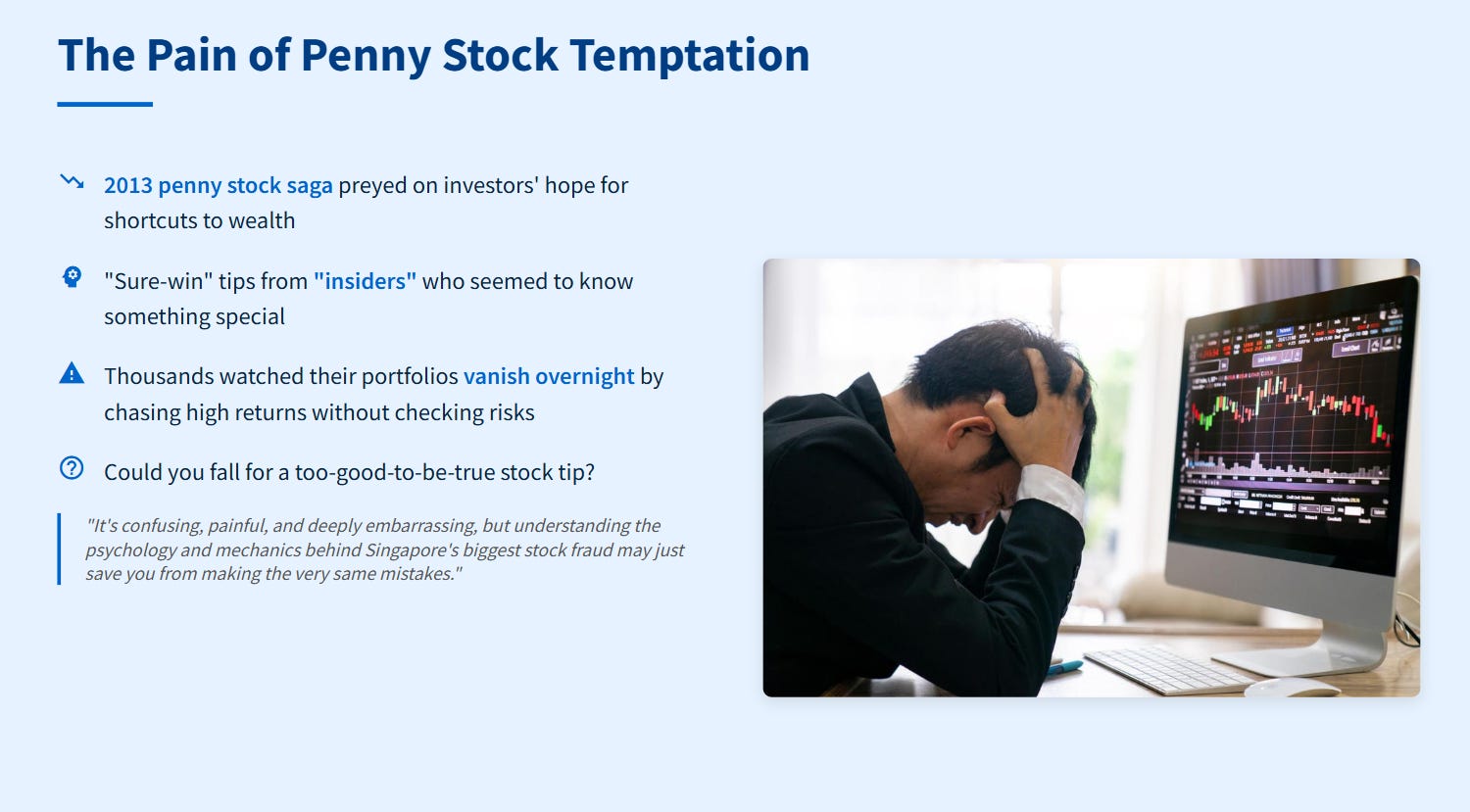
When “sure-win” tips start making the rounds, even seasoned investors are at risk. It’s that nagging feeling when a friend or forum swears a tiny stock is going to fly. Many Singapore investors don’t just feel it—they act on it.
The 2013 penny stock saga preyed on this exact hope: a shortcut to wealth, championed by “insiders” who seemed to know something special. But in chasing high returns without checking the risks, thousands watched their portfolios vanish overnight.
This story is more than just a tale of greed; it’s a crash course in spotting danger before it’s too late. If you’ve ever wondered, “Could I fall for a too-good-to-be-true stock tip?” or found yourself reading improbable profit stories on WhatsApp, understanding the psychology and mechanics behind Singapore’s biggest stock fraud may just save you from making the very same mistakes.
Buckle up—because this story has everything: big egos, detailed manipulation, devastated investors, and tough lessons for all of us hunting alpha in the Singapore market.
Iggy’s Take: Don’t kid yourself—everyone, no matter how experienced, is vulnerable to making emotional decisions when it comes to penny stocks. These shares prey on our hope and our craving for validation from others. If you ever find yourself getting “secretly lucky” about a hot tip, stop and take a breath. There’s no shame in getting caught up in hype, but it hurts a lot more if you refuse to see it coming.
Anatomy of a Scam: The BAL Stock Conspiracy
Let’s strip the financial jargon. The masterminds, John Soh Chee Wen and Quah Su-Ling, orchestrated a complex, multi-layered scheme involving three penny stocks: Blumont Group, Asiasons Capital, and Liongold Corp.
These shares (often called the “BAL stocks”) weren’t household names, but they generated a dramatic buzz. Soh and Quah created the illusion of success, using slick trading patterns and rumours of “institutional support” to lure in both retail investors and big players.
From August 2012 to October 2013, the syndicate manipulated prices using vast sums of borrowed money—misleading banks and brokers to get even more firepower. As prices soared, hype exploded in chatrooms, broker notes, and over-optimistic media.
But the scheme was a house of cards built on leverage. In October 2013, the manipulation became unsustainable. The selling started, triggering a catastrophic collapse. $8 billion in paper value vaporized almost instantly. The aftermath left thousands of furious investors and a rattled Singapore Exchange.
Table 1: BAL Stocks Before and After the 2013 Crash
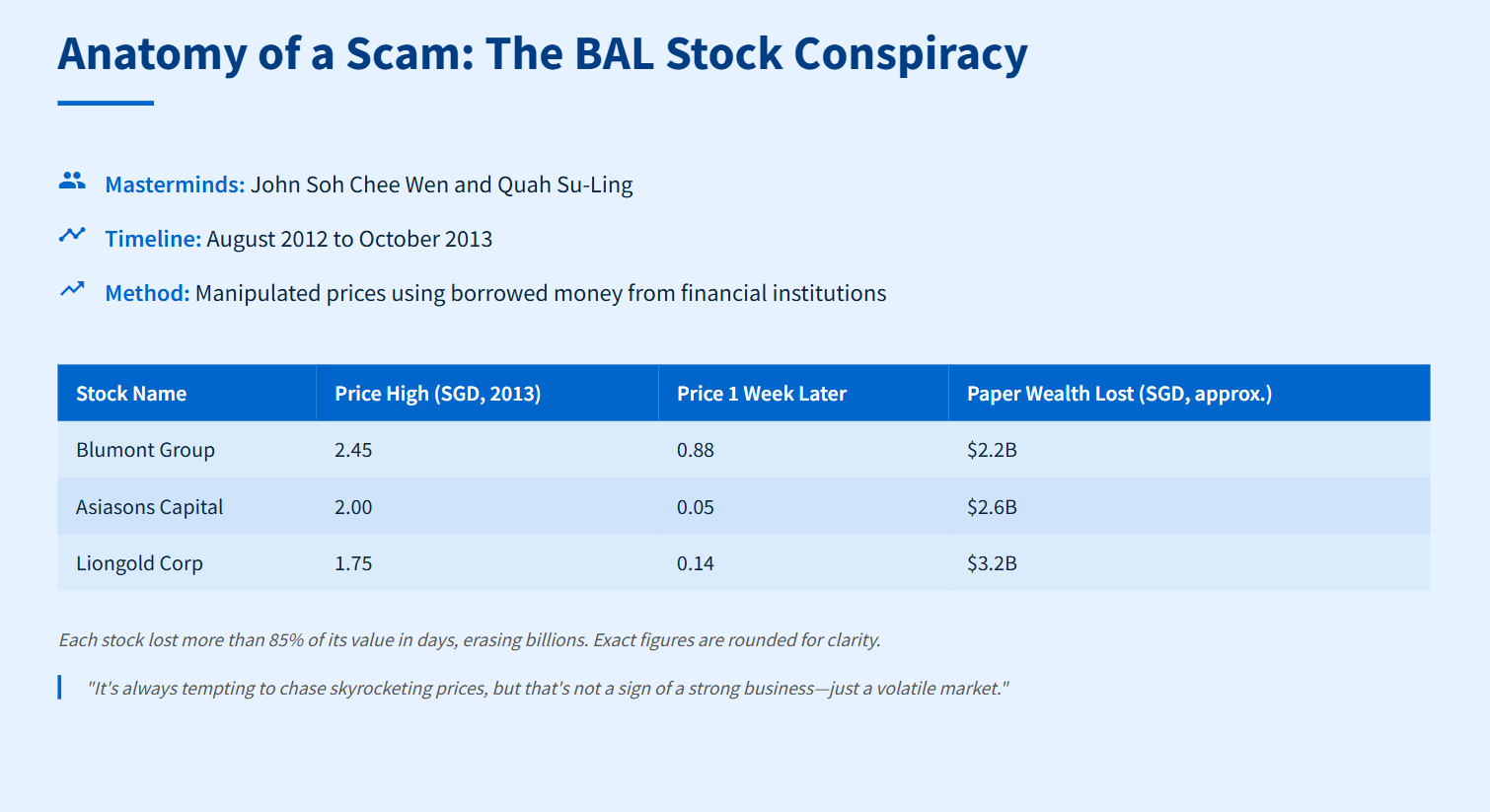
Caption: This table makes the scale of destruction clear—each stock lost more than 85% of its value in days, erasing billions. Note: Exact figures are rounded for clarity.
Iggy’s Take: Chasing skyrocketing prices is always tempting, but that’s a sign of a volatile market, not a strong business. Liquidity and hype can make prices jump, but both can disappear overnight. Don’t convince yourself that “money already made” means there’s plenty left to grab; instead, keep your eyes glued to company fundamentals, not just the wild ticker movements.
What Really Happened: The Courtroom Revelations
After years of investigation, Singapore’s Court of Appeal confirmed: Soh and Quah were the architects. They used incriminating text messages and emails to direct elaborate trading across 189 accounts, opened via 20 different institutions. When the music stopped, Soh faced 36 years’ jail on 180 charges; Quah got 20 years on 169 charges. The law caught up, but only after enormous damage was done.
What’s unique in this case isn’t just the scale, but the sophistication. Manipulative trades created the illusion of market support, drawing in ever more buyers while insiders cashed out. When cracks appeared, Soh brazenly tried to deflect blame onto others and even tampered with witnesses. The courts saw through it all.
Table 2: BAL Fraud—By The Numbers
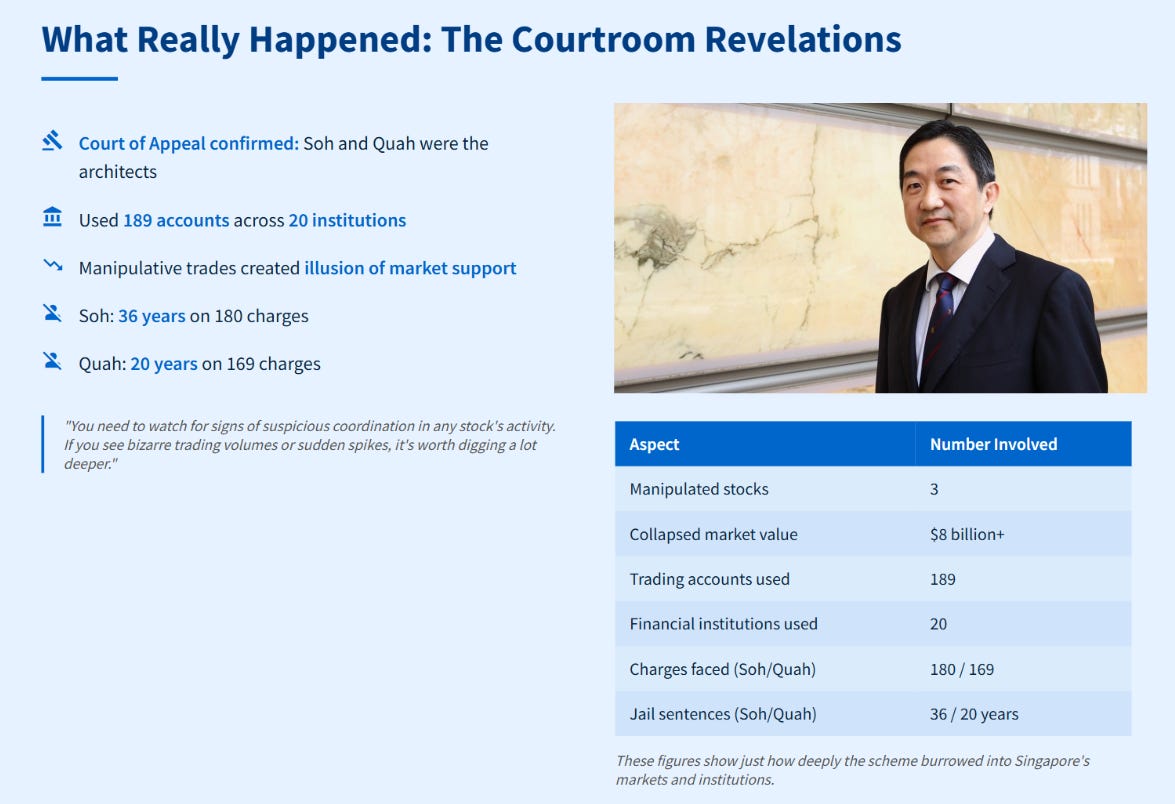
Caption: These figures show just how deeply the scheme burrowed into Singapore’s markets and institutions, and the scale of legal action taken.
Iggy’s Take:
You need to watch for signs of suspicious coordination in any stock’s activity. If you see bizarre trading volumes or sudden spikes, it’s worth digging a lot deeper. Don’t trust so-called “market support” at face value—always ask who’s really behind the move. Most of all, when insiders start blaming others or hiding trades, treat that as a blaring siren of risk.
Why Did Investors Follow? The Psychology of Penny Stock Mania
It’s easy—in hindsight—to blame “greedy” investors. But real life is messier. Soh and Quah cultivated an aura of credibility and market expertise. They whispered to the right circles, orchestrated constant news flow, and propped up prices just long enough for latecomers to believe it was “safe.” The market’s collective FOMO took over.
Retail and institutional investors alike were lured by wild price jumps and the excitement of being “early.” Add in dazzling headlines and online chatter, and rational caution went out the window.
Table 3: Investor Mindset Triggers—A Penny Stock Perfect Storm
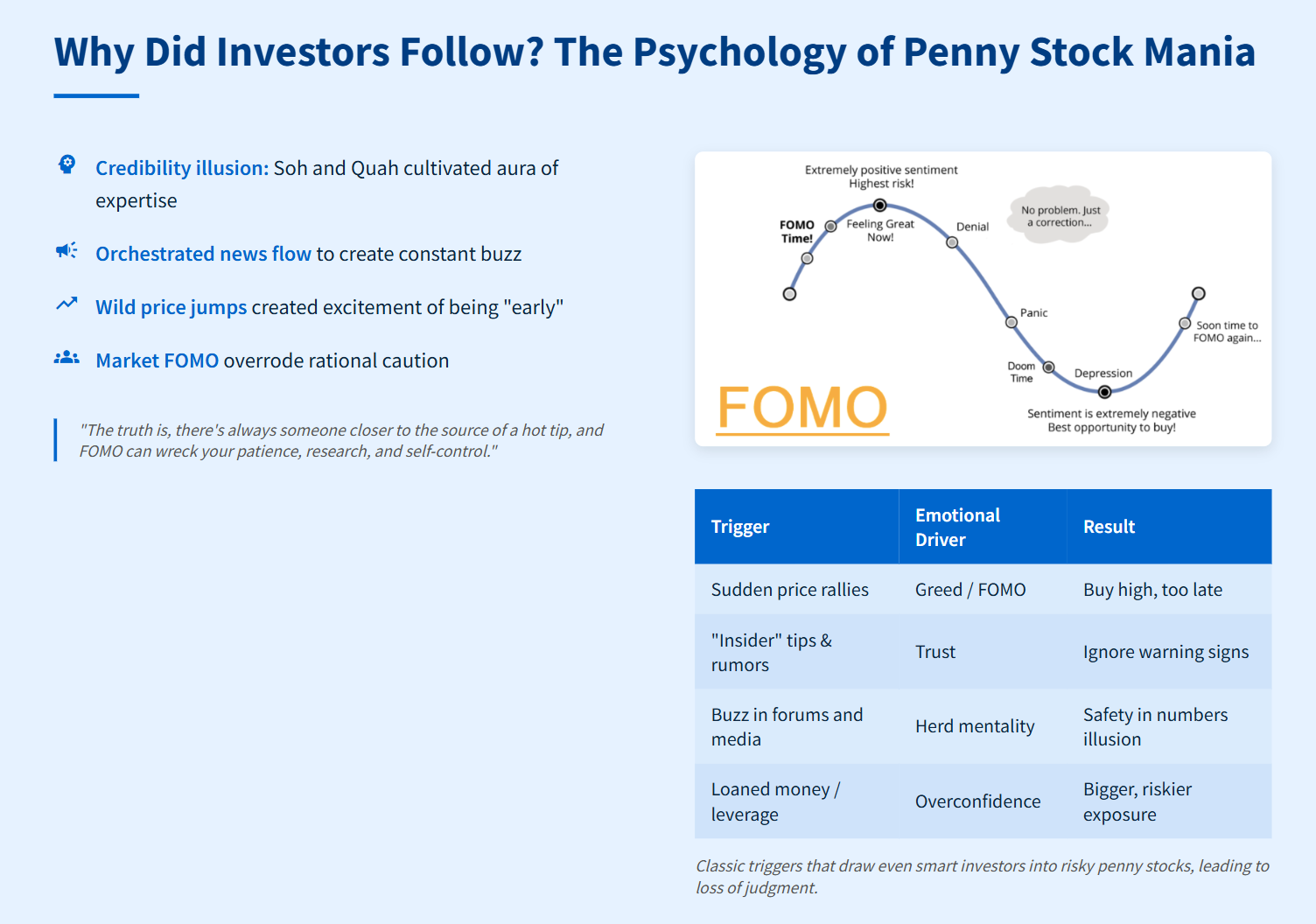
Caption: This table breaks down the classic triggers that draw even smart investors into risky penny stocks, leading to loss of judgment.
Iggy’s Take:
The truth is, there’s always someone closer to the source of a hot tip, and FOMO can wreck your patience, research, and self-control. Trust your own checklist before acting, and don’t feel ashamed to pause or walk away when hype peaks. Even veteran investors fall for market excitement at times—your best move is to make stepping back a habit.
Regulatory Response: How Singapore Changed the Game
The penny stock crash was a watershed moment. The Singapore Exchange (SGX) and Monetary Authority of Singapore (MAS) ramped up enforcement, compliance, and monitoring. Circuit breakers, suspicious activity alerts, and tighter rules on margin and short selling became the norm after 2013.
These changes aimed to protect investors from a repeat of BAL-style frauds, but also made trading more transparent and less prone to wild swings.
Table 4: Post-2013 SGX Safeguards (Summary)
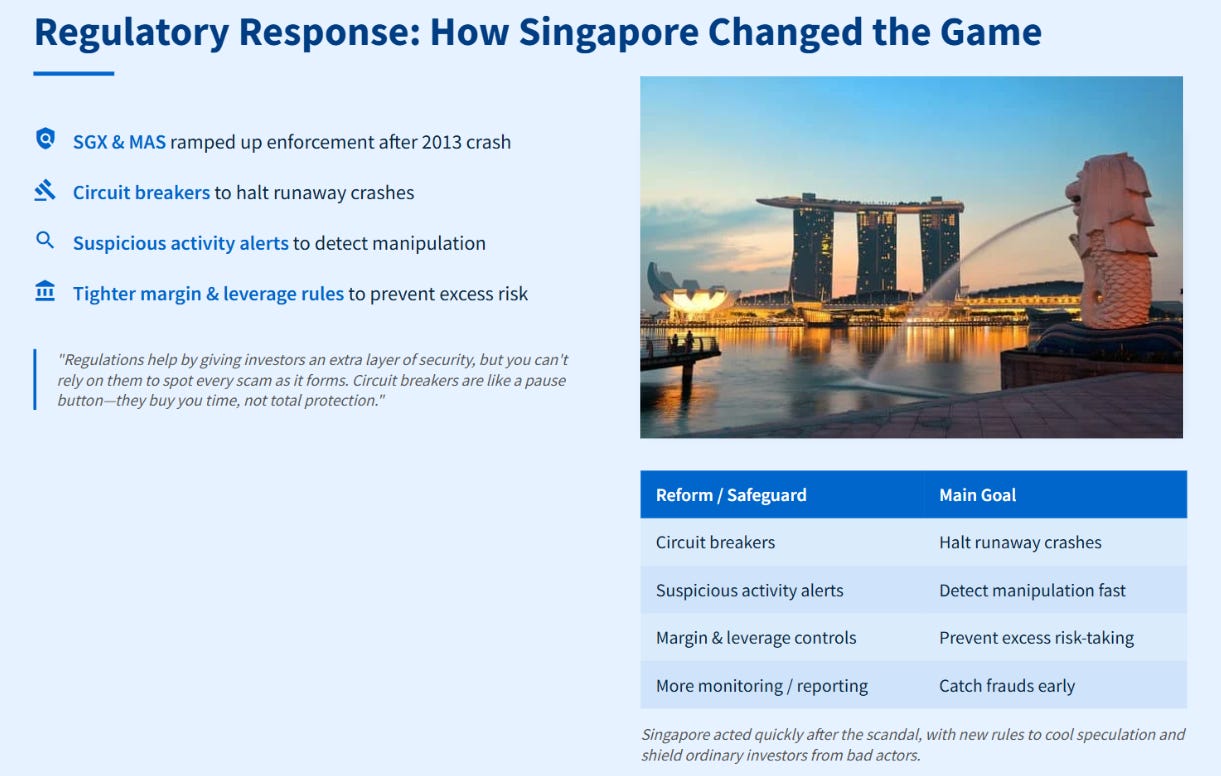
Caption: Singapore acted quickly after the scandal, with new rules to cool speculation and shield ordinary investors from bad actors.
Iggy’s Take:
Regulations help by giving investors an extra layer of security, but you can’t rely on them to spot every scam as it forms. Circuit breakers are like a pause button—they buy you time, not total protection. Make it your habit to review official news and company releases, and don’t stop learning, because the market’s tricks are always evolving.

