Indonesia Cut Its Gas Exports to Singapore. Is It About the Haze? What the Sources Actually Say
The cut is about 8% of Indonesia’s 2024 pipeline gas exports to Singapore. A minister has warned about countries that do not respect Indonesia, without naming one. This piece sets out what the sources link, and what they do not.
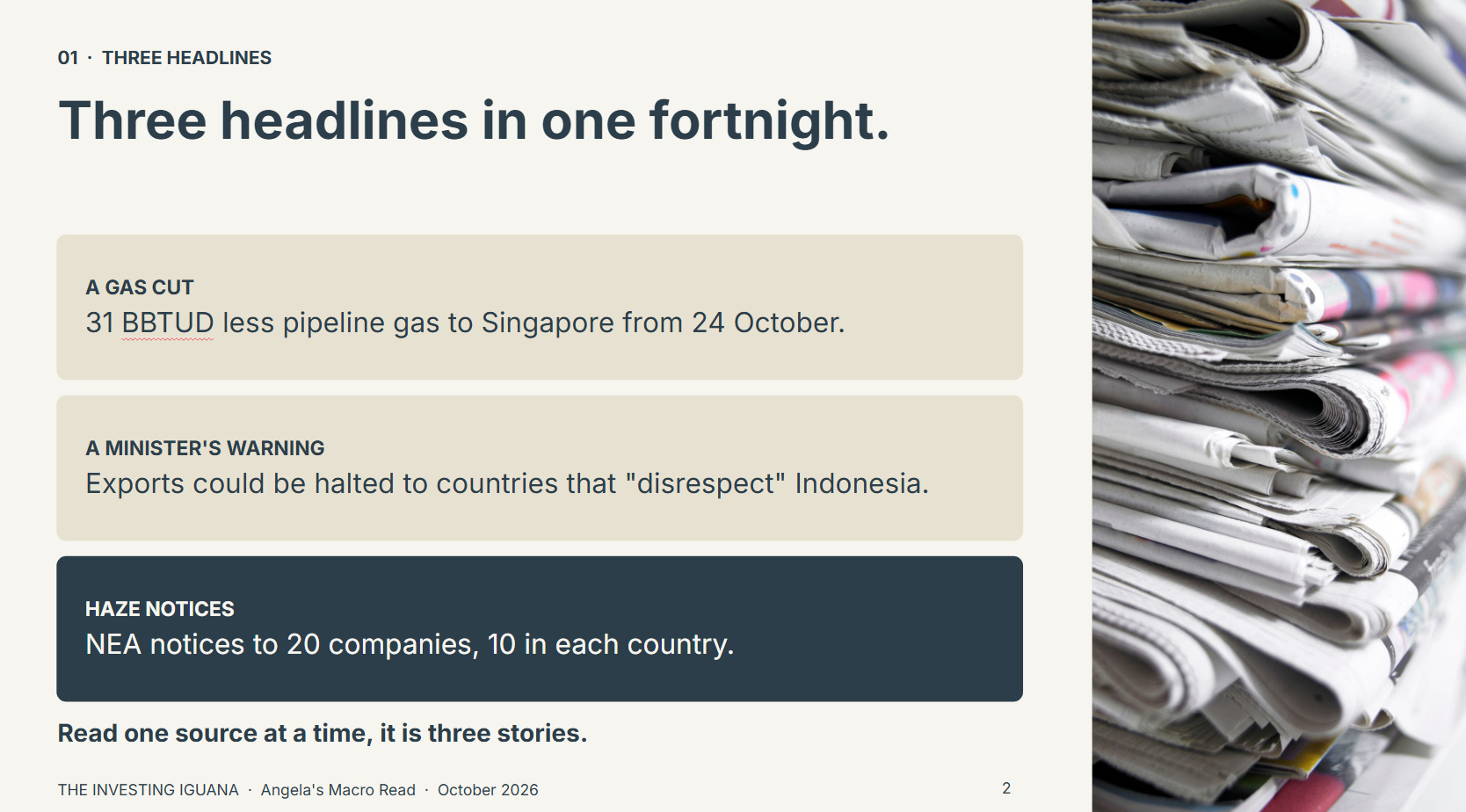
Indonesia began cutting its pipeline gas exports to Singapore on 24 October, by 31 billion British thermal units a day (BBTUD), according to Mothership’s report of the upstream regulator’s announcement. Two days earlier, a senior Indonesian minister said he would not hesitate to consider halting exports to countries that “disrespect” Indonesia. Within the same fortnight, Singapore’s National Environment Agency (NEA) served haze-related notices on 20 companies. Put side by side, it looks like one story. Read one source at a time, it is three.
Gas is the part that touches a household. About 95% of Singapore’s electricity is generated from natural gas, according to Eco-Business (22 October 2026) citing the Ministry of Trade and Industry. So a headline about gas from Indonesia is, sooner or later, a question about the power bill, and it deserves a slower read than a headline usually gets.
I read the Mothership, Eco-Business, Malay Mail, AsiaOne and South China Morning Post reports, the NEA notice, the Ministry’s September 2025 parliamentary reply, and the GasCo statement carried by Red Hot Singapore. I also read the Business Times (Straits Times) report of 24 October, which supplies the share of exports that the cut represents. I take no view on what Singapore or Indonesia should do. What I can do is set out what each source says and where it stops.
What This Piece Does
It lays out what happened, in order, with each source’s date.
It works through three questions: whether any source links the gas cut to the haze, how large the cut is against what Singapore can fall back on, and what it could mean for the power bill and for listed companies.
It labels my own arithmetic as mine, and says plainly where a source is silent.
The first two questions are free to read. The third, on the power bill and listed companies, is in the members’ half. Nothing here is a recommendation.

What Happened, in Order
Question 1: Does Any Source Link the Cut to the Haze?
🟠 Angela’s Observation
Question 2: How Big Is the Cut, and What Does Singapore Have Behind It?
🟠 Angela’s Observation
Question 3: What Could This Mean for the Power Bill and for Listed Companies?
What I Am Watching Next, Without Predicting
Iggy’s Forensic Read
Sources
What Happened, in Order
Four dates, three different institutions
On 16 and 19 October, NEA issued Preventive Measure Notices to 10 Indonesian companies over fires in Sumatra and Kalimantan, according to AsiaOne. On 21 October, at a cabinet meeting marking two years of President Prabowo Subianto’s government, Energy Minister Bahlil Lahadalia told reporters he was considering not renewing gas export contracts with neighbouring countries, as quoted by Malay Mail citing the Jakarta Globe. The same day, Eco-Business reports, the President said Indonesia must protect its natural wealth, and added: “For certain countries that like to insult the Indonesian nation, in time we will reveal the companies.”
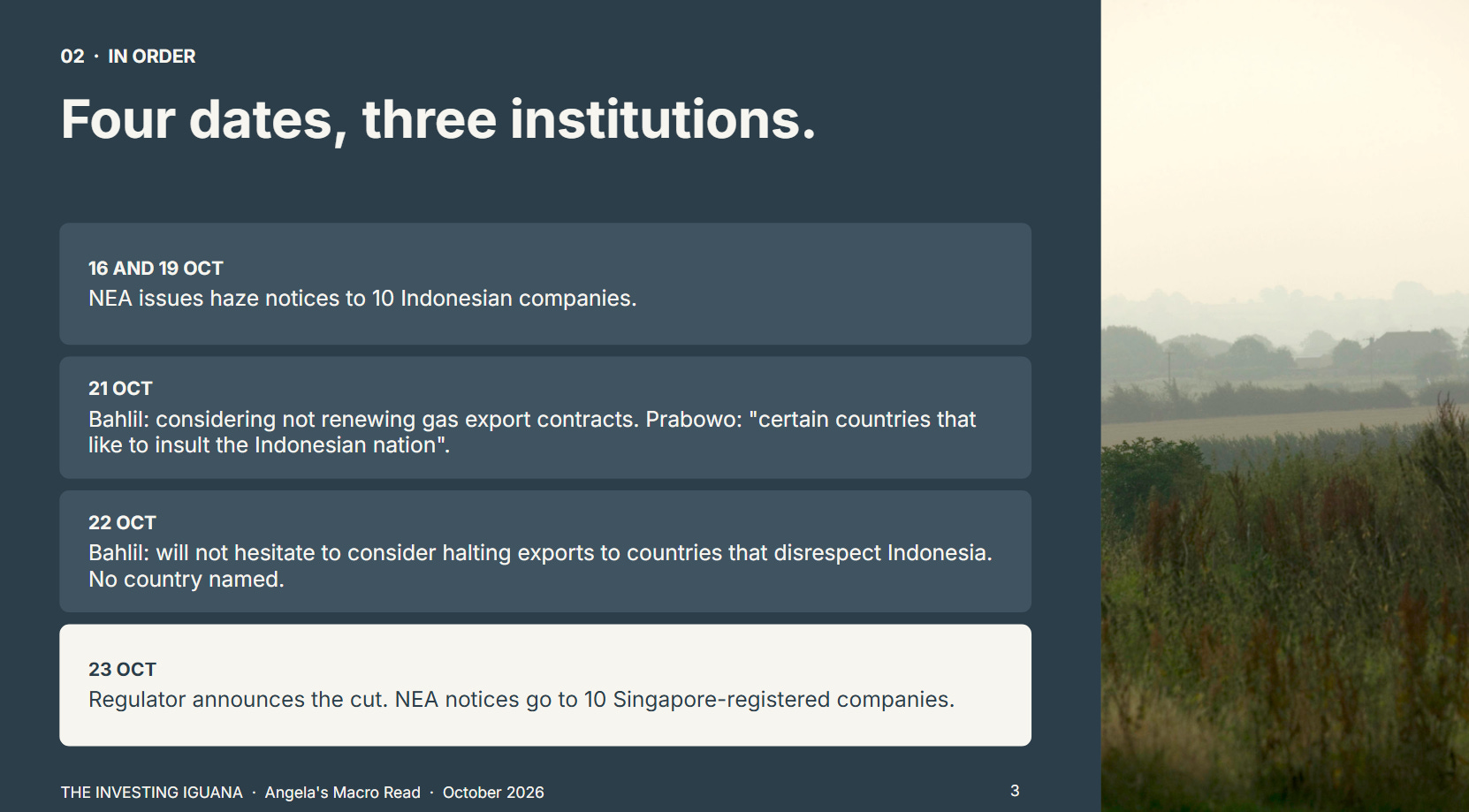
On 22 October, aboard a gas production vessel off East Kalimantan, Bahlil said: “I will carry out an evaluation, and I will not hesitate to consider halting exports to countries that disrespect Indonesia.” He named no country. On 23 October, the head of the upstream regulator SKK Migas announced the cut, effective 24 October, and NEA announced notices under Section 10 of the Transboundary Haze Pollution Act to 10 Singapore-registered companies in the palm oil and forestry sectors, asking about their links to Indonesian concessions.
What the cut is
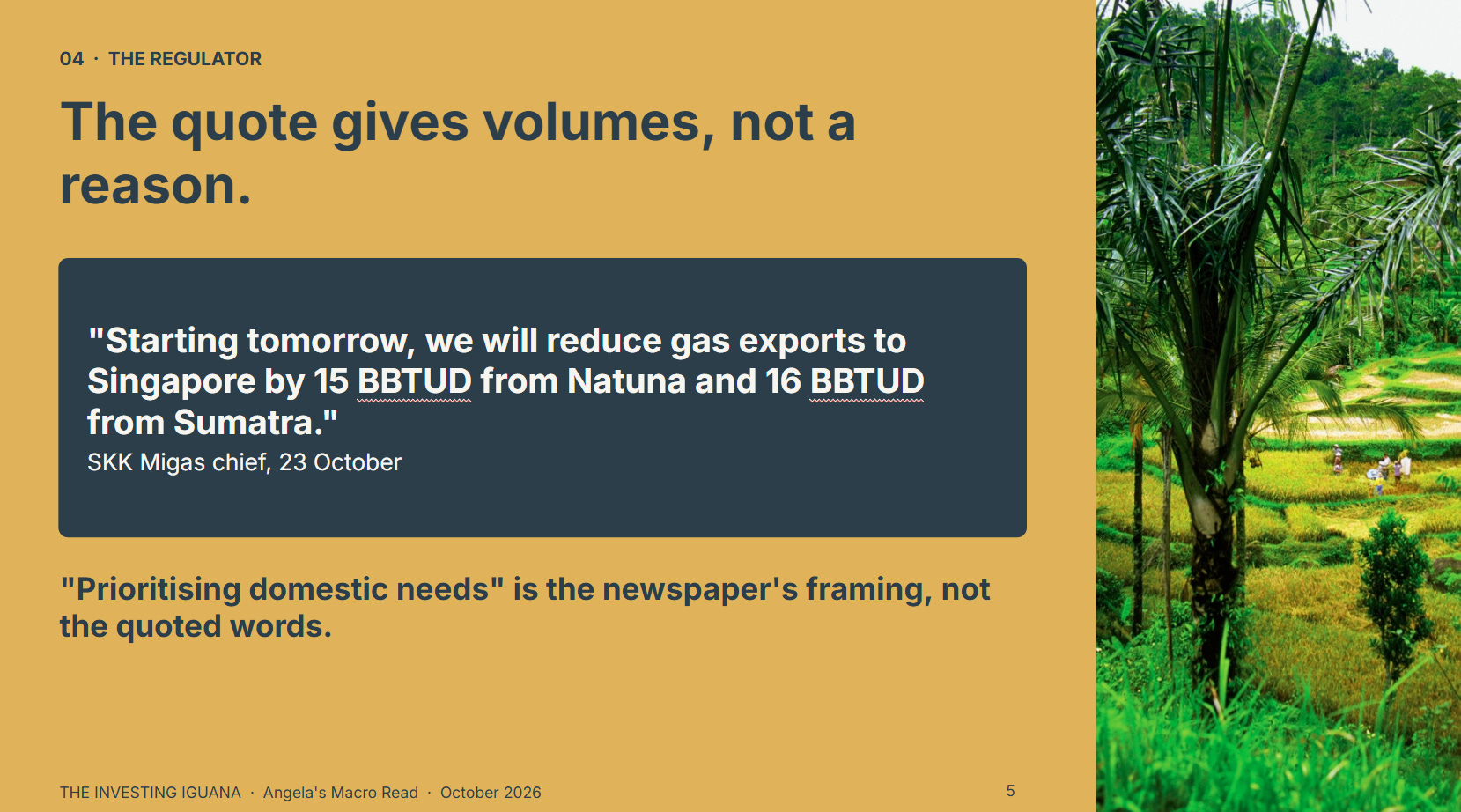
Business Times, carrying a Straits Times report of 24 October, gives a cut of 31 BBTUD: 15 BBTUD from Natuna and 16 BBTUD from Sumatra, the Sumatra part from the Jambi Merang field. The regulator’s chief is quoted as saying: “Starting tomorrow, we will reduce gas exports to Singapore by 15 BBTUD from Natuna and 16 BBTUD from Sumatra.”
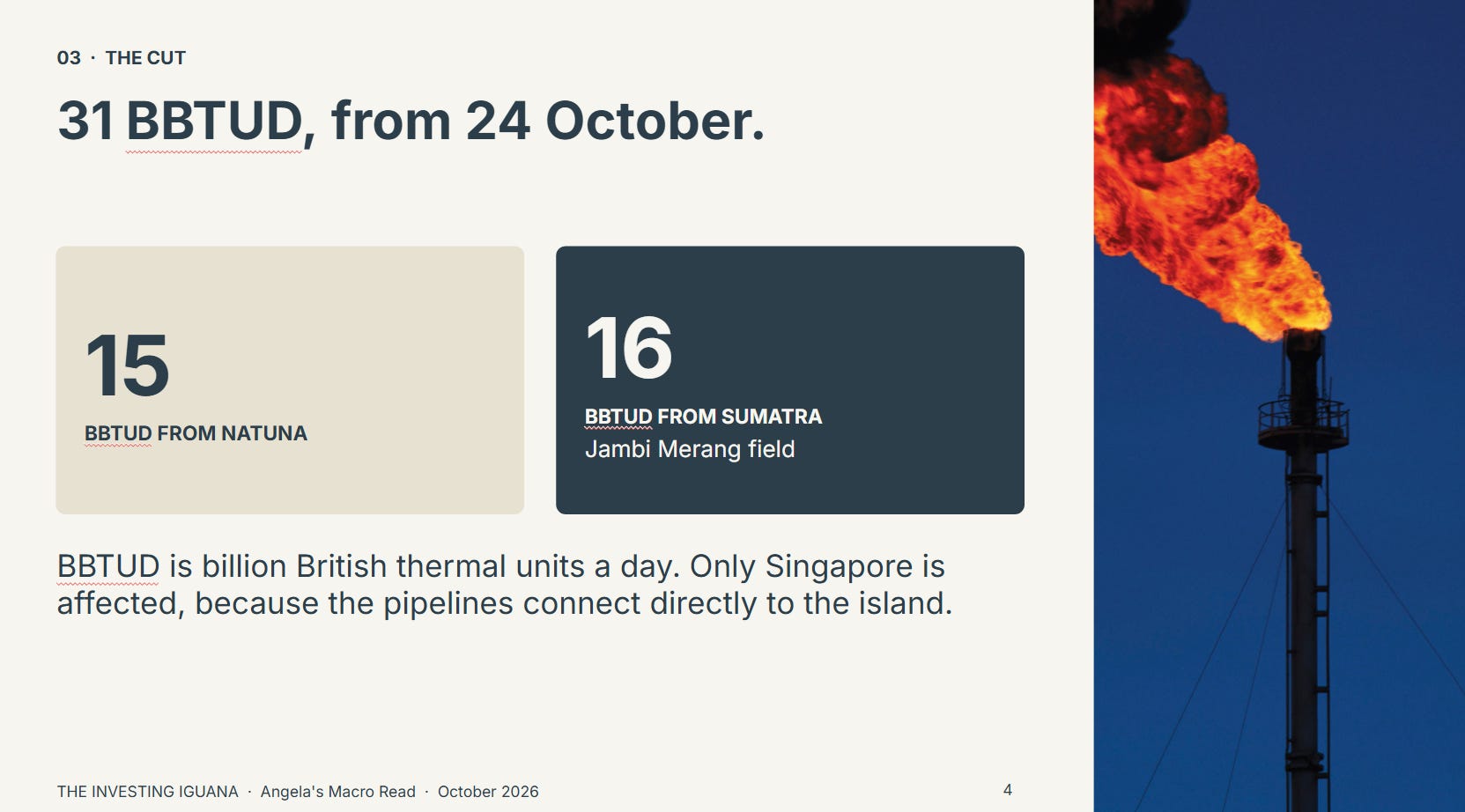
Only Singapore is affected, he said, because the relevant pipelines connect directly to the island. The quote gives the volumes and the date but no reason. The report’s own framing is that the government is prioritising domestic energy needs. That framing is the newspaper’s, not the regulator’s quoted words. Mothership, citing CNBC Indonesia, reports the same split.
Question 1: Does Any Source Link the Cut to the Haze?
What each source says, and what it leaves out
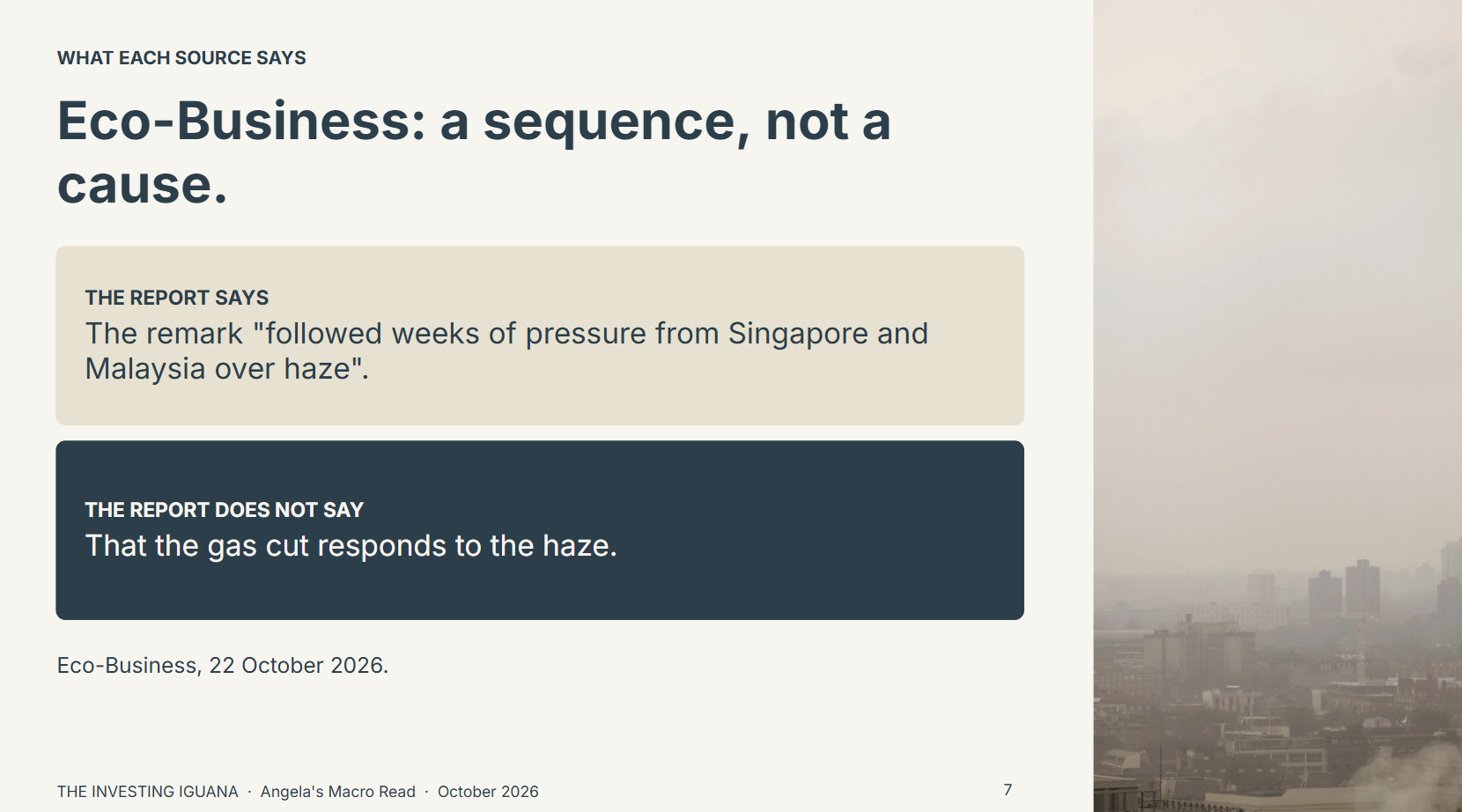
The reports divide in a useful way. Eco-Business is the only one I read that connects the threads. It says Bahlil’s remark “followed weeks of pressure from Singapore and Malaysia over haze”, and it sets the President’s “certain countries” comment beside the haze investigations. That is a sequence of events, not a statement of cause. Neither Eco-Business nor any minister says the gas cut is a response to the haze.
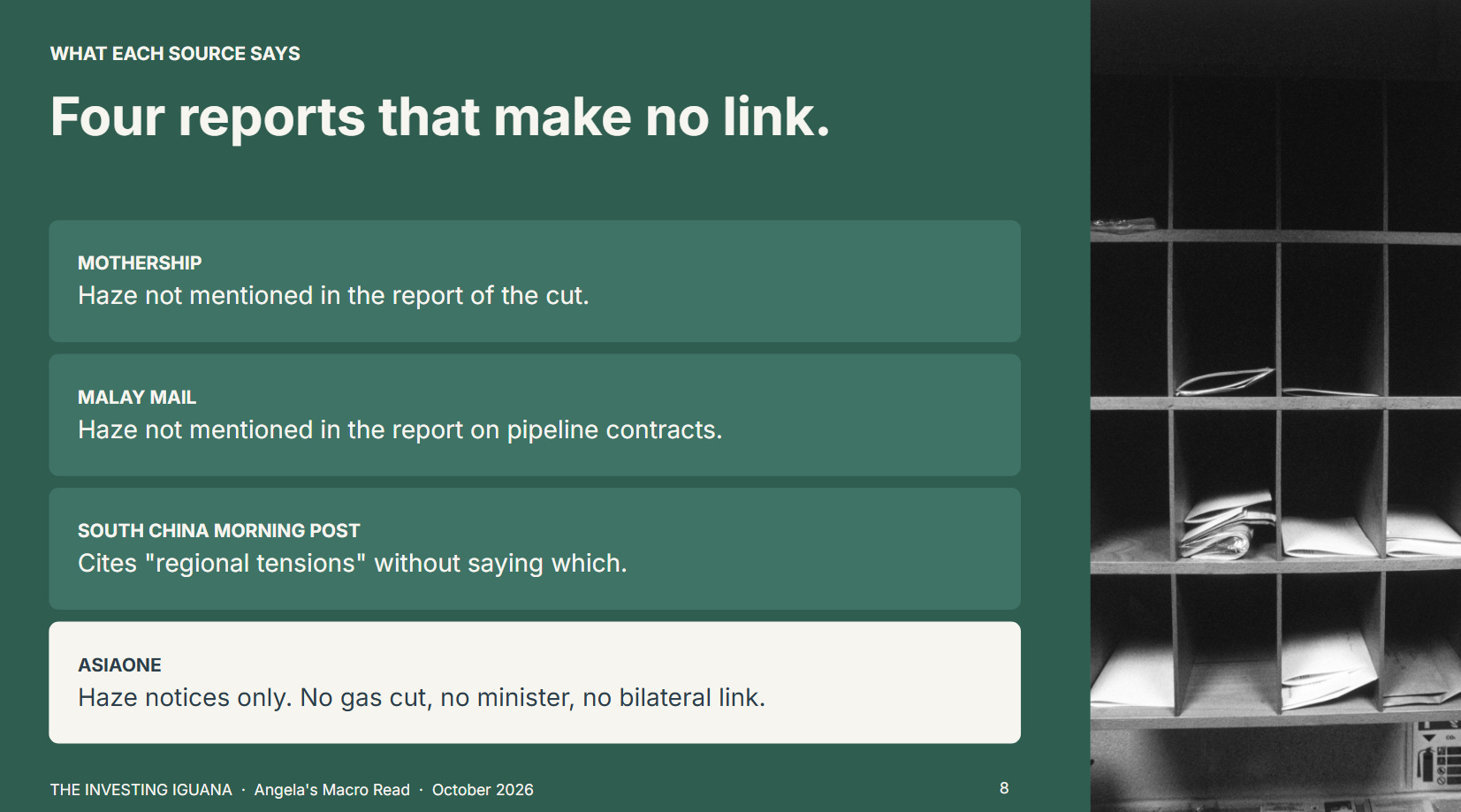
The others do not make the link. Mothership’s report of the cut does not mention haze. Malay Mail’s report on the pipeline contracts does not mention haze. The South China Morning Post refers to “regional tensions” without saying which. AsiaOne’s report on the NEA notices does not mention the gas cut or the minister, and draws no line between the probe and relations with Indonesia; Singapore’s Minister for Sustainability and the Environment, Grace Fu, describes the notices as a step to establish facts and “follow the evidence”.
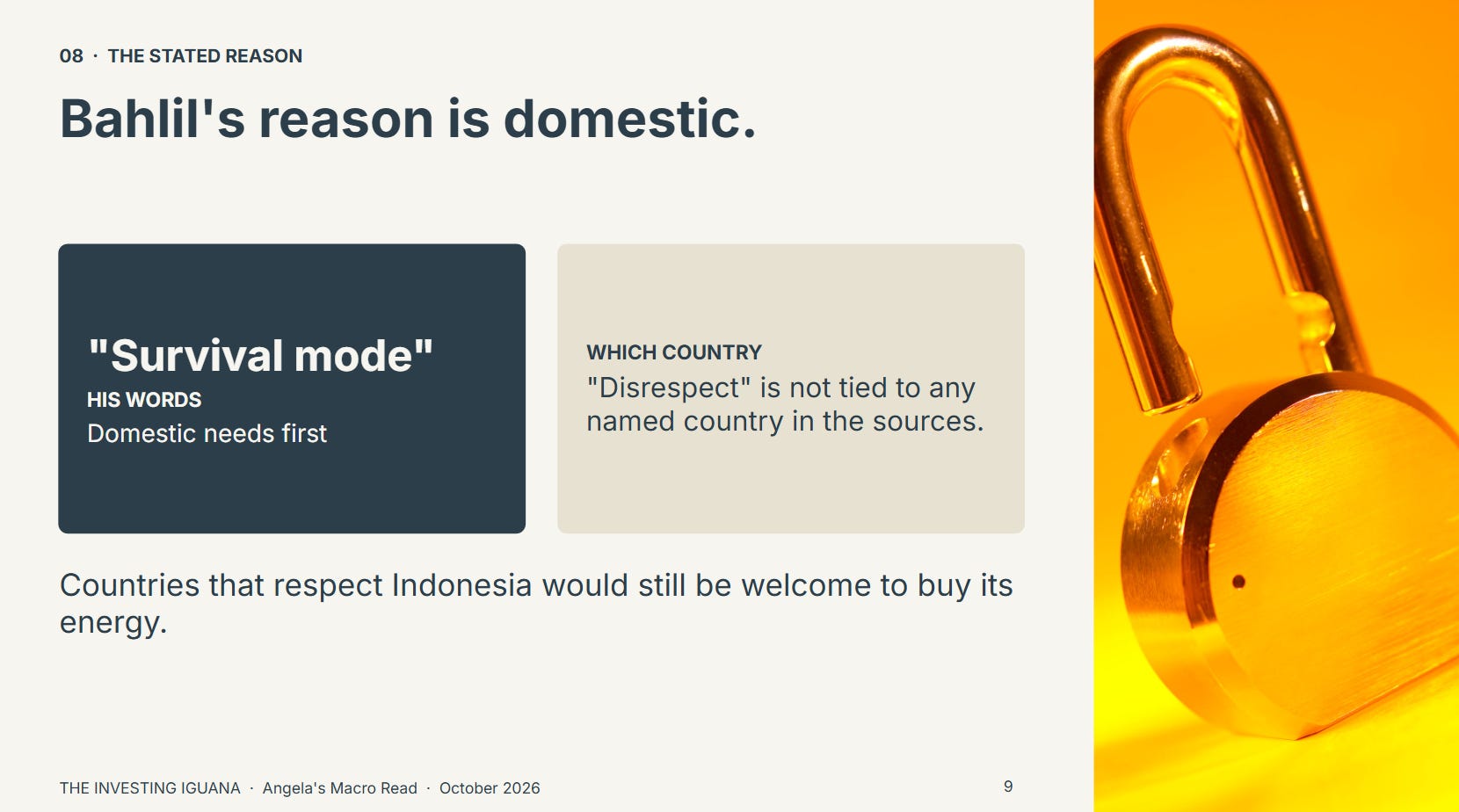
Bahlil’s own stated reason is domestic. He called it “survival mode” and said natural resources “will be used for domestic needs first”. He also said countries that respect Indonesia would still be welcome to buy its energy. Which country he means by “disrespect” is not stated anywhere I found.
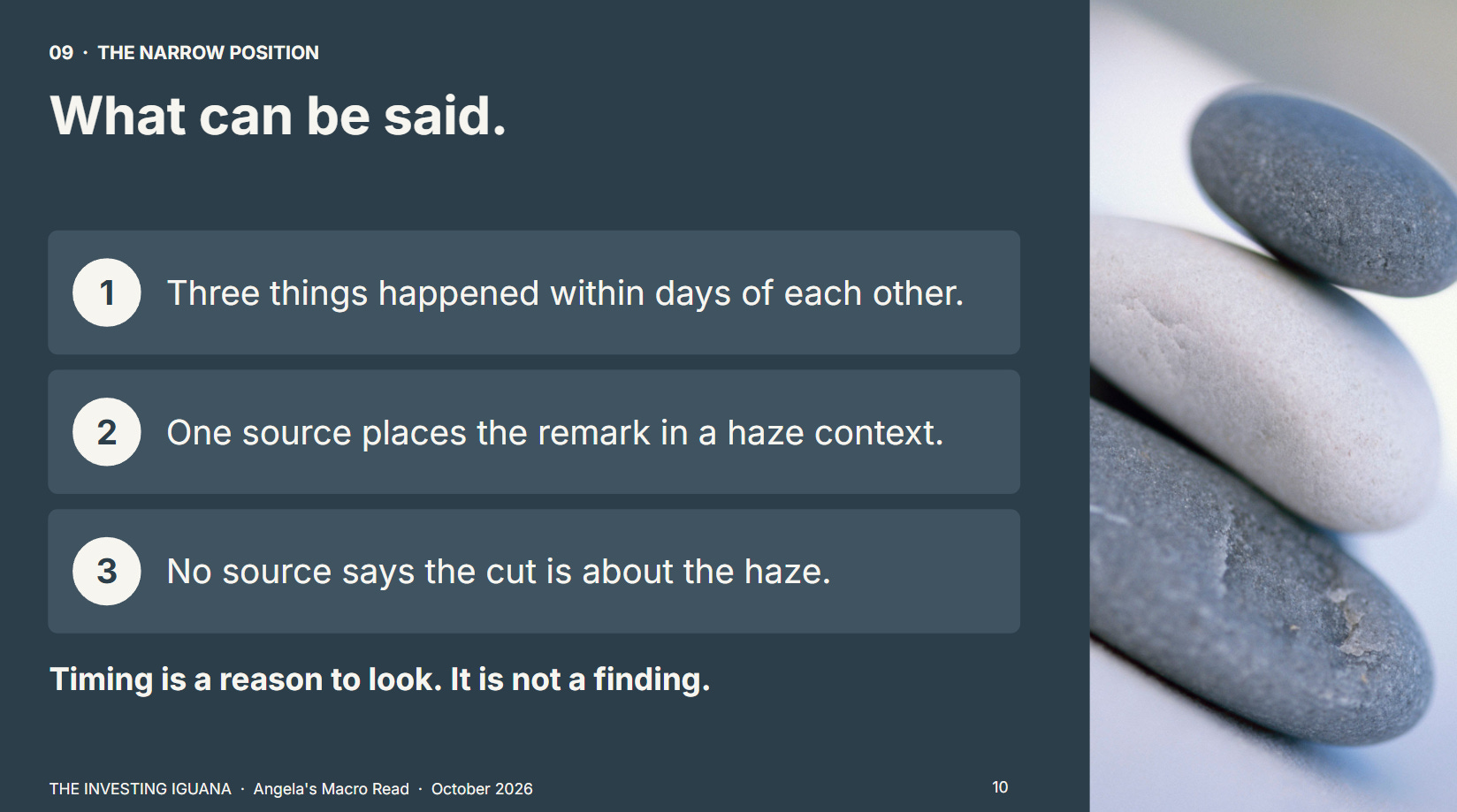
So the honest position is narrow. Three things happened within days of each other. One source places the minister’s remark in a haze context. No source I read says the cut is about the haze, and no source rules it out. I am not going to fill that gap, and I would be careful of any headline that does.
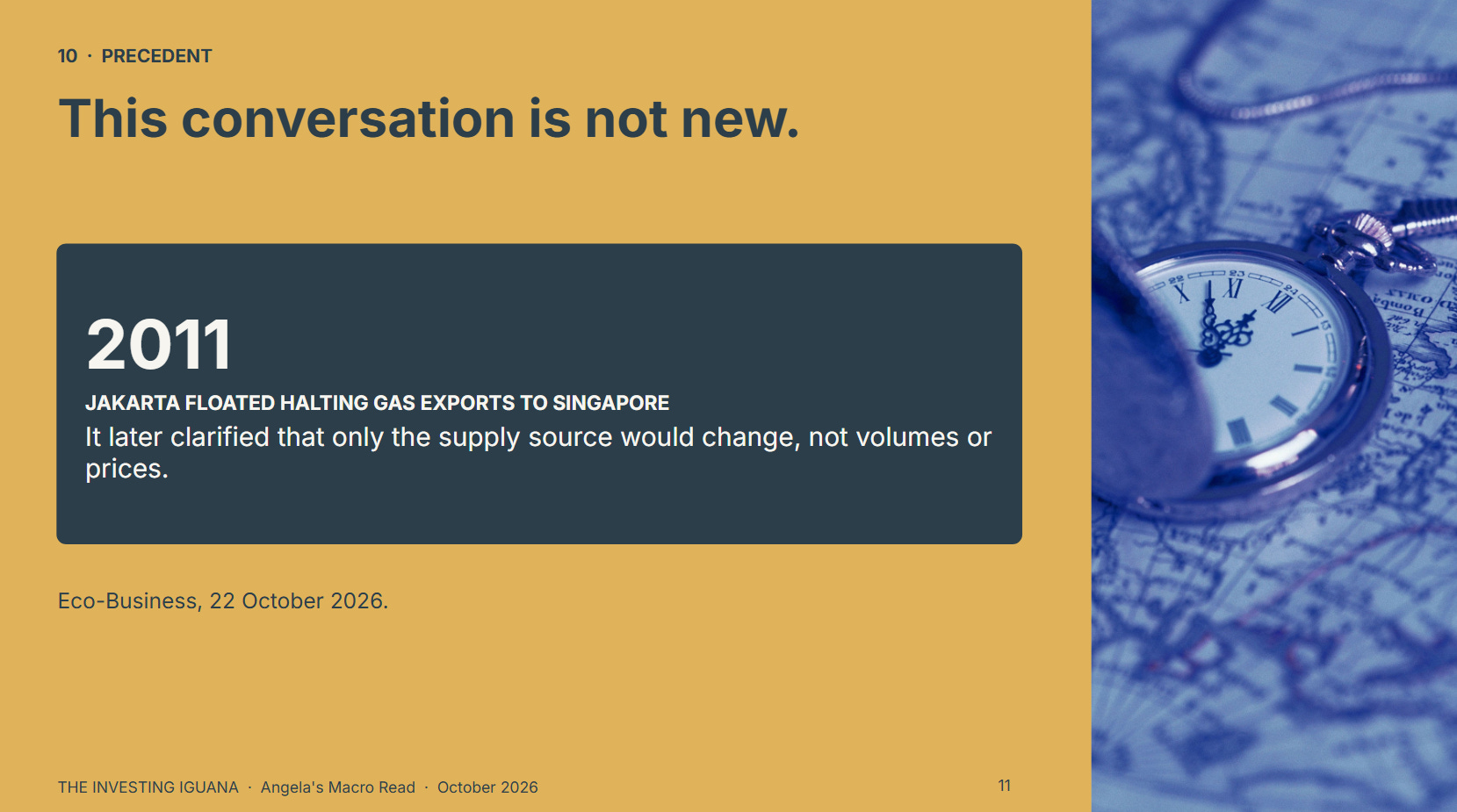
The pushback I expect is a fair one: surely the timing is the answer. Timing is a reason to look, and it is not a finding. The Eco-Business report itself notes that Jakarta floated halting gas exports to Singapore in 2011 and then clarified that only the supply source would change, not volumes or prices. Energy and domestic supply have been in Indonesia’s conversation for years without the haze.
🟠 Angela’s Observation
I have a rule about the kopitiam queue. If the auntie at the drinks stall and the uncle at the rice stall both look unhappy on the same morning, I do not decide the two are related. They might be, but I have not asked either of them. It is tempting to join the dots when three headlines land in one week, because a single story is easier to follow than three. What would I need to see before I believed the dots were joined by something other than my own wish to join them?
Question 2: How Big Is the Cut, and What Does Singapore Have Behind It?
The size
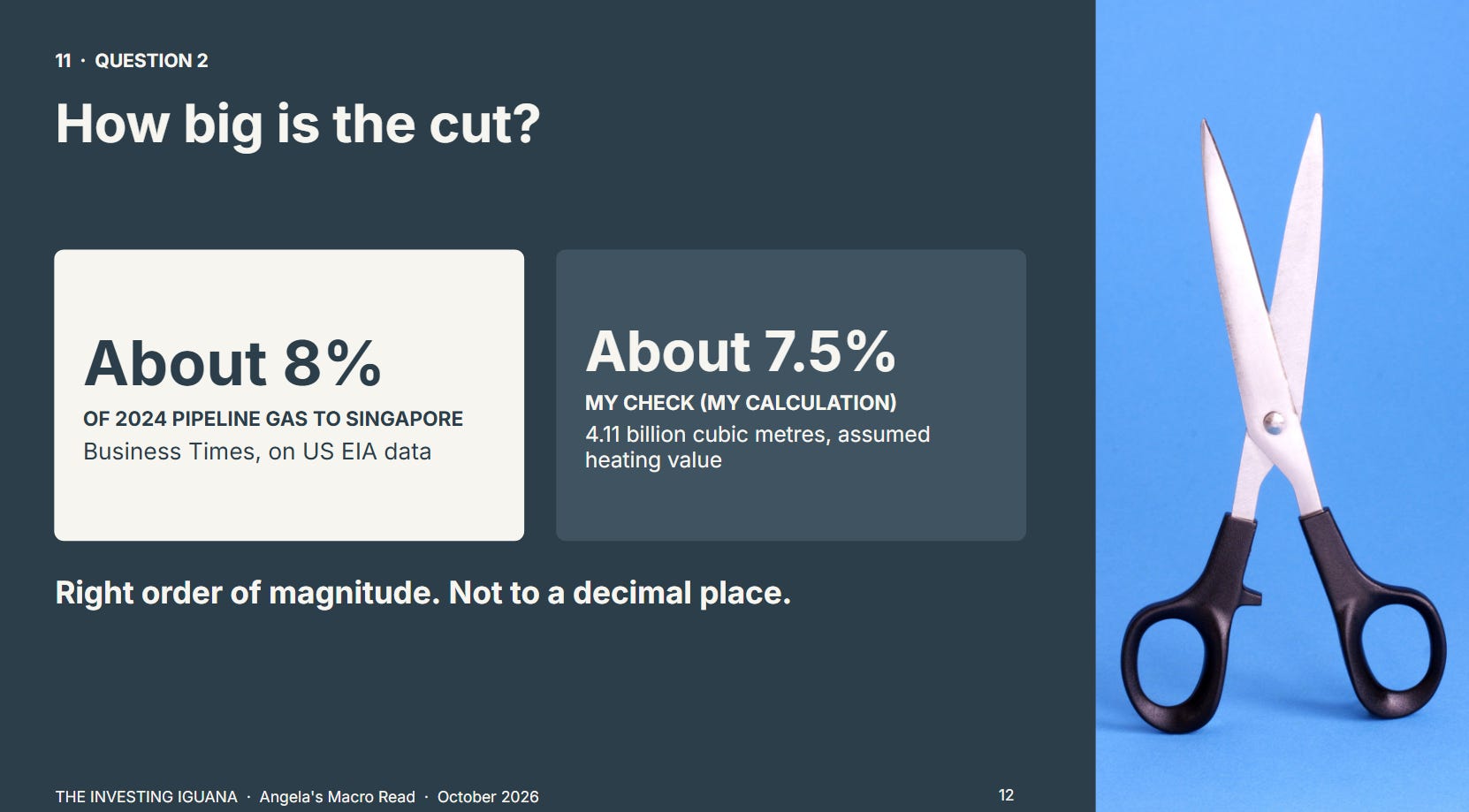
Business Times puts the cut at about 8% of the pipeline gas Indonesia exported to Singapore in 2024, based on figures from the US Energy Information Administration (EIA). The EIA figure is about 4.11 billion cubic metres for that year. My own check, converting 31 BBTUD at a typical heating value of 1,037 British thermal units per cubic foot, gives about 7.5%, and about 7.1% to 8.2% across heating values from 950 to 1,100. The heating value is my assumption. So “about 8%” holds up as the right order of magnitude, and I would not quote it to a decimal place.
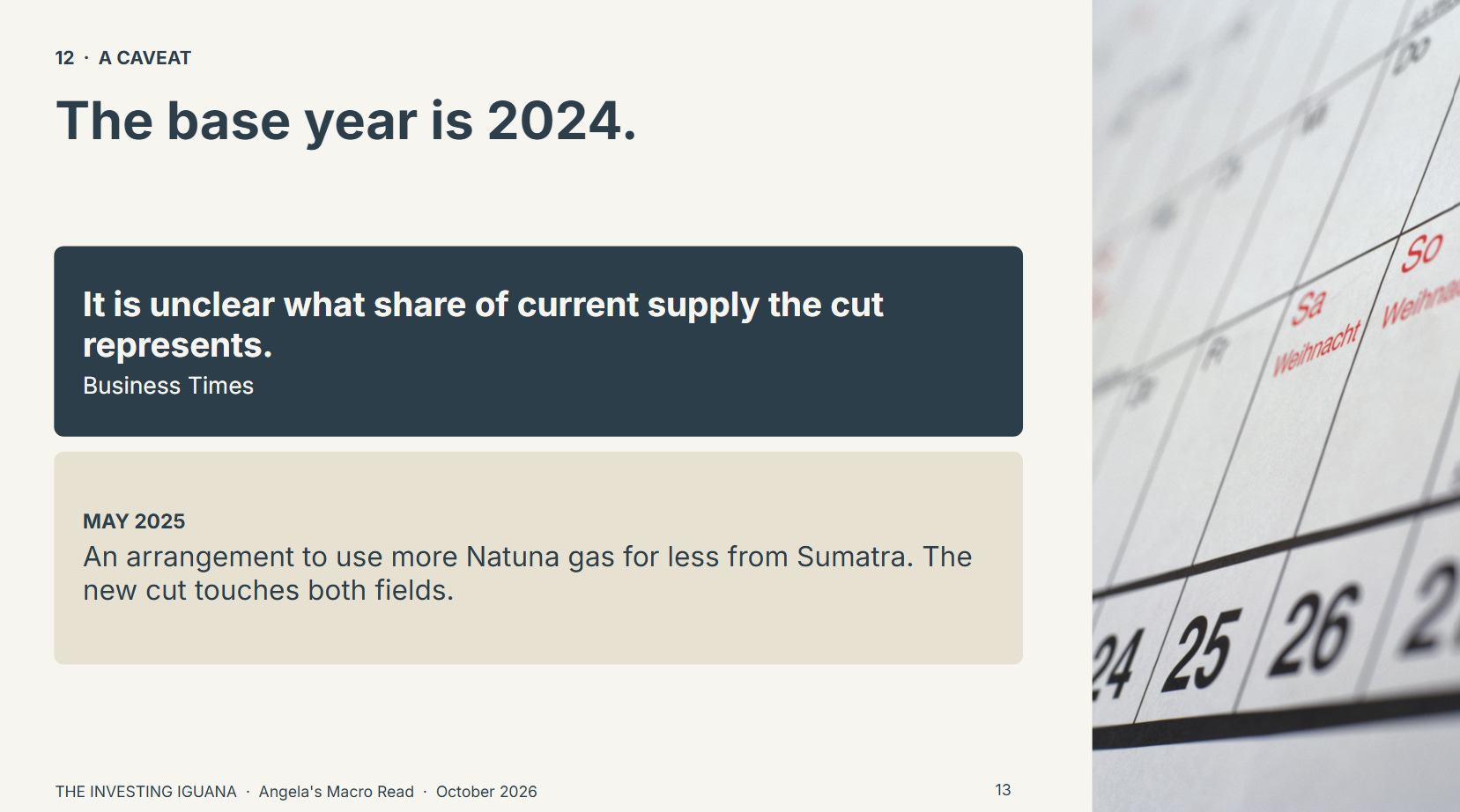
The base is also 2024. Business Times says plainly that it remains unclear what proportion of current supplies the cut represents. That matters, because in May 2025 Indonesia and Singapore signed an arrangement to use more Natuna gas to make up for less from Sumatra, according to the same report, so current flows may differ from 2024. The new cut touches both fields.
The fallbacks
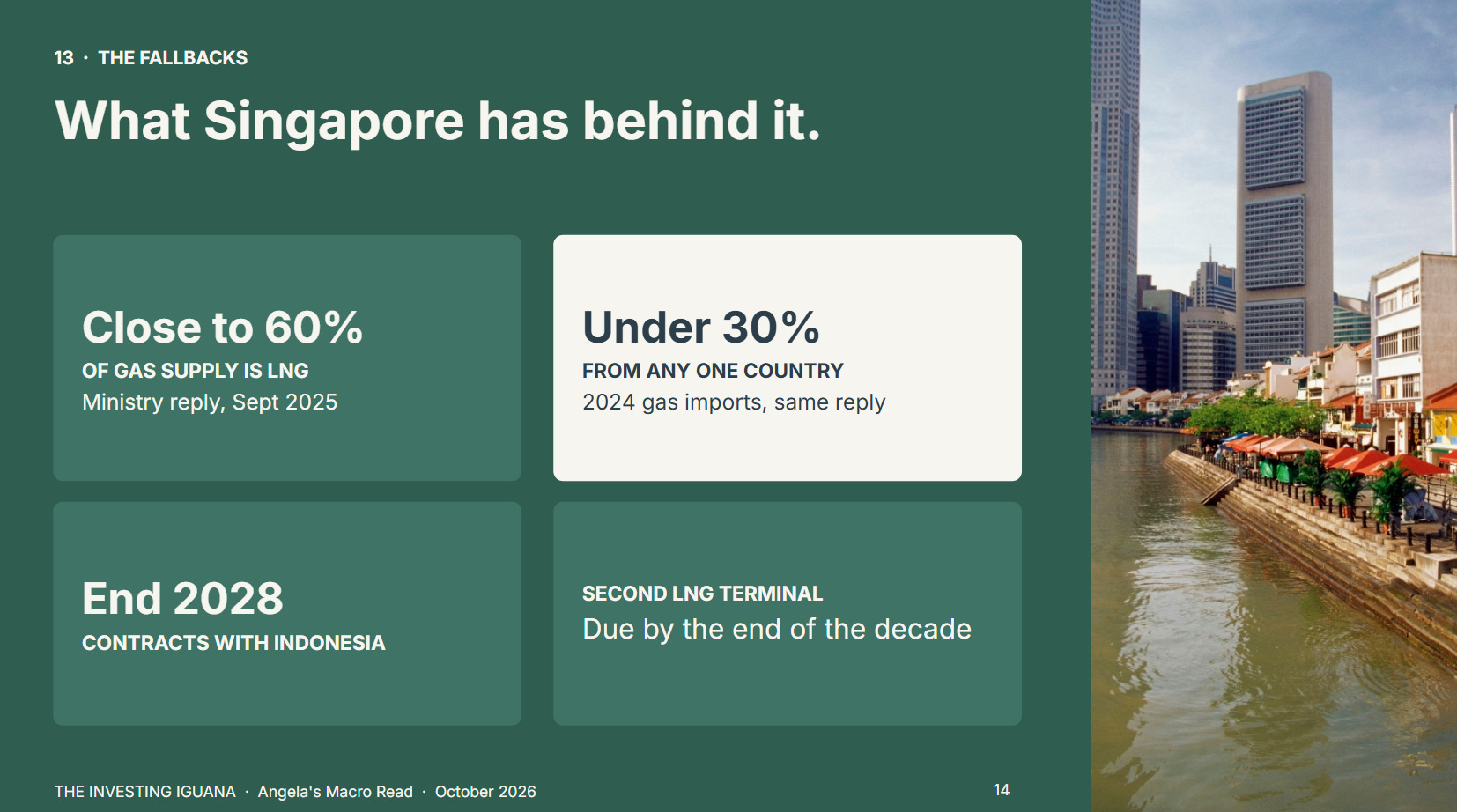
The Ministry’s September 2025 parliamentary reply says liquefied natural gas (LNG) accounts for close to 60% of Singapore’s gas supply, that no single country supplied more than 30% of gas imports in 2024, and that the current contracts with Indonesia expire at the end of 2028. It adds that rising domestic demand in Indonesia “may affect how much gas Indonesia is able to continue to export”. In other words, the possibility was on the record before this week. The first LNG terminal has operated since 2013, and a second is due by the end of the decade.
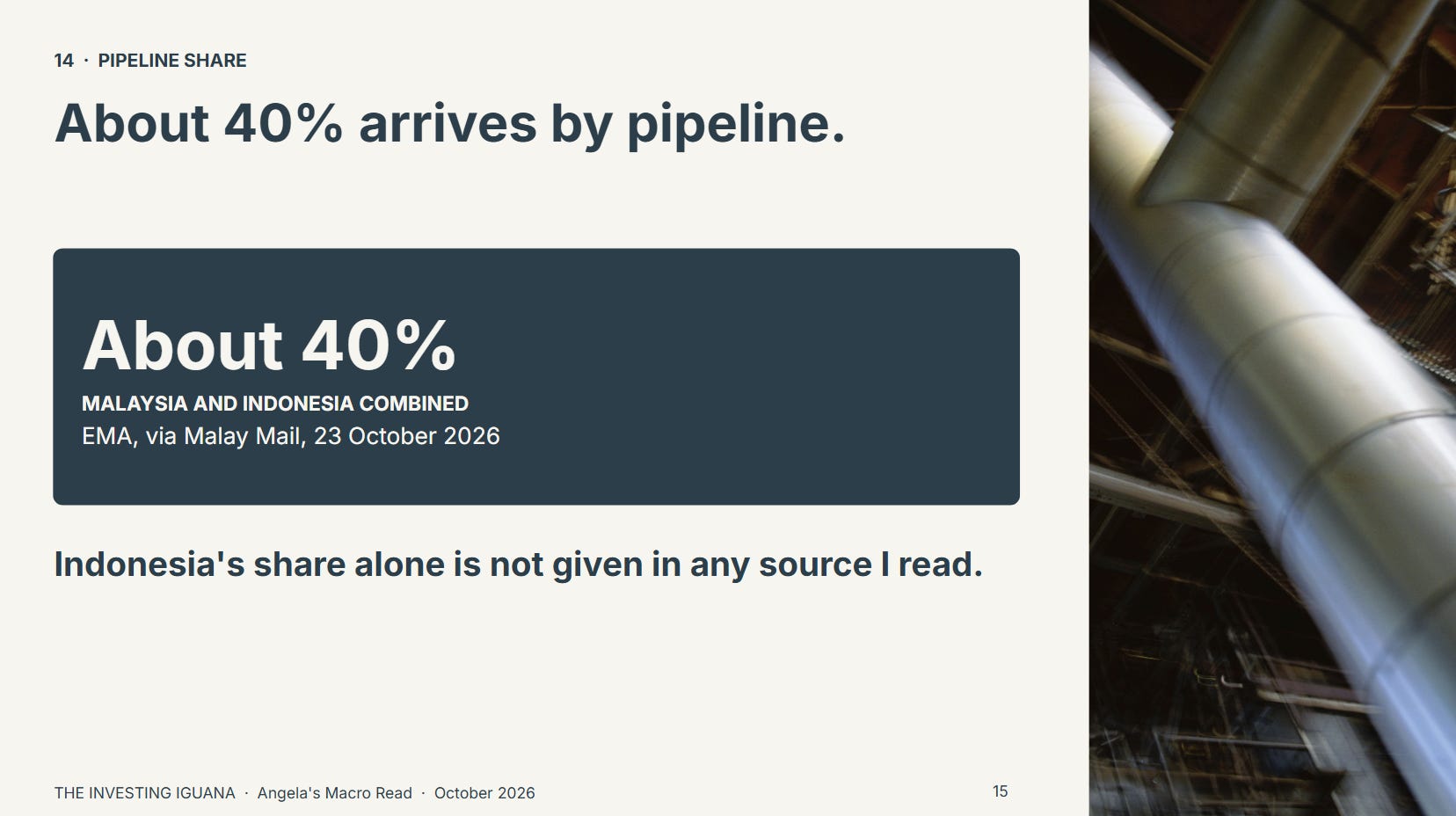
Singapore’s Energy Market Authority says about 40% of the country’s gas arrives by pipeline from Malaysia and Indonesia combined, according to Malay Mail on 23 October 2026. The data year is not given in the excerpt I read. Indonesia’s share alone is not given in any source I read.
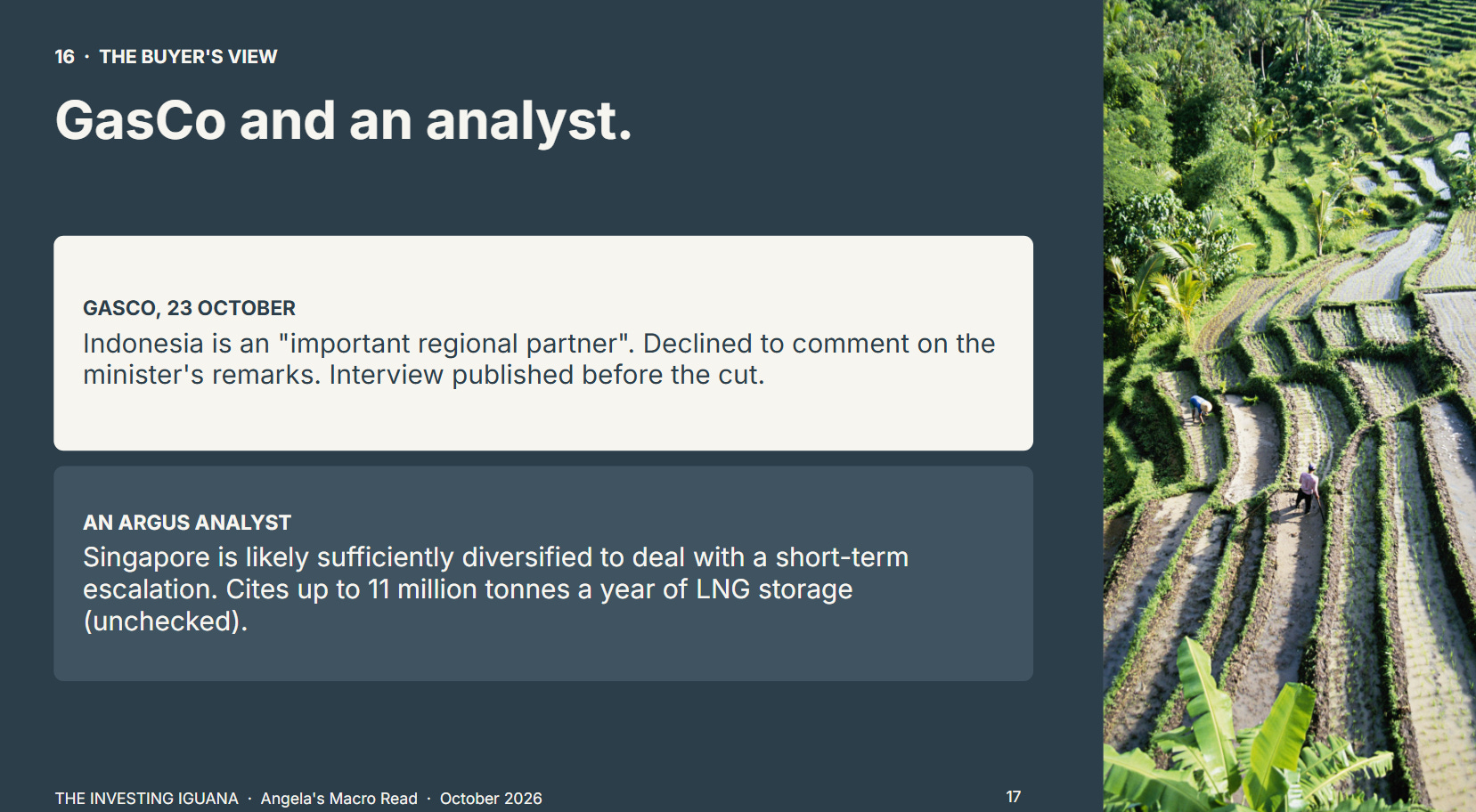
On the company side, GasCo, the central gas buyer (Malay Mail reported its creation in May 2025), told Business Times in an interview carried by Red Hot Singapore on 23 October that Indonesia is an “important regional partner”, declined to comment on the minister’s remarks, and said it will continue to work closely with regional partners. That interview was published before the cut was announced. An analyst at Argus Media, quoted in the same report, said Singapore is likely sufficiently diversified to deal with a short-term escalation. As at 24 October I found no new Singapore government statement on the cut itself.
The upper bound
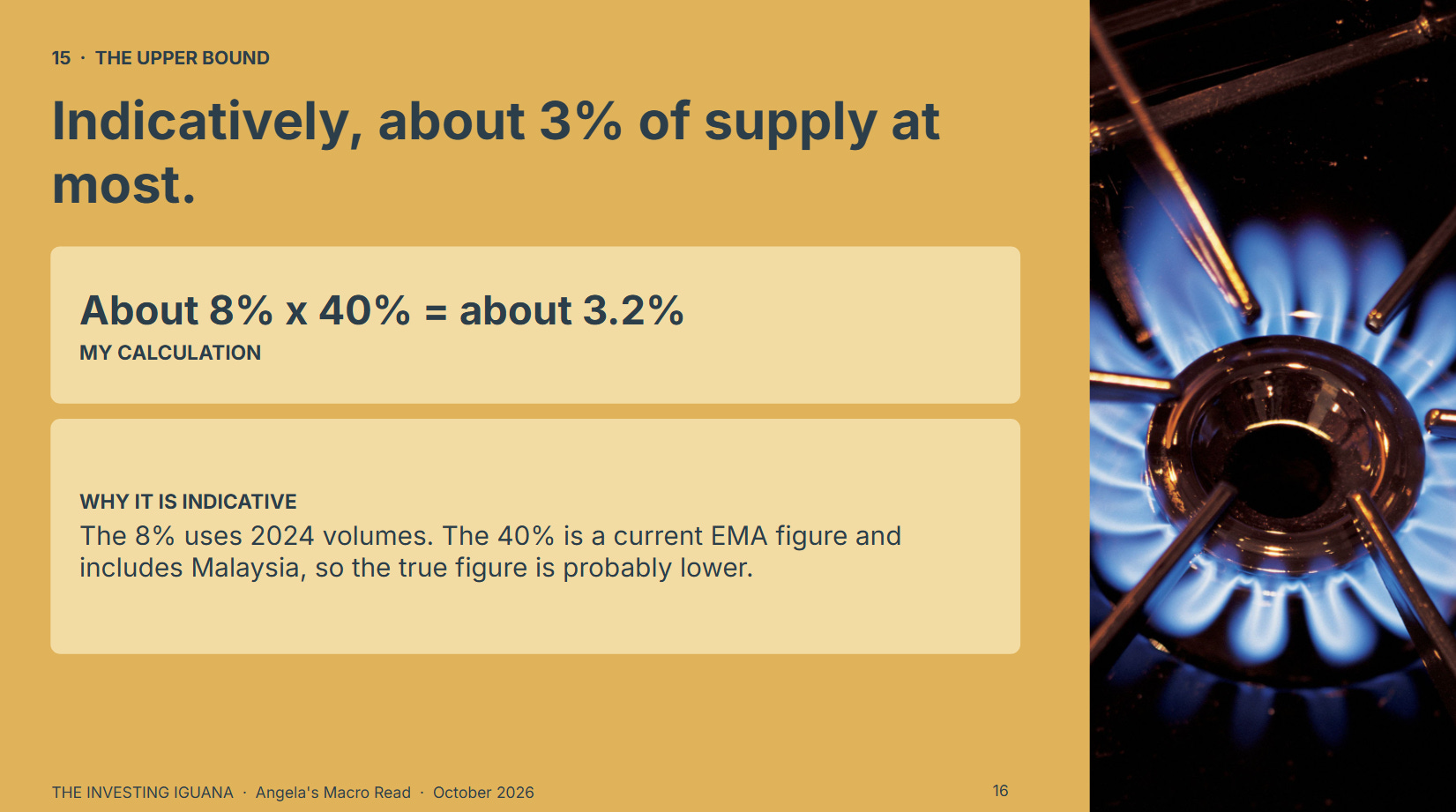
Here is a number I can build from the sources, with its limits stated. The cut is roughly 7% to 8% of Indonesia’s pipeline exports to Singapore, on the Business Times figure built from EIA data for 2024. Pipeline gas from Indonesia and Malaysia together is about 40% of Singapore’s supply. So the cut is indicatively no more than about 3% of Singapore’s total gas supply (0.08 times 0.40 is about 3.2%), and probably less, because Malaysia supplies part of the 40%. This is my own arithmetic, both inputs are approximations, and the 8% uses 2024 volumes while the 40% is a current EMA figure, so I treat the result as indicative.
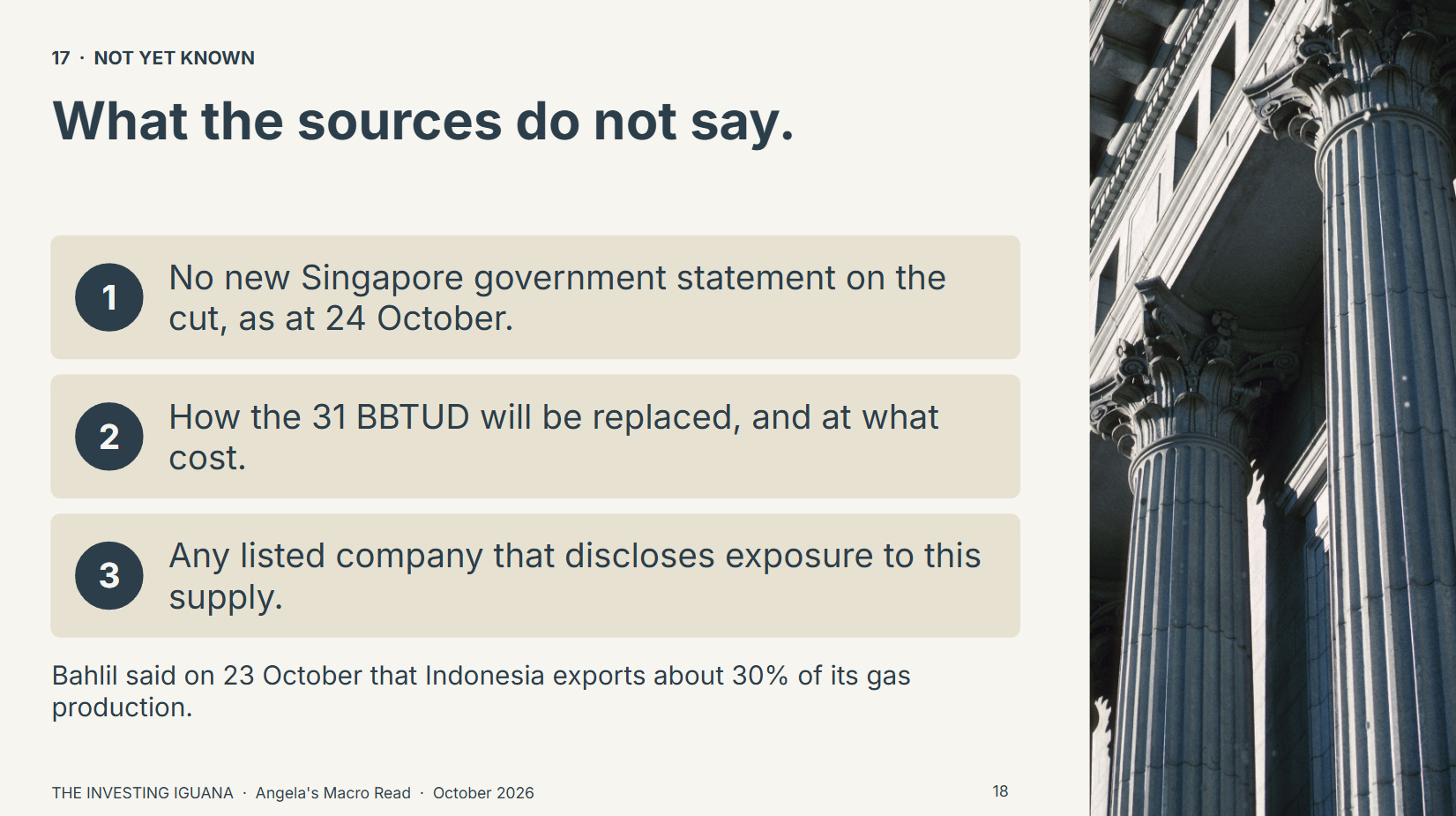
The pushback is that a small cut now says nothing about a larger one later. That is correct, and I do not argue with it. The cut is small beside the supply, but the contracts expire in 2028, and a minister has said he is considering not renewing them. Business Times adds that on 23 October Bahlil said Indonesia exports about 30% of its gas production and that allocations would be reviewed to direct more to domestic industry, and that the 2022 extension to 2028 was already at lower volumes than the previous contract. Small today and uncertain later are both true.
🟠 Angela’s Observation
I used to think of the gas supply the way I thought of my CPF statement: one big number, either fine or not. The more I read, the more it looked like a market stall with several suppliers, where losing one tray of fruit on a Saturday is an annoyance and losing the whole stall on a long weekend is a different matter. The sources I read say it is the first case today. They do not promise it stays that way. What would change my mind from the first case to the second?
What the Paid Half Adds
The free half sets out what happened, what each source does and does not link, and how large the cut is. The paid half takes the next step: what the figures could mean for the electricity bill, what the sources say about listed companies named in the notices, and a short test for reading the next energy headline. The extra is depth, nothing else. There are three ways in.
The Substack Only Plan, US$8/month, gives the full written analysis, portfolio walkthroughs and analyst cheatsheets.
The YouTube Only Plan, S$5/month, gives the full-length Members Edition video.
The YouTube/Substack Combo, S$12/month, gives all of it.
<div style=”border-left: 4px solid #C6934B; padding-left: 16px; margin: 24px 0;”>
🔒 What’s Next
The next section sets out why a roughly 3% bound on supply does not translate one for one into the power bill, and what the filings and notices say about the companies named.