



Indonesia Just Raised Rates to Defend Its Currency. Singapore Can’t Do That, And That’s the Point.
Bank Indonesia hiked to 5.75% to stop foreign capital fleeing its currency. Singapore’s central bank is managing something most people do not even know exists, and that difference is why your CPF SA return works the way it does.
Indonesia’s central bank raised interest rates three times in two months this year, not because its economy was overheating, but because foreign investors were pulling money out. Singapore’s central bank did something different that same stretch. It did not raise a rate at all, because it does not set one, and understanding why matters more for your CPF than you would think.

I have spent years running SGX balance sheets through a forensic screen, but this one sent me down a different rabbit hole entirely: central banking mechanics, not stock forensics. Whether you are still building your CPF and SRS balances or already living off them, the difference between how Indonesia and Singapore manage their currencies is not abstract. It is part of why one of your safest instruments works the way it does.
This is not a stock pick or a zone verdict today. It is the plumbing underneath everything else I write about.

What Actually Happened in Jakarta
Malaysia Did Not Have to Do the Same Thing
What Singapore’s Central Bank Actually Does Instead
Why Singapore Chose the Currency, Not a Rate
Insight Box: Capital Flight Is a Currency Problem, Not Just a Rate Problem
Why This Is Not Just a Trivia Question for Your CPF
Insight Box: A Guarantee Only Means What It Is Actually Guaranteed Against
The Takeaway
What Actually Happened in Jakarta
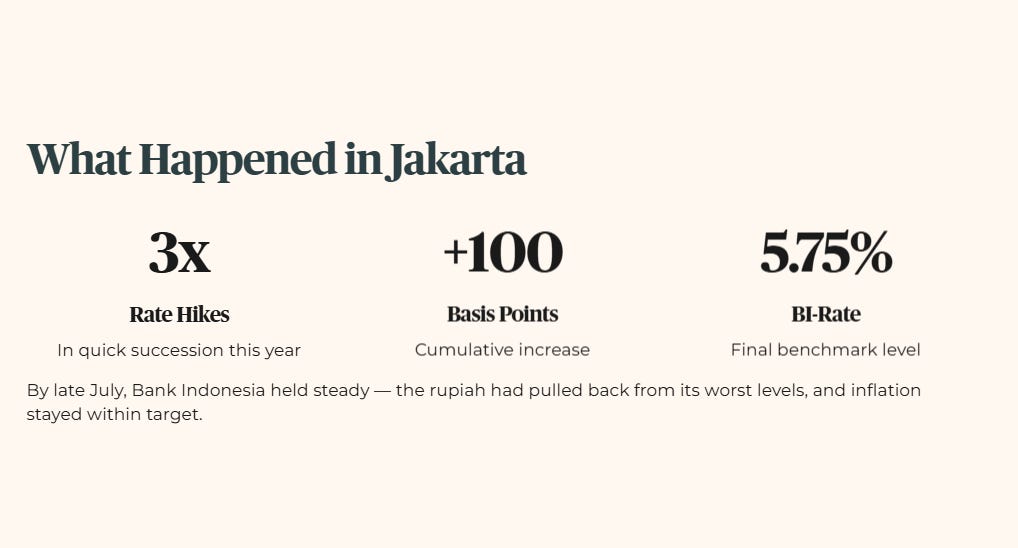
Bank Indonesia raised its benchmark BI-Rate three times in quick succession this year, a cumulative 100 basis points, taking it to 5.75%. By the time the central bank met again in late July, it held steady at that level, and officials framed it as a win. The rupiah had pulled back from its worst levels, and inflation stayed within target.
But the reason for those hikes matters more than the outcome. Indonesia was not fighting an overheating domestic economy. It was defending its currency against capital flight, foreign investors moving money out toward higher yields elsewhere, pressuring the rupiah lower and threatening to import inflation through a weaker exchange rate. Raising the benchmark rate was the defensive tool available to make Indonesian assets more attractive to the same foreign capital that was leaving.
That is a genuinely different exercise from a central bank raising rates because its own economy is running hot. It is closer to a landlord raising rent to keep a tenant from moving out, not because the market suddenly justified it, but because the alternative was losing the tenant entirely.

It is worth being fair to Bank Indonesia here. The central bank did not act rashly, and the currency did stabilise somewhat after the hikes took hold. But the tool it reached for came with a real domestic cost. Higher benchmark rates flow through to higher commercial borrowing costs across the economy, and businesses that depend on affordable credit felt that squeeze while the central bank was busy making Indonesian assets more attractive to the same foreign capital that had been leaving.
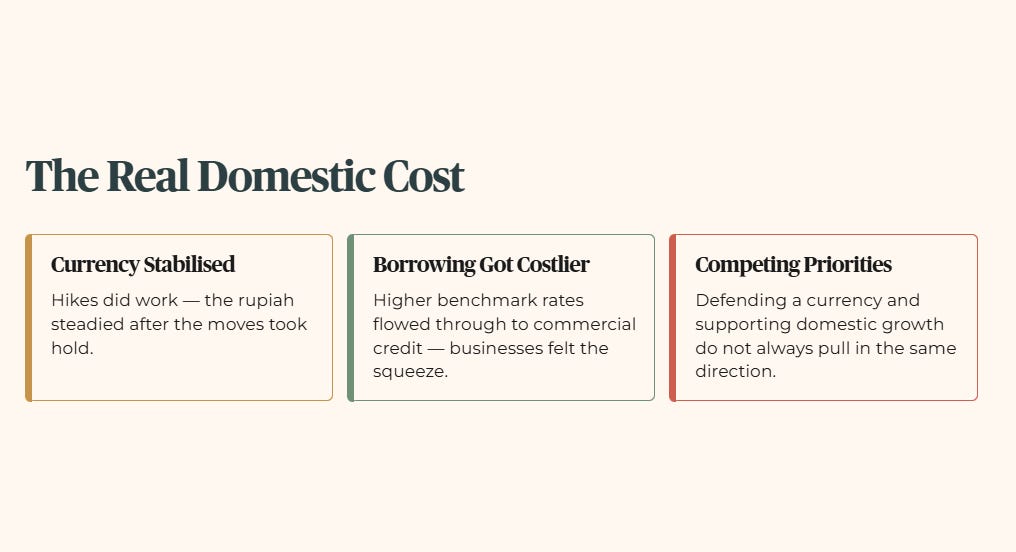
Defending a currency and supporting domestic growth are not always pulling in the same direction, and this year’s episode is a fairly clean example of what happens when a central bank has to choose.
Malaysia Did Not Have to Do the Same Thing
Across the Causeway, Bank Negara Malaysia held its Overnight Policy Rate steady at 2.75% through the same period, a level it has maintained since a cut back in mid-2025. Malaysia faced a lot of the same global pressure Indonesia did this year, elevated US rates, Middle East volatility, unsettled commodity prices, and did not need emergency defensive hikes to hold its currency steady.
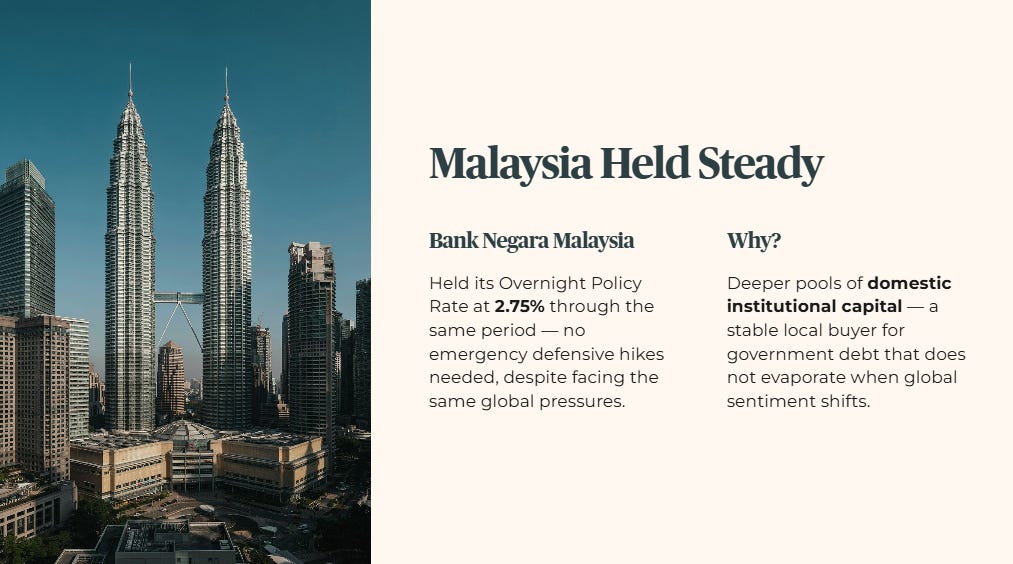
Part of the difference comes down to something less visible than a headline interest rate: how much of each country’s government debt is funded domestically versus by foreign capital that can leave quickly. Malaysia has deeper pools of domestic institutional capital, its version of a national pension fund among them, providing a stable local buyer for government debt that does not evaporate the moment global sentiment shifts.
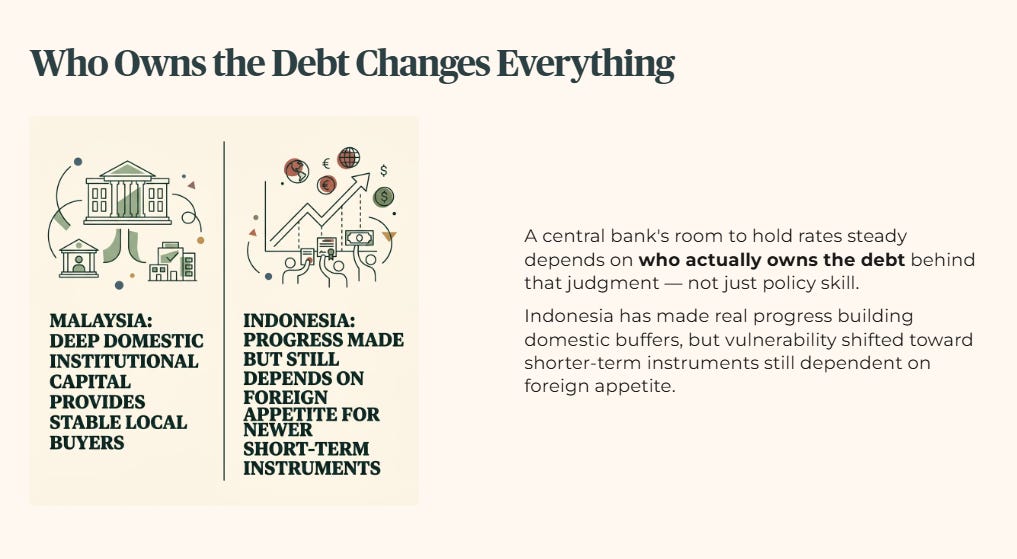
Indonesia has spent years trying to build the same kind of domestic buffer, with real progress, but the vulnerability did not disappear so much as shift toward newer, shorter-term instruments that still depend heavily on foreign appetite.
The point is not that Indonesia mismanaged anything. It is that a central bank’s room to hold rates steady depends on more than just its own policy judgment. It depends on who actually owns the debt behind that judgment.
What Singapore’s Central Bank Actually Does Instead
Here is the part most people managing CPF and SRS money have never actually had explained to them. MAS does not set an interest rate the way Bank Indonesia or Bank Negara does.
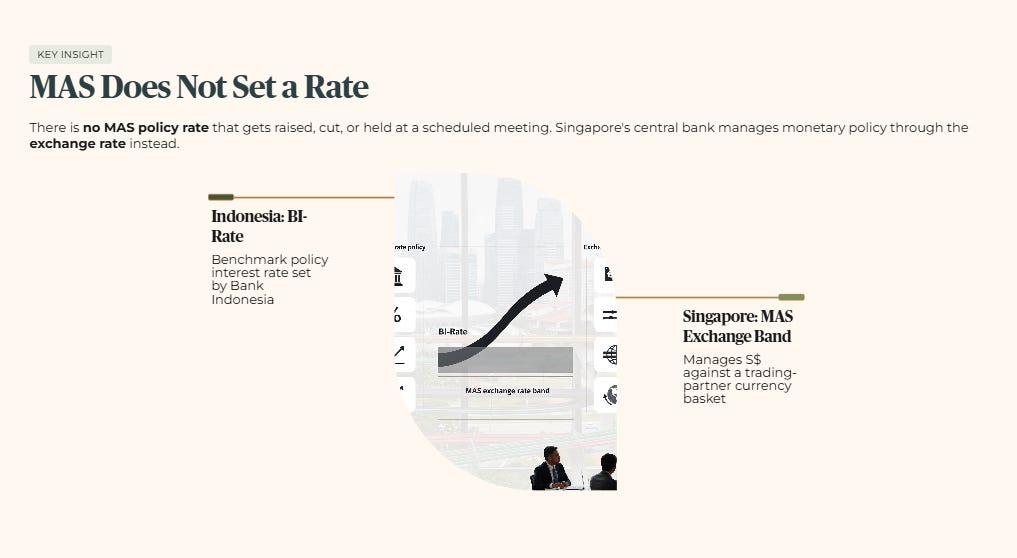
There is no MAS policy rate that gets raised, cut, or held at a scheduled meeting. Singapore’s central bank manages monetary policy through the exchange rate instead, letting the Singapore dollar float within an undisclosed band against a basket of currencies from its major trading partners, and adjusting how steeply that band is allowed to appreciate over time.
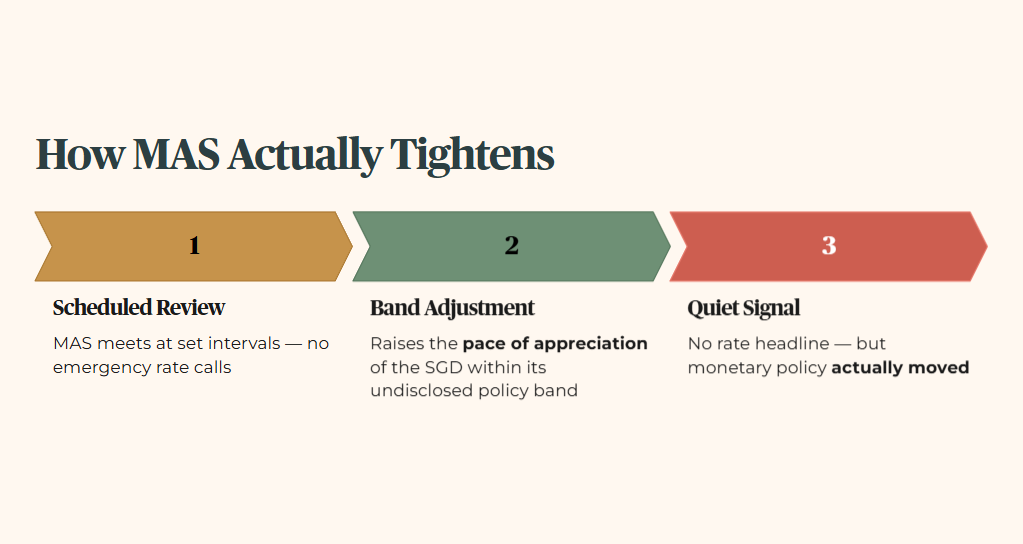
When MAS tightened policy at its most recent scheduled review, it did not touch a rate at all. It raised the pace at which the Singapore dollar is allowed to appreciate within its policy band, its second such tightening move in successive reviews, while leaving the width and centre of that band unchanged. To someone expecting a rate announcement, that would look like nothing happened. In MAS’s own framework, that is monetary policy actually moving.
Why Singapore Chose the Currency, Not a Rate
This is not an accident of institutional design. For a small, extremely open economy like Singapore’s, where imports and exports both run far larger than domestic output, the exchange rate has more direct influence over imported inflation than a domestic interest rate would.
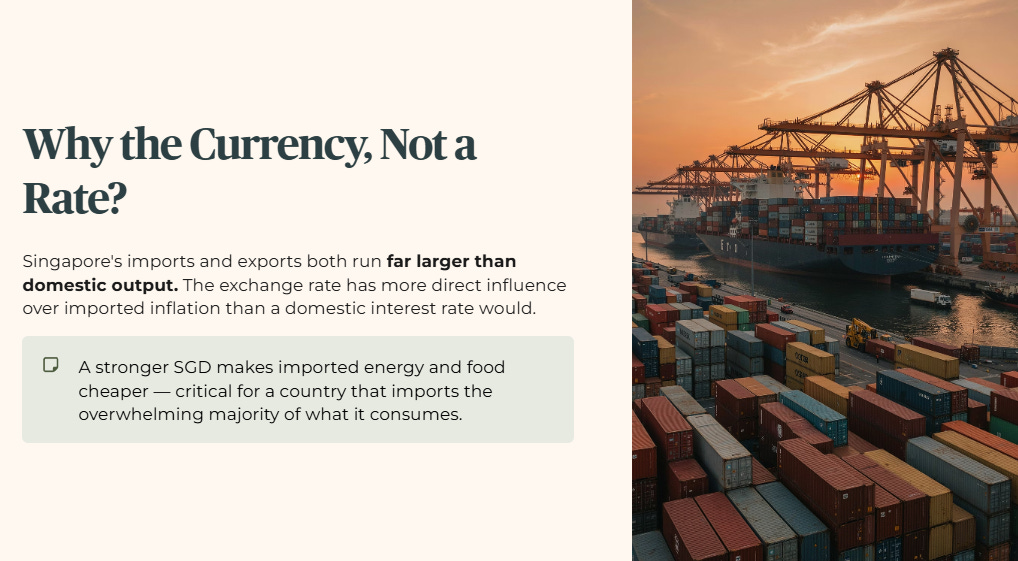
A stronger Singapore dollar makes imported goods, including energy and food, cheaper in local terms, which matters enormously for a country that imports the overwhelming majority of what it consumes. Managing the currency directly gives MAS a more precise lever for the specific inflation risk Singapore actually faces, rather than relying on an interest rate that would ripple through the economy far less predictably.
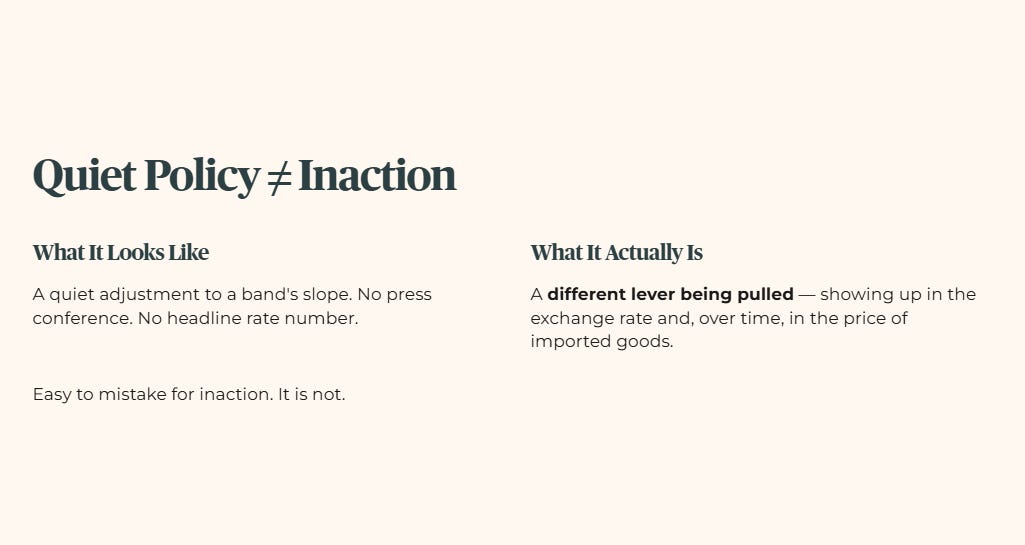
There is a practical consequence to this that rarely gets spelled out. Because MAS is not defending a headline rate, Singapore’s monetary policy announcements can look almost uneventful to anyone expecting drama: a quiet adjustment to a band’s slope rather than a press conference about a rate decision. That quietness is easy to mistake for inaction. It is not. It is a different kind of lever being pulled, one that shows up in the exchange rate and, over time, in the price of imported goods, rather than in a number that makes headlines the way a rate hike does.
MAS has explained the mechanism. The next calculation is why CPF’s 4.0% guarantee becomes a tougher yield benchmark than a higher number carrying currency-defense risk.
