Inflation Just Hit a Two-Year High. Does Your Portfolio Actually Notice?
The cost of living just went up for the second month running. The question worth asking isn’t what changed, it’s whether your yield kept up.
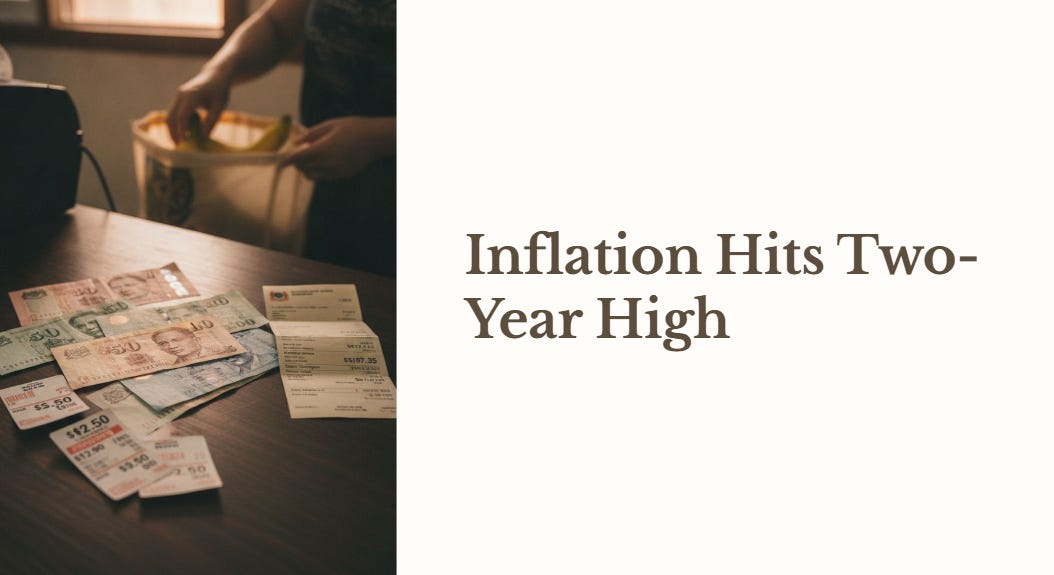
Singapore’s headline inflation climbed to 2.2% in July, the highest reading since August 2024. That’s the second straight month of acceleration, up from 1.9% in June. Most people will read that number, feel a vague sense of “prices going up again,” and move on with their day. I want to slow down on it instead, because a headline print like this either confirms your portfolio is doing its job or quietly exposes that it isn’t, and most people never actually check which.

What Actually Moved
Iggy’s Insights
Why This Doesn’t Move Any Zone Verdicts Today
The STI-REIT Tension This Feeds Into
Iggy’s Insights
Running the Actual Numbers
What To Actually Watch From Here
Iggy’s Elite Read
What Actually Moved
The July print wasn’t driven by anything exotic. Electricity and gas tariffs stepped up in the third quarter, a direct pass-through of higher global energy prices that had been building since earlier in the year.
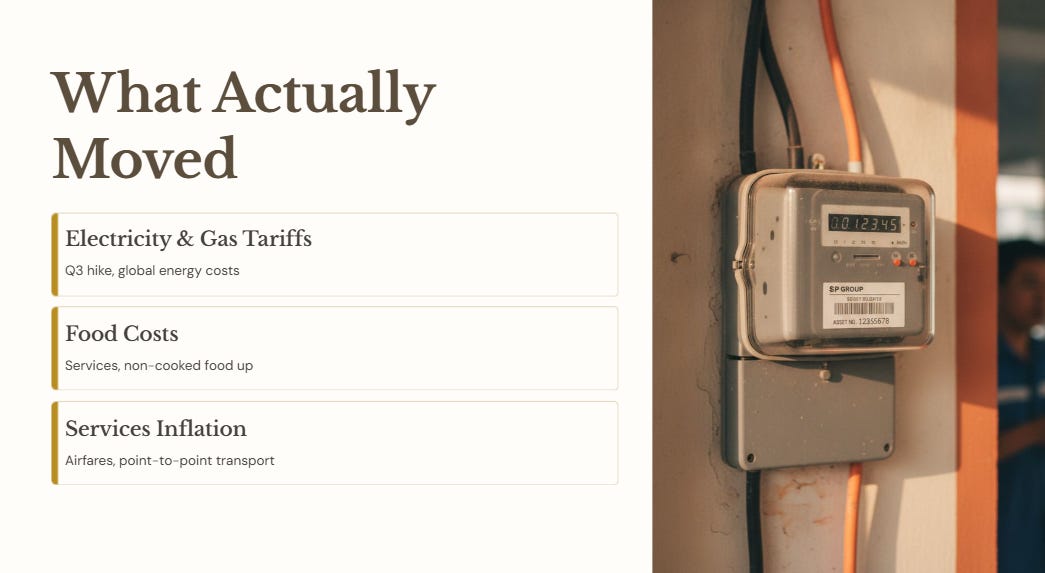
Food costs edged higher too, both food services (your hawker meal, your kopitiam breakfast) and non-cooked food. Services inflation also picked up, largely airfares and point-to-point transport, so if your Grab fares have felt a little steeper lately, that’s not your imagination.
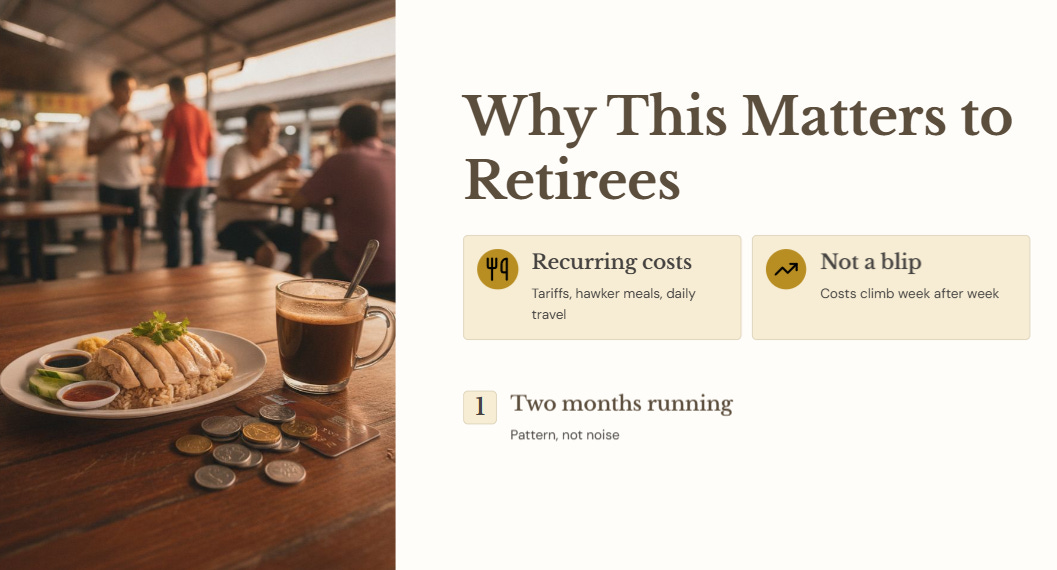
None of that is unusual or alarming in isolation. This is the ordinary machinery of a cost-of-living squeeze, not a crisis. But it’s precisely because these are such ordinary, recurring expenses that this print actually matters to a retiree’s plan. This isn’t a one-off spike in something exotic you can wait out. Tariffs, hawker prices, and transport costs are recurring line items, and a genuine two-month acceleration in the things you pay for every single week deserves more attention than a single “inflation ticked up” headline usually gets.
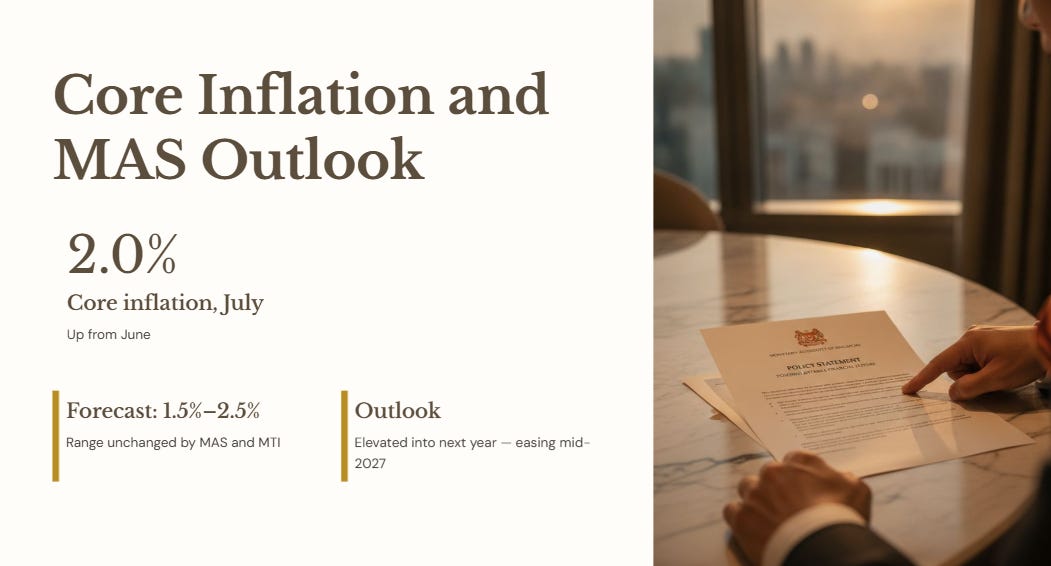
Core inflation, which strips out accommodation and private transport, moved to around 2.0% in July, also up from June. MAS and MTI’s own forecast range for the year remains unchanged at 1.5% to 2.5%, but their own commentary flags something worth sitting with: they expect core inflation to stay elevated into next year before it meaningfully eases, roughly around the middle of 2027. So this isn’t being framed internally as a one-month blip. It’s being framed as a stretch.
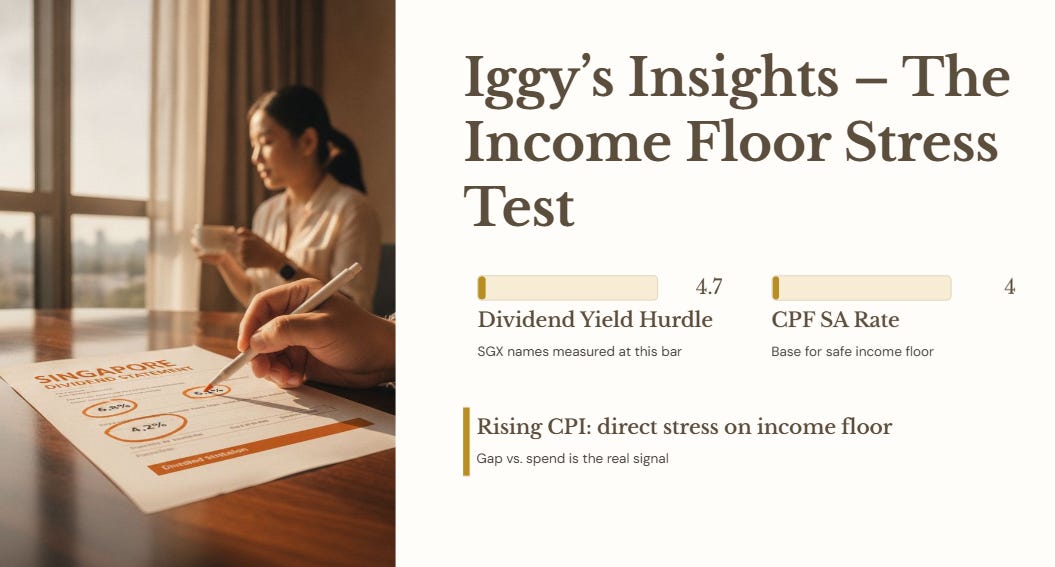
🟢 Iggy’s Insights
Here’s the part that doesn’t get said often enough. A rising cost-of-living print isn’t just a headline for the general public, it’s a direct stress test for your income floor. Every SGX dividend name I screen gets measured against a 4.7% yield hurdle, and that hurdle exists precisely for moments like this one. It’s not there because 4.7% is a nice round target, it’s there because it’s calibrated against CPF SA at 4.0%, the highest-quality guaranteed SGD return that exists in the system, plus a real risk premium on top.
When core inflation is genuinely elevated and staying elevated, the gap between “my dividend income” and “what my actual monthly spend now requires” either widens or it doesn’t, and that’s the only question that actually matters here. The headline print is noise. What it does to that gap is the signal.
No One Pays Him To Be Right
The Verdict Doesn’t Change Because The Bill Needs Paying. Every finance channel says “unbiased.” Most of them also have a sponsor, an affiliate link, or a subscriber count to protect deciding what gets softened. Iggy doesn’t. This channel started as, and still is, a passion project, not an income source. That’s not a slogan, it’s the actual reason a Zone 4 verdict stays a Zone 4 verdict even when the stock is one half of Singapore holds.

Iggy’s Elite Investors aren’t paying for faster access to opinions that were always going to be diplomatic anyway.

You’re paying for the version of this analysis that exists because it doesn’t need to please anyone, zero-day forensic breakdowns, the complete “Red Zone” watchlist, and institutional-grade cheatsheets built without a single sponsor’s name attached to the verdict.

For S$12/month, less than two kopi and kaya toast sets at Raffles Place, you’re not just getting the report first. You’re the reason it’s still honest.
Why This Doesn’t Move Any Zone Verdicts Today
I want to be precise about something, because it would be easy to overreach here. This CPI print, on its own, does not change a single zone assignment in my Ledger. Inflation is a macro input, not a company-level fact.
A stock’s gearing, its interest coverage, its trailing yield against its own balance sheet, none of that shifts because of a national price index reading. If Keppel DC REIT was Zone 4 yesterday on an occupancy miss, it’s still Zone 4 today. If OCBC was Zone 5 on a yield floor breach, that verdict rests on OCBC’s own trailing dividend math, not on the CPI print.
What this print does do is change the backdrop those verdicts sit against. A dividend that clears my 4.7% hurdle today, in a world where core inflation is running near 2%, is doing real work for a retiree’s income. That same dividend, unchanged in dollar terms, does noticeably less work if the underlying cost of living it needs to fund keeps climbing while the payout stays flat. This is why a genuinely fortress-balance-sheet name with a flat, unchanging dividend deserves closer scrutiny in a rising-cost environment than the same name would in a low-inflation one, not because the balance sheet weakened, but because what the income needs to cover got more expensive.
The STI-REIT Tension This Feeds Into
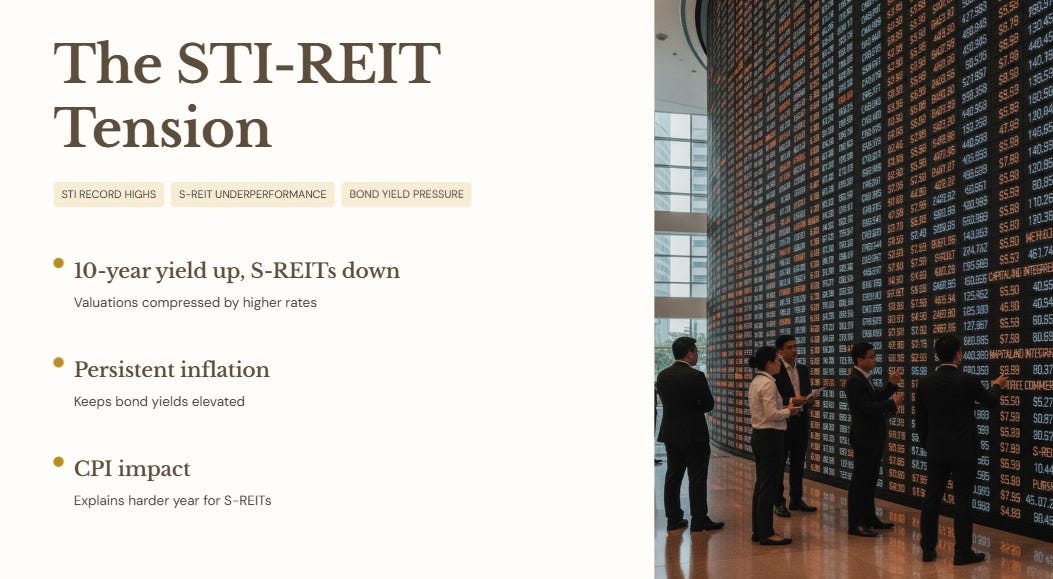
There’s a second layer worth naming here, and it connects directly to something I’ve been tracking closely this month: the widening gap between STI’s record-high run and S-REITs’ underperformance. Part of that story is US Treasury yield transmission into REIT valuations, and part of it is domestic. Singapore’s 10-year government bond yield has climbed meaningfully this year, and that’s the actual benchmark S-REIT yield spreads get priced against, not the CPI print directly, but the two aren’t unrelated. Persistent inflation pressure is one of the inputs that keeps government bond yields elevated, and elevated bond yields are exactly what’s been compressing S-REIT valuations relative to the broader index.
So this CPI print doesn’t move a REIT’s zone call today. But it’s one more data point reinforcing why S-REITs, as a sector, have had a harder year relative to STI than the headline index performance alone would suggest. If you’ve been wondering why your REIT holdings haven’t kept pace with the market even while collecting steady distributions, this is part of the mechanism, not the only part, but a real one.
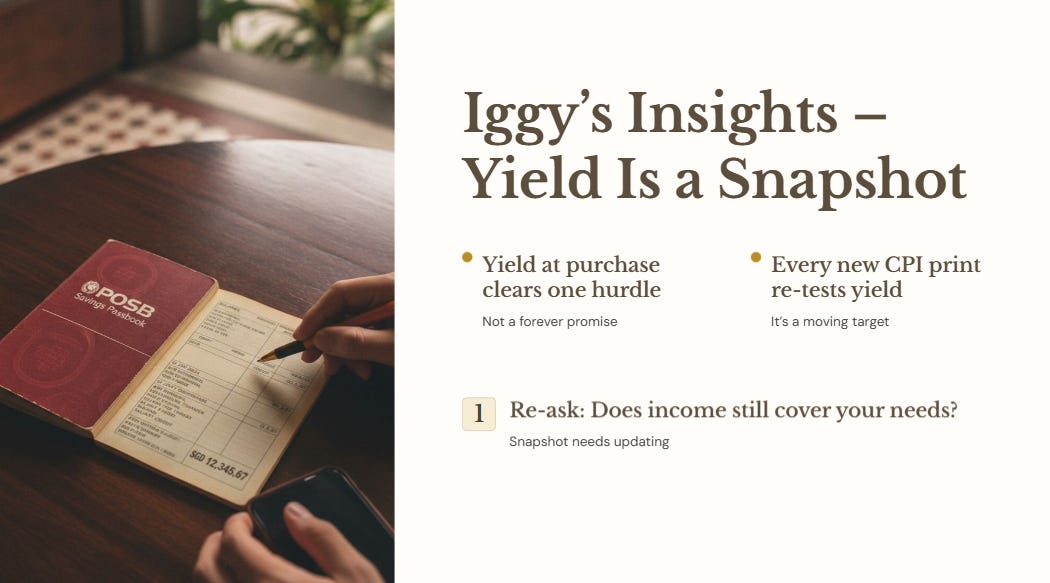
🟢 Iggy’s Insights
I get asked some version of this question a lot: if my dividend yield is fine on paper, why does my portfolio feel like it’s not actually getting ahead? Here’s the honest answer. A yield that clears the hurdle at the moment you bought the stock isn’t a permanent guarantee, it’s a snapshot. Every rising CPI print quietly re-tests that snapshot against a moving target. This doesn’t mean panic-selling anything that’s still fundamentally sound. It means treating “does my income still comfortably clear what I actually need to live on” as a question worth re-asking periodically, not a box you tick once and forget. The framework doesn’t get easier just because the answer might be uncomfortable.
🔒 What’s Next
The forensic floor exists for exactly this scenario. What the actual math looks like when you run a real income comparison against this print is where this gets genuinely useful.