


You've likely seen the headlines about the U.S. office market. Words like "empty," "distressed," and "apocalypse" get thrown around. It’s enough to make any sane investor nervous. Then, you see a Singapore-listed REIT like Prime US REIT (OXMU) trading at a valuation an analyst called "depressingly low." Your gut tightens. Is this a golden opportunity to buy cheap, or are you about to catch a falling knife?
Many investors are frozen. On one hand, the low price is tempting. On the other, the fear of permanent work-from-home trends and rising interest rates is real. The news is a confusing mix of dividend cuts and hopeful "buy" calls. It’s hard to know who to believe.
Let's cut through the noise. In this analysis, I will break down exactly what is happening with Prime US REIT. We will look at its financials, the risks, and the recent signs of life in its leasing activity. By the end, you will have a clear, data-backed view on whether this is a "buy," "hold," or "sell" for your portfolio.
The Elephant in the Room: Why So Cheap?
Prime US REIT's stock has been hit hard. The reason is simple: a perfect storm of problems. First, rising interest rates make borrowing money more expensive. This directly hurts REITs, which use debt to buy properties. Higher interest payments mean less cash left for dividends.
Second, the work-from-home trend has challenged the need for office space. This has led to lower occupancy rates and downward pressure on rents across the U.S. market. For Prime US REIT, this has resulted in a painful, but necessary, cut in dividends to preserve cash. You can see this sharp decline clearly.
Table: Prime US REIT Semi-Annual Dividend Per Share (2021–2025)
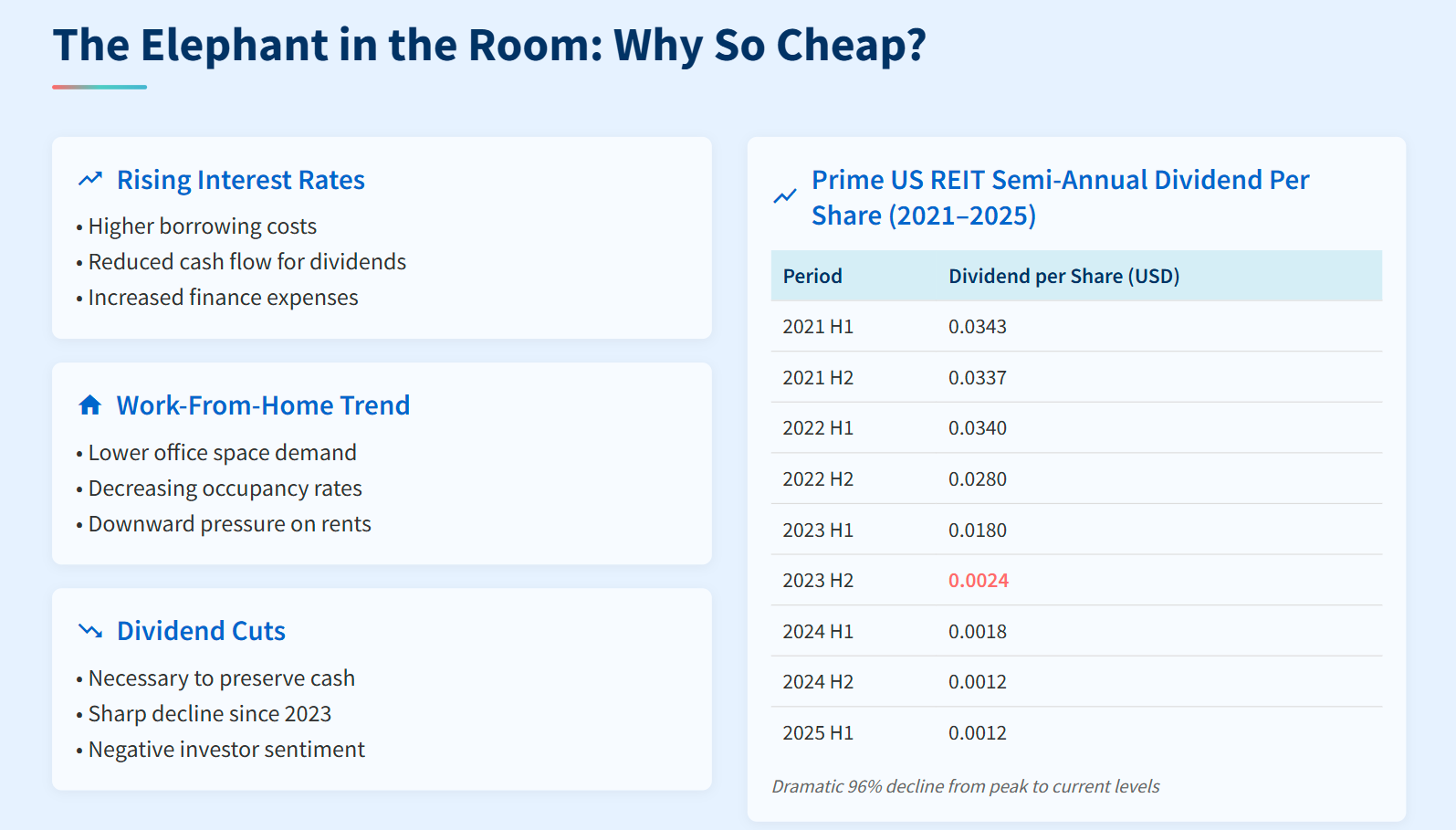
This table shows the dramatic fall in Prime US REIT's distributions. The steady, reliable income that investors once counted on has evaporated since early 2023. This collapse is the primary reason for the stock's poor performance and the current negative sentiment surrounding it. For income investors, this trend was a deal-breaker.
