



Japan’s Grid Constraints Are Reshaping S-REITs. Keppel DC REIT’s Own Numbers Tell a Different Story.
Every outlet covering this week’s Tokyo data centre deals is asking whether Japan is a good growth story. That’s the wrong question if you already own the REIT.
Every headline this week reads the same way. Singapore’s data centre REITs are chasing Japan’s data centre boom, buying up scarce, power-ready assets before someone else does. Keppel DC REIT just agreed to pay roughly S$1.39 billion for two more of them near Tokyo. I ran the actual math on what that deal does to the one metric it’s supposed to help. It barely moves, on the figures disclosed so far.
I’ve been tracking Keppel DC REIT’s Cardiff vacancy since it first pulled portfolio occupancy below my 95% floor. It’s the single hard gate keeping this REIT out of a cleaner zone. So when a S$1.39 billion acquisition lands with “portfolio strength” in the framing, my first move is always the same: pull the actual before-and-after numbers before I believe the framing.

Why Japan, and Why Now
The Deal, and What It Was Supposed to Fix
The Gate This Creates
A Quick Note Before the Verdict
The Comparison That Actually Tests This
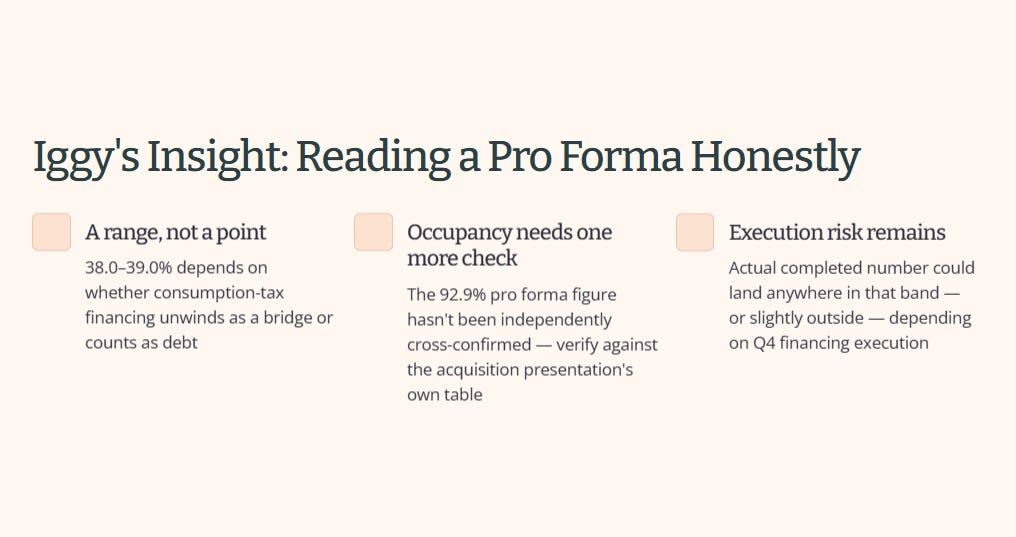
Iggy’s Insight: Reading a Pro Forma Number Honestly
What This Actually Means for the Zone Call
Iggy’s Elite Read
Why Japan, and Why Now
Japan’s data centre market is genuinely tight.
Cushman & Wakefield puts the country’s operational capacity at more than 1.8 gigawatts with a vacancy rate around 6.6%, one of the largest and most mature markets in Asia-Pacific. Demand keeps climbing on domestic enterprise workloads, cloud adoption, and AI compute, and Cushman & Wakefield estimates roughly 3.5 gigawatts of further pipeline by 2030, of which nearly 40% of what’s under construction and around a quarter of what’s planned is already pre-leased before it’s even built.
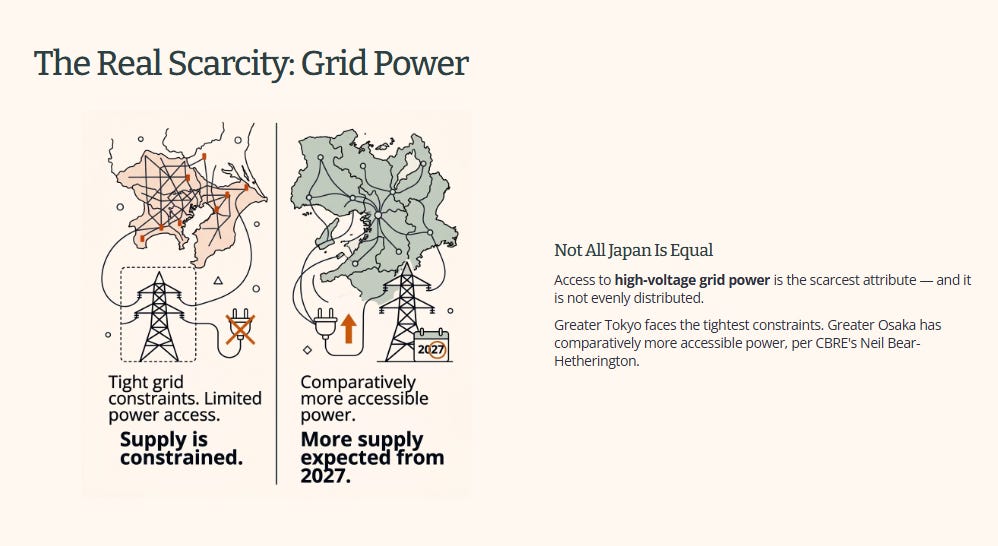
The scarcity isn’t capacity in the abstract, it’s grid-connected, power-ready capacity specifically. Access to high-voltage grid power has become one of the most valuable attributes a data centre asset can have, and that access is not evenly spread across the country. Greater Tokyo faces some of the tightest grid constraints in Japan. CBRE’s Neil Bear-Hetherington notes that Greater Osaka has comparatively more accessible power by comparison, with more supply expected there from 2027, though this is a market-level distinction rather than a guarantee for any single Osaka property.
That regional split matters more than the trend coverage usually credits it. It means “Japan data centre exposure” is not one story. It’s at least two, depending on which grid you’re actually buying into.
The Deal, and What It Was Supposed to Fix
Keppel DC REIT’s move is an 88.62% effective interest in two freehold hyperscale colocation data centres in Inzai City, Greater Tokyo, Tokyo DC 4 and Tokyo DC 5. Keppel itself, the sponsor, retains 1.38%, and the existing operator keeps the remaining 10%.
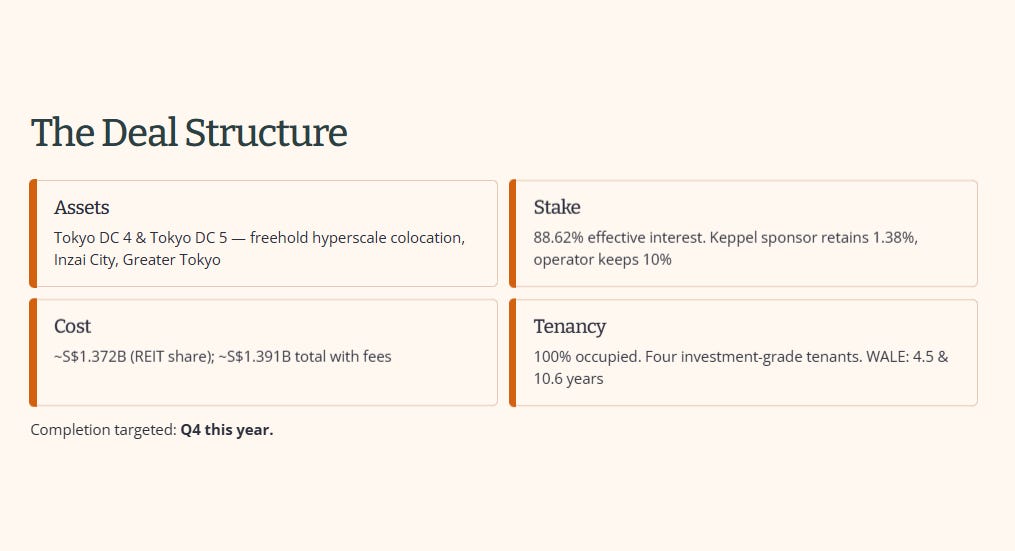
The effective purchase consideration for the REIT’s share is approximately S$1.372 billion, with total outlay around S$1.391 billion once fees and expenses are included. Both assets are already 100% occupied by four investment-grade internet enterprise and IT-services tenants, with asset-level weighted average lease expiries of 4.5 and 10.6 years respectively. Completion is targeted for the fourth quarter of this year.

On paper, this is exactly the kind of asset the whole sector is competing for: fully leased, long-dated income, sitting in one of the more power-constrained data centre markets in Japan.
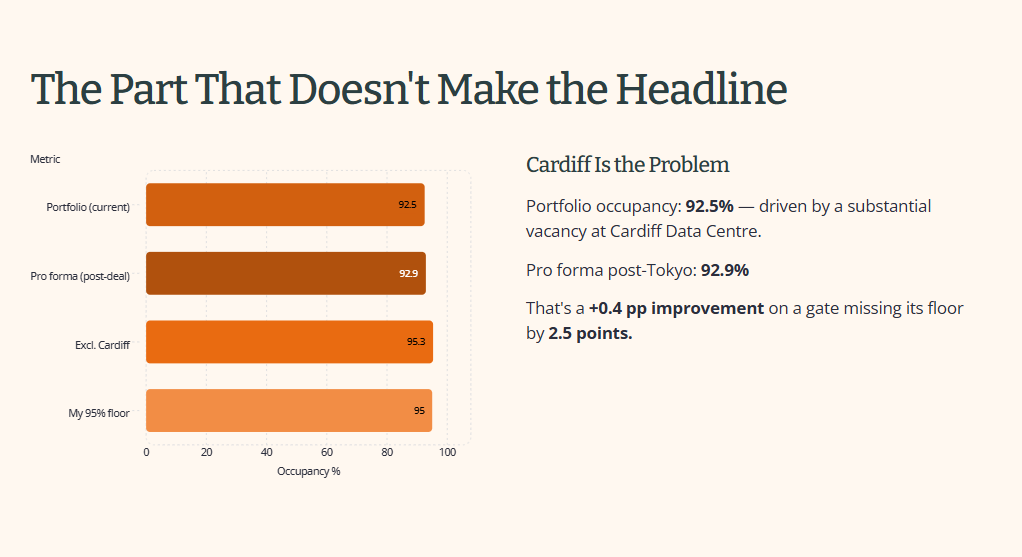
Here’s the part that doesn’t show up in the headline. Keppel DC REIT’s portfolio occupancy has been sitting at 92.5% since a substantial vacancy opened up at the Cardiff Data Centre, the principal disclosed driver of the decline (Keppel’s own 1H2026 presentation shows portfolio occupancy would sit at 95.3% excluding Cardiff). That’s the single hard gate failure keeping this REIT at Zone 4 rather than a cleaner call. Management’s disclosed pro forma for the Tokyo deal shows portfolio occupancy moving from 92.5% to 92.9% once it completes.
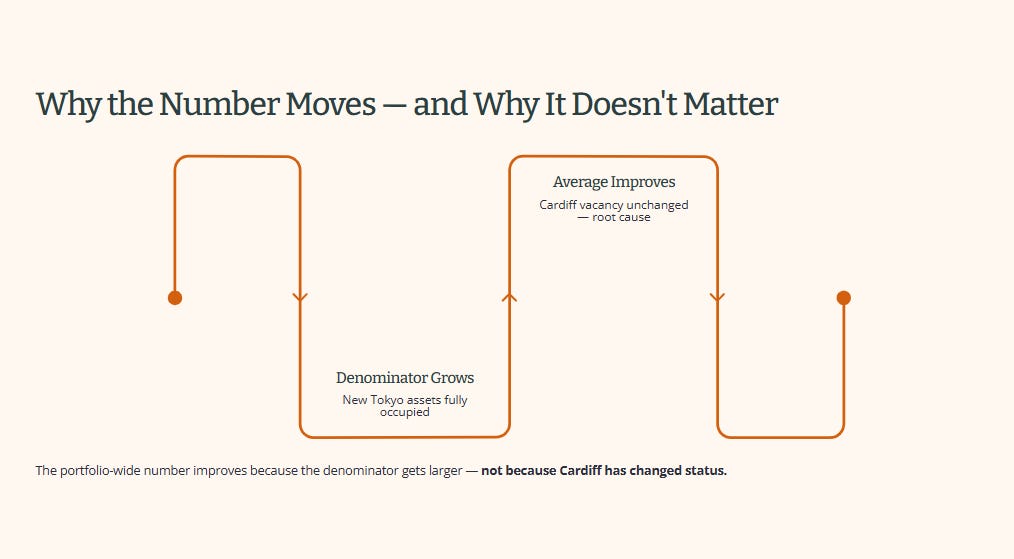
That’s a 0.4 percentage point improvement, on a gate that’s currently missing its 95% floor by 2.5 points. The announced Tokyo transaction doesn’t itself re-lease, sell, or write down Cardiff. The portfolio-wide number improves because the denominator gets larger and fully occupied, not because the asset that actually caused the miss has changed status.
The Gate This Creates
If the occupancy improvement were the whole story, this would already be a reasonable trade: dilute a stubborn problem with better assets elsewhere, buy time for Cardiff separately. But the deal doesn’t come free on the balance sheet side.
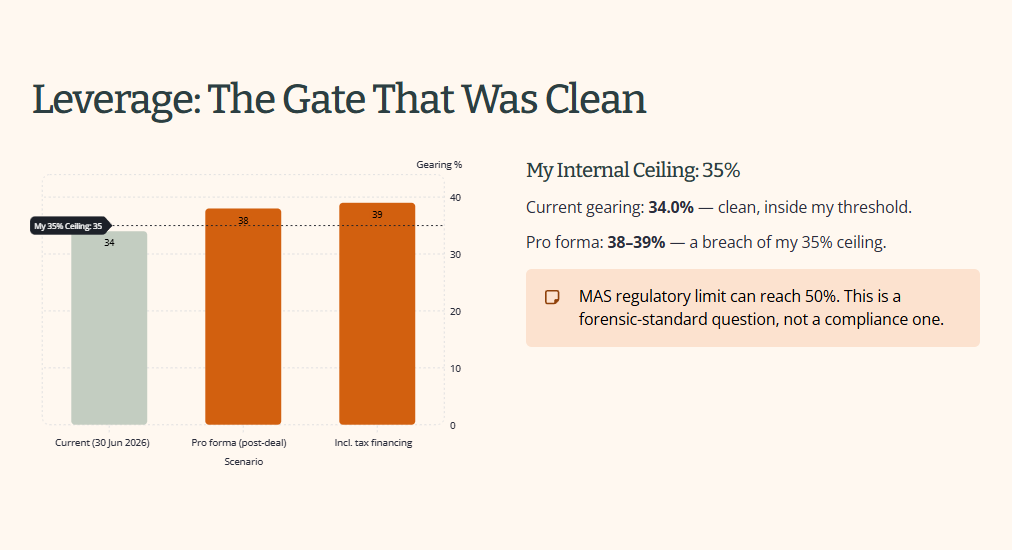
As of the 30 June 2026 reporting date, aggregate leverage sits at 34.0%, comfortably inside my 35% ceiling, the one hard gate this REIT has cleared under my own thresholds. Management’s own pro forma for the Tokyo acquisition puts leverage at 38.0% post-completion, or 39.0% if temporary consumption-tax financing is included. Both figures stay inside MAS’s regulatory limit, which can rise as high as 50% where the relevant interest-coverage condition is met, so nothing here is a compliance problem. Under my own internal 35% ceiling, both pro forma figures represent a breach.
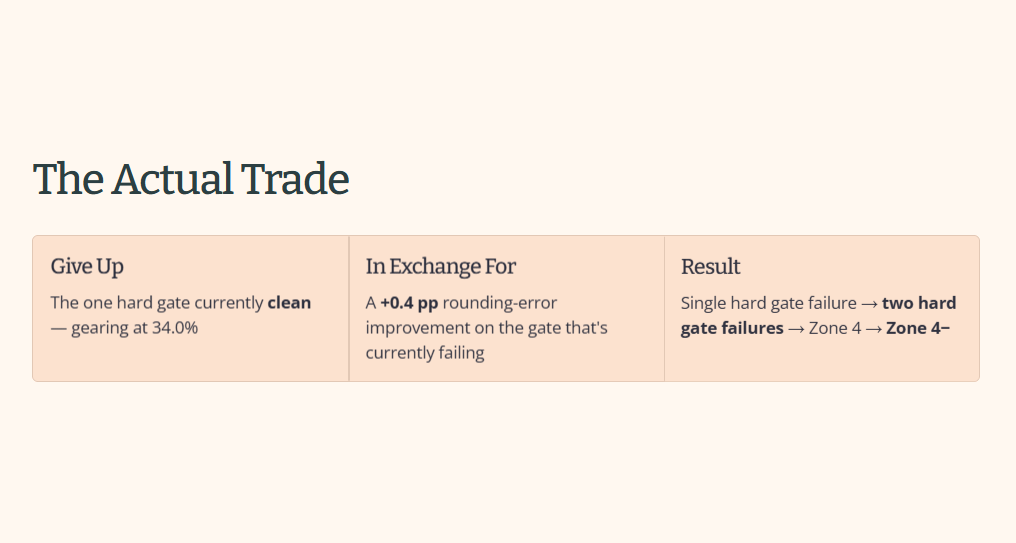
So the actual trade being made, under my Ledger rules rather than any external standard, is this: give up the one hard gate that’s currently clean, in exchange for a rounding-error improvement on the hard gate that’s currently failing. If the deal completes as structured and gearing lands anywhere near that pro forma range, Keppel DC REIT moves from a single hard gate failure to two, which under my own suffix rules would push this from Zone 4 into Zone 4-, regardless of how the completion announcement frames the occupancy story.
A Quick Note Before the Verdict
A Quick Note Before the Verdict. You aren’t here for the kopi tips or the hype. You’re here because you want the forensic truth before you commit a single dollar of your capital. That tells me something about the kind of investor you are.

But here’s the uncomfortable truth about how independent publishing works. The algorithm doesn’t know you read every word. It doesn’t know you checked the gearing ratio twice. It only sees one signal, whether you’ve hit that subscribe button. Every forensic investor who reads without subscribing is invisible to the machine.

If this analysis has ever helped you identify a risk or calculate a margin of safety, subscribe for free now and share this with one person who needs to hear it. Not for me. To tell the algorithm that data-driven SGX analysis deserves a seat at the table alongside the noise.
The Comparison That Actually Tests This
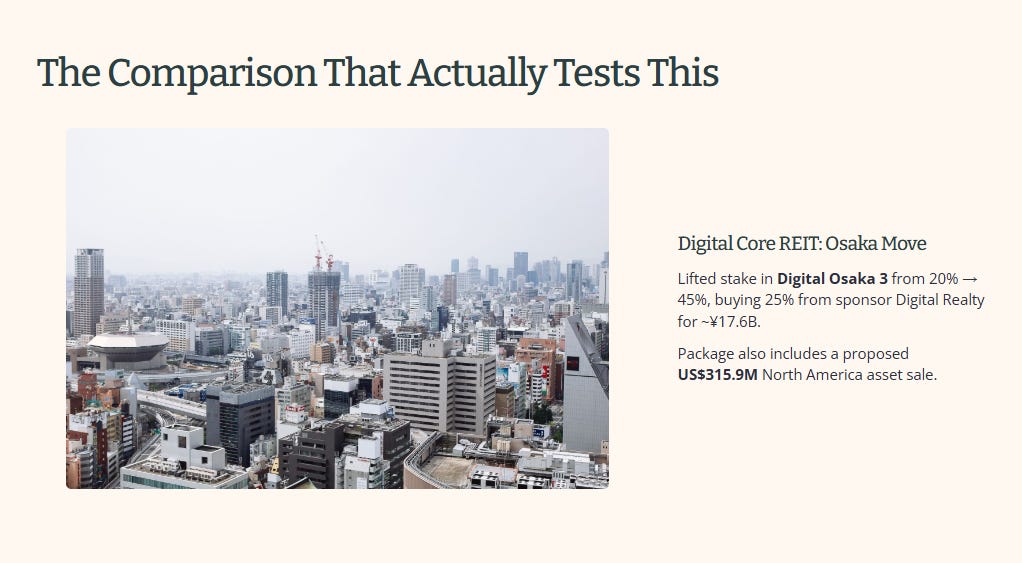
Keppel DC REIT isn’t the only S-REIT making this bet. Digital Core REIT agreed to lift its stake in an Osaka asset, Digital Osaka 3, from 20% to 45%, buying the additional 25% from its own sponsor, Digital Realty, for roughly ¥17.6 billion, as part of a wider package that also includes a proposed US$315.9 million North America asset sale.
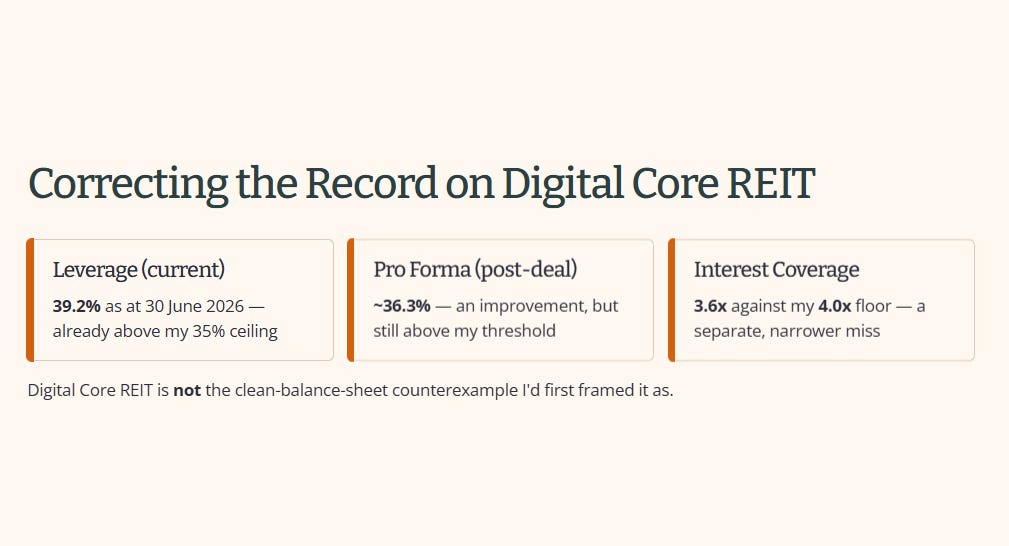
I want to correct something here rather than let a cleaner story stand uncorrected. Digital Core REIT is not the clean-balance-sheet counterexample I’d first framed it as. Its aggregate leverage was 39.2% as at 30 June 2026, and the combined transaction package is expected to bring that down to approximately 36.3% pro forma, an improvement, but still above my 35% ceiling. Its interest coverage, at 3.6x against my 4.0x floor, is a separate, narrower miss.
So the actual contrast isn’t a stretched Keppel DC REIT against a comfortably clean Digital Core REIT. It’s two REITs both moving in the wrong direction on my gearing ceiling from different starting points: Keppel DC REIT is adding assets while leverage rises from a clean 34.0% toward 38 to 39%, and Digital Core REIT is expanding into Osaka within a package that’s expected to reduce leverage, yet still leaves it above my threshold either way.
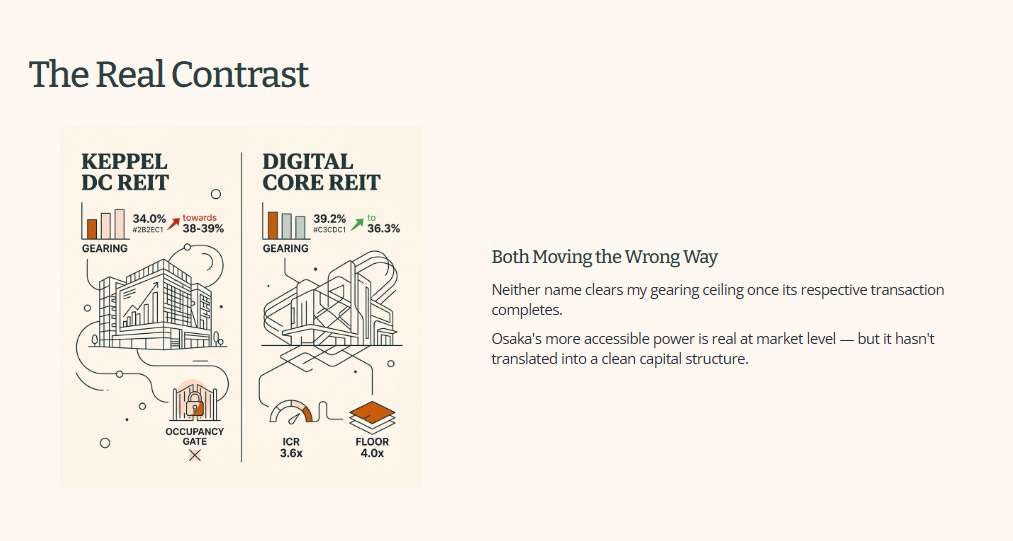
Neither name clears my gearing ceiling once its respective transaction completes. Osaka’s comparatively more accessible power position, per CBRE, is real at the market level, but it hasn’t translated into a clean capital structure for the REIT buying into it here.
🔒 What’s Next
The Tokyo numbers above explain why Keppel DC REIT wants this deal. The other number, the one that doesn’t show up in the completion press release, decides whether the trade was actually worth making.
