



Keppel DC REIT’s $1.2 Billion Deal Is “Accretive.” Here’s the Discount New Units Are Priced At.
The REIT says the Tokyo acquisitions lift DPU by 2.6%. New units are being sold at a 2.5 to 4.6% discount to fund it, and existing unitholders absorb both sides of that math.
Keppel DC REIT told the market its new Tokyo acquisition lifts distribution per unit by 2.6 percent. It didn’t lead with the other number: new units are being sold to fund the deal at up to a 4.6 percent discount. A unitholder who bought in years ago and someone considering buying into the placement on 10 September are reading two different stories from the same announcement.

I want to be fair to this deal before I get skeptical about the financing. Tokyo Data Centre 4 and 5 are fully leased, freehold, and bought at a genuine discount to their own valuation, that’s a good acquisition on the merits. But “accretive” is doing a lot of work in this announcement, and it only tells you what happens to distribution per unit, not what happens to your proportional ownership of the trust that pays it. Both things can be true at once, and I want to walk through exactly how.

The Announcement
How It’s Being Paid For
Iggy’s Insight
The Balance Sheet This Deal Sits On Top Of
The Accretion Math
What The Numbers Say About Who Pays
What This Means for the Zone 4 Call
What To Watch Next
Iggy’s Insight
Legacy Holders vs Fresh Capital
Iggy’s Forensic Zone: Zone 4, Caution
Iggy’s Elite Read
Iggy’s Forensic Disclaimer
The Announcement
Keppel DC REIT and its sponsor, Keppel, are jointly buying nearly all of two freehold, fully leased data centres in Inzai City, Greater Tokyo, for a combined 190 billion yen, about US$1.2 billion, a roughly 2.1 percent discount to the properties’ own independent valuation. Keppel DC REIT takes the larger share, an 88.62 percent effective interest in each asset, paying approximately 168.4 billion yen. The existing operator retains a 10 percent stake in both.
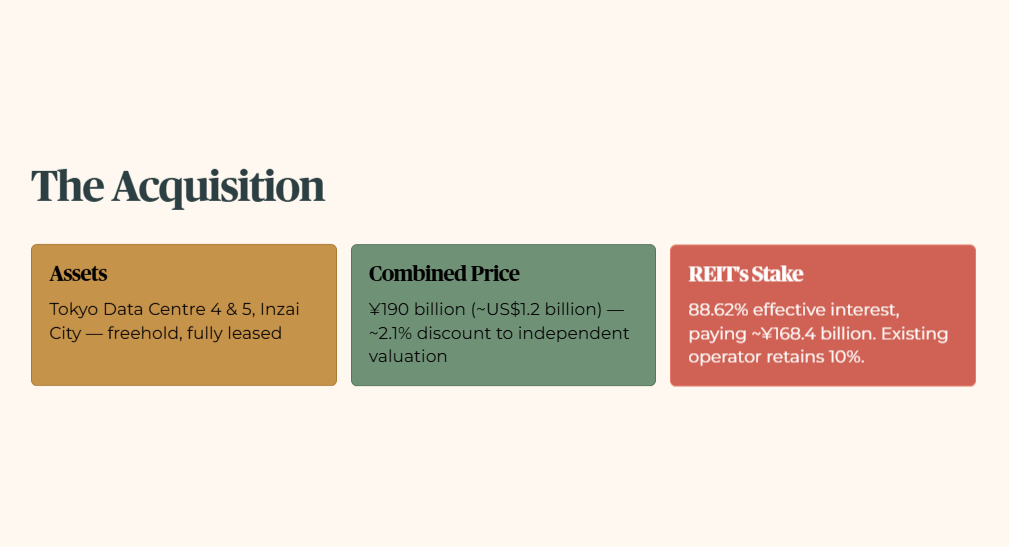
Both buildings are fully occupied by four investment-grade tenants, three of them entirely new to Keppel DC REIT’s client base. That matters beyond the headline occupancy figure: the REIT’s single largest tenant currently accounts for 43.5 percent of portfolio rental income, and this deal brings that down to roughly 38.2 percent, a genuine reduction in client concentration risk, not just a bigger portfolio.
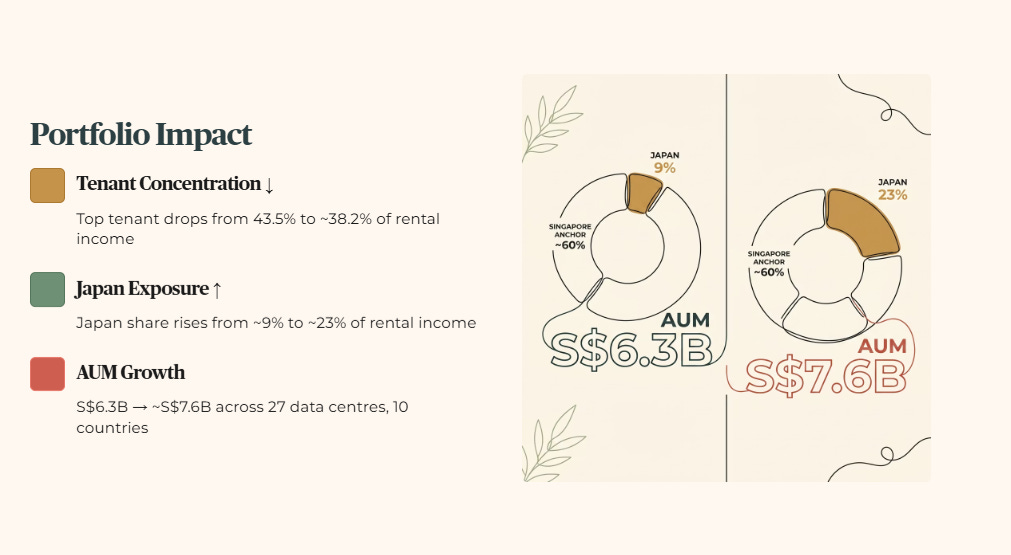
Completion is targeted for the fourth quarter of 2026. Once done, Japan’s share of Keppel DC REIT’s portfolio rental income jumps from about 9 percent to roughly 23 percent, while Singapore remains the anchor at around 60 percent. Total assets under management grow from S$6.3 billion to about S$7.6 billion across 27 data centres in 10 countries.
How It’s Being Paid For
This is the part of the announcement that determines who actually benefits, and by how much.
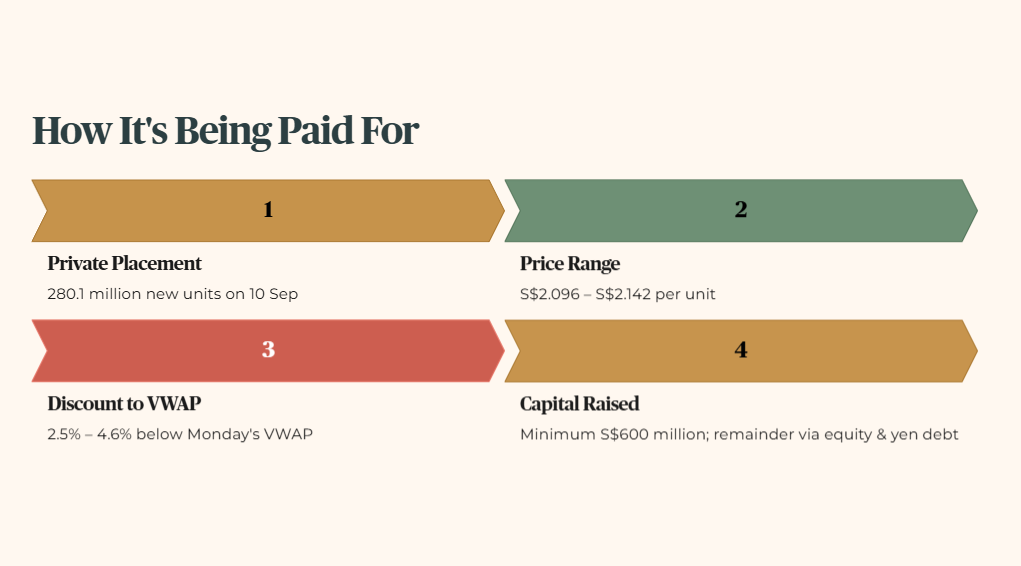
The REIT plans to raise at least S$600 million through a private placement of 280.1 million new units on 10 September, priced between S$2.096 and S$2.142. That range sits 2.5 to 4.6 percent below Monday’s volume-weighted average price, or VWAP, the average price a unit traded at across the day, weighted by how many units changed hands at each level, and the standard reference point placements are priced against. The remaining funding comes from a mix of equity and yen-denominated debt, with the exact split not yet finalised.

Selling new units at a discount to the prevailing price is standard practice for REIT placements, it’s how you get institutional buyers to commit quickly, but it isn’t free. Every existing unitholder’s proportional claim on the trust’s assets and future distributions gets diluted by the new units issued, and the placement price effectively hands new buyers a discount that existing unitholders don’t receive.
🟢 Iggy’s Insight
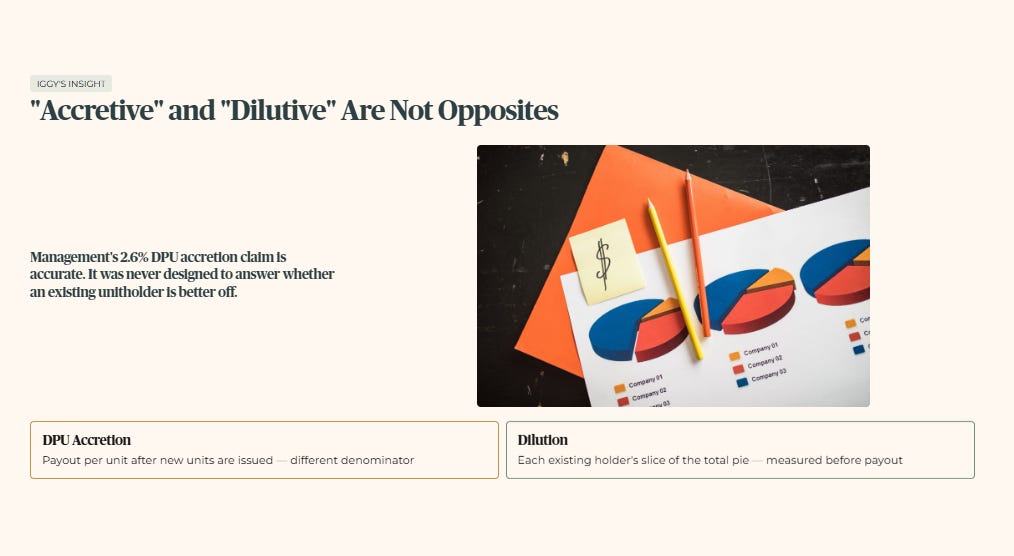
“Accretive” and “dilutive” are not opposites here, and that’s the part most coverage of this deal skips. DPU accretion measures the payout per unit after the new units are issued. Dilution measures what happens to each existing unitholder’s slice of the total pie before that payout even gets calculated.
A REIT can genuinely raise the distribution per unit and still shrink an existing holder’s proportional ownership at the same time, because those are two different denominators being compared to two different numerators. Management’s 2.6 percent DPU accretion claim is accurate. It’s also not the whole answer to whether an existing unitholder is better off, and it was never designed to answer that question.
The Balance Sheet This Deal Sits On Top Of
This transaction doesn’t touch the actual reason Keppel DC REIT carries a Zone 4 verdict today, and I want to be explicit about that rather than let a big, positive-sounding announcement quietly imply otherwise.
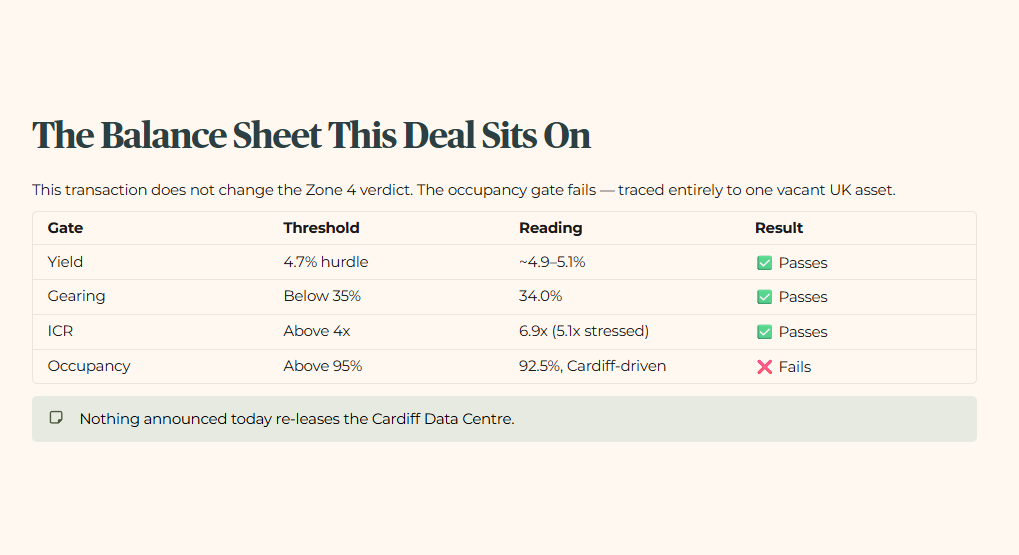
These figures are carried forward from the last confirmed Ledger update, not re-tested for this piece. The single hard gate failing, occupancy, traces entirely to one tenant vacating the Cardiff Data Centre in the UK. Nothing announced today re-leases that space.
¹ A separate data pull this session returned a conflicting 7.32% TTM yield reading. Cross-checked against the Ledger’s confirmed 1H 2026 DPU, the 4.9-5.1% figure holds up under independent recalculation and is used here; either reading clears the 4.7% hurdle, so the occupancy-driven Zone 4 call is unaffected regardless of which is correct.
The Accretion Math
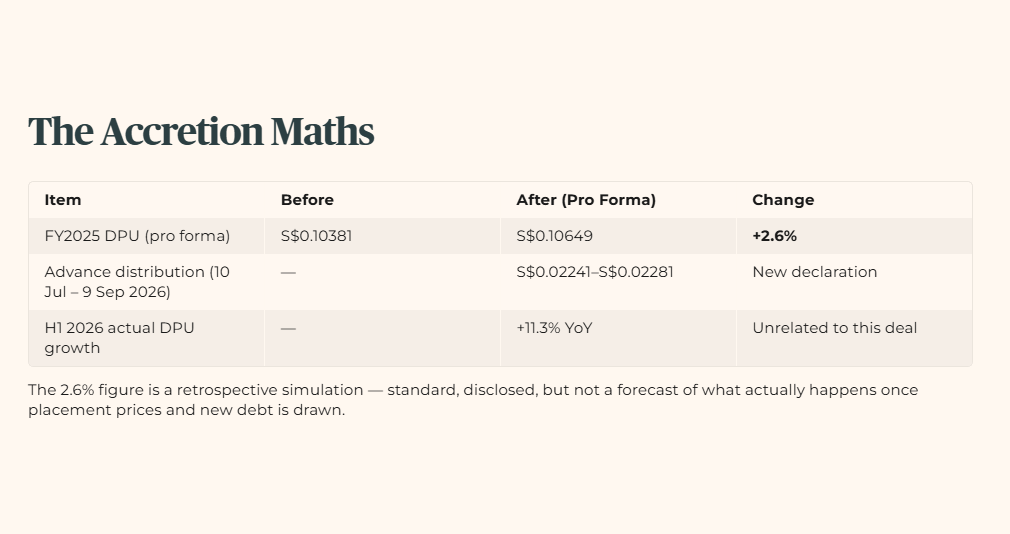
The pro forma 2.6 percent figure is a retrospective simulation, run as if the deal had already closed at the start of last year, using last year’s numbers. It’s a standard, disclosed way to illustrate accretion, not a forecast of what actually happens once the placement prices and the new debt is drawn.
No One Pays Him To Be Right
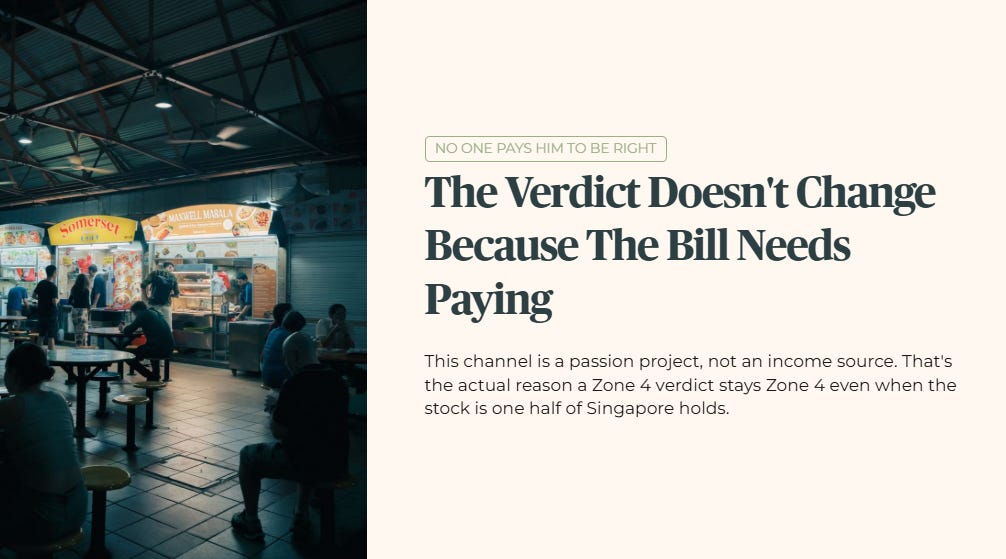
The Verdict Doesn’t Change Because The Bill Needs Paying. Every finance channel says “unbiased.” Most of them also have a sponsor, an affiliate link, or a subscriber count to protect deciding what gets softened. Iggy doesn’t. This channel started as, and still is, a passion project, not an income source. That’s not a slogan, it’s the actual reason a Zone 4 verdict stays a Zone 4 verdict even when the stock is one half of Singapore holds.
Iggy’s Elite Investors aren’t paying for faster access to opinions that were always going to be diplomatic anyway. You’re paying for the version of this analysis that exists because it doesn’t need to please anyone, zero-day forensic breakdowns, the complete “Red Zone” watchlist, and institutional-grade cheatsheets built without a single sponsor’s name attached to the verdict.
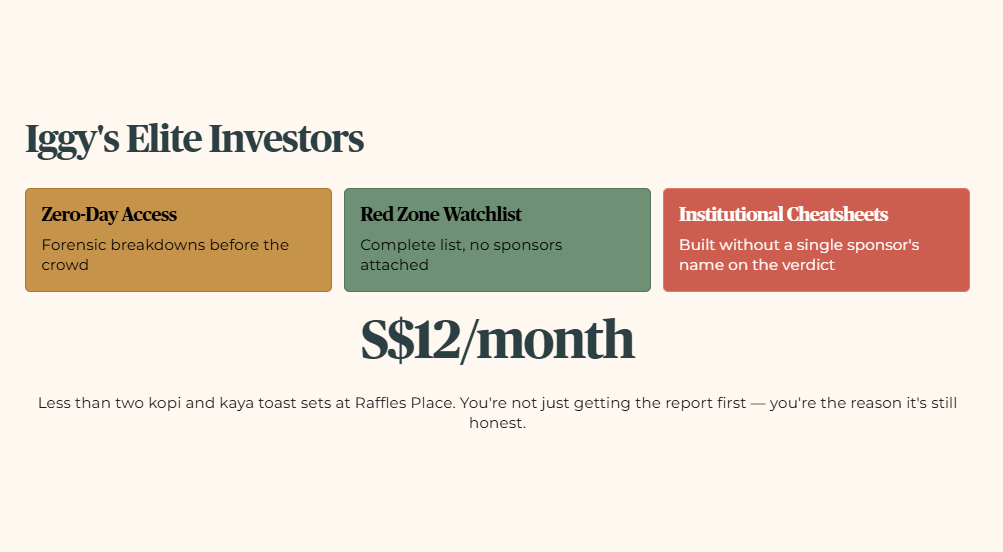
For S$12/month, less than two kopi and kaya toast sets at Raffles Place, you’re not just getting the report first. You’re the reason it’s still honest.
What The Numbers Say About Who Pays
A genuine Peer Comparison table isn’t available this session, no comparable data centre REIT placement data was pulled, so in its place, here’s the actual placement math broken out plainly.
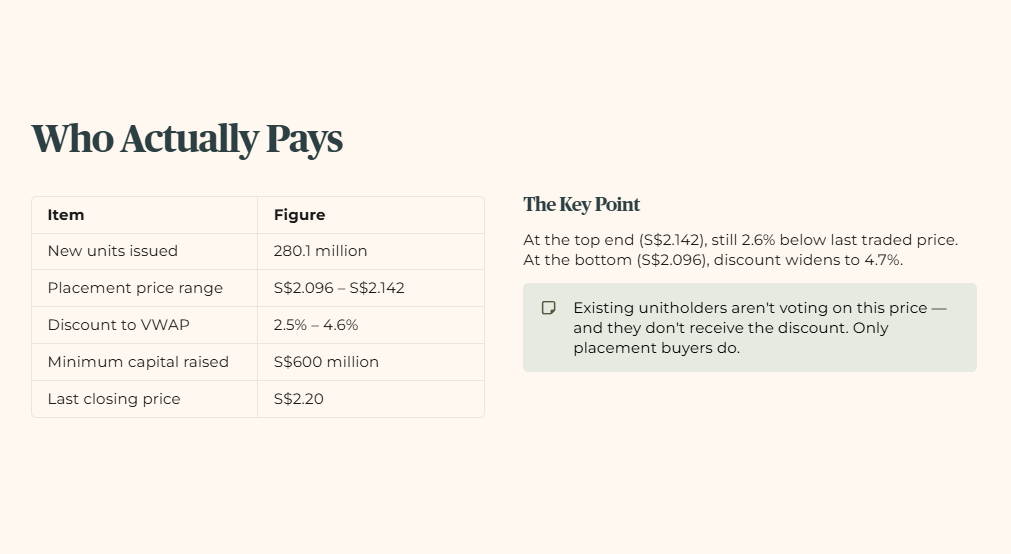
end of the placement price, S$2.142, that’s still 2.6 percent below where the units last traded. At the bottom end, S$2.096, the discount widens to 4.7 percent. Existing unitholders aren’t voting on this price, and they don’t receive the discount either, only the placement’s institutional buyers do.
🔒 What’s Next
The occupancy gate that actually drives this REIT’s Zone 4 call isn’t resolved by this acquisition, and whether the new, fully occupied Tokyo assets mathematically move that number once blended into the portfolio is the calculation below.
