


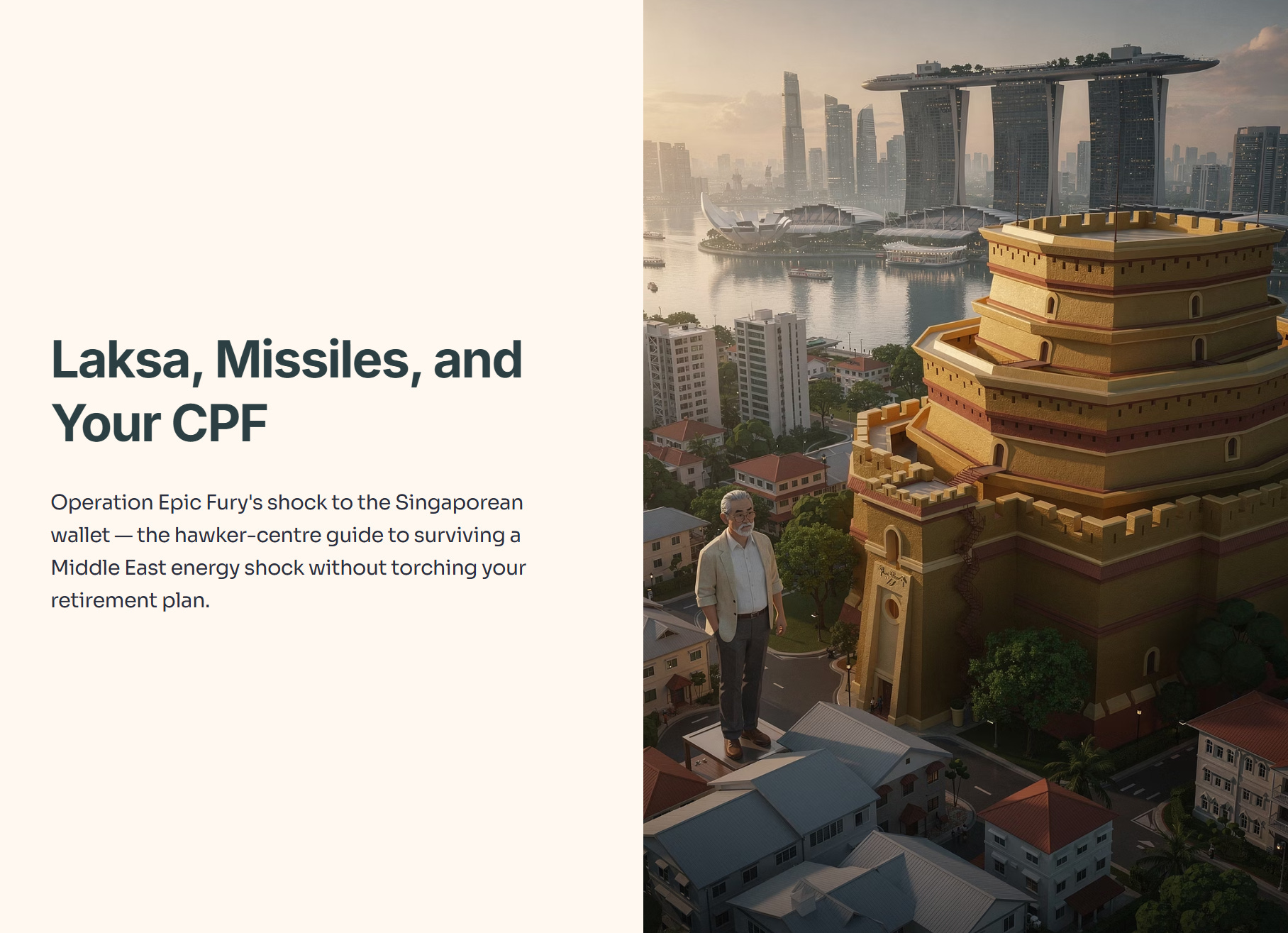
🦎 The “Epic Fury” Macro Shock: Kinetic War and the Singaporean Wallet
If you walk into the Bedok Interchange Hawker Centre right now, the air isn’t just thick with the smell of laksa—it’s vibrating with a specific, high-frequency tension. The uncles at table seven aren’t arguing about football; they are staring at live feeds of the Persian Gulf, watching the first open kinetic strikes on Iranian soil in decades. This isn’t another “shadow war” headline. Operation Epic Fury has effectively turned the Middle East into a combat zone, and the smoke rising over Tehran is drifting straight into the Singaporean kitchen table.
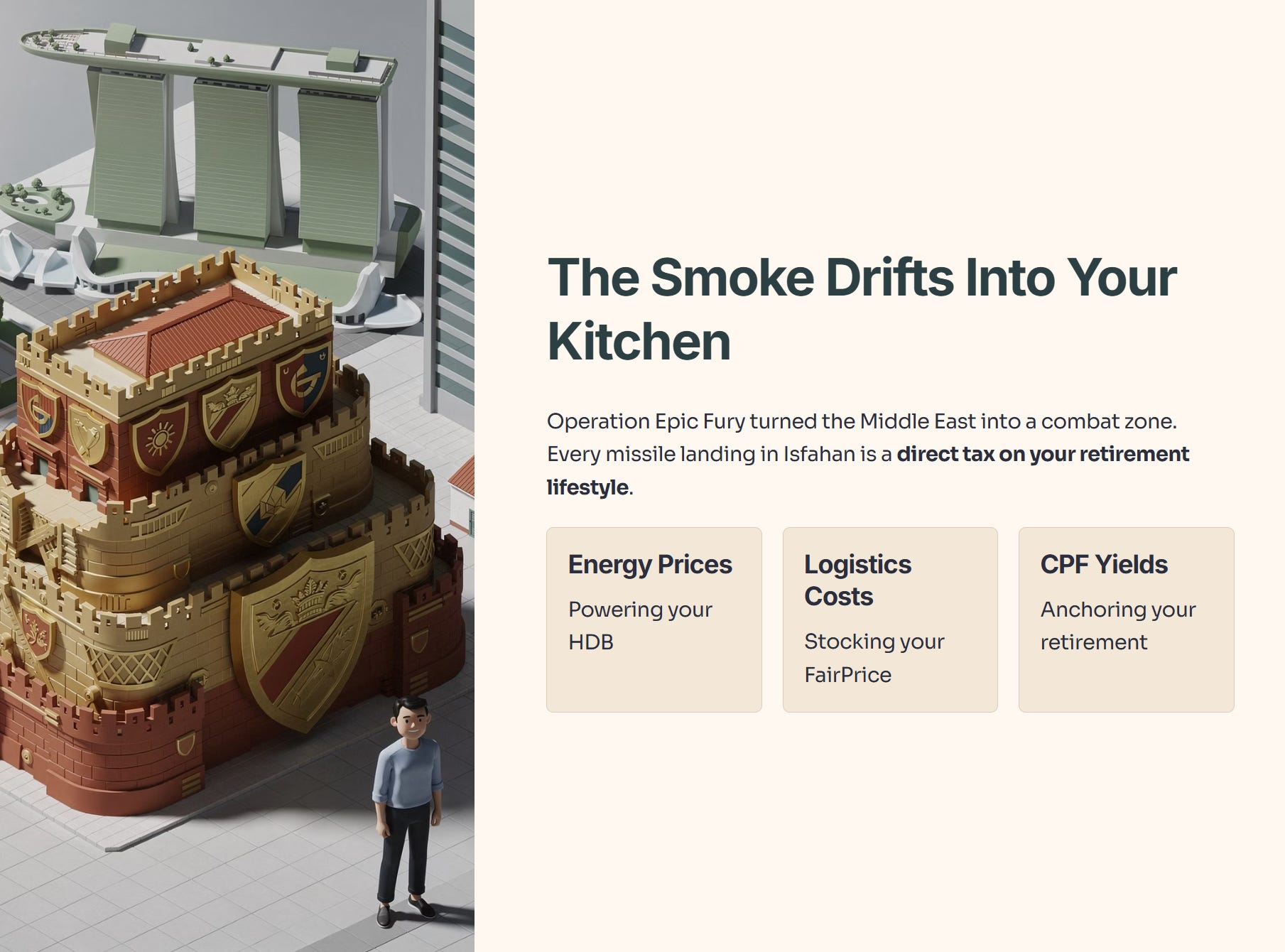
And look, on the surface, this feels like a distant geopolitical chess move. But here is the uncomfortable truth that the mainstream media is too polite to say: every missile that lands in Isfahan is a direct tax on your retirement lifestyle. We are no longer talking about “market volatility”; we are talking about a structural shock to the energy prices that power your HDB, the logistics that stock your FairPrice, and the yields that anchor your CPF.
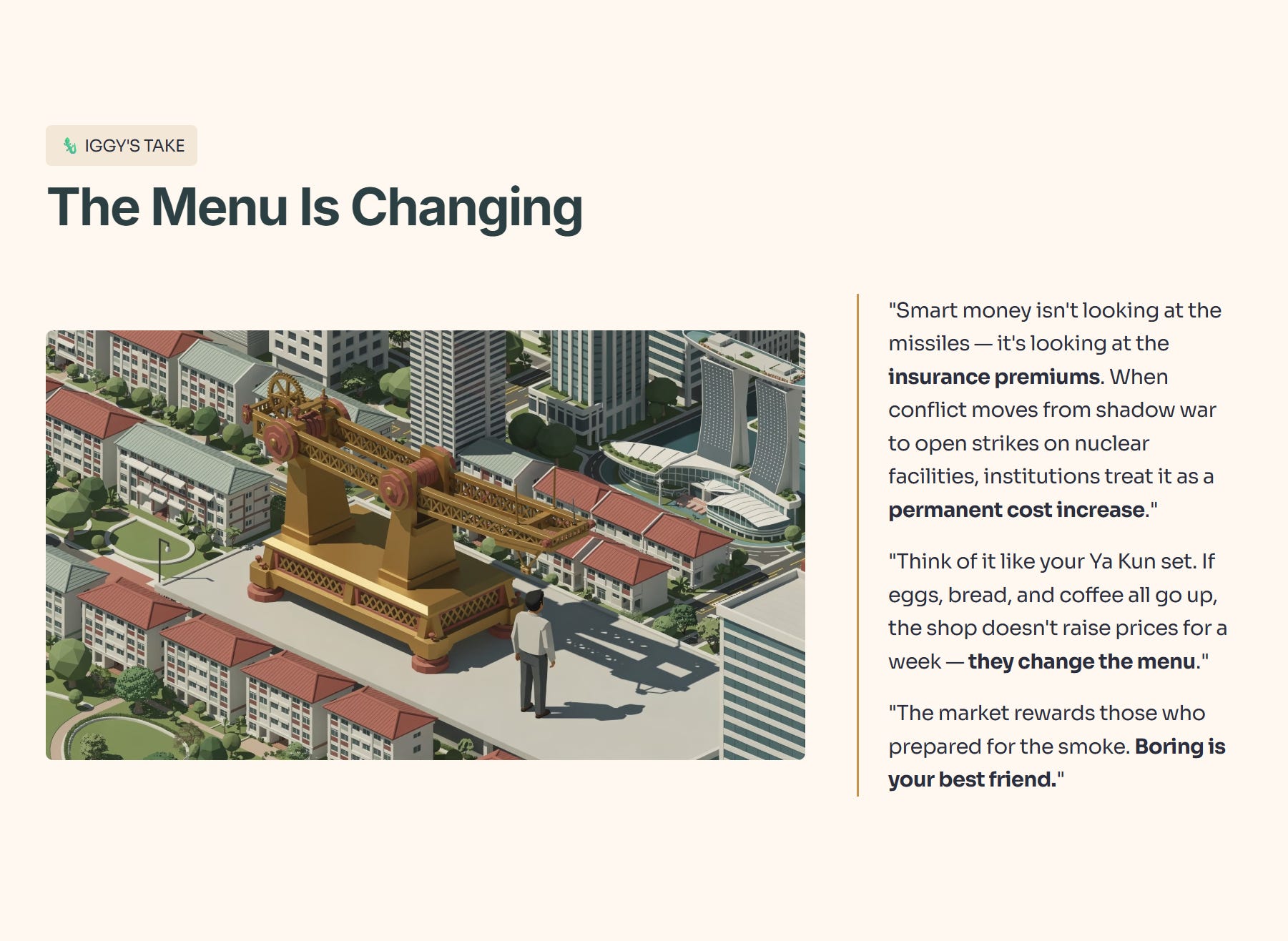
🦎 Iggy's Take: "Smart money isn't looking at the missiles; it is looking at the insurance premiums. When a conflict moves from a 'shadow war' to open strikes on nuclear facilities, institutional players treat it as a permanent increase in the cost of doing business. Think of it like your favorite Ya Kun Kaya Toast set. If the price of eggs, bread, and coffee all go up, the shop doesn't just raise prices for a week—they change the menu. Global energy is changing its menu, and the premium for 'safety' is getting expensive. The market doesn't reward those who wait for the fire to go out; it rewards those who prepared for the smoke. Boring is your best friend here."
In This Article:
The Global Storm: Operation Epic Fury
Forensic Action: Audit Your Fuel Exposure
The Local Impact: The Singaporean Wallet
The Five-Layer Rule: Energy Shock
The Currency Shield: Understanding S$NEER
What This Means For You
The Data Proof: Forensic Evidence
The Strategic Landscape: Scenario Matrix
The Singapore Investor Playbook
The Yield Spread Formula
Case Study: DBS (SGX: D05)
Case Study: OCBC (SGX: O39)
Case Study: UOB (SGX: U11)
Yield Spread Table (March 2026)
The 25% Concentration Rule
Calculate Your SAN Score
Action Plan: Your Three Moves This Week
Iggy’s Bottom Line
InvestingPro Reality Check
The Verdict
About Iggy & the Elite 170
In the Singapore market, the gap between a smart entry and becoming someone else’s exit liquidity can be as little as 48 hours. That’s the cost of informational lag.
Free subscribers get my analysis up to 14 days later. The Elite 170 get it the moment it’s ready.
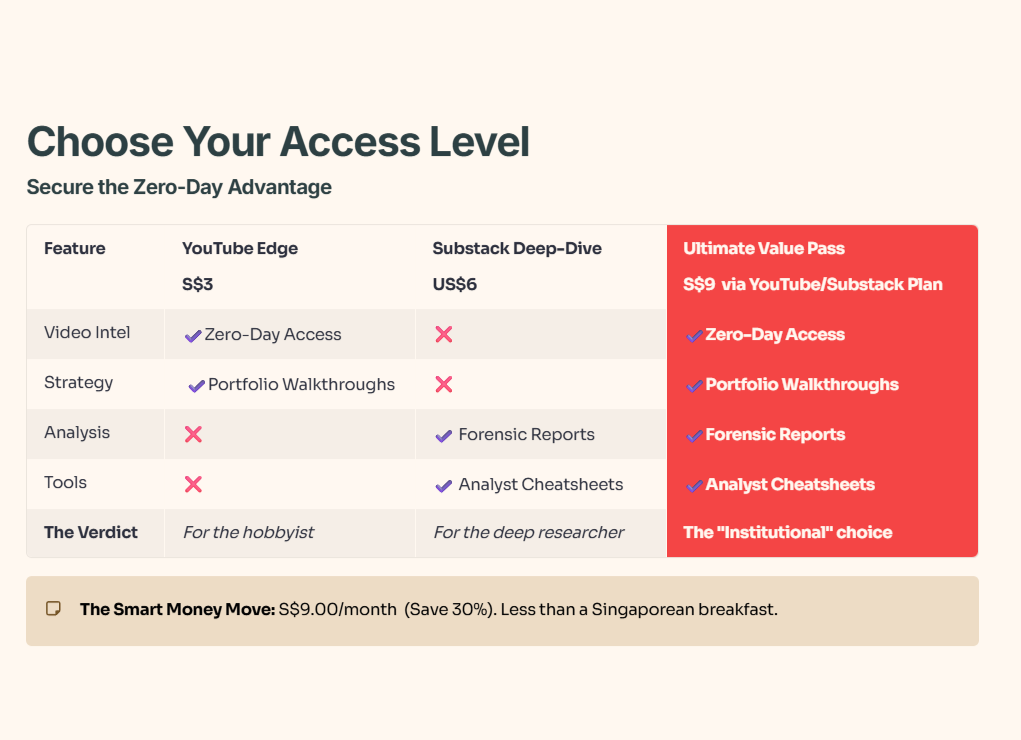
Your Edge: The S$9 Ultimate Value Pass bundles zero-day video intel, forensic reports, and analyst cheatsheets into one institutional-grade feed — for less than a Singaporean breakfast.
The Global Storm: Operation Epic Fury
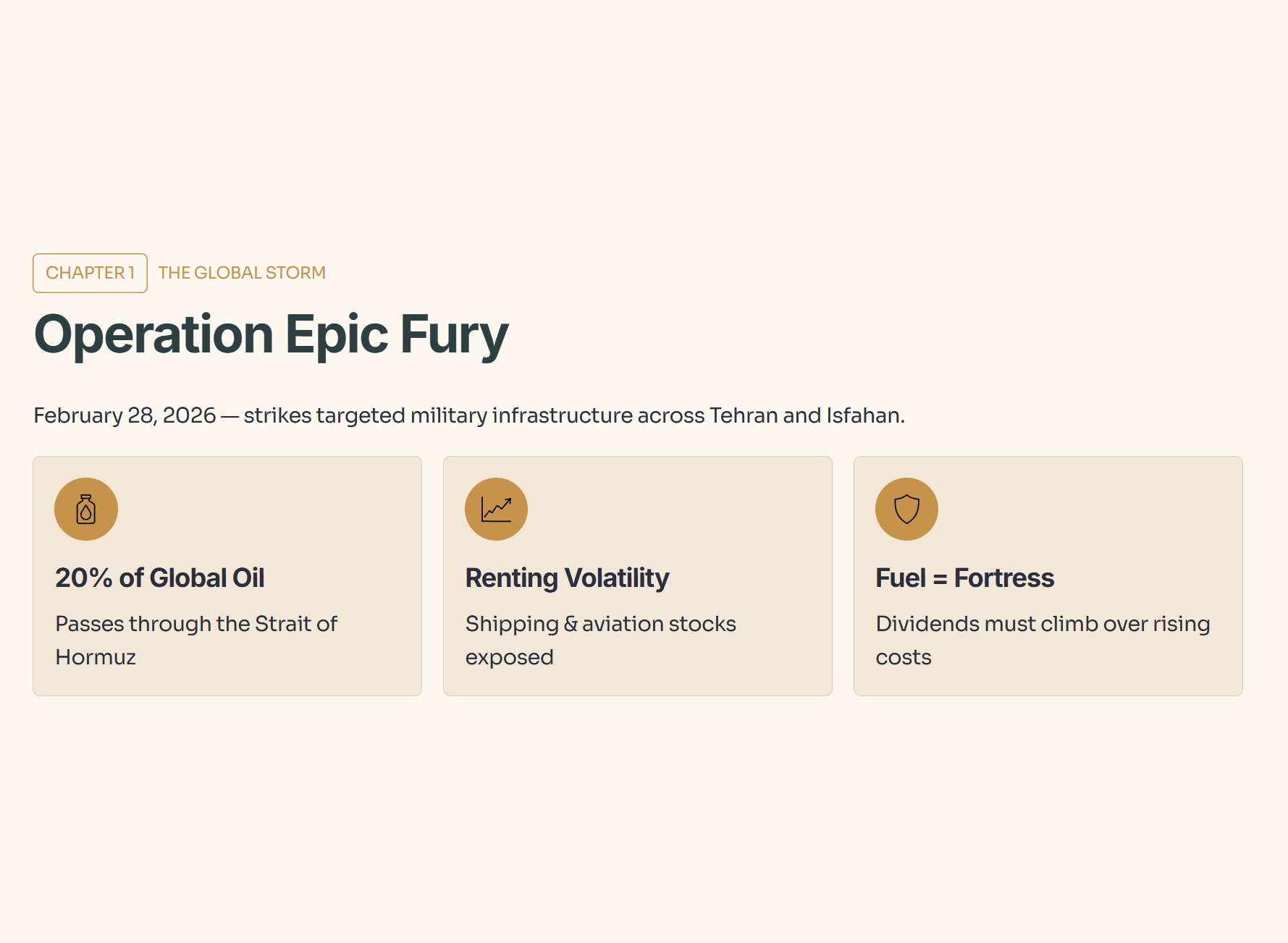
The geopolitical landscape underwent a seismic shift on February 28, 2026, with the commencement of Operation Epic Fury. The strikes targeted military infrastructure across Tehran and Isfahan. But we need to go a level deeper. The "Forensic Gap" here isn't the military strategy; it's the energy transit. Approximately 20% of global oil consumption passes through the Strait of Hormuz—a route that, if disrupted, would send shockwaves through every import-dependent economy in Asia .
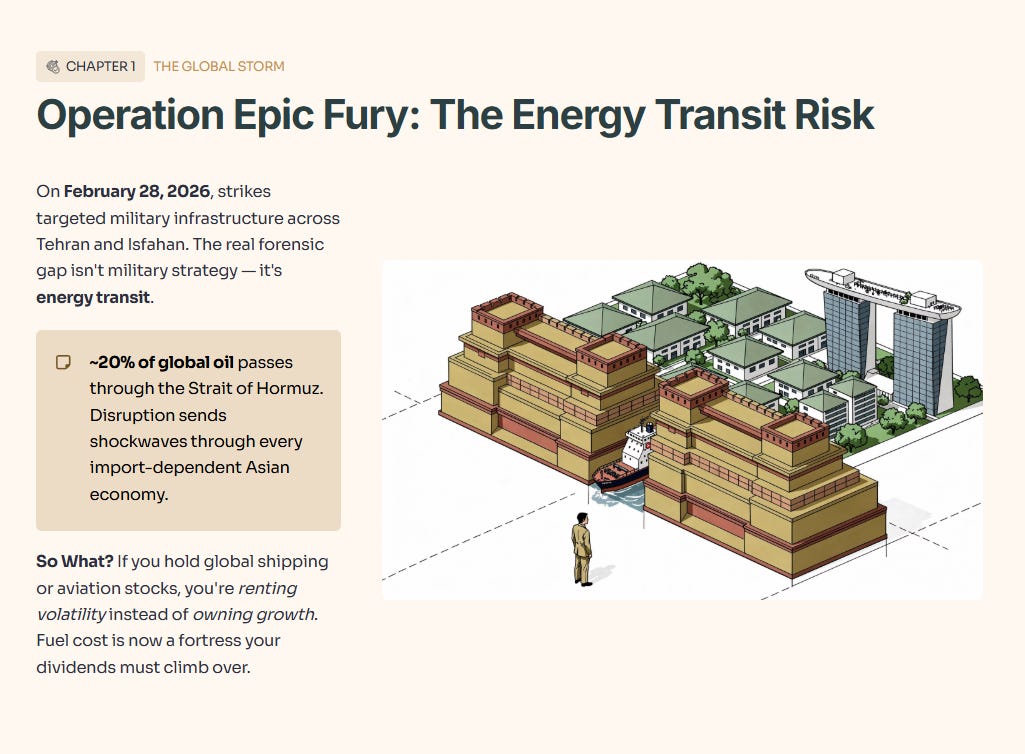
Let’s apply the So What rule here because this is where the math meets your psychology. If you are holding global shipping or aviation stocks, you are now “renting” volatility instead of “owning” growth. The cost of fuel is no longer a variable; it is a fortress that your dividends must climb over.
Forensic Action: Audit Your Fuel Exposure
Review your portfolio for companies with high fuel exposure—SIA Engineering, SATS, and any logistics REITs. Calculate whether they can pass these costs to customers. If margins are already thin (below 5%), this conflict is a signal to reassess your position, not to hold blindly.
Here is the counter-intuitive truth as of March 1, 2026: despite the strikes, Brent crude closed at $72.87, up just 2.87% on the day . Why aren't prices spiking to $100? Because the market is watching OPEC+ signals. Saudi Arabia and the UAE are signaling potential production increases, and OPEC+ is considering adding 137,000 barrels per day as early as April . The institutional view, reflected in HSBC's latest analysis, maintains a $65 forecast for 2026, noting that spare capacity in the Mideast Gulf remains significant—though none of that capacity matters if the Strait of Hormuz is actually closed.
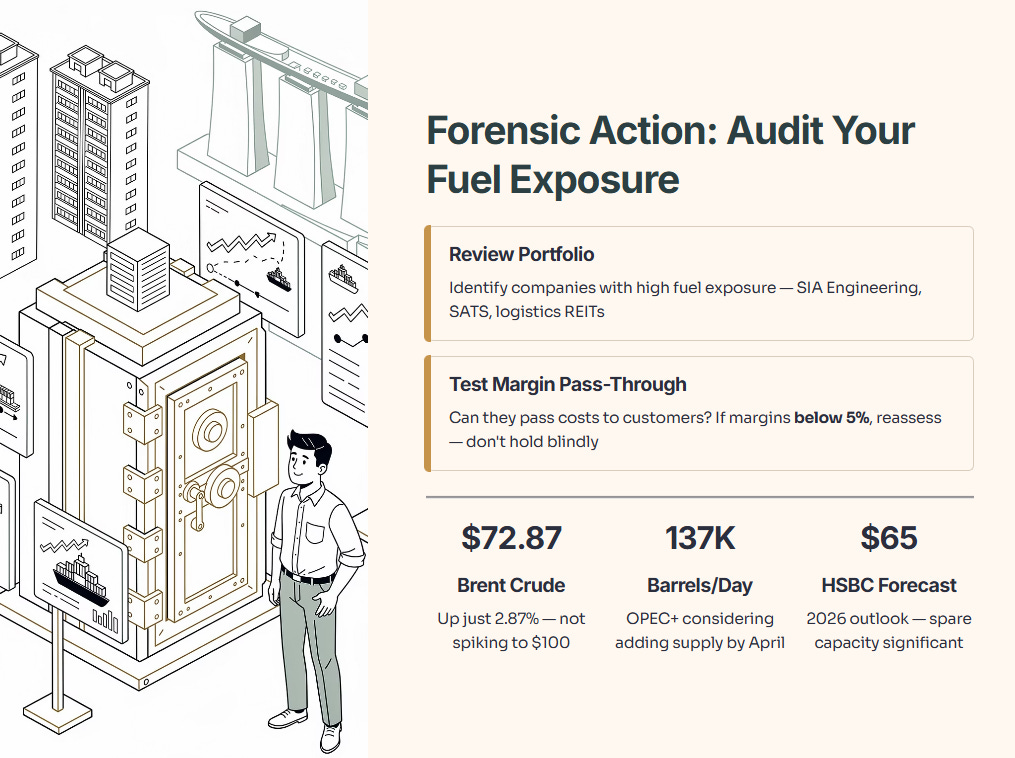
🦎 Iggy's Insight: "The shipping companies aren't the problem—they just pass on surcharges. The real victims are the businesses that consume shipping: retailers dependent on imported goods, manufacturers with just-in-time inventory, and any REIT with tenants who can't absorb higher logistics costs. Follow the cost, not the headline. And right now, the headline says $72.87, but the cost says 'volatility premium permanently embedded.'"
The Local Impact: The Singaporean Wallet
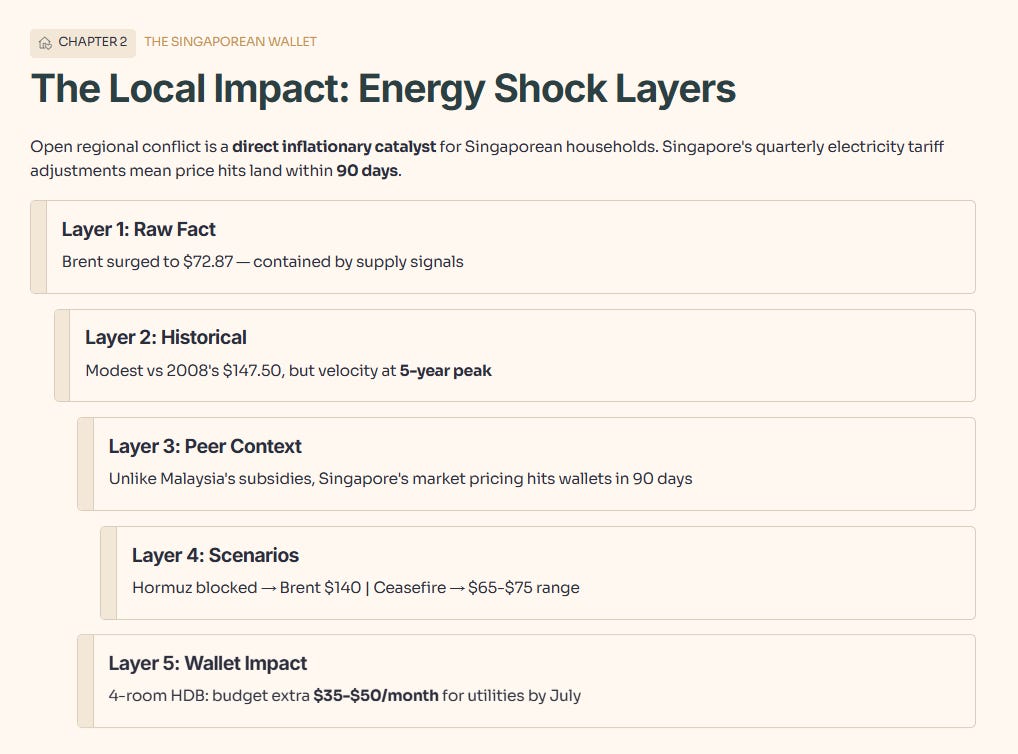
The transition to open regional conflict serves as a direct inflationary catalyst for the Singaporean household. The primary transmission mechanism is the energy market. Singapore’s electricity tariffs are adjusted quarterly, and while Brent has only moved modestly so far, the velocity of the move—the fastest weekly jump in five years—matters more than the absolute level.
The Five-Layer Rule: Energy Shock
Layer 1 (Raw Fact): Brent crude exhibited a weekend trading surge to $72.87 following the strikes—a meaningful move, but contained by supply-side signals .
Layer 2 (Historical Benchmark): While modest compared to the 2008 high of $147.50, the velocity is at a 5-year peak. The market is pricing in uncertainty, not scarcity.
Layer 3 (Peer Context): Unlike Malaysia, which uses heavy fuel subsidies, Singapore’s market-based pricing means any sustained elevation in energy prices hits wallets within 90 days through quarterly tariff reviews.
Layer 4 (Forward Scenario): If the Strait of Hormuz is blocked, analysts warn Brent could test $140; if a ceasefire holds and OPEC+ delivers supply, prices could settle toward the $65-$75 range .
Layer 5 (Wallet Impact): For a typical 4-room HDB household in Woodlands or Sembawang, the current trajectory suggests budgeting an extra $35-$50 per month for utilities by July—assuming no further escalation.
🦎 Iggy's Insight: "If you hold Keppel Corporation or Sembcorp Industries, rising energy prices flow directly to their bottom line through their power generation arms. But don't chase them now—utilities are defensive, not growth. They belong in the 'sleep well' portion of your portfolio, not the 'eat well' portion. The real winners here aren't necessarily the producers; they're the companies with fixed-price contracts who can suddenly charge market rates. But in this environment, 'winners' is a temporary title."
The Currency Shield: Understanding S$NEER
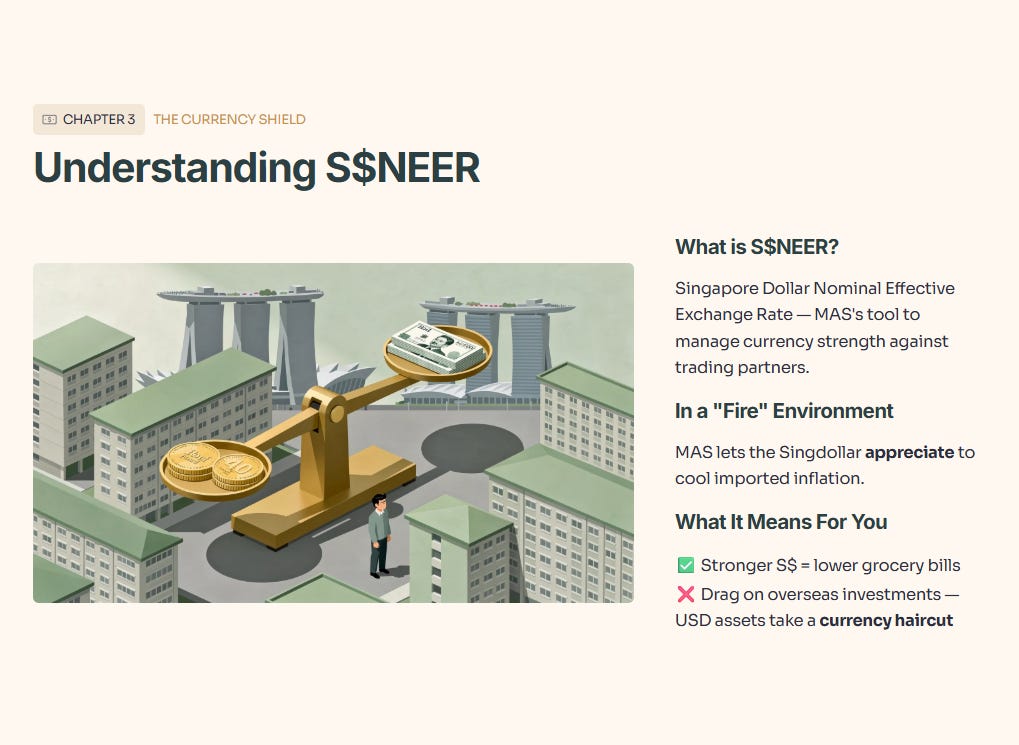
Let’s pause on a term: S$NEER. This is the Singapore Dollar Nominal Effective Exchange Rate, the tool MAS uses to manage our currency’s strength against a basket of trading partners’ currencies. In a “Fire” environment of high imported inflation, MAS typically lets the Singdollar appreciate to cool price pressures.
What This Means For You
A stronger Singdollar is good news for your grocery bills but acts as a drag on your overseas investments. If you hold USD-denominated assets (like US tech stocks), your returns just took a currency haircut—and in a volatile environment, that haircut can be severe.
🦎 Iggy's Take: "MAS isn't going to let the Singdollar collapse just to help your Apple shares. Their mandate is domestic inflation, not your US portfolio performance. If you're holding significant USD assets right now, you're effectively short the Singdollar. For a retiree in a 4-room HDB, currency risk is invisible but it steals just as much as a market crash. Consider whether SGD-hedged ETF alternatives make sense for your next allocation."
The Data Proof: Forensic Evidence
We audit the balance sheet of the macro environment. The number that matters most right now is the Gold price at $5,274—up nearly 1% on the day and trading at its highest level in a month . This is the "Fear Gauge," and it is flashing amber, not red, but the trend is unmistakable: institutions are rotating into safety.
Macro Evidence Dashboard (March 1, 2026)
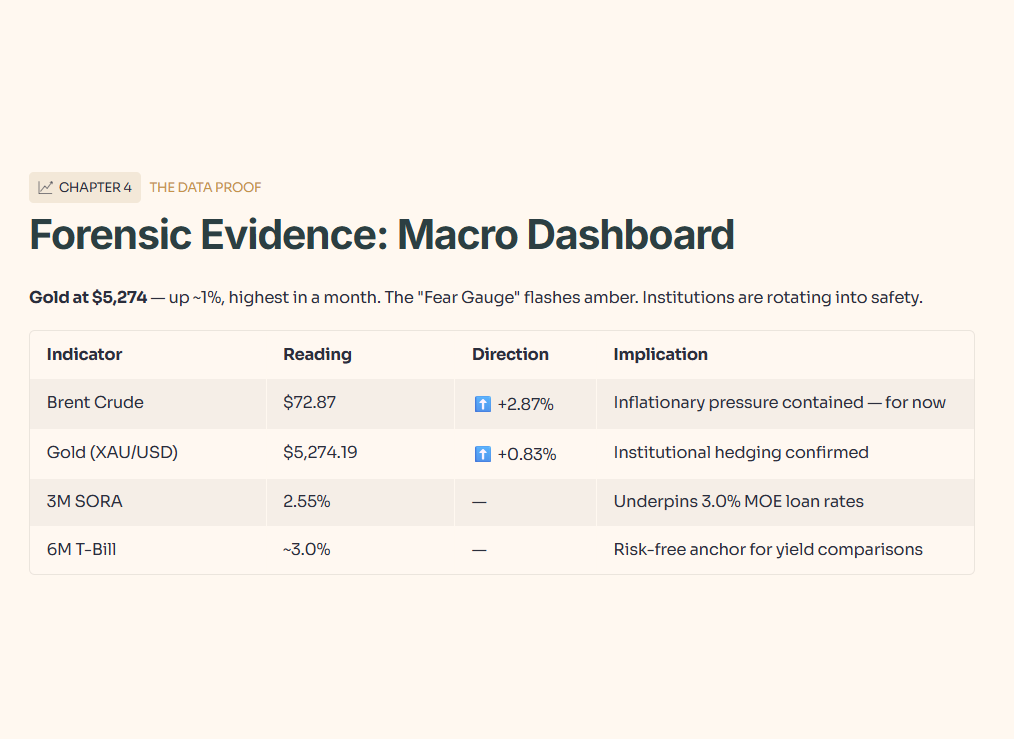
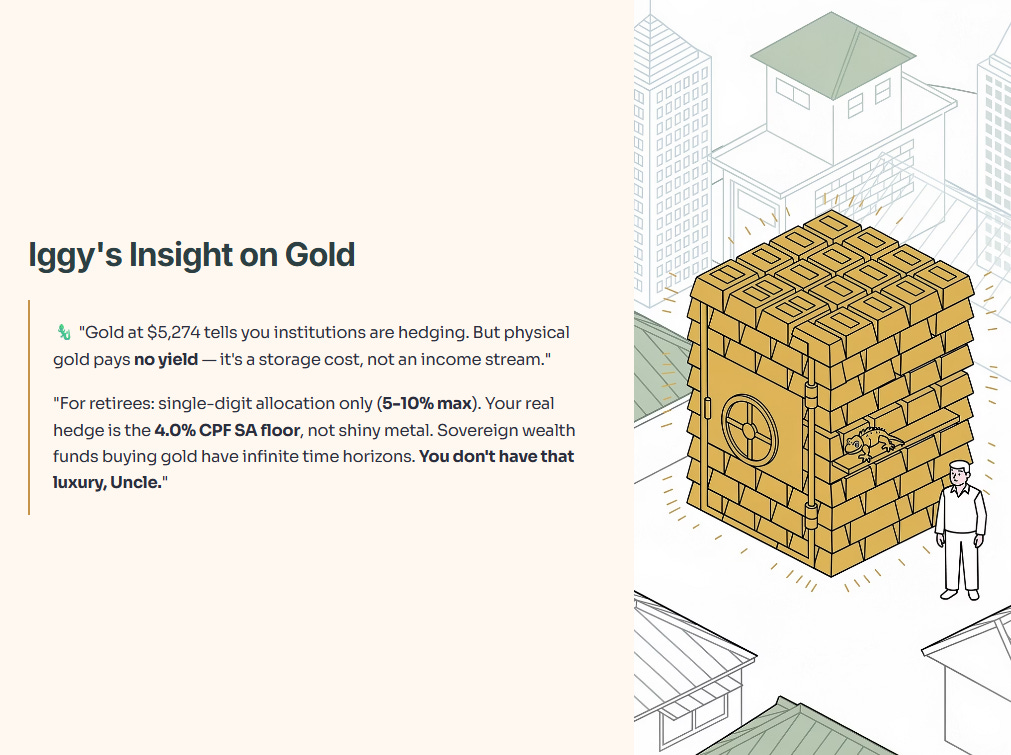
🦎 Iggy’s Insight: “Gold at $5,274 is telling you institutions are hedging. But physical gold pays no yield—it’s a storage cost, not an income stream. For retirees in the Bedok/Marine Parade pairing, this belongs in single-digit percentages only (5-10% max). Your real hedge is the 4.0% CPF SA floor, not shiny metal. The institutions buying gold aren’t retirement investors; they’re sovereign wealth funds with infinite time horizons. You don’t have that luxury, Uncle.”
The Strategic Landscape: Scenario Matrix
The Middle East conflict is a spectrum of forensic possibilities. For a retiree in Jurong or Bukit Batok managing SRS funds, the mathematical justification for every asset must be the Yield Spread—the compensation you receive for taking risk instead of parking money in CPF SA at 4.0%.
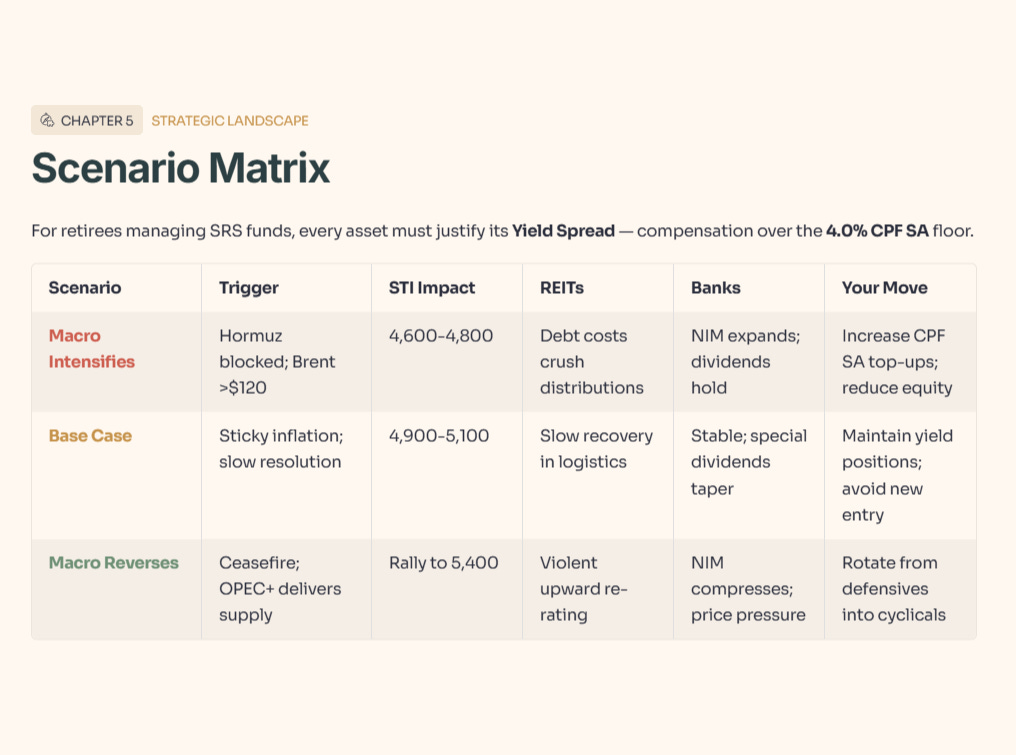
🦎 Iggy’s Take: “The forensic investor plans for Scenario A even when Scenario B feels inevitable. Why? Because survival in Singapore depends on surviving the unexpected shock that wipes out the unprepared. A financial tool is never inherently good or bad; its value depends entirely on the task you are trying to accomplish. In the world of Singapore retirement, your only task is replacing your salary with reliable, unshakeable cash flow. Build a structure that doesn’t collapse just because the wind changed direction.”
The Singapore Investor Playbook
The Yield Spread Formula
Let’s apply the forensic standard:
Risk Premium=Asset Yield(%)−Risk-Free Rate(%)Risk Premium=Asset Yield(%)−Risk-Free Rate(%)
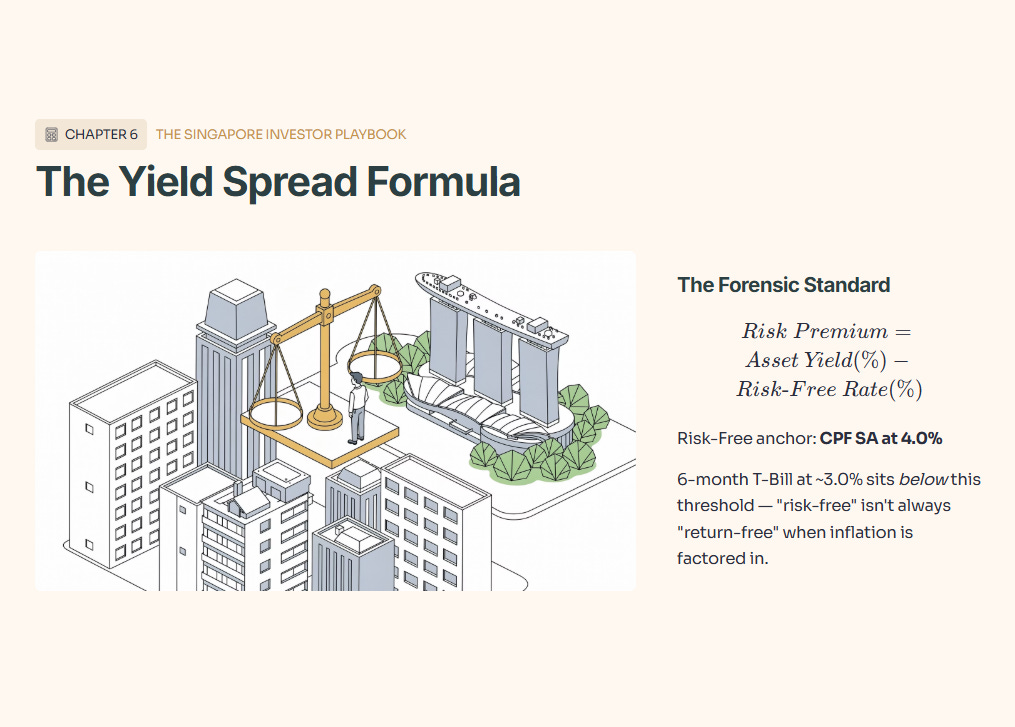
For my own model portfolio, the Risk-Free anchor is the CPF Special Account at 4.0%. The 6-month T-Bill, at approximately 3.0%, sits below this threshold—a reminder that "risk-free" isn't always "return-free" when inflation is factored in
Case Study: DBS (SGX: D05)
With a projected 2026 dividend of S$3.30 per share (including capital return dividends) and a share price around S$56, the forward yield is approximately 5.9% . Against the 4.0% CPF SA floor, the Calculated Spread is 190 basis points.
🦎 Iggy’s Verdict: “At 190bps, DBS passes our 150bps minimum safety threshold. You are being paid 1.9% to take equity risk instead of parking money in your CPF Special Account. For an income-focused portfolio, this passes muster—but only just. The fortress is still standing, and the walls are thick enough.”
You’ve now got the one number that decides whether a bank is “sleep-well” income or “headline-risk” yield—next I’ll show you the exact pass/fail threshold and which of the Big 3 clears it (and why one of them looks safe but mathematically isn’t).
