
Editor’s Note: This post has been updated on October 19, 2025, to ensure it is fresh and accurate, and now includes our sharpened analysis on the Johor-Singapore SEZ, its direct impact on Data Centre REITs, and a clearer portfolio-wide strategy.
Many of us feel the same tug-of-war: we crave returns but dread bubbles. You see big headlines about record spending and wonder if this fuels growth—or debt. You worry about regional headwinds and policy shifts that could rattle markets. The good news? Malaysia’s RM470 billion Budget 2026 is designed for disciplined expansion. In this deep dive, I’ll unpack the forces at play, show you where opportunities lie, and map out concrete steps to position your portfolio.
Why This Budget Matters to Singaporean Investors
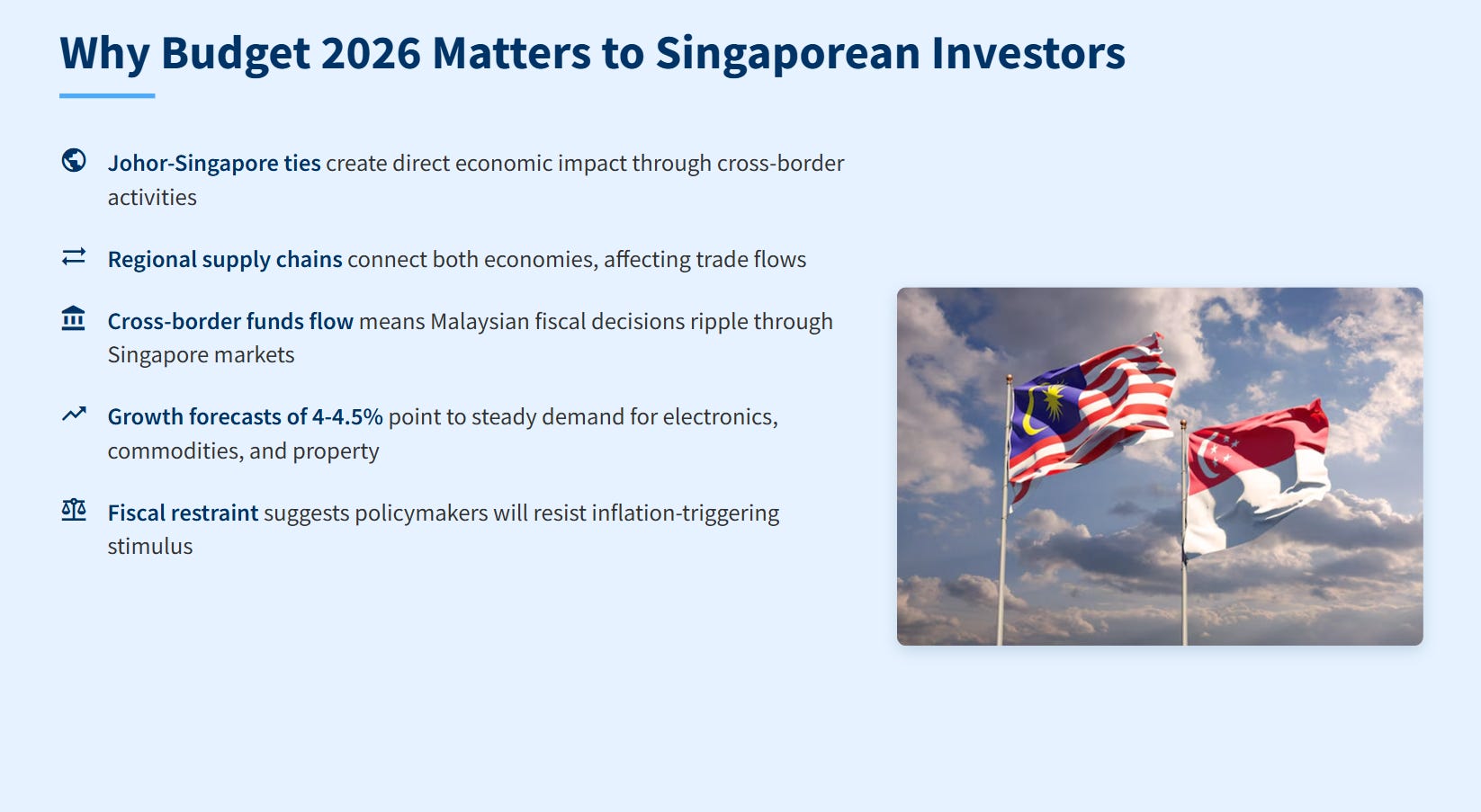
This isn’t just a Malaysian domestic story. Every ringgit decision ripples directly into Singaporean portfolios. Malaysia’s 4-4.5% growth forecast is a direct demand signal for Singapore’s banks (like DBS and UOB) financing cross-border deals and our industrial S-REITs with tenants in the Johor-Singapore SEZ. At the same time, the commitment to fiscal restraint helps tame regional inflation and stabilize the MYR—a key concern for any Singaporean holding Malaysian assets or dividend stocks. This budget dictates the stability of your cross-border investments.
Key Allocation Breakdown
Operating costs dominate, but growth projects still get muscle. The government is spreading spending across routine functions, targeted development, and strategic partnerships with private investors.
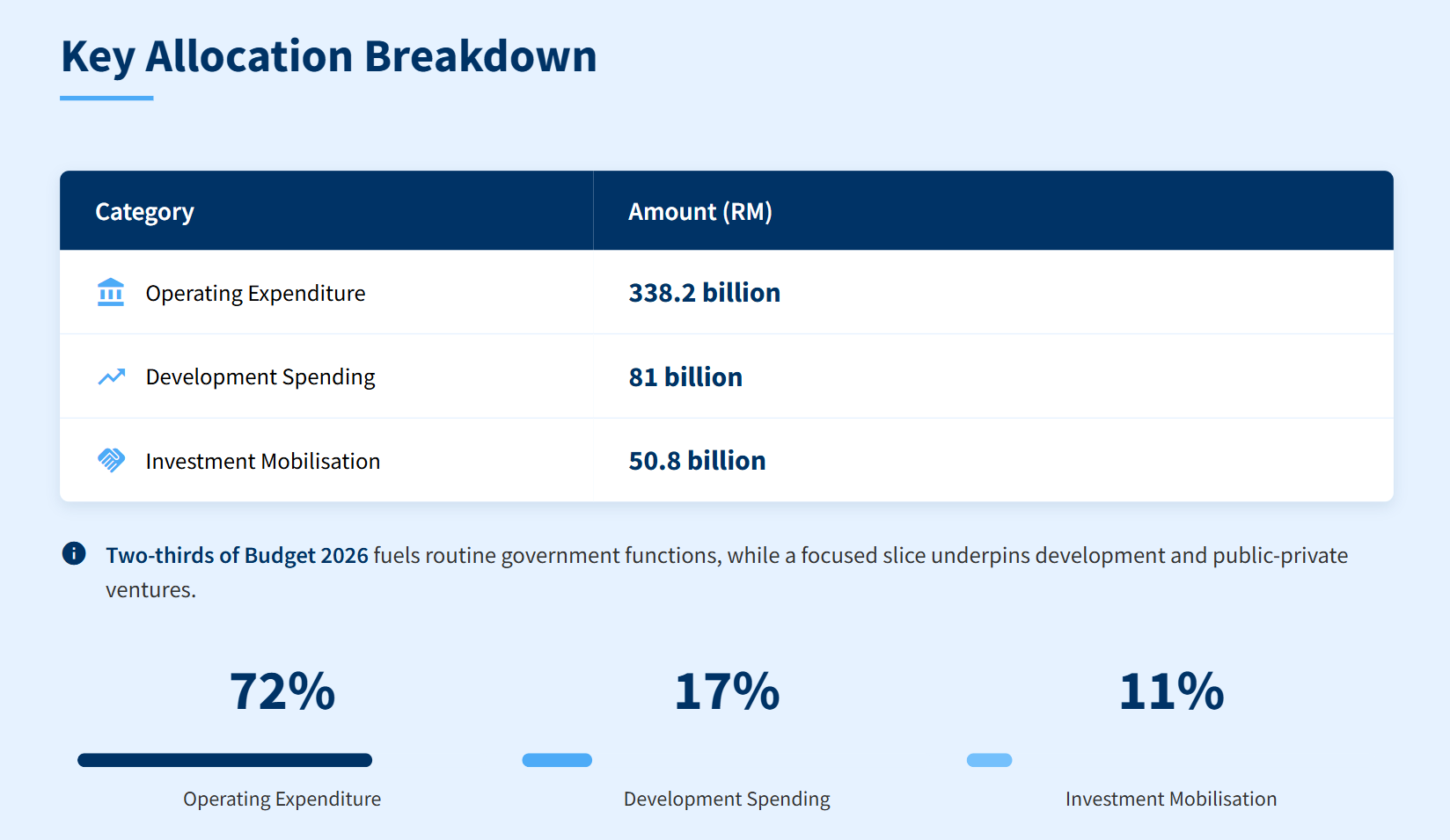
This table highlights how two-thirds of Budget 2026 fuels routine government functions, while a focused slice underpins development and public-private ventures.
Growth Drivers and Critical Risks
The Tech & Tariff Tightrope
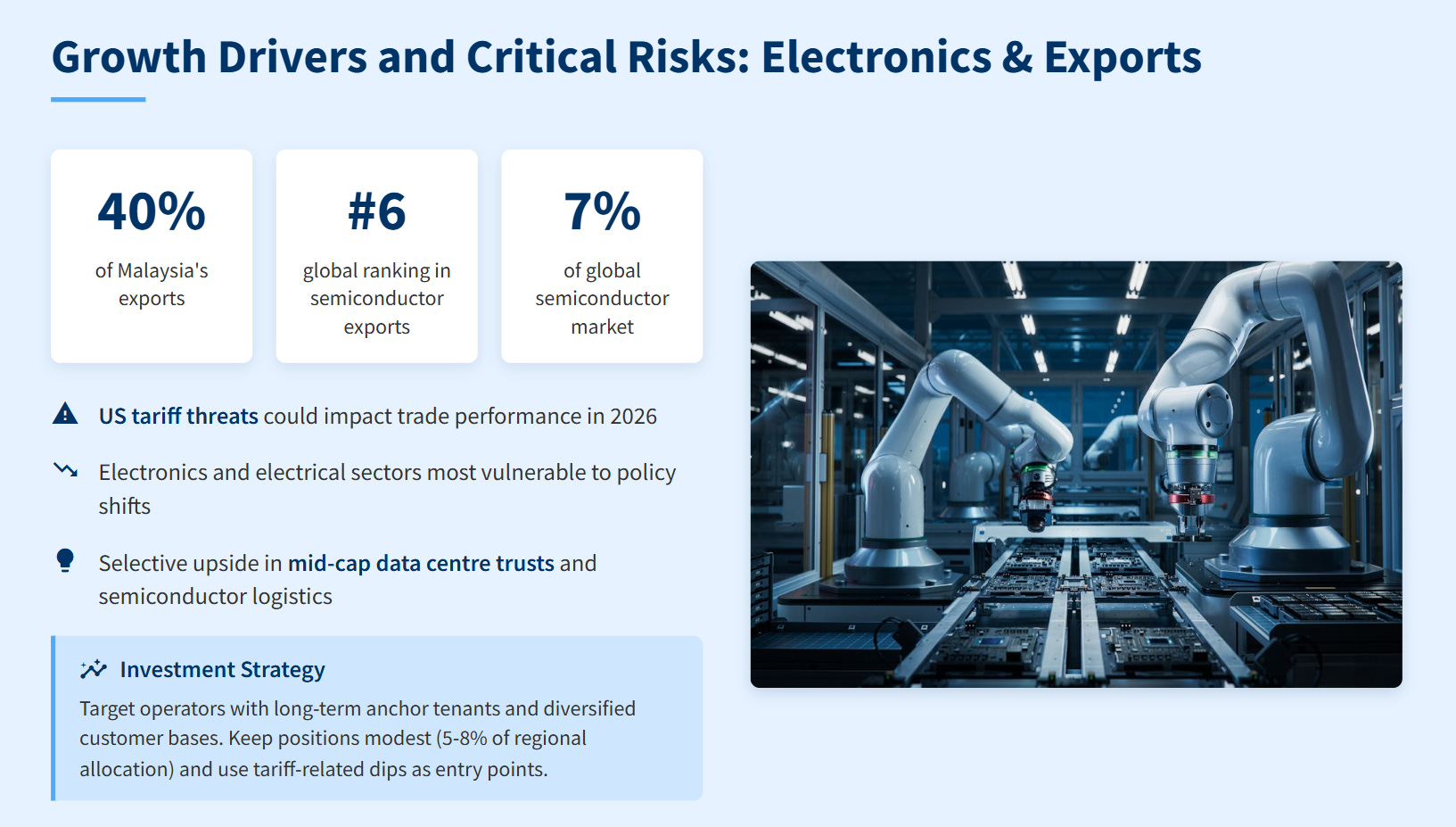
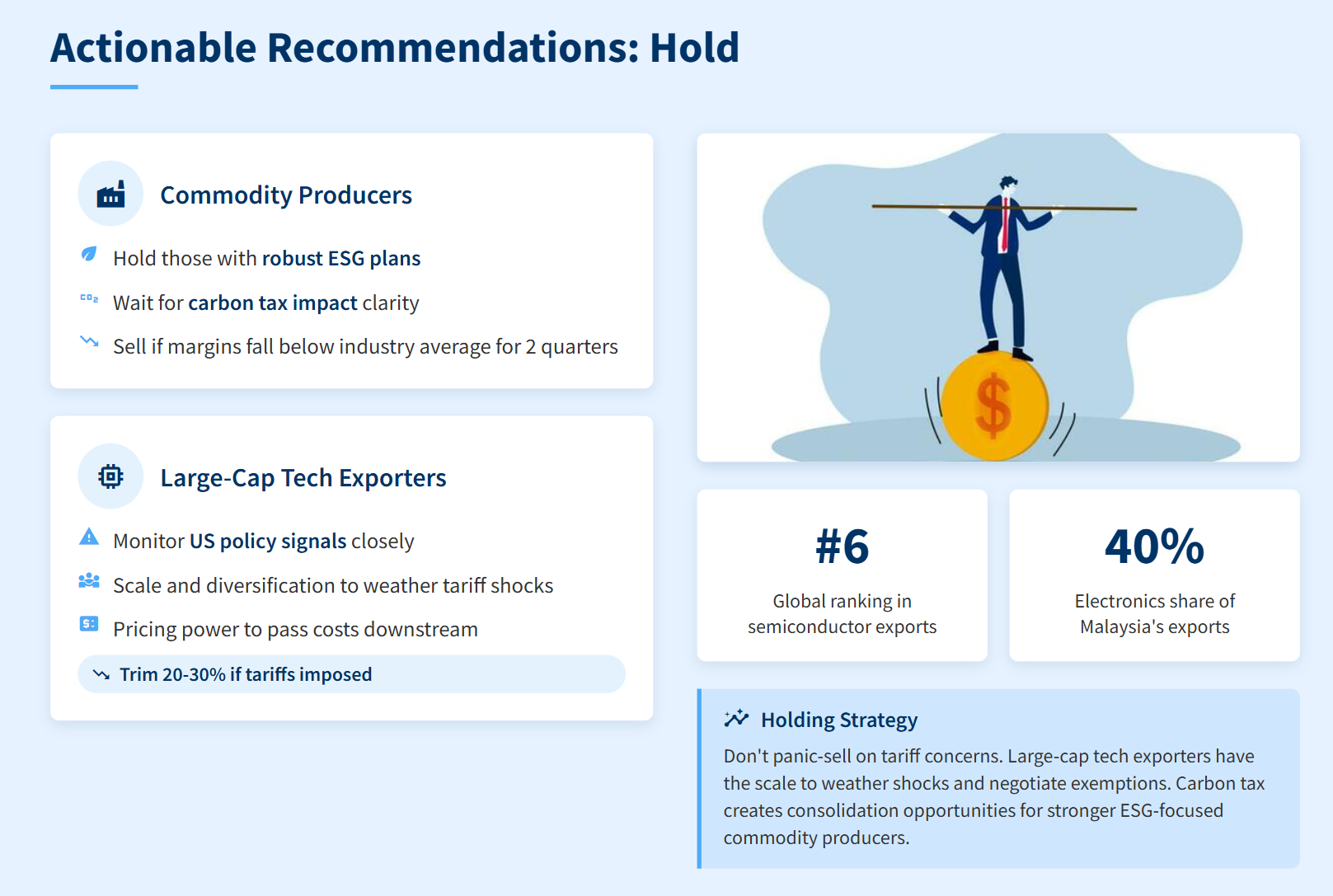
With electronics making up roughly 40 percent of exports and Malaysia ranking as the world’s sixth-largest semiconductor exporter, this sector is a core engine for growth. However, US tariff threats hang overhead. The government itself warns that a full-year impact could weigh on 2026 trade performance.
This poses a critical question for investors: should you overweight Malaysian tech? My analysis shows the upside is selective. The real opportunity lies not in the obvious large-cap exporters, but in mid-cap data centre trusts and semiconductor logistics names. The key is to find operators with long-term anchor tenants and diversified customer bases, which insulates them from supply-chain shocks.
Given the risk of tariff exemptions being lifted, I would keep positions modest—perhaps 5 to 8 percent of your regional allocation. The risk-reward is attractive, but it demands discipline. Use any tariff-related dips as entry points rather than going all-in today.
The Smart Money: Following Private Capital into PPPs
While the headline development outlay dipped slightly to RM81 billion, the real story is how the government is funding major projects. The Public-Private Partnership (PPP) Master Plan 2030 is mobilizing over RM50 billion from government-linked companies, private partnerships, and statutory bodies.
This creates a clear roadmap for investors: follow the private capital.
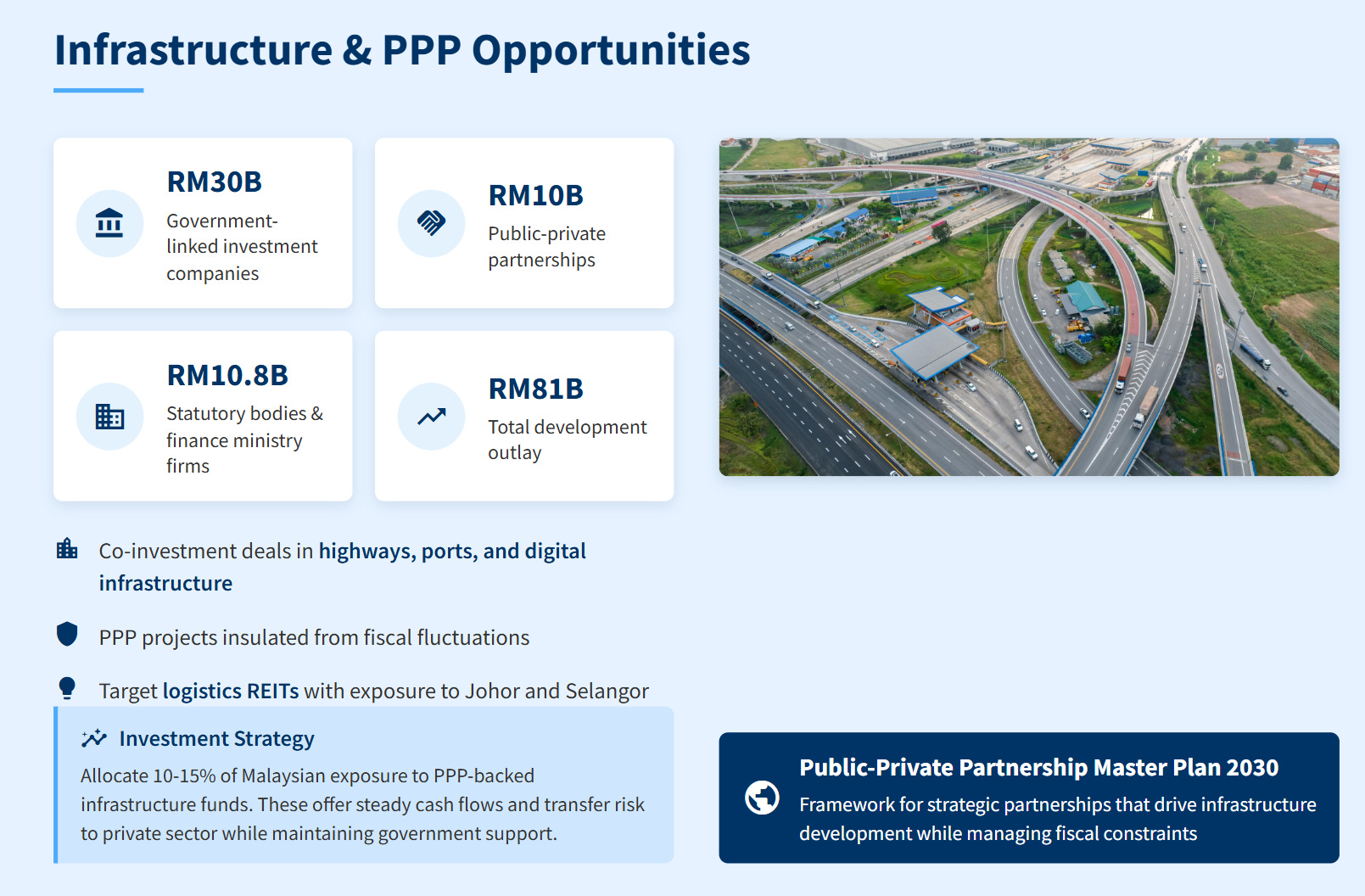
These PPP structures mean co-investment deals in highways, ports, and digital infrastructure are insulated from future fiscal “wiggles.” This makes REITs and infrastructure bonds with explicit PPP backing the most attractive play. These vehicles offer steady, predictable cash flows anchored by long-term contracts and private capital, not by year-to-year budget politics.
I particularly like logistics REITs with exposure to Johor and Selangor, where this infrastructure spending is concentrated. The beauty of a well-structured PPP is that it transfers project risk to the private sector while locking in government support—a rare win-win for an investor’s portfolio. If you can access infrastructure funds that tap into these deals, allocating 10 to 15 percent of your Malaysian exposure here is a smart, defensive move.
The Sweet Spot: Discipline, Handouts, and the Bond Market
At first glance, the budget seems contradictory. The government is issuing RM100 one-off handouts to 22 million Malaysians under the Sara Scheme while simultaneously tightening its belt to shrink the fiscal deficit from 3.8% to 3.5% of GDP.
This is a classic “threading the needle” strategy. The social spending buys political capital and tempers cost-of-living pains, while the strict deficit target signals fiscal credibility to the market.
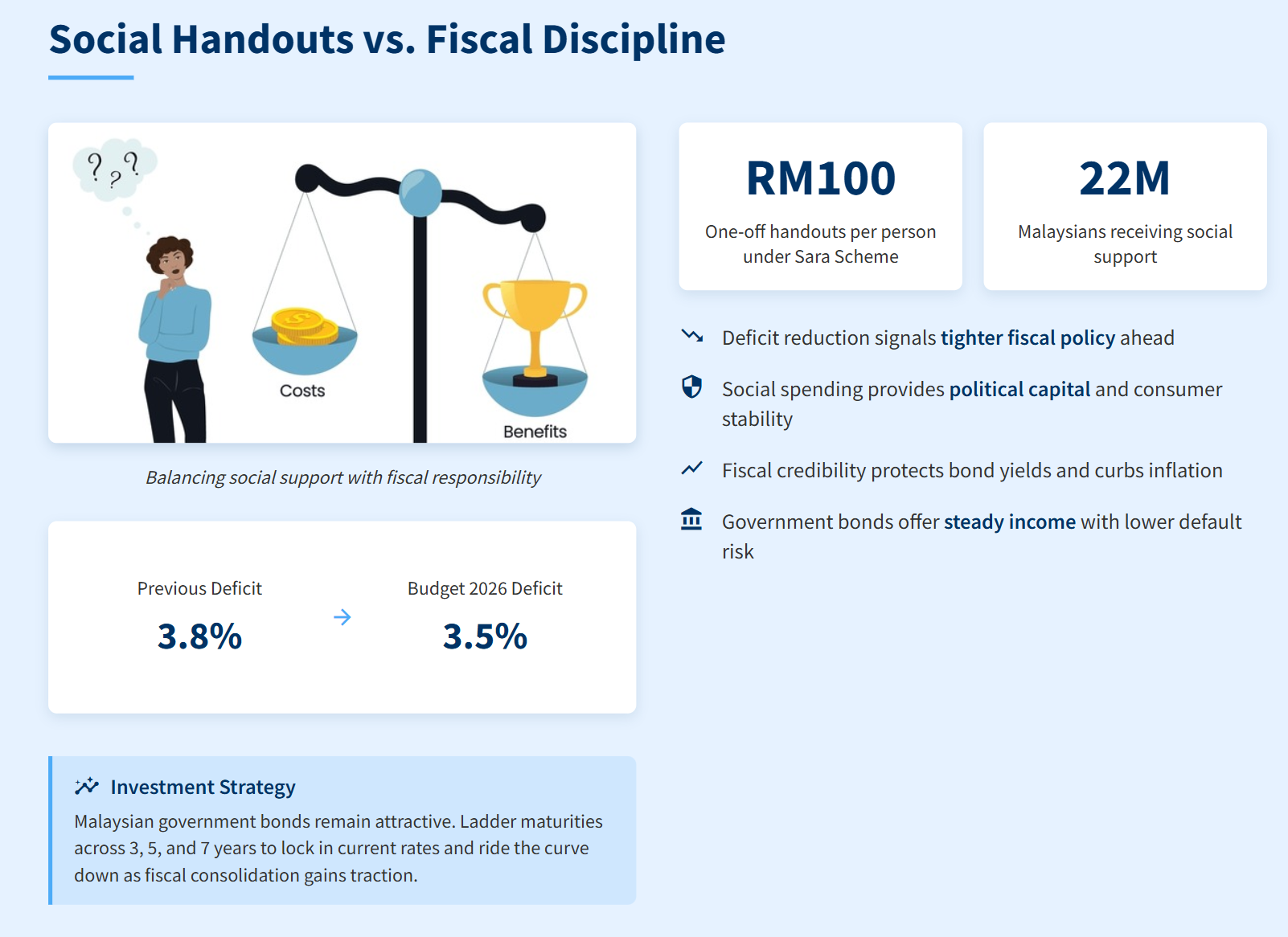
For investors, this combination is powerfully bullish for fixed income. It shows policymakers are serious about curbing long-term inflation (which protects bond yields) without triggering a recession. This is why Malaysian government bonds remain a clear buy. As this fiscal consolidation gains traction, the yield curve should stay attractive.
The smart move here is to ladder maturities across 3, 5, and 7 years. This allows you to lock in current rates and “ride the curve” down. This isn’t a quick flip; it’s a core play for patient, income-focused money.
The Two-Speed Play: Borneo’s Build-Out and the Johor Tech Magnet
The budget creates two distinct regional growth stories that investors can tap.
First, the massive infrastructure build-out in Borneo. Allocations for Sabah and Sarawak are jumping to RM6.9 billion and RM6.0 billion respectively—a huge increase from 2022 levels. This fresh federal outlay is real, sustained, and points to a long-cycle opportunity for early movers in utilities, logistics, ports, and power distribution in those states. This is a play for patient capital in infrastructure funds exposed to the region.
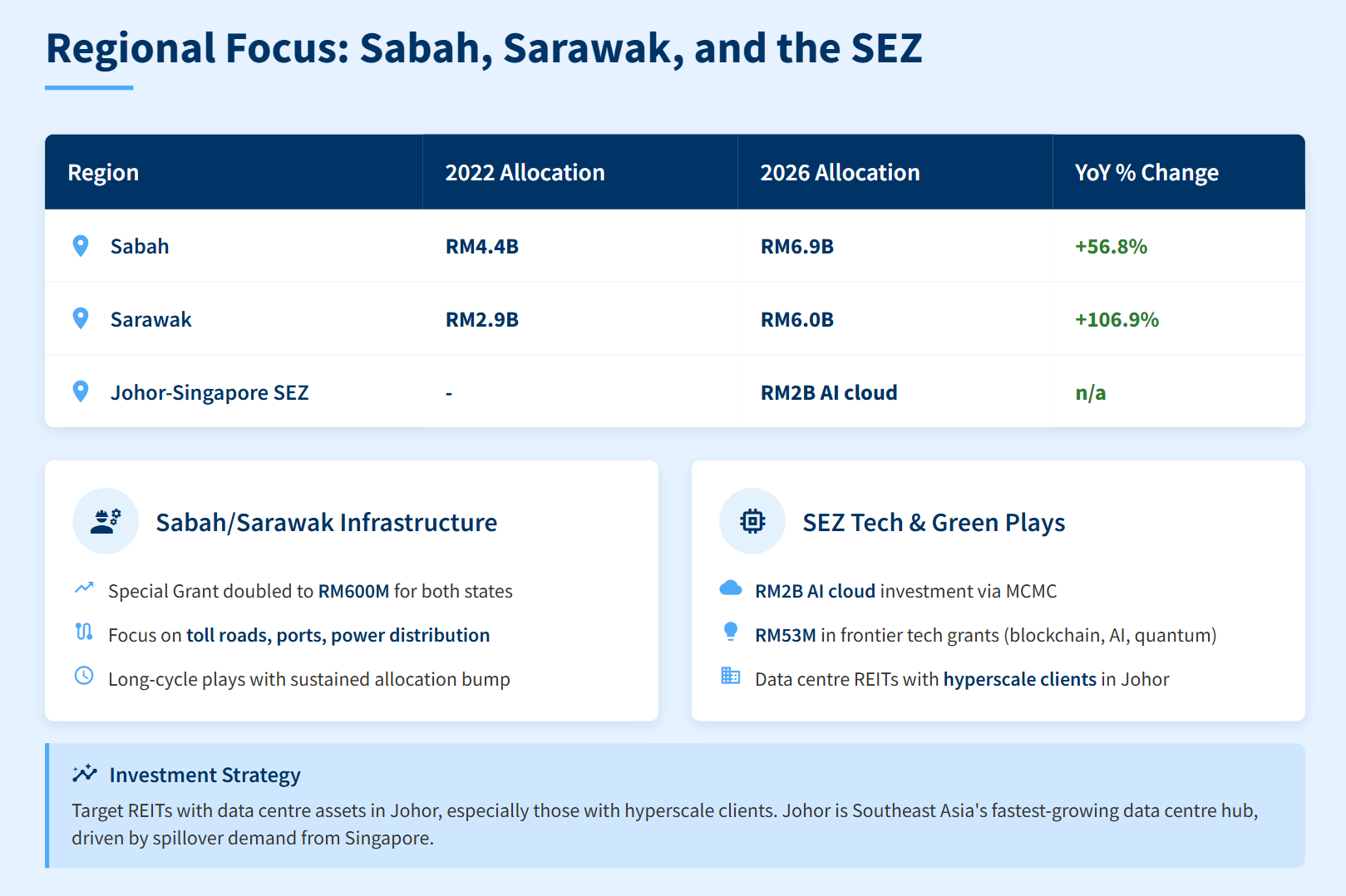
Second, and more critical for Singaporean investors, is the Johor-Singapore Special Economic Zone (SEZ). The government is priming the pump with targeted grants, including RM2 billion for a sovereign AI cloud and RM53 million for frontier tech. These grants spotlight high-value niches, but the core strategy here is REITs with data centre assets in Johor.
Driven by massive spillover demand from Singapore, Johor is now Southeast Asia’s fastest-growing data centre hub. The SEZ framework provides the tax breaks and regulatory streamlining to act as a magnet for tech investment. The smart play is to favor operators with hyperscale clients (e.g., major cloud providers) on long-term leases, as they offer the most predictable and robust growth.
The Carbon Tax: A Double-Edged Sword for Investors
The government is vowing “no debt splurge,” and it’s backing it up with serious new guardrails. Measures like the new Fiscal Responsibility Act and two major tax changes—an upcoming carbon tax and “sin tax” hikes—are designed to enforce discipline.
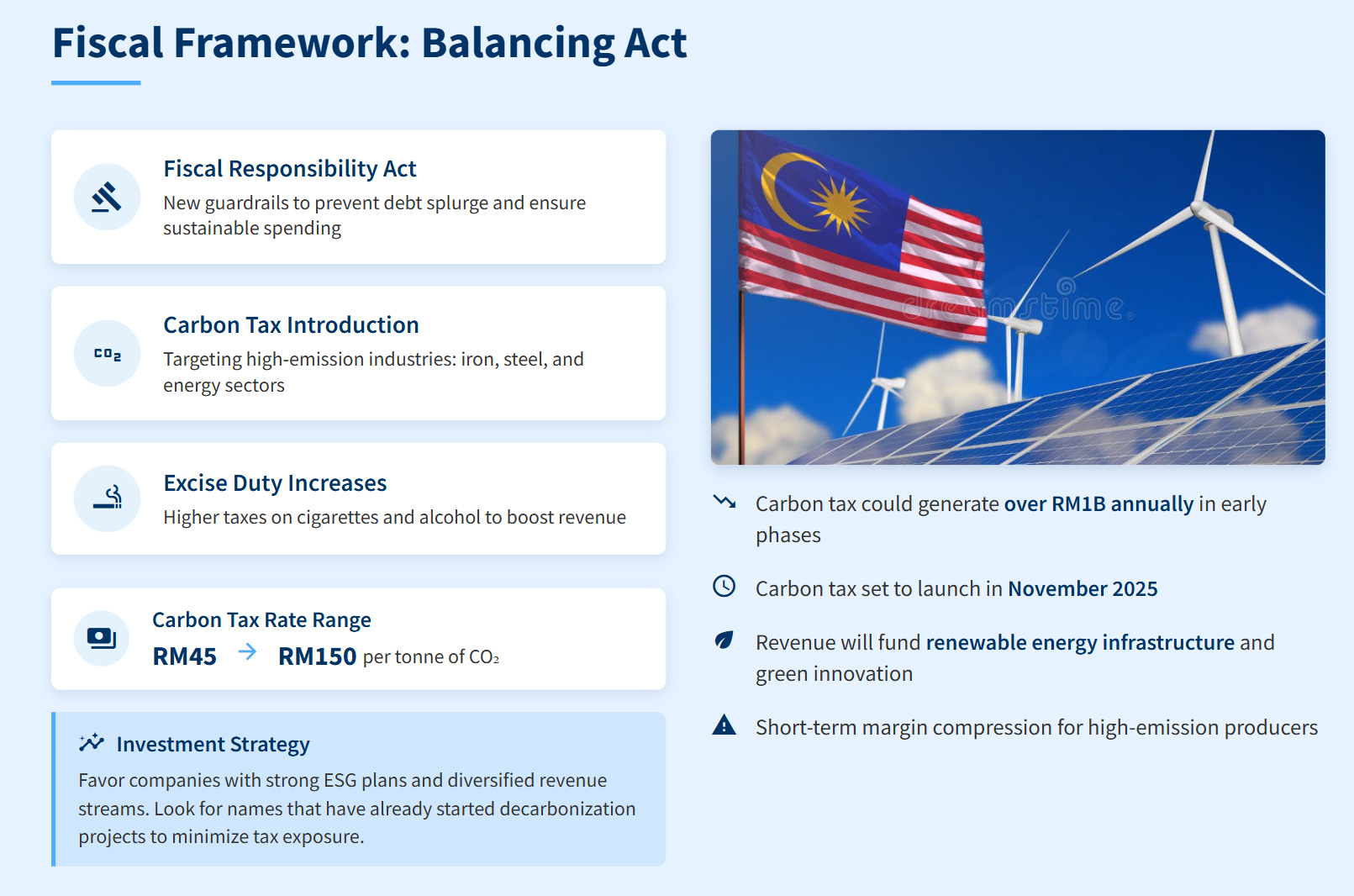
Starting in 2026, a carbon tax will target high-emission industries like iron, steel, and energy, with projected rates between RM45 and RM150 per tonne. This, combined with new excise duties on cigarettes and alcohol, creates a classic double-edged sword for investors.
On one side, these levies mean immediate margin compression for commodity sectors. I expect steel and energy producers to try and pass costs to customers, but their margins will get squeezed first. This is a clear headwind.
On the other side, this new revenue is not just disappearing. It’s being earmarked to fund the green transition—specifically renewable energy and green innovation. This creates a long-term tailwind.
The smart play here is to differentiate. Favor companies that already have strong ESG plans and have started their decarbonization projects; they will have lower tax exposure and better pricing power. This is the time to avoid pure-play steel or coal operators unless they trade at a deep discount. The short-term adjustment will be painful, but the policy clearly rewards the long-term, green-focused winners.
A Deep Dive for Malaysian Investors: Your 2026 Financial Playbook

Tax Reliefs: How to Maximize Your Take-Home Pay
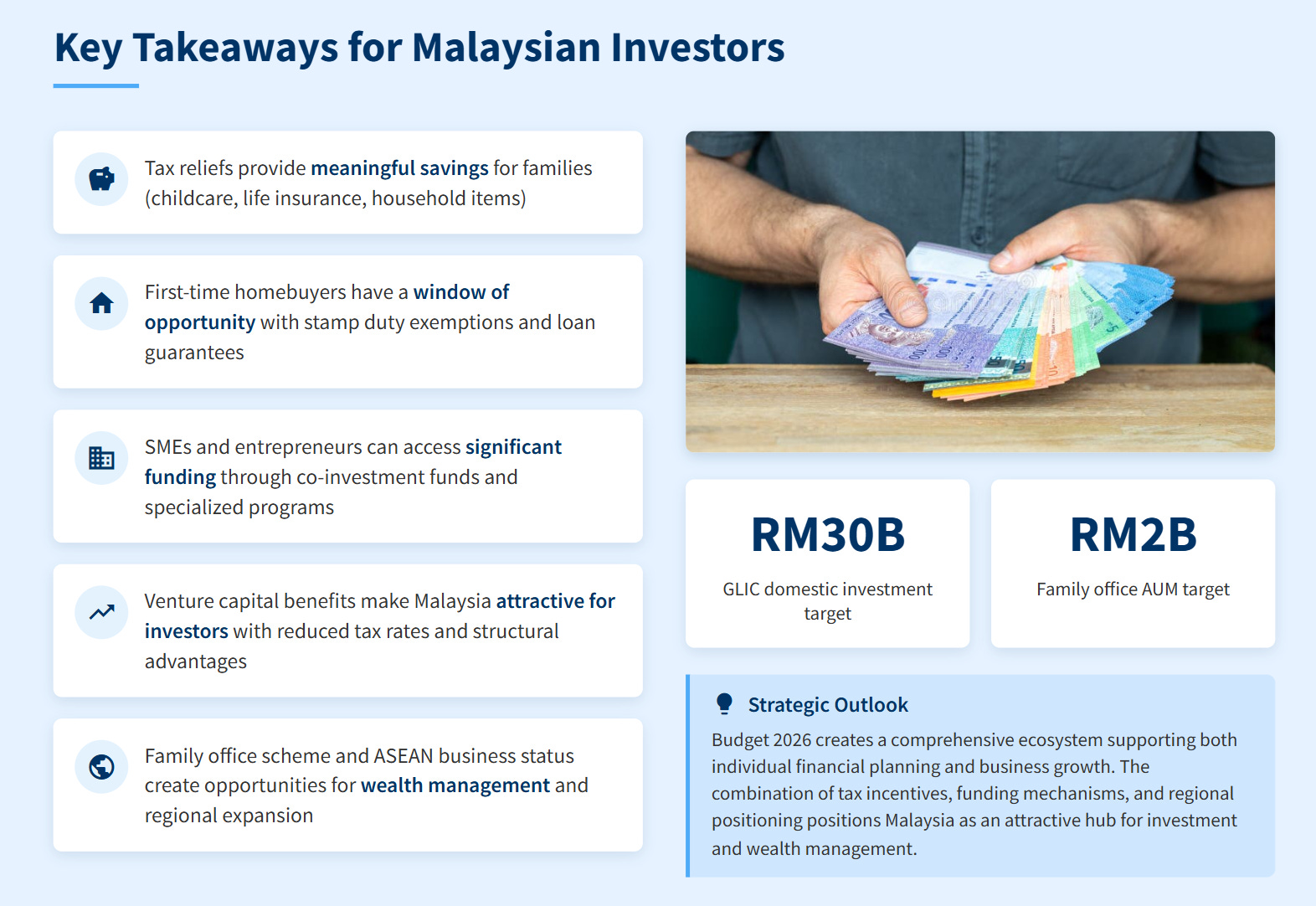
Budget 2026 delivers a range of tax reliefs that are meaningful, if incremental. They are designed to ease household burdens, and you should view them as direct opportunities to optimize your savings.
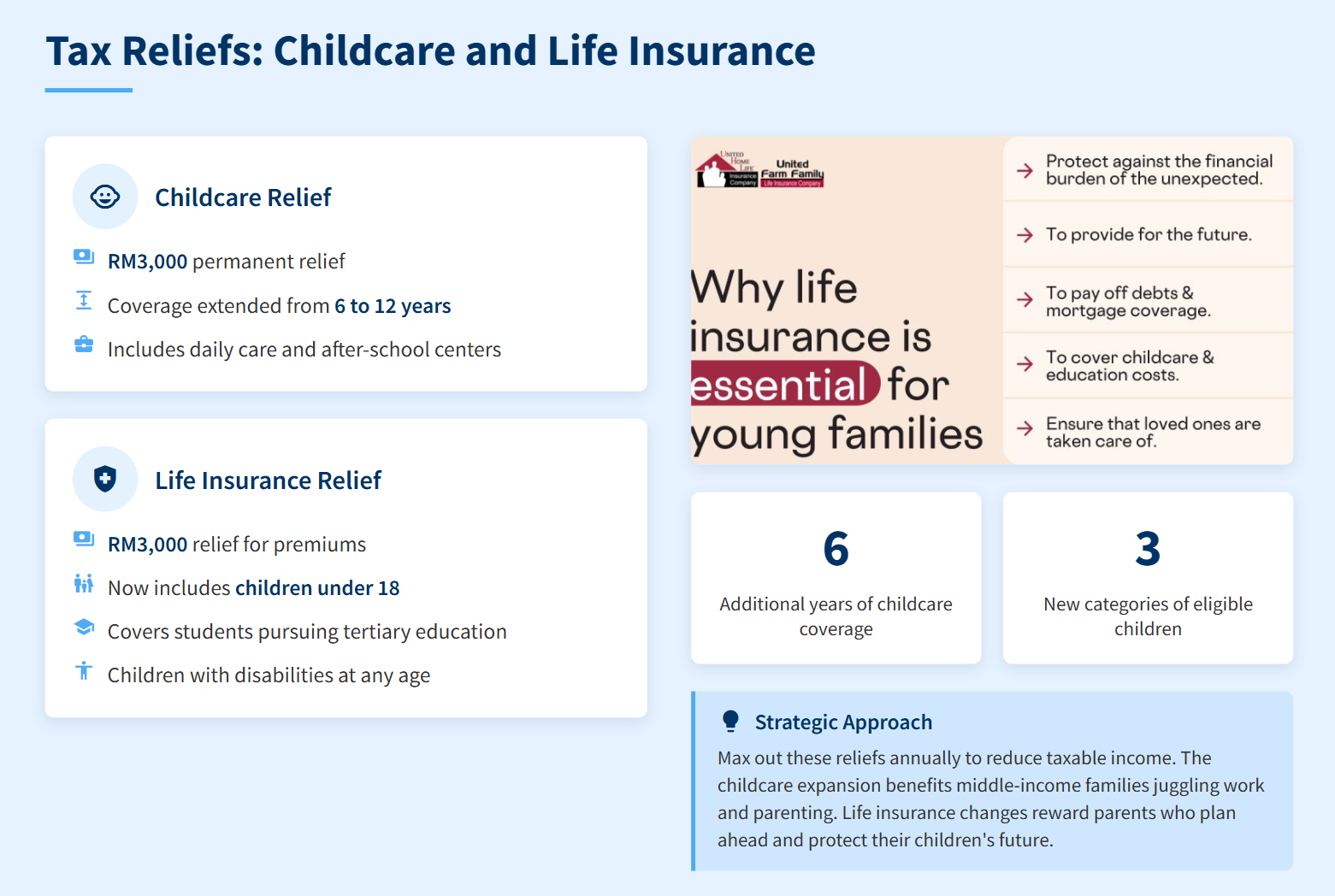
The biggest wins are for middle-income families. The permanent RM3,000 childcare relief is now expanded to cover children up to 12 years old (from six), which is a significant win for working parents. Similarly, the RM3,000 life insurance relief has been expanded to include premiums paid for your children.
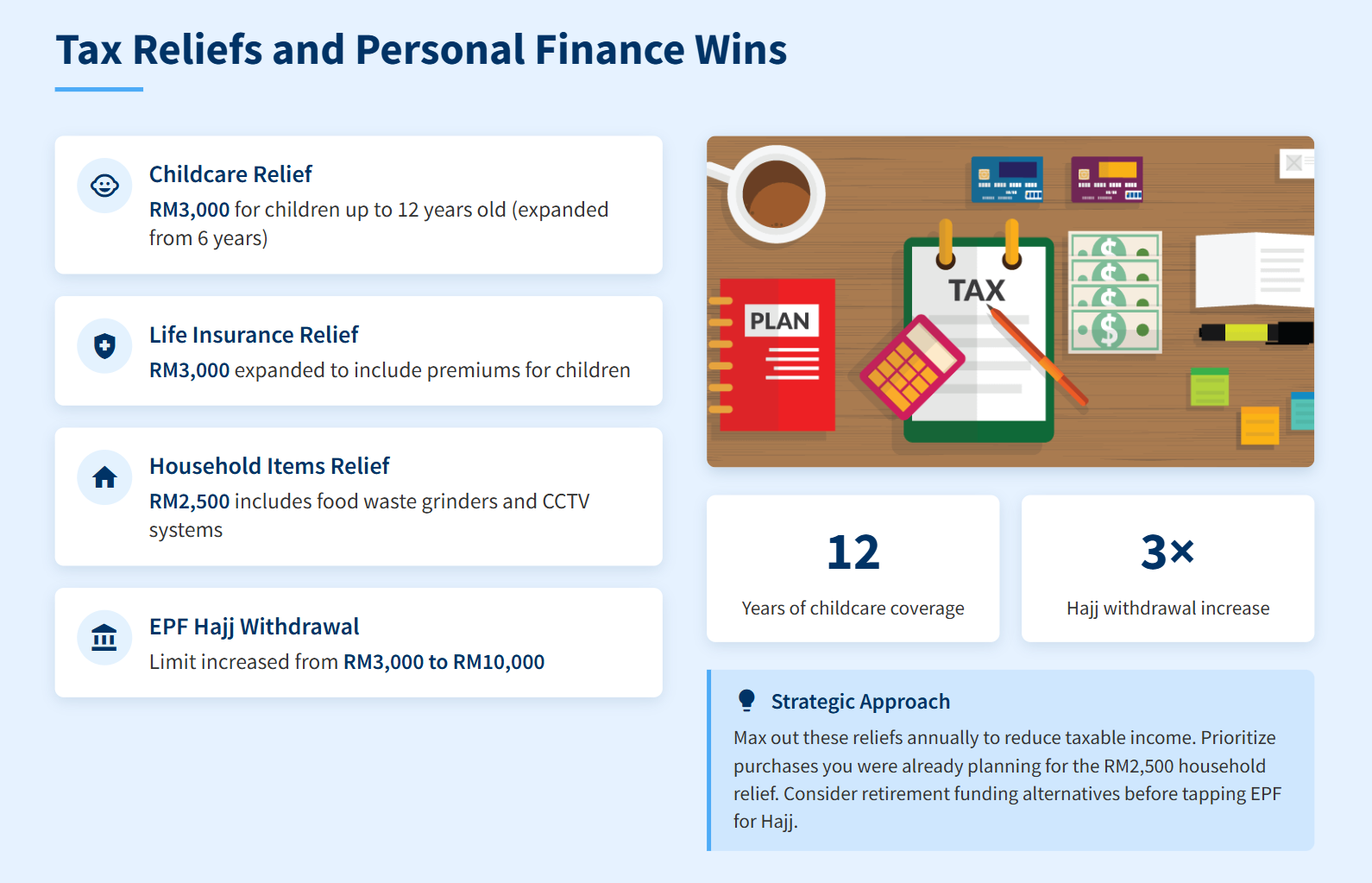
My advice is simple: max out these reliefs every year. They are a direct reduction of your taxable income, and over time, that compounds into serious, risk-free savings.
For homeowners, the RM2,500 tax relief for household items now includes food waste grinders and CCTV systems, in addition to EV chargers. This is a “nice-to-have” relief. Prioritize items like an EV charger or CCTV if you were already planning the purchase. Don’t buy an item just to claim the relief—that defeats the purpose of saving money.
Finally, the EPF withdrawal limit for the Hajj pilgrimage has tripled from RM3,000 to RM10,000. While this offers practical flexibility, it’s a move that requires extreme discipline. Remember: every ringgit withdrawn from your EPF is a ringgit taken from your retirement nest egg. You should only tap this if you have significant, alternative retirement funding already locked in.
Property: A Pro-Local Policy Creates Two Clear Plays
The budget’s property measures are clearly pro-local, creating distinct opportunities for both first-time buyers and savvy investors.
1. The Play for First-Time Buyers: Your Window is Open
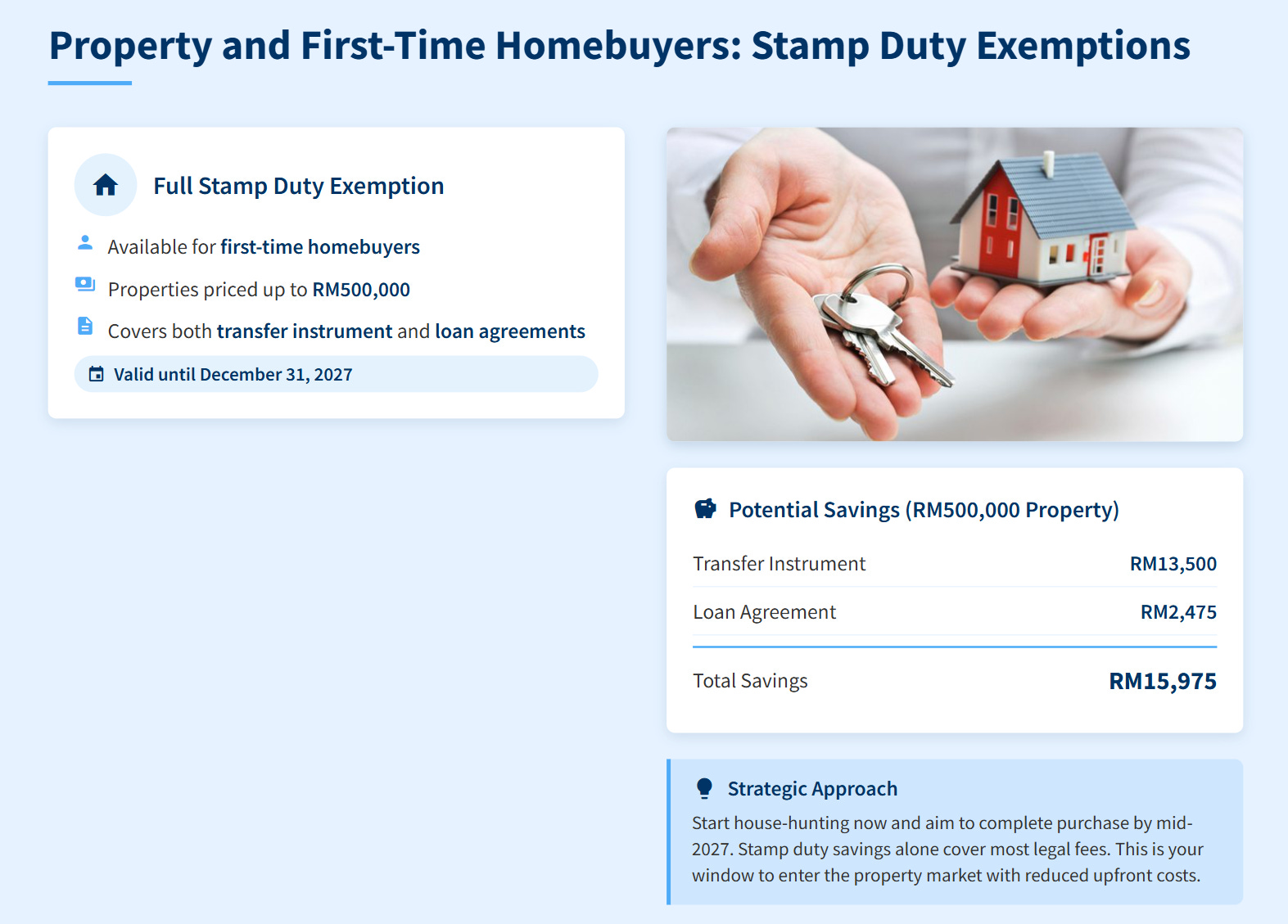
For those looking to buy their first home, this is your window. The government has extended the full stamp duty exemption for properties up to RM500,000 until the end of 2027. This is a significant direct subsidy—on a RM500,000 property, the total savings on the transfer and loan agreements are nearly RM16,000, enough to cover most of your legal fees.
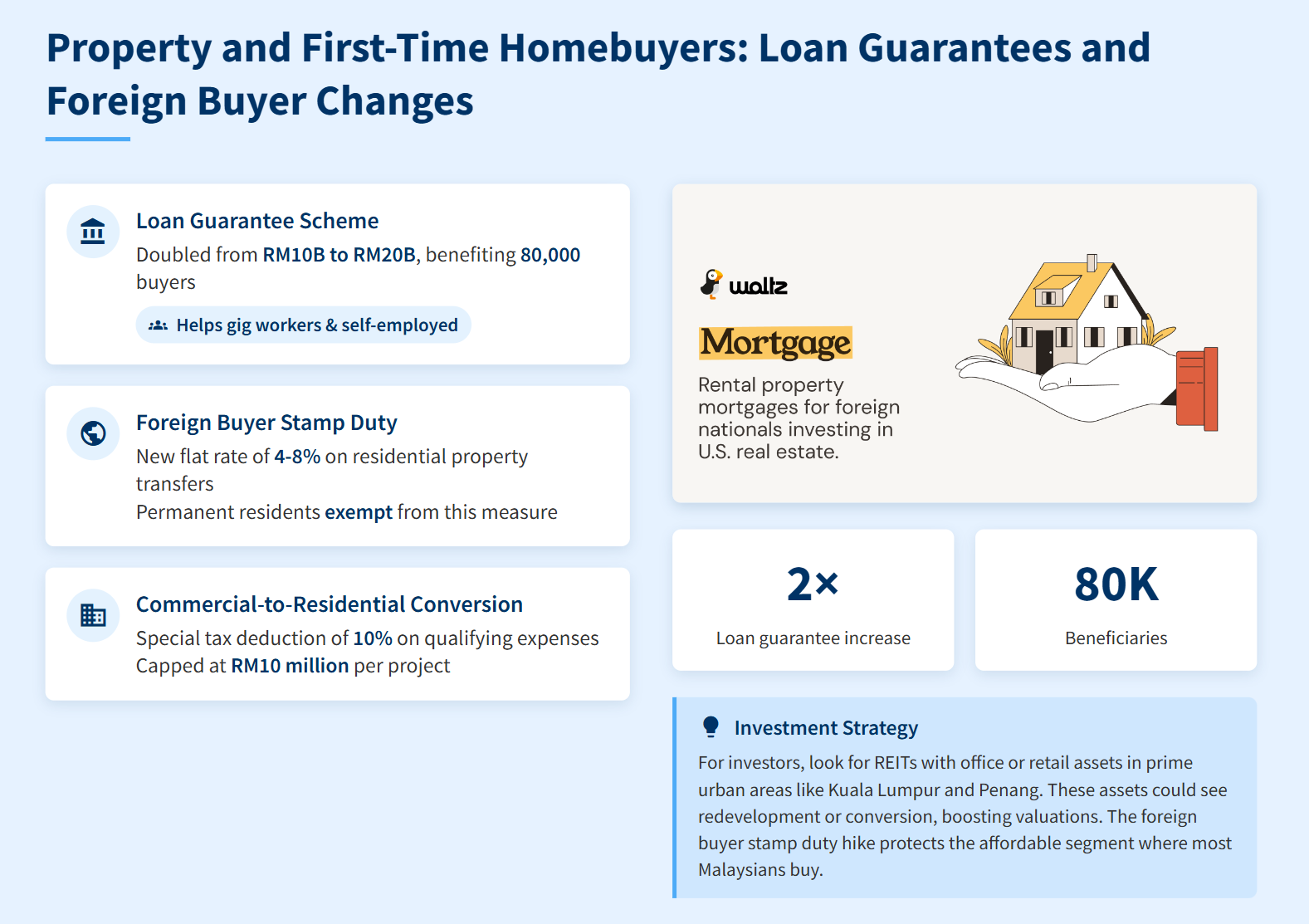
Crucially, this is paired with a doubling of the loan guarantee scheme to RM20 billion. This signals to banks that they should be more flexible, especially with gig workers and self-employed individuals who often struggle to meet traditional financing criteria.
My advice: Start house-hunting now. Aim to complete your purchase by mid-2027 to give yourself a safe buffer before the deadline.
2. The Play for Investors: Follow the Conversion Money
For property investors, the budget signals a clear, nuanced opportunity. The government is incentivizing developers to convert aging commercial buildings into residential units via a 10% tax deduction on qualifying expenses.
This is a bright neon sign pointing to where developers will focus: urban redevelopment. The smart play is to look for REITs holding older office or retail assets in prime urban areas like Kuala Lumpur and Penang. These are the exact assets poised for conversion, which could unlock significant valuation gains.
This pro-local strategy is reinforced by the new 4% to 8% flat stamp duty on foreign buyers, which aims to cool speculation at the high end. While a headwind for luxury developers, this policy protects the affordable segment where most Malaysians buy and supports the goal of stable homeownership without fueling a bubble.
A Boon for Business: Your Guide to the New SME & Startup Capital
For SME owners and entrepreneurs, Budget 2026 is your best friend. The government is injecting significant capital into the ecosystem, and you need to know how to get it.
1. For SME Owners & Mid-Sized Companies:
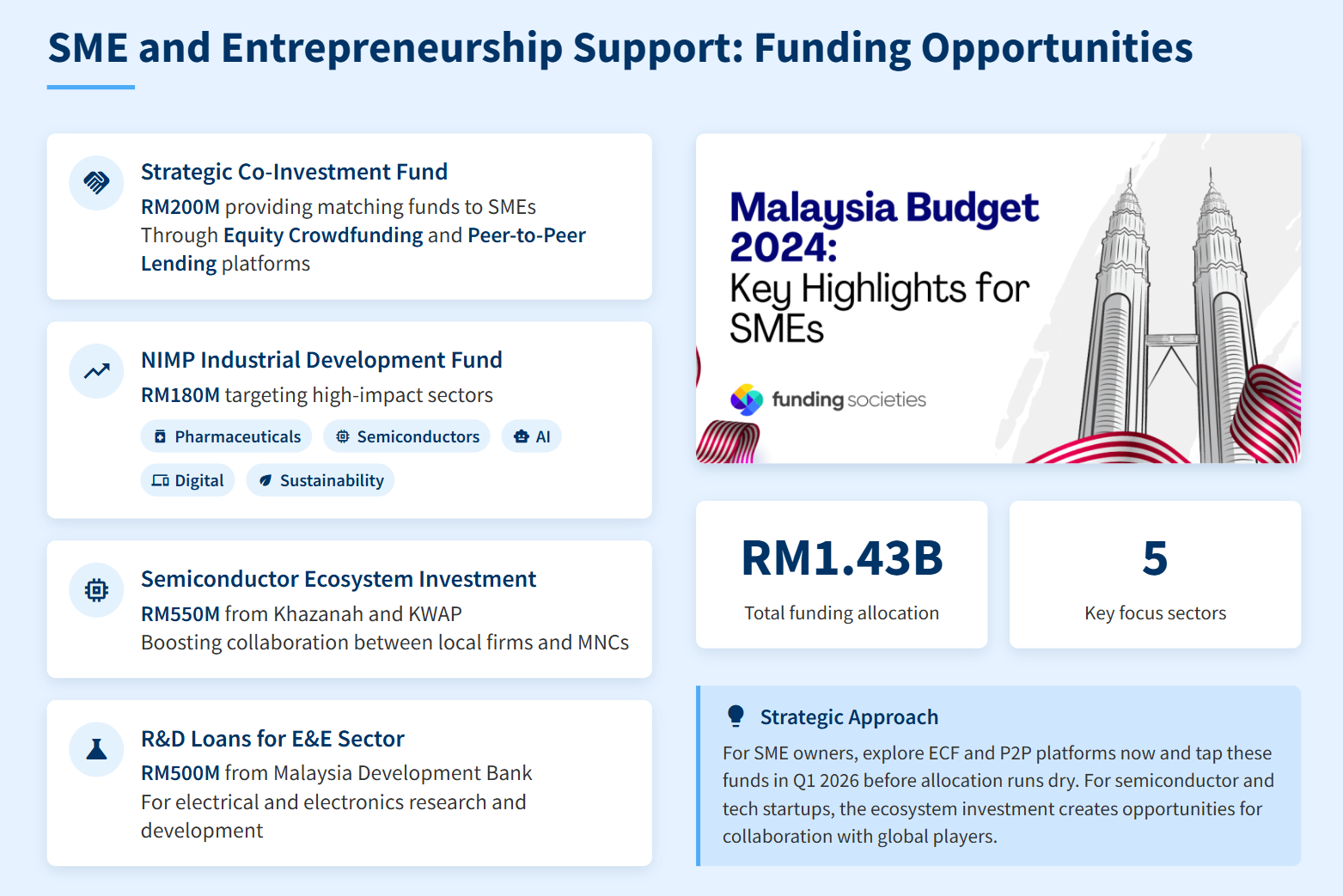
The RM200 million Strategic Co-Investment Fund is a game-changer for companies that struggle with traditional bank loans. This fund provides matching capital through Equity Crowdfunding (ECF) and P2P lending platforms.
My advice: Don’t wait. Start polishing your business pitch now and explore these ECF/P2P platforms. The goal is to be ready to tap these funds in Q1 2026 before the allocation runs dry.
2. For High-Impact & Tech Startups:
The government is making a highly targeted bet on high-value sectors. A combined RM1.43 billion is being deployed via:
RM180 million from the NIMP Industrial Development Fund (for pharma, AI, digital, etc.).
RM550 million from Khazanah and KWAP to boost the semiconductor ecosystem.
RM500 million in loans from Malaysia Development Bank for E&E research.
The launch of SemiconStart, an incubator to help chip startups tackle high prototyping costs.
My advice: If you are a semiconductor or tech startup, the SemiconStart incubator is a no-brainer. Apply early. Leverage the access to global incubators and networks it provides.
3. For Venture Capitalists (GPs and LPs):
The new tax incentives are a direct invitation for Malaysia to become a regional VC hub. A new 5% corporate tax rate for Venture Capital Companies (VCCs) and a 10% rate for VCMCs are now in effect.
This creates a massive structural advantage. A 5% VCC rate beats Singapore’s 17% corporate tax on many structures, especially when combined with the new tax exemption on dividends paid to individual shareholders. For both LPs and GPs, this is a clear signal to consider domiciling new funds in Malaysia to capitalize on a policy tailwind that will attract capital for the next five years.
Investment Opportunities for Local Capital
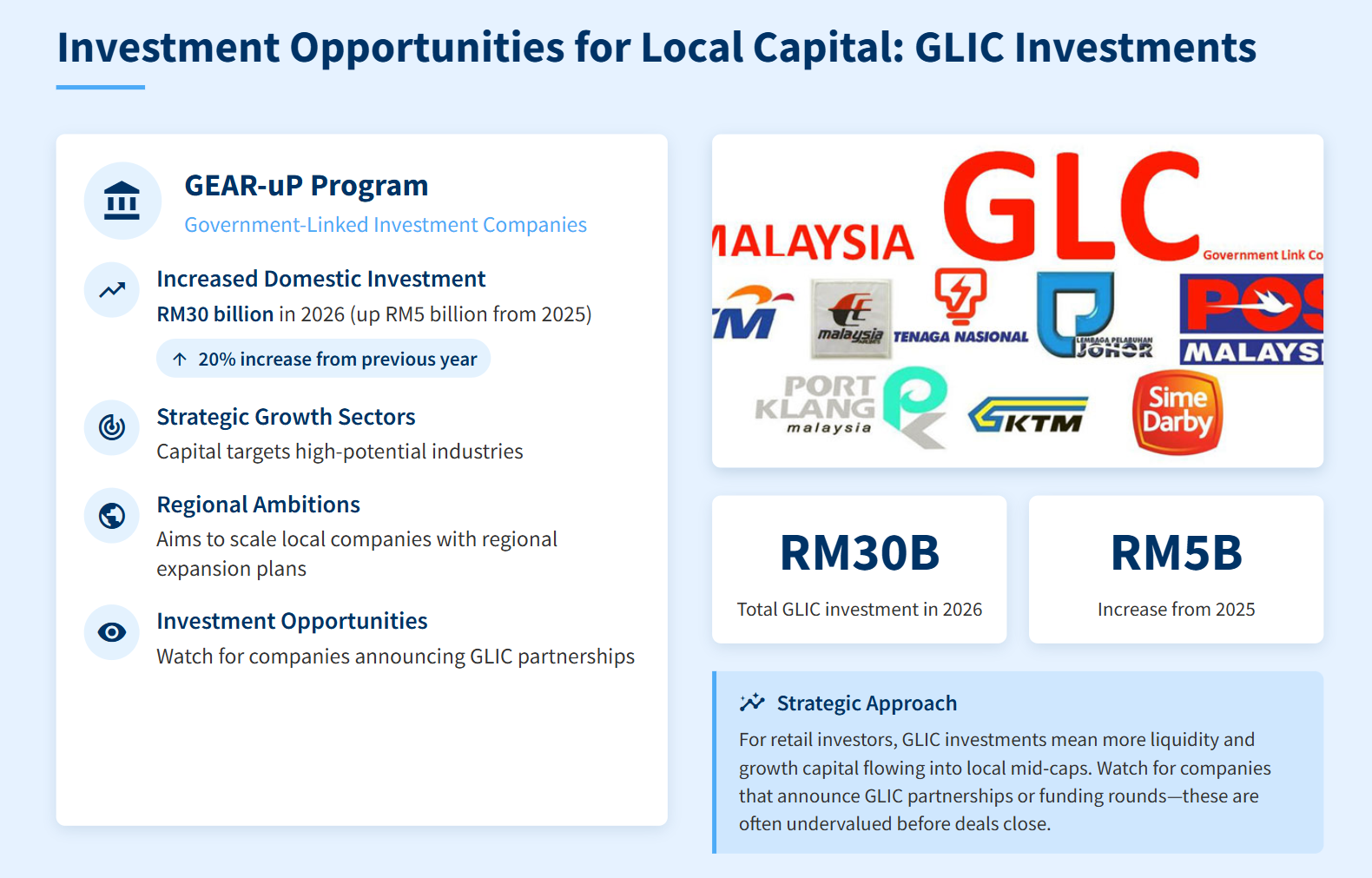
Government-Linked Investment Companies under the GEAR-uP program are increasing domestic investments to RM30 billion in 2026, up RM5 billion from 2025. This capital targets strategic growth sectors and aims to scale local companies with regional ambitions.
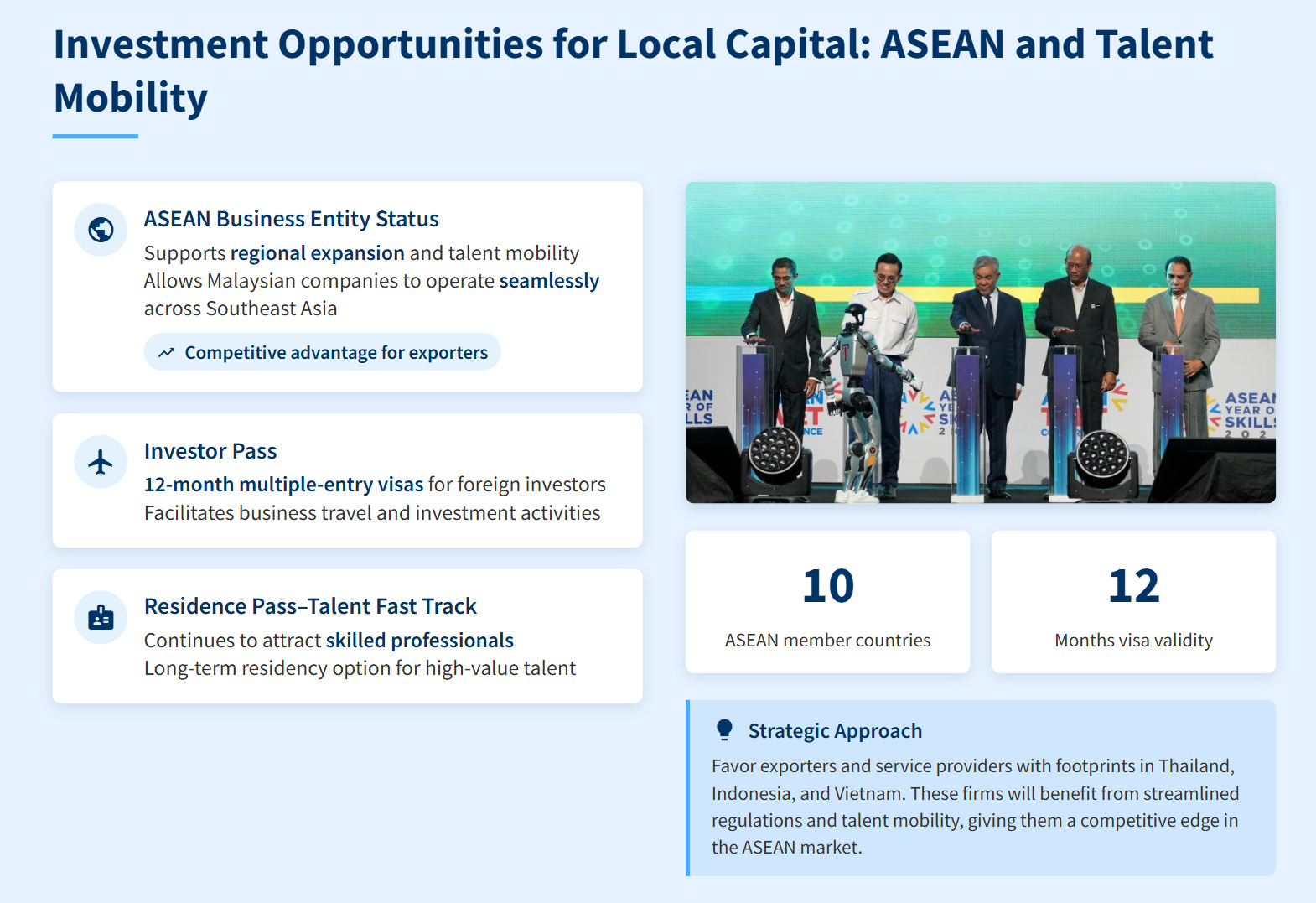
The ASEAN Business Entity status supports regional expansion and talent mobility, allowing Malaysian companies to operate seamlessly across Southeast Asia. The Investor Pass offers 12-month multiple-entry visas for foreign investors, while the Residence Pass–Talent Fast Track scheme continues to attract skilled professionals.
The Single Family Office Incentive Scheme in Forest City has attracted RM400 million in assets under management, with a target of RM2 billion by end-2026. This scheme offers tax incentives for family offices managing wealth in Malaysia, positioning the country as a wealth management hub.
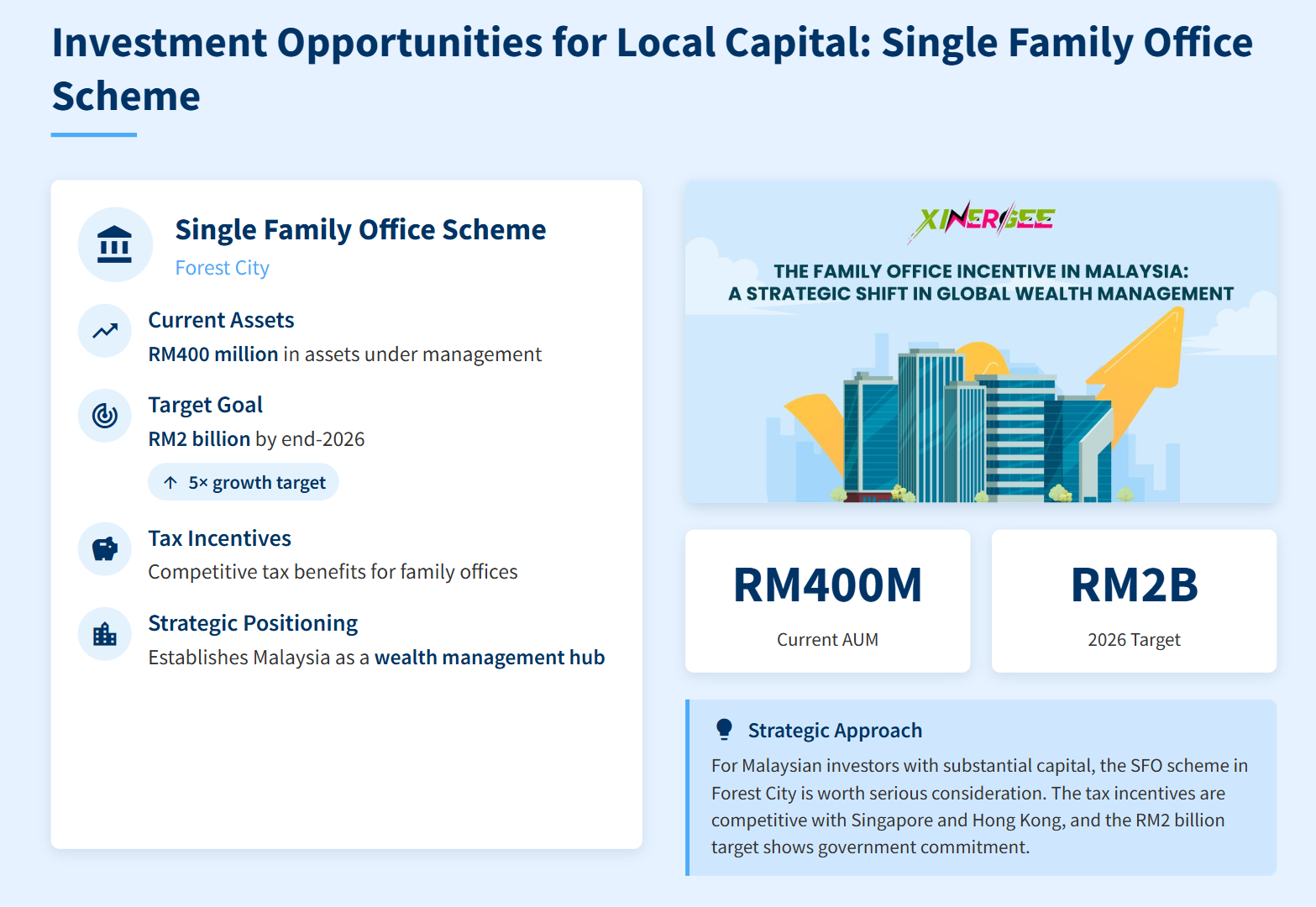
Iggy’s Take: For Malaysian investors with substantial capital, the SFO scheme in Forest City is worth serious consideration. The tax incentives are competitive with Singapore and Hong Kong, and the RM2 billion target shows government commitment. I would engage a tax advisor to structure your family office properly and lock in the benefits before the scheme evolves. For retail investors, the GLIC investments under GEAR-uP mean more liquidity and growth capital flowing into local mid-caps. Watch for companies that announce GLIC partnerships or funding rounds—these are often undervalued before the deals close. The ASEAN Business Entity status is a tailwind for companies with regional operations, so favor exporters and service providers with footprints in Thailand, Indonesia, and Vietnam. These firms will benefit from streamlined regulations and talent mobility, giving them a competitive edge.
Actionable Portfolio Strategy (SG & MY)
Buy
1. Data Centre REITs (Johor-Focused)
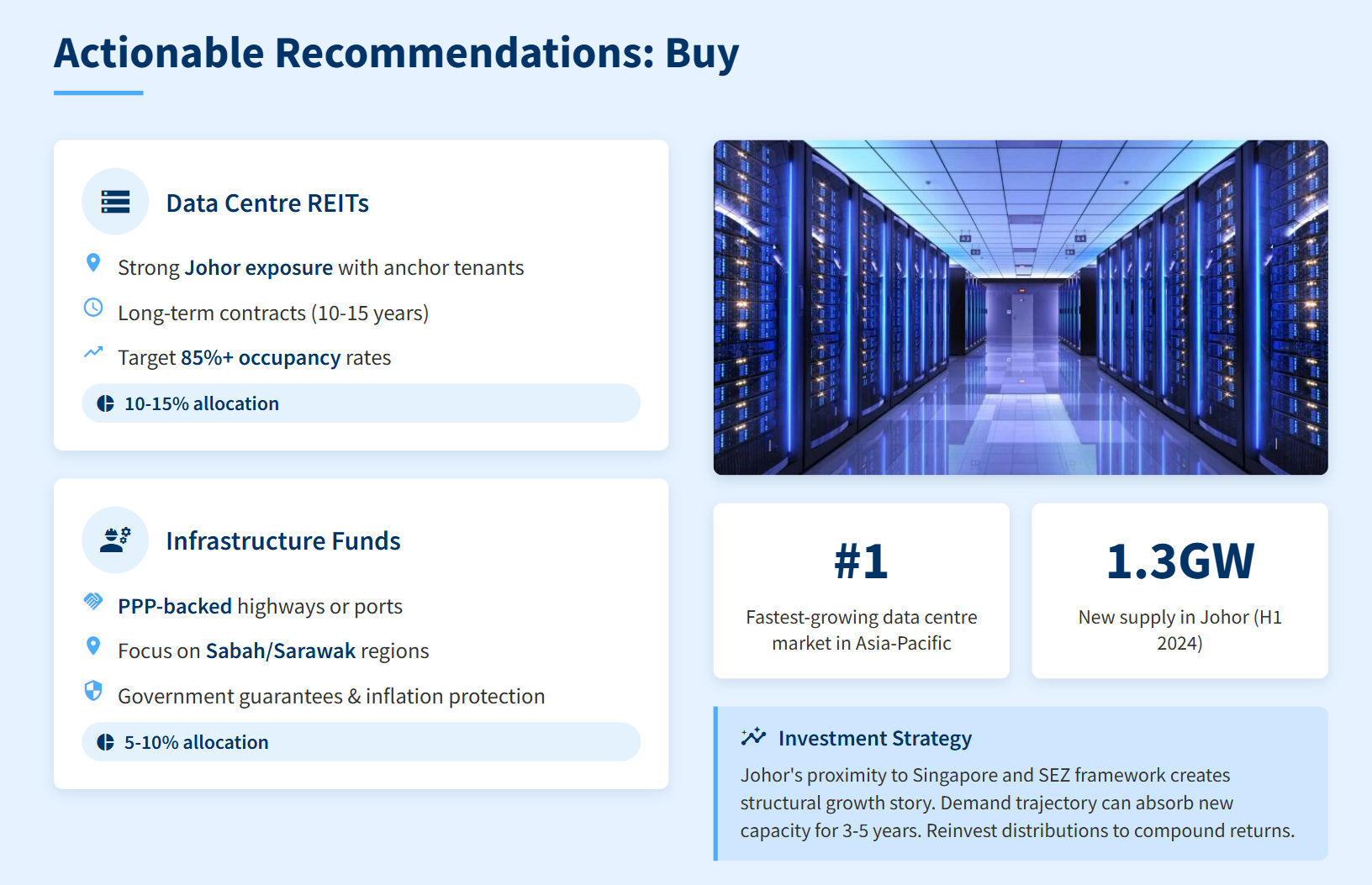
This is a structural growth story, not a cyclical trade. The Johor-Singapore SEZ and its proximity to Singapore have made Johor the fastest-growing data centre market in Asia-Pacific, with demand (1.3 GW of new supply) and a massive pipeline (3 GW upcoming) to back it up.
These REITs offer predictable cash flows and significant capital appreciation. However, not all are created equal.
The key is to find operators with “hyperscale” clients—major cloud providers and AI firms. These tenants sign 10 to 15-year leases, which drive steady, reliable distributions. I would target REITs with high occupancy rates (above 85%) and a diversified tenant mix.
While the risk of oversupply is real, the demand trajectory is steep enough to absorb new capacity for the next 3-5 years. Allocate 10-15% of your Malaysian portfolio here and reinvest the distributions to compound your returns.
2. Infrastructure Funds (Sabah & Sarawak-Focused)
This is a direct, politically-backed infrastructure play. Development allocations for Sabah and Sarawak have more than doubled, and the Special Grant for both states has also doubled to RM600 million. This federal cash will flow directly into long-cycle assets: roads, ports, and utilities, which generate revenue from tolls, user fees, and government concessions.
The investment thesis here is simple: these projects come with long-term, inflation-linked contracts. The political commitment to secure support and drive economic rebalancing is clear.
For the best risk-adjusted returns, I like funds that focus on greenfield projects with explicit government guarantees. This is not a quick trade; it’s a buy-and-hold strategy for 5 to 10 years. Expect steady, mid-single-digit returns plus valuable inflation protection.
Hold
1. Commodity Producers (with Strong ESG Plans)
The new carbon tax, targeting iron, steel, and energy sectors with rates up to RM150 per tonne, is a clear headwind that will increase operational costs.
However, this is not an automatic “Sell.” I would hold existing positions in producers that have announced credible green transition plans, such as carbon capture, renewable energy integration, or efficiency retrofits. These firms will have lower tax liabilities and better margins over time.
Think of this tax as a catalyst for consolidation. Stronger players with robust ESG roadmaps will gain market share as weaker, dirtier ones exit. The sell signal is not the tax itself; the signal is a failure to adapt. Sell only if a company shows no credible ESG plan or if its margins fall below the industry average for two consecutive quarters.
2. Large-Cap Tech Exporters
With electronics at 40% of exports and looming US tariff threats, the risk here is obvious. However, do not panic-sell.
Large-cap tech exporters have the scale, pricing power, and diversification to weather these shocks. They can shift production, renegotiate with customers, and lobby for exemptions.
The correct strategy is to hold these positions and monitor US policy signals closely. If tariffs are actually imposed, that is the time to trim your exposure by 20-30% and reallocate to more domestic-focused plays. But until that happens, you hold. The risk is elevated, but so is the potential upside if trade tensions ease.
Sell/Avoid
Overleveraged Small-Cap Industrials (Excise-Exposed)
The government is raising excise duties on cigarettes and alcohol to boost revenue. This is not a minor adjustment; this is a permanent hike that will directly compress margins for at least the next two to three years.
These names lack the financial cushion to absorb higher costs, and the tighter overall fiscal environment means there will be no bailouts or subsidies. This creates an immediate refinancing risk for any company that is already overleveraged.
My advice here is clear: Sell any positions in this category and redeploy the capital into higher-quality plays with stronger balance sheets. This is the time to check your holdings.
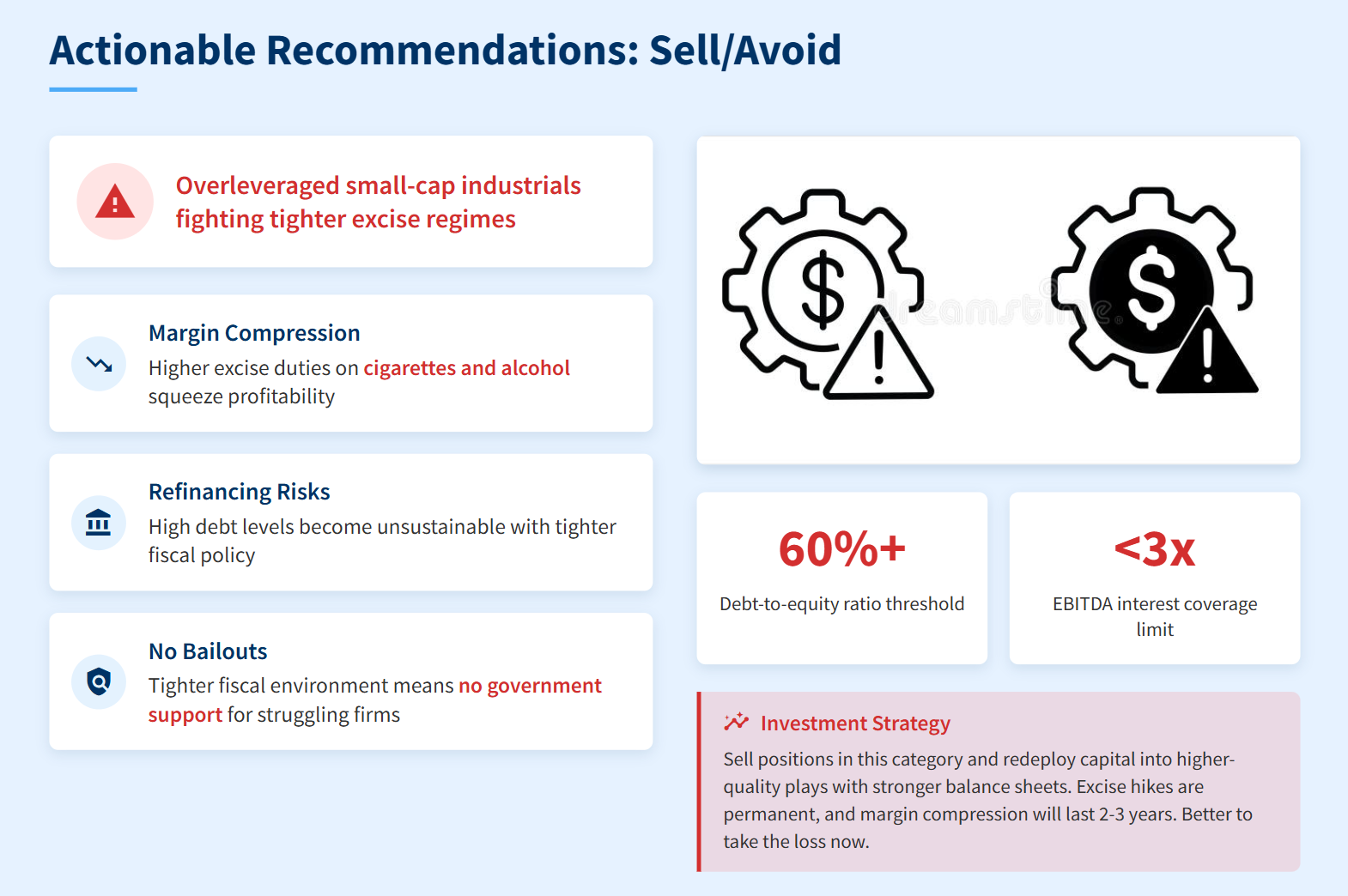
The Red Flag Screen: Avoid any company with exposure to these sectors that has a debt-to-equity ratio above 60% or an EBITDA interest coverage ratio below 3x. It is better to take the loss now and move on.