



Mapletree Industrial Trust’s DPU Just Fell. But That’s Not Even the Real Problem.
Why a REIT that still yields 6.6% just landed in Zone 4- territory.
Mapletree Industrial Trust just cut its DPU by 4.9%. That is not what should worry you. Gearing crossed the ceiling, occupancy fell below the floor, and interest coverage fell clearly short of the line, not a borderline miss.
I run the numbers on SGX stocks so retirees don’t have to guess. This quarter, the number that grabbed the headline is the smallest problem on the page.

Here is who this is for. If you are still adding to your portfolio in your fifties, a REIT with a temporary occupancy wobble in one segment might be a name worth watching for a better entry. If you are already drawing down income in your sixties, a dividend cut on a name you hold is a different conversation entirely. It deserves a straight answer, not a headline.

This piece tries to give both readers what they actually need.

The Data Centre Problem
Gearing Moved the Wrong Way Too
Coverage: Not a Borderline Case After All
Insight Box: When Three Gates Fail At Once
The Financial Health Checklist
Legacy Holders vs. Fresh Capital
The Dividend Trajectory
What This Is Really Worth
Insight Box: A Wide Valuation Spread Is Itself A Signal
Where This Leaves MIT
What Actually Happened This Quarter
Mapletree Industrial Trust (MIT) reported its 1QFY26/27 results this month. The top-line story is a REIT under quiet pressure from a segment that used to be its growth story.
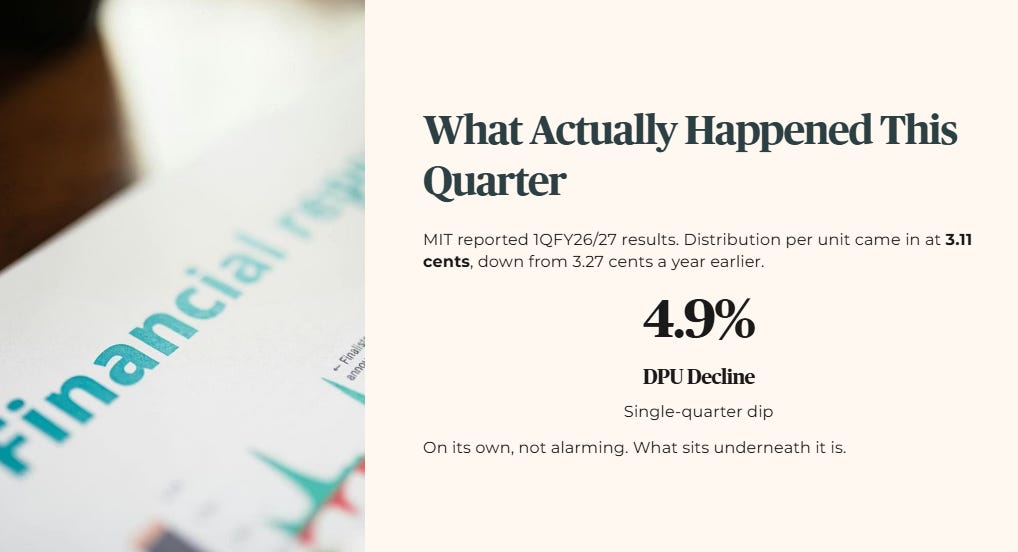
Distribution per unit came in at 3.11 cents, down from 3.27 cents a year earlier. That is a 4.9% decline. On its own, a single-quarter dip like this would not normally trigger alarm. What makes it worth a closer look is what is sitting underneath it.
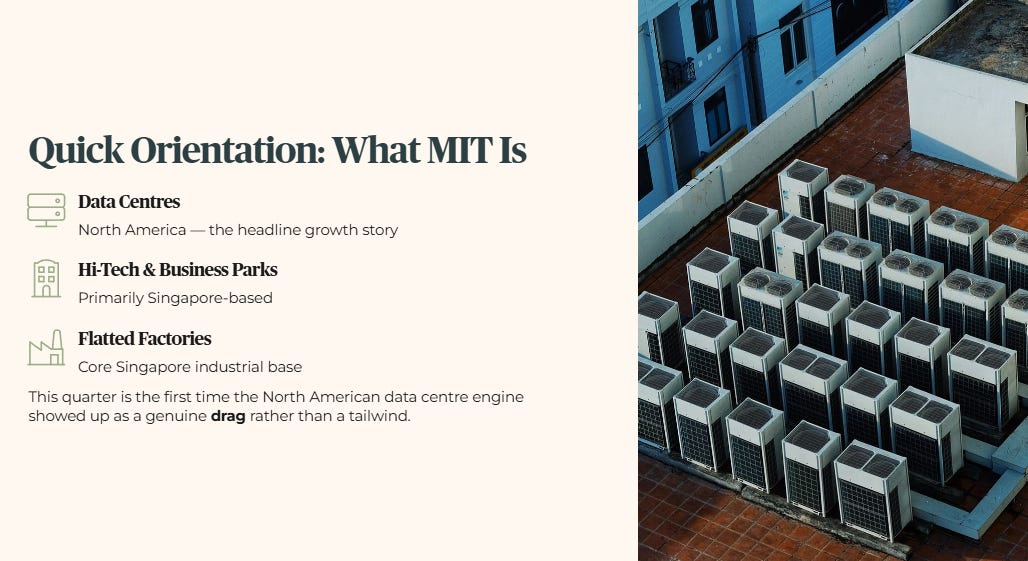
For readers newer to MIT, some quick orientation. This is one of the larger industrial S-REITs on the exchange. Its portfolio spans data centres, hi-tech buildings, business parks, and flatted factories, mostly in Singapore, with a meaningful and growing slice of data centre exposure in North America. That North American data centre push has been the trust’s headline growth story for several years now. The pitch to investors was that MIT was diversifying beyond Singapore’s industrial space into a higher-growth, higher-demand asset class riding the broader data centre boom. This quarter is the first time that specific growth engine has shown up as a genuine drag rather than a tailwind. That shift in direction is worth sitting with before moving on to the numbers themselves.

It is also worth being precise about what did not happen this quarter. This is not a case of a REIT getting caught with a sudden, unexplained collapse across every segment. The Singapore-based industrial and business park assets are, by most accounts in the results deck, holding up reasonably well. The pressure is concentrated, not diffuse. That is a meaningfully different story from a REIT where everything is deteriorating at once. It matters for how you read the balance sheet numbers that follow.
The Data Centre Problem
MIT’s Data Centre segment, once the trust’s headline growth driver, is now its weakest link. Portfolio-wide occupancy fell to 90.7% from 91.2%. That is itself already below the 95% threshold this framework applies to prime assets. But the portfolio average understates the real story.
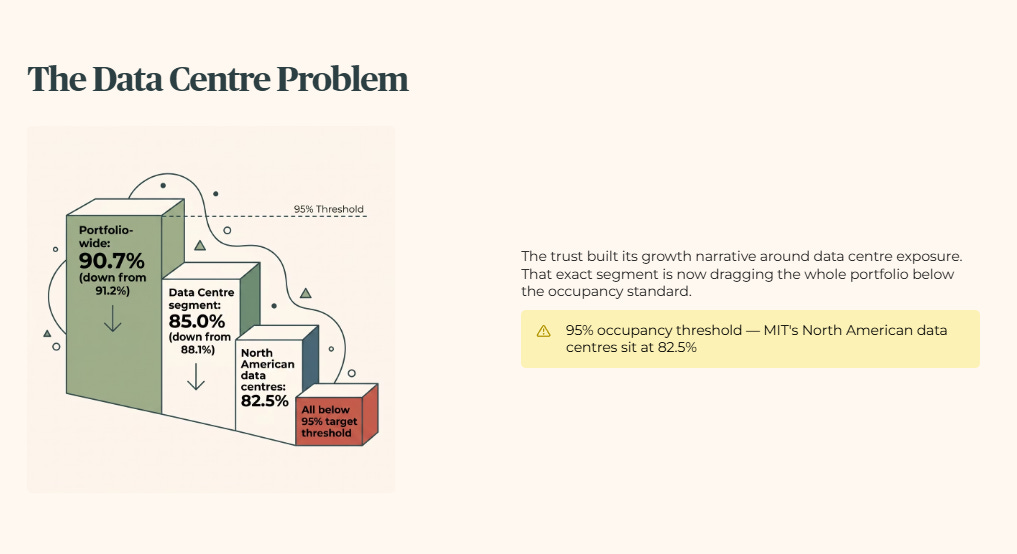
The Data Centre segment specifically sits at 85.0% occupancy, down from 88.1%. Within that segment, the North American data centre portfolio alone has fallen to 82.5%.
That is the driver. A trust that built its growth narrative around data centre exposure is now watching that exact segment drag the whole portfolio below the occupancy standard this framework requires for REITs.

This is worth sitting with for a moment, because it inverts the usual story investors have been telling themselves about data centre REITs generally. The broader narrative over the past few years has been that data centre exposure is the safe, high-demand corner of the industrial REIT space, driven by cloud computing and, more recently, AI infrastructure buildout. MIT’s North American portfolio softening does not necessarily mean that broader thesis is wrong.
It could just as easily reflect asset-specific or market-specific leasing dynamics rather than a sector-wide slowdown. But it is a useful reminder that “data centre exposure” is not a single uniform quality. Where those data centres sit, who the tenants are, and how those specific lease terms are structured all matter more than the segment label alone.
Gearing Moved the Wrong Way Too
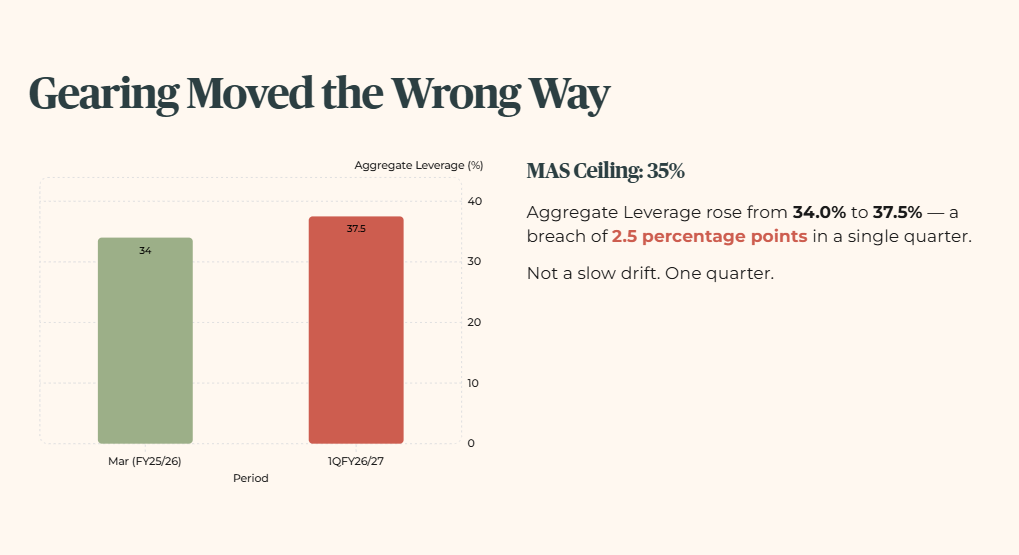
Aggregate Leverage, the governing gearing metric for REITs under MAS rules, rose to 37.5% at 1QFY26/27, up from 34.0% at the end of March. That is a breach of the 35% ceiling by 2.5 percentage points. It happened in a single quarter, not a slow drift over several periods.
Coverage: Not a Borderline Case After All
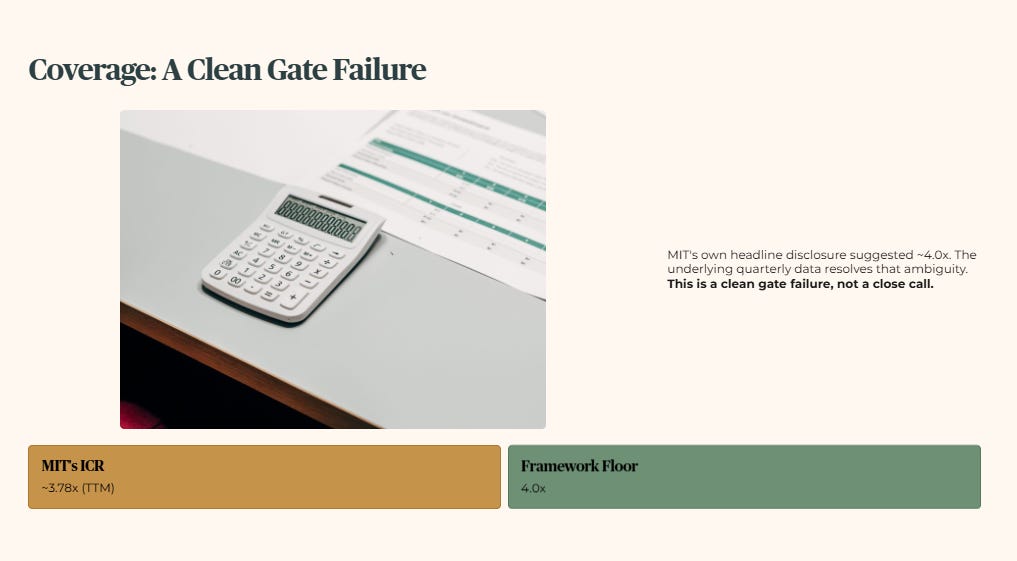
Interest coverage ratio, calculated from trailing twelve-month operating income against trailing twelve-month gross interest expense, comes in at approximately 3.78x. This is meaningfully below the framework’s 4.0x floor. It is not a boundary case sitting exactly on the line. The trust’s own headline disclosure had suggested a figure right at 4.0x, which would have left this framework arguing over whether touching a floor counts as clearing it. The underlying quarterly data resolves that ambiguity. This is a clean gate failure, not a close call.
🟢Insight Box: When Three Gates Fail At Once
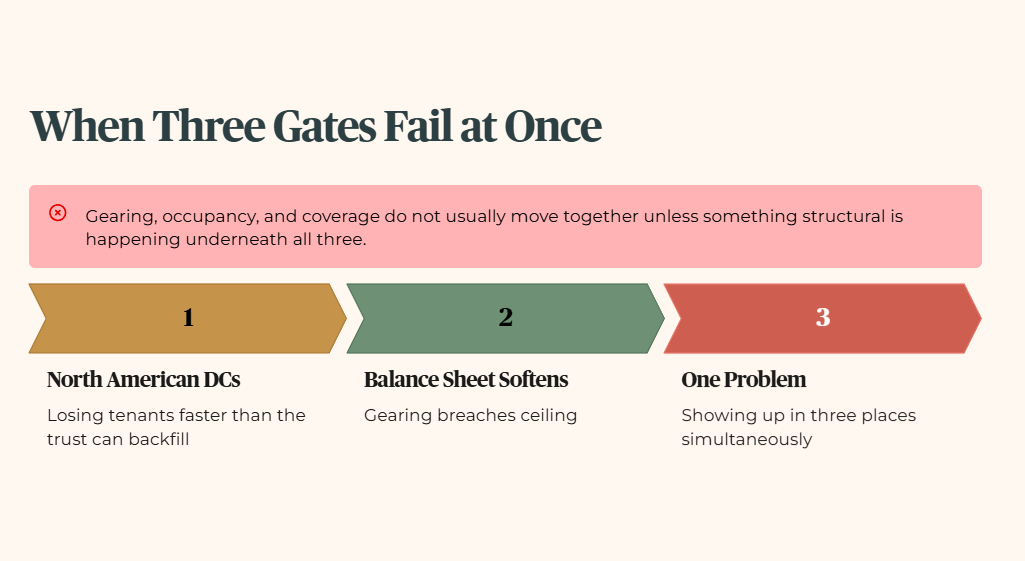
A single hard gate failure often has a clean story behind it, a one-off lease expiry, a temporary financing cost. Three gates failing in the same quarter is a different animal. Gearing, occupancy, and coverage do not usually move together unless something structural is happening underneath all three. In MIT’s case, that something is the North American data centre portfolio losing tenants faster than the trust can refinance or backfill around it. When the balance sheet, the asset base, and the debt servicing capacity all soften in the same quarter, that is not three unrelated problems. That is one problem showing up in three places.
The zone label is clear. The calculation that determines why MIT falls to Zone 4-, rather than merely caution territory, sits in the next section.
