



When MAS Tightens, Your REIT’s Balance Sheet Is the One That Answers For It
Twelve of sixteen economists polled by Reuters expected the Monetary Authority of Singapore to hold policy steady this week. MAS tightened instead, for the second review in a row. When the market’s consensus gets this wrong on something as dry as an exchange rate band, it is usually a signal worth more attention than the headline it generated.
I want to walk through what this actually does to the cost of running a leveraged balance sheet in Singapore dollars, because that is where this decision eventually lands, not in the headline inflation number, but in the funding cost line of every geared REIT on the exchange. Let’s start with what MAS did, then follow the mechanism through to a name already sitting on our Ledger with real exposure to this exact question.

What MAS Actually Did
The Mechanism That Actually Touches Your Portfolio
The Test Case: Keppel DC REIT
Insight Box: Why Gearing Headroom Matters More In A Tightening Bias
What This Means Beyond Keppel DC REIT
The CPF SA Anchor, Briefly
Insight Box: A Surprise Move Is Not The Same As A Regime Change
What MAS Actually Did
On Monday, MAS raised the rate of appreciation of the Singapore dollar nominal effective exchange rate policy band. This is the second tightening this year, following April’s steepening in response to the Strait of Hormuz conflict and the oil price spike that followed. The width and centre of the band were left unchanged. Only the slope moved, and only slightly, smaller in magnitude than April’s adjustment.
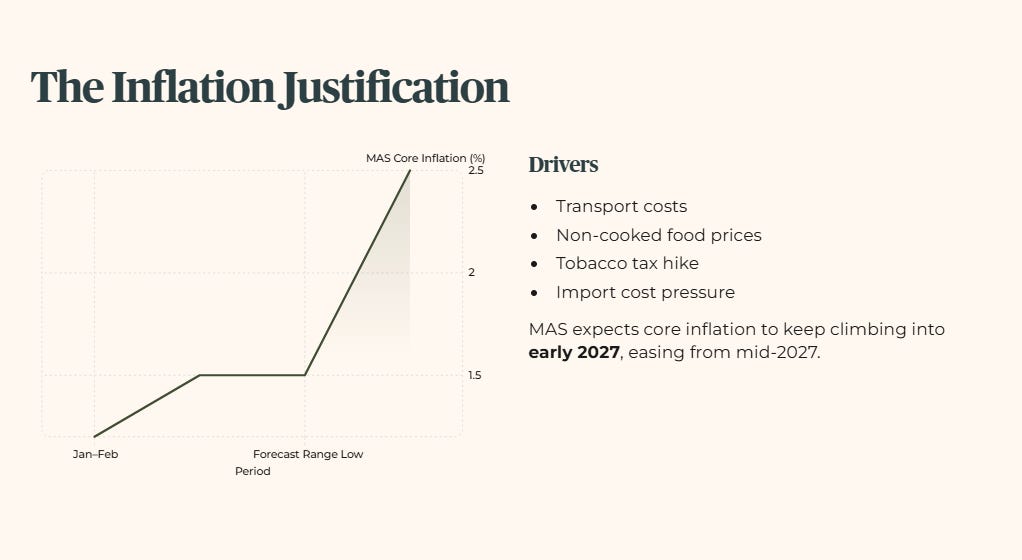
The justification MAS gave centres on inflation that has picked up since the start of the year. MAS core inflation, the quarterly measure the central bank actually targets, rose to 1.5% year on year in the second quarter, up from 1.2% in January and February. This was driven by transport costs, non-cooked food prices, and a tobacco tax hike layered on top of import cost pressure. Headline and core both remain inside MAS’s forecast range of 1.5% to 2.5% for the year. MAS expects core inflation to keep climbing into early 2027 before easing from around the middle of that year.
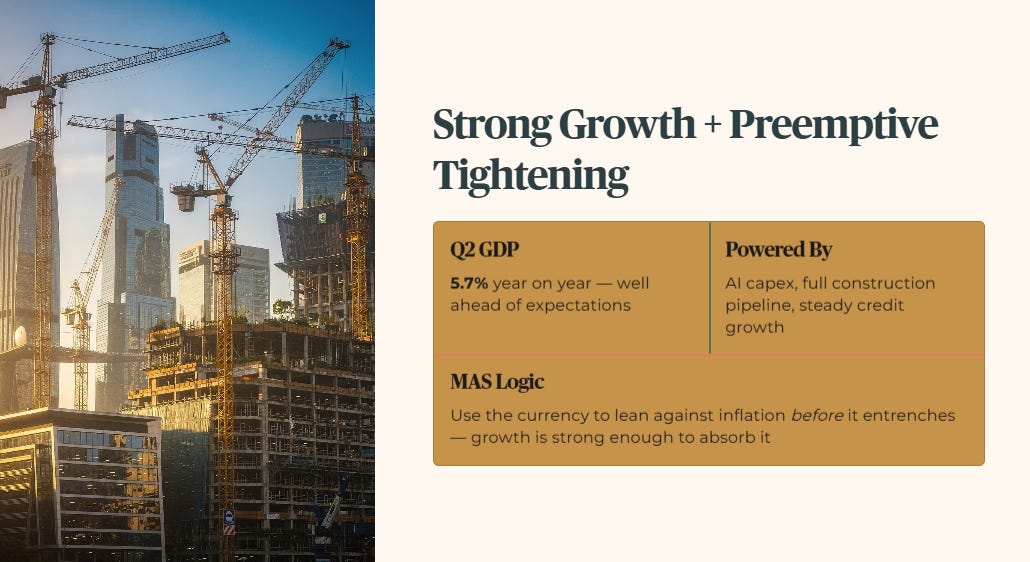
None of this is alarming on its own. What is worth sitting with is that MAS moved preemptively, tightening into a growth backdrop that was actually strong. Second quarter GDP came in at 5.7% year on year, well ahead of expectations, powered by AI-related capital expenditure, a full construction pipeline, and steady credit growth in the financial sector.
Strong growth and a preemptive tightening bias sitting side by side is not a contradiction. It is MAS doing what MAS’s framework is built to do, using the currency rather than an interest rate to lean against inflation risk before it becomes entrenched, precisely because growth is strong enough to absorb it.
The Mechanism That Actually Touches Your Portfolio
Here is where I want to be precise rather than let this slide into a loose narrative about “tightening means REITs suffer,” because that framing skips the actual transmission mechanism. Skipping it is how forensic discipline turns into headline reaction.
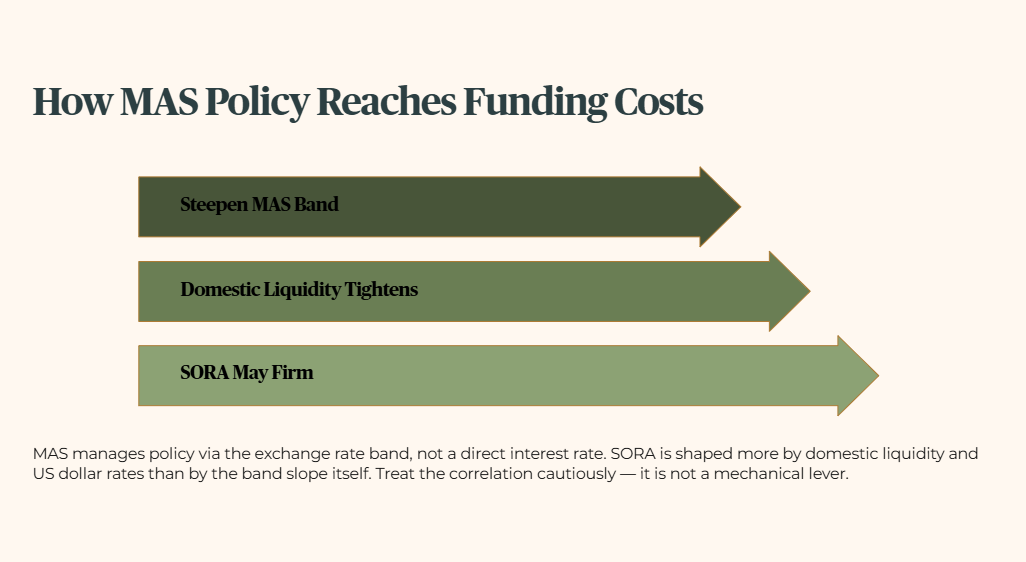
MAS does not set a Singapore dollar interest rate the way the US Federal Reserve sets the Fed Funds Rate. It manages policy through the exchange rate band. Singapore dollar interbank rates, the Singapore Overnight Rate Average, or SORA, that actually determines funding costs for floating-rate debt, are shaped by domestic liquidity conditions and global funding conditions, particularly US dollar rates, more directly than by the slope of the currency band itself. A steeper appreciation path can, at the margin, coincide with tighter domestic liquidity and firmer short-term SGD rates, since defending a faster appreciation path sometimes requires MAS to manage liquidity more actively. But this is a correlation worth treating cautiously, not a mechanical lever.
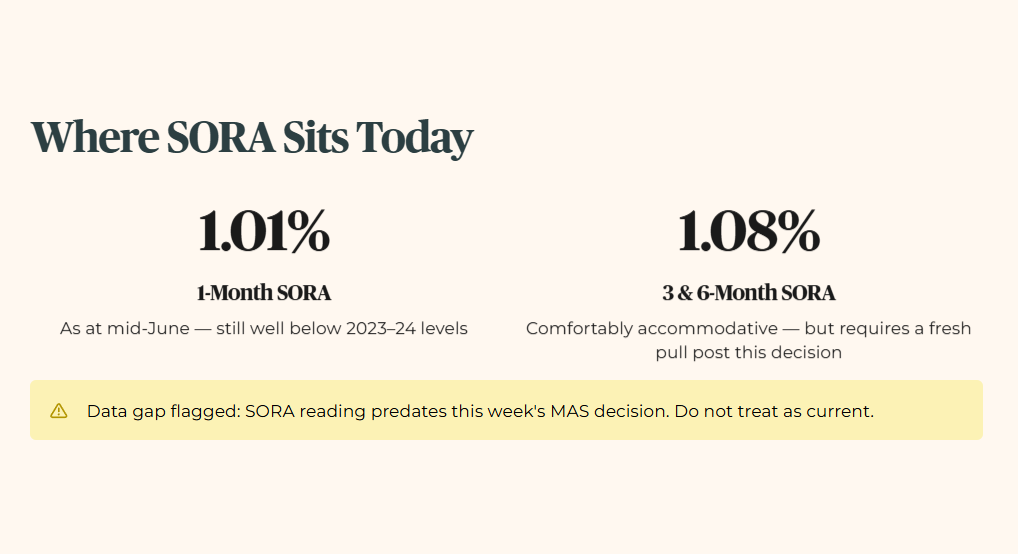
SORA today, as at the Macro Dashboard’s most recent confirmed reading in mid-June, sat around 1.01% on the 1-month tenor and roughly 1.08% on the 3 and 6-month tenors. This is still comfortably below where it sat through most of 2023 and 2024. That figure needs a fresh pull before I would treat it as current against this week’s decision, and I am flagging that gap rather than assuming it has moved.
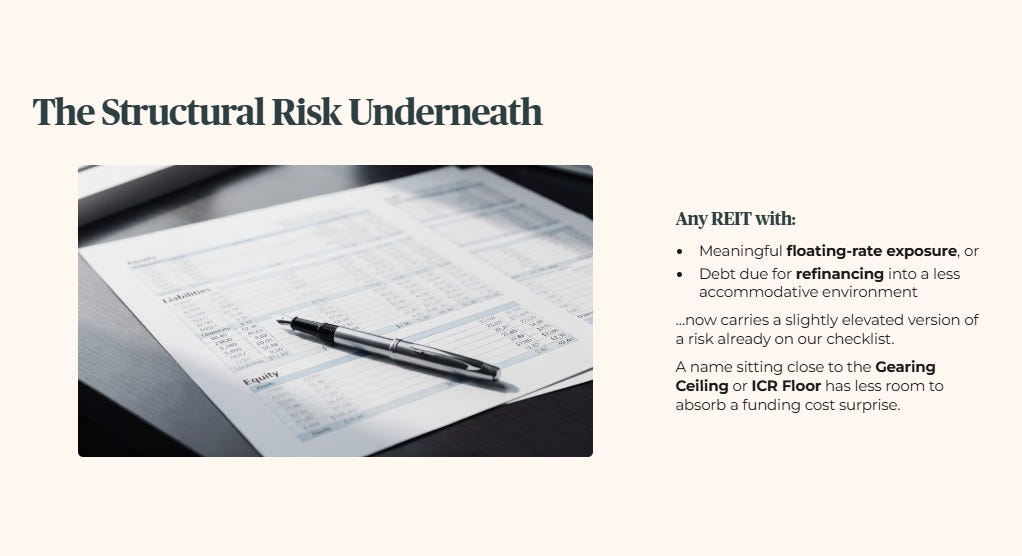
What I can say with more confidence is the structural point underneath all of this: any REIT carrying meaningful floating-rate exposure, or debt due for refinancing into a less accommodative rate environment than the one it was underwritten in, now carries a slightly elevated version of a risk that was already on our checklist. The Gearing Ceiling and ICR Floor exist precisely because funding costs are not static. A name sitting close to either threshold has less room to absorb a funding cost surprise than a name sitting comfortably inside both.
The Test Case: Keppel DC REIT
Keppel DC REIT is a useful name to walk through here, not because this MAS move changes its Ledger status today, it does not, but because its own structural profile happens to sit at an interesting intersection of exactly the variables this decision touches.
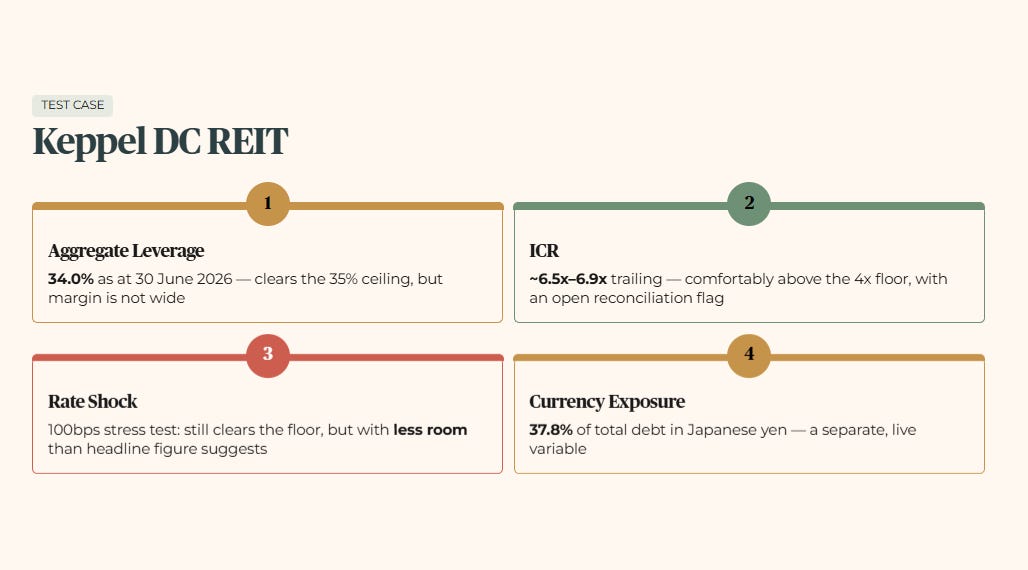
Aggregate Leverage (as at 30 June 2026): 34.0%, having improved 110 basis points from the prior quarter following repayment of the Tokyo DC3 consumption tax loan. This clears the 35% Gearing Ceiling, but the margin is not wide.
ICR (Interest Coverage Ratio): Sits somewhere in the region of 6.5x to 6.9x trailing depending on methodology, comfortably above the 4x floor either way, though the exact figure carries an open reconciliation question between two verified sources that I would rather flag than paper over.
Rate Shock Stress Test: Stress-tested against a hypothetical 100 basis point rate shock, the REIT’s own disclosure suggests it still clears the floor, but with less room to spare than the headline trailing figure suggests on its own.
Currency Exposure: Roughly 37.8% of the REIT’s total debt sits in Japanese yen, a currency whose own policy path remains a separate, live variable that this piece is not attempting to forecast.
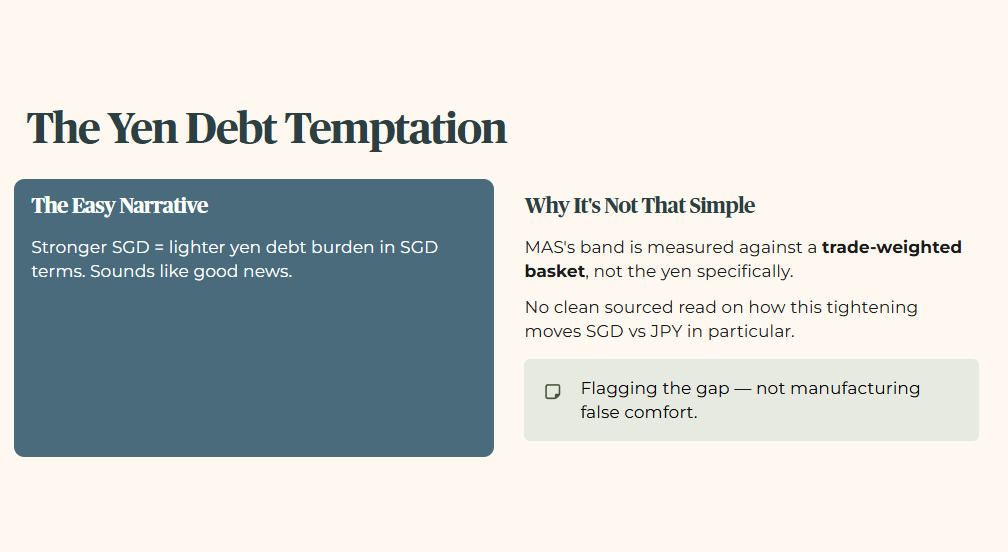
I want to be careful about one specific temptation here. It would be easy to say MAS strengthening the Singapore dollar’s appreciation path is straightforwardly good news for a REIT carrying yen debt, since a stronger Singapore dollar against the yen would lighten that debt burden in Singapore dollar terms. But MAS’s policy band is measured against a trade-weighted basket of currencies, not against the yen specifically. I do not have a clean, sourced read on how this specific tightening moves the Singapore dollar against the yen in particular, as opposed to the basket as a whole. That is a real open question, not a conclusion I am prepared to draw from this data, and I would rather flag the gap than manufacture false comfort.
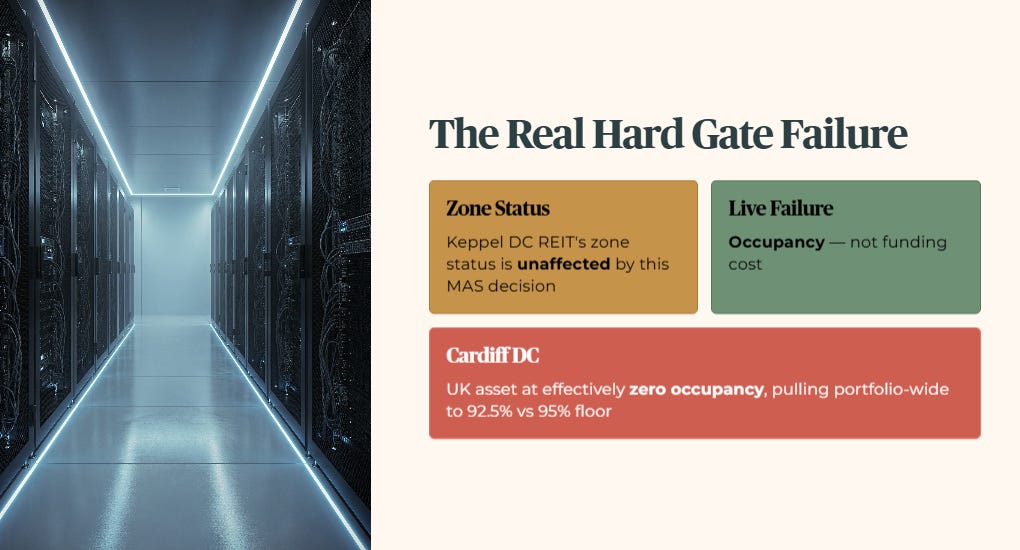
What I can say plainly is that Keppel DC REIT’s current zone status is unaffected by any of this. The REIT’s live hard gate failure remains occupancy, not funding cost. This was driven by the Cardiff Data Centre vacancy that took the UK asset to effectively zero occupancy and pulled portfolio-wide occupancy to 92.5% against the 95% prime-asset floor.
Iggy’s Forensic Zone: Zone 4, Caution (Growth Read: fortress balance sheet, clears the yield hurdle comfortably on both trailing and forward bases, Cardiff Data Centre vacancy is the sole constraint)
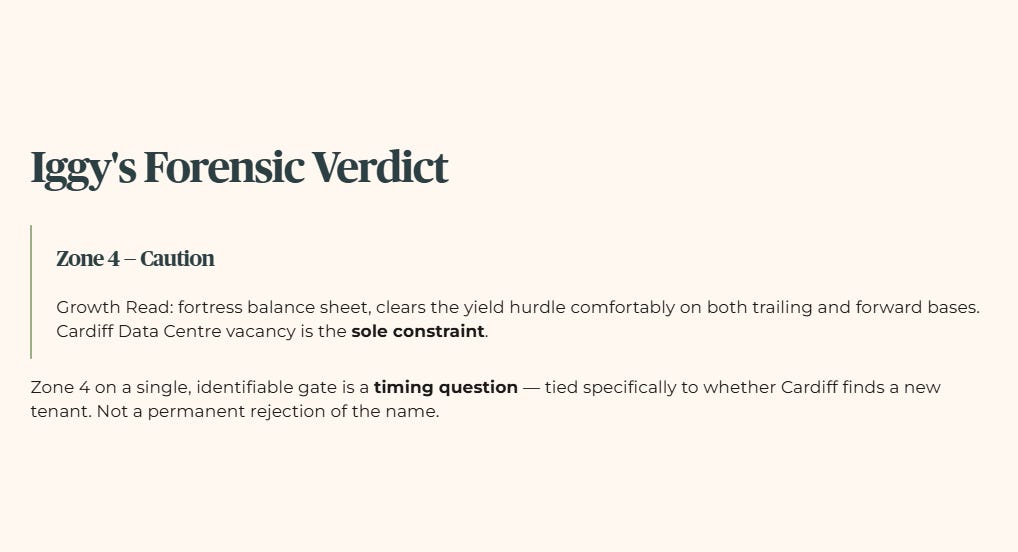
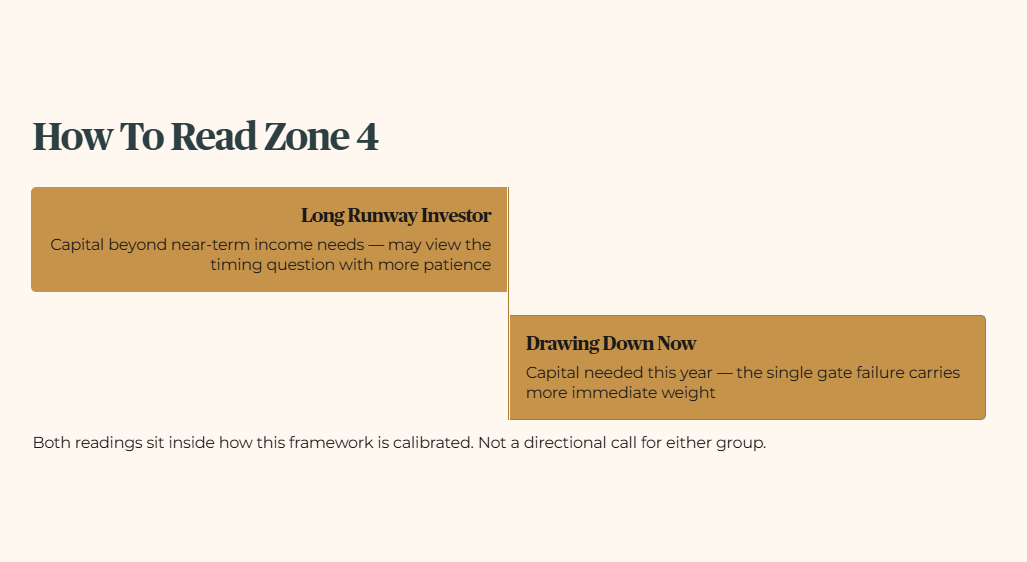
A reader with a genuinely long runway before retirement drawdown, or capital allocated beyond what near-term income needs demand, may reasonably view this differently than a reader drawing down capital this year. Both readings sit inside how this framework is calibrated, not as a directional call for either group. A Zone 4 verdict on a single, identifiable gate remains a timing question, tied specifically to whether Cardiff finds a new tenant, not a permanent rejection of the name.
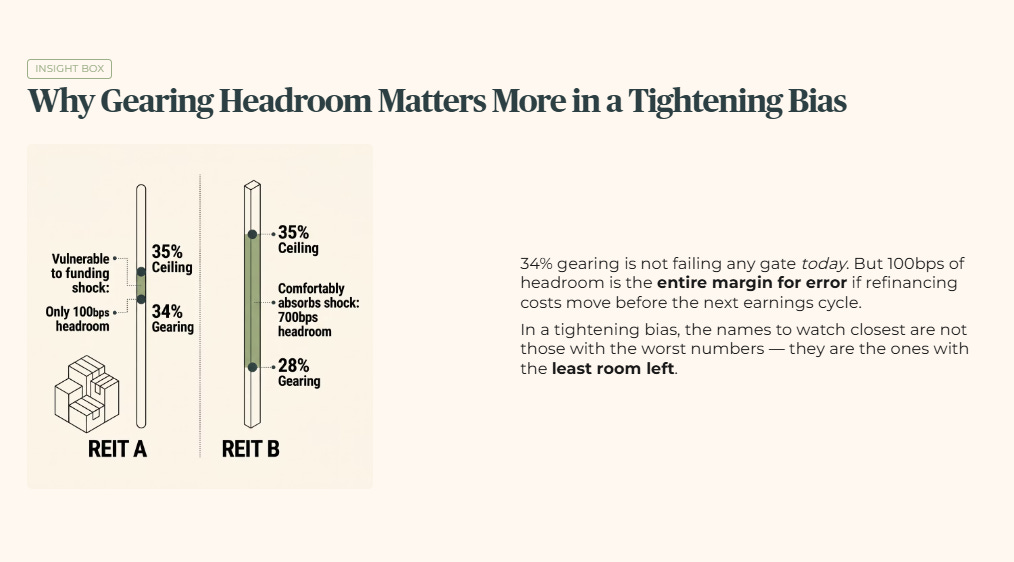
🟢Insight Box: Why Gearing Headroom Matters More In A Tightening Bias
A REIT sitting at 34% gearing against a 35% ceiling is not failing any gate today. But that 100 basis point of headroom is the entire margin for error if refinancing costs move against it before the next earnings cycle. Compare that to a REIT sitting comfortably at 28% gearing. The same funding cost shock lands on a balance sheet with genuine room to absorb it without approaching a hard gate at all.
This is precisely why the Gearing Ceiling exists as a hard threshold rather than a soft guideline. Headroom is not a cosmetic number, it is the actual buffer between a manageable funding environment and a forced response. In a tightening bias, however mild, the names worth watching closest are not necessarily the ones with the worst numbers today. They are the ones with the least room left before a modest shift turns a soft flag into a hard one.
The funding shock scenarios that matter most for your REITs start with that same 34% versus 35% gearing margin, the next section is where we run that headroom against a live tightening bias and spell out exactly how fast a soft flag can turn hard.
