



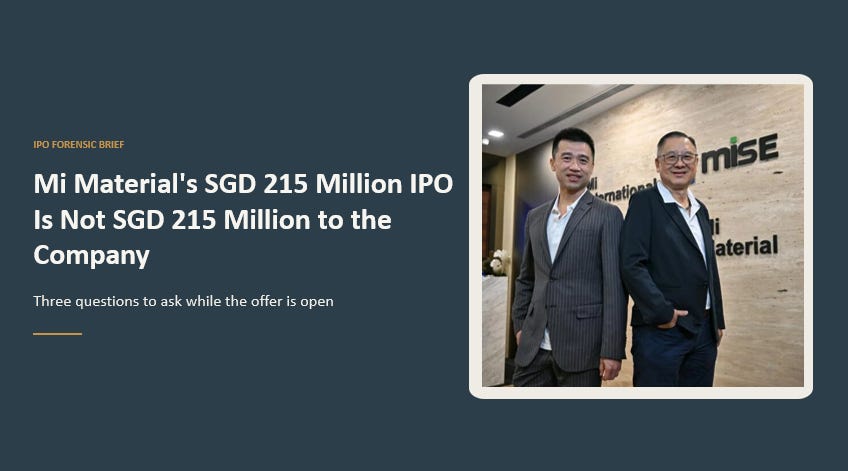
Mi Material’s SGD 215 Million IPO Is Not SGD 215 Million to the Company. Three Questions to Ask While the Offer Is Open
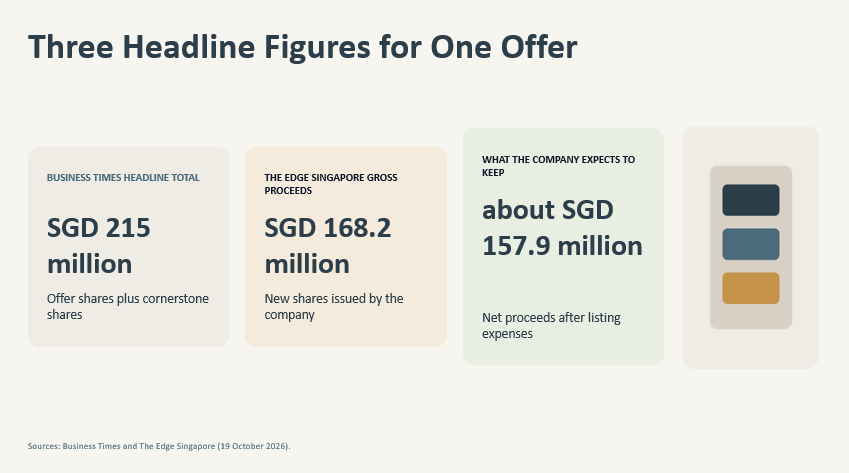
Of the SGD 215 million in the headlines, the company expects to keep about SGD 157.9 million. Here is where the rest goes, what the profit rests on, and what the dividend intention would pay.
Two numbers appeared in the headlines when Mi Material launched its Singapore IPO on 19 October. Business Times reported SGD 215 million and The Edge Singapore reported SGD 168.2 million. Both are correct, and neither is what the company expects to keep, which is about SGD 157.9 million.
Two kinds of reader will open this. One watches every new listing and wonders about putting in an application, the other keeps a dividend portfolio and wonders whether a chip materials maker belongs in it, and some of us are both. I read both reports in full before writing, and I take no view on whether anyone should apply. What I can do is set out what the numbers say and where they stop.
What This Piece Does
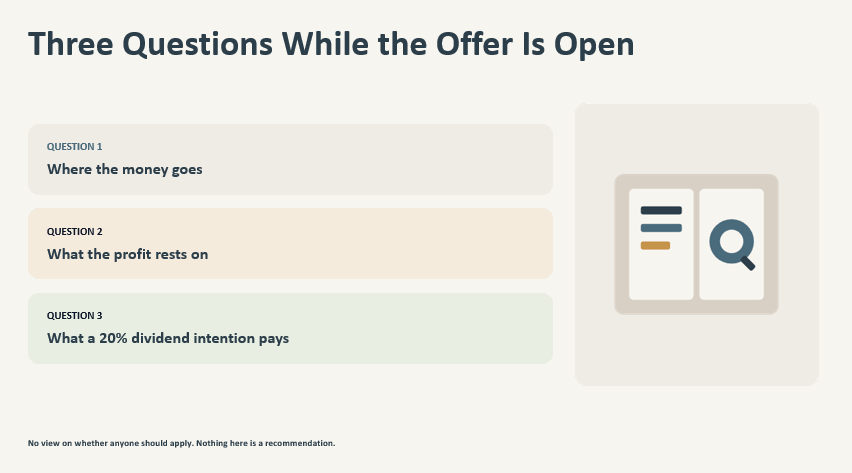
It lays out the offer in plain terms: the dates, the share counts, who the cornerstone investors are, and how small the public tranche is.
It follows the money in three steps, from the headline total to what the company expects to keep, and then looks at what the profit growth rests on.
It works out what a dividend of 20% of profit could pay, using an illustration that is labelled as mine.
This piece takes no view on share price direction. Nothing here is a recommendation.

What This Piece Does
The Offer in Plain Terms
What is being sold, and when
Who the cornerstones are
Question 1: How Much of the SGD 215 Million Reaches the Company?
Three numbers, one bridge
Where the SGD 157.9 million is meant to go
🟠 Angela’s Observation
Question 2: What Is the Profit Growth Resting On?
The numbers, with the low base removed
Profit grew nearly three times as fast as revenue
Customers and concentration
What the price asks you to believe
Question 3: What Does a 20% Dividend Intention Pay?
What the company has said
The arithmetic, and a comparison I want to be fair about
🟠 Angela’s Observation
What I Am Watching Next, Without Predicting
Iggy’s Forensic Read
Where the figures come from.
The Offer in Plain Terms
What is being sold, and when
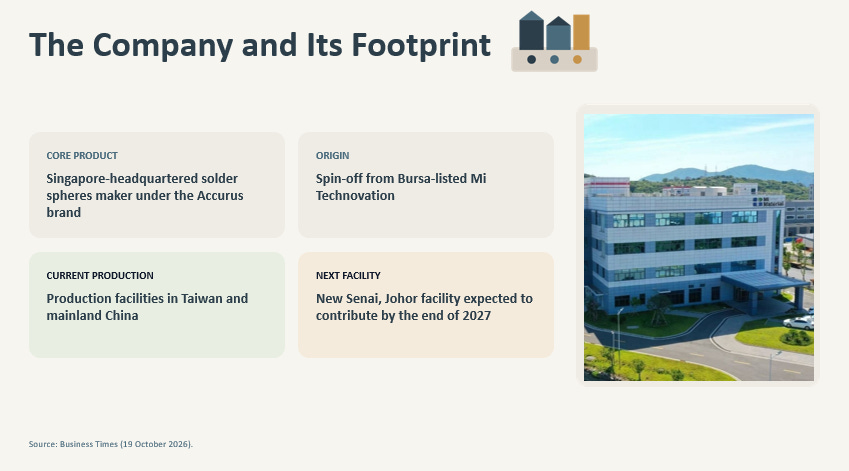
Mi Material is a Singapore-headquartered maker of solder spheres, the small metal balls that connect chips to their packaging, sold under the Accurus brand. It is a spin-off from Bursa-listed Mi Technovation, with production in Taiwan and mainland China and a new facility being set up in Senai, Johor. Business Times reports that the Senai facility is expected to start contributing to the bottom line by the end of 2027.
The offer price is SGD 1.80 a share. The Singapore public offer opened at 9.00 pm on Monday 19 October and closes at 12.00 pm on Monday 26 October, with trading expected to start at 2.00 pm on Wednesday 28 October. OCBC and CGS International are the joint global coordinators, bookrunners and underwriters.
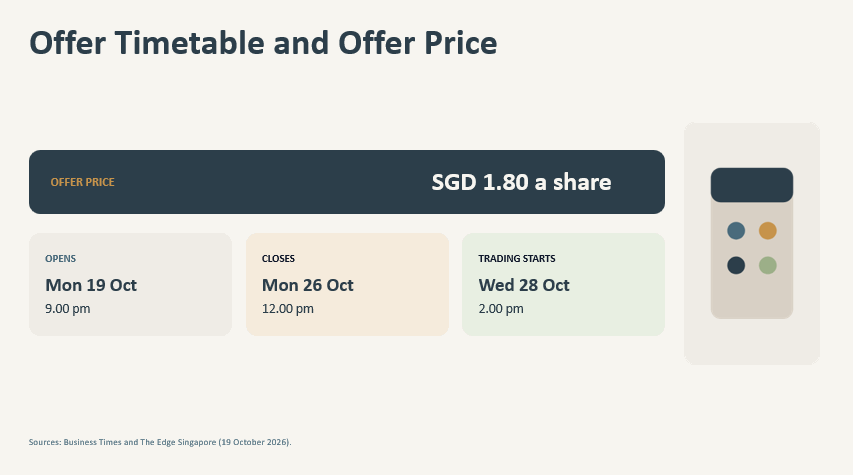
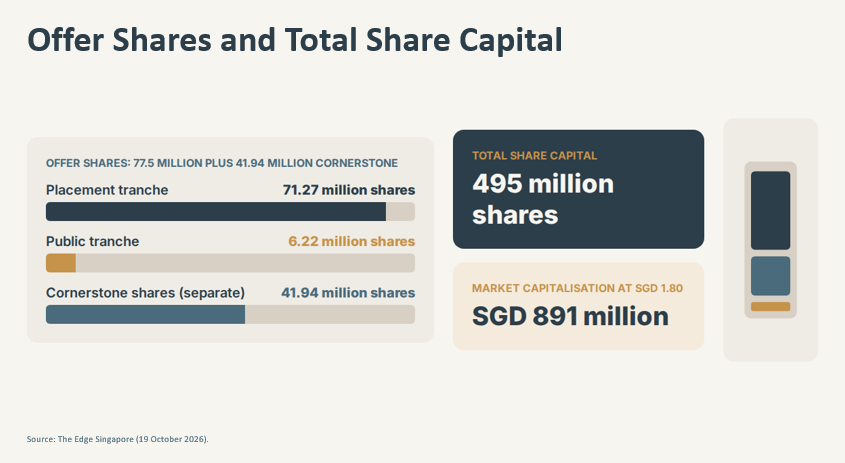
There are 77.5 million offer shares. Of these, 71.27 million go to institutional and other investors through the placement tranche, and 6.22 million go to the public. Separately, cornerstone investors have agreed to take 41.94 million new shares at the same price. After the offer, the company’s total share capital is 495 million shares, which at SGD 1.80 gives a market capitalisation of SGD 891 million.
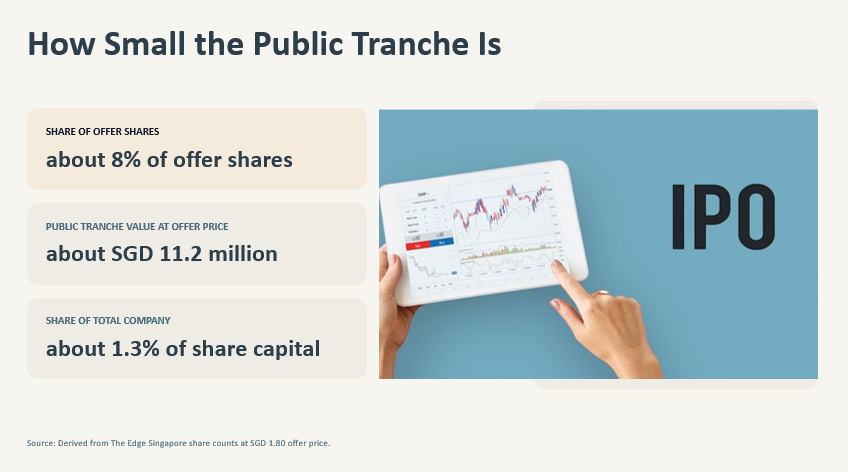
Here is a number I find easy to miss. The public tranche is about 8% of the offer shares, worth roughly SGD 11.2 million at the offer price, and about 1.3% of the company’s share capital. Whether that is generous or tight depends on how many people apply, and I have no figure for that.
Who the cornerstones are
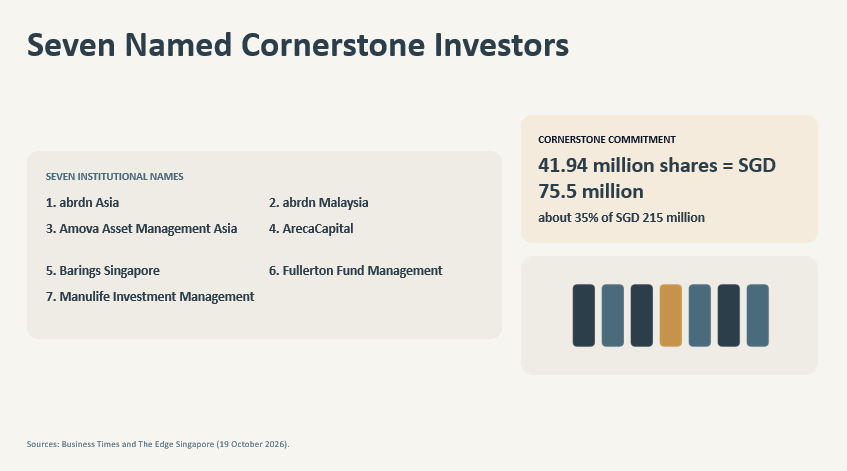
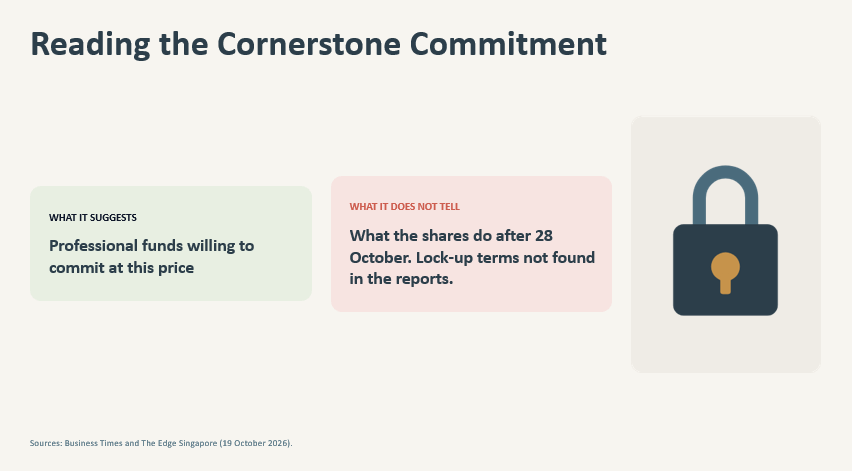
Business Times names seven cornerstone investors: abrdn Asia, abrdn Malaysia, Amova Asset Management Asia, ArecaCapital, Barings Singapore, Fullerton Fund Management and Manulife Investment Management. Their 41.94 million shares come to SGD 75.5 million, about 35% of the SGD 215 million.
It is reasonable to read that as professional funds being willing to commit at this price. It does not tell me what the shares will do after 28 October, because these funds have different time horizons, different information and different reasons for taking part. I have not found the cornerstones’ lock-up terms in either report, so I will not guess at how long they are committed.
Question 1: How Much of the SGD 215 Million Reaches the Company?
Three numbers, one bridge
The headline total in Business Times is SGD 215 million, made up of SGD 139.5 million from the 77.5 million offer shares and SGD 75.5 million from the cornerstones. The Edge reports SGD 168.2 million as gross proceeds. The company then expects net proceeds of about SGD 157.9 million after listing expenses.
The gap between the first two figures is SGD 46.8 million, which is exactly 26 million shares at SGD 1.80. That is my own arithmetic from the two reports, and it matches how the numbers split: 51.5 million new offer shares plus 41.94 million cornerstone shares gives 93.44 million new shares, and 93.44 million at SGD 1.80 is SGD 168.2 million. The remaining 26 million offer shares are existing shares sold by a selling shareholder, so that money goes to the seller and not to the company.
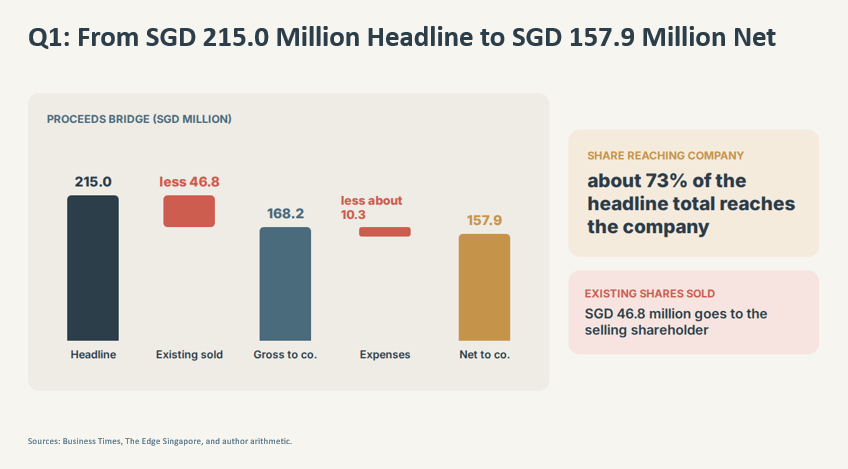
On those figures, about 73% of the headline total reaches the company. The rest is the seller’s proceeds and listing costs. Neither is unusual, and a prospectus is supposed to show both. They just do not appear in the headline.
The Red Flags Were Always There
The Warning Signs Were Never Hidden. In this market, the difference between a “Sanctuary” and a “Yield Trap” usually isn’t hidden information, it’s a set of numbers sitting in the same filings everyone can access: the gearing ratio, the occupancy rate, the debt maturity schedule. The red flags are always there. The question is whether you have a framework built to actually read them, or whether you’re taking the headline yield at face value.
Paid Members don’t stop at the headline yield. They get the full forensic breakdown, every time: the gearing ratios, the occupancy gaps, the debt overhang, laid out in full rather than summarised into a number. The complete Red Zone watchlist. Forensic cheatsheets built to flag the landmines dressed up as opportunities.
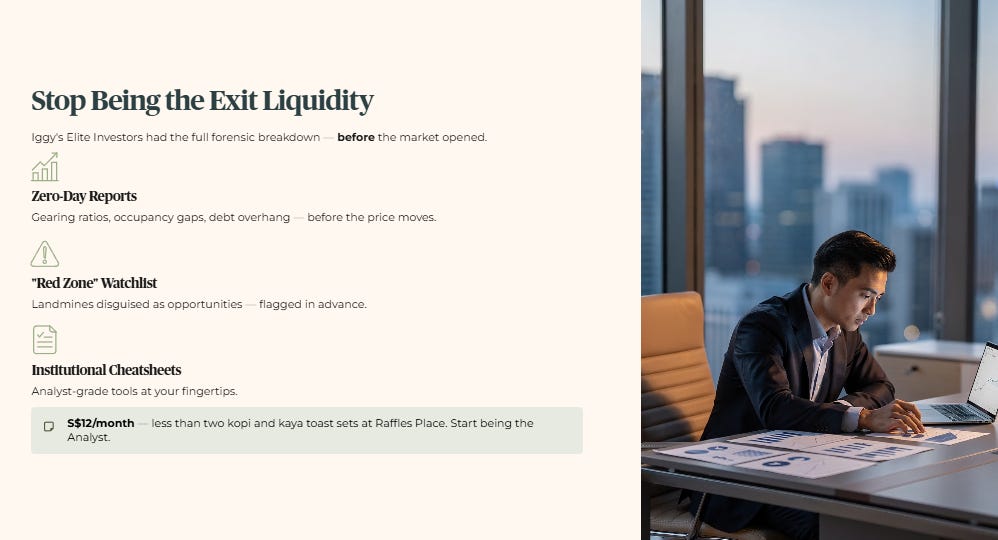
With the YouTube/Substack Combo at S$12/month, you’re not paying to move faster than the market. You’re paying to see the reasoning the headline yield leaves out.
Where the SGD 157.9 million is meant to go
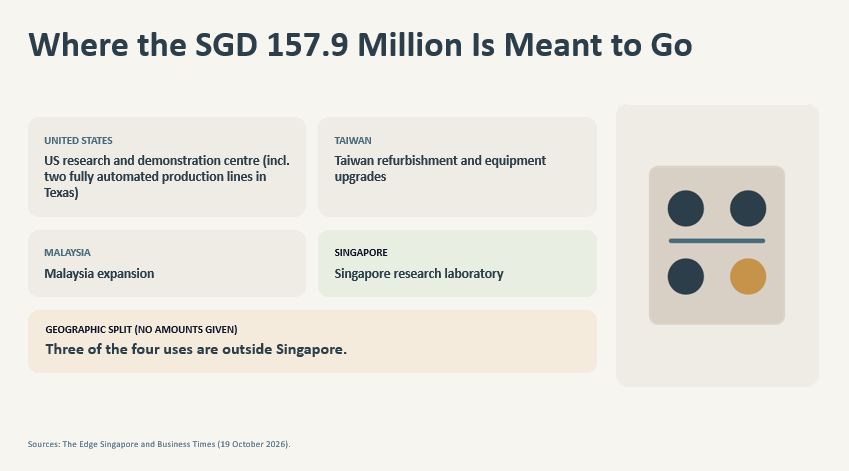
The Edge lists four uses: a research and demonstration centre in the United States, refurbishment and equipment upgrades at the Taiwan facilities, expansion of the Malaysia facilities, and a research laboratory in Singapore. Business Times adds that the US facility includes two fully automated production lines in Texas. Neither report gives a split by amount. Of the four uses, three are outside Singapore.
That is a normal pattern for a company that sells to customers across the region and beyond, and it does not bother me. It does mean the listing venue and the place the money is spent are different things. The question I would ask is what each use is expected to add to revenue, and when. Business Times quotes the CEO, Kevin Tan, saying “we are more focused on the things that we can control.” I read that as an honest answer to a question about the October sell-off in semiconductor stocks, and not as an answer about the use of proceeds.
🟠 Angela’s Observation
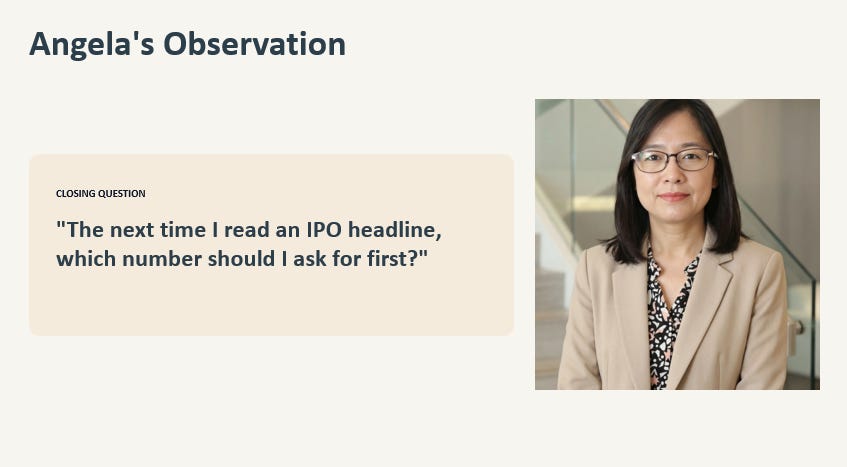
When I first read SGD 215 million, I pictured a company walking away with a very large cheque. Then I did the subtraction. About SGD 158 million, and most of the gap was a shareholder selling part of what it already owns. That is not a criticism, because it happens in IPOs all the time and the prospectus says so. It just reminded me that I read a headline total the way I read a set-meal price at the kopitiam, as the whole bill, and forget that the drinks are extra. The next time I read an IPO headline, which number should I ask for first?
Question 2: What Is the Profit Growth Resting On?
The numbers, with the low base removed
These are the figures Business Times reports, in millions of US dollars. The margins are my own arithmetic, net profit divided by revenue.
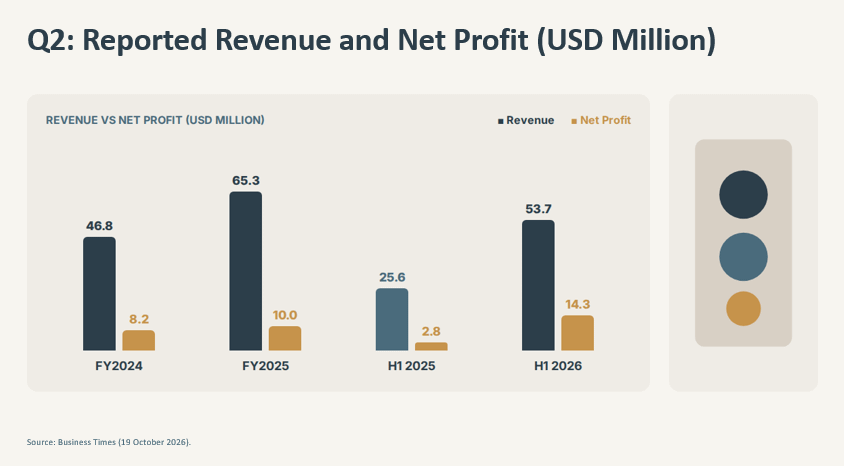
The first thing that jumps out is that the profit for the first half of 2026, USD 14.3 million, is already more than the whole of FY2025 at USD 10.0 million. Compared with H1 2025, it is more than five times as large, and revenue has roughly doubled.
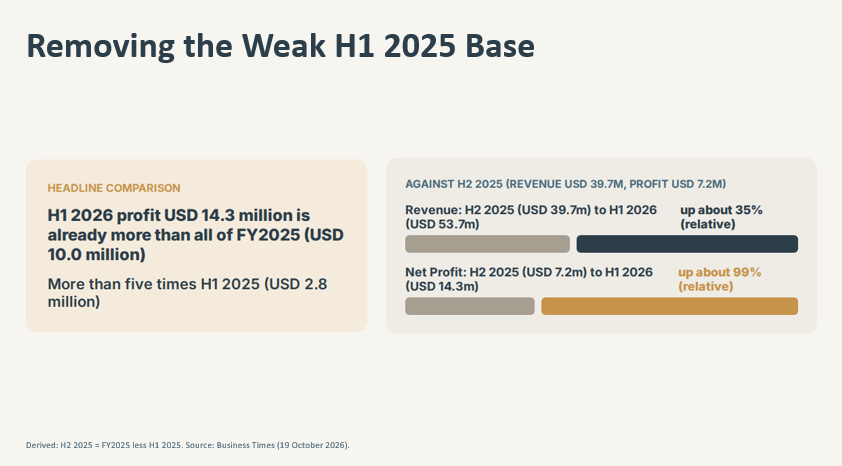
The pushback I expect is the obvious one: if profit has gone up five times, what is there to question? The answer is that the first half of 2025 was a weak half. Taking it out of FY2025 leaves a second half of USD 39.7 million in revenue and USD 7.2 million in profit, a margin of 18.1%. Against that second half, H1 2026 revenue is up about 35% and profit is up about 99%. That is still strong growth. It is just a different size of story from “five times”.
🔒 What’s Next
Against the second half of 2025, revenue is up about 35% and profit is up about 99%. The margin comparison in the next section shows why those two figures are so far apart.
