OCBC and UOB both beat second-quarter expectations, but the headline hides a crucial difference. I explain why OCBC’s S$2.22 billion result looks broad-based, while UOB’s S$1.48 billion profit included a non-recurring gain and came with lower fee-growth guidance. For anyone relying on bank dividends for CPF, SRS, or household income, the forward message matters more than yesterday’s profit number.
Key takeaways:
OCBC net profit rose 22% to S$2.22 billion.
OCBC’s interim dividend increased to S$0.47 from S$0.41.
UOB’s other non-interest income jumped 28%, partly from asset divestments.
UOB reduced 2026 fee-growth guidance from high single-digit to low single-digit.
UOB’s S$0.88 dividend was up from S$0.85 ordinary payment.

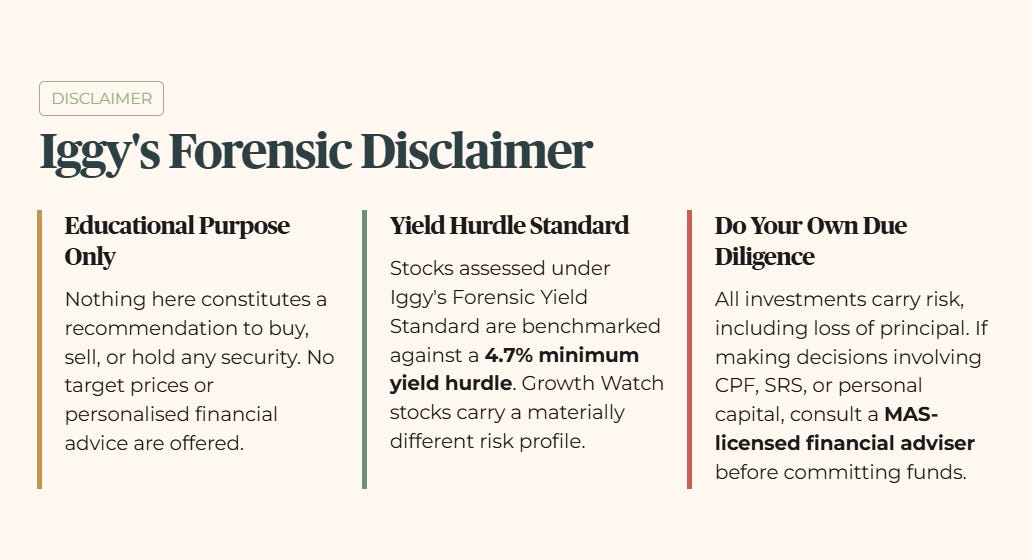
Iggy’s Forensic Disclaimer
This content is produced for educational and informational purposes only. I am not a financial advisor — I am a retail investor who applies forensic analysis to my own portfolio and shares that process publicly. Nothing here constitutes a recommendation to buy, sell, or hold any security, and no specific target prices or personalised financial advice are offered. Stocks assessed under Iggy’s Forensic Yield Standard are benchmarked against a 4.7% minimum yield hurdle; stocks flagged as Growth Watch fall below this threshold but demonstrate clean balance sheet metrics and an identifiable growth catalyst — these carry a materially different risk profile and are not suitable as yield replacements for income-dependent investors. All data is sourced from public filings and verified sources; where data is unverified it is explicitly flagged. All investments carry risk, including the potential loss of principal, and past performance is not indicative of future results. If you are making investment decisions involving CPF, SRS, or personal capital, please conduct your own due diligence or consult a MAS-licensed financial adviser before committing funds.