



OUE REIT’s 5.8% DPU Uplift Depends on a One-Off Payout. The Recurring Number Is Lower 🦖
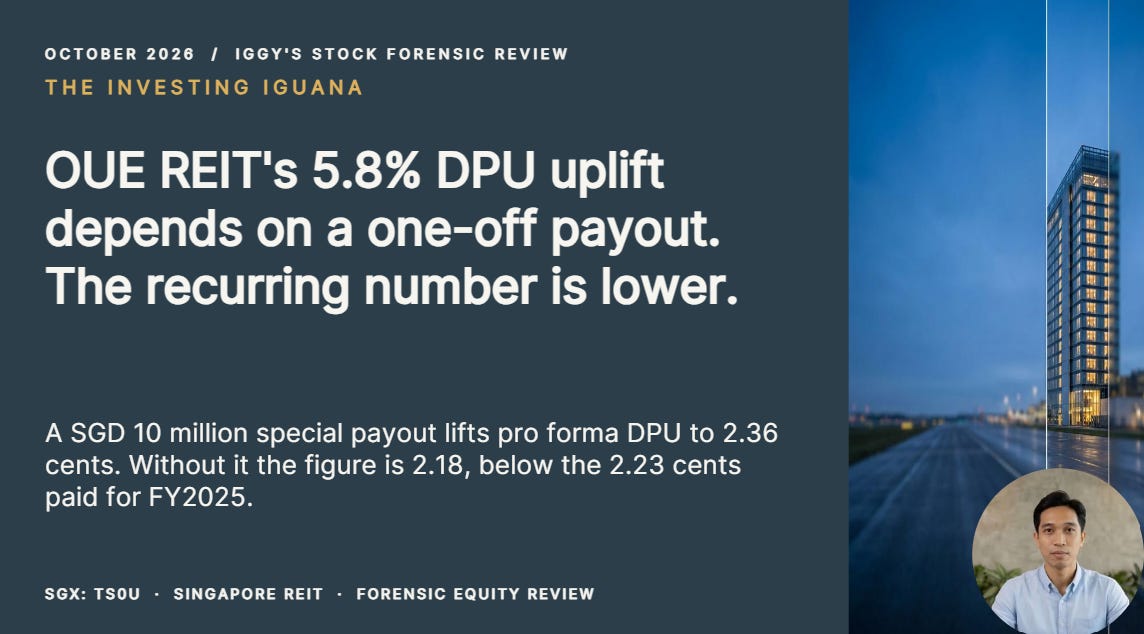
A S$10 million special payout lifts pro forma DPU to 2.36 cents. Without it the figure is 2.18, below the 2.23 cents paid for FY2025.
OUE REIT’s circular on the sale of Crowne Plaza Changi Airport shows distribution per unit rising 5.8%. Take out a special payout that stops after two years and the same table shows a fall of 2.2%. Both numbers sit in the company’s own document, one table apart.
If you hold OUE REIT, you have probably seen the 5.8% in the company’s announcements, and you are owed the version that shows what is left when the special payout ends. If you are looking at the units for the first time at about SGD 0.33, the yield looks generous, and it helps to know what it rests on. You are both reading the same filings, so I will stay with the filings. I am not telling either of you what to do.
What This Piece Does
It sets out what the circular, the vote result and the interim accounts say about the sale of Crowne Plaza Changi Airport, who the purchaser is, and what the DPU table does and does not include.
It shows where the first-half growth came from, how the distribution was funded, and what else is in motion.
It shows how OUE REIT tests against my thresholds, what the balance sheet carries into the sale, and what I will watch next.
The first part is free. The balance sheet, the tests that set the label, the comparison with two other REITs and my closing read are in the paid half.
No view on share price direction. Nothing here is a recommendation.

What the Circular Says
The sale, in the company’s own numbers
What the DPU table counts
What the First-Half Results Show
Hotels supplied almost all of the growth
A lighter interest bill did the rest
Iggy’s Insights
Where OUE REIT Sits on My Framework
What the Payout Looks Like at SGD 0.33
What paid the first-half distribution
What else is in motion
What the Balance Sheet Carries
Where the Tests Land
Iggy’s Insights
Legacy Holders vs. Fresh Capital
What I Would Watch Next
Iggy’s Forensic Read
Sources
What the Circular Says
The sale, in the company’s own numbers
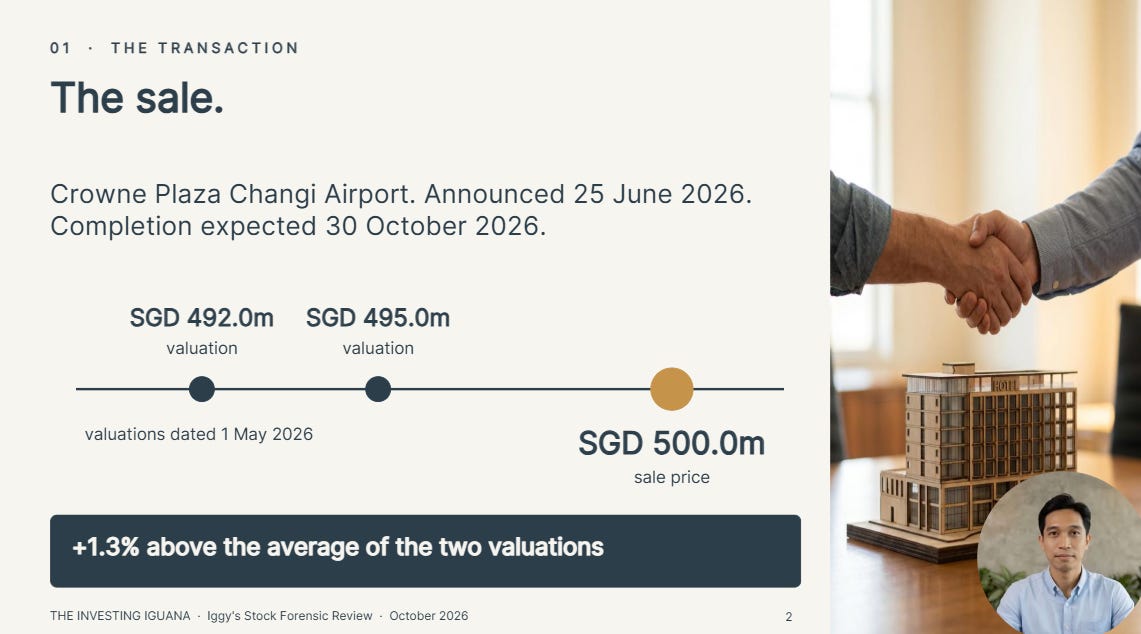
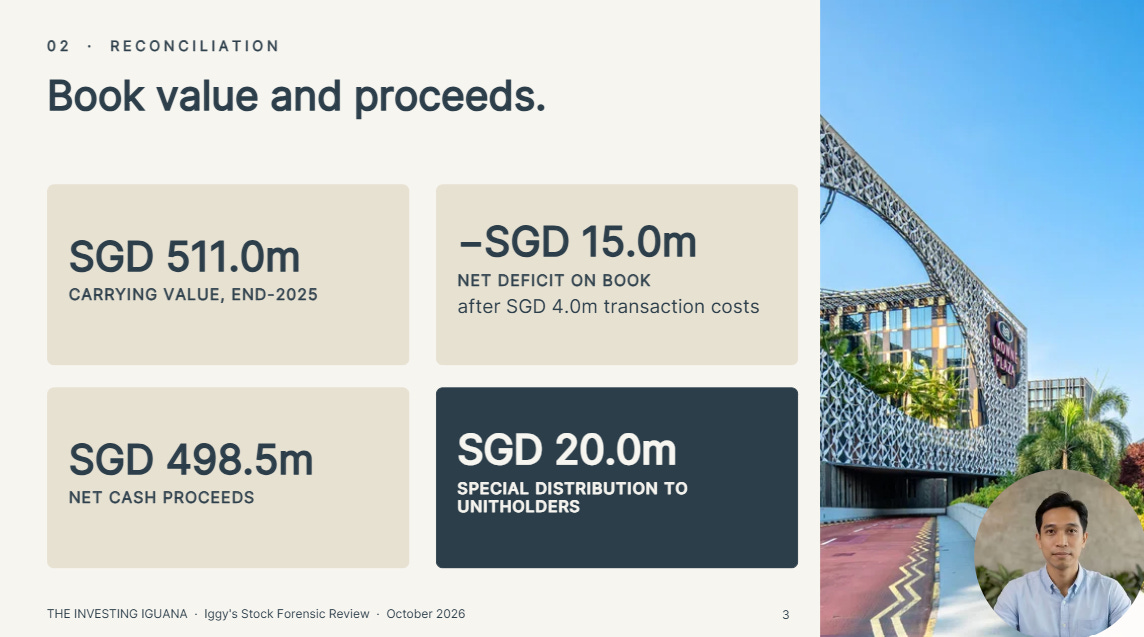
On 25 June 2026 OUE REIT announced the sale of Crowne Plaza Changi Airport for SGD 500.0 million. That is 1.3% above the average of two independent valuations, SGD 492.0 million and SGD 495.0 million, both dated 1 May 2026. The hotel was carried at SGD 511.0 million at the end of 2025, so the price is SGD 11.0 million lower, and after about SGD 4.0 million of divestment costs the circular shows a net deficit of SGD 15.0 million against book value. The company puts net cash proceeds at about SGD 498.5 million and intends to pay about SGD 20.0 million of that to unitholders as a special distribution, spread evenly over the first two years after completion. Completion is expected on 30 October 2026.
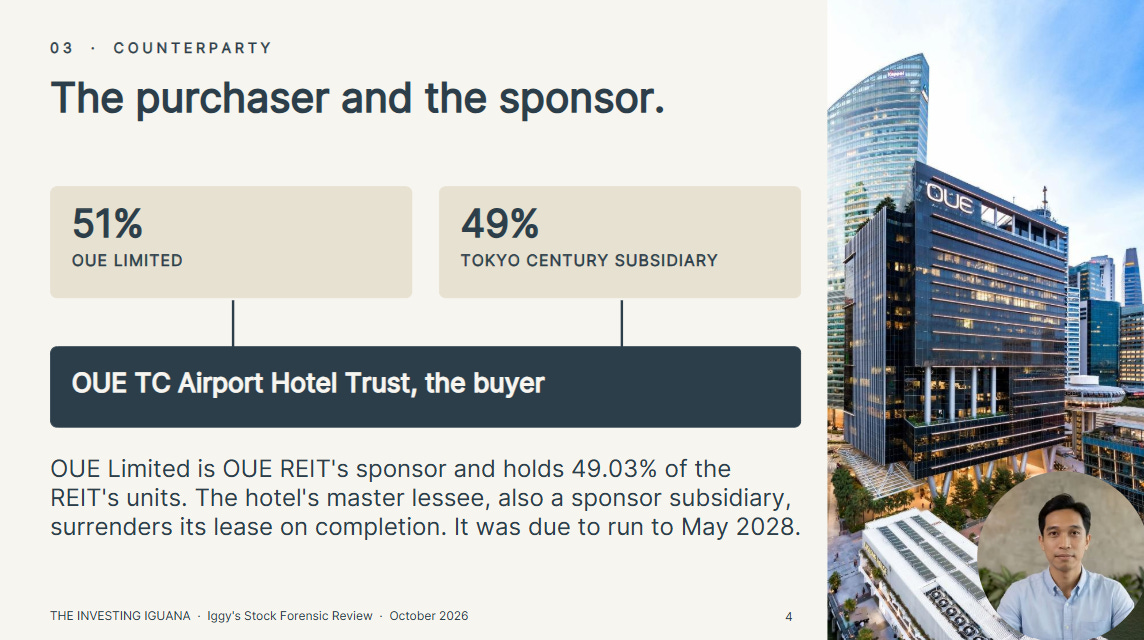
The purchaser is OUE TC Airport Hotel Trust. It is owned through a joint venture company in which OUE Limited, the REIT’s sponsor, holds 51% and a subsidiary of Tokyo Century Corporation holds 49%. As the circular states, OUE Limited also holds 49.03% of OUE REIT’s units. The hotel’s master lessee, which pays the REIT rent under a lease the circular says runs to May 2028, is a subsidiary of the sponsor as well, and the circular has that lease surrendered as the sale completes. I am not suggesting anything was done wrongly.
The rules for a deal like this require independent scrutiny, and the documents show it. Deloitte, as independent financial adviser, found the terms normal and not prejudicial to minority unitholders.
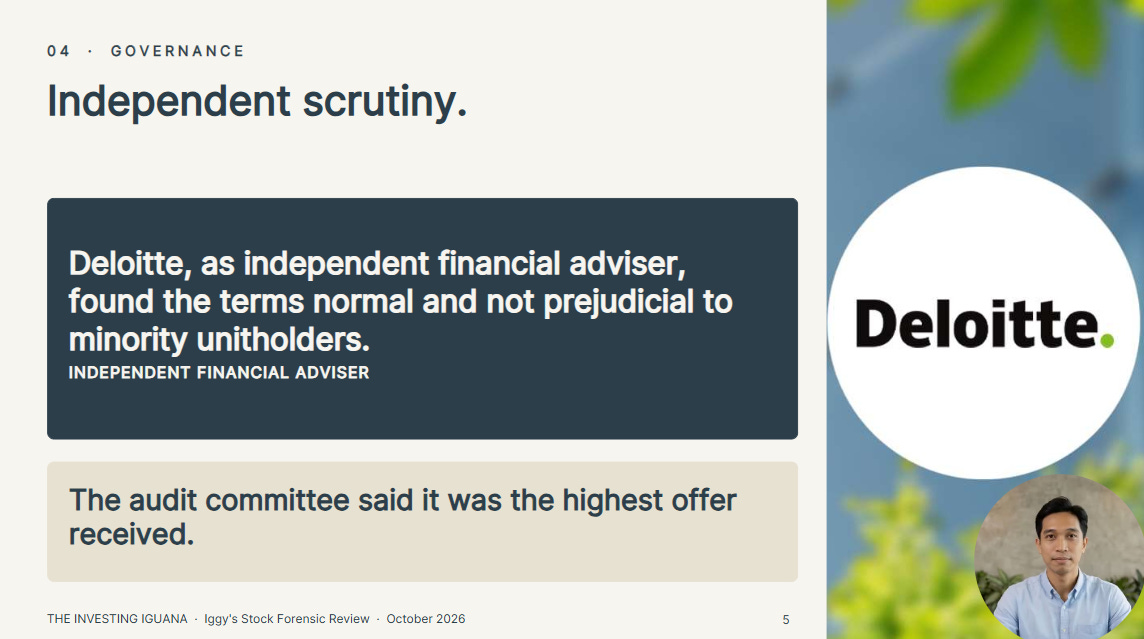
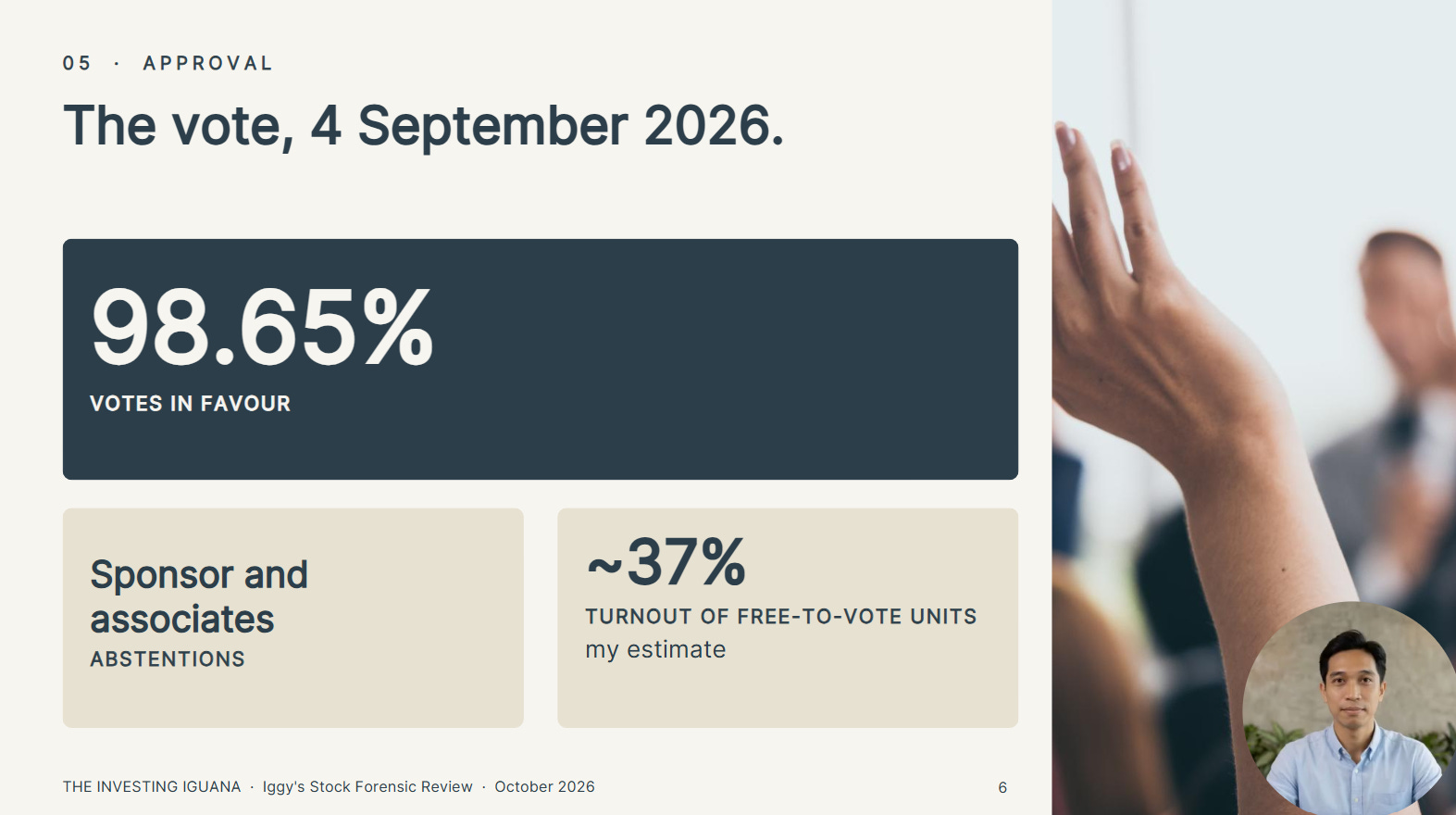
The audit committee said it was the highest offer received. At the vote on 4 September, 98.65% of the votes cast were in favour, with the sponsor and its associates abstaining. By my estimate, about 37% of the units free to vote took part.
That is the deal on its own terms. The next table is where the headline comes from.
What the DPU table counts
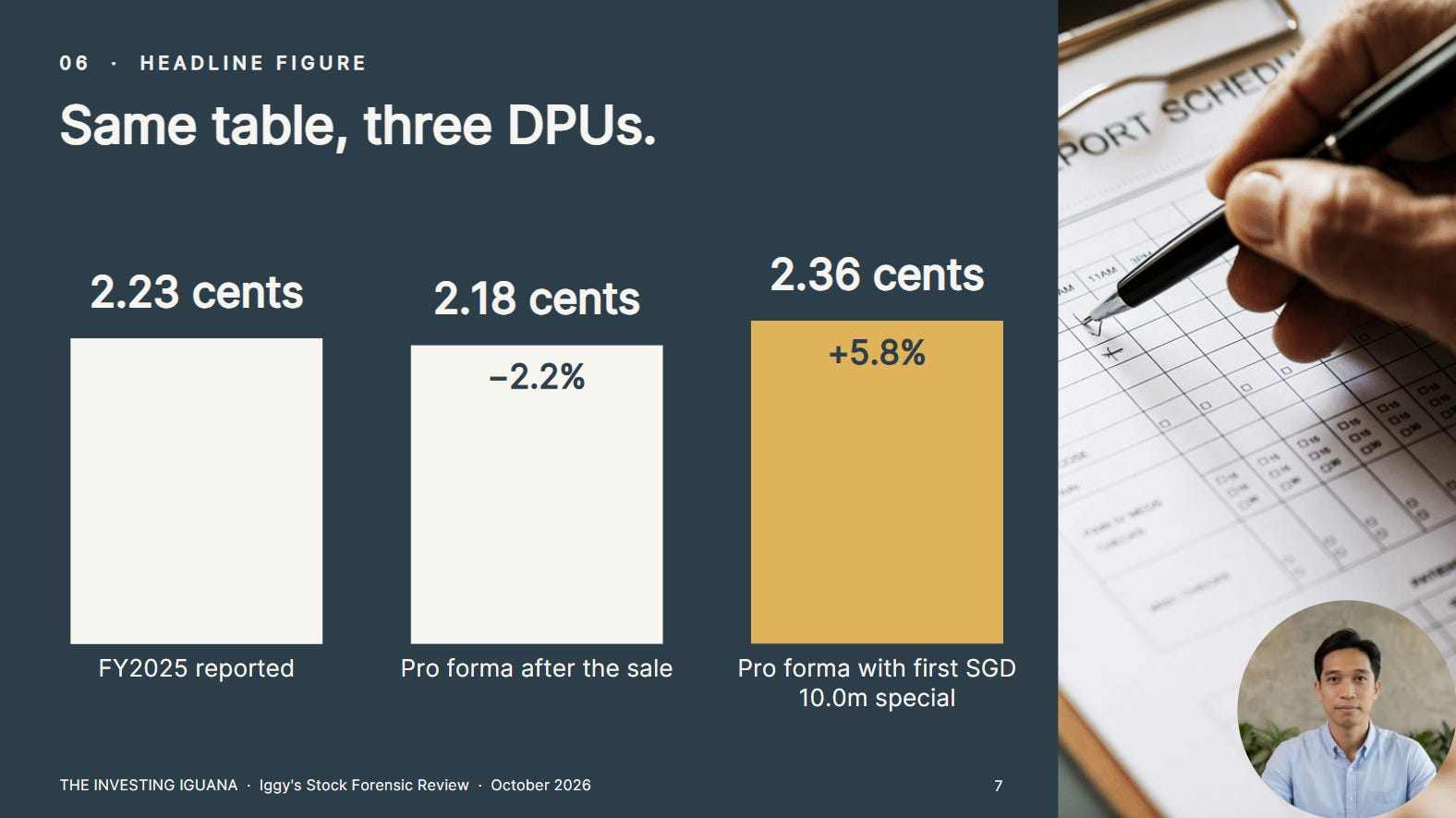
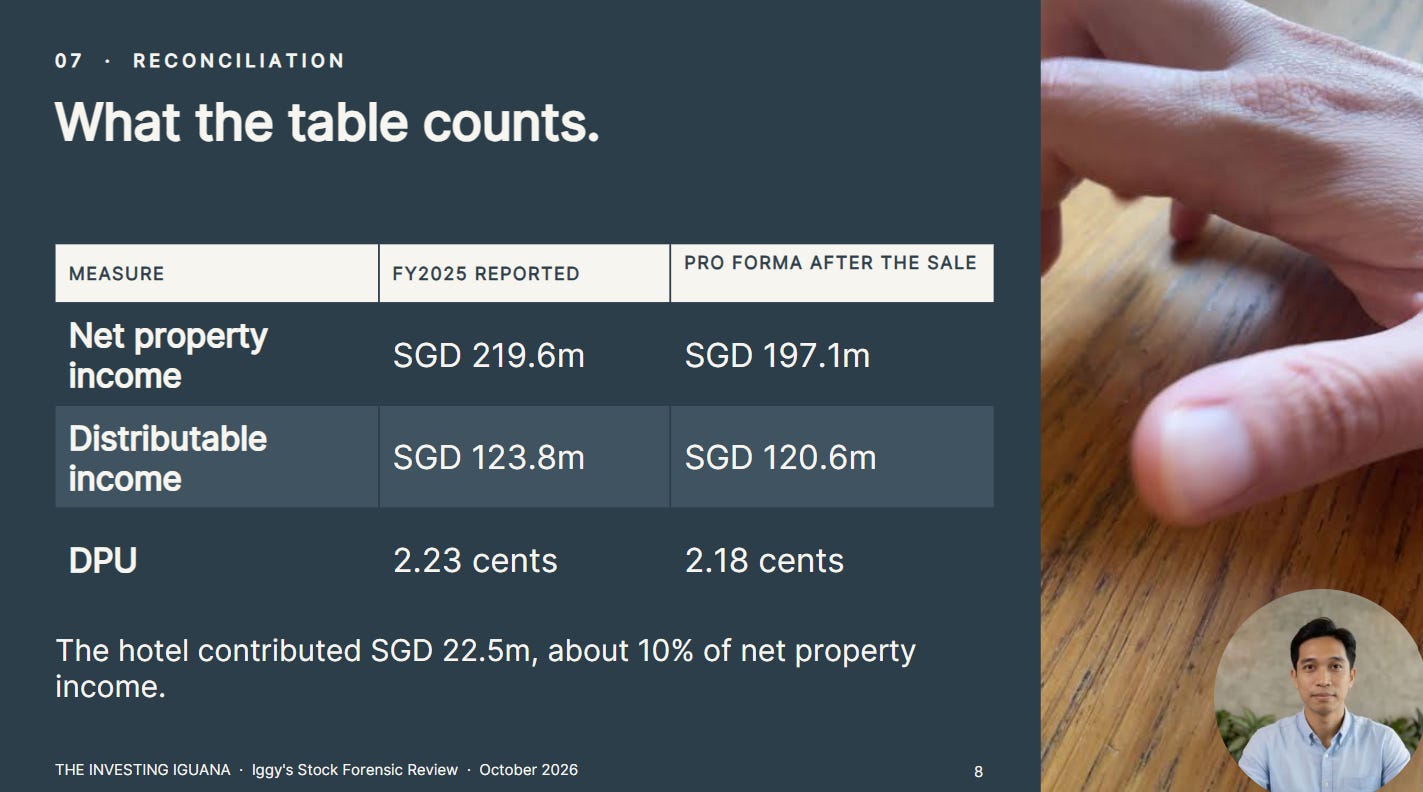
The circular restates FY2025 as if the sale had completed on 1 January 2025. Net property income falls from SGD 219.6 million to SGD 197.1 million, because the hotel contributed SGD 22.5 million, about 10% of the total. Distributable income falls from SGD 123.8 million to SGD 120.6 million, because the interest saved on the debt repaid offsets most of the lost income. DPU goes from 2.23 cents to 2.18 cents, a fall of 2.2%. Then the table adds the first SGD 10.0 million of the special distribution, and DPU becomes 2.36 cents, which is 5.8% above 2.23. Net asset value per unit moves from SGD 0.56 to SGD 0.55, which is the SGD 15.0 million deficit plus that SGD 10.0 million, my arithmetic.
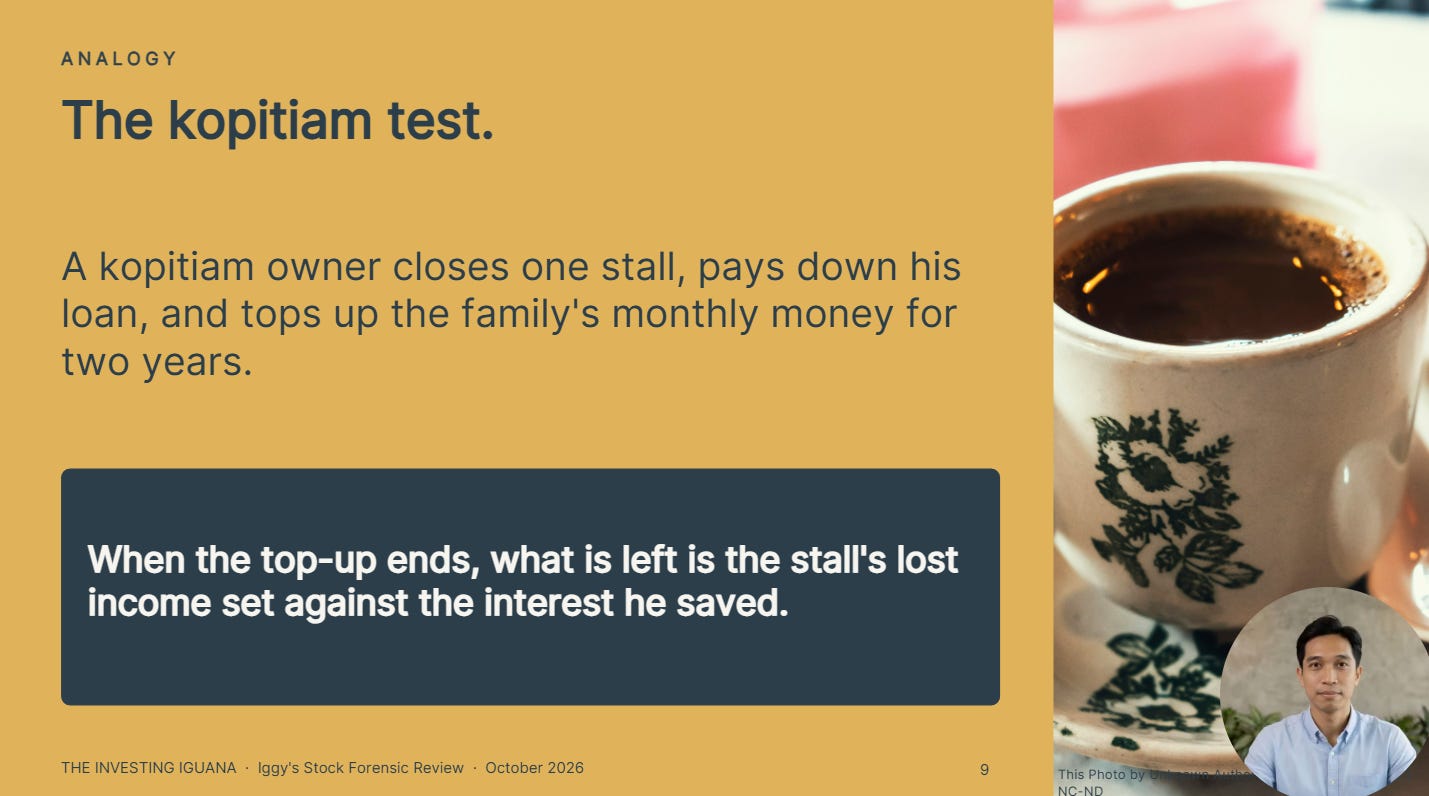
Think of a kopitiam owner who closes one stall, uses the money to pay down his loan, and tops up the family’s monthly money for two years. The monthly figure looks higher. When the top-up ends, what is left is the stall’s lost income set against the interest he saved.
The company’s announcement leads with the 5.8%. The special distribution is SGD 20 million in total, paid over two years, and the circular says its structure, timing and amount are subject to change. After that the base is 2.18 cents.
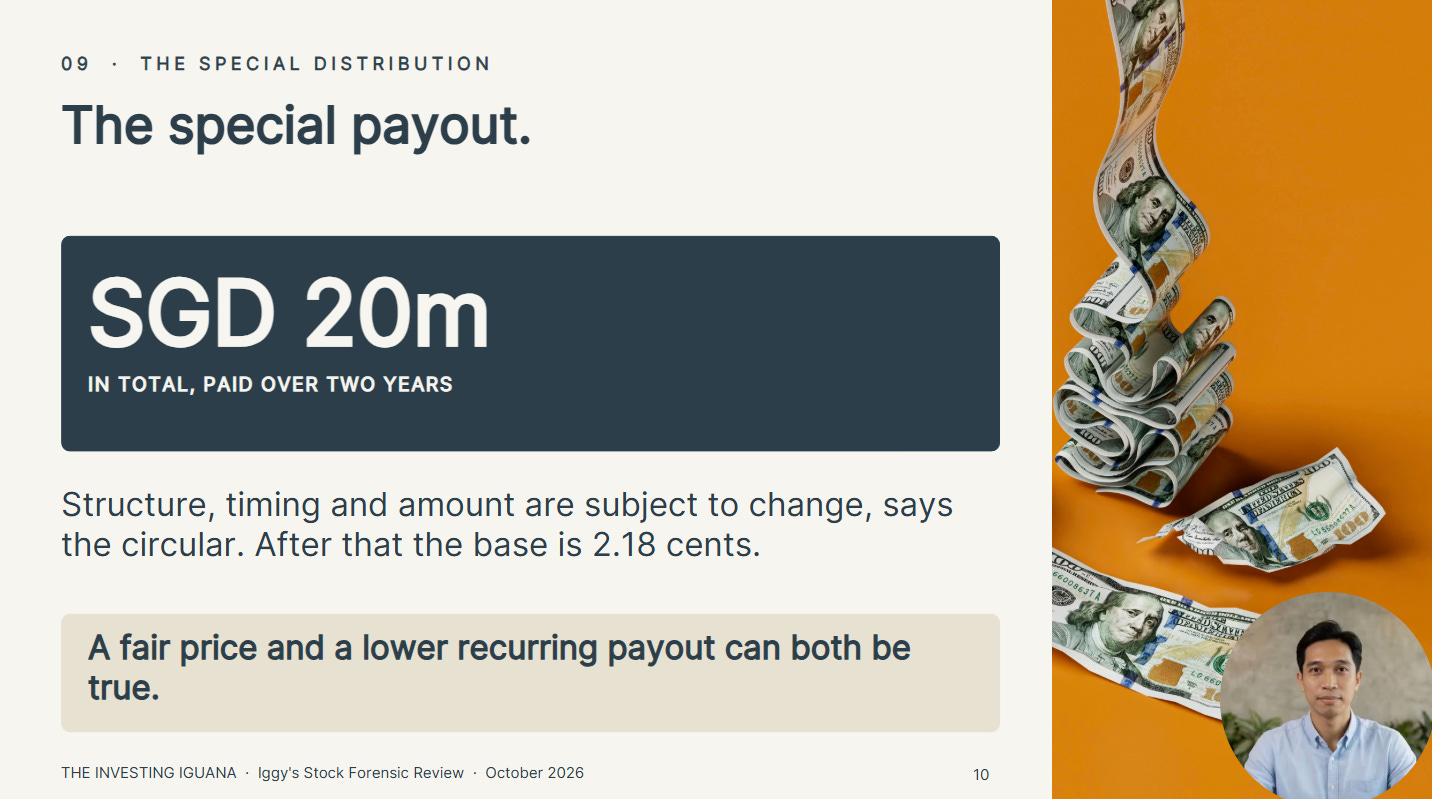
A reader will say: “The price is above both valuations, an independent adviser says the terms are fair, and nearly everyone voted yes. Surely that settles it?” It settles whether the price is fair, and I have no evidence that it is not. A fair price and a lower recurring payout can both be true, and the circular shows both in adjacent columns.
What the First-Half Results Show
Hotels supplied almost all of the growth
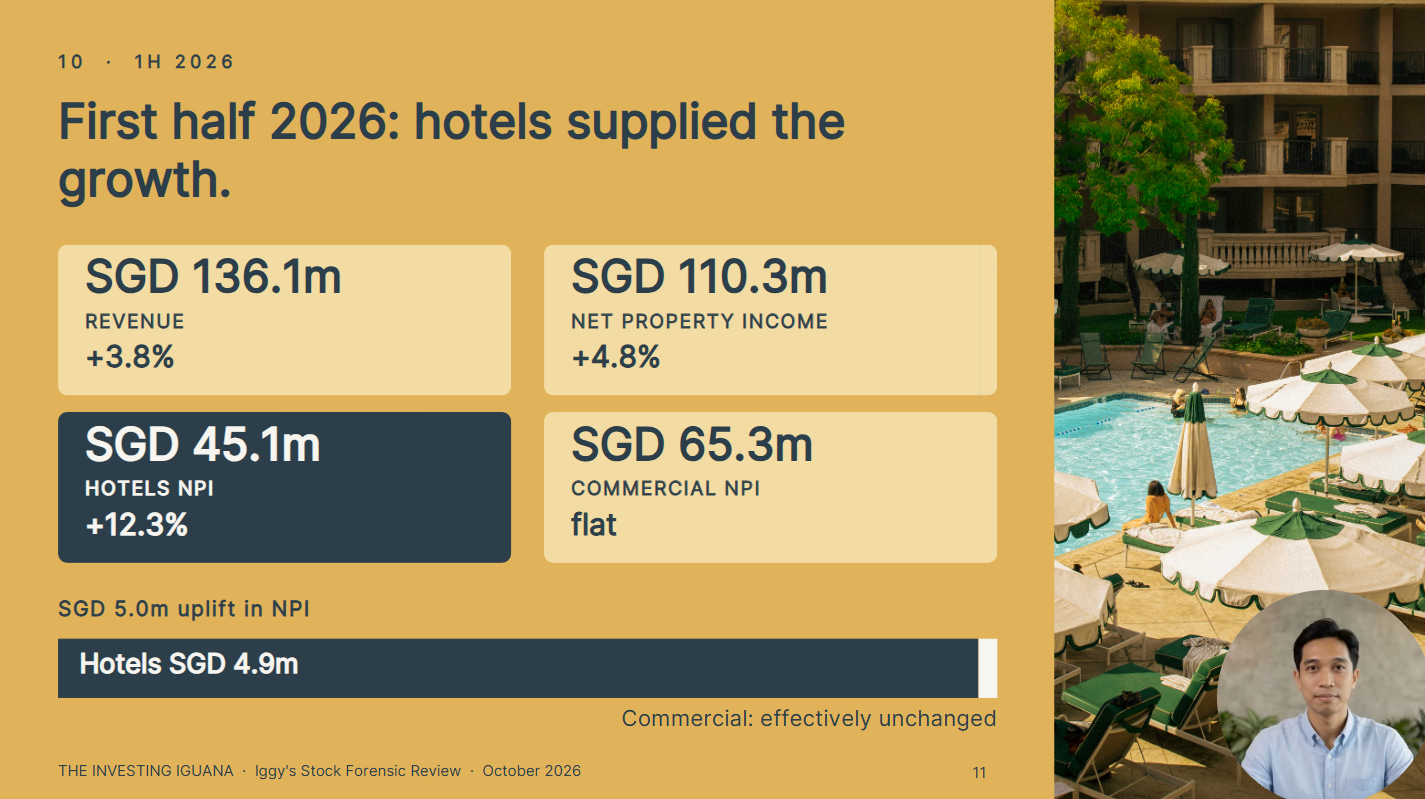
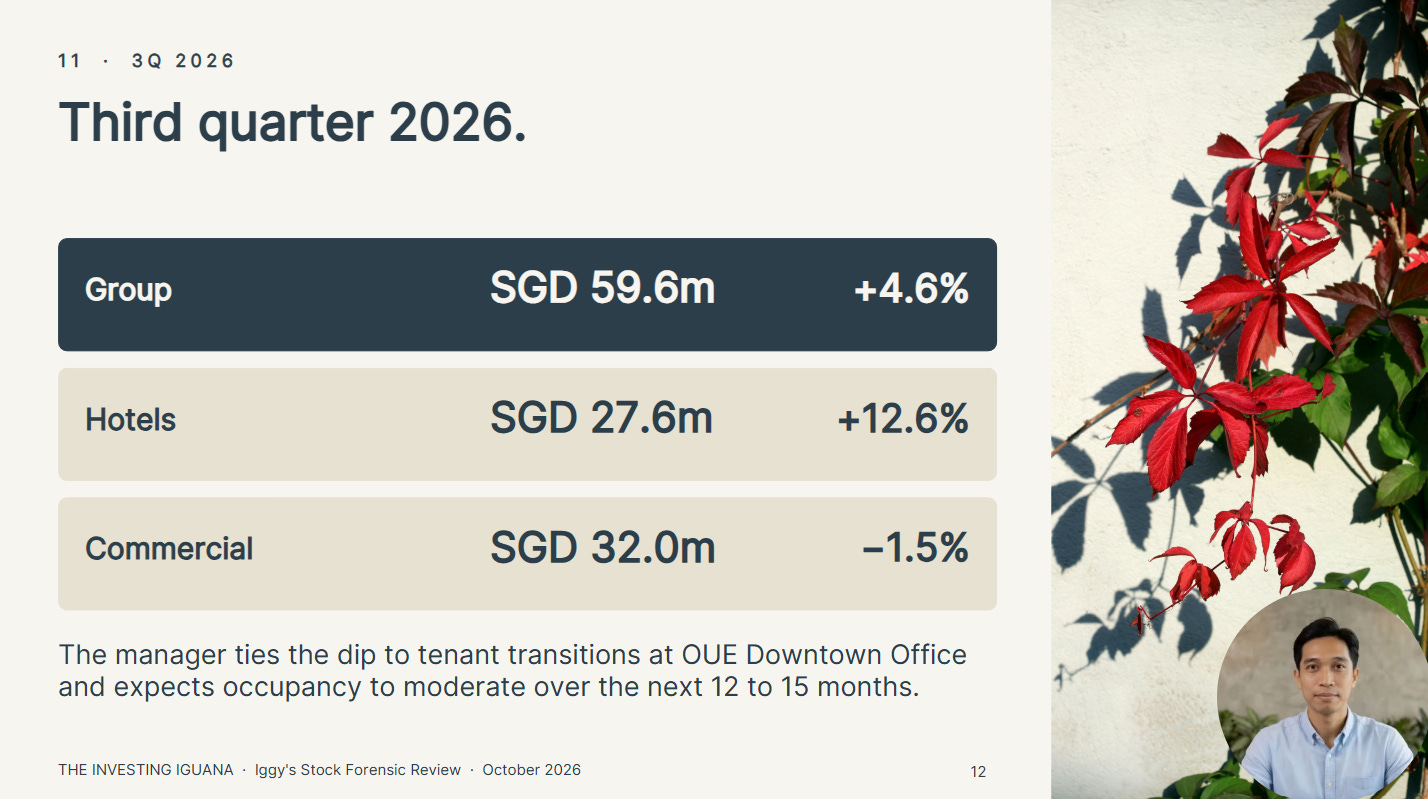
For the six months to 30 June 2026, revenue was SGD 136.1 million, up 3.8%, and net property income was SGD 110.3 million, up 4.8%. Of the SGD 5.0 million increase in net property income, SGD 4.9 million came from the two hotels, whose income rose 12.3% to SGD 45.1 million. The commercial properties, One Raffles Place, OUE Downtown Office and Mandarin Gallery, were flat at SGD 65.3 million. The third-quarter update on 21 October has the same shape. Group net property income rose 4.6% to SGD 59.6 million, the hotels rose 12.6% to SGD 27.6 million, and the commercial segment fell 1.5% to SGD 32.0 million. The manager ties the commercial dip to tenant transitions at OUE Downtown Office and expects occupancy to moderate over the next 12 to 15 months.
A lighter interest bill did the rest
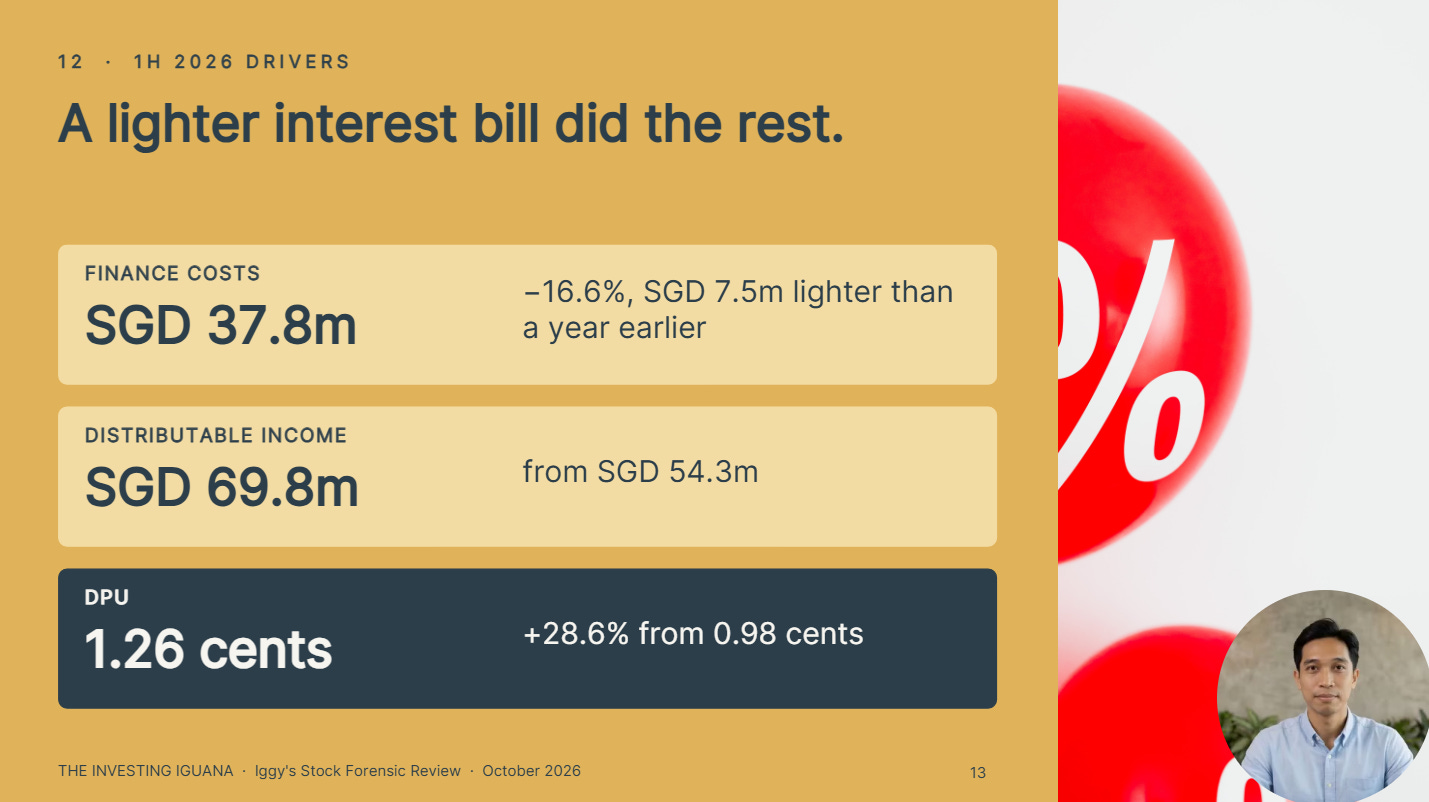
Finance costs fell 16.6% to SGD 37.8 million, which is SGD 7.5 million less than a year earlier. Distributable income rose from SGD 54.3 million to SGD 69.8 million, and DPU from 0.98 to 1.26 cents, up 28.6%. The first-half accounts also carry a SGD 16.1 million fair value loss on the hotel, booked when it was reclassified as held for sale at the agreed price. It is a non-cash item that the company adds back in the distribution statement, which is standard practice.
🦖 Iggy’s Insights
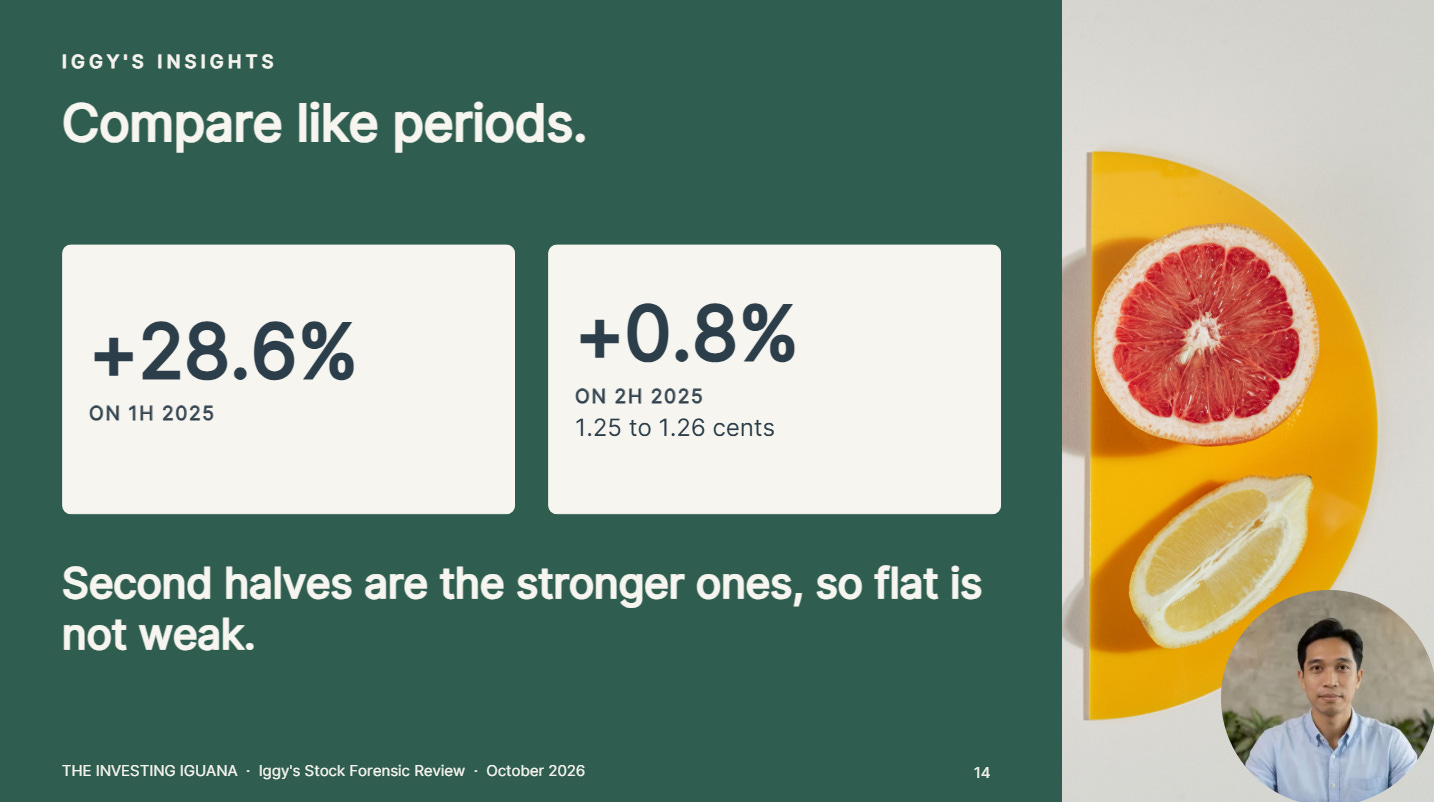
A year-on-year jump and a half-on-half step tell different stories. OUE REIT’s DPU rose 28.6% on the first half of 2025. Against the second half of 2025 it rose 0.8%, from 1.25 cents to 1.26. Second halves have been the stronger ones, so flat is not weak. But the 28.6% rests on a low base and on an interest bill SGD 7.5 million lighter. A saving like that lifts the number once, and the next comparison starts from the lower bill. When a company quotes growth, ask which period it is measured against, then ask what the next comparison looks like.
Where OUE REIT Sits on My Framework
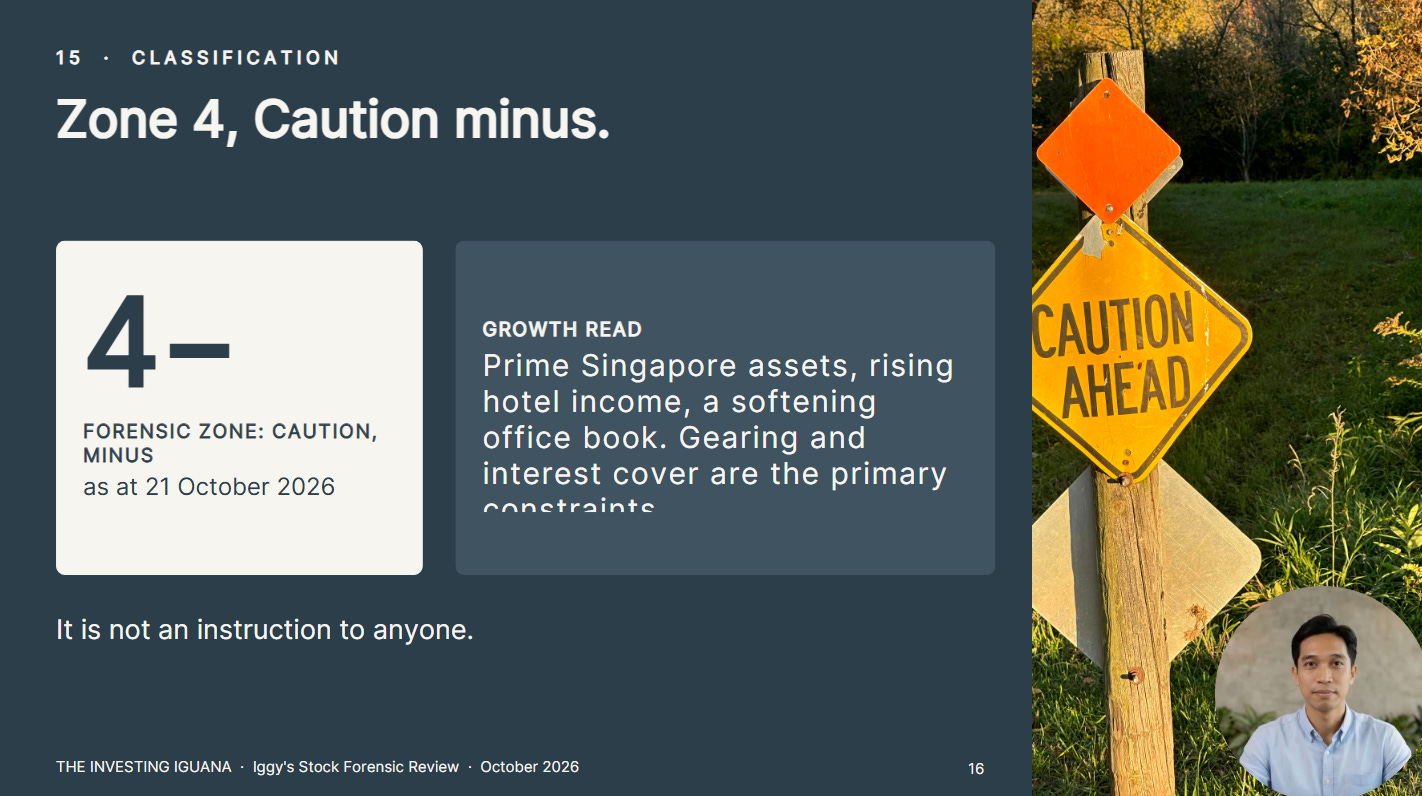
Iggy’s Forensic Zone: Zone 4, Caution - (Growth Read: prime Singapore assets with rising hotel income but a softening office book, gearing and interest cover are the primary constraints)
The zone is as at 21 October 2026 and will be recalculated against the price on the day I next cite it. Zone 4 describes how my framework is calibrated. It is not an instruction to anyone. The framework is built around a reader drawing income in retirement, so it applies fixed tests to every company. Someone with many years before drawdown may reasonably sit through the swings it is built to flag, and someone using money beyond what retirement income needs may reasonably hold a company to a different standard. The paid section shows which tests set the label and by how much.
What the Payout Looks Like at SGD 0.33
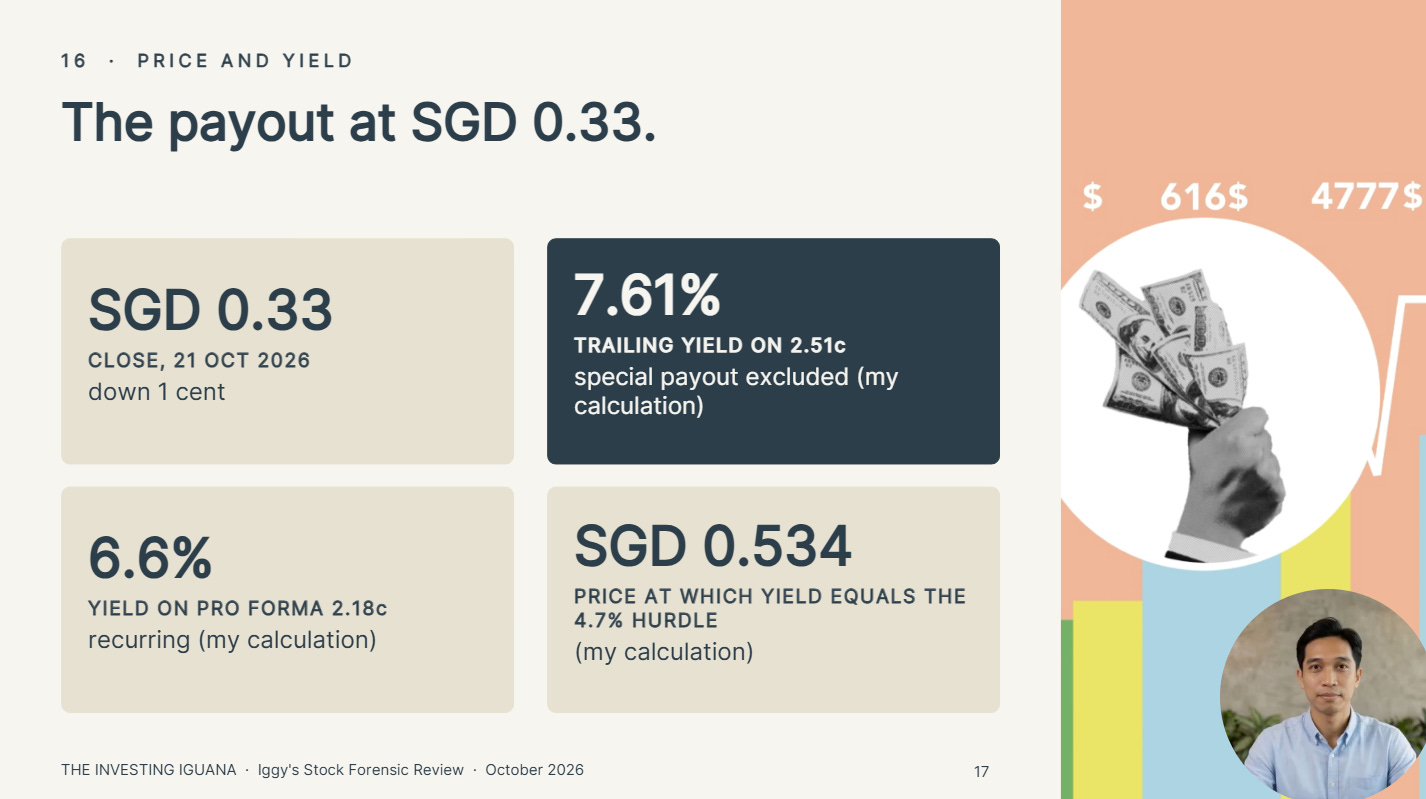
OUE REIT closed at SGD 0.33 on 21 October, down 1 cent on the day, according to market data pages. The third-quarter update came out after that close, so prices since then may differ, and I will say so if I cite a later one. The last two half-year payments were 1.25 cents for the second half of 2025 and 1.26 cents for the first half of 2026. That is 2.51 cents over the trailing twelve months, and at SGD 0.33 a yield of 7.61%, my arithmetic. It clears my 3.2% forensic floor on yield and my 4.7% hurdle by a wide margin. It would equal the hurdle only at about SGD 0.534. Even on the pro forma recurring DPU of 2.18 cents it would be 6.6%. The special distribution is not in these figures, because a one-off payment is never added to the governing yield.
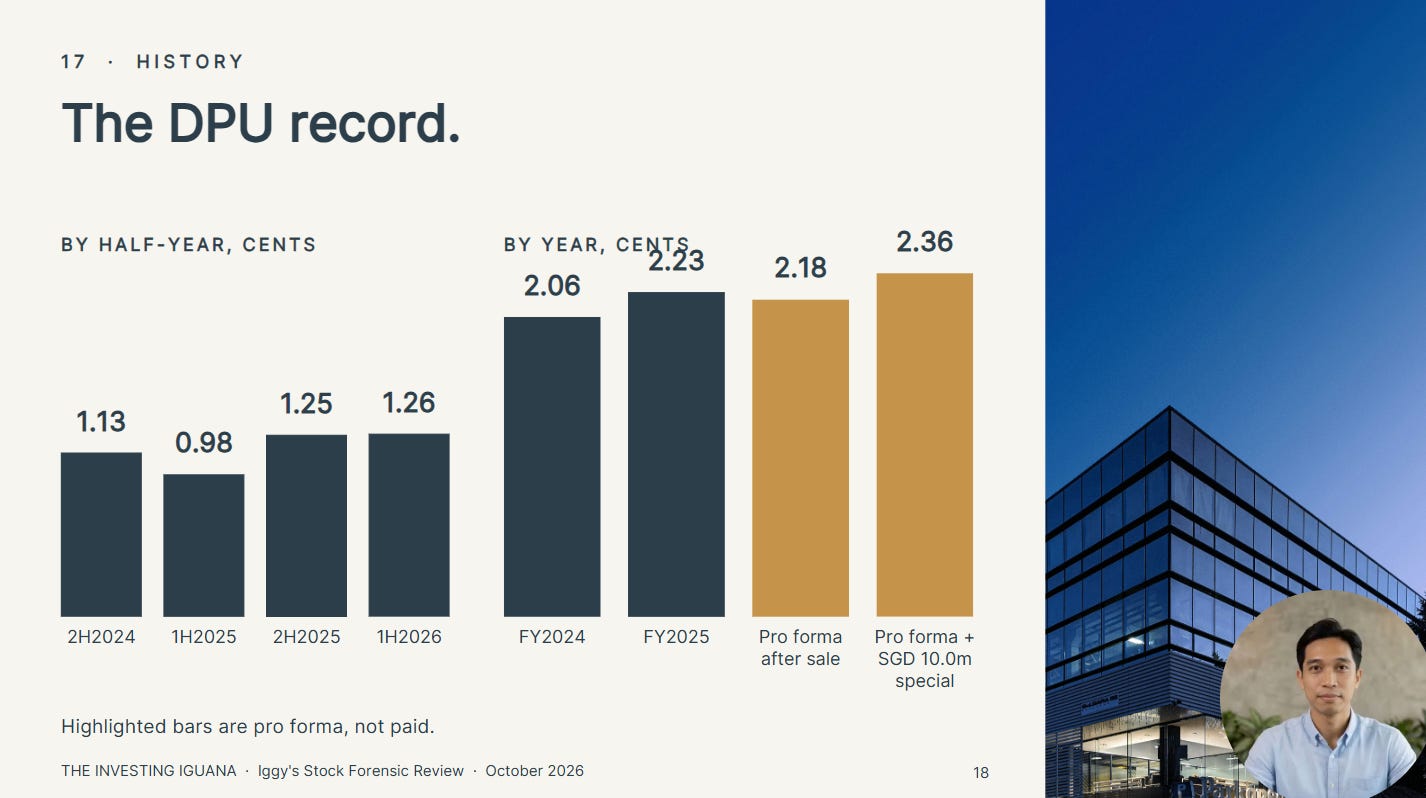
Source: company results releases and the circular. The company reported FY2025 DPU up 8.3% on FY2024, so the record is genuinely rising. It is a record built on falling interest costs and a stronger hotel segment, and the table’s last two rows are pro forma, not paid.
What paid the first-half distribution
In the first half, cash from operations was SGD 81.2 million. After interest paid of SGD 35.3 million, capital spending of SGD 15.1 million, and adding dividends from the OUE Bayfront joint venture of SGD 8.8 million and interest received of SGD 0.8 million, about SGD 40.4 million was left, my arithmetic.
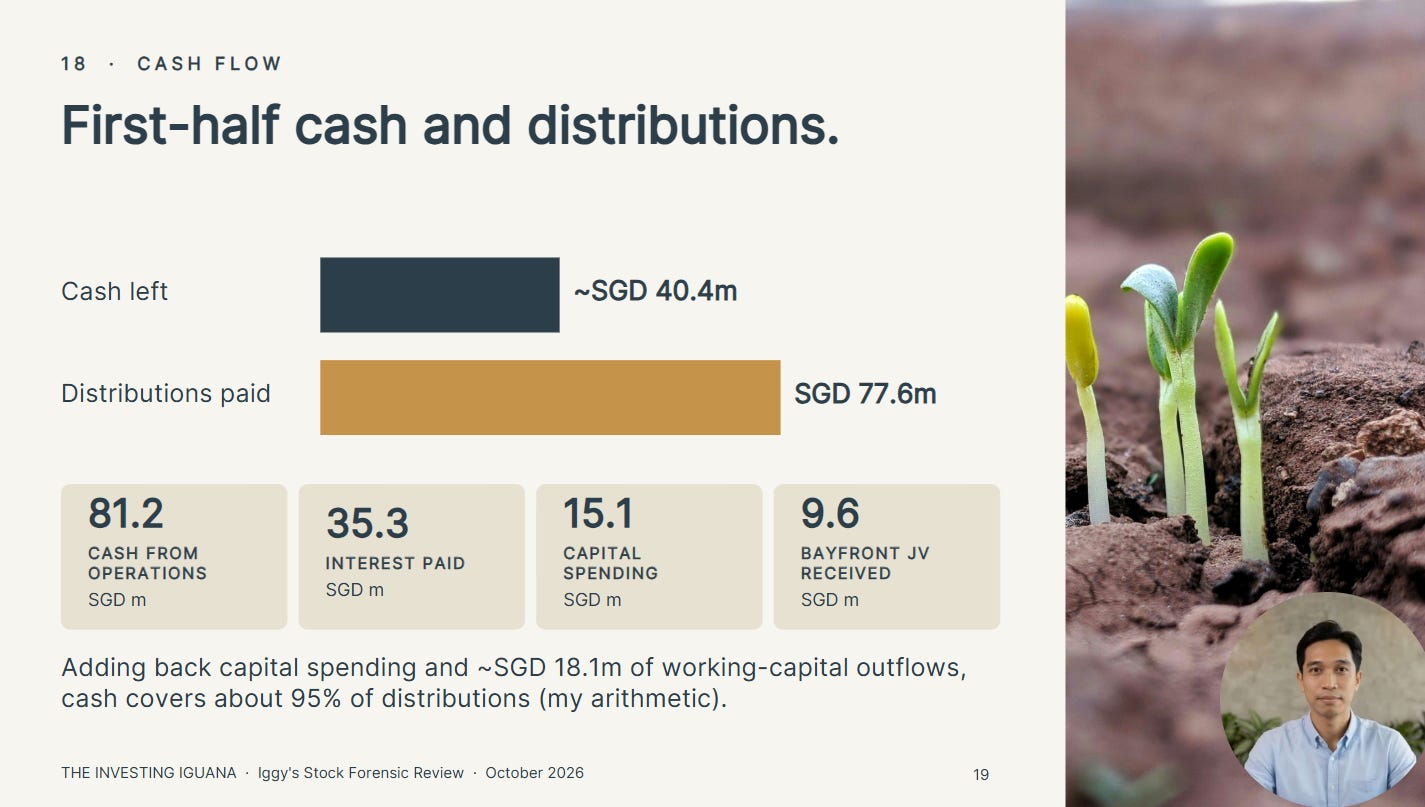
Distributions paid in the half were SGD 77.6 million, made up of SGD 69.1 million to unitholders, SGD 7.4 million to minority holders in One Raffles Place’s owner and SGD 1.1 million to the perpetual unit holder. Add back the capital spending and about SGD 18.1 million of working-capital outflows, which the filing ties to a performance fee payment, refunds of rental deposits, progress payments on One Raffles Place and a land rent deposit, and the cash covers about 95% of those distributions. The interim statements say borrowings rose mainly because of loan drawdowns for the March distribution and for the Sydney acquisition.
A household that tops up one month’s allowance from its overdraft has proved nothing. A pattern is a different matter, and one half is not a pattern.
What else is in motion
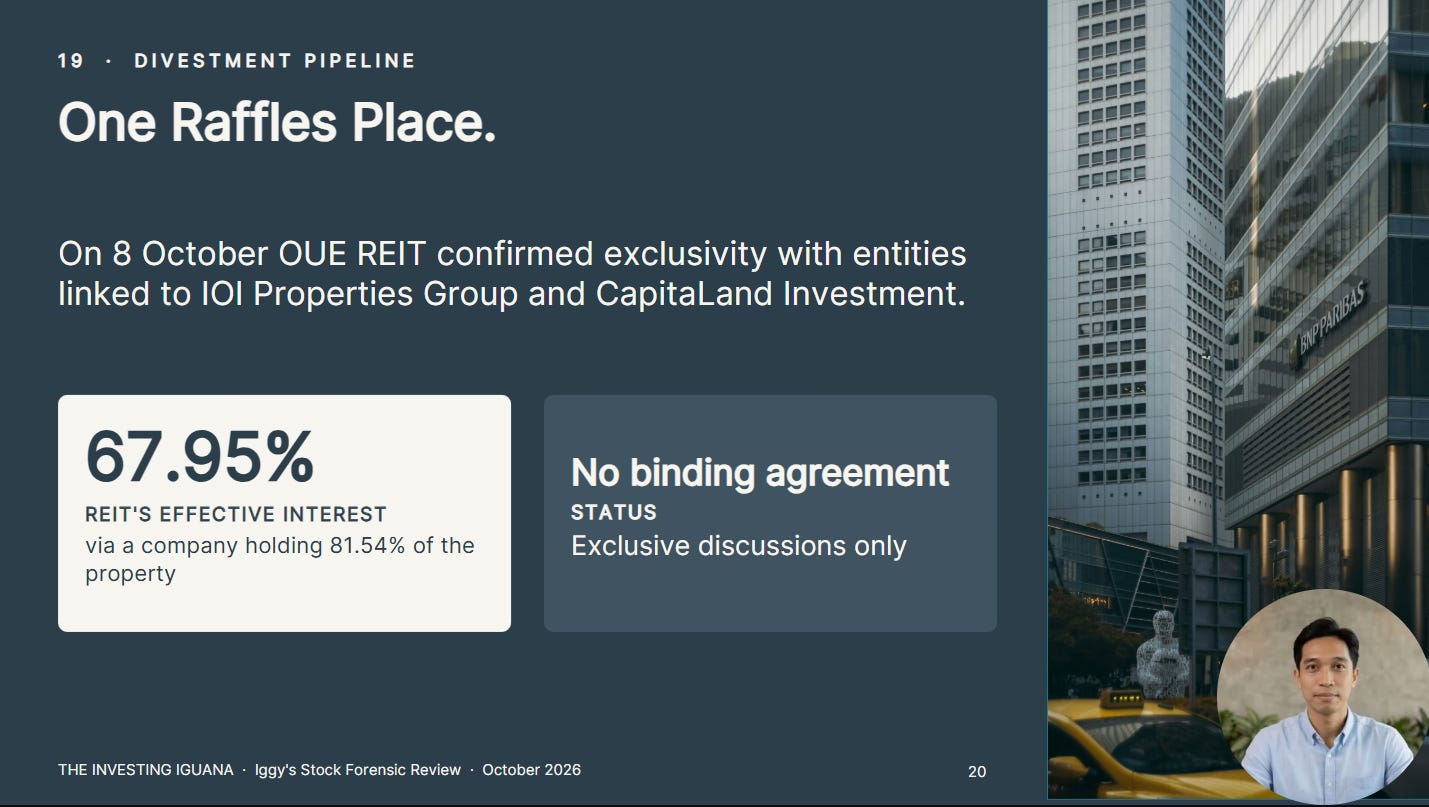
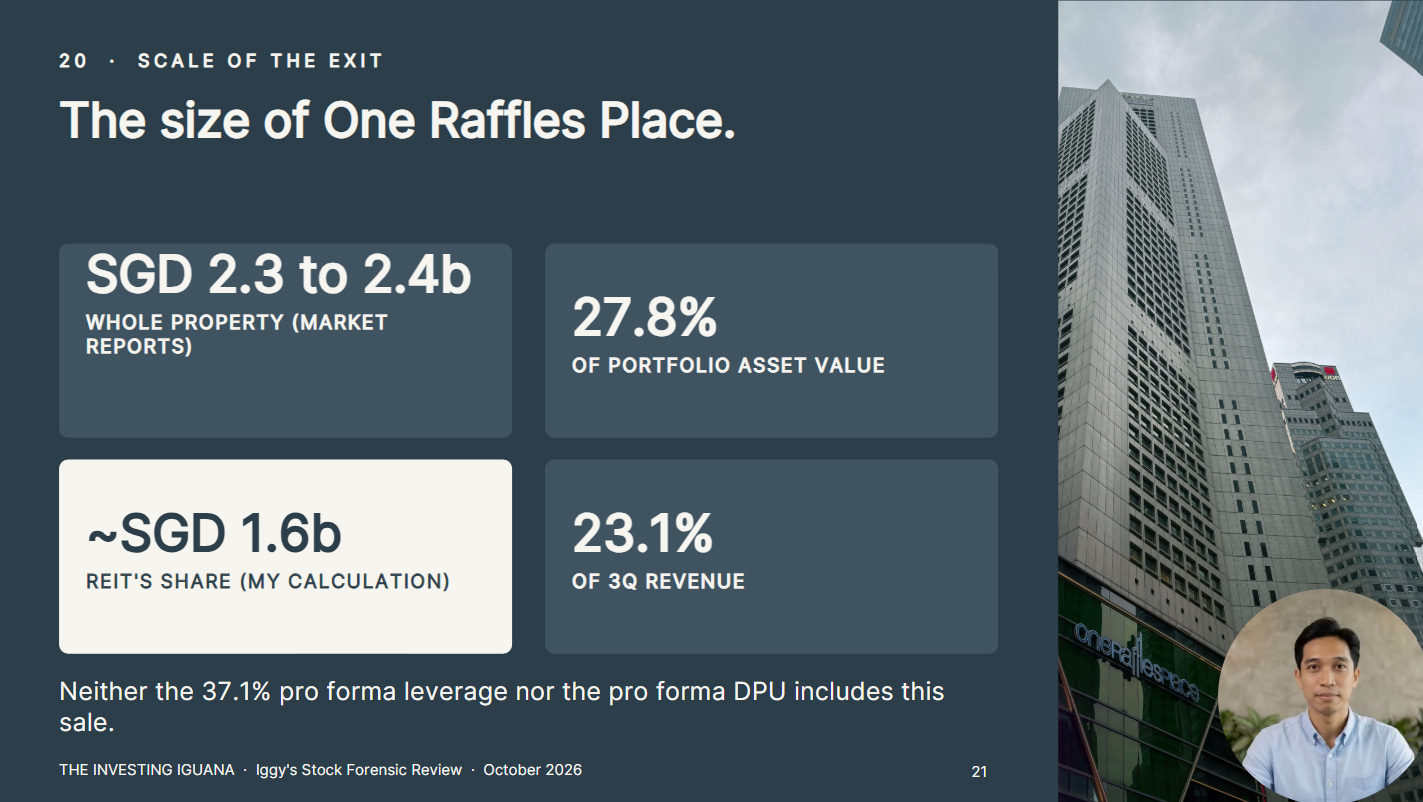
Crowne Plaza Changi Airport is the first sale. On 8 October OUE REIT confirmed that it is in exclusivity with entities linked to IOI Properties Group and CapitaLand Investment over the sale of One Raffles Place, and that no binding agreement has been signed. The REIT’s effective interest is 67.95%, through a company that owns 81.54% of the property. Market reports put the price between about SGD 2.3 billion and SGD 2.4 billion for the whole property, close to its end-2025 valuation of about SGD 2.37 billion on the same basis, my arithmetic. On those figures the REIT’s share would be about SGD 1.6 billion. One Raffles Place is 27.8% of the portfolio’s asset value on the company’s proportionate basis, and 23.1% of third-quarter revenue. The third-quarter update lists the negotiations as a chance to reallocate capital and does not say the REIT is the seller. The 8 October confirmation does. Neither the 37.1% pro forma leverage nor the pro forma DPU includes this sale.
What the Paid Half Adds
The free half has set out what the circular says, where the first-half growth came from, how the distribution was funded and where OUE REIT sits on my framework. What it has not shown is why the label is what it is. The paid half sets out how much debt the REIT carries and how the company’s own ratio is built, what interest cover looks like with and without the perpetual units, how far office occupancy has slipped, and which tests set the label and by how much. It then puts OUE REIT beside two other REITs on the same tests and works through what the payout means for someone who bought at a different price.
The Substack Only Plan, US$8 a month, gives you the full written analysis, the portfolio walkthroughs and the analyst cheatsheets.
The YouTube Only Plan, S$5 a month, gives you the full-length Members Edition video.
The YouTube/Substack Combo, S$12 a month, gives you all of it.

🔒 What’s Next
The 7.61% yield clears my hurdle with room to spare. The leverage and interest cover figures in the next section show why that number alone does not decide the label.
