




Two companies most people lump into the same bucket, “Singapore property stocks”, report results this week. And the more I looked at them side by side, the less alike they turned out to be.
Both CapitaLand Investment and City Developments report their first-half results on 13 August. Same sector, same reporting date, completely different businesses, and as it turns out, a similar problem underneath both of them.
YOUR FORENSIC VERDICT, ONE PAGE.
The full audit is above. This is the Iggy Forensic Audit distilled to one A4 page — every number that matters, every flag that triggered, one clear verdict. Save it, print it, pull it out when this stock crosses your radar again, or when you need to refer to these data points for your retirement planning.

Two ways of making money in property
Angela’s Observation
What CDL is dealing with right now
What CLI is dealing with right now
Angela’s Observation
What to watch when results land
Two ways of making money in property
Here’s the distinction that took me longer than I’d like to admit to actually understand.

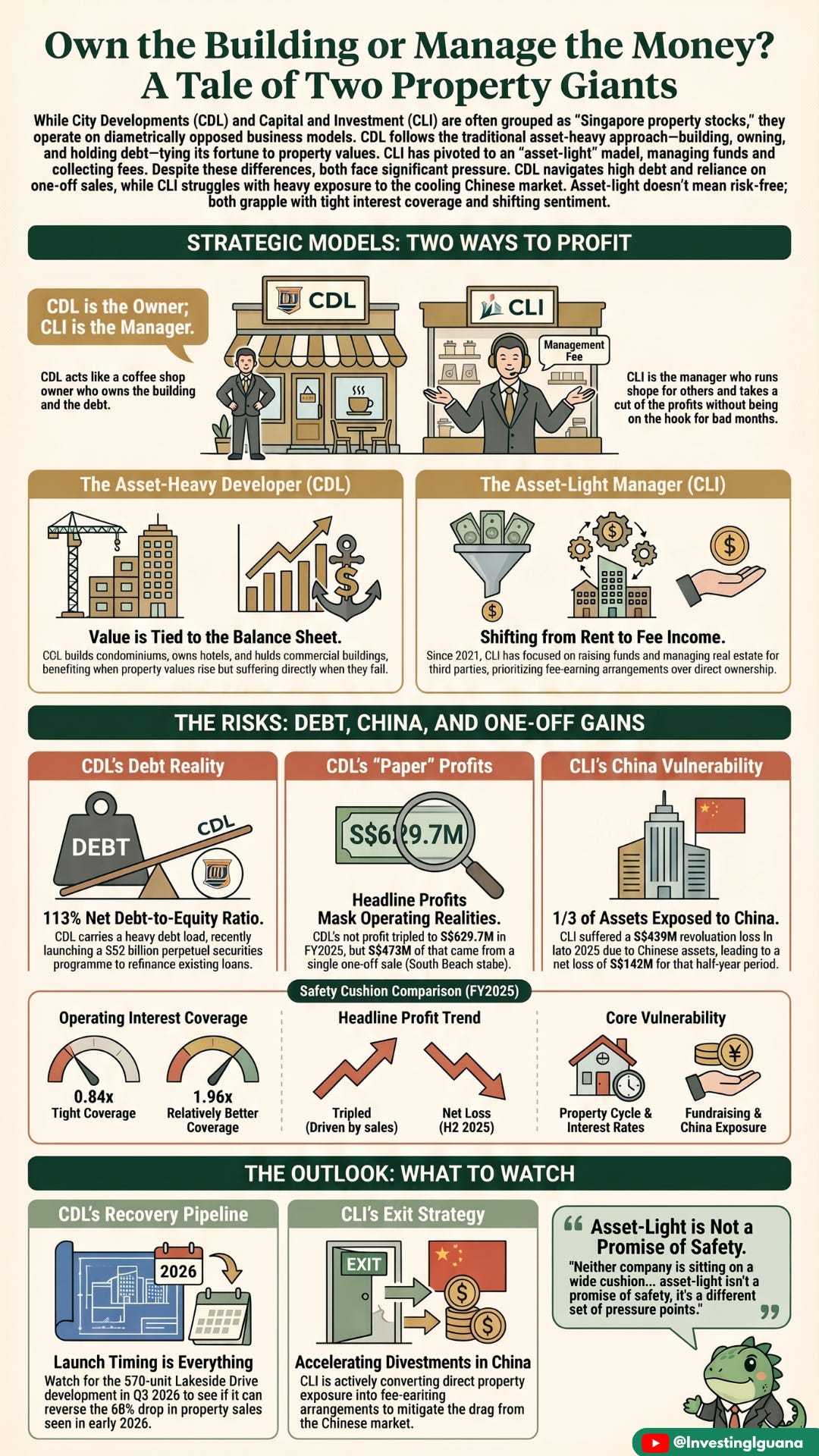
City Developments does what most people picture when they think “property company.” It builds condominiums, sells the units, owns hotels, and holds commercial buildings on its own balance sheet. When property values rise, CDL’s asset base rises with them. When property values fall, or when interest rates on all that borrowed money climb, CDL feels it directly, because it’s the one holding the building and the debt.

CapitaLand Investment doesn’t really do that anymore, not in the way it used to. Since 2021, the company has been deliberately shifting away from owning property directly and toward managing money on behalf of other investors. It raises funds, buys and manages real estate on their behalf, and collects a fee for doing so. This is the “asset-light” model you might have heard mentioned in passing. CLI still owns some property directly, but a growing share of its business now comes from fee income rather than rental income or capital appreciation.

Think of it this way. CDL is like owning the coffee shop. CLI is more like being the person who manages coffee shops for other owners and takes a cut of the profits, without personally being on the hook if the shop has a bad month.
That distinction matters more than it sounds like it should, and it’s the whole reason I wanted to look at these two together.
🟠 Angela’s Observation
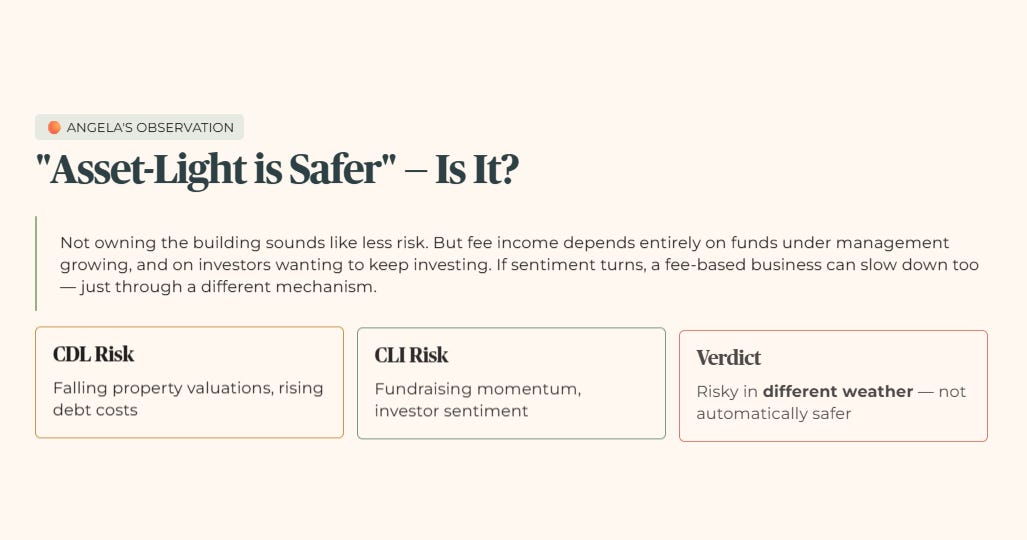
The thing that surprised me is how much easier it is to say “asset-light is safer” than it is to actually prove it. On paper, not owning the building sounds like less risk. You don’t carry the debt, you don’t carry the empty units if nobody wants to buy them. But fee income depends entirely on the funds under management actually growing, and on investors actually wanting to keep investing in your funds.
If sentiment turns, or if raising new capital gets harder, a fee-based business can slow down too, just through a different mechanism than a falling property valuation. I don’t think either model is automatically the safer one. I think they’re risky in different weather.
What CDL is dealing with right now
City Developments had a strong FY2025 on paper. Net profit after tax tripled to S$629.7 million for the year, and pre-tax profit doubled to S$771.5 million. A big part of that jump came from selling its 50.1 percent stake in the South Beach development to IOI Properties, a sale that generated a gain of roughly S$473 million on its own.
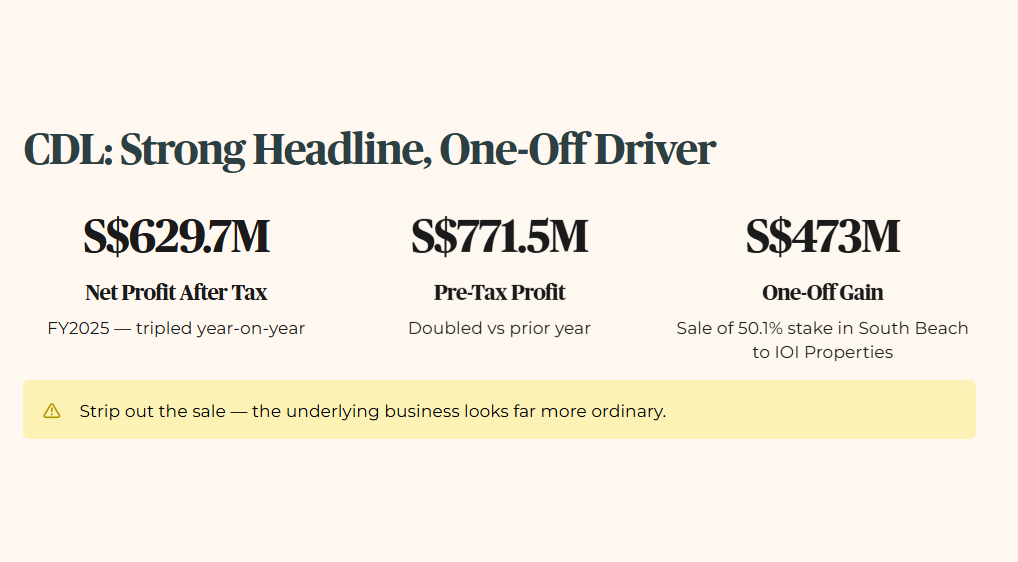
That’s a one-off. Strip out the sale and the underlying business looks a lot more ordinary. First-quarter 2026 property sales actually fell sharply, S$609.6 million worth of units sold, down 68 percent from S$1.9 billion in the same quarter a year earlier, mostly because there wasn’t a big launch this time around comparable to last year’s 777-unit project.
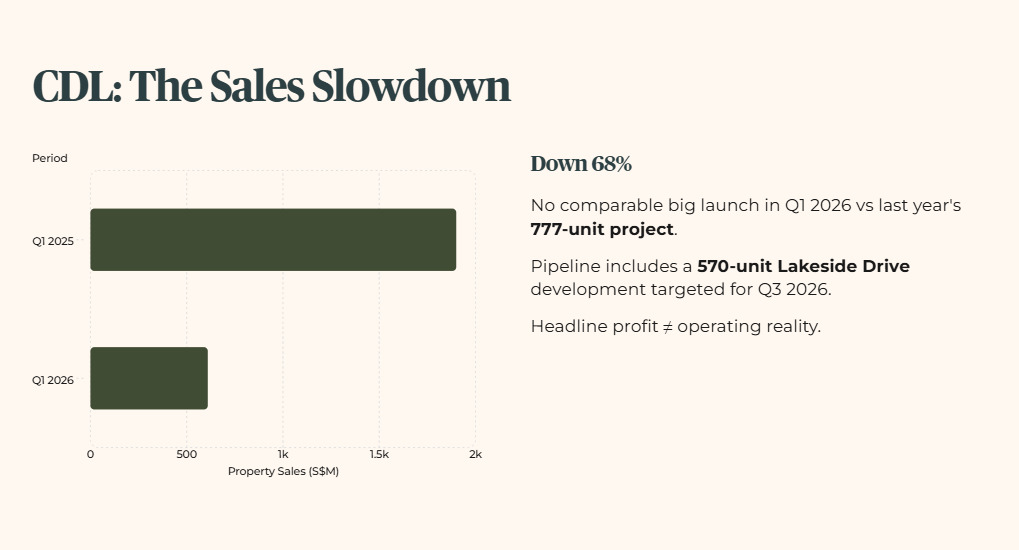
CDL does have new projects in the pipeline, including a 570-unit development on Lakeside Drive targeted for the third quarter of this year, so there’s more coming. But it tells you the headline profit number and the operating reality underneath it aren’t quite the same story.
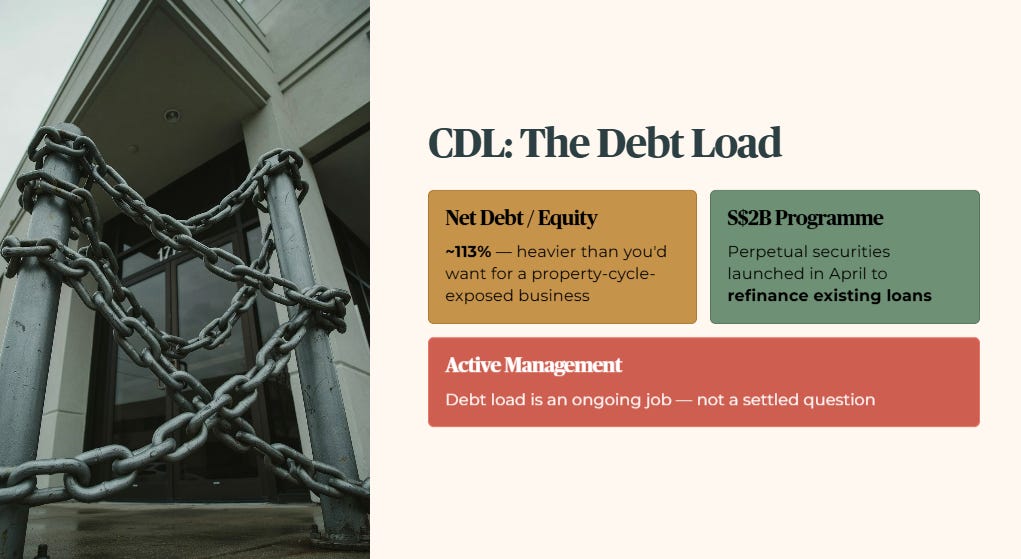
CDL also carries real debt. Net debt sits at roughly 113 percent of total equity, which is a heavier load than you’d want for a business this exposed to property cycles and interest rates. In April, the company launched a S$2 billion perpetual securities programme specifically to refinance existing loans, which tells you managing that debt load is an active, ongoing job, not a settled question.
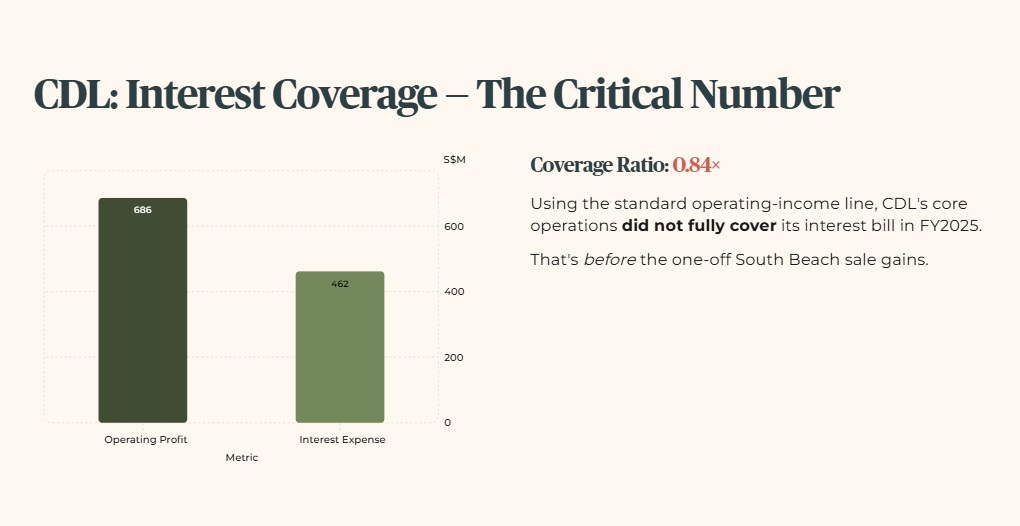
Here’s the part I keep coming back to. Using CDL’s full-year operating profit for FY2025, S$685.7 million, against its full-year interest expense of S$461.8 million, the company’s core operations covered its interest bill only 1.5 times over. Once you strip in the specific interest coverage calculation my team ran using the standard operating-income line, the figure comes out to 0.84 times, meaning operating income alone didn’t fully cover the interest bill for the year. That’s before the one-off property sale gains that made the headline profit number look so strong.
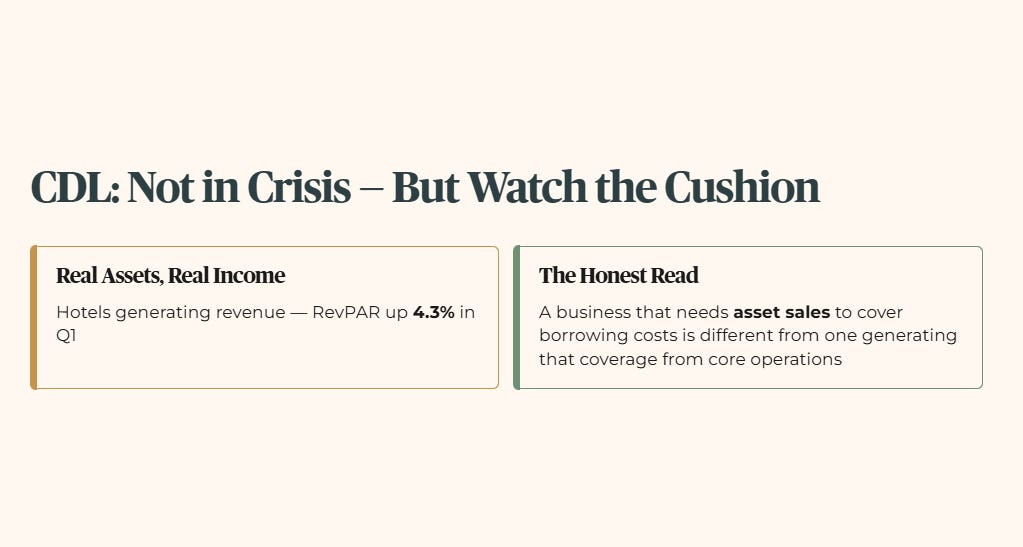
To be fair to CDL, this isn’t a company in crisis. It has real assets, real hotels generating real income, revenue per available room actually rose 4.3 percent in the first quarter. But a business that needs asset sales to comfortably cover its own borrowing costs is not the same thing as a business generating that coverage from its core operations.
What CLI is dealing with right now
CapitaLand Investment’s story reads differently on the surface.
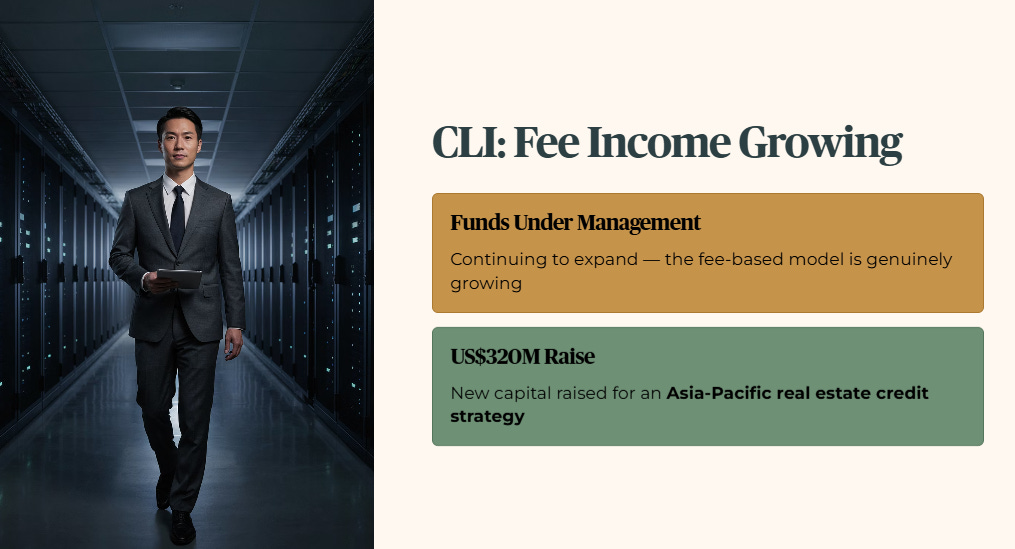
The fee-based model is genuinely growing, funds under management continue to expand, and the company has been actively raising new capital, including a recent US$320 million fundraise for an Asia-Pacific real estate credit strategy.
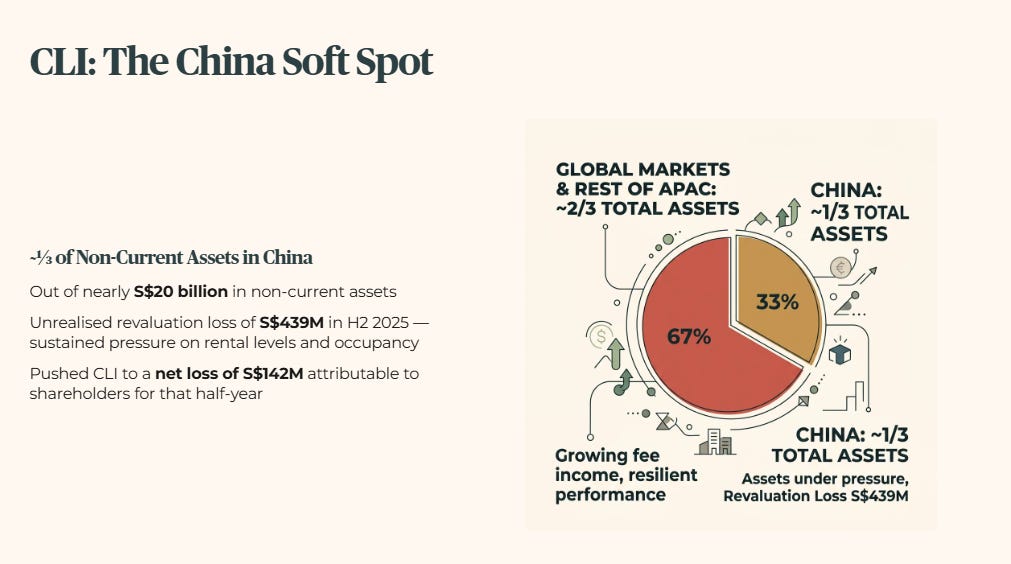
But CLI has its own soft spot, and it’s China. Roughly a third of CLI’s non-current assets, out of nearly S$20 billion, sit in China, and the company took an unrealized revaluation loss of S$439 million in the second half of 2025 alone, largely from Chinese real estate assets where rental levels and occupancy have been under sustained pressure. That loss was significant enough to push CLI to a net loss attributable to shareholders of S$142 million for that half-year period, even as the broader fee-income story kept growing.
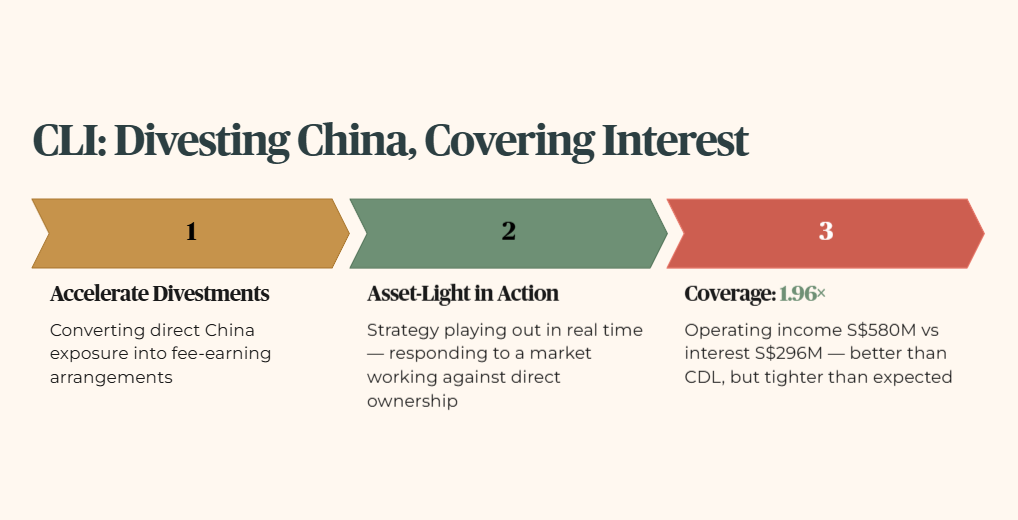
Management’s response has been to accelerate divestments in China, converting more of that direct property exposure into fee-earning arrangements instead, which is really the asset-light strategy playing out in real time, in response to a market that’s currently working against direct ownership.
The interest coverage figure you are about to see is the line that decides whether CLI’s “asset-light” pitch clears Iggy’s safety floor or starts triggering soft flags on your dividend stability.
