



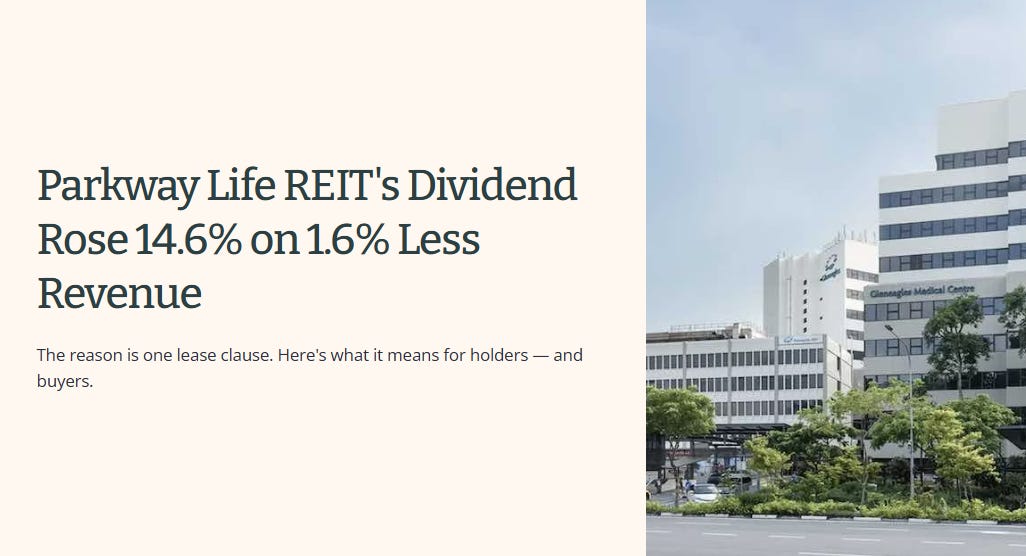
Parkway Life REIT’s Dividend Rose 14.6% on 1.6% Less Revenue. The Reason Is One Lease Clause. 🦖
Revenue slipped on a weaker yen and vacant Japan properties, while the rent actually received from the Singapore hospitals stepped up 24.3%. Here is what that does to a holder’s income, and what the lease formula implies for the next payout.
Parkway Life REIT’s revenue fell 1.6% in the first half of 2026. Its distribution per unit rose 14.6%. Both numbers come from the same results announcement, and both are correct.
If you hold Parkway Life REIT, the higher payment reached your account on 8 September, and the question you are probably asking is whether another rise like it is coming. If you are thinking of buying, the question is different, because the unit starts at a yield that depends on what you pay today. I read the half-year financial statements, the business update and the lease terms line by line, because the explanation is not on the first page of any of them.
What This Piece Does
The cause. Why the distribution rose while revenue fell, using the REIT’s own financial statements.
The arithmetic. The trailing yield at the 5 October 2026 close, and how far it sits from my 4.7% Minimum Yield Hurdle.
The next step. What the lease formula implies for the next payout, and what the balance sheet looks like behind it.
I have no view on where Parkway Life REIT’s unit price goes next, and nothing here is a recommendation.

Revenue Down, Distribution Up
Where the Extra Cash Came From
From 8.77 Cents to a 4.15% Yield
The Question Holders Ask Next
The Balance Sheet Behind the Payout
What Matures From March 2027
What Is Inside the 14.6%
Zone Trajectory and Soft Flags
Legacy Holders vs. Fresh Capital
Iggy’s Elite Read
Revenue Down, Distribution Up
Here is the half year ended 30 June 2026 against the same half of 2025.
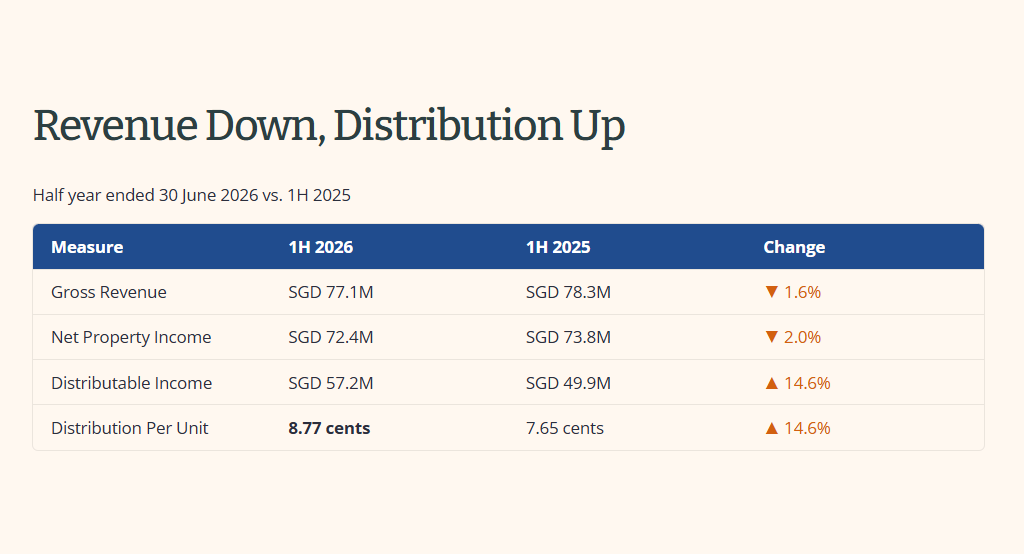
Measure 1H 2026 1H 2025 Change Gross revenue SGD 77.1 million SGD 78.3 million down 1.6% Net property income SGD 72.4 million SGD 73.8 million down 2.0% Distributable income SGD 57.2 million SGD 49.9 million up 14.6% Distribution per unit 8.77 cents 7.65 cents up 14.6%
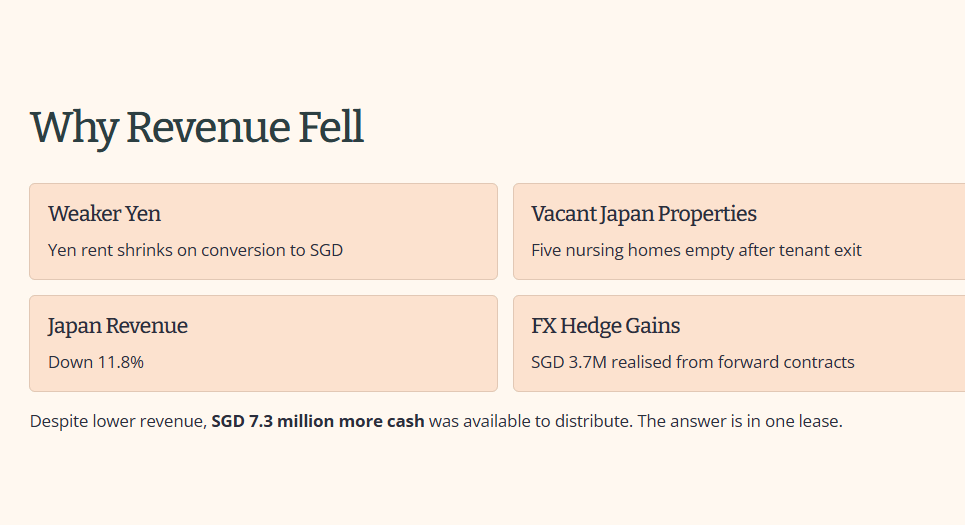
Distributable income is the cash the REIT can pay to unitholders once non-cash items are taken out. The REIT gives two reasons for the fall in revenue. The yen weakened, which shrinks yen rent when it is converted to Singapore dollars, and a tenant exit left five Japan nursing homes empty. Japan’s gross revenue fell 11.8%, while Singapore’s rose 2.4% and France’s rose 4.2%. The REIT also hedges its Japan and France income, and it booked about SGD 3.7 million of realised foreign exchange gains in the half from settling those forward contracts.
So revenue is lower, and yet SGD 7.3 million more cash was available to distribute. The answer is in one lease.
Where the Extra Cash Came From
The three Singapore hospitals, Mount Elizabeth, Gleneagles and Parkway East, are leased to a subsidiary of IHH Healthcare under a single master lease. That lease produces about 68% of the REIT’s revenue. It was renewed in 2022 for 20.4 years, with rent rebates in the early years and higher rent afterwards.
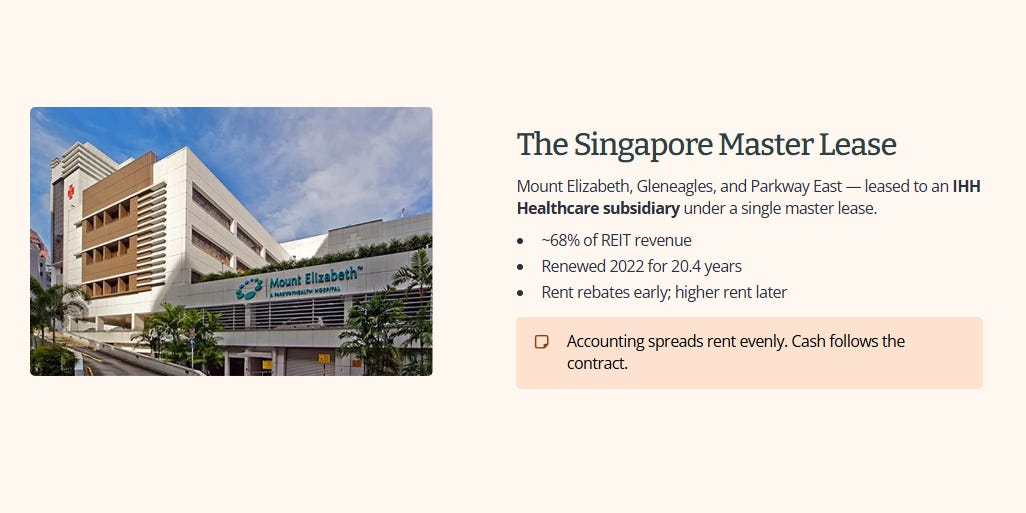
Accounting rules say that kind of rent must be spread evenly across the whole lease when it is reported as revenue. The cash that arrives follows the contract, not the average. Picture a kopitiam landlord who charges a stall holder discounted rent for three years and full rent after that. The accountant reports the same average rent every month. The landlord’s bank account shows the discount first and the full rent later.
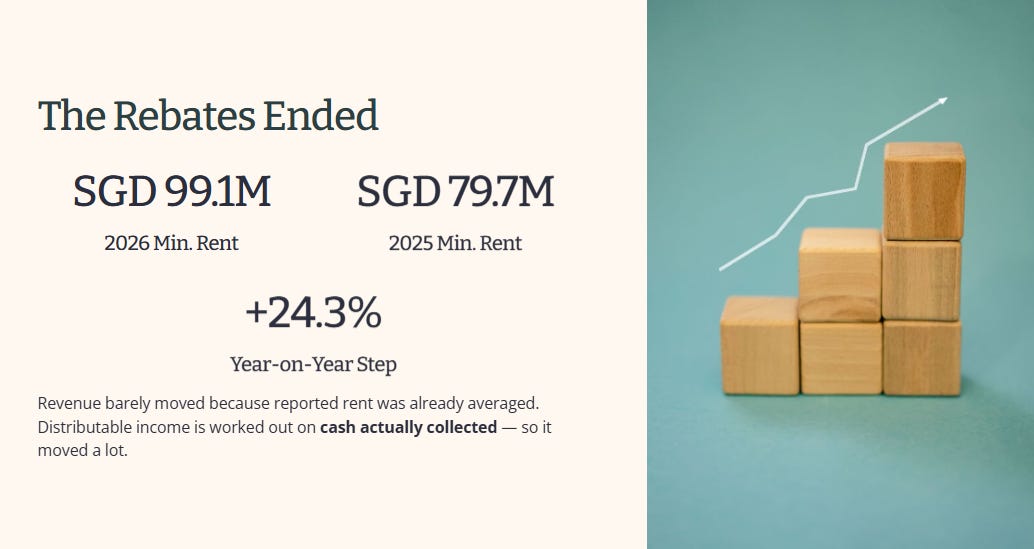
That is what happened here. The three years of rebates ended, and the minimum rent for 2026 is SGD 99.1 million, against SGD 79.7 million in 2025. That is SGD 19.3 million more for the year, or 24.3%. Because the reported rent was already averaged, revenue barely moved. Distributable income is worked out on the rent actually collected, so it moved a lot.
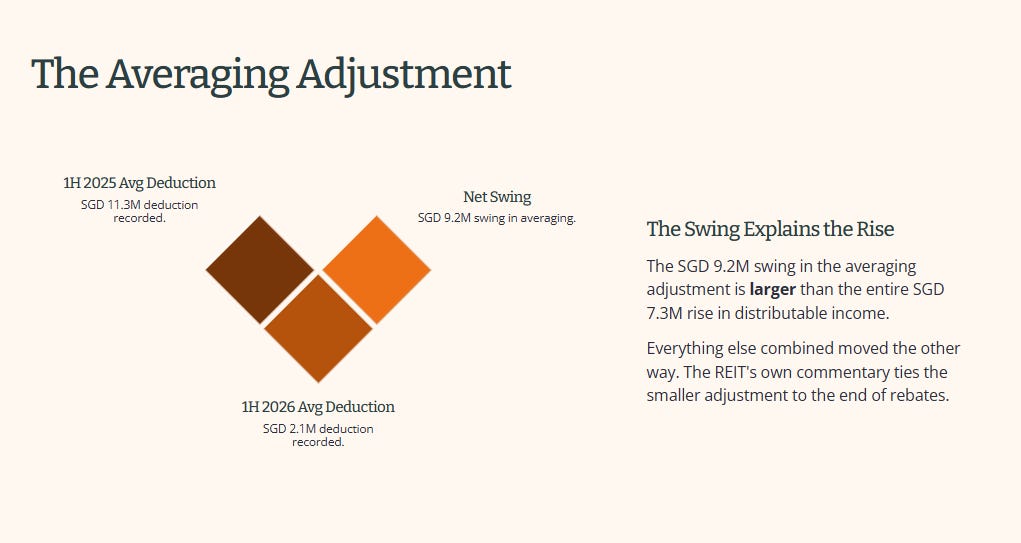
The financial statements show the same thing a second way. Each half year, the REIT takes the averaging effect back out when it works out what it can distribute. In the first half of 2025 that adjustment was a deduction of SGD 11.3 million. In the first half of 2026 it was SGD 2.1 million. That swing of SGD 9.2 million is larger than the whole SGD 7.3 million rise in distributable income, which means everything else together moved the other way. The REIT’s own commentary ties the smaller adjustment to the end of the rebates and the higher rent now being collected.
The Window Is Already Open
What Free Subscribers See Is the Headline. What Members See Is the Reason.
Every piece I publish gives free subscribers the zone number and the label the moment it goes live. What they don’t get is the reasoning behind it, the soft flag breakdown, the exact margin that triggered the call, the trajectory that would change it. That gap between the verdict and the reasoning isn’t something you can wait out. It’s the actual content, and it stays behind the paywall permanently, not for a week, not until the next piece bumps it down the feed.

YouTube/Substack Combo members get the complete breakdown the moment it publishes: full-length videos, the complete Red Zone watchlist, and institutional-grade cheatsheets, not a summary of the verdict, the actual forensic case for it.
For S$12/month, you’re not paying to read this sooner. You’re paying to stop reading headlines and start reading the case.
From 8.77 Cents to a 4.15% Yield
A trailing yield divides the last 12 months of distributions by today’s price. The last two payments were 7.64 cents for the second half of 2025, paid on 10 March 2026, and 8.77 cents for the first half of 2026, paid on 8 September 2026. That is 16.41 cents. At the 5 October 2026 close of SGD 3.95, the trailing yield is 4.15%.
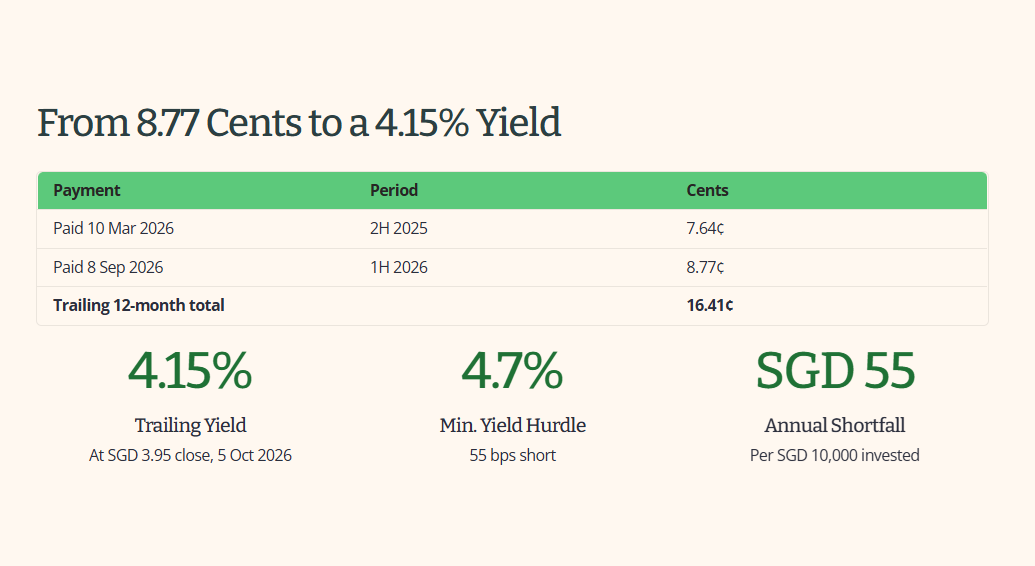
The Forensic Floor is 3.2% and the Minimum Yield Hurdle is 4.7%. At 4.15% Parkway Life REIT clears the Floor and sits 55 basis points under the Hurdle. In money terms, SGD 10,000 placed in the units at SGD 3.95 receives about SGD 415 a year from the last 12 months of distributions. At 4.7% the same SGD 10,000 would receive SGD 470, a shortfall of about SGD 55 a year.
The REIT’s own announcement shows a higher yield, 4.33%, at the 30 June price of SGD 4.05. That figure doubles the half-year payment to 17.54 cents, so it assumes the second half matches the first. I use the trailing figure because it is built only from payments already made. On the doubled basis at SGD 3.95 the yield would be 4.44%, which is still under the Hurdle.
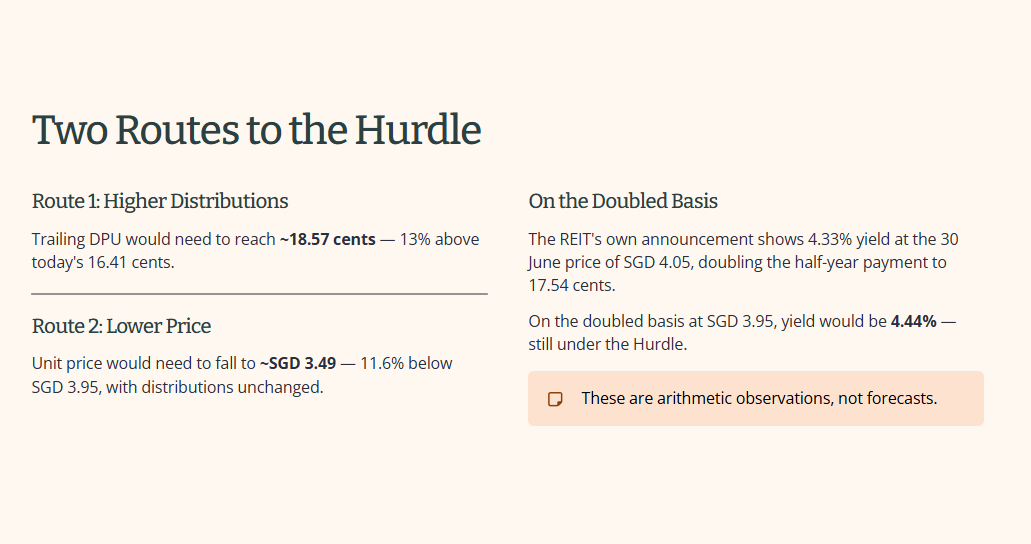
There are two routes to the Hurdle, and neither is a forecast. Trailing distributions would need to be about 18.57 cents, which is 13% above today’s 16.41 cents. Or the price would need to be about SGD 3.49, which is 11.6% below SGD 3.95, with distributions unchanged.
Iggy’s Forensic Zone: Zone 4, Caution, at the 5 October 2026 close (Growth Read: defensive lease-backed income on a clean balance sheet, the entry yield is the sole constraint).
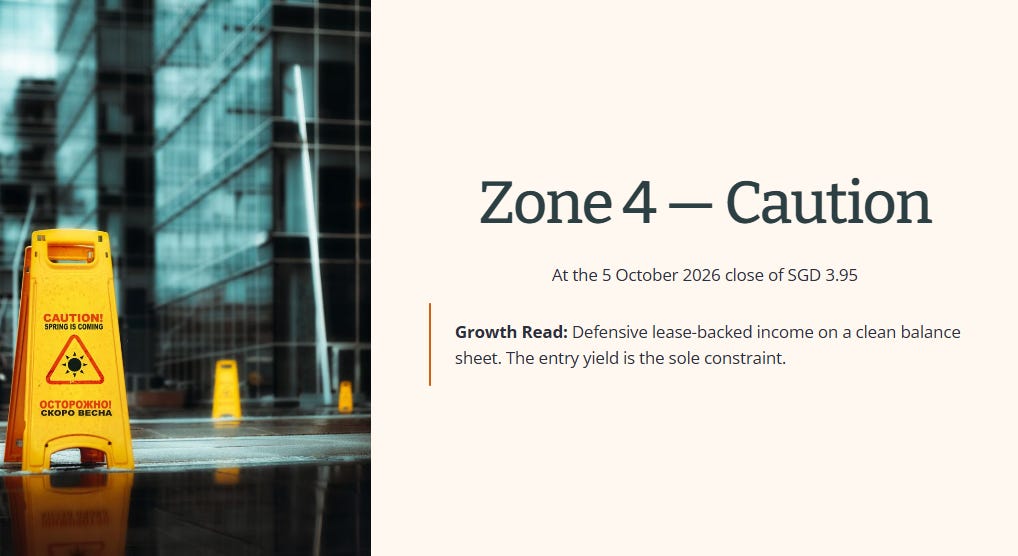
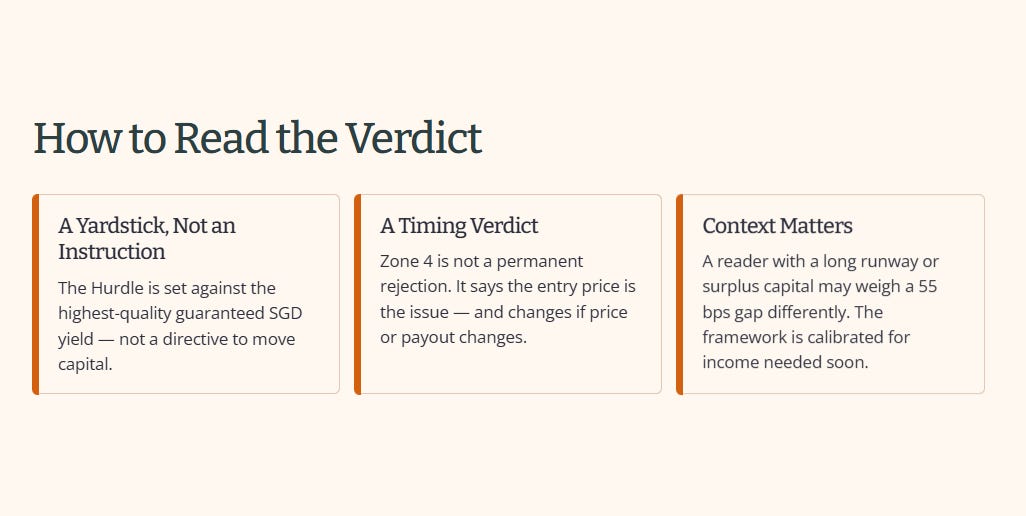
A word on how to read that verdict. The Hurdle is set against the highest-quality guaranteed Singapore dollar yield available. It is a yardstick, not an instruction to move your capital there. A Zone 4 on yield is also a timing verdict, not a permanent rejection. It says the entry price is the issue, and it changes if the price or the payout changes. The framework is calibrated for income that is needed soon. A reader with a long runway before drawing income, or with capital beyond what retirement requires, may reasonably weigh a 55 basis point gap differently. That describes how the framework is set, and it is not guidance to anyone.
The Question Holders Ask Next
The pushback I expect is that Parkway has raised its payout almost every year since it listed, so this rise is just the pattern continuing. The record is real. Management’s chart shows recurring DPU rising every year from 2007 to 2025. The size of the steps is what has changed.
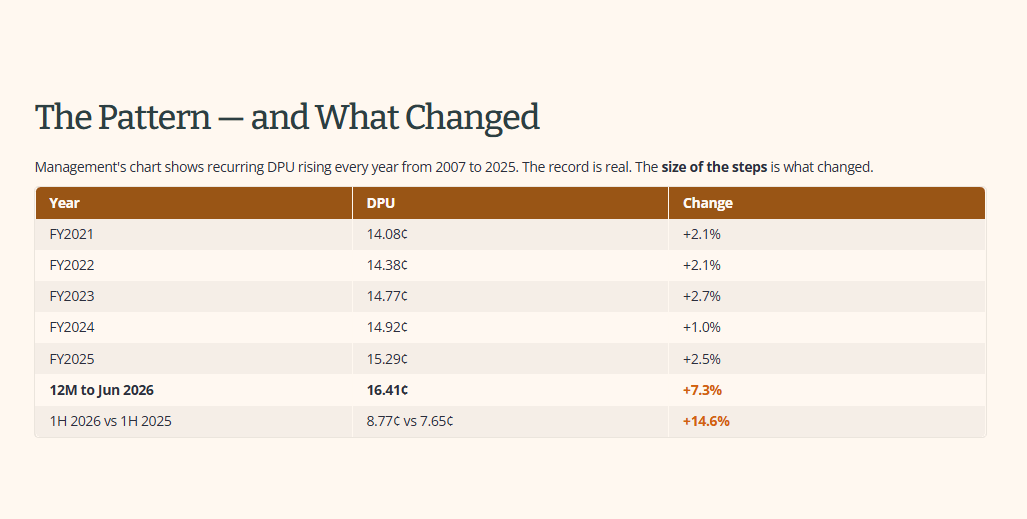
For five years the annual rise sat between 1.0% and 2.7%. The 14.6% is outside that range, and the cause is a change in what one lease pays, not a faster-growing business.
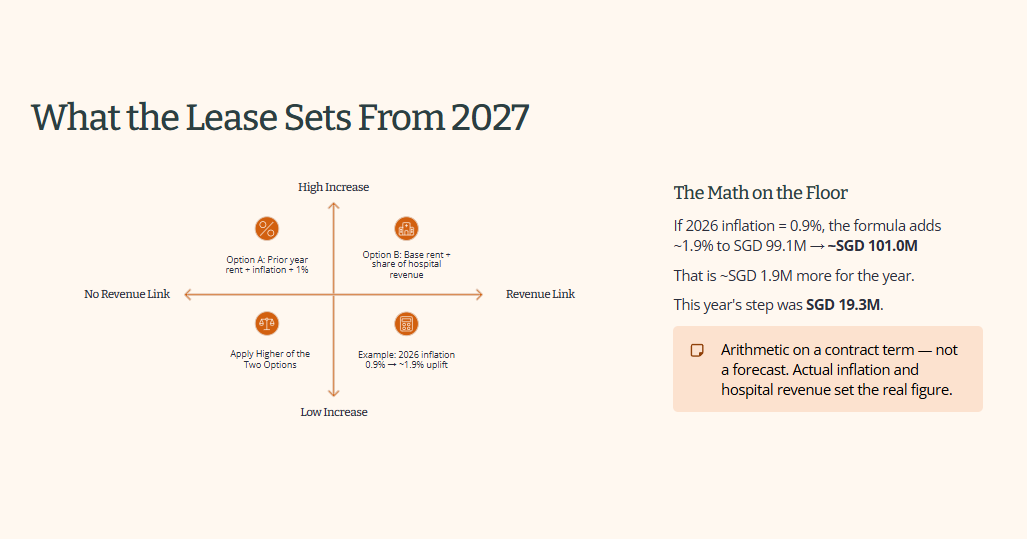
The same lease sets the rent from here. From 2027 the Singapore rent is the higher of two figures: the preceding year’s rent increased by inflation plus 1%, or a base rent plus a share of the hospitals’ revenue. The first figure acts as a floor. If inflation for 2026 comes in at the 0.9% used this year, it adds about 1.9% to SGD 99.1 million, which is about SGD 101.0 million, or roughly SGD 1.9 million more for the year.
This year’s step was SGD 19.3 million. That is arithmetic on a contract term, not a forecast, because actual inflation and the hospitals’ revenue will set the real figure. Other items can still move the payout, including the empty Japan properties, the yen and any revenue sharing, but none of the items disclosed so far is of that size.
💡 Insight Callout
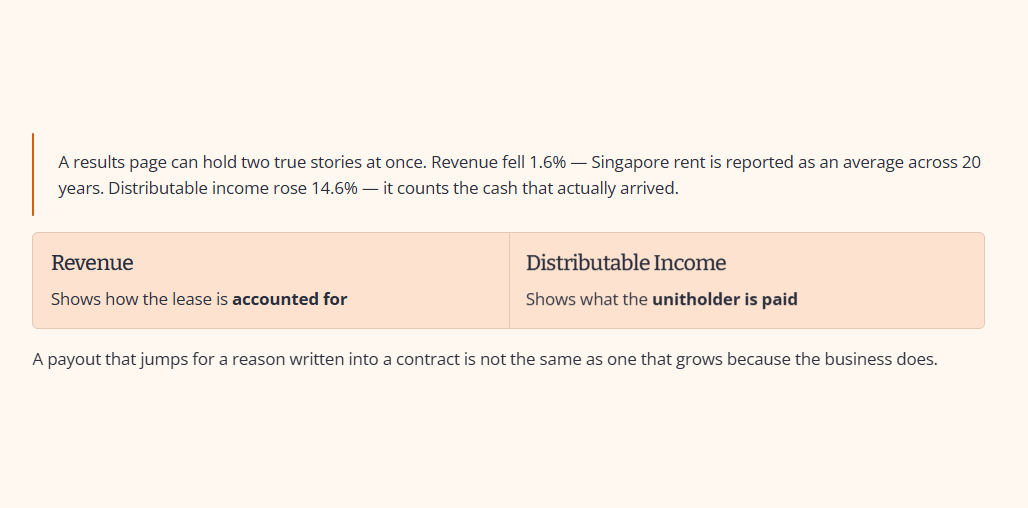
A results page can hold two true stories at once. The income statement says Parkway Life REIT’s revenue fell 1.6%, because Singapore rent is reported as an average across 20 years. The distribution statement says income rose 14.6%, because it counts the cash that actually arrived. Neither is wrong, but they answer different questions. Revenue shows how the lease is accounted for. Distributable income shows what the unitholder is paid. When the two move in opposite directions, the gap between them is the story, and a payout that jumps for a reason written into a contract is not the same as one that grows because the business does.
🔒 What’s Next
The formula puts the next rent step near 2% against 24.3% this year, so the next section tests whether the balance sheet can carry the debt that starts maturing in March 2027.
