




ComfortDelGro’s own results deck calls its earnings “resilient.” Profit after tax fell 19.7 percent. Resilient is one word for it.

If you’re still adding to your CPF or SRS portfolio in your fifties, a stock like this deserves a second look before you buy more of it. If you’re already living off distributions in your sixties, the flat interim dividend probably looked reassuring on the surface, until you saw what’s happening underneath it. Either way, ComfortDelGro just handed us a textbook case of a headline number hiding the real story.



The Headline Number vs the Real Number
Where the Money Actually Went: Taxi and Private Hire
Singapore: A Shrinking Taxi Fleet, A Growing PHV Bet
Australia and the UK: Two Different Kinds of Pressure
The Balance Sheet Question Nobody’s Asking
Iggy’s Insight
The Forensic Screen: Financial Health Checklist
The Dividend Trajectory: A Raise That Became a Pause
Peer Comparison: An Honest Gap
What Happens Next: Reading the Outlook Against the Gearing Breach
What Zone 4 Actually Means For You
Iggy’s Insight
Iggy’s Forensic Zone: Zone 4, Caution
The Headline Number vs the Real Number
Here’s what ComfortDelGro’s 1H2026 results actually say, once you separate the top line from the bottom line.
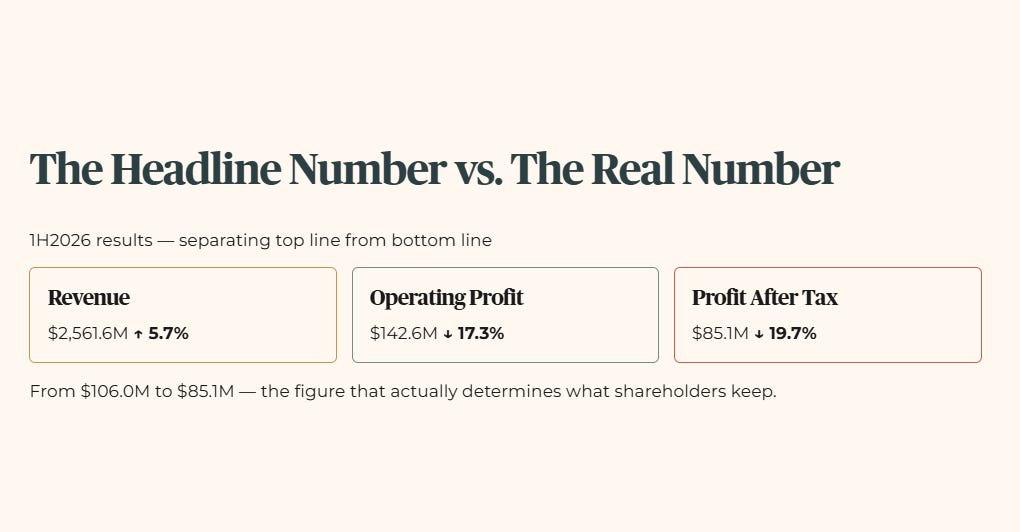
Revenue rose to $2,561.6 million, up 5.7 percent from $2,422.7 million a year earlier. That’s the number management leads with, and it’s genuinely true. But operating profit fell to $142.6 million, down 17.3 percent from $172.5 million. Profit after tax and minority interests, the figure that actually determines what shareholders keep, fell to $85.1 million, down 19.7 percent from $106.0 million.
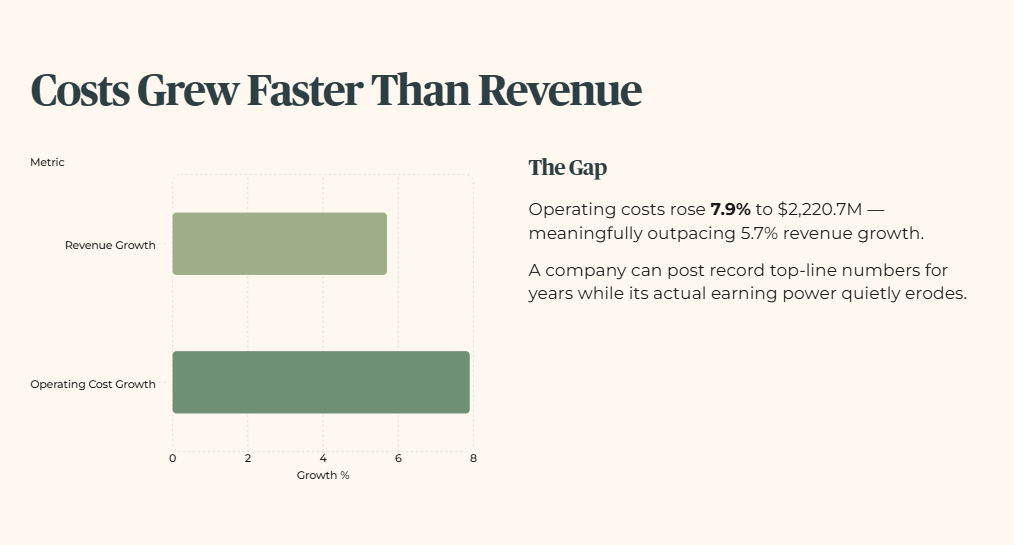
Growing revenue with shrinking profit means one thing: costs grew faster than income, and not by a small margin. Operating costs rose 7.9 percent to $2,220.7 million, meaningfully outpacing the 5.7 percent revenue growth. A company can post record top-line numbers for years while its actual earning power quietly erodes, and that’s close to what’s happening here, though not evenly across the business.
Where the Money Actually Went: Taxi and Private Hire
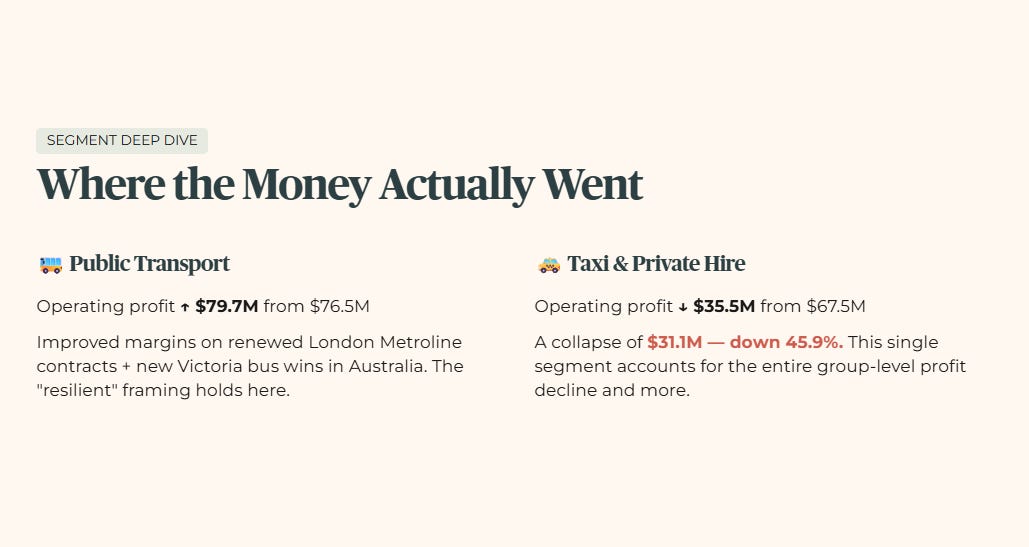
Public Transport, ComfortDelGro’s bus and rail segment, is genuinely doing fine. Operating profit there rose to $79.7 million, up from $76.5 million, helped by improved margins on renewed London Metroline bus contracts and new Victoria bus contract wins in Australia. This is the part of the “resilient” framing that actually holds up.
The Taxi and Private Hire segment is a different story entirely. Operating profit collapsed to $35.5 million from $67.5 million, a decline of $31.1 million, or 45.9 percent. That single segment accounts for the entire group-level profit decline and more. Without it, ComfortDelGro’s other segments were broadly stable to improving this half.
Singapore: A Shrinking Taxi Fleet, A Growing PHV Bet
In Singapore specifically, the taxi fleet shrank year on year while the private-hire vehicle fleet grew, a deliberate strategic shift toward the platform-enabled model. That’s a rational response to where the market’s heading, but it comes with a transition cost, and this half’s numbers show that cost landing in real time, not as a hypothetical.
Australia and the UK: Two Different Kinds of Pressure
Australia’s Taxi/PHV business faced straightforward ride-hailing competition and cautious consumer spending, a demand-side problem that isn’t specific to ComfortDelGro.
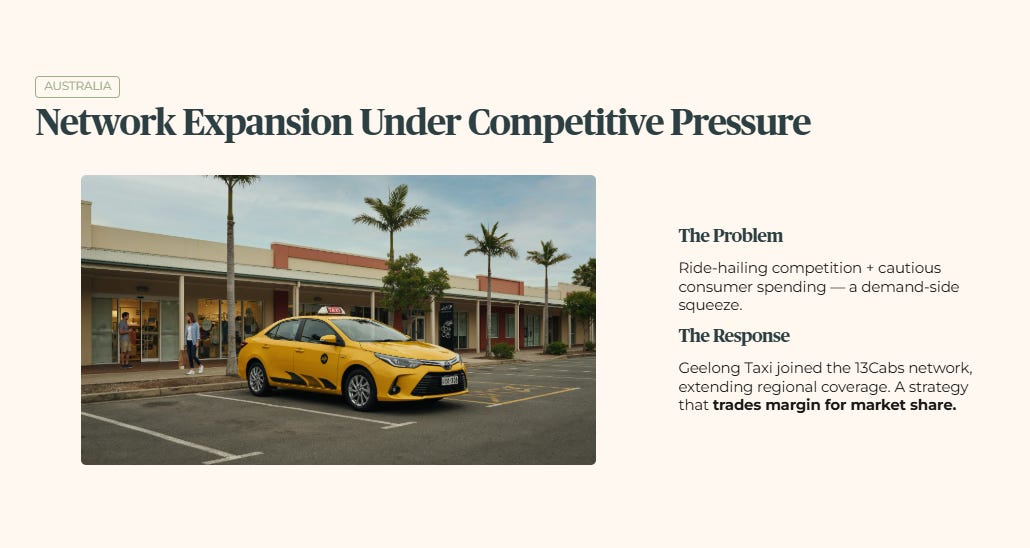
The response so far has been network expansion rather than retreat, Geelong Taxi joined the 13Cabs network this half, extending regional coverage even as overall B2C volumes stayed under pressure from platform competitors with deeper pockets for promotional pricing. That’s a defensible strategy, but it’s a strategy that trades margin for market share, which is part of why Australia’s operating profit contribution slipped alongside the rest of the segment.
The UK’s premium B2B segment, run through Addison Lee, was hit by reduced corporate travel demand tied to the Middle East conflict, a geopolitical shock rather than a structural weakness in the underlying business.
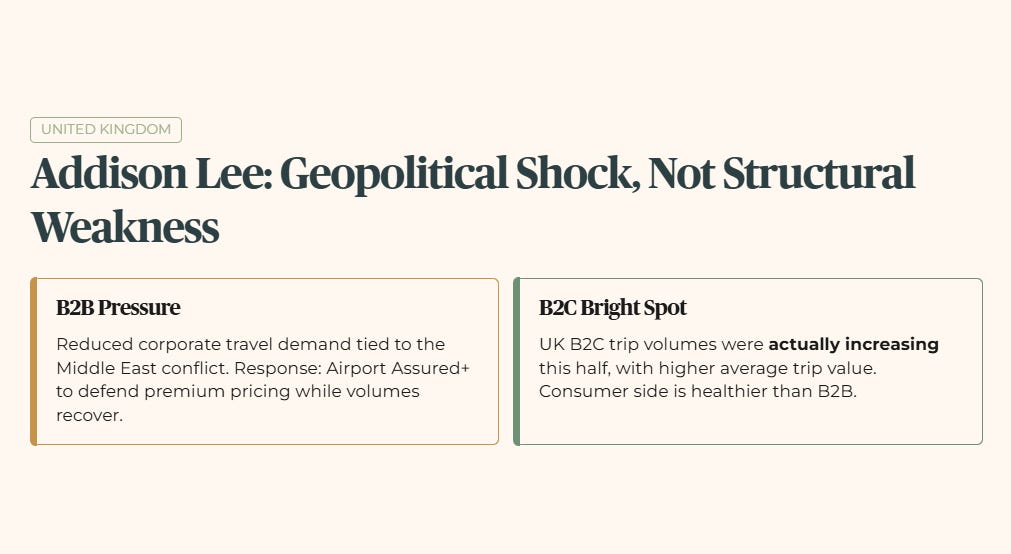
Addison Lee has responded by enhancing its airport service offering through what the company calls Airport Assured+, aimed at improving traveller experience and presumably defending premium pricing power while corporate volumes recover. UK B2C trip volumes, meanwhile, were actually increasing this half, with higher average trip value, suggesting the consumer side of the UK business is healthier than the B2B side that’s currently getting hit.
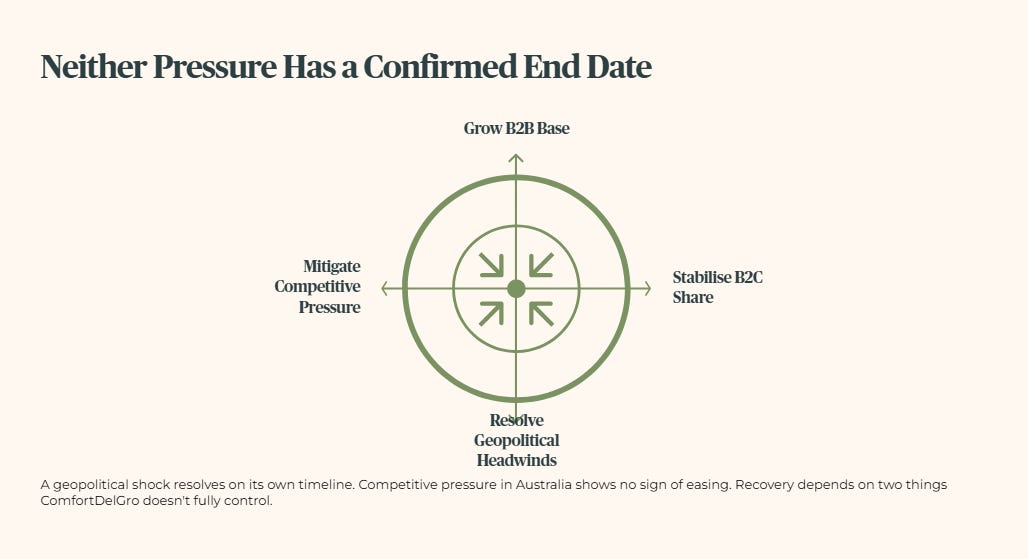
Both pressures are real, and neither is permanent by nature. But neither has a confirmed end date either, which matters for how you should read the forward trajectory. A geopolitical shock resolves on its own timeline, not a quarterly reporting cycle, and competitive pressure in Australia’s ride-hailing market shows no sign of easing on its own. The honest read is that Taxi/PHV’s recovery depends on two things ComfortDelGro doesn’t fully control, and one thing it does: how quickly it can grow the B2B base and stabilise B2C share across all three geographies simultaneously, which is exactly what management says it’s focused on doing.
The Taxi/PHV problem explains the profit fall. The Debt/Capital calculation in the next section shows whether ComfortDelGro’s balance sheet can absorb the recovery plan.
