



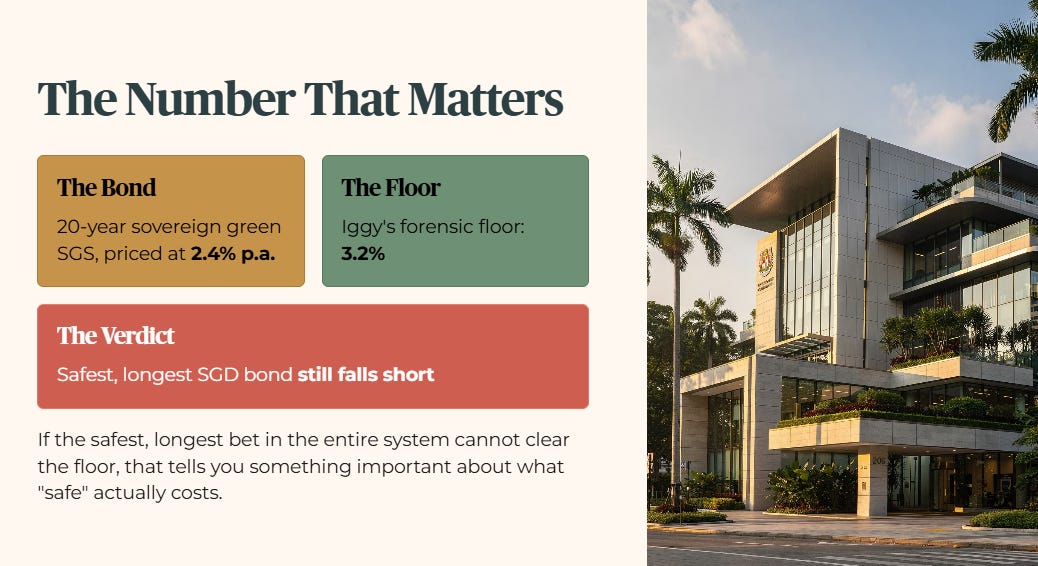
Singapore just locked in money for twenty years at 2.4% per annum. Twenty years is about as far out as the SGD bond market goes, and 2.4% is still below the 3.2% forensic floor this channel uses to judge every SGX income name. If the safest, longest bet in the entire system cannot clear the floor, that tells you something important about what “safe” actually costs right now.
Let the numbers speak.

What Actually Happened
The SGD Risk-Free Curve, In Full
Why Duration Alone Doesn’t Buy Back Yield
Iggy’s Insight: The Floor Is Doing Its Job
Read-Through for Retirement Portfolios
Iggy’s Insights
Closing
Warm Entry Beat
Whether you have twenty years of runway or two, this matters the same way. A younger reader building a war chest and a retiree drawing down CPF are both being told, by the market itself, that duration alone does not buy adequate return, only genuine risk-taking does. This is not a stock call. It is a reading of the ruler every stock call in this channel gets measured against, and this week the ruler just moved.
What Actually Happened
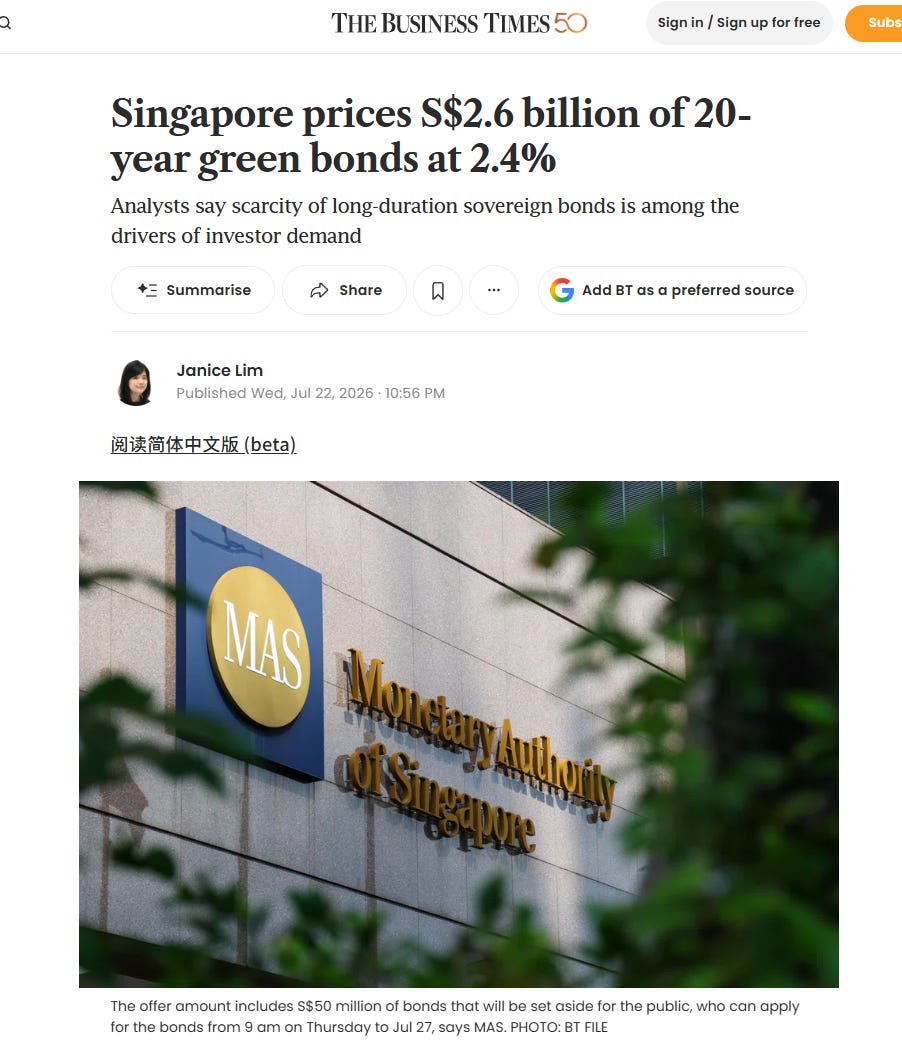
On Wednesday, the Monetary Authority of Singapore priced S$2.6 billion of 20-year sovereign green bonds at a yield of 2.4%, the maximum size in the S$2.1 billion to S$2.6 billion range it had signalled, on the back of a S$4.6 billion order book from institutional investors, 1.83 times the amount on offer.
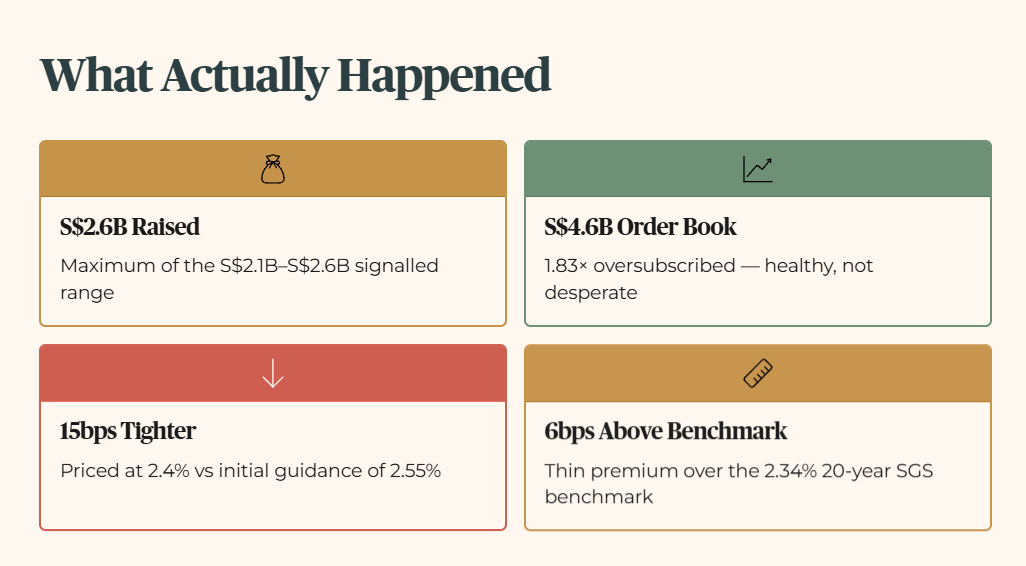
The pricing came in about 15 basis points tighter than the initial guidance of 2.55%, which tells you demand was healthy, not desperate. MAS also flagged that the benchmark 20-year Singapore Government Securities yield stood at 2.34% on the same day, meaning this new issue priced only about six basis points above the going rate for comparable duration, a thin premium for a brand new, oversubscribed offer.
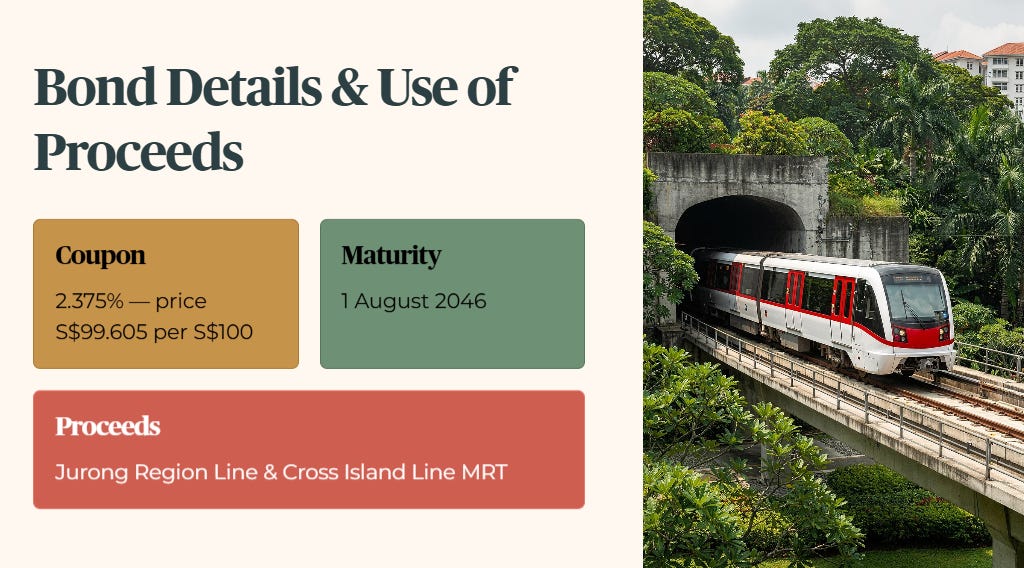
The coupon works out to 2.375%, sold at an offering price of S$99.605 per S$100 of principal, with the bonds maturing 1 August 2046. They replace the previous 20-year benchmark, which was set to mature in March 2046. Proceeds go toward Singapore’s Green Bond Framework, funding environmentally sustainable projects including two new MRT lines, the Jurong Region Line and the Cross Island Line.
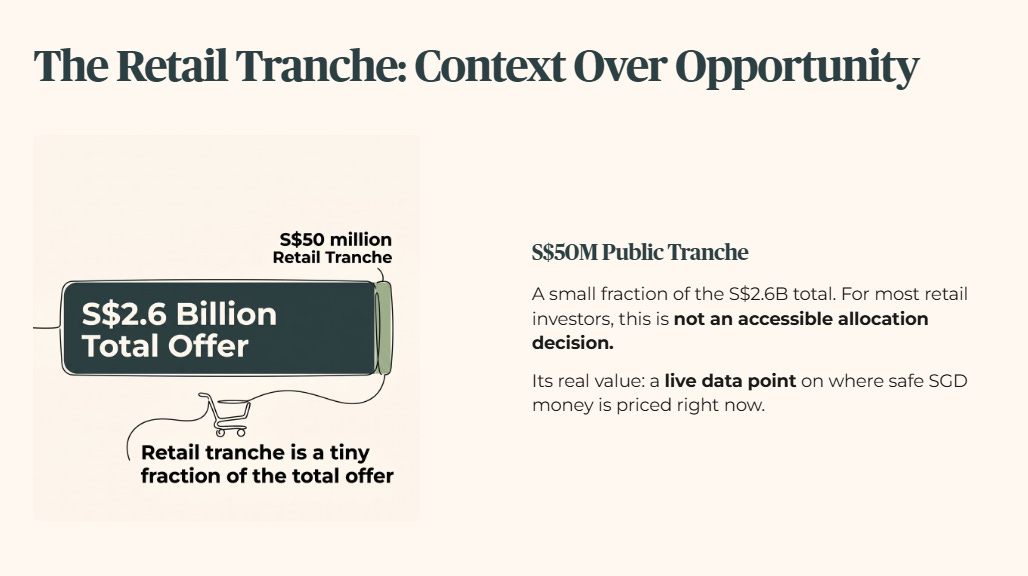
A public tranche of S$50 million was set aside, open for applications from 9am Thursday through noon on 27 July. Worth being upfront about scale here: S$50 million against a S$2.6 billion total offer is a small fraction, so for most retail investors this is not really an accessible allocation decision. Its real value to you is not as something to buy, it is as a live data point on where safe SGD money is being priced right now, and that data point belongs directly in the forensic framework this channel runs on.
The SGD Risk-Free Curve, In Full
Here is where every safe, guaranteed instrument in the SGD system currently sits, measured against the two numbers that matter for retirement income: the 3.2% forensic floor and the 4.7% minimum yield hurdle.
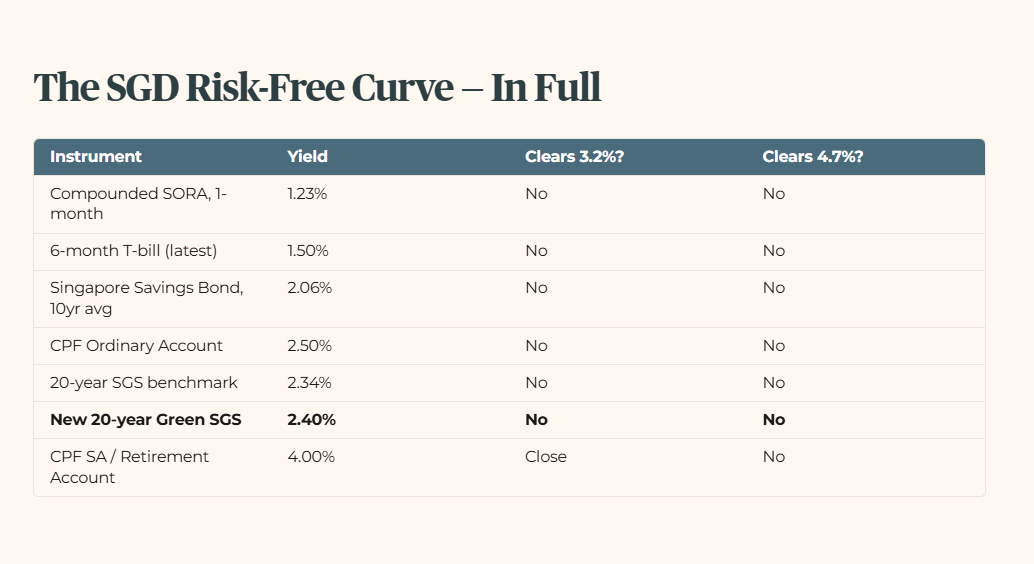
Every single row fails the 3.2% floor. Not one guaranteed, government-backed, capital-safe SGD instrument currently available clears the bar this channel sets before it will call a yield genuinely adequate. CPF SA and RA at 4.0% come the closest, which is exactly why this framework has always anchored its floor logic to CPF SA as the highest-quality guaranteed yield in the system, not to T-bills or SSBs, which sit meaningfully lower and would make the floor too easy to clear.
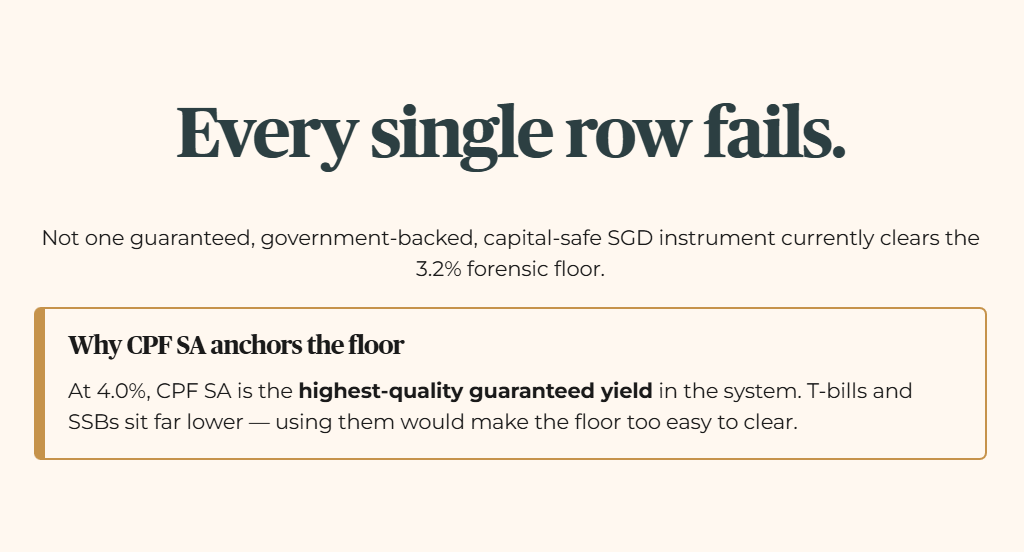
The new twenty-year green bond sits almost exactly where the six-month T-bill and the Singapore Savings Bond ten-year average already sit, just above two percent, nowhere near the floor. That is the headline finding of this piece: nineteen and a half extra years of duration bought back roughly 90 basis points of yield versus the six-month T-bill, and it still was not enough.
The next section takes that 90 basis point shortfall and runs it through the 3.2% floor and 4.7% hurdle explicitly, turning a single yield miss into a full forensic verdict on what “safe” money can and cannot do inside a retirement portfolio.
