



Nine SGX names carry dividend or distribution dates on the calendar this September. I ran five of them, the ones a CPF and SRS audience is actually likely to hold or consider, through my own forensic screen before the headline yield numbers get stale. Only one cleared every gate I check.
This isn’t a buy list, and it never will be, my own house rule bans that kind of language entirely. What it is: a test of whether September’s dividend announcements can actually clear the 4.7% hurdle I use for every SGX income name, benchmarked against CPF Special Account’s guaranteed 4.0%. If you’re managing retirement drawdown, this tells you which of these names are asking you to accept less than the safest guaranteed yield in the system for taking on equity risk.

If you’ve got a longer runway or capital beyond what retirement needs, the same numbers still matter, they just carry different weight.

Why September’s Calendar Is a Useful Test
The 4.7% Hurdle, Quick Refresher
Running September’s List
Food Empire Holdings (F03), Miss
Centurion Corporation (OU8), Miss
OUE Limited (LJ3), Miss
Iggy’s Insight: One Payment Is Not a Yield
Asian Pay Television Trust (S7OU), The One Everyone Will Get Wrong
Sasseur REIT (CRPU), The One That Clears It
Iggy’s Insight: Clearing the Hurdle Is Not the Same as Passing the Screen
The Red Flags Were Always There
What This Actually Tells You
Iggy’s Elite Read
Why September’s Calendar Is a Useful Test
Most yield checklists get written in the abstract, five signs, five rules, apply them whenever you happen to look.
September’s ex-dividend calendar is a chance to run the actual framework against real, dated, upcoming distributions rather than a hypothetical. Nine names on the calendar isn’t a curated list I chose to flatter the exercise, it’s what’s actually happening this month, and the results are exactly as uneven as you’d expect from testing a framework against reality instead of cherry-picked examples.
Five of those nine are the names most likely to actually sit in a CPF or SRS-linked portfolio, so that’s where this piece spends its time, rather than working through every small-cap name on the calendar regardless of relevance.
The 4.7% Hurdle, Quick Refresher
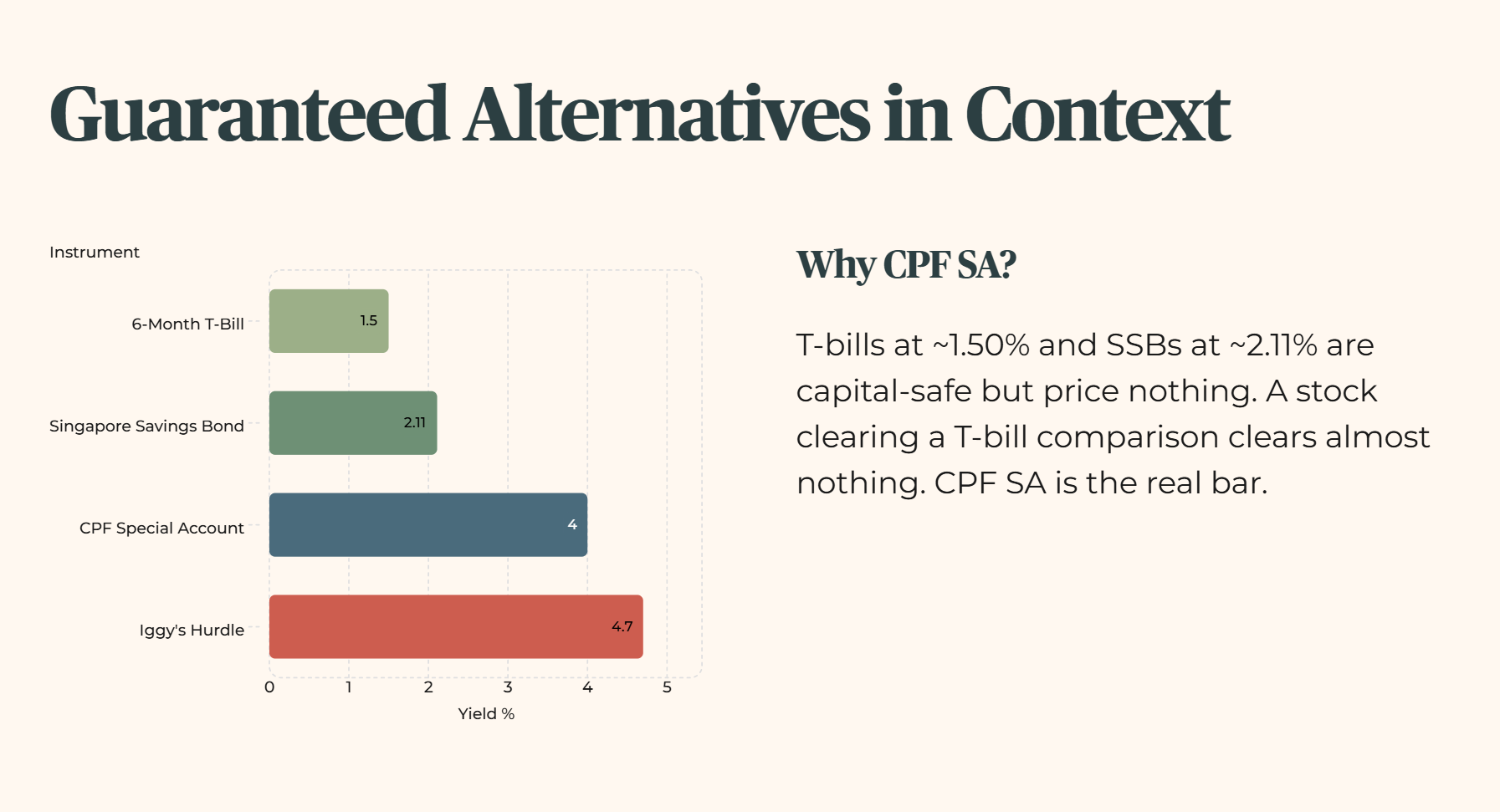
CPF Special Account currently pays 4.0% a year, guaranteed, confirmed for the quarter covering July through September.
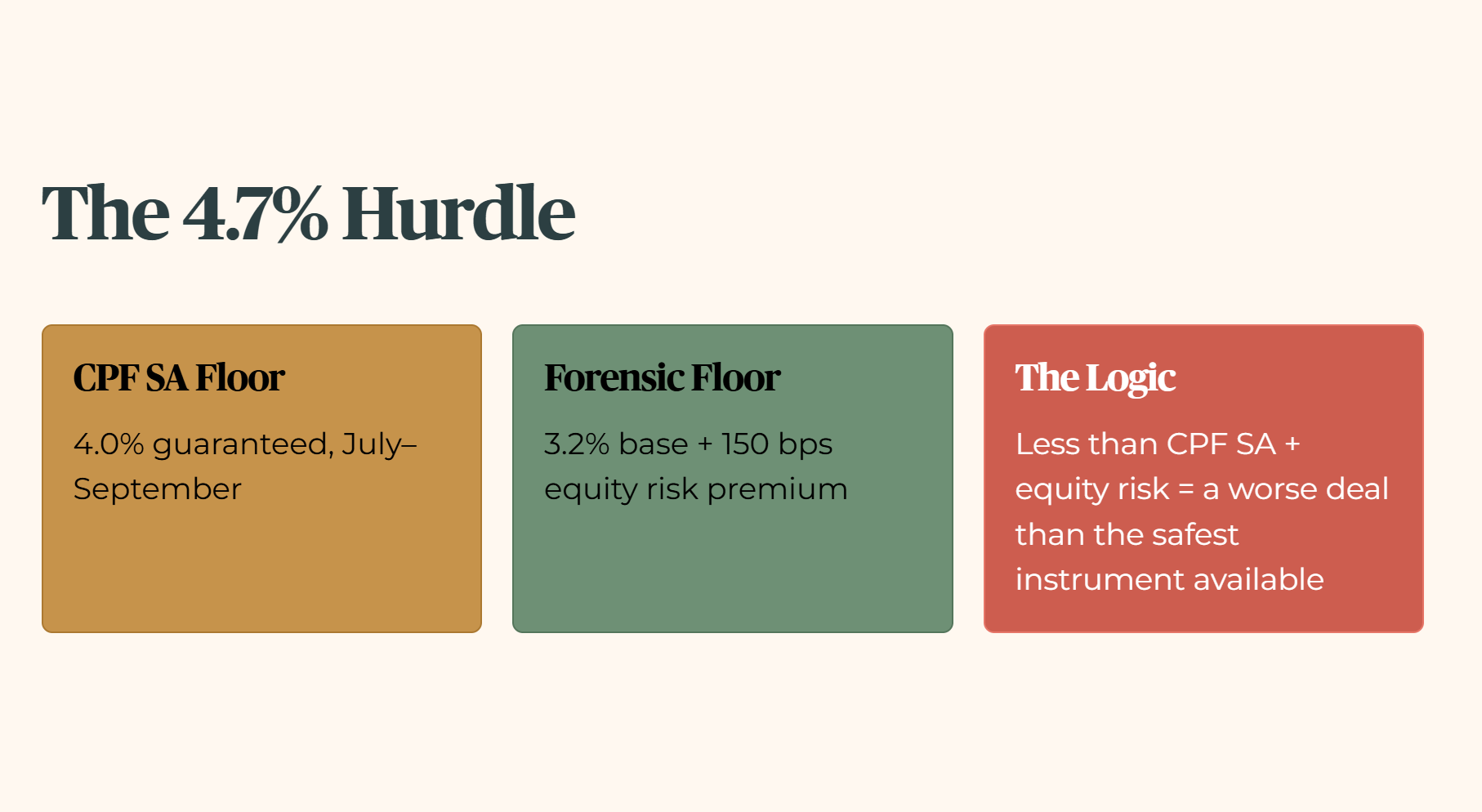
My hurdle for any SGX income stock sits at 4.7%, a 3.2% forensic floor plus 150 basis points for equity risk. The logic isn’t “you could put this exact dollar into CPF instead,” since CPF contributions are capped by the Retirement Sum ceiling. It’s that CPF SA is the highest-quality guaranteed SGD yield the system offers, and a stock asking for less compensation than that guaranteed rate, while carrying real equity risk on top, is asking you to accept a worse deal than the safest instrument available.
A miss isn’t an automatic disqualification. It’s a number worth knowing before you decide anything else.
Worth seeing where the other guaranteed options sit for contrast. The most recent completed 6-month T-bill auction cleared at roughly 1.50%, well below CPF SA and nowhere close to functioning as a meaningful yield filter on its own. Singapore Savings Bonds, the most recent tranche, average out to roughly 2.11% over ten years. Both exist as capital-safe options, but neither one prices equity risk the way a hurdle needs to if it’s going to mean anything.
That’s why this hurdle is built against CPF SA specifically, not the T-bill rate, and not a savings account. A stock that clears a T-bill comparison clears almost nothing. A stock that clears CPF SA has actually cleared a real bar.
Running September’s List
Food Empire Holdings (F03), Miss
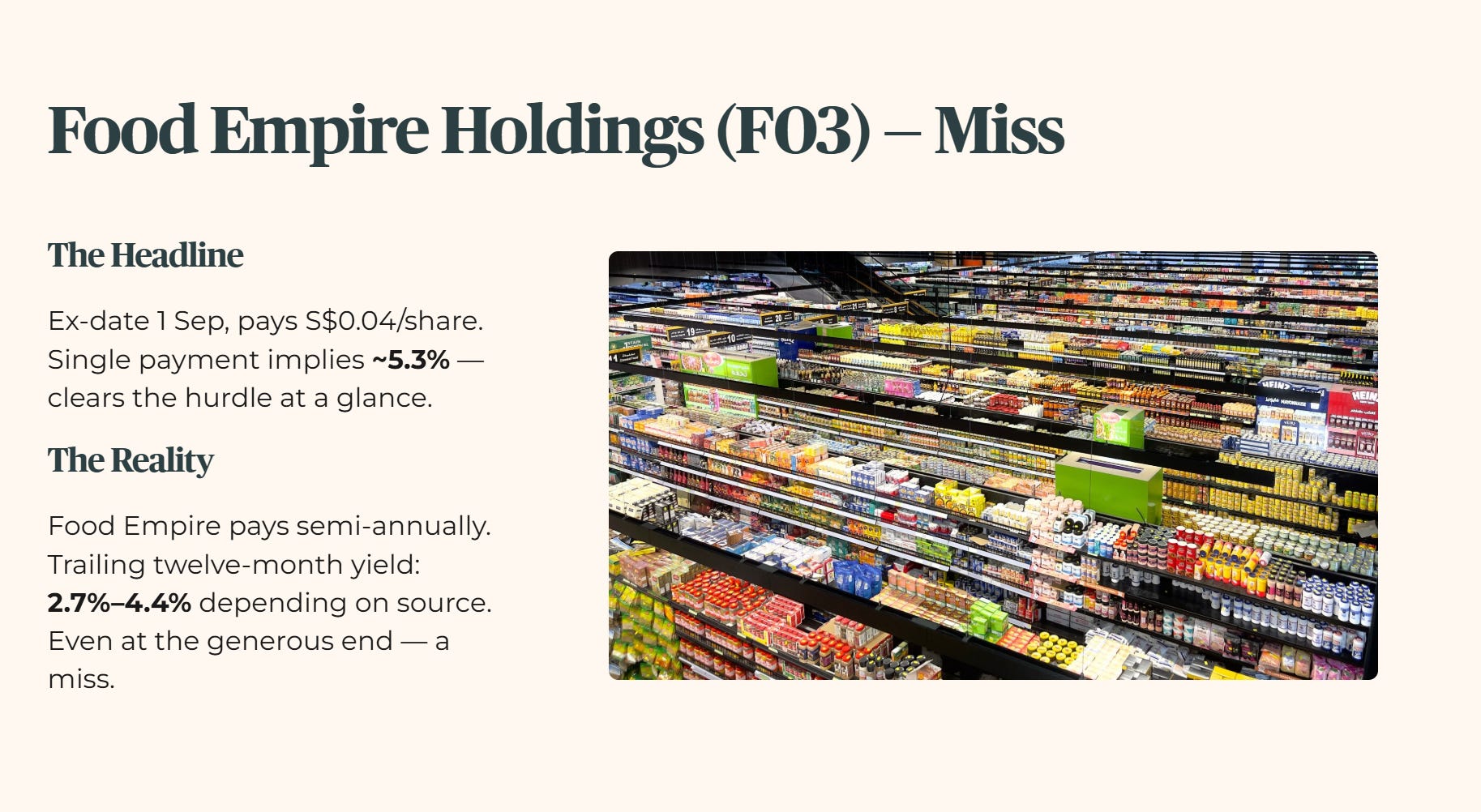
Food Empire’s next distribution, ex-date 1 September, pays 10 September at S$0.04 a share. On that single payment alone against the current price, the yield works out to roughly 5.3%, which clears the hurdle at a glance. But that’s one distribution, not a trailing annual figure, and Food Empire pays semi-annually. Once you build the actual trailing twelve-month yield from both payments this year, the number drops meaningfully, trailing yield across several data sources runs anywhere from roughly 2.7% to 4.4% depending on exactly which four quarters get counted and when the source last updated. Even at the generous end of that range, Food Empire misses the 4.7% hurdle.
Centurion Corporation (OU8), Miss
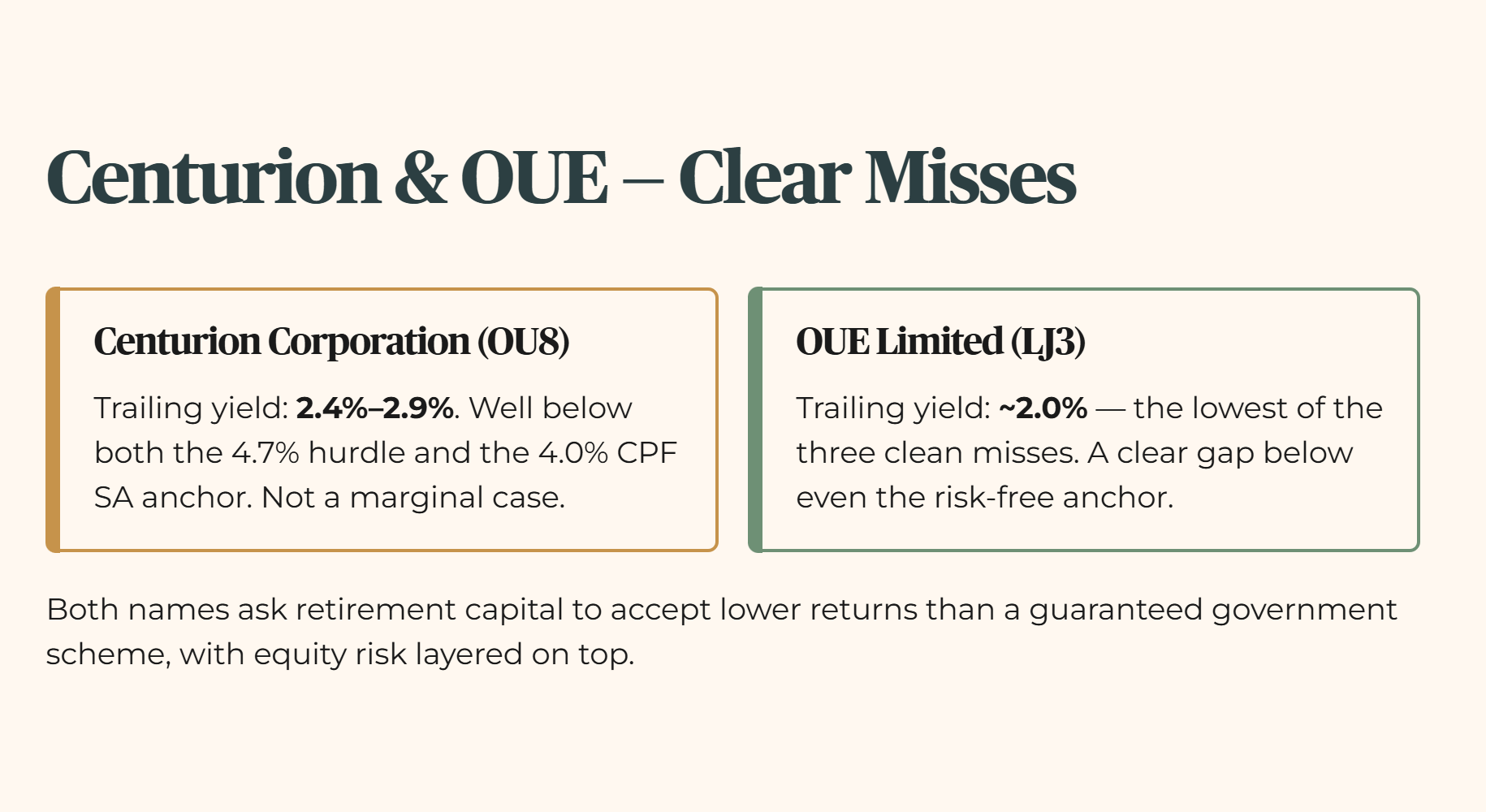
Centurion’s trailing yield sits in the 2.4% to 2.9% range across the sources I checked, well below both my hurdle and the 4.0% CPF SA anchor. This isn’t close. A stock at this yield level is asking retirement-focused capital to accept a lower return than a guaranteed government scheme, with equity risk layered on top.
OUE Limited (LJ3), Miss
OUE Limited’s trailing yield comes in at roughly 2.0%, the lowest of the three clean misses on this list. Same read as Centurion: not a marginal case, a clear gap below even the risk-free anchor.
🟢 Iggy’s Insight: One Payment Is Not a Yield
A single dividend announcement, divided into the current price, produces a number that looks like a yield but isn’t a trailing one. Semi-annual and quarterly payers need their actual recent payments stacked into a genuine twelve-month figure first.
Food Empire’s next payment alone implies 5.3%. Its actual trailing yield is less than half that, depending on which four quarters get counted. This distinction matters most for exactly the names that look best on a single-line dividend calendar, since a calendar showing one upcoming payment has no way to show you what happened to the other one.
Any calendar checked this way needs a second step before the percentage column means anything.
🔒 What’s Next
Three names on this list clear the yield hurdle on paper. Only one of them actually earns it, and the other tells you exactly why trailing yield alone is the wrong number to trust this month.
