



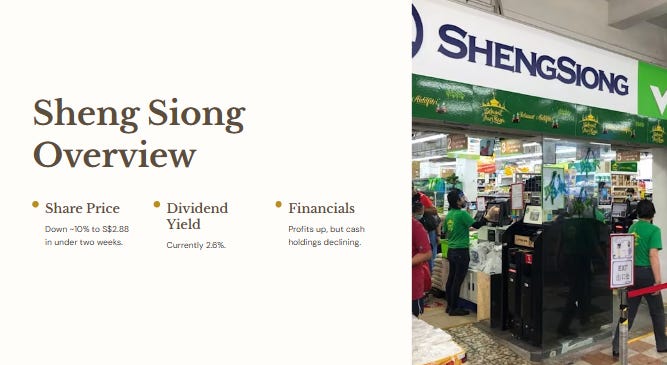
Sheng Siong Is Down About 10%. The Dividend Is 2.6% and the Warehouse Costs S$520M 🦖
Profit rose 11.9% in the first half while cash fell SGD 33 million. Here is what changed between the two, and what a 2.6% dividend can and cannot carry
Sheng Siong traded at SGD 2.88 mid-session on Monday 12 October. On 2 October the same shares were about SGD 3.20, so the price is down about 10% over the six sessions since, counting today’s.
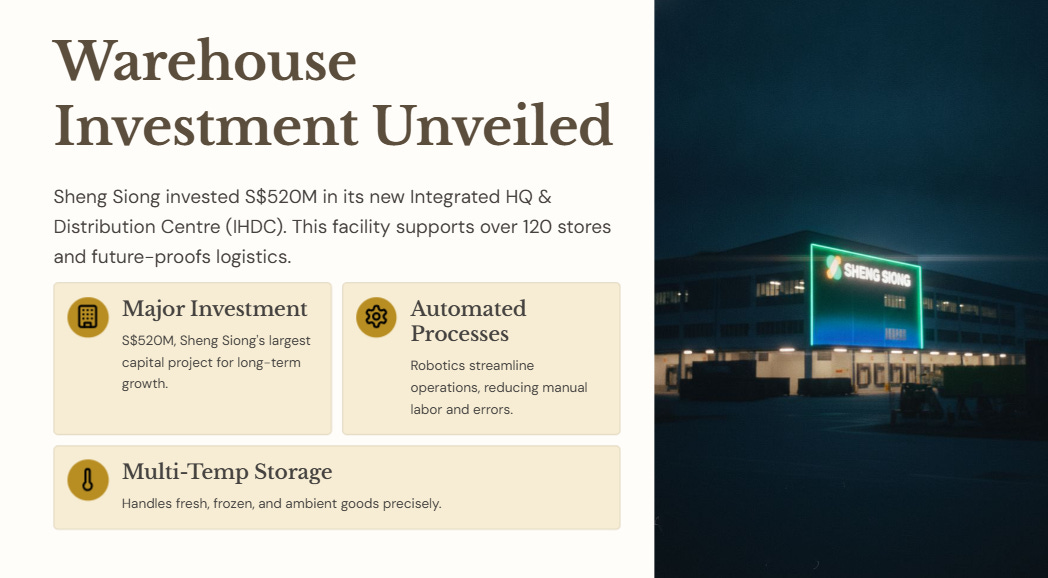
If you own it, or you have been waiting for a reason to look at it, the useful question is not whether 10% is a lot. It is whether the business you were paying for has changed. The results for the first half of FY2026, to 30 June, show profit up 11.9% and cash in the bank down. That combination is why I went into the statements this morning, and it is what this piece walks through.
I used four sources: Sheng Siong’s results announcement on SGX, the SGX dividend notices, an Investing.com data sheet dated 11 October, and a delayed SGX quote from 10:11 Singapore time today. Every figure carries its source, and where I could not check one against the filing I have marked it.
What This Piece Does
What you are paid and what you pay. The dividend per share, the yield at SGD 2.88, and the price set against one year of profit.
What changed in the cash. Why profit rose in the first half while operating cash flow fell, and how much cash is left after leases.
What the next five years may ask of the dividend. The SGD 520 million warehouse project, set against the cash the business makes.
I have no view on where the share price goes next, and nothing here is a recommendation.

What This Piece Does
What the Business Is
What Happened to the Price
What You Are Paid
What You Pay For
Profit Up, Cash Down
What the Free Half Has Shown
The Dividend Against My Tests
The Warehouse Against the Dividend
What the Broker Cut Adds
What Would Change My Reading
Three Things to Take With You
Iggy’s Elite Read
What the Business Is
Sheng Siong runs no-frills supermarkets, mostly in HDB estates. The 1H FY2026 announcement lists 90 stores in Singapore and six in Kunming, China, and the new warehouse is designed to support more than 120 stores.
It is the supermarket at the bottom of the block, where the weekly shop for many households is done. Revenue has risen steadily as a result, from SGD 1,339 million in 2022 to SGD 1,570 million in 2025, according to the same sheet. It earned about 31.8 cents of gross profit on each dollar sold in the first half. The sheet also lists finding new store sites as a limit on growth, in a country with little spare land.
What Happened to the Price
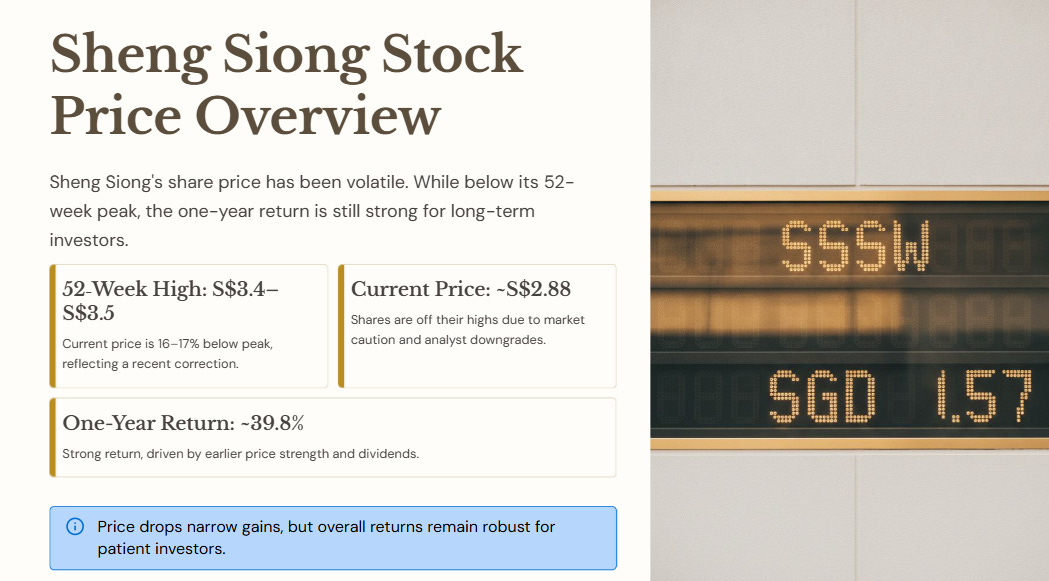
The Investing.com sheet, dated 11 October, gives a 52-week high of SGD 3.42. Another Investing.com page shows SGD 3.46, so I treat the high as roughly SGD 3.4 to SGD 3.5. At SGD 2.88 the shares are roughly 16% to 17% under it. The sheet shows a total return of 39.8% over one year as at the Friday close of SGD 2.92, and I have not checked that against a second source. If it holds, the shares are still well above where they were a year ago.
I cannot tell you why the price fell. Business Times reported that Maybank lowered its rating on 9 October and cut its target price, and headlined a fall of about 3% in the shares afterwards. I have not read the Maybank note, and I have not confirmed which session the 3% refers to. I also do not have the daily closes between 2 and 9 October, so I cannot say how much of the fall came before the note and how much after. A broker note and a falling price often travel together without one causing the other.
What You Are Paid
The plain point first: the dividend is ordinary, regular and growing, but small at this price.
Sheng Siong’s last two payments were a final dividend of 3.80 cents, paid on 15 May 2026, and an interim of 3.75 cents, paid on 28 August 2026, according to the SGX notices. Together they come to 7.55 cents a share over the last 12 months. That is a sum of two payments, not a rate the company has declared for a year. Neither was a special dividend, and there was no scrip option.A year earlier the same two payments were 3.2 cents each, which makes this year’s total about 18% higher.
At SGD 2.88, 7.55 cents is a yield of 2.62%. I count only payments actually made. The Investing.com sheet shows 2.44%, which does not reconcile to those two payments, so I do not use it.
In cash terms, SGD 10,000 at SGD 2.88 buys about 3,470 shares and pays about SGD 262 a year, or about SGD 22 a month. That is my arithmetic from the last two payments, for illustration only.
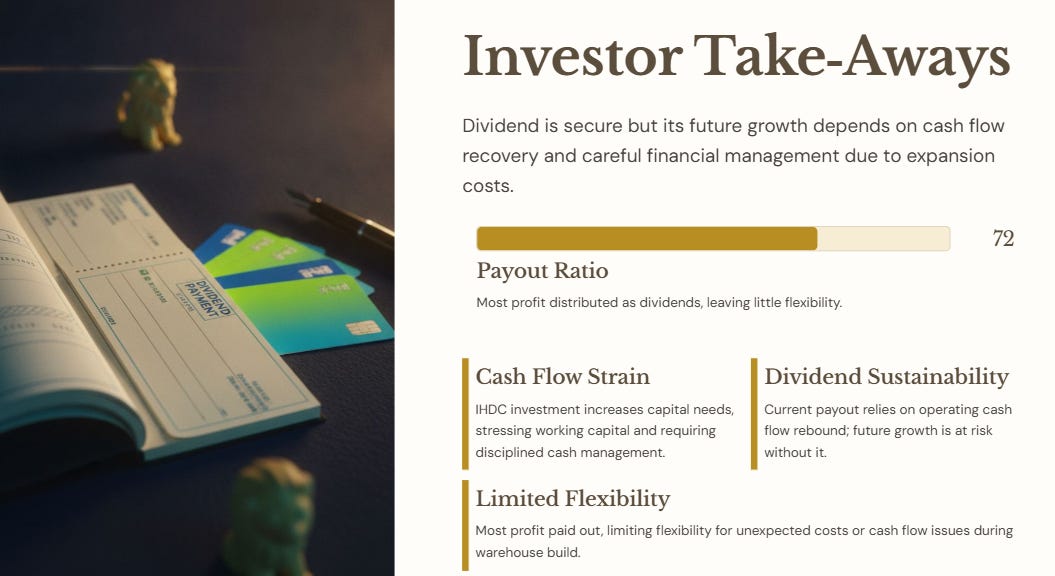
A payout ratio is the share of profit paid out as dividends. For FY2025 Sheng Siong paid 7.0 cents against earnings per share of 9.94 cents, a payout ratio of 70.4%, according to its 2H FY2025 press release. Seven dollars in every ten of profit leave as dividends. That leaves room to keep raising the payment for a year or two, but not much beyond that unless profit grows as fast. On 1,503 million shares, payments of 7.55 cents over 12 months cost the company about SGD 113 million. That is my arithmetic, and it is a number to keep in mind because it comes back below.
Against profit of SGD 157.9 million for the 12 months to 30 June 2026, that is an implied payout ratio of about 72%. It is my own estimate, not a reported figure.
💡 Insight Callout
A yield rises when the price falls, even when nothing else changes. At about SGD 3.20 the same 7.55 cents was a yield of 2.36%. At SGD 2.88 it is 2.62%, an improvement of 26 basis points that the company did not produce. It did not pay a cent more. Only the price moved. So when a stock falls and the yield screen looks better, the question to ask is whether the payment behind the yield changed. Here it did not, which means the gain on the screen is the price talking and not the business.
You Shouldn’t Be Reading This Alone
One Forensic Lens. The difference between a “Sanctuary” and a “Yield Trap” usually comes down to a handful of numbers most investors never check: the gearing ratio, the interest coverage, where the distribution is actually coming from. Free subscribers get the zone number and label. Paid Members get the full audit behind it, every time.
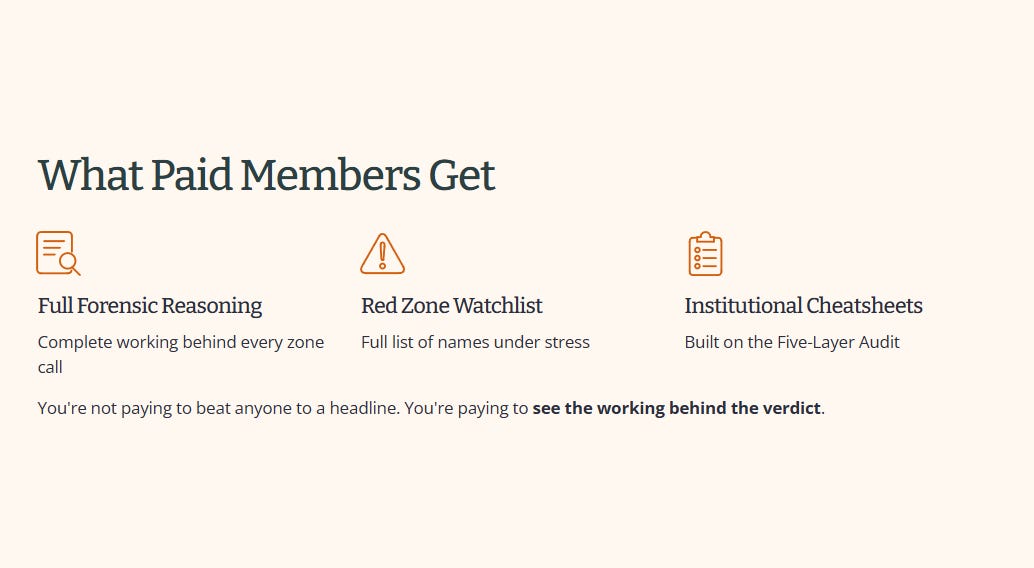
Paid Members don’t just get the report earlier. They get the complete forensic reasoning behind every zone call, the full “Red Zone” watchlist, and institutional-grade cheatsheets, all built on the same Five-Layer Audit you see here. The difference is depth, not speed. You’re not paying to beat anyone to a headline. You’re paying to see the working behind the verdict, with the YouTube & Substack Combo plan.
That’s a punctuation-only fix. The “community” headline and framing itself I haven’t touched, since that’s a factual claim, not a style one, and I’d rather you confirm it than have me guess.
What You Pay For
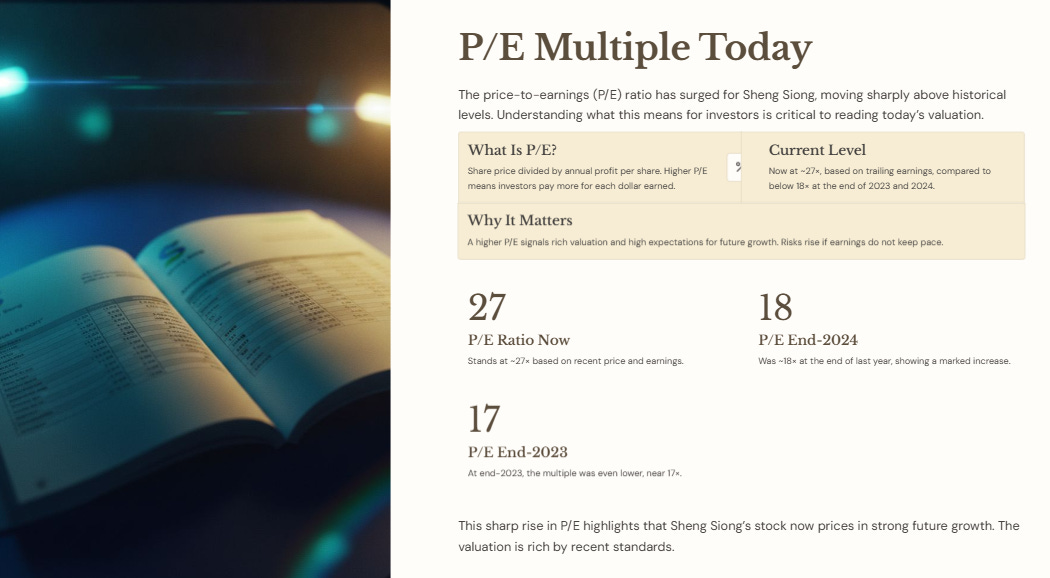
The plain point first: at SGD 2.88 you pay about 27 times one year of profit.
The price-to-earnings ratio, or P/E, divides the share price by the profit per share. Sheng Siong’s profit over the 12 months to 30 June 2026 was SGD 157.9 million, or about 10.5 cents a share, so the P/E at SGD 2.88 is about 27.4. The earnings figures are from the Investing.com sheet and the division is mine.
Put another way, for every SGD 100 you pay for the shares, the business earns about SGD 3.65 a year. About SGD 2.62 of that comes back to you as dividend.
The same sheet shows the P/E at 18.1 at the end of 2023 and 17.3 at the end of 2024. These are third-party year-end figures, not company-reported ones, so treat the comparison as a guide. On them, the price paid for each dollar of profit is about 58% higher than at the end of 2024, even after this fall.
A higher P/E is not a fault by itself. It says the market expects profit to keep growing. The 11 October sheet’s analyst summary expects earnings growth of 12%, 6% and 3% for FY2026 to FY2028. That is slowing, not speeding up.
Profit Up, Cash Down
The plain point first: profit rose, but the cash the stores generated fell.
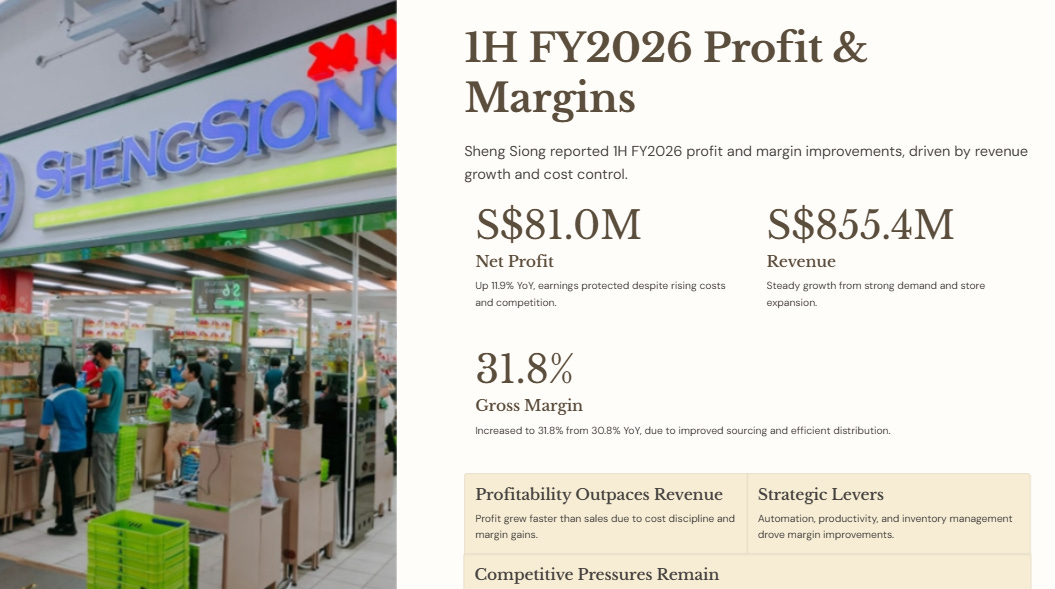
In the first half of FY2026, net profit rose 11.9% to SGD 81.0 million, on revenue of SGD 855.4 million. Gross margin improved from 30.8% to 31.8%, according to the results announcement.
Operating cash flow is the cash the business generates from running its stores, after tax, before it pays for warehouses or dividends. The statement calls it net cash from operating activities. The table below sets it beside two other lines from the same statements. All figures are in SGD million.
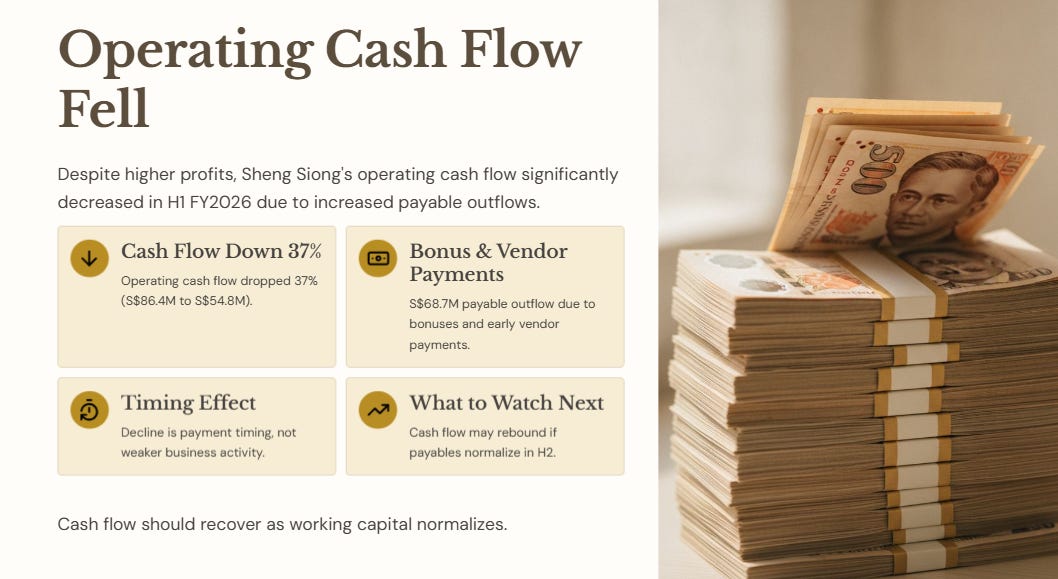
Operating cash flow fell by about 37%. The line below it more than accounts for that. The cash flow statement shows SGD 68.7 million going out through the change in trade and other payables, which is money owed to suppliers and staff, against SGD 23.7 million a year earlier. Sheng Siong attributes the lower operating cash flow to bonuses paid during the half and to settling amounts due to vendors earlier than before.
That is a SGD 45 million larger outflow, against a SGD 32 million fall in operating cash flow. Had payables moved as they did a year earlier, the arithmetic puts operating cash flow above last year’s level. That is my own calculation, with everything else held equal. The balance sheet shows a slightly different figure, a fall in payables of SGD 68.4 million from year-end, which is a separate measure.
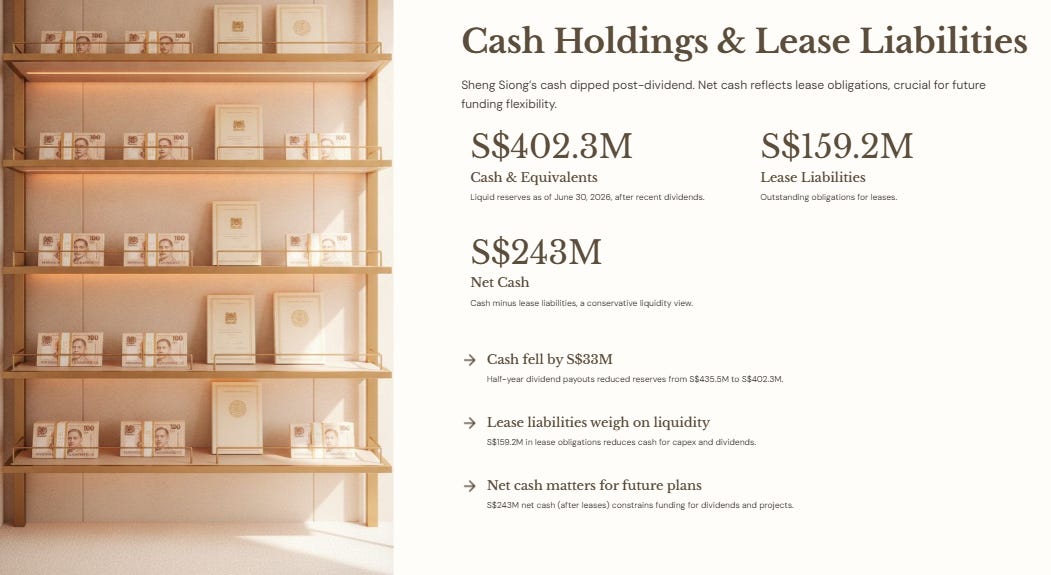
Picture a kopitiam stall that pays its suppliers a week early and hands out the annual bonus in the same month. The till looks lighter that month. The stall has not earned less.
I read the fall as timing and not as a weaker business, but that is a reading and not a fact. What would settle it is whether those payables build back in the second half. I have not found a statement on that from the company.
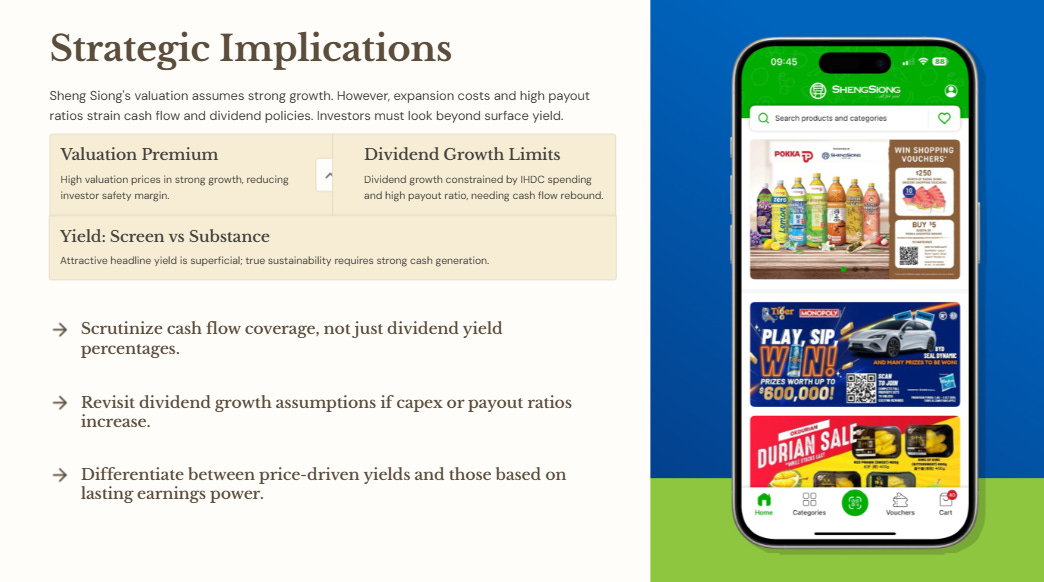
Cash was SGD 402.3 million at 30 June 2026, down SGD 33.2 million over the half, after SGD 57.1 million of dividends were paid.
The filing reports no bank borrowings and lease liabilities of SGD 159.2 million. Net cash is cash minus what is owed, so counting leases it is about SGD 243.1 million, and leaving them out it is the full cash balance. I use the after-lease figure from here on.
What the Free Half Has Shown
By now three figures are established. The last 12 months of payments cost about SGD 113 million. The price is about 27 times profit. And cash after leases is about SGD 243 million. The open question is whether the cash the stores generate can carry the dividend and a large building project at the same time.
🔒 What’s Next
At 7.55 cents a share over the last 12 months, the payments cost about SGD 113 million, and the next section sets that figure beside the SGD 520 million Sungei Kadut project to see how much room is left in the cash the business makes.
