



Singapore Airlines called its own balance sheet “robust” in the same release that reported a net loss. The market barely blinked, the stock actually rose the same week. I ran the actual numbers anyway.
I’ve been watching SIA’s fuel cost line for two quarters now, ever since the Middle East conflict started reshaping every airline’s cost base, and this quarter is the first time it actually broke through to the net result. Whether you hold SIA for the yield or as a quality name to ride through cycles, this quarter asks something different of each of you, and a press release calling its own balance sheet “robust” deserves more scrutiny than a headline adjective gets. Let’s go through what actually holds up.


The Loss, In Context
The Balance Sheet Claim, Audited
🦎 IGGY’S INSIGHT
Cash Is Real, Leverage Direction Is Worth Watching
The Air India Drag
The Yield Hurdle
Live Case Study: SIA (C6L)
The Red Flags Were Always There
The Forensic Gap
Strategic Considerations
The Loss, In Context
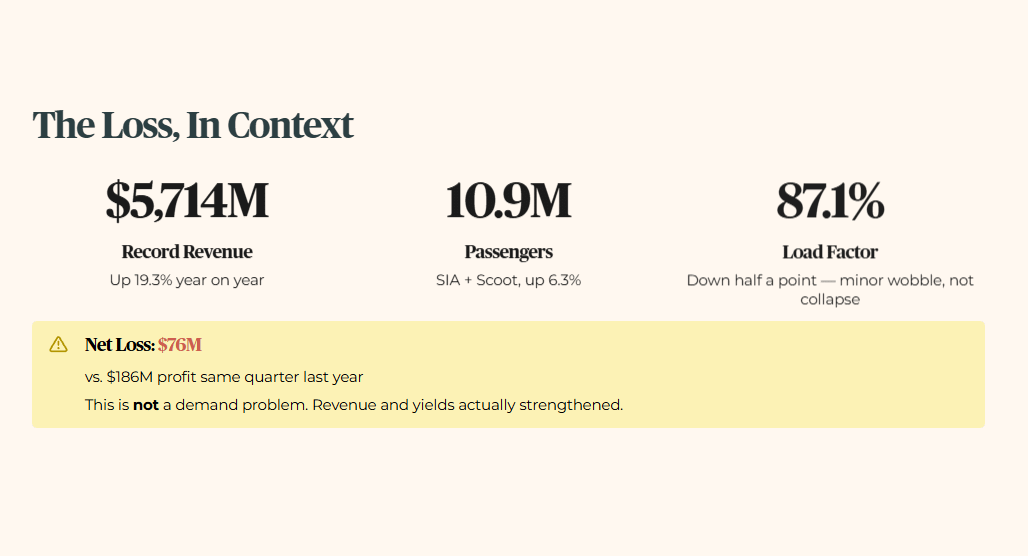
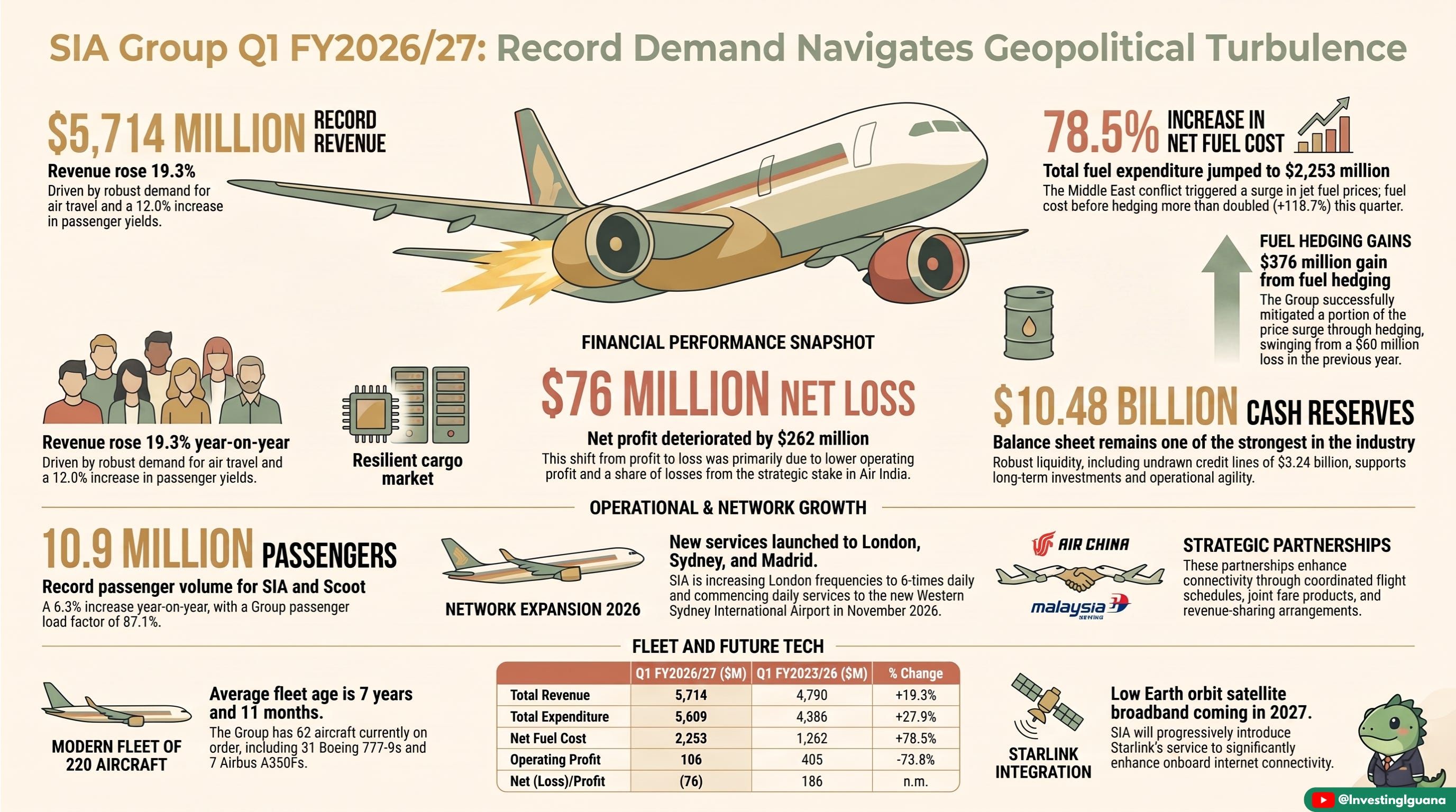
SIA Group posted a net loss of $76 million for Q1 FY2026/27, against a $186 million profit the same quarter a year ago. That is a real swing, but the story underneath it is not a demand problem. Revenue hit a record $5,714 million, up 19.3% year on year, on strong passenger demand and a 12% rise in passenger yields. SIA and Scoot carried a combined 10.9 million passengers, up 6.3%. Group passenger load factor came in at 87.1%, down half a point as capacity growth slightly outran traffic growth, a minor efficiency wobble, not a demand collapse.
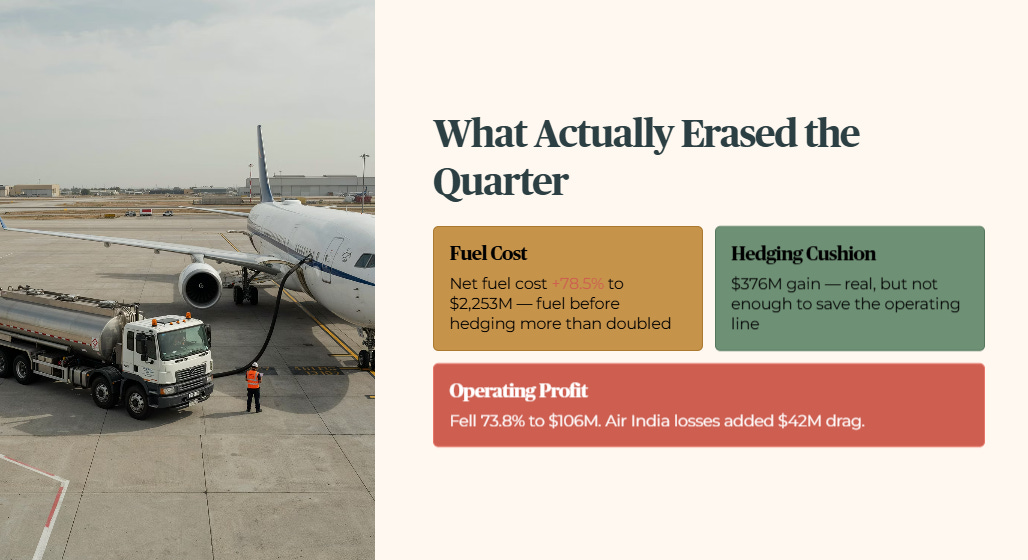
What actually erased the quarter was fuel. Net fuel cost jumped 78.5% to $2,253 million, driven by a surge in jet fuel prices tied to the Middle East conflict that began in late February 2026. Fuel cost before hedging more than doubled. A $376 million fuel hedging gain partially offset the damage, a genuine cushion, not a rounding error, but not enough to save the operating line. Operating profit fell 73.8% to $106 million. Add a widening $42 million share of losses from Air India, the second consecutive quarter this has weighed on the group, and you get the $76 million net loss.

This is a business whose core commercial engine, revenue and yield, actually strengthened this quarter. The loss came from one external cost shock and a coequal investment drag, not from operations deteriorating. That distinction matters for how you read the balance sheet claim that follows, because a company under real structural pressure and a company absorbing a one-quarter fuel shock look very different when you actually check their solvency numbers instead of trusting the adjective in the press release.
The Balance Sheet Claim, Audited
Here is the sentence from SIA’s own release: “A robust balance sheet, anchored by cash reserves of $10.48 billion, supports the Group’s operational agility to seize opportunities and sustain long-term investments.” That is a confident, specific-sounding claim. My forensic checklist runs four gates against any balance sheet claim, regardless of who is making it. Here is where SIA actually lands.
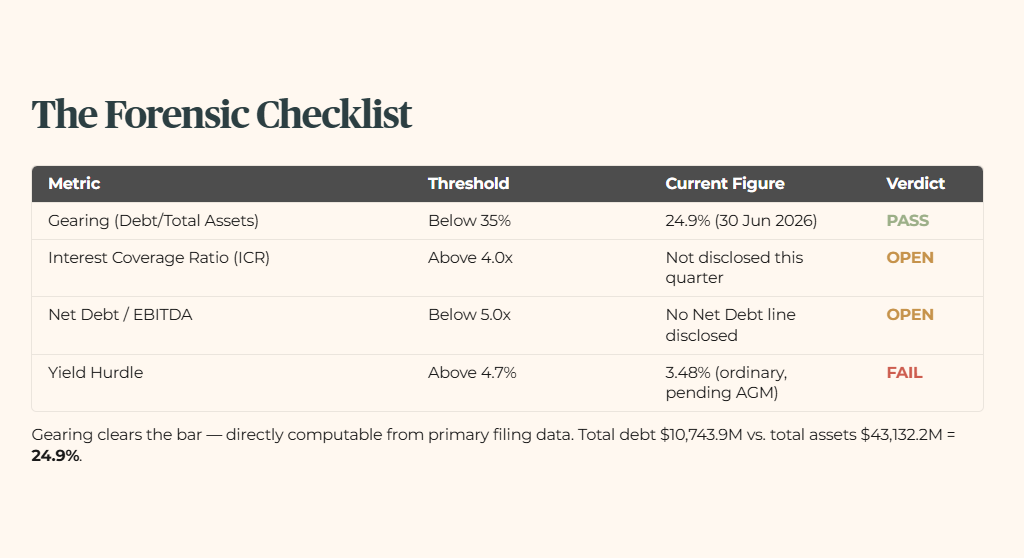
Gearing genuinely clears the bar. Using SIA’s own reported total debt of $10,743.9 million against total assets of $43,132.2 million as at 30 June 2026, gearing comes to 24.9%, well inside my 35% ceiling. This is a directly computable figure from primary filing data, no estimation required.

The other two solvency gates are where “robust” stops being a checkable claim and starts being an adjective doing a lot of unearned work. SIA’s Q1 announcement does not break out a finance or interest expense line, so I cannot independently calculate ICR this quarter, the figure remains open pending the full audited financial statements. SIA also does not appear to publish a standalone “Net Debt” figure the way some peers do, so a Net Debt/EBITDA reading would have to be assembled from components pulled across different sources, and the last attempt to do exactly that produced a cash figure that did not reconcile against SIA’s own reported cash position. Rather than carry forward a number I cannot stand behind, both gates stay open in my own tracking until they can be built from a genuinely reconciled source.
🦎 IGGY’S INSIGHT
“Robust” is a word, not a coverage ratio. A press release can call a balance sheet robust without ever showing you the interest expense line that would let you check the claim.
That is not necessarily dishonest, companies are not obligated to disclose every metric every quarter, but it means the reader who takes the adjective at face value has confirmed nothing.
Two of my four standard solvency gates simply cannot be verified from this quarter’s disclosure alone. The forensic point is not that SIA is hiding something. It is that half a checklist passing and half a checklist being unconfirmable are two very different things, and only one of them deserves the word robust.
Cash Is Real, Leverage Direction Is Worth Watching
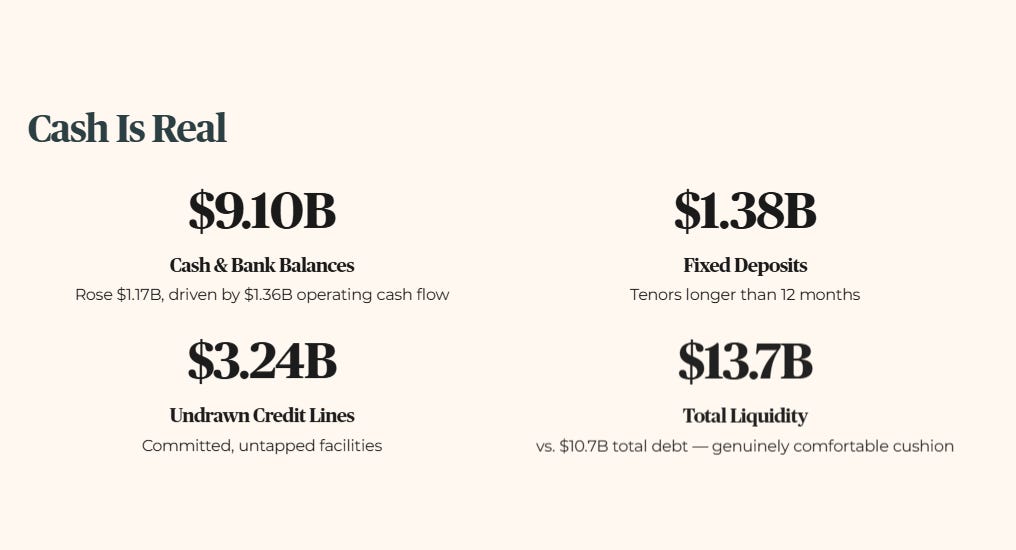
What is genuinely verifiable, and genuinely strong, is liquidity. Cash and bank balances rose $1.17 billion to $9.10 billion, driven by $1.36 billion in net cash generated from operations, proceeds from maturing fixed deposits, and a new bond issuance. Beyond that, SIA holds a further $1.38 billion in fixed deposits placed for tenors longer than 12 months, plus access to $3.24 billion in undrawn committed credit lines. Add it together and SIA is sitting on roughly $13.7 billion in cash, near-cash, and untapped facilities against $10.7 billion in total debt. That is a genuinely comfortable liquidity cushion, and it is the part of the “robust” claim that actually stands up to a direct check.
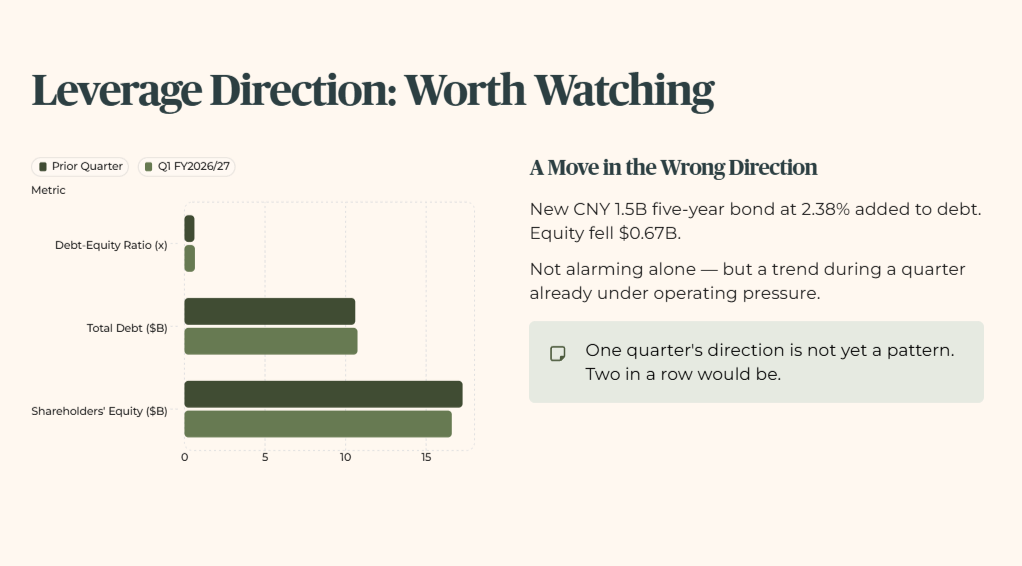
The direction of leverage, though, is worth a line of caution rather than a pass. Total debt rose modestly to $10,743.9 million, mainly from a new offshore CNY1.5 billion five year bond priced at 2.38%. Group shareholders’ equity fell $0.67 billion to $16.59 billion. The combination pushed the debt-equity ratio from 0.62x to 0.65x. That is not an alarming move on its own, but it is a move in the wrong direction during a quarter when the operating result was already under pressure, and it is exactly the kind of trend that deserves tracking rather than dismissing, since a single quarter’s direction is not yet a pattern, but two in a row would be.
The Air India Drag
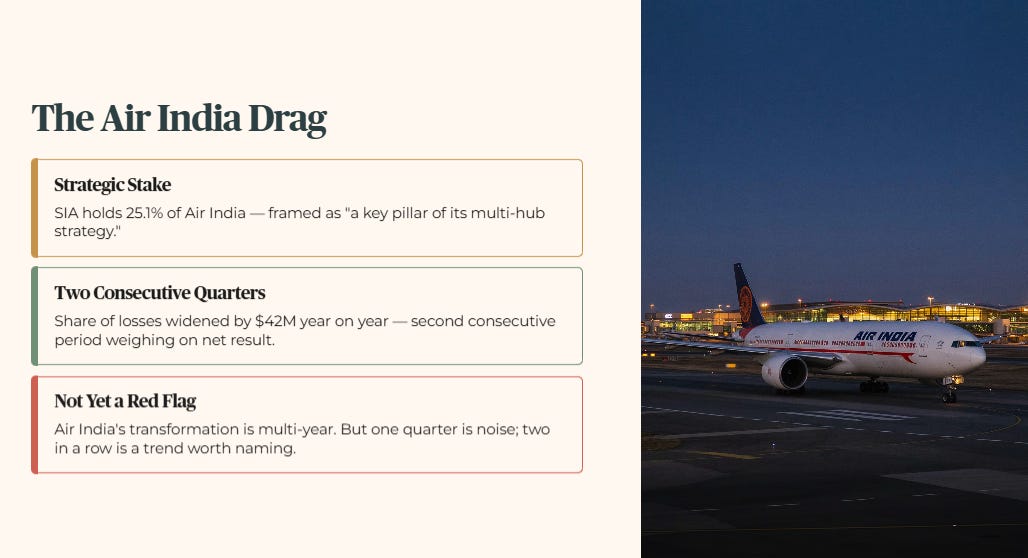
SIA’s 25.1% strategic stake in Air India is framed in its own release as “a key pillar of its multi-hub strategy.” The framing is fair, Air India’s fleet renewal and service improvements are real and ongoing. But the Group’s share of Air India’s losses widened by $42 million year on year this quarter, the second consecutive period this line has weighed on the net result. One quarter of associate losses is noise. Two in a row, on a strategic stake this size, starts to look like a trend worth naming rather than folding silently into the overall loss figure. This is not yet a forensic red flag, Air India’s transformation programme is multi-year by design and short-term drag was always plausible, but it is a line I will be watching closely at the next result, and I would rather flag it early than pretend it is not there.
The Yield Hurdle
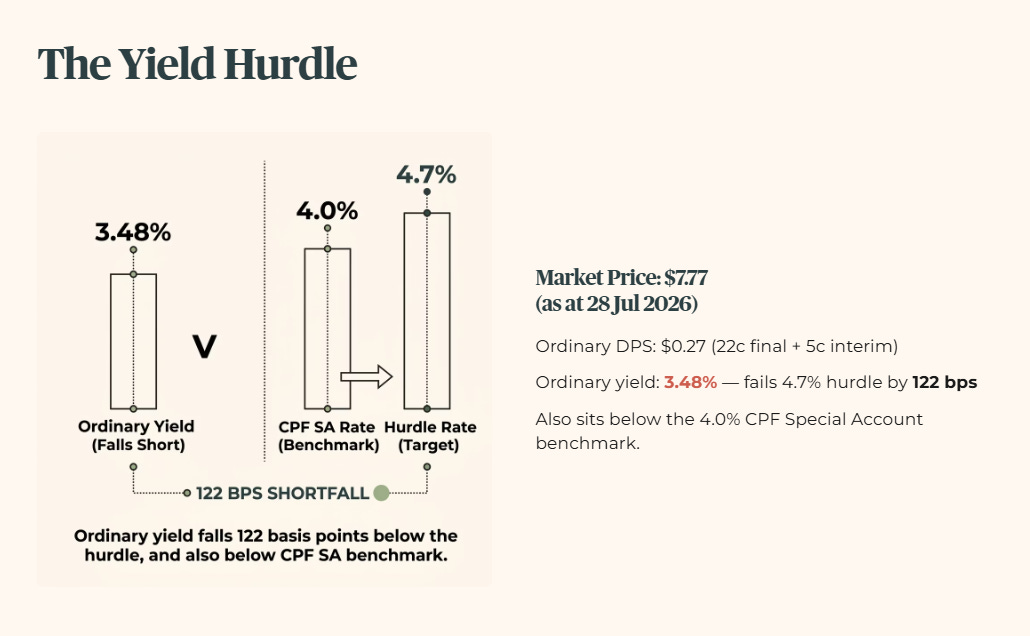
Turning to the number that actually decides the zone call: at a market price of $7.77 (as at 28 Jul 2026), SIA’s ordinary dividend per share of $0.27, comprising a 22 cent final and 5 cent interim, produces an ordinary yield of 3.48%. That fails my 4.7% minimum yield hurdle by 122 basis points, and it sits below the 4.0% CPF Special Account benchmark as well.
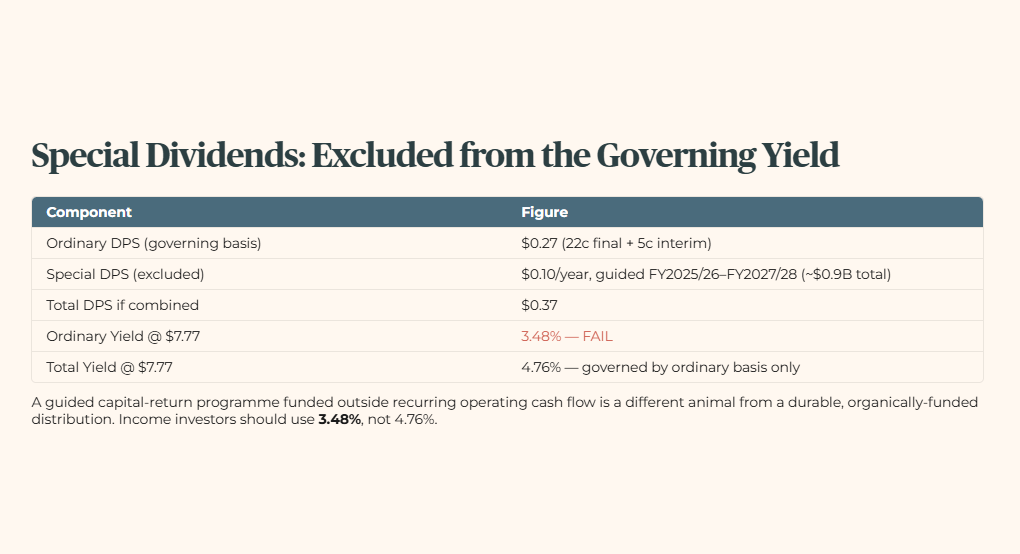
SIA also runs a guided, time-bound special distribution package, 10 cents per share annually from FY2025/26 through FY2027/28, roughly $0.9 billion in total. Including those specials, total DPS of $0.37 would produce a yield of 4.76%, technically clearing the hurdle. I exclude the specials from the governing yield figure, the same treatment I apply to SingTel’s Value Realisation Dividends, because a guided capital-return programme funded outside recurring operating cash flow is a different animal from a durable, organically-funded distribution, even when the company itself guides it years in advance. A reader deciding whether SIA clears the income bar for a retirement portfolio should be looking at the 3.48% figure, not the 4.76% one.
One live caveat before this figure gets treated as settled: SIA’s 54th AGM was held on 24 July 2026, and as of this writing the formal outcome announcement confirming shareholder approval of the proposed final dividend has not yet been published through SIA’s own investor relations channels. Every prior year’s AGM outcome has posted within days of the meeting. Until this one does, I am treating the ordinary DPS base as directionally reliable but not yet formally final, and I will update this figure the moment the confirmation lands.
Live Case Study: SIA (C6L)
Iggy’s Forensic Zone: Zone 4-, Caution (Growth Read: strong liquidity position, a compound profile of yield miss plus elevated soft flag count are the constraints).
This is not a single clean gate failure the way a fortress-balance-sheet, yield-only miss would read. SIA’s Zone 4- is a compound call: the ordinary yield fails the hurdle by a wide margin, and weighted soft flags sit at 2.0, driven by dependency on the guided special distribution programme to supplement ordinary income while core profitability now faces fresh fuel cost pressure, and by a net profit compression pattern that has extended into an outright quarterly net loss. Either factor alone would be enough to qualify for the “-” suffix, together they reinforce rather than soften the call.
The ordinary yield fails the hurdle here, the next section is where I start weighing that miss against the soft flag profile and retirement calibration to decide whether SIA belongs in your income portfolio at all.
