



Singapore Retail REITs: A 2026 Update
Six names, one label, and a one-year performance gap wide enough to make “retail REIT” almost meaningless as a category
I went looking for a simple update on how Singapore’s retail REITs are doing this year. What I found instead was six trusts sitting under the same sector label with almost nothing else in common. Some are having a genuinely good year. One just changed its name. And at least one story only makes sense once you stop looking at the price and start looking at what’s actually being paid out.
Here’s what I found when I looked past the sector average.

The name change nobody mentioned
When the price and the payout tell different stories
What about the ones actually having a good year
Starhill Global: a REIT where the answer depends on which question you ask
Frasers Centrepoint Trust: growth that’s real, but not quite what it looks like
Putting the sector back together
The name change nobody mentioned
Lippo Malls Indonesia Retail Trust isn’t called that anymore.

As of 27 March this year, it trades under a new name, Landmark REIT, same SGX code, same underlying portfolio, different label on the ticker. Companies don’t usually rename themselves in the middle of a good run.
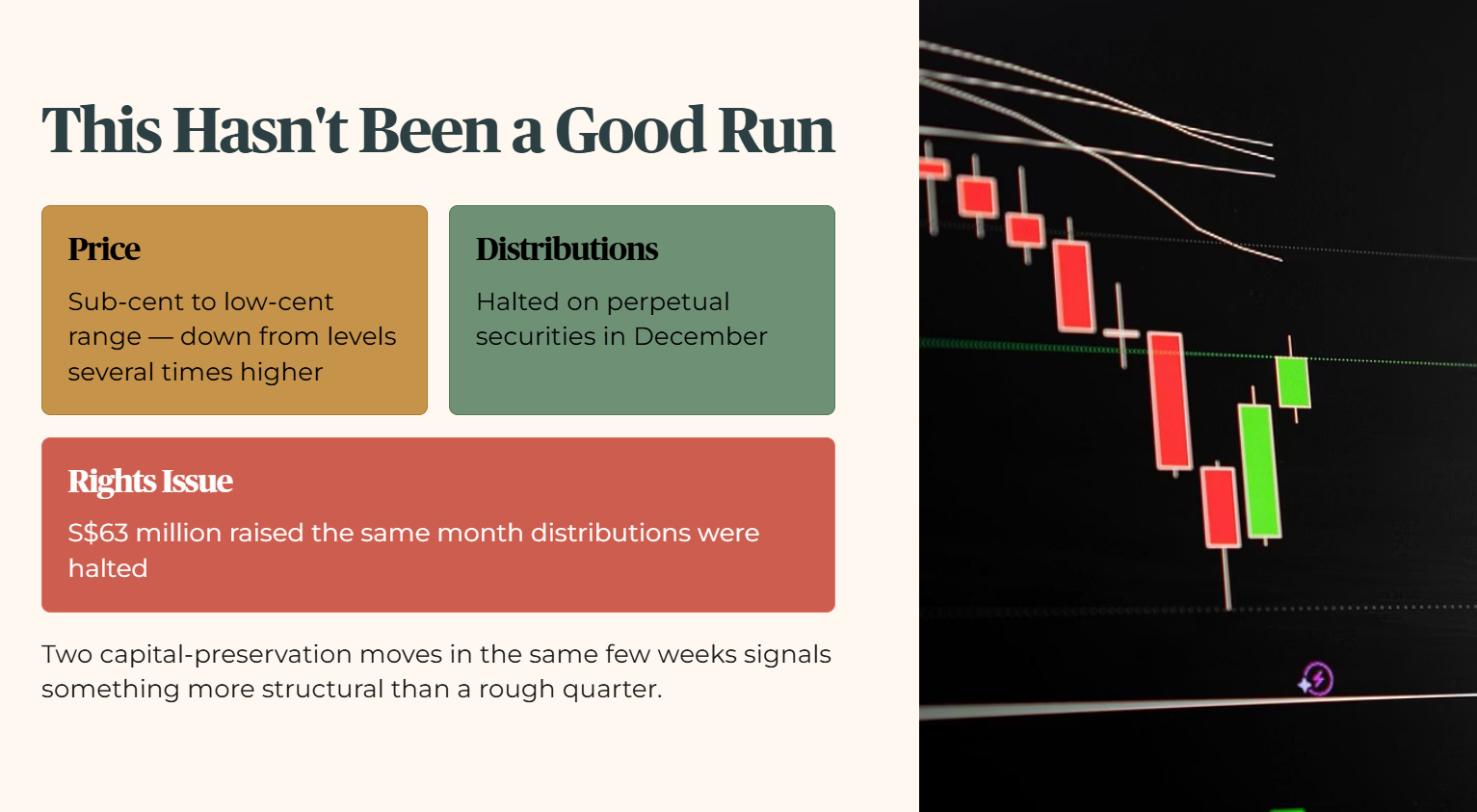
And this hasn’t been a good run. The counter has traded in the sub-cent to low-cent range for most of this year, down from levels several times higher not long ago. The trust halted distributions on its perpetual securities in December, and launched a S$63 million rights issue the same month.
Two capital-raising and cash-preservation moves inside the same few weeks tells you the difficulty here isn’t a rough quarter, it’s something more structural. I don’t know if the rename is meant to signal a fresh chapter or just distance from a bruised name. Either way, it’s worth knowing if this counter is sitting in your portfolio under a name you might not recognise on a statement anymore.
🟠 Angela’s Observation
My husband asked me last week why a REIT would bother changing its name. I didn’t have a great answer at the time, beyond “maybe they want people to forget.” Having looked closer, I think that’s actually close to right, but not in a dishonest way.
A name carries a reputation, and if the reputation has taken this much damage, from halted payouts to a rights issue in the same month, a fresh name is at least an honest admission that the old chapter is over. What I keep coming back to is a simpler question for anyone holding a REIT they haven’t checked on in a while: would you still recognise it if it changed its name tomorrow? Because apparently, sometimes they do.
No One Pays Him To Be Right
The Verdict Doesn’t Change Because The Bill Needs Paying. Every finance channel says “unbiased.” Most of them also have a sponsor, an affiliate link, or a subscriber count to protect deciding what gets softened. Iggy doesn’t. This channel started as, and still is, a passion project, not an income source. That’s not a slogan, it’s the actual reason a Zone 4 verdict stays a Zone 4 verdict even when the stock is one half of Singapore holds.
Iggy’s Elite Investors aren’t paying for faster access to opinions that were always going to be diplomatic anyway. You’re paying for the version of this analysis that exists because it doesn’t need to please anyone, zero-day forensic breakdowns, the complete “Red Zone” watchlist, and institutional-grade cheatsheets built without a single sponsor’s name attached to the verdict.
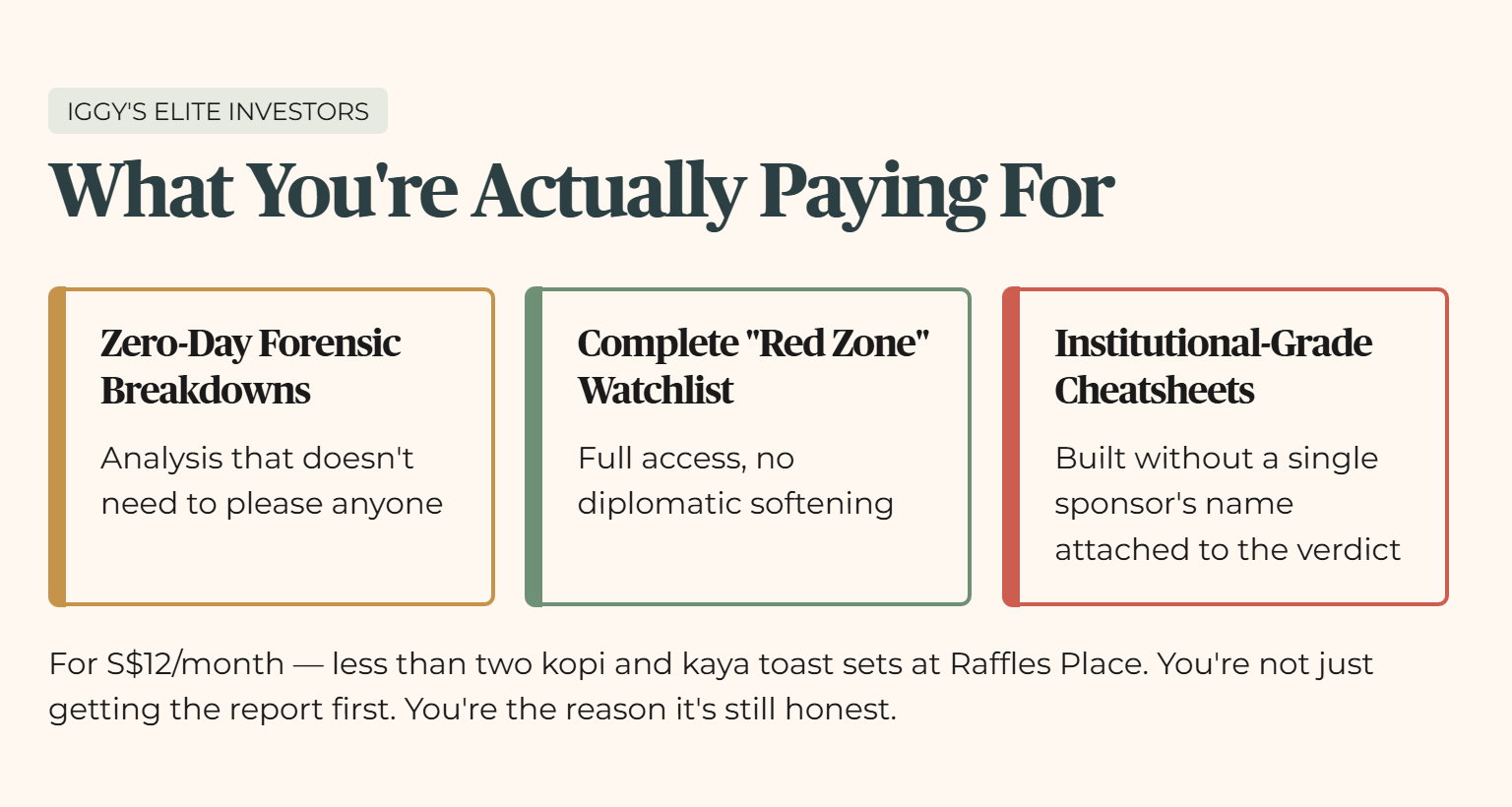
For S$12/month, less than two kopi and kaya toast sets at Raffles Place, you’re not just getting the report first. You’re the reason it’s still honest.
When the price and the payout tell different stories
Sasseur REIT is the opposite kind of surprising. Its unit price has actually drifted down a little over the past year. But its distribution per unit for the first half of this year rose 10.2 percent from the year before, a real, confirmed increase, not a one-off. Gearing is comfortably low for the sector, occupancy sits above 98 percent, and the cost of servicing its debt has actually come down.

So why would a REIT with improving fundamentals see its price fall? The honest answer is that price and fundamentals don’t always move together in the short run, especially right now. Government bond yields, both here and in the US, have been climbing, and REITs get priced against those benchmarks constantly.

When the comparison point moves, REIT prices can drift even when nothing about the underlying business has gotten worse. It’s a timing and valuation story, not a business quality one, but if you’re only glancing at the price, you’d never know the difference.
What about the ones actually having a good year
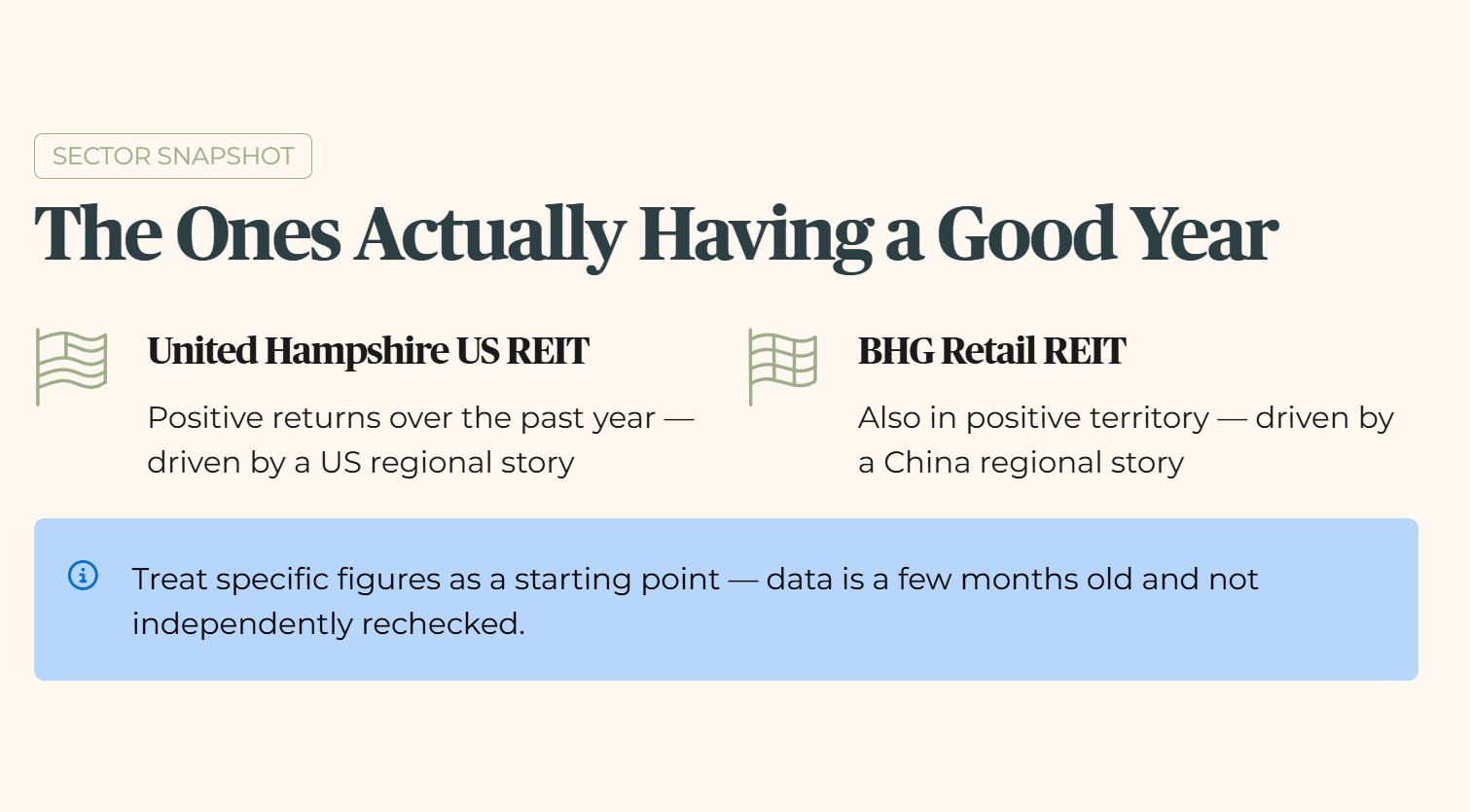
Not every name in this sector is having a hard time. United Hampshire US REIT and BHG Retail REIT both appear to have posted positive returns over the past year based on the data I could find, though I’d treat those specific figures as a starting point rather than gospel, the numbers I’m working from are a few months old and I haven’t independently rechecked them the way I did for the names above.

What I can say with more confidence is that a US-focused retail REIT and a China-focused retail REIT sitting in the same “positive” bucket as each other tells you these two are being driven by completely different regional stories, not a shared Singapore retail narrative.
Starhill Global: a REIT where the answer depends on which question you ask
This one genuinely surprised me. Depending on how you measure it, Starhill Global REIT has either had a modestly positive year or a negative one. Its unit price is down for the year so far. But once you count the distributions actually paid out to unitholders, the total return over the past twelve months comes out positive.
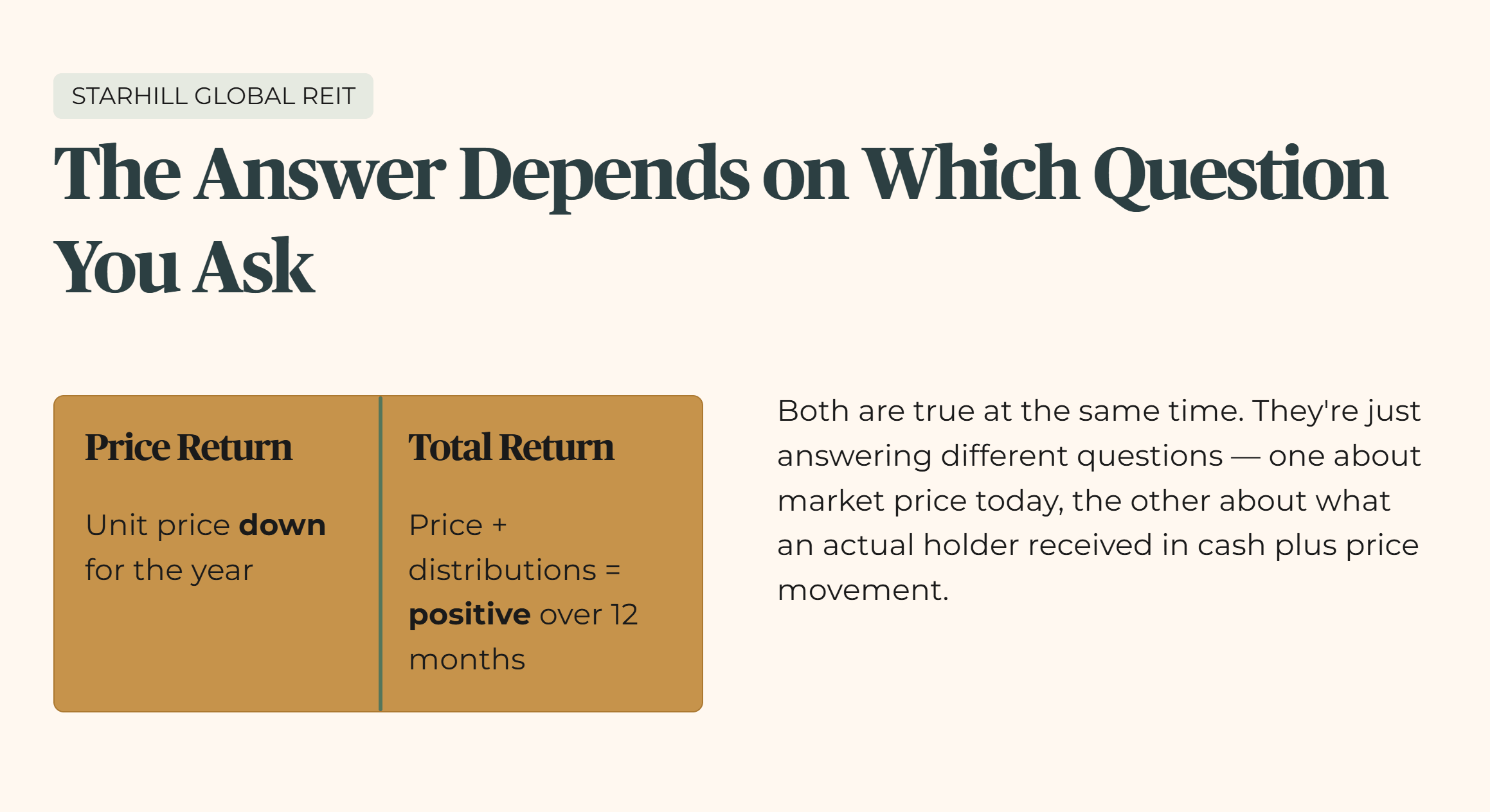
Both of those are true at the same time. They’re just answering different questions, one about what the market thinks the units are worth today, the other about what an actual holder received in cash plus price movement. Underneath both numbers sits a less ambiguous fact worth knowing, Starhill’s earnings for the year came in well below the year before, net income down sharply, even as sales held up.
A REIT can keep the distribution flowing for a while even when the earnings underneath are getting thinner. That’s worth watching, not panicking over.
🔒 What’s Next
Frasers Centrepoint Trust’s headline growth numbers look strong this year, revenue and income both jumped sharply. The next section looks at where that growth actually came from, and whether it tells the same story as the DPU figure suggests.
