




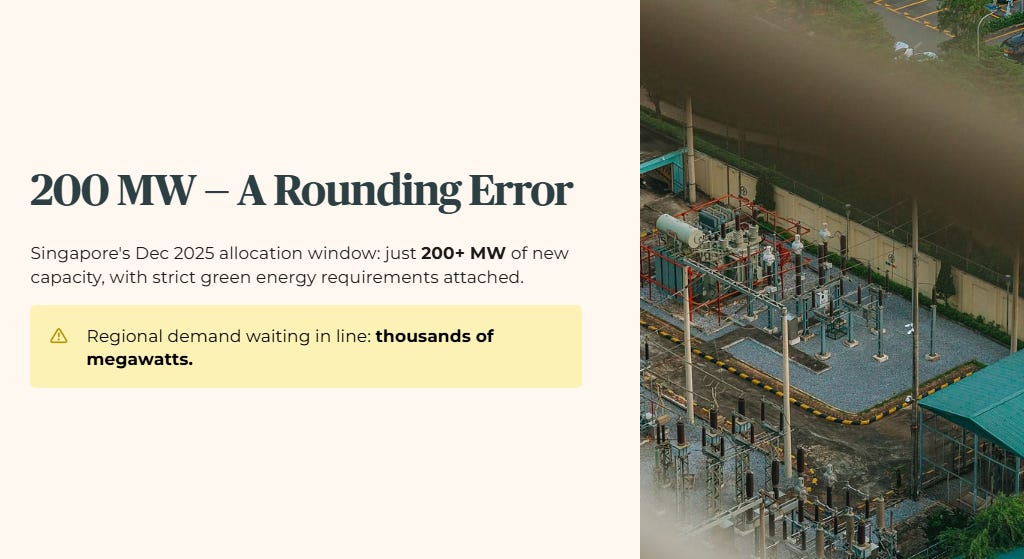
Singapore rations data centre capacity the way I ration approval for a stock. Slowly, selectively, and only for names that clear a demanding bar. In December 2025, the government opened a new allocation window for just over two hundred megawatts of fresh capacity, with strict green energy and efficiency requirements attached. That is a rounding error against the thousands of megawatts of regional demand actually waiting in line.
Here’s the question that discipline creates, and that most REIT investors never ask. If Singapore is deliberately keeping its own data centre footprint small and clean, where is the rest of that demand actually going, and what does that place look like on the ground.

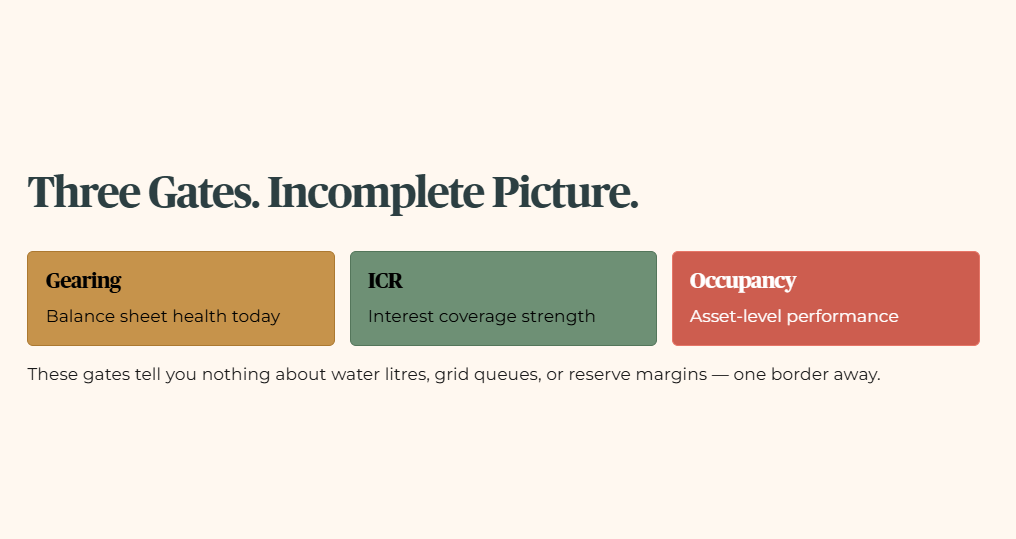
I get asked why I check gearing, ICR, and occupancy on every REIT in my coverage, as if that were the whole picture. It isn’t. Those three gates tell you whether a specific building’s balance sheet holds up today. They tell you nothing about the physical constraints building up one border away, where the region’s real growth is actually happening, and where a very different set of numbers, water litres, grid connection queues, reserve margins, are starting to matter just as much.
Whether you are holding a data centre REIT inside your CPF-linked SRS account or as part of a separately allocated growth sleeve, the discipline below is the same: know what is actually happening upstream of the number on your statement.

Why Singapore Stays Small On Purpose
Where The Rest Of The Demand Actually Goes
The Grid Behind The Water Problem
The Number That Does Not Show Up On Any REIT’s Balance Sheet
Iggy’s Forensic Zone
The Gate That Does Not Exist Yet
Johor Is Not Simply Absorbing The Growth Quietly
Landlord, Not Partner
What I Am Actually Watching From Here
Why Singapore Stays Small On Purpose
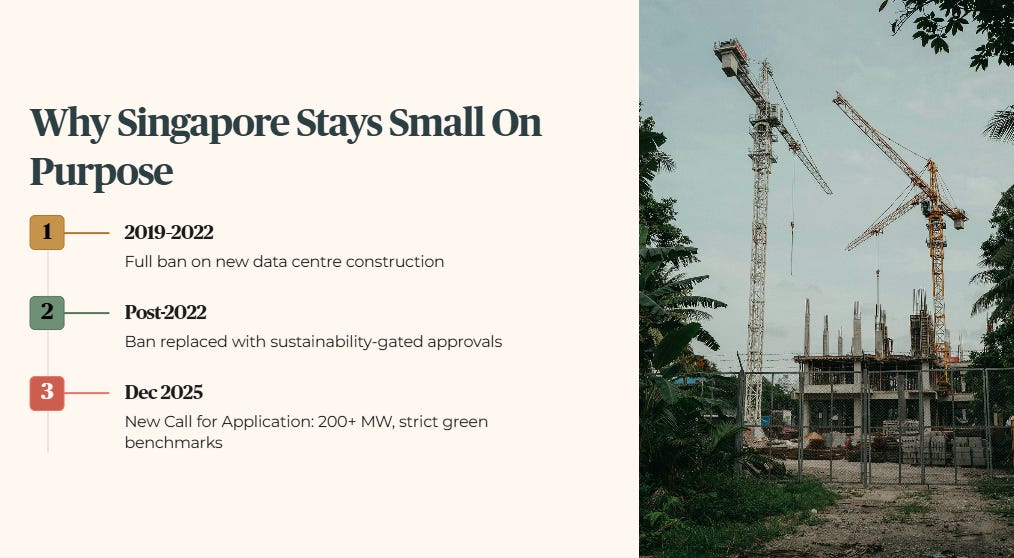
Singapore banned new data centre construction outright between 2019 and 2022. The concern was straightforward. A small, land-scarce, water-scarce city-state was about to hand over too much of its limited space and power grid to server farms. When the freeze lifted, Singapore did not reopen the floodgates. It replaced the ban with a selective, sustainability-gated system instead.
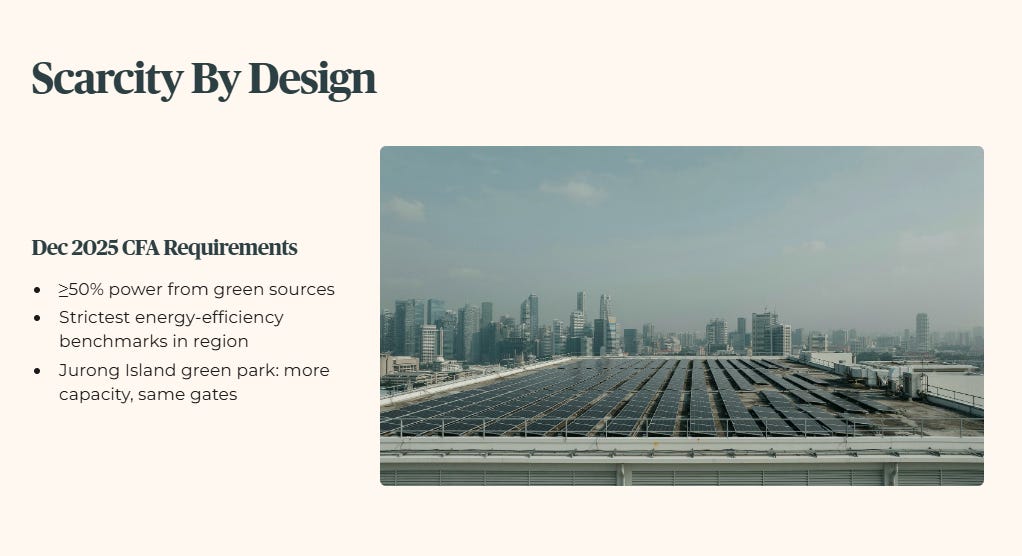
The most recent version of that system, the Data Centre Call for Application launched on 1 December 2025 by Singapore’s Economic Development Board and Infocomm Media Development Authority, released at least two hundred megawatts of new capacity, contingent on operators sourcing at least half their power from green sources and hitting some of the strictest energy-efficiency benchmarks in the region. A separate, larger green data centre park planned for Jurong Island could add meaningfully more capacity over time, but again, gated on sustainability performance, not simply issued to the highest bidder.
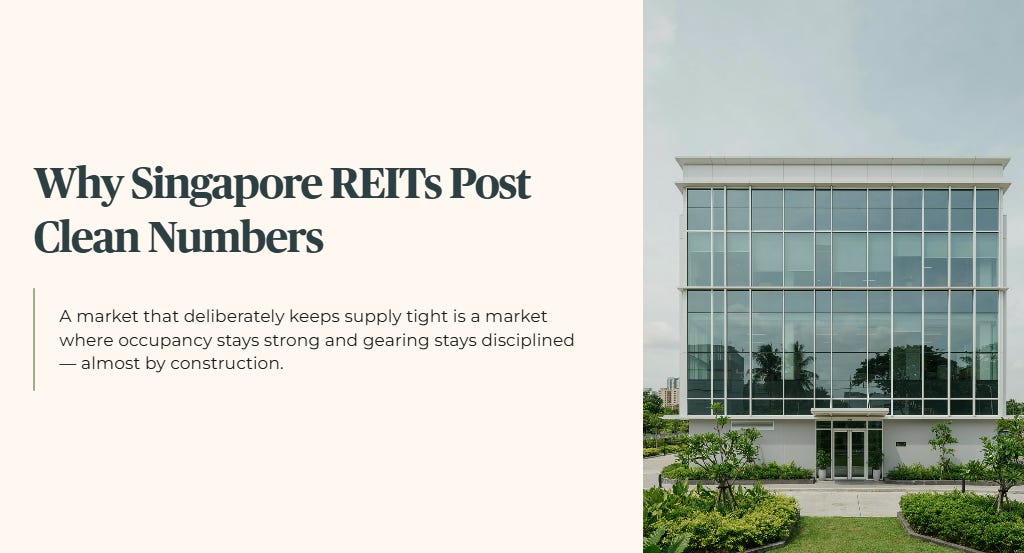
This is scarcity by design, not by accident. And it is precisely why Singapore’s listed data centre REITs can post the clean numbers they do. A market that deliberately keeps its own supply tight, and keeps standards high for who gets to build in it, is a market where occupancy stays strong and gearing stays disciplined almost by construction. The gates I check are not failing here because the underlying market has been curated to make them pass.
Where The Rest Of The Demand Actually Goes
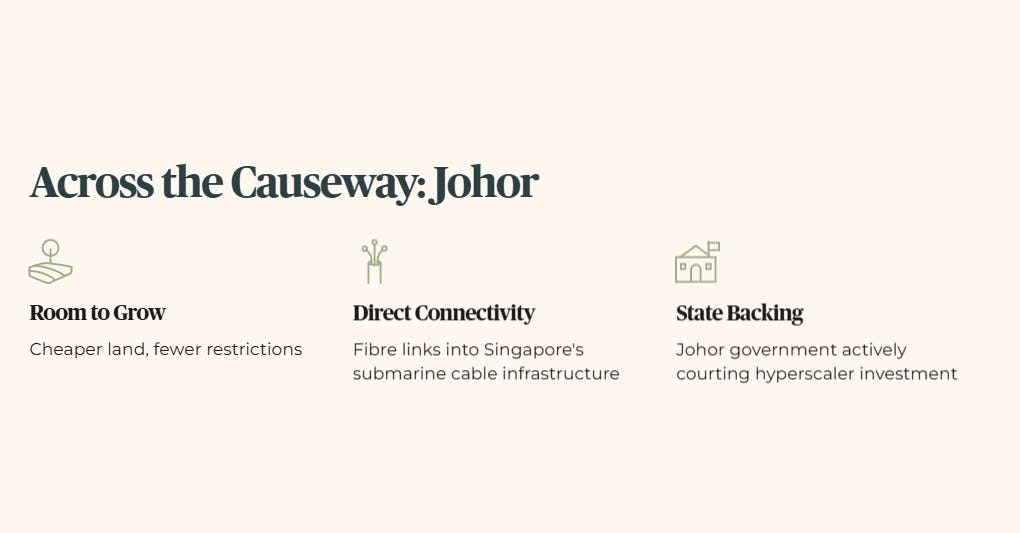
Regional demand for AI and cloud infrastructure runs into the thousands of megawatts. Singapore’s rationed allocations leave most of that appetite unfed. Across the Causeway, Johor has the one thing Singapore deliberately does not offer in the same volume. Room to grow, cheaper land, direct fibre connectivity back into Singapore’s own submarine cable infrastructure, and a state government actively courting the investment.
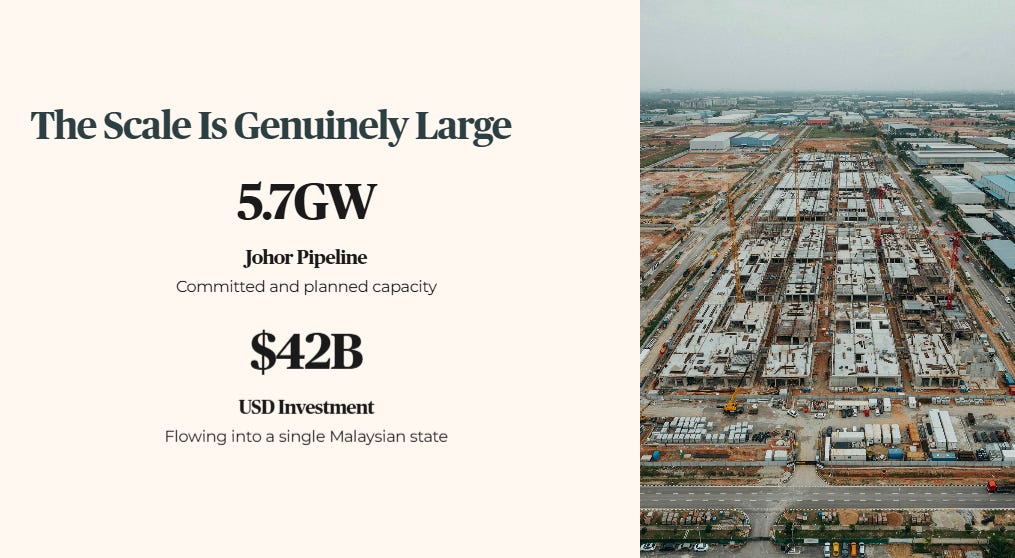
The scale of what has actually moved there is genuinely large, though the exact figure depends on who is counting and what stage of development they are counting. Industry trackers I checked place Johor’s committed and planned pipeline at roughly 5.7 gigawatts, with cumulative investment from hyperscalers and technology companies in the region of forty-two billion US dollars. That is forty-two billion US dollars worth of investment flowing into a single Malaysian state.
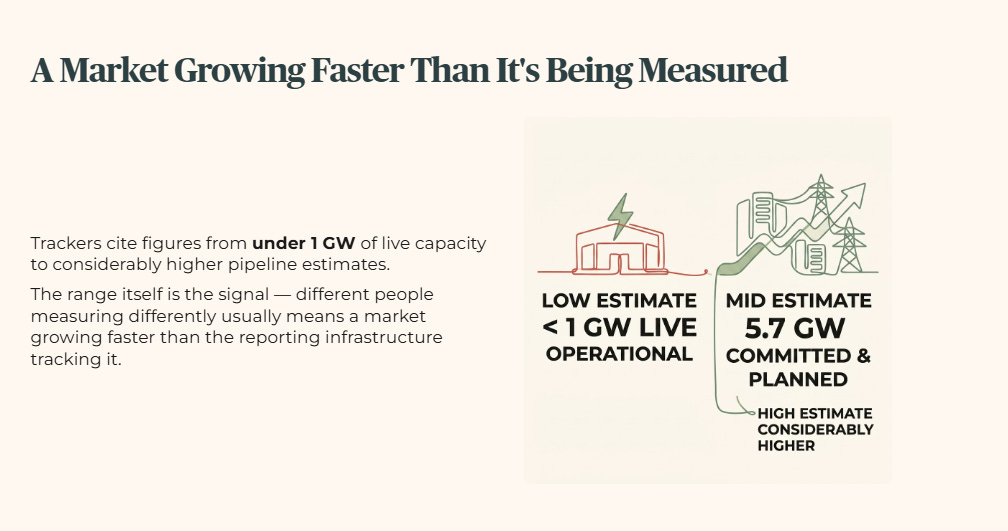
Other trackers, using broader or narrower definitions of what counts as “pipeline,” cite figures ranging from under one gigawatt of live operational capacity up to considerably higher incoming-pipeline estimates. The range itself tells you something. This is a market still being measured differently by different people, which is usually a sign of a market growing faster than the reporting infrastructure tracking it.
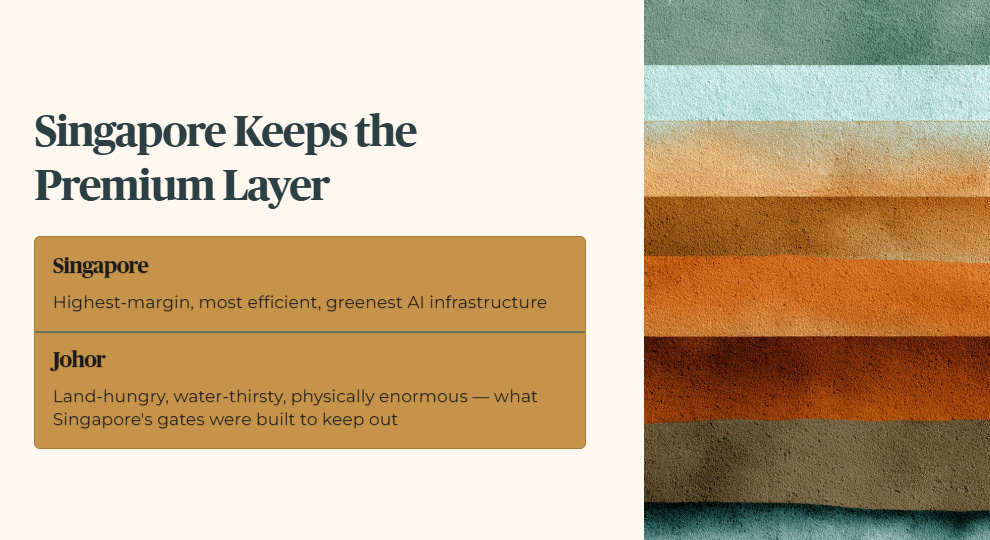
What Singapore keeps for itself, in other words, is the highest-margin, most efficient, greenest layer of the region’s AI boom. Johor absorbs the rest of it. The land-hungry, water-thirsty, physically enormous part of the industry that Singapore’s own gates were specifically built to keep out.
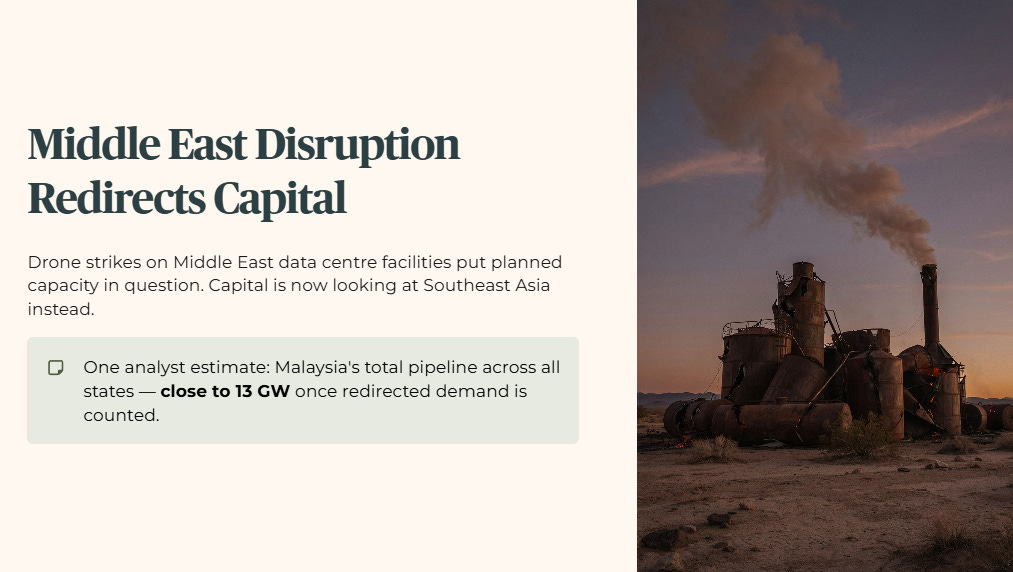
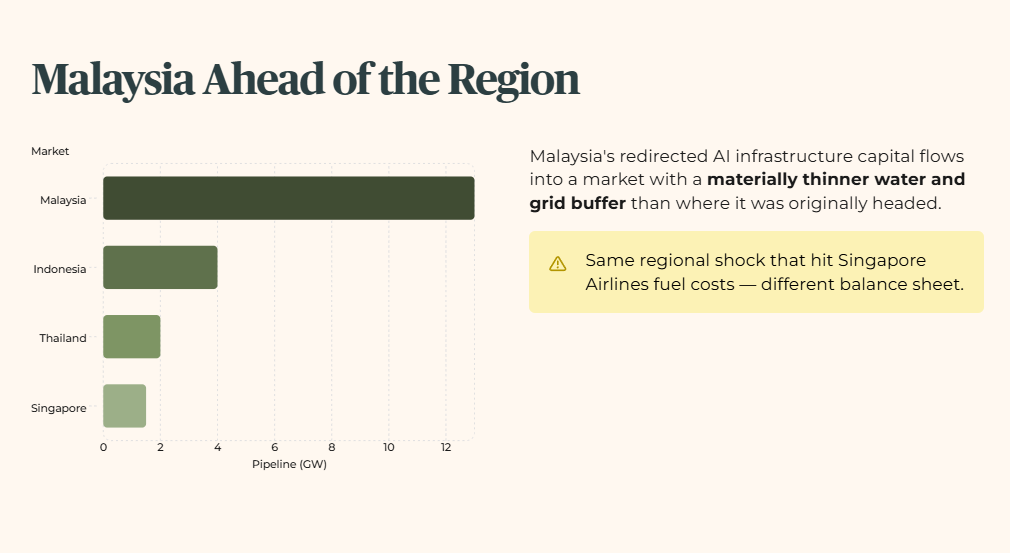
There is also a newer piece to this story worth knowing, and it connects to a conflict I have already flagged elsewhere in my coverage. Drone strikes on data centre facilities in the Middle East earlier this year put a meaningful share of that region’s own planned capacity in question, and some of the capital that would have gone there has started looking at Southeast Asia instead. One analyst estimate puts Malaysia’s total data centre pipeline, across all states, at close to thirteen gigawatts once that redirected demand is accounted for.
That puts Malaysia ahead of Indonesia, Thailand, and Singapore combined. I have already written about how the same Middle East conflict has hit Singapore Airlines through fuel costs. This is the same regional shock showing up on a completely different balance sheet, redirecting AI infrastructure capital toward a market with a materially thinner water and grid buffer than the one it was originally headed for.
The Grid Behind The Water Problem
Water is not the only constraint quietly tightening. Malaysia’s own government has told parliament that electricity consumption from data centres nationally is projected to climb to over seventy thousand gigawatt-hours by 2035. That is close to a third of the country’s total projected demand growth.
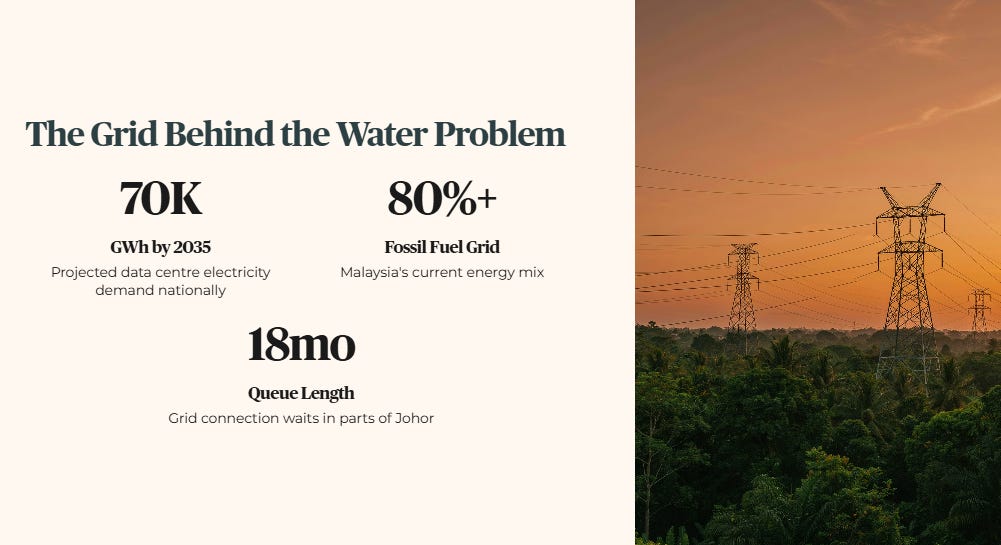
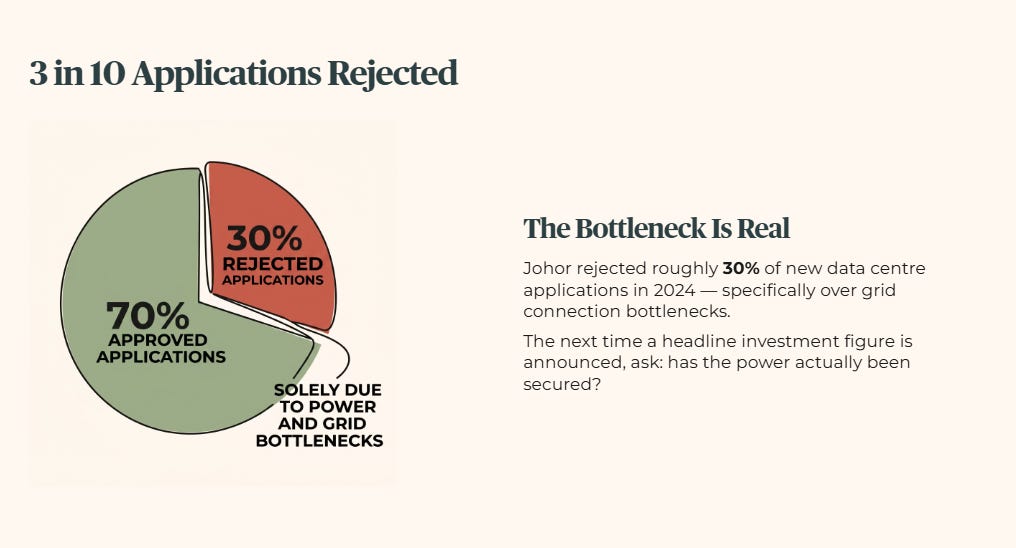
Malaysia’s grid remains more than eighty percent dependent on fossil fuels today, and meeting incoming hyperscaler demand has already meant plans to expand gas-fired generation capacity substantially. Grid connection queues in parts of Johor are already running as long as eighteen months, and the state rejected roughly three in ten new data centre applications in 2024 specifically over these bottlenecks. That is a number worth remembering the next time a headline investment figure gets announced without mentioning whether the power to actually run the facility has been secured yet.
The Number That Does Not Show Up On Any REIT’s Balance Sheet
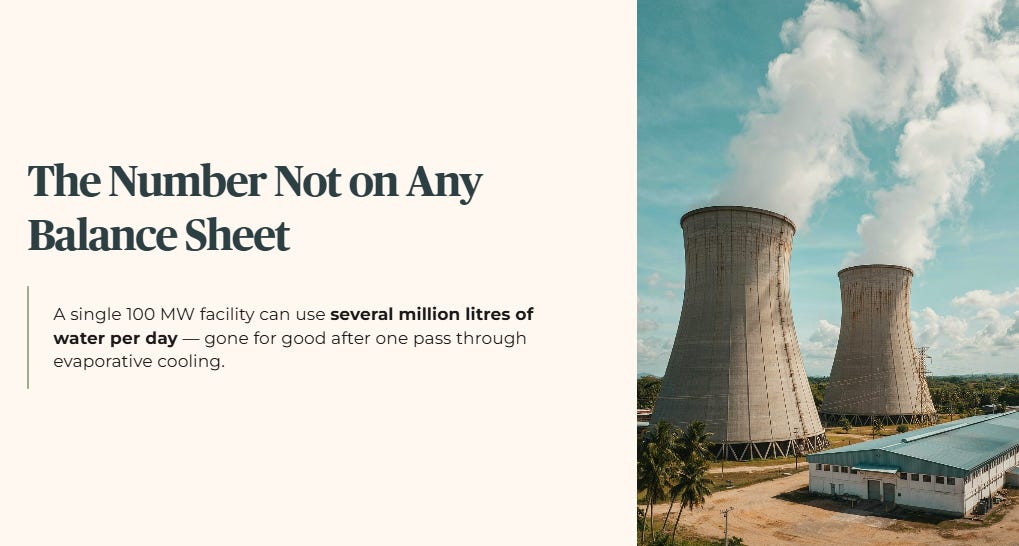
A data centre does not just need power. In a tropical climate, the cheapest way to keep one cool is evaporative cooling, pumping water through the facility and venting the resulting vapour into the air, gone for good. A single hundred-megawatt facility can use several million litres a day this way, water that disappears into the air after one pass through the cooling system.
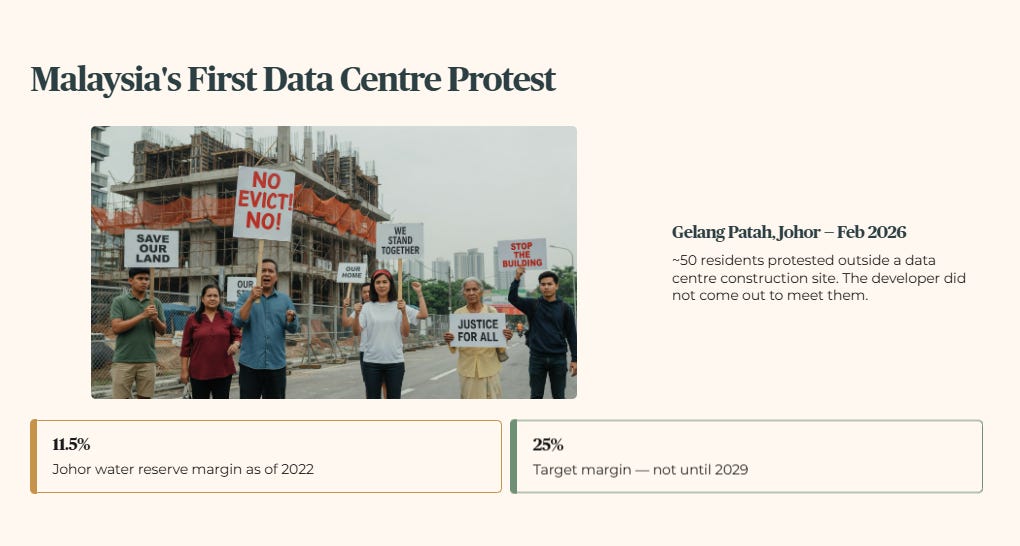
In February 2026, close to fifty residents in Gelang Patah, Johor, gathered outside a data centre construction site to protest, in what has been described as Malaysia’s first public demonstration specifically against a data centre. The developer did not come out to meet them. The concern was not abstract. Johor’s own water reserve margin, the buffer between what the state can supply and what is actually being drawn down, stood at just 11.5% as recently as 2022, with the state’s water operator targeting an improvement to 25% only by 2029.
That means the state has very little spare water capacity if demand spikes or if a dry season hits. Government estimates place nationwide data centre water demand requests in the range of eight hundred million litres a day, a figure regulators themselves have said cannot be fully and sustainably supplied at current infrastructure levels. Eight hundred million litres a day is water that has to come from somewhere, and Malaysia’s current system does not have that much slack built in.
The water reserve margin figure above still clears the status quo, the next section shows how that single constraint starts to rewrite the forensic risk profile for every Singapore REIT leaning on Johor’s growth.
