



ST Engineering’s Order Book Reached SGD 37.7 Billion. Its Nine-Month Update Has No Profit Figure 🦖
Only SGD 3.1 billion of the order book is due for delivery in the rest of 2026. Here is what a record order book does and does not say about profit and yield.
Open the nine-month update that ST Engineering published on 13 November 2026 and look for the number most shareholders check first. It is not there. The deck gives revenue, contract wins, the order book, an expense ratio and a dividend. It gives no net profit, no operating profit and no balance sheet.
The company calls this document a market update, and it is a different thing from a full set of results. That does not make it a document to skip. It makes it one to read for what it says and to be exact about what it cannot answer. The last profit figure the company reported was for the six months to 30 June 2026: net profit attributable to shareholders of SGD 512 million, up from SGD 403 million.
If you own ST Engineering, this update tells you the order book is the largest the company has recorded and that the quarterly dividend went from 4.0 cents to 5.0 cents. If you are looking at the stock for the first time, those two facts are easy to read as one story about a growing income stream. They are two separate facts, and the second one is a question about price. I am not telling either of you what to do. I am setting out what the company reported, what it paid, and where ST Engineering sits on my tests.
What This Piece Does
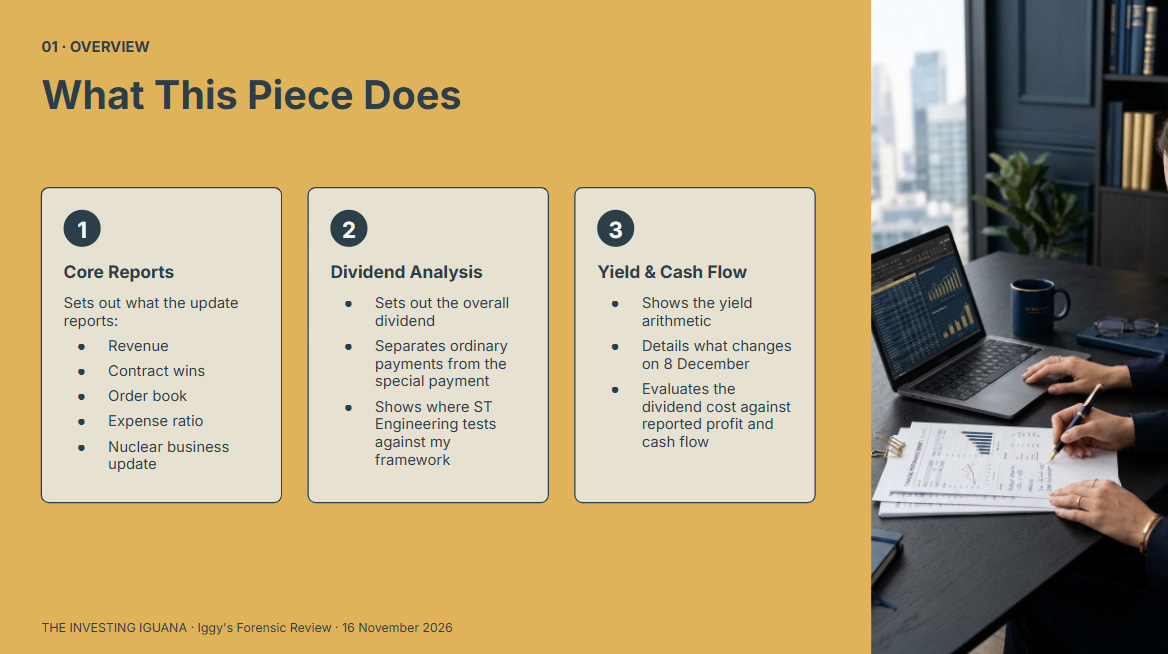
It sets out what the update reports: revenue, contract wins, the order book, the expense ratio and the nuclear business update.
It sets out the dividend, separates the ordinary payments from the special one, and shows where ST Engineering tests against my framework.
It shows the yield arithmetic, what changes on 8 December, and what the cost of the dividend looks like against the last profit and cash flow the company reported.
All of it is free to read. The yield arithmetic, the payment on 8 December, the debt and interest cover figures from the half-year, the soft flag and the closing read sit in the second half, which Substack shows once you subscribe free.
No view on share price direction. Nothing here is a recommendation.

What This Piece Does
The Headline: Revenue Up 10%, or 13% Rebased
Reported and Rebased
Where the Growth Came From
🦖 Iggy’s Insights
The Contract Wins
The Order Book
What the Order Book Is, and Is Not
The Expense Ratio
The Business Update: Nuclear, With No Numbers
The Dividend: 4.0, 5.0 and 5.0 Cents
Ordinary and Special
🦖 Iggy’s Insights
Where ST Engineering Sits on My Framework
The Yield Arithmetic
What Changes on 8 December
What the Special Dividend Does to the Test
What the Dividend Costs
The Balance Sheet, From the Half-Year
The Soft Flag
Legacy Holders and Fresh Capital
Where the Tests Land
🦖 Iggy’s Forensic Read
What I Would Compare Next
The Headline: Revenue Up 10%, or 13% Rebased
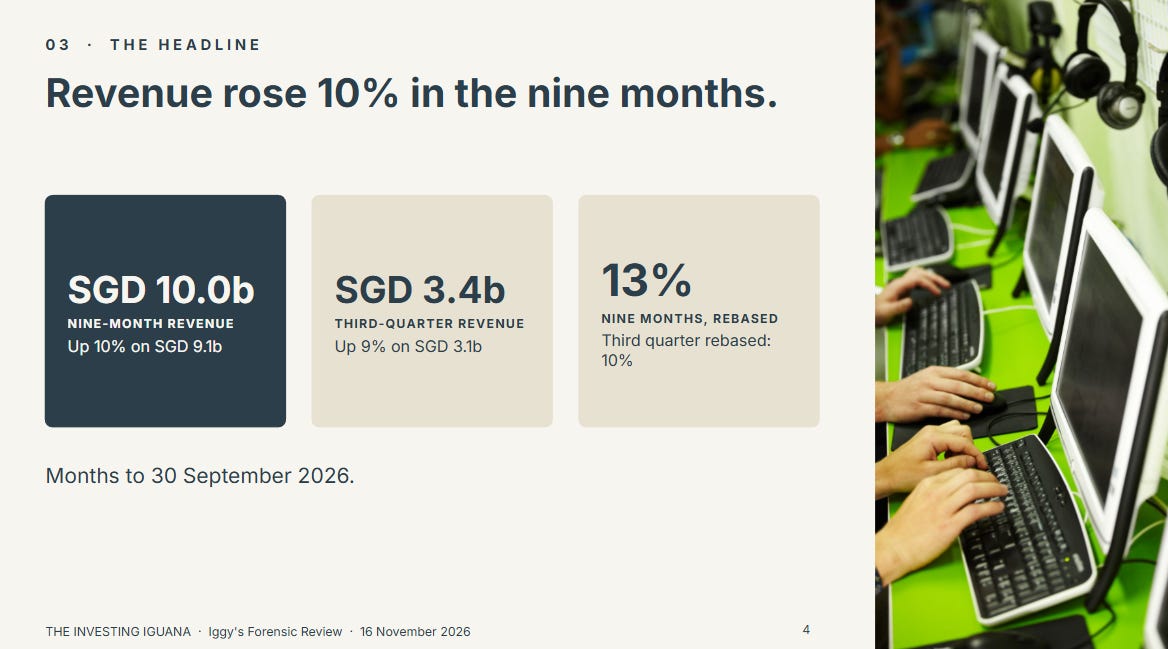
Group revenue for the nine months to 30 September 2026 was SGD 10.0 billion, up 10% on SGD 9.1 billion a year earlier. Third-quarter revenue was SGD 3.4 billion, up 9% on SGD 3.1 billion.
Reported and Rebased
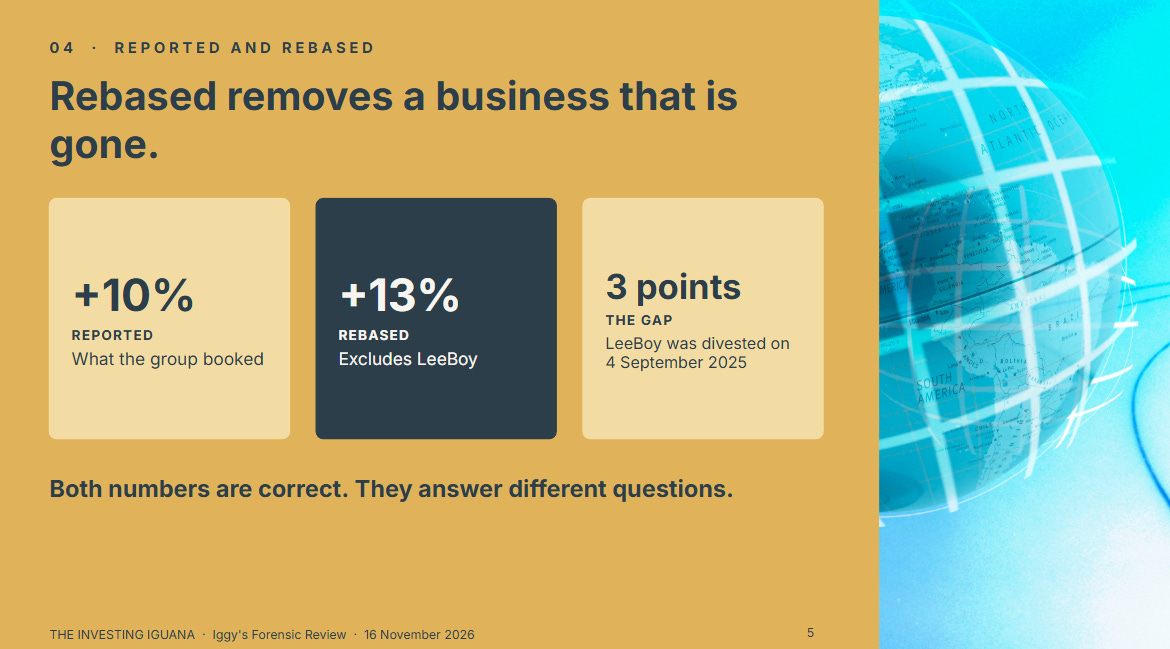
The company also gives a rebased figure. Rebased means adjusted to exclude LeeBoy, a business ST Engineering divested on 4 September 2025. On that basis nine-month revenue is up 13% and third-quarter revenue is up 10%.
Both numbers are correct, and they answer different questions. The reported figure is what the group booked. The rebased figure compares the same set of businesses in both years. The three-point gap between 10% and 13% is the effect of removing a business that is no longer there.
Where the Growth Came From
Revenue grew in all three segments. The deck gives the figures in billions, so the percentages carry rounding.
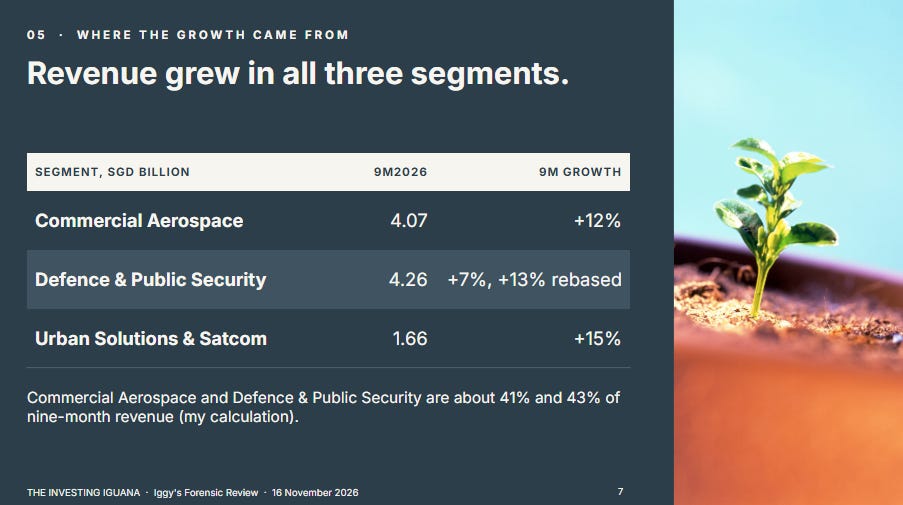
Commercial Aerospace and Defence & Public Security are about 41% and 43% of nine-month revenue, my arithmetic. The company attributes the Commercial Aerospace growth to higher revenue from engine maintenance, repair and overhaul and from nacelles. It attributes the Defence & Public Security growth to Marine and Digital Systems & Cyber, which the deck abbreviates as DS&C. It attributes the Urban Solutions & Satcom growth to higher Urban Solutions and Satcom revenue.
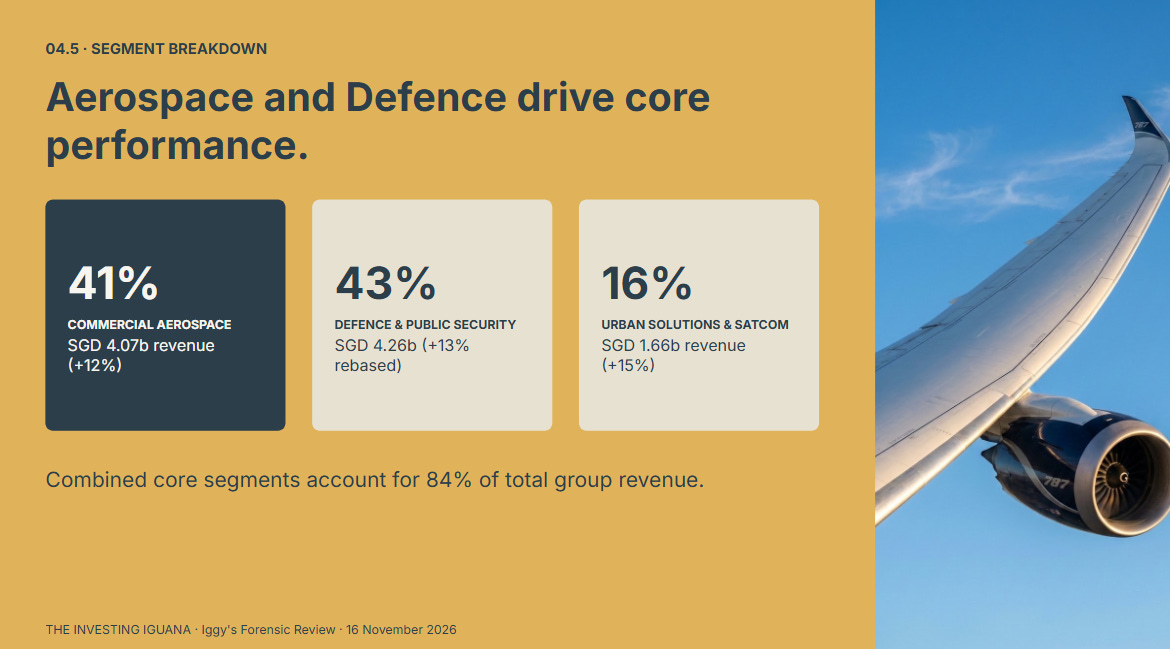
The rebased adjustment matters most in Defence & Public Security. Reported, that segment grew 7% over nine months. Rebased, it grew 13%, which puts it level with the group’s rebased figure.
🦖 Iggy’s Insights
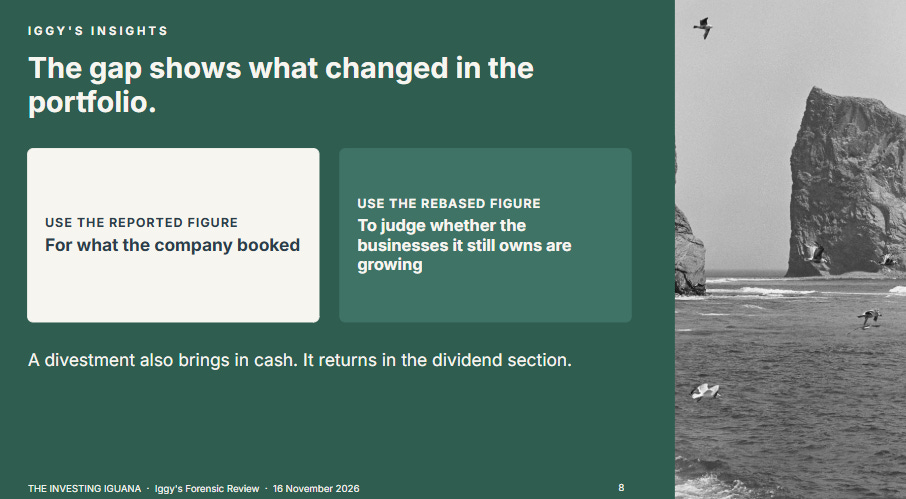
When a company shows a reported growth rate and a rebased one, the gap tells you how much of the change came from what it sold or closed, and how much from the business it still runs. Here the gap is 3 points over nine months. Neither number is the wrong one. Use the reported figure for what the company booked, and the rebased figure to judge whether the businesses it still owns are growing. A divestment also brings in cash, which is why it shows up again in the dividend section.
The Contract Wins
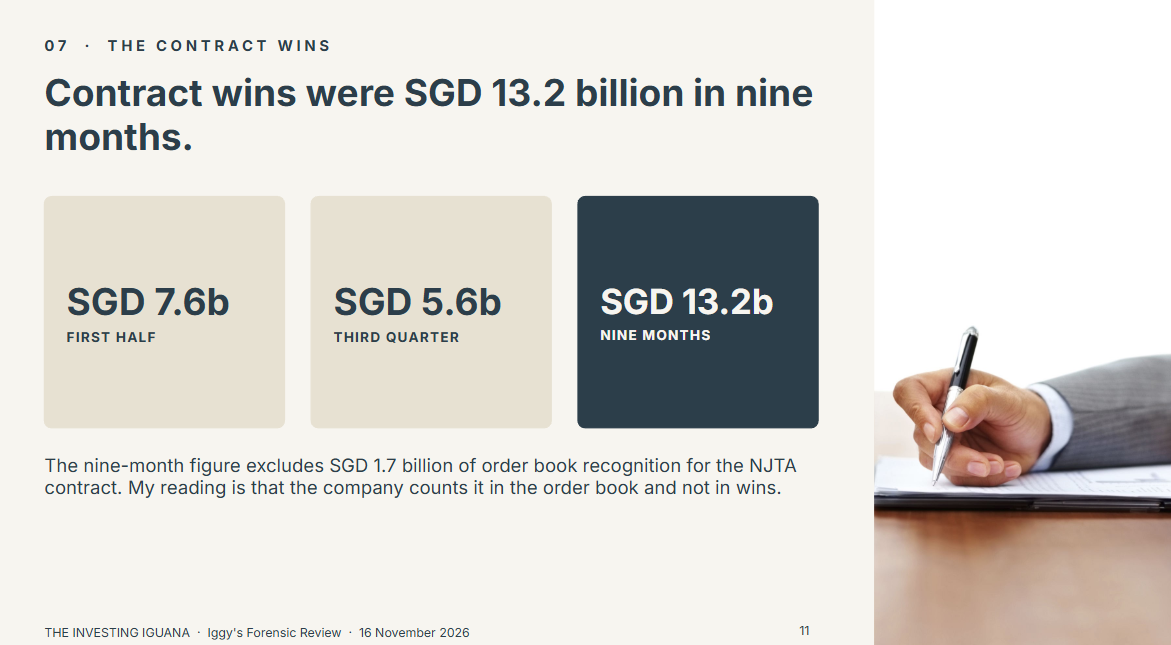
ST Engineering reports SGD 5.6 billion of new contracts in the third quarter. For the nine months, contract wins are SGD 13.2 billion, which is SGD 7.6 billion in the first half plus the third quarter. By segment the nine-month figures are SGD 4.2 billion for Commercial Aerospace, SGD 5.5 billion for Defence & Public Security and SGD 3.5 billion for Urban Solutions & Satcom.
One footnote changes how to read that. The nine-month group and Urban Solutions & Satcom figures exclude SGD 1.7 billion of order book recognition for the NJTA contract. My reading is that the company keeps that amount out of contract wins and counts it in the order book.
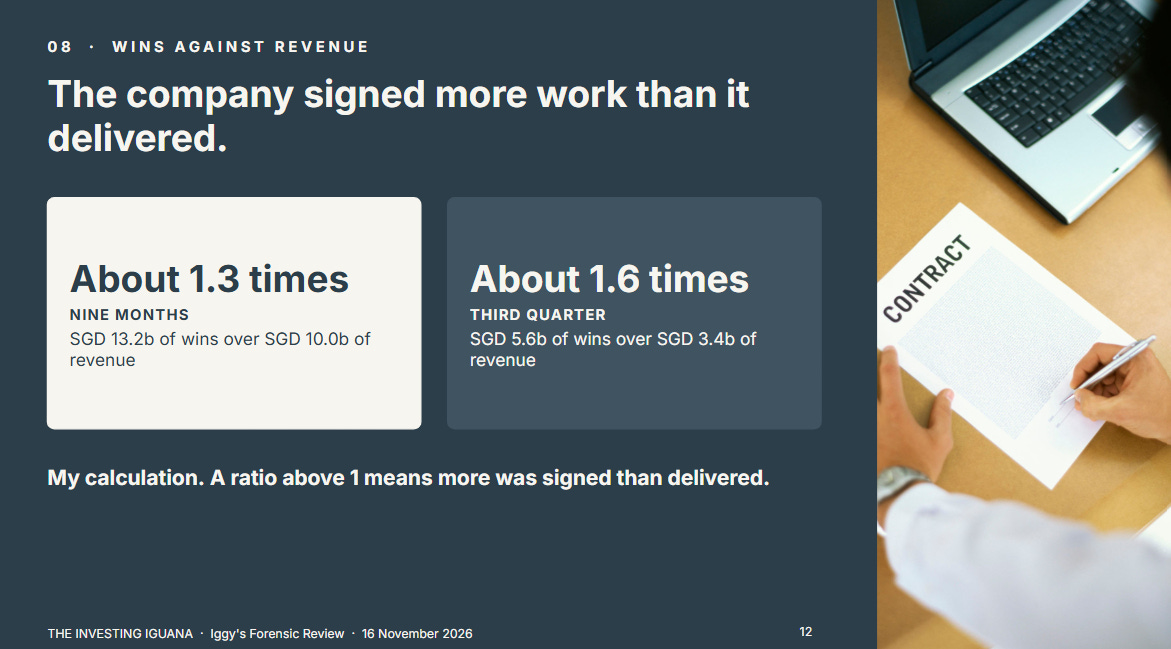
Contract wins of SGD 13.2 billion are about 1.3 times nine-month revenue of SGD 10.0 billion, my arithmetic. For the third quarter alone it is about 1.6 times. A ratio above 1 means the company signed more work than it delivered in the period.
The named third-quarter wins are a spread: a first Airbus A220 airframe heavy maintenance contract with an Asia-Pacific operator, a five-year contract to supply 40mm ammunition to the United Kingdom Ministry of Defence, turnkey rail services for the Taoyuan MRT, and tolling work in Dubai and Tampa. The deck gives no value for any individual contract.
The Order Book
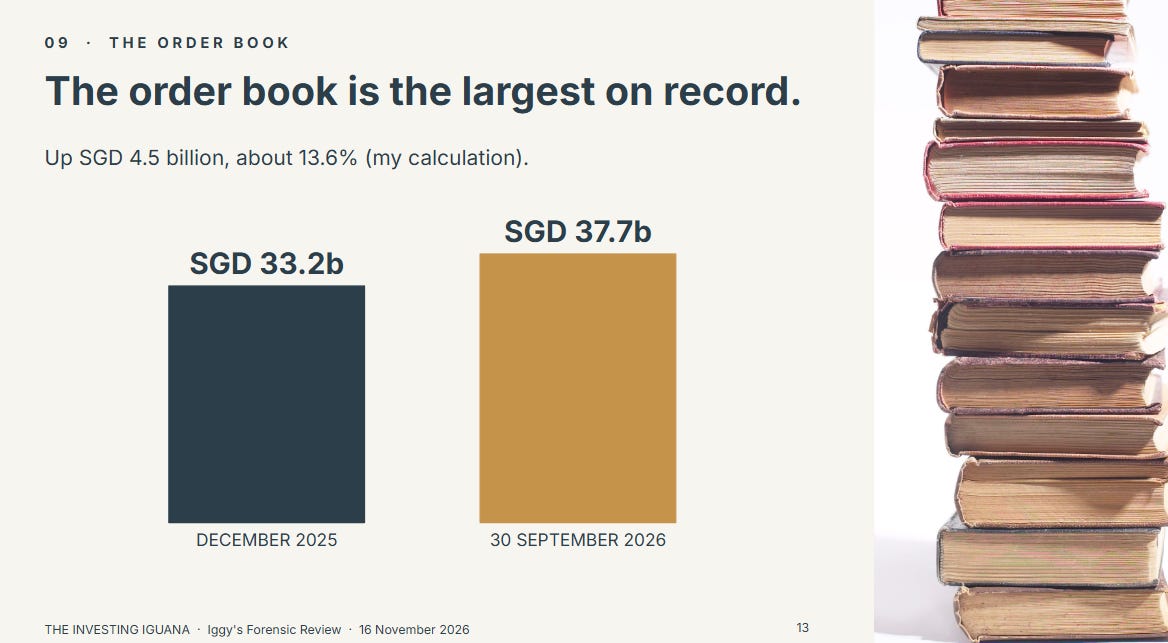
The order book was a record SGD 37.7 billion at 30 September 2026, up from SGD 33.2 billion in December 2025. That is SGD 4.5 billion higher, or about 13.6%, my arithmetic.
What the Order Book Is, and Is Not
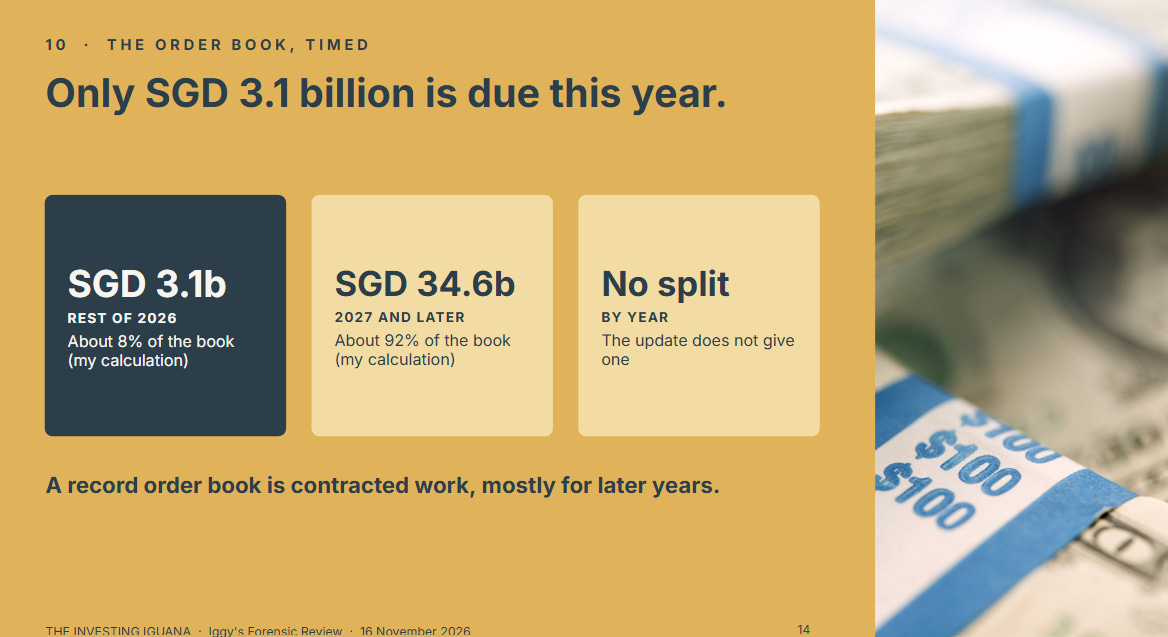
Of the SGD 37.7 billion, the company expects to deliver SGD 3.1 billion in the rest of 2026. That is about 8% of the book. The other SGD 34.6 billion is for 2027 and later, and the deck does not split it by year.
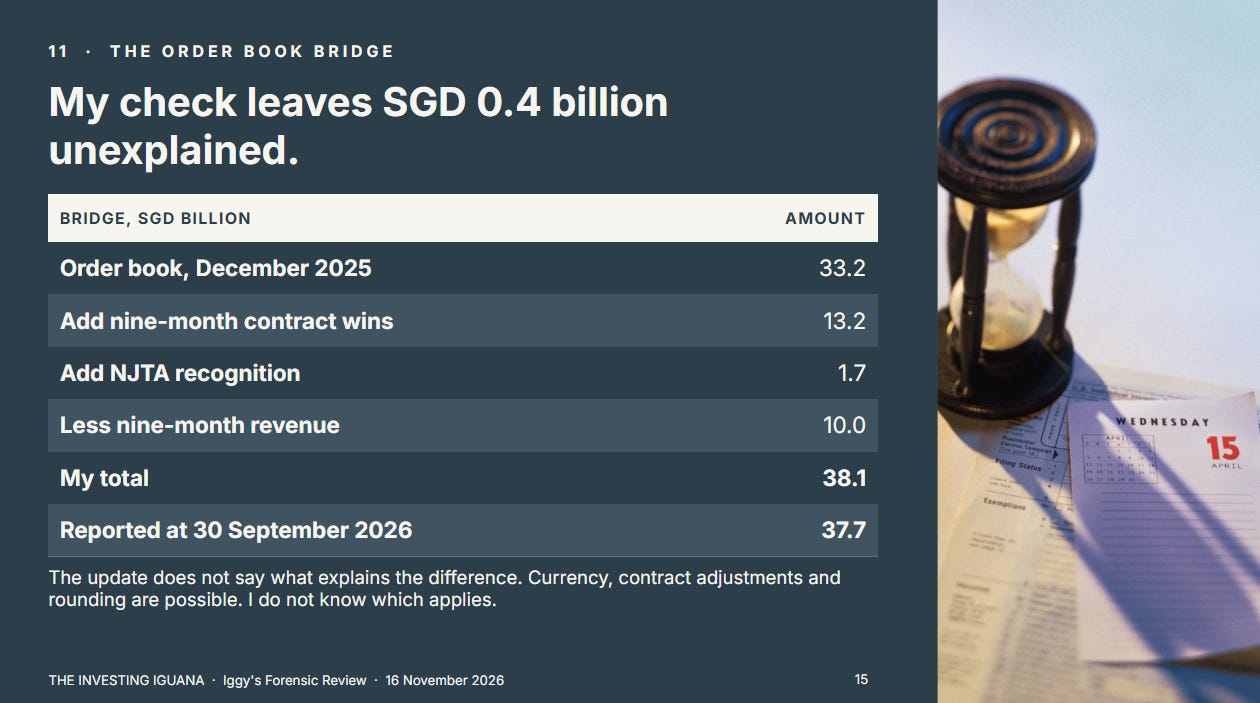
I checked how the order book moved. Start with SGD 33.2 billion, add nine-month contract wins of SGD 13.2 billion and the NJTA recognition of SGD 1.7 billion, and subtract nine-month revenue of SGD 10.0 billion. That gives SGD 38.1 billion, which is SGD 0.4 billion above the reported SGD 37.7 billion. The deck does not say what accounts for the difference. Currency moves, adjustments to existing contracts and rounding are all possible, and I do not know which applies.
There is one more comparison. In its full-year 2025 results, the company said it expected to deliver about SGD 9.9 billion in 2026 from the SGD 33.2 billion book it held at December 2025. Nine-month revenue is already SGD 10.0 billion. The difference has to come from work won and delivered within the year, which is my reading, and the deck does not break it out.
A fair objection is that a record order book means the revenue is assured. It means the work is contracted. It does not say what the work earns, and an order book is a statement about future revenue and not about profit or cash. The nine-month update has no profit number to set it against.
The Expense Ratio
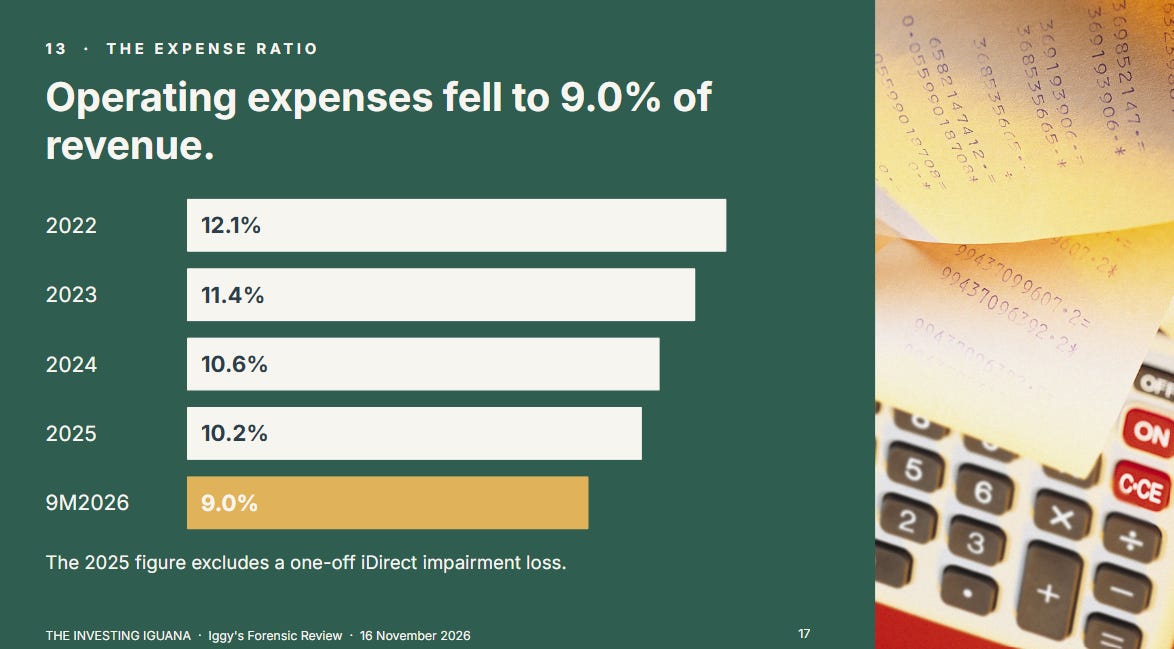
The company shows operating expenses as a share of revenue, and calls the nine-month figure a record low at 9.0%. The ratio was 12.1% in 2022, 11.4% in 2023, 10.6% in 2024 and 10.2% in 2025. The 2025 figure excludes a one-off impairment loss on the iDirect group. The company announced that loss on 12 November 2025 as a non-cash charge of SGD 667 million, against a carrying amount of SGD 837 million. The deck does not give the ratio with the loss included.
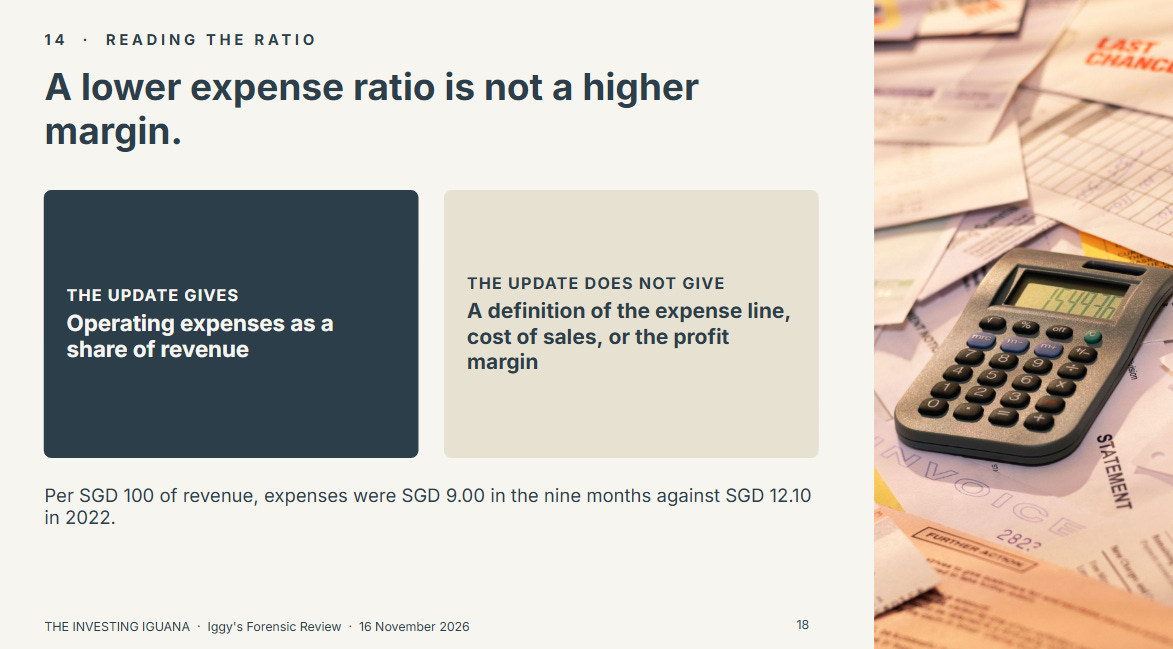
Put plainly, operating expenses were SGD 9.00 for every SGD 100 of revenue in the nine months, against SGD 12.10 in 2022. That is a fall of SGD 3.10 per SGD 100. The update does not define the expense line, and it does not show cost of sales. A lower operating expense ratio is not the same thing as a higher profit margin, and the update gives the first and not the second.
The Business Update: Nuclear, With No Numbers
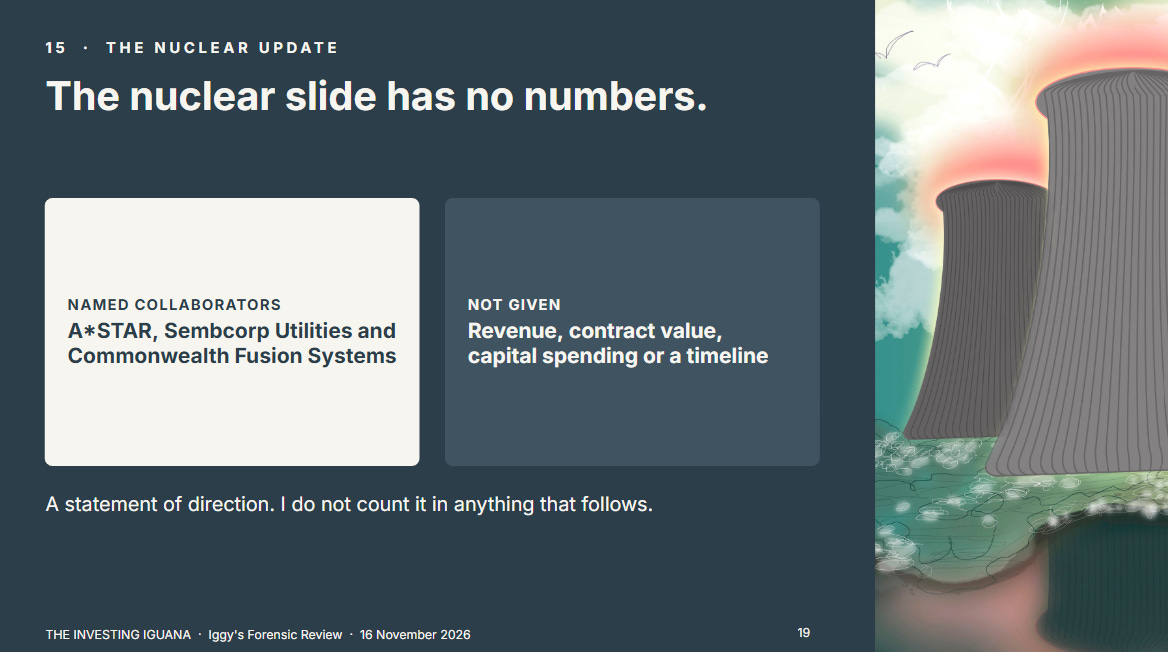
The update ends with a business update on the nuclear energy sector. The company describes it as exploring long-term opportunities and names the partners it already works with: A*STAR, Sembcorp Utilities and Commonwealth Fusion Systems. The activities listed include factory-fabricated structural modules, tungsten coating for the inner wall of a fusion reactor, and digital twin, cybersecurity and artificial intelligence services.
The slide has no revenue, no contract value, no capital spending and no timeline. It is a statement of direction. A reader who sees nuclear in a headline should know the update attaches no figure to it, and I do not count it in anything that follows.
The Dividend: 4.0, 5.0 and 5.0 Cents
The company paid 4.0 cents for the first quarter and 5.0 cents for the second. For the third quarter the board declared a 5.0 cent interim dividend, payable on 8 December 2026. The first three quarters total 14.0 cents a share.
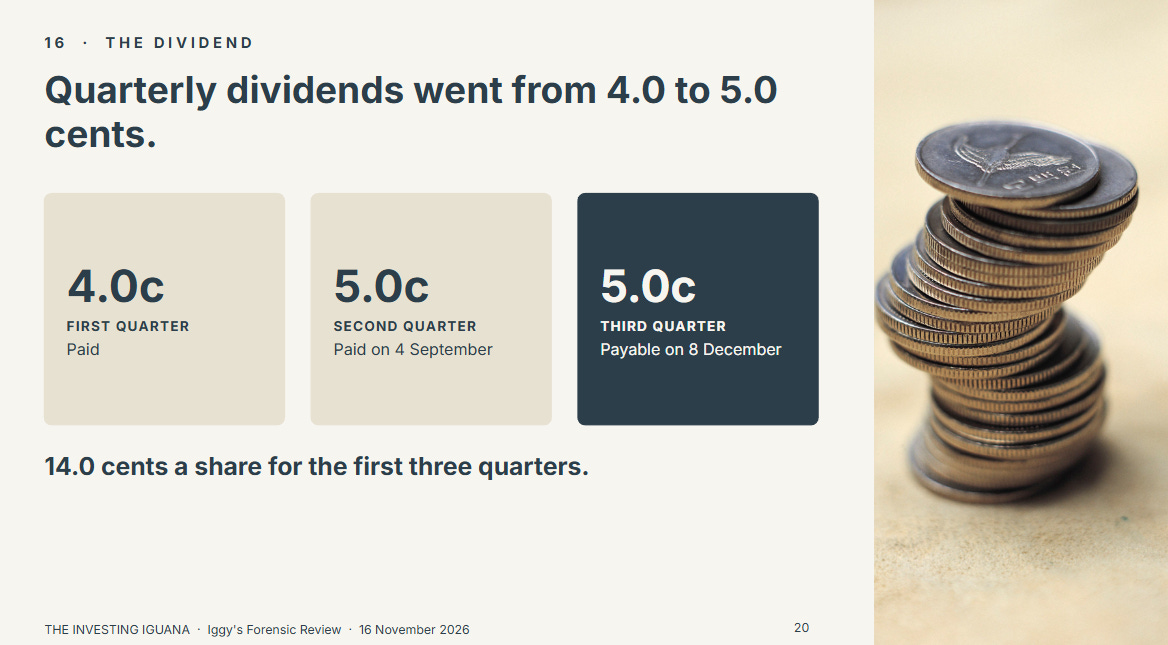
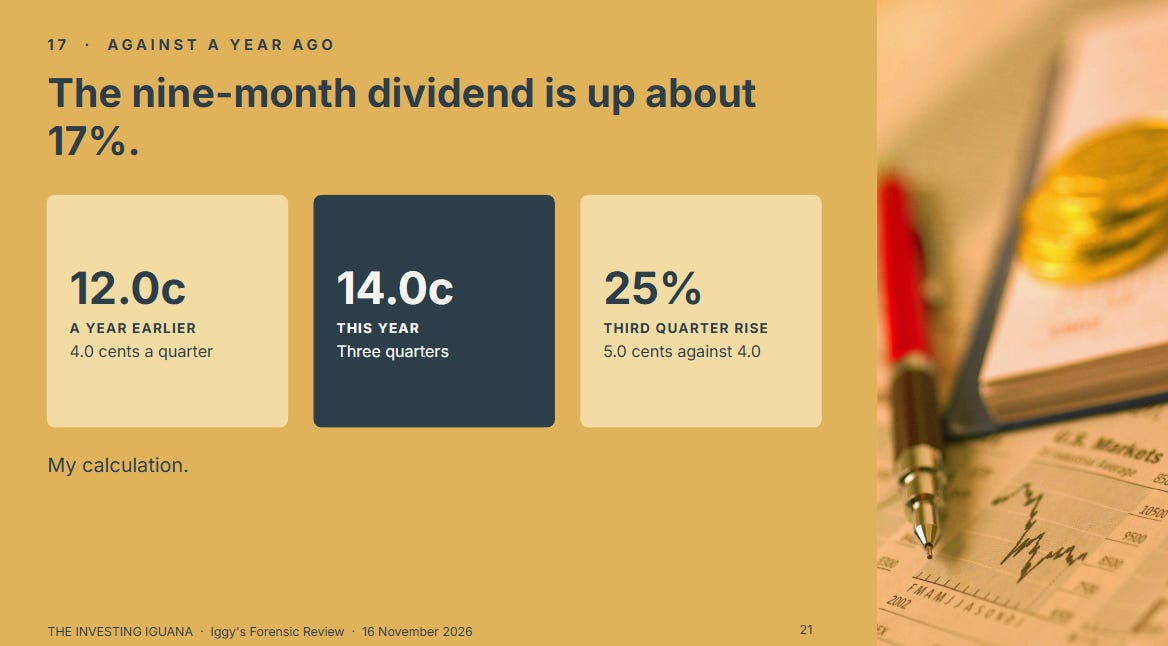
A year earlier the first three quarterly dividends were 4.0 cents each, 12.0 cents in total. The nine-month total is therefore up by 2.0 cents, about 17%. The third-quarter dividend is 25% higher than the one a year earlier. Those percentages are my arithmetic.
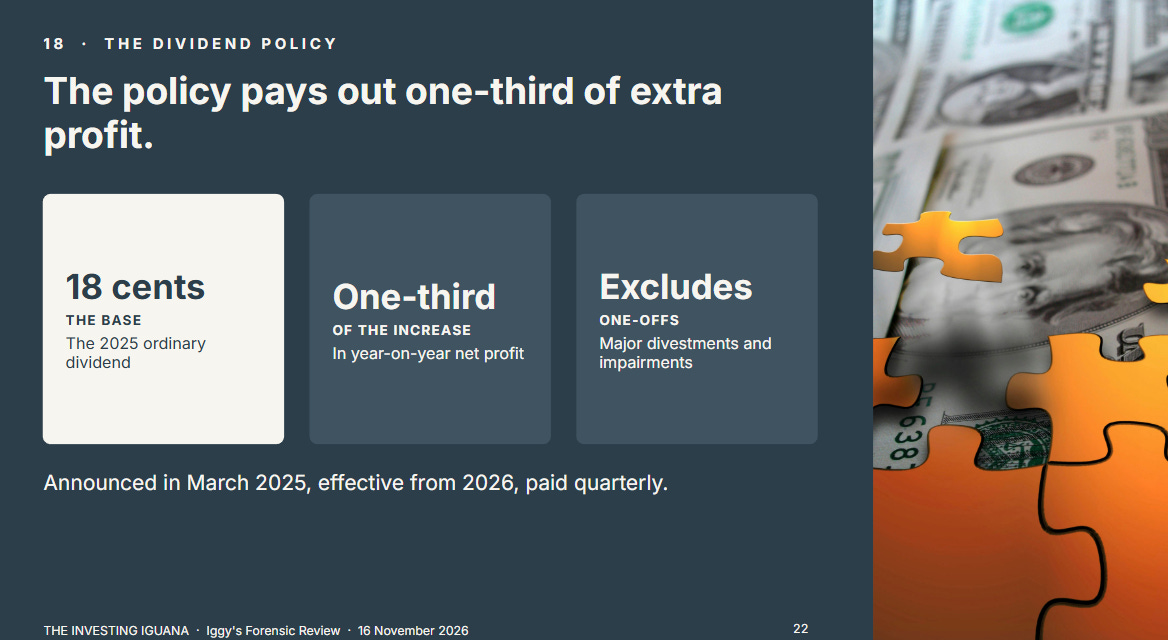
The company’s dividend policy, announced in March 2025, runs on quarterly payments. From 2026 it says it will pay “about 1/3 of its year-on-year increase in net profit as incremental dividends.” The policy says the calculation excludes one-off effects of major divestments and impairments. The base is 18 cents a share, the 2025 ordinary dividend, so the 2026 total is 18 cents plus one-third of the increase in net profit. The deck does not give a record date for the 3Q dividend, and I add it from the SGX notice before publication
Ordinary and Special
There is another payment in the last twelve months. In May 2026 the company paid its final dividend for 2025 of 6.0 cents and a special dividend of 5.0 cents, which together with 12.0 cents of interim dividends made 23.0 cents for the year. The special was tied to divestment proceeds: the company said it came to SGD 156 million, about a quarter of SGD 594 million in cash from recent divestments.
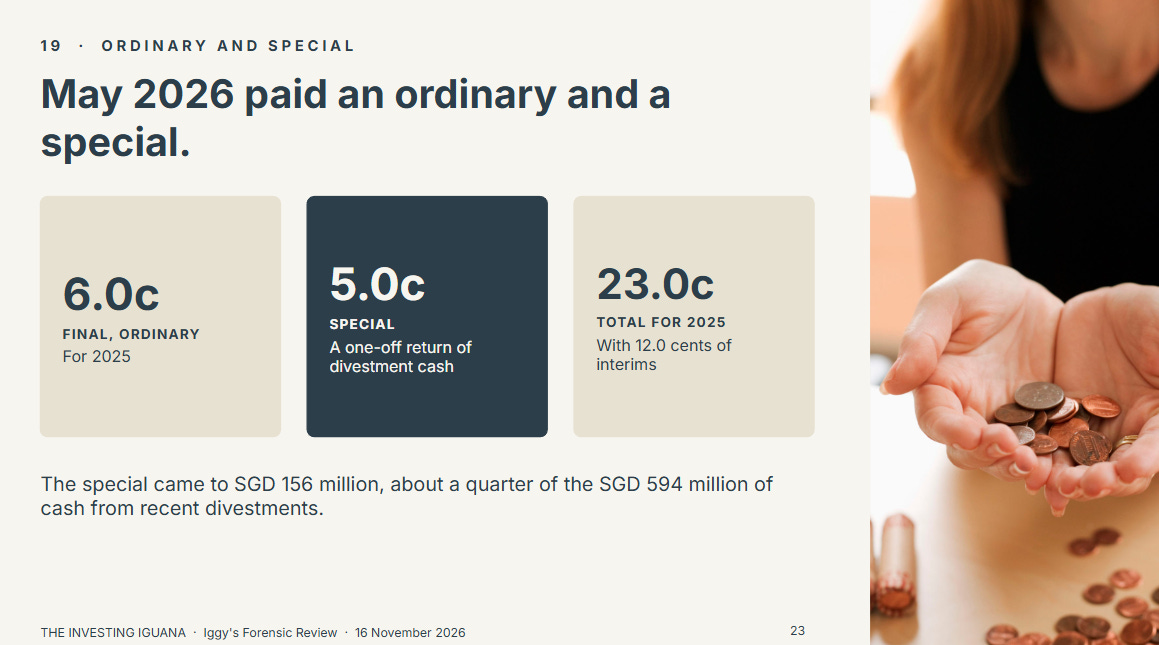
So the dividend history has two kinds of payment in it. The quarterly payments are the ordinary dividend. The 5.0 cent special was a one-off return of divestment cash.
🦖 Iggy’s Insights
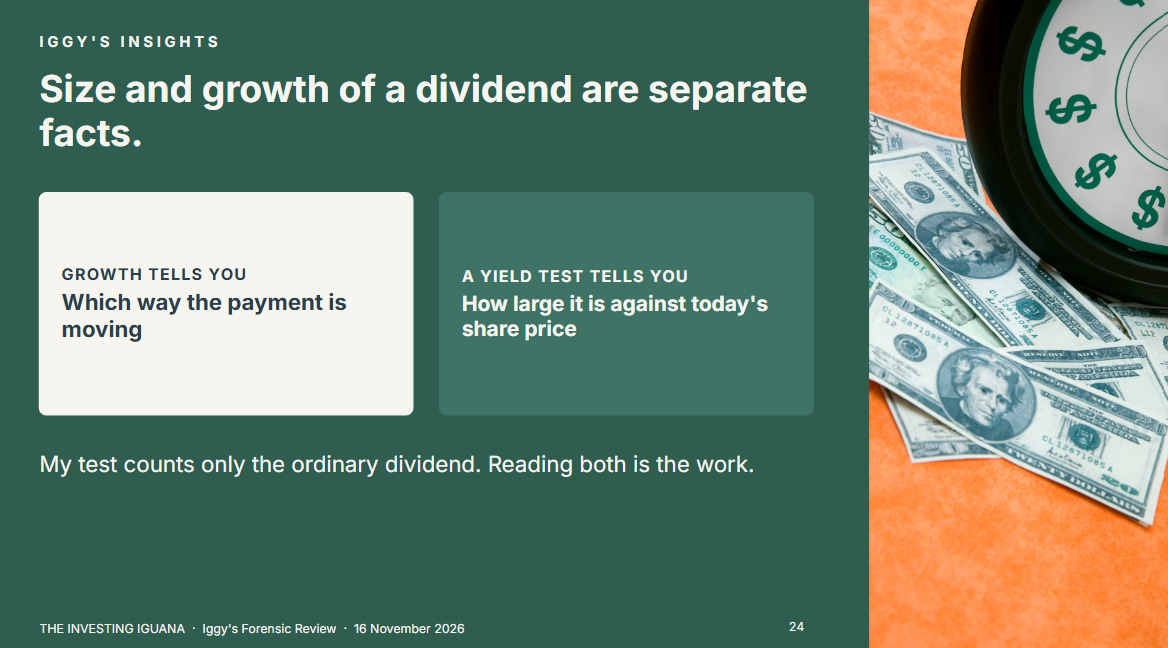
The size of a dividend and the speed at which it grows are separate facts. A company can raise its payment every quarter and still pay a small amount for each dollar of share price. A growth rate tells you which way the payment is moving. A yield test tells you how large it is against what the share costs today. My test counts only the ordinary dividend, because a special dividend is a one-off by my rule. Reading both numbers is the work, and neither answers the other.
Where ST Engineering Sits on My Framework
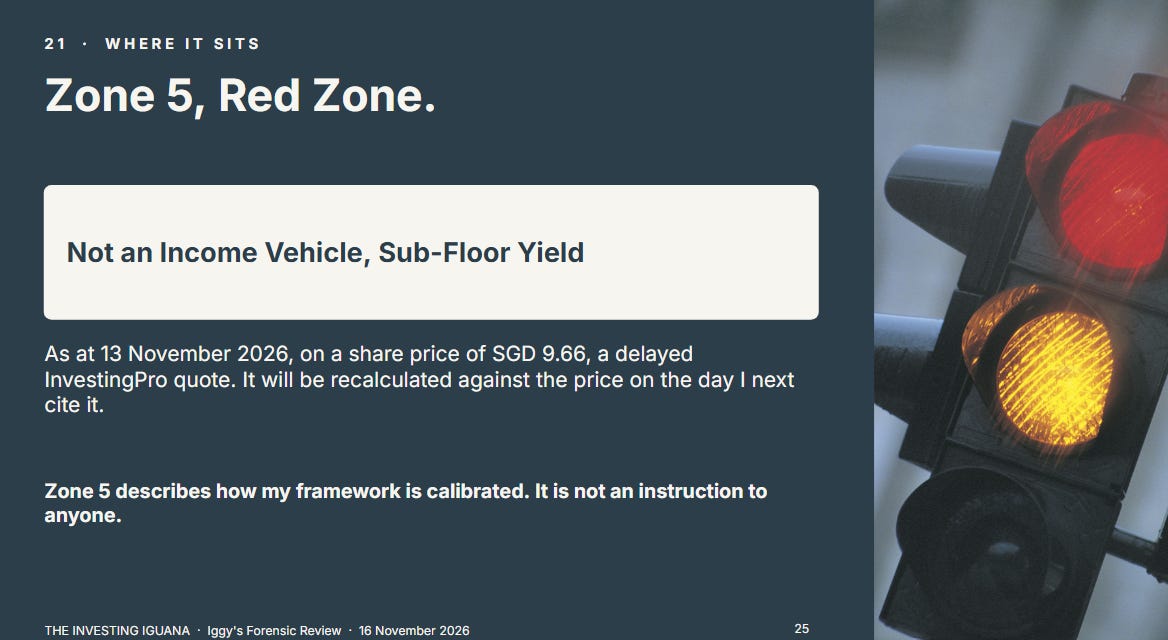
Iggy’s Forensic Zone: Zone 5, Red Zone (Not an Income Vehicle, Sub-Floor Yield)
The zone is as at 13 November 2026, on a share price of SGD 9.66, a delayed InvestingPro quote, and will be recalculated against the price on the day I next cite it. Zone 5 describes how my framework is calibrated and is not an instruction to anyone. The qualifier names the category. It describes a company that clears my other tests and fails the one built for retirement income, and it does not make the verdict any softer.
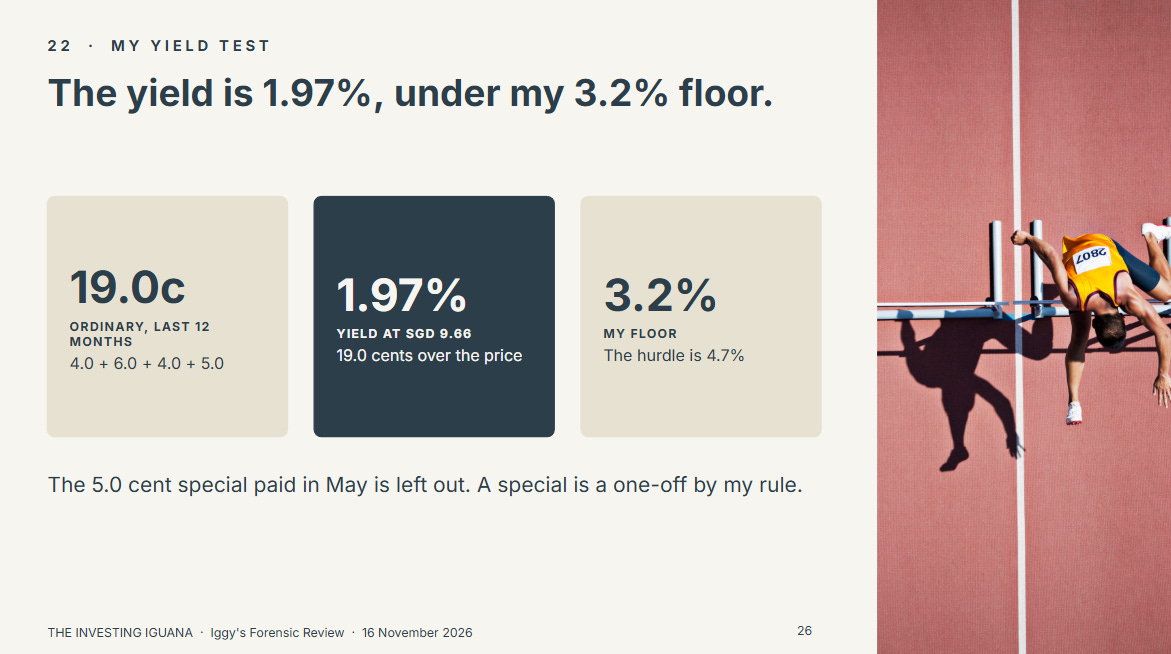
The framework is built around a reader drawing income in retirement, so it applies fixed tests to every company. Two kinds of reader may reasonably apply a different standard: someone with many years before drawdown, who can sit through the swings the framework is built to flag, and someone using money beyond what retirement income needs. The sections below show which test sets the label, by how much, and what would change it.
Keep Reading: Free Subscription
The rest of this piece sets out why the zone is what it is: the yield arithmetic at a range of prices, what the 8 December payment does to my yield base, what the dividend costs against the last profit and cash flow the company reported, the debt and interest cover figures from the half-year, the one soft flag I count, and what a holder who bought years ago sees compared with someone buying now.
To read it, subscribe to The Investing Iguana on Substack for free with an email address. Nothing in this piece needs a paid plan. Paid plans cover the member-only pieces and the full-length Members Edition videos.