
S-REIT Retail Buys vs Big Money Exit - Daily Pulse: SGX 6 Apr
Beyond the bank-driven rally, Olam and GeoEnergy numbers reveal a different truth. We audit the liabilities the headlines missed today.
🦎 Daily Pulse: SGX Digest — 6 April 2026

The Straits Times Index is flashing green. The wallets most Singaporeans actually rely on are not.
The STI held a reference close of 4,947.50 on 2 April, the final trading day before the Easter long weekend. On the morning of 6 April, it opened near 4,950. On the surface, this looks like strength. Headlines talk about resilience. Screens look calm.
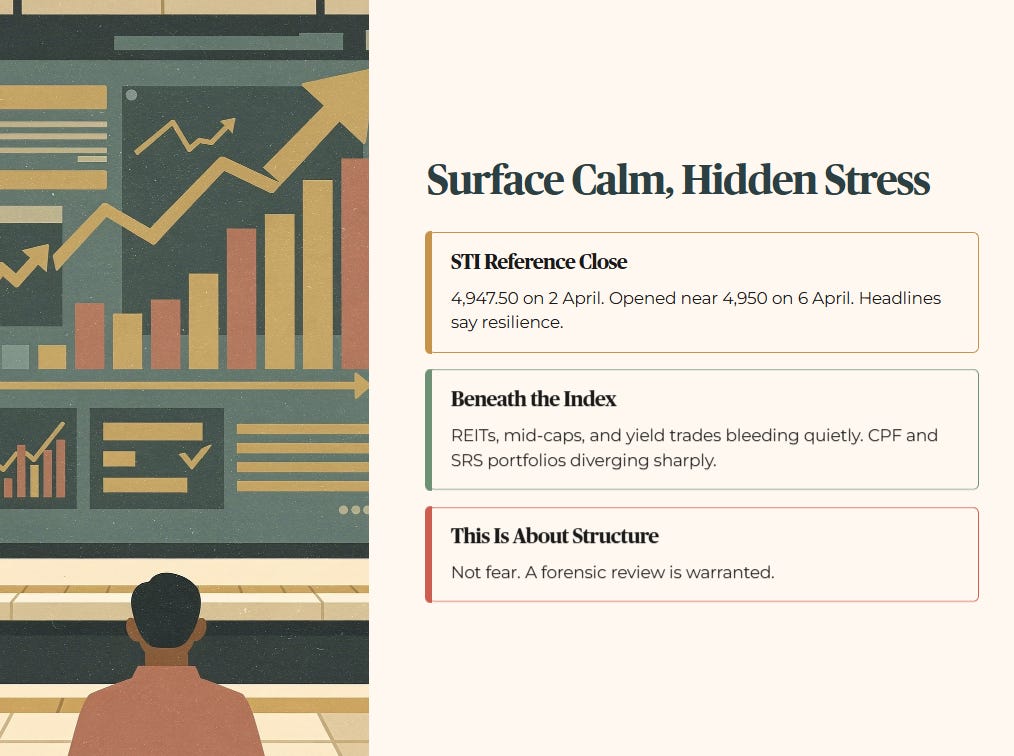
But beneath the index, the mechanics tell a different story. Retail portfolios heavy with REITs, mid-caps, and yield trades are bleeding quietly. The divergence between index heavyweights and the assets most CPF and SRS investors actually hold is now wide enough to trigger a forensic review.
This is not about fear. This is about structure.

In This Article:
Market Snapshot The Optics Versus the Math
The Three Layer Split in the Singapore Market
The Audit Begins Case Studies
Financial Health Checklist
Dividend Trajectory Forensic View
Peer Comparison Snapshot
Analyst Chatter Filtering the Noise
Watchlist and Yield Spread The Hard Floor Test
Iggy’s Forensic Compliance Standards Standard Disclaimer
About Iggy & the Elite Investors
The Window Closes Fast. In this market, the difference between a “Sanctuary” and a “Yield Trap” is decided in a single trading session. By the time this analysis reaches you as a free subscriber, the entry window Iggy identified has already opened — and often closed.

Iggy’s Elite Investors don’t just get the report earlier. They get it when the numbers still matter — zero-day forensic breakdowns, the full “Red Zone” watchlist, and institutional-grade cheatsheets at the moment the setup is live, not after the market has already priced it in.
For S$9/month — less than a kopi and kaya toast set at Raffles Place — you stop being the Exit Liquidity and start being the Analyst.
Market Snapshot — The Optics Versus the Math
The STI’s Q1 2026 total return came in at 5.6%, driven predominantly by financials and industrial heavyweights. ST Engineering delivered +28.4%, Wilmar +25%, and SGX +15.8% on a total return basis. Banks continue to harvest elevated net interest margins, and their balance sheets remain fortresses by regional standards.
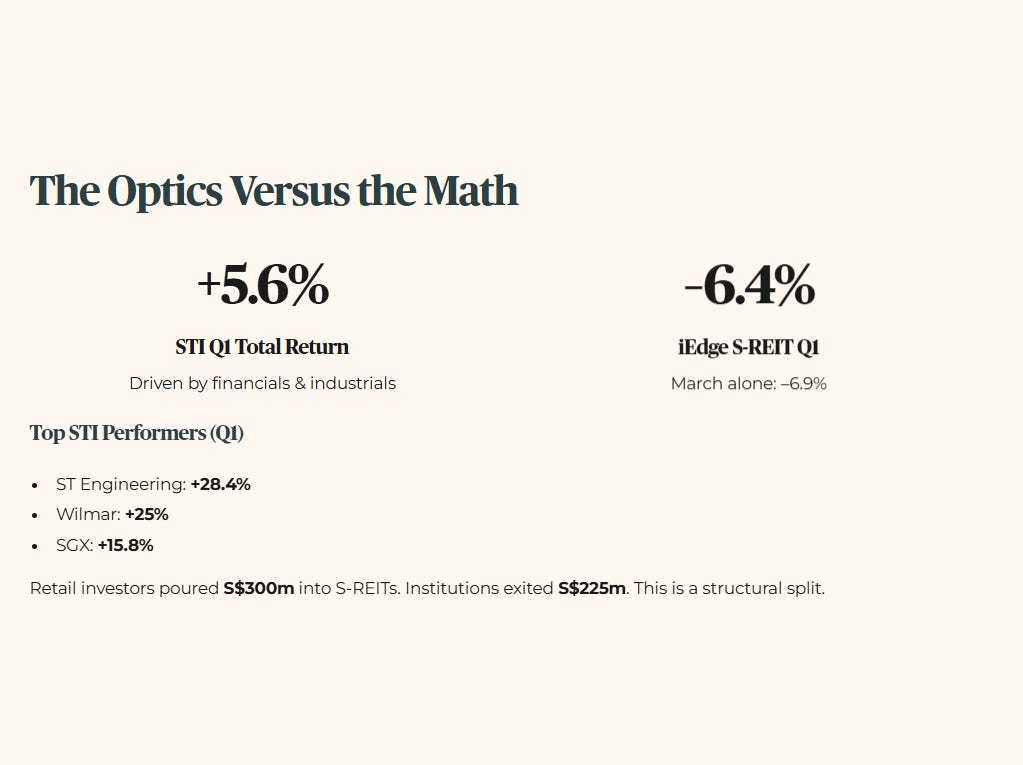
Contrast that with the iEdge S-REIT Index. Q1 closed with a –6.4% total return. March alone was –6.9%. Retail investors poured over S$300 million into S-REITs during the month, buying the dip. Institutional investors exited to the tune of S$225 million over the same period.
This is not a rounding error. It is a structural split.
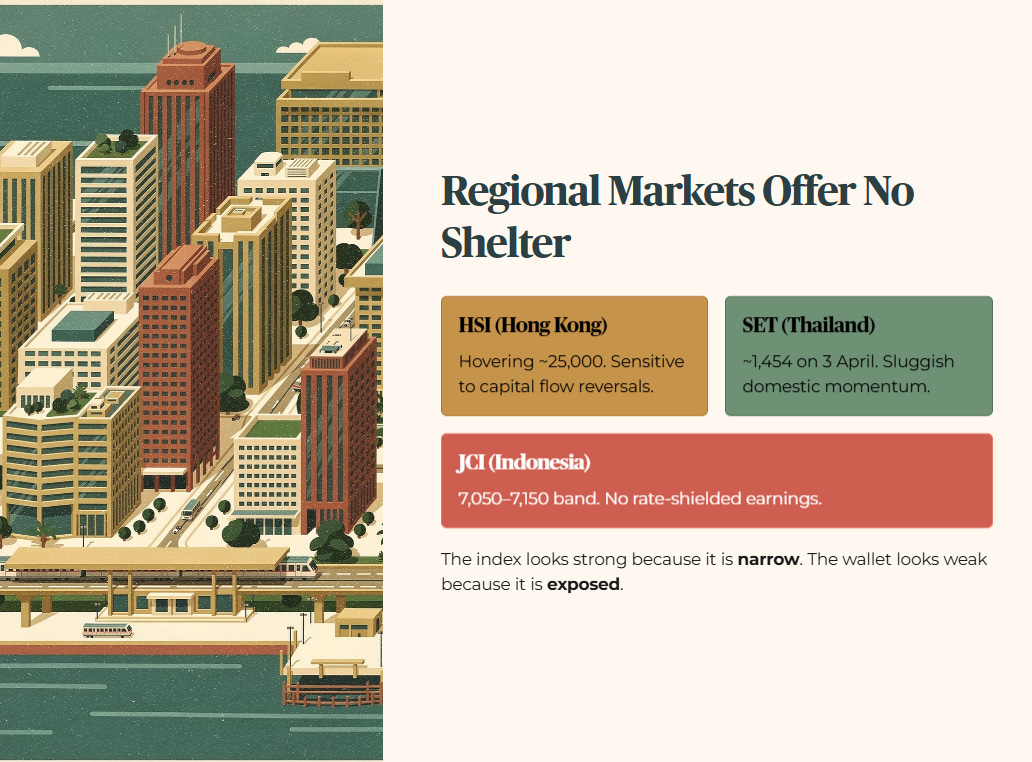
Regional markets offer little comfort. Hong Kong’s HSI continues to hover near the 25,000 region, sensitive to capital flow reversals. Thailand’s SET closed around 1,454 on 3 April, reflecting sluggish domestic momentum. Indonesia’s JCI traded in the 7,050–7,150 band. None of these markets offer the rate-shielded earnings that Singapore’s banking majors currently enjoy.
The index looks strong because it is narrow. The wallet looks weak because it is exposed.
The Three-Layer Split in the Singapore Market
At this stage of the cycle, Singapore equities have effectively split into three camps.
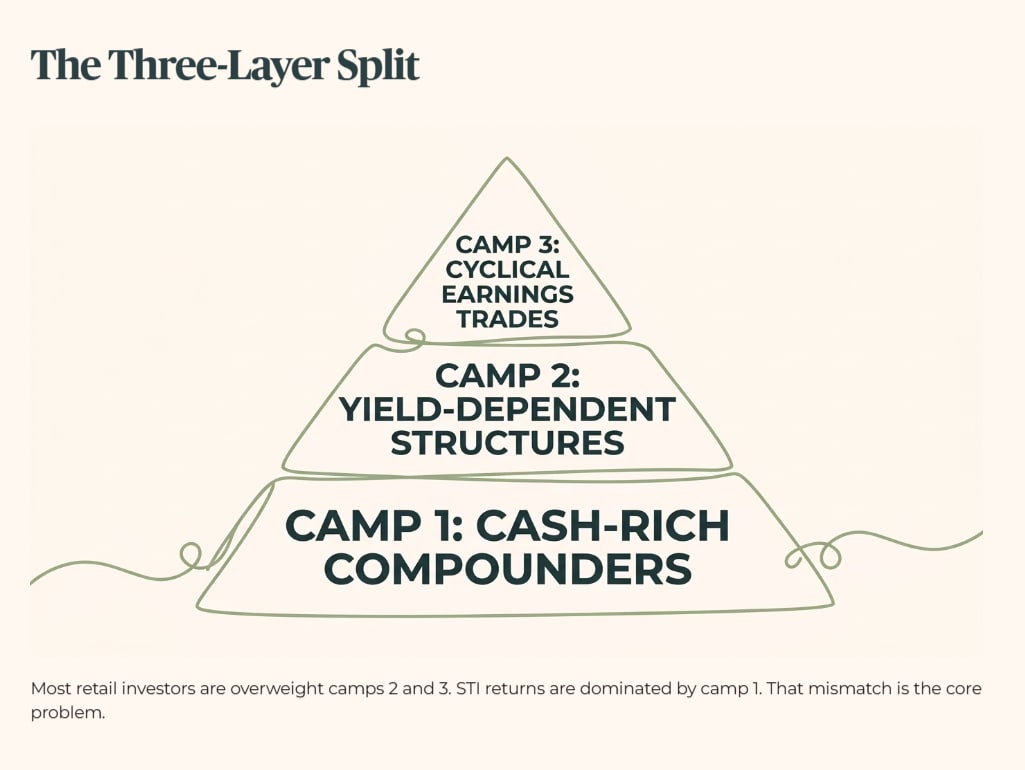
Cash-rich balance sheet compounders — large banks and selected industrials. Low refinancing risk. Earnings buoyed by higher-for-longer rates. These names are carrying the STI.
Yield-dependent leveraged structures — REITs, business trusts, and property-linked vehicles. Operating cash flows increasingly absorbed by interest expense. Distribution optics sustained only if refinancing remains benign. These names are carrying the retail wallet downward.
Cyclical earnings trades — commodities and export-driven names. Peak earnings now behind them. Capital allocation discipline becomes the decisive variable.
Most retail investors are overweight the second and third bucket, while the STI’s returns are dominated by the first. That mismatch is the core problem.
The Audit Begins — Case Studies
1. OlamGroup (VC2.SI) — Gearing Does Not Disappear When Assets Change Hands
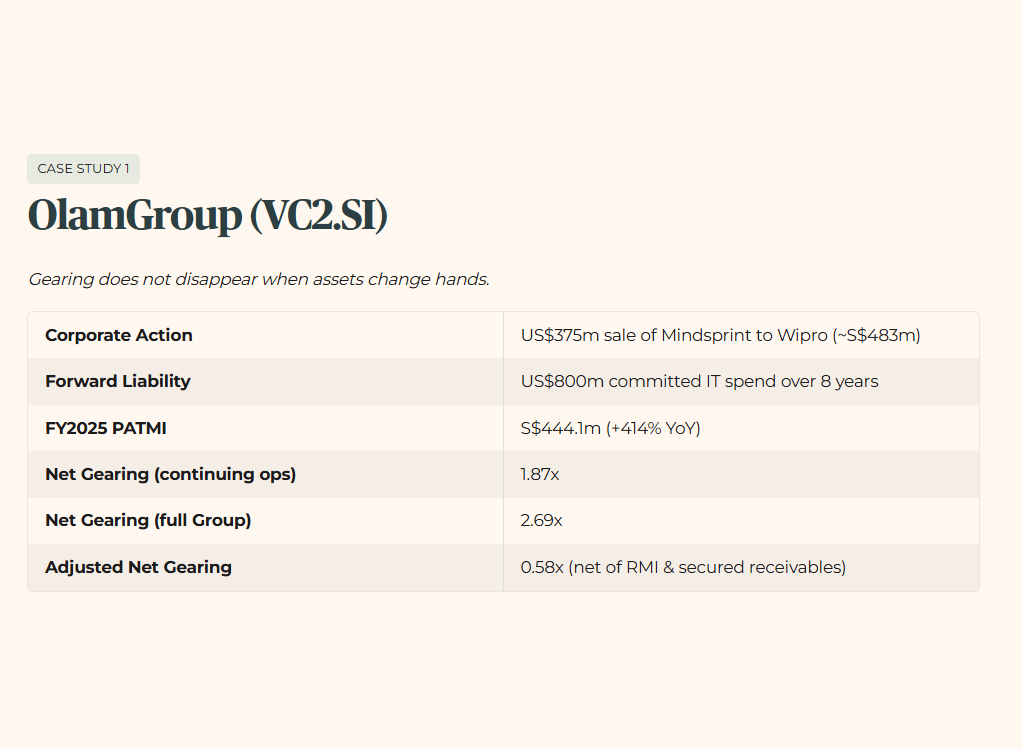
OlamGroup’s corporate story has been marketed as a stepwise simplification. Asset monetisation. Sharper focus. Deleveraging optics. The raw numbers demand a colder look.
Layer 1 — Raw Fact
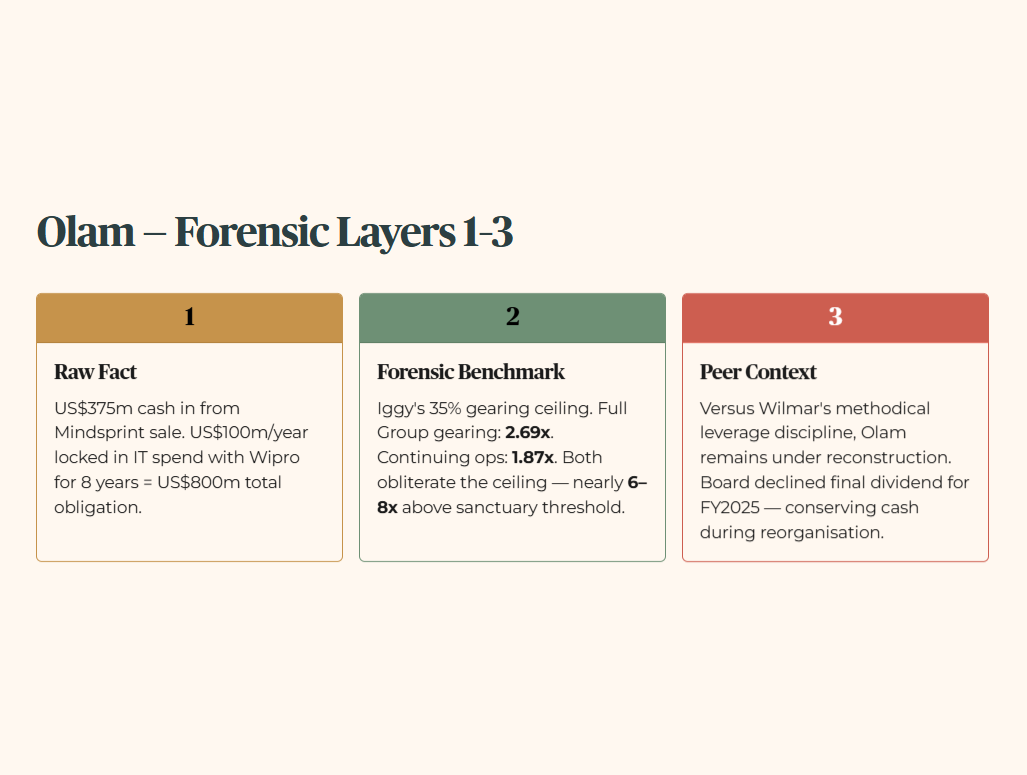
OlamGroup is receiving US$375 million (approximately S$483 million) in cash from the sale of its Mindsprint IT unit to Wipro, with completion targeted by end-June 2026. In parallel, it has committed to roughly US$100 million per year in IT spend with Wipro over eight years — a total contractual obligation of approximately US$800 million over the life of the agreement.
Layer 2 — Forensic Benchmark
Under Iggy’s Forensic Compliance Standards, a 35% gearing ceiling is the absolute maximum for assets expected to function as portfolio anchors. OlamGroup’s full consolidated net gearing stood at 2.69x as at 31 December 2025 — this is the legally reported balance sheet position, with Olam Agri still consolidated pending completion of the SALIC sale. Even on the most charitable pro-forma basis, stripping out Olam Agri entirely, continuing operations gearing stands at 1.87x. Both figures obliterate the forensic ceiling. The most favourable reading of the balance sheet is still nearly six times above the sanctuary threshold.
Layer 3 — Peer Context
Compared with WilmarInternational’s methodical working capital discipline and cautious leverage management, OlamGroup’s residual group remains under reconstruction. The promised deleveraging path leaves little margin for operational error or a funding cost surprise. Olam itself acknowledges this — the board declined to recommend a final dividend for FY2025, citing the need to conserve cash during the reorganisation.
Layer 4 — Forward Scenario
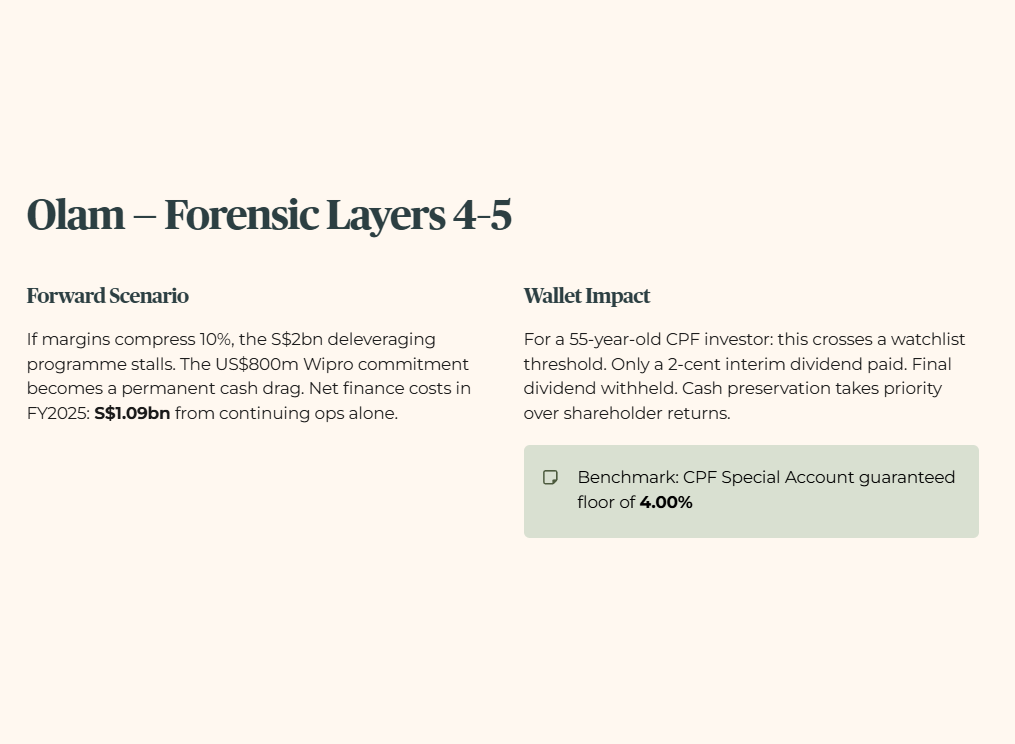
If funding costs remain elevated or operating margins compress by even 10%, the targeted S$2 billion deleveraging programme stalls. At that point, the US$800 million Wipro vendor commitment converts from “operating efficiency” into a permanent cash flow drag — a liability that accounting labels differently but the cash flow statement treats identically. Note also that OlamGroup’s net finance costs in FY2025 were S$1.09 billion from continuing operations alone. The interest burden is not a rounding line. It is a structural constraint.
Layer 5 — Wallet Impact
For a 55-year-old investor in Toa Payoh relying on CPF payouts, this structure crosses a watchlist threshold. This is not a defensive income anchor. The board’s own decision to pay only a 2-cent interim dividend and withhold the final dividend for FY2025 is the clearest possible signal that cash preservation takes priority over shareholder returns at this stage of the reorganisation. Exposure, if any, must be sized with extreme conservatism against the guaranteed 4.00% CPF Special Account floor.
The direction of travel may be correct. The destination remains distant.
🦎 Iggy’s Insight — OlamGroup
Balance sheets do not heal just because assets change hands. The market fixates on the US$375 million cash inflow from the Mindsprint sale and relaxes. That reaction is misplaced. What matters is the net obligation profile. The eight-year, locked-in IT spend recreates a fixed drain on cash flows that behaves very much like debt, even if accounting labels it differently.
When gearing already sits at 2.69x on a fully consolidated basis — nearly eight times above Iggy’s 35% forensic ceiling — swapping explicit leverage for contractual rigidity does not improve resilience. It only shifts where the stress shows up. And the board’s own dividend decision confirms the diagnosis: when a company earning S$444 million in PATMI still withholds its final dividend to conserve cash, the balance sheet is telling you something the press release is not.
Deleveraging is not about optics. It is about removing structural claims on future cash. The invoice looks different. The cash drain does not.
2. GeoEnergyResources (RE4.SI) — Dilution After the Peak
Commodity cycles are unforgiving teachers. The mistake is rarely made at the bottom. It is usually made after the peak, when the urgency feels lower.
Layer 1 — Raw Fact
GeoEnergyResources is raising approximately S$18 million via an equity placement at S$0.515 per share — the bottom of the indicated range after book-building — diluting existing holders by roughly 2%, after net income has fallen approximately 77% from cycle highs.
Layer 2 — Forensic Benchmark
Peak commodity profits are expected to strengthen balance sheets and fortify cash buffers. Companies that execute placements after earnings have already collapsed are signalling one of two things: that the surplus years were not fully banked, or that the forward capital requirement is larger than management has publicly framed.
Layer 3 — Peer Context
Peers that navigated previous coal cycles prudently used windfall years to eliminate refinancing exposure. GeoEnergyResources’ approach of raising fresh equity as the cycle fades prioritises optionality over fortress balance sheet construction.
Layer 4 — Forward Scenario
A further 10% drop in thermal coal pricing would leave a reduced earnings engine supporting a larger equity base. Yield compression becomes arithmetic, not conjecture. The placement is modest in percentage terms today. Its cost compounds in every future distribution calculation.
Layer 5 — Wallet Impact
For CPFIS portfolios, this belongs firmly in the satellite bucket. Capital allocation discipline must be tracked closely as the cycle fades out of favour. The 2024 P/E of approximately 7–8x looks optically cheap, but a cheap price on a deteriorating earnings base is a valuation trap, not a margin of safety.
Equity dilution rarely feels urgent at the top. It always feels expensive later.
🦎 Iggy’s Insight — GeoEnergyResources
Commodity mistakes are usually revealed after the peak, not during the boom. GeoEnergyResources’ equity placement is small in percentage terms, but timing matters more than size. Raising fresh capital after earnings have already collapsed by more than 75% signals that the surplus from the super-cycle was not fully banked.
Once dilution enters the picture, the mathematics of future yield change permanently. A smaller earnings engine must now support a larger equity base. For cyclical businesses, capital discipline is the real dividend defence. When that discipline weakens, volatility migrates from prices into the shareholder register. The cycle may recover one day. The dilution never does.
3. STI Versus iEdge S-REIT Index — Two Different Realities
Layer 1 — Raw Fact
The STI advanced 5.6% on a total return basis in Q1 2026. The iEdge S-REIT Index delivered –6.4% over the same period. These two numbers describe the same market at the same time.
Layer 2 — Forensic Benchmark
The long-held retail assumption that “a rising STI lifts all boats” fails structurally when index leadership is concentrated in rate-benefiting financials with very different balance sheet profiles from the yield names most retail investors hold.
Layer 3 — Peer Context
Banking majors are currently subsidising index optics, while mid-cap REITs grind under refinancing pressure. DBSGroup and OCBC compound quietly at elevated margins. REITs refinance loudly into a rate environment they were not designed for..
Layer 4 — Forward Scenario
If the US Federal Reserve holds rates flat for most of 2026 — as the March FOMC suggested, maintaining the 3.50–3.75% target range — the divergence widens further. Banks compound. REITs refinance. MAS is additionally expected to tighten its S$NEER appreciation slope at the April 2026 policy review, which would signal rising domestic inflation pressures and further erode the rate relief that REIT bulls are waiting for.
Layer 5 — Wallet Impact
Consider a 60-year-old in Marine Parade with S$150,000 in a REIT-heavy CPFIS portfolio. While the STI headline told them everything was fine, their portfolio absorbed an estimated S$9,600 drawdown in Q1 alone — purely from the –6.4% REIT index return. Index strength does not automatically translate to distribution safety. The fortress belongs to the banks. The retail yield basket stands outside the walls.
🦎 Iggy’s Insight — STI Versus iEdge S-REIT Index
Indexes can rise while households feel poorer. This is one of those moments. The STI’s strength is genuine but narrow, carried by banks that benefit from high rates. The iEdge S-REIT Index tells the opposite story: leverage designed for a low-rate world colliding with refinancing reality.
The critical insight is that index performance is no longer a reliable proxy for retail portfolio health. When retail money flows into falling yield assets while institutions exit, it usually reflects yield anchoring — buying based on past distributions — rather than balance sheet underwriting.
In this environment, diversification by ticker is meaningless. Diversification by funding structure is what actually matters. A portfolio of ten REITs is not diversified. It is concentrated in a single interest rate bet.
Financial Health Checklist
Dividend Trajectory — Forensic View
Peer Comparison Snapshot
Analyst Chatter — Filtering the Noise
This week’s institutional notes lean heavily on two themes: “value creation” at OlamGroup and “financial flexibility” at GeoEnergyResources. The language is polished. The numbers are less forgiving.
OlamGroup’s asset sale does improve immediate liquidity. It does not erase the forward IT spend now locked contractually for eight years. Analysts celebrating the cash inflow glide past that obligation because it lives below the headline. And they are not wrong that OlamGroup needs cash. The discomfort lies elsewhere. Debt does not disappear just because it changes its label.
On the REIT front, the institutional consensus is quietly shifting. Net outflows of S$225 million from institutional hands in March, against retail inflows of S$300 million, describes a transfer of risk — not a vote of confidence. When sophisticated capital exits and retail capital enters the same vehicle, the forensic question is always: who has done the more rigorous refinancing analysis?
🦎 Iggy’s Insight
Spin-offs feel decisive. They create the comforting illusion that complexity has been removed. But when a company sells a unit for cash and immediately signs a multi-year, fixed-cost contract with the buyer, the balance sheet has not healed. It has been rearranged.
The liability did not vanish. It simply moved from debt to operating obligation.
Investors who stop their analysis at the sale headline miss the structural continuity of risk. Forensic accounting exists to catch exactly this illusion before it enters a retirement wallet.
Watchlist and Yield Spread — The Hard Floor Test
The current 6-month Singapore T-bill cut-off yield stands at 1.46% (BS26106T, auctioned 26 March 2026). On its own, that number feels benign. It should not be read as permission to lower standards.
For forensic purposes, Iggy’s Forensic Floor sits at 3.2%. This is not a forecast of where rates go. It is a stress test — ensuring that asset selection survives a return to long-term average interest rate conditions, not just today’s auction print.
Add a mandatory 150 basis points of risk premium, and the minimum sanctuary hurdle becomes 4.7%.
Any asset whose yield only clears that bar by ignoring refinancing risk, engineering distributions through debt, or relying on asset recycling rather than operating cash flow fails the test. None of the three cases audited today clear it cleanly.
🦎 Iggy’s Take — The Bottom Line
This market is telling two stories at once.
The STI, carried by banks and large industrials, looks healthy. It probably is. The retail yield basket, however, is contending with debt structures designed for a different rate regime — and the Q1 numbers have made that mismatch visible in a way that can no longer be explained away.
OlamGroup is restructuring but remains heavily leveraged, with a locked-in cost obligation that outlasts the headline cash inflow. GeoEnergyResources is raising equity as earnings fade — a sequence that historically signals cycle exhaustion, not opportunistic positioning. The iEdge S-REIT Index is sinking while retail money chases yesterday’s yield, paying today’s price for tomorrow’s refinancing risk.
For a 60-year-old in Marine Parade managing SRS drawdowns, this divergence is not academic. You cannot glance at the STI near 5,000 and assume your REIT-heavy portfolio is insulated. It is like admiring a freshly painted HDB exterior while ignoring the corroded pipes behind your own kitchen wall.
The optics are in order. The plumbing is not.
🦎 Iggy’s Insight
The reason we track the 3.2% forensic floor is simple. Market optics lie. When hundreds of millions flow into falling REITs while balance sheets deteriorate, investors are anchoring on past distributions instead of future survivability.
A sanctuary asset does not need financial gymnastics to clear its hurdle. It clears it cleanly, even under stress. If it cannot, the yield is not compensation. It is a warning. The numbers will always outlive the narrative.
Iggy’s Forensic Compliance Standards — Standard Disclaimer
This content is produced for educational and informational purposes only. I am not a financial advisor — I am a retail investor who applies forensic analysis to my own portfolio and shares that process publicly. Nothing here constitutes a recommendation to buy, sell, or hold any security, and no specific target prices or personalised financial advice are offered. All data is sourced from public filings and verified sources; where data is unverified it is explicitly flagged. All investments carry risk, including the potential loss of principal, and past performance is not indicative of future results. If you are making investment decisions involving CPF, SRS, or personal capital, please conduct your own due diligence or consult a MAS-licensed financial adviser before committing funds.


