


If you’re new here, welcome—The Investing Iguana just hit 1.3 million reads and 65,000 likes. We’re thrilled to welcome over 30 YouTube Premium subscribers and 15 paid Substack members. We landed 8th in Tiger Brokers’ 2024 Influential Tigers ranking. Since October 2025, I’ve produced over 1,200 videos and more than 600,000 watch hours, spanning local and global market trends. If you want deeper context and a sharper edge in Singapore’s markets, you’re right where you need to be.
The Headline That Should Scare You (A Little)
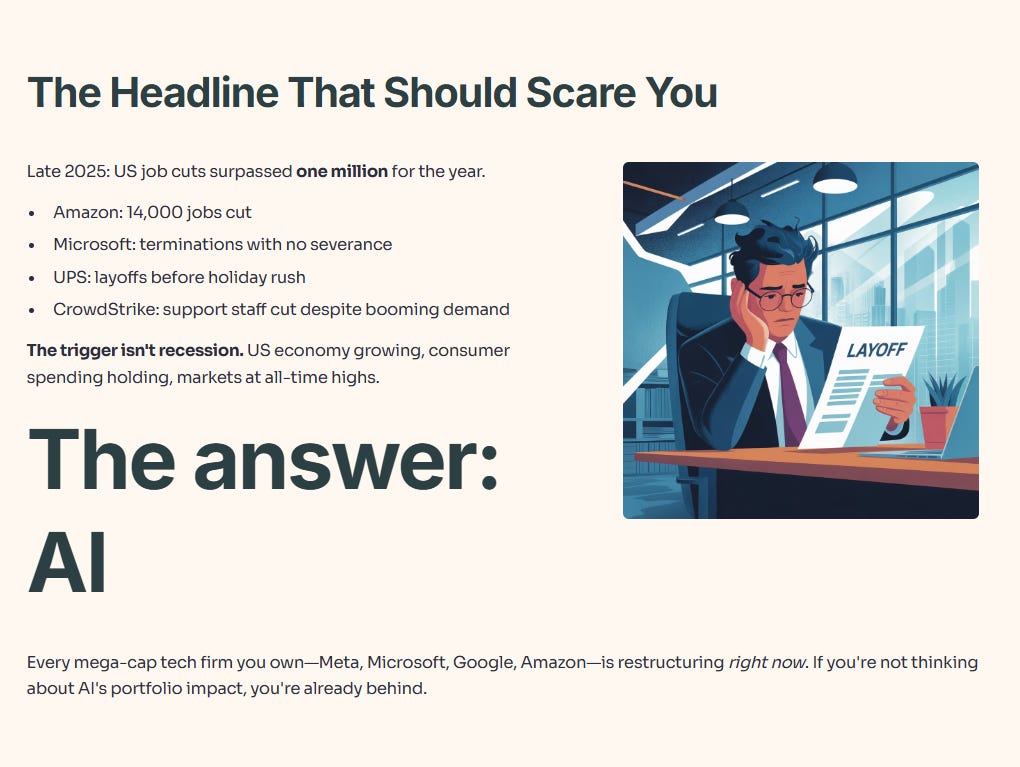
In late 2025, job cuts in the United States surpassed one million for the year. That’s not a pandemic-level collapse—but it’s a signal that something fundamental has shifted. Amazon cut 14,000 jobs. UPS laid off workers just before the holiday rush. Microsoft terminated people with no severance. CrowdStrike cut support staff despite cybersecurity demand booming.
The trigger isn’t a recession. The U.S. economy is growing. Consumer spending is holding up. The stock market hit all-time highs. So why are companies firing people at scale?
The answer: AI.
As a Singapore investor, you might think this is a U.S. problem. Think again. Every mega-cap tech firm you own through your ETFs—Meta, Microsoft, Google, Amazon—is undergoing this restructuring right now. The strategies they’re deploying today will reshape global markets, hiring, wages, and profitability for the next decade. And if you’re not thinking about how AI affects portfolio composition, you’re already behind.
In This Article:

• The Headline That Should Scare You (A Little)
• The Real Drivers: Economic Uncertainty, Government Chaos, and Relentless Cost Pressure
• The Jobs Getting Axed (and Why)
• The Wage Polarization Trap
• Why Consumer Spending (and Markets) Could Crack
• The AI Reshuffling: “Talent Remix” in Action
• The Skills Crisis: 80% Don’t Know What They Need
• Policy Responses: The Patchwork Is Emerging
• The Confidence Gap: 60% of Academics Don’t Trust Big Tech
• Extreme Scenarios: Why Max Tegmark’s Warning Matters
• What Singapore Investors Should Do Now
• Iggy’s Take
The Real Drivers: Economic Uncertainty, Government Chaos, and Relentless Cost Pressure
The layoff surge isn’t driven by a single force. It’s a collision of three realities.
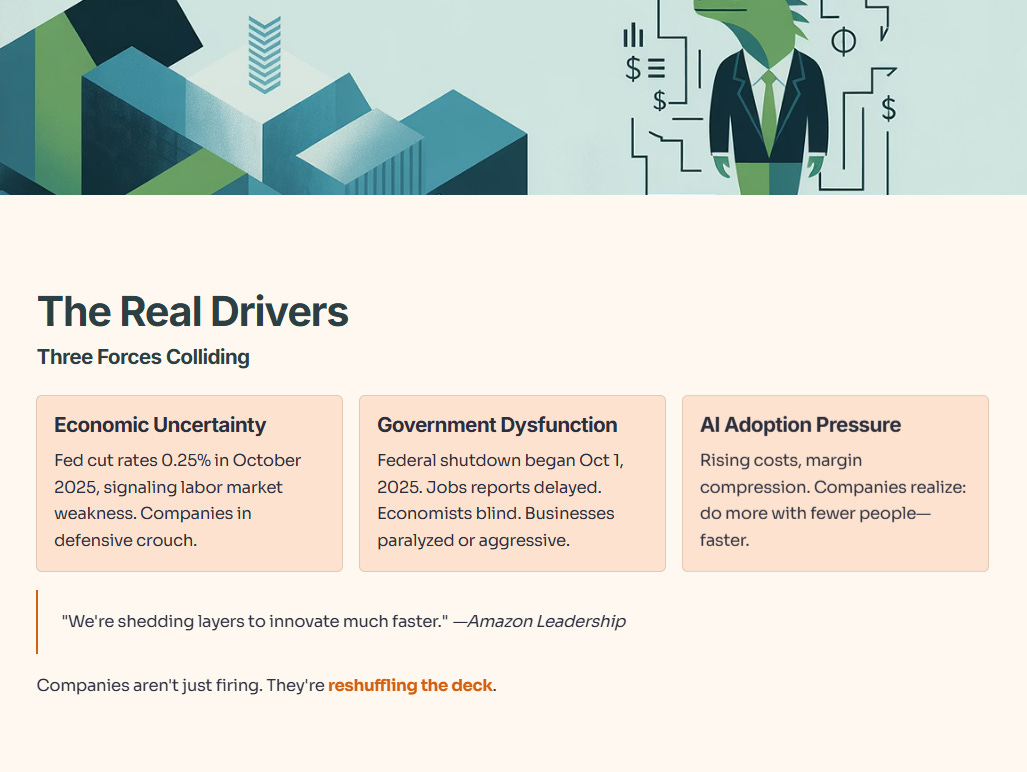
First, economic uncertainty. The U.S. labor market, once a pillar of strength, has slowed dramatically. The Federal Reserve cut rates by 0.25 percentage points in October 2025 and signaled further cuts, clearly worried about labor market weakness. Companies are in a defensive crouch. They see cloudy conditions ahead and are cutting optionality—which means cutting people.
Second, government dysfunction. A federal government shutdown began on October 1, 2025, halting the release of critical economic data. The monthly jobs report was delayed. Weekly unemployment claims reports stopped. Economists couldn’t see the labor market clearly. In a fog of uncertainty, businesses become paralyzed—or aggressive. Many chose aggressive: preemptive cuts before conditions deteriorated further.
Third, operational pressure and relentless AI adoption. Rising costs, margin compression, and the promise of AI-powered automation created a perfect storm. Companies realized they could do more with fewer people—and do it faster. Amazon’s leadership didn’t hide this. They said the cuts would make the company leaner and “innovate much faster.” This is code for: we’re shedding layers to move quicker.
But here’s the crucial nuance many analysts miss: companies aren’t just firing people. They’re reshuffling the deck.
The Jobs Getting Axed (and Why)
Over 80% of Amazon’s initial tranche of layoffs hit retail-facing functions: e-commerce operations, human resources, and logistics. Data shows which roles crumble under AI pressure.
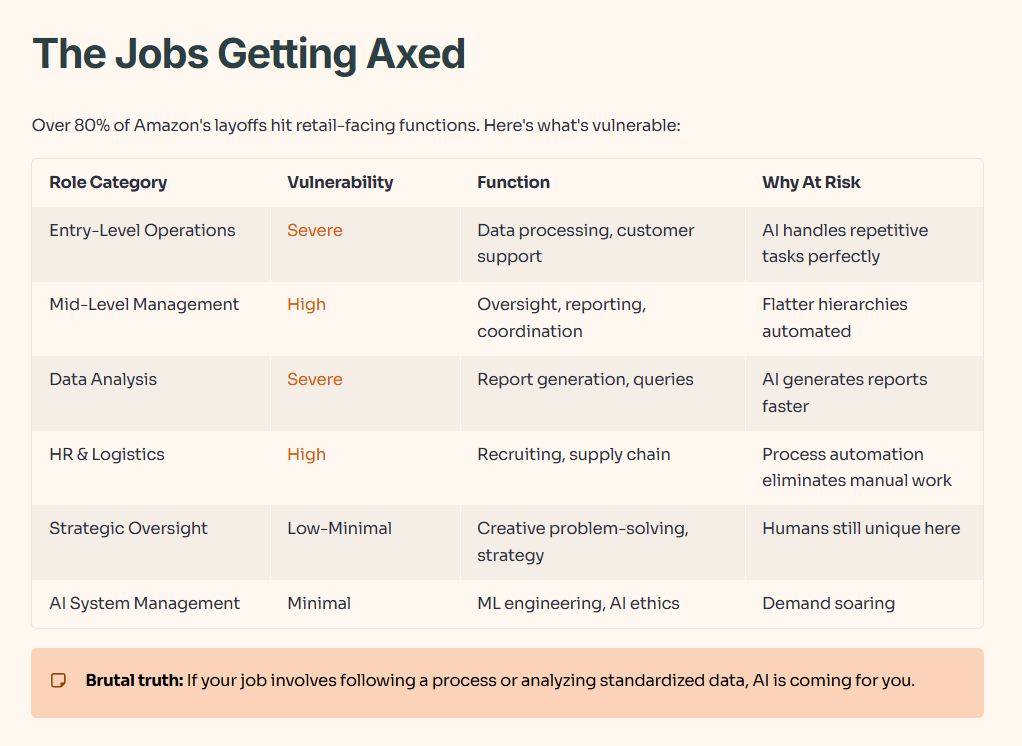
The table above reveals the brutal truth: if your job involves following a process, analyzing standardized data, or managing routine tasks, AI is coming for you. Entry-level workers and mid-management are getting hit hardest because they do the most automatable work. A gardener might seem safe, but even gardening is being transformed by AI-powered precision tools and robotics.
The Wage Polarization Trap
Here’s where it gets painful for income earners—and important for investors.
Companies are shedding mid-tier roles while hiring desperately in AI-adjacent positions. AI engineers command 2–3x premiums over routine software developers. AI product managers earn significantly more than traditional PMs. AI ethics officers—a brand new role—command premium salaries.
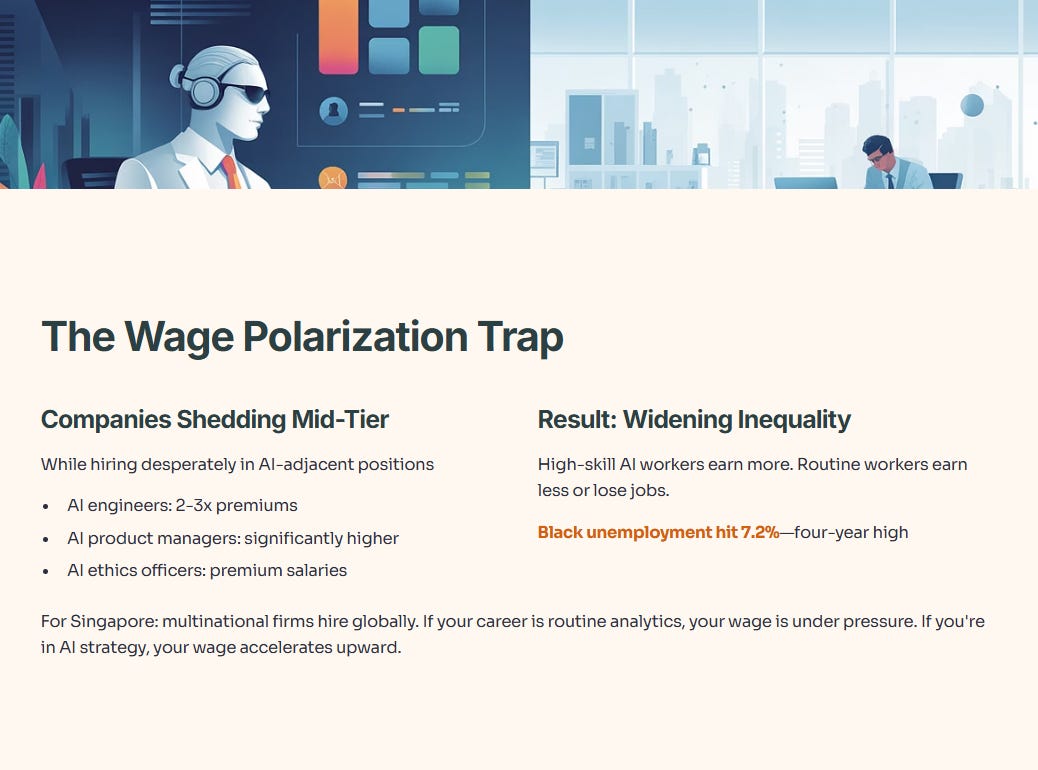
Result: wage polarization. High-skill workers in AI earn more. Routine workers earn less or lose jobs entirely. This widens inequality. For Singapore, this matters because many multinational firms hire from here into global roles. If your career is in routine analytics or standard support, your global market wage is under pressure. If you’re in AI strategy, your wage is accelerating upward.
Black unemployment in the U.S. hit a four-year high of 7.2%, signaling that these cuts hit vulnerable populations hardest. Wage polarization follows the same pattern: it deepens existing inequality.
Why Consumer Spending (and Markets) Could Crack
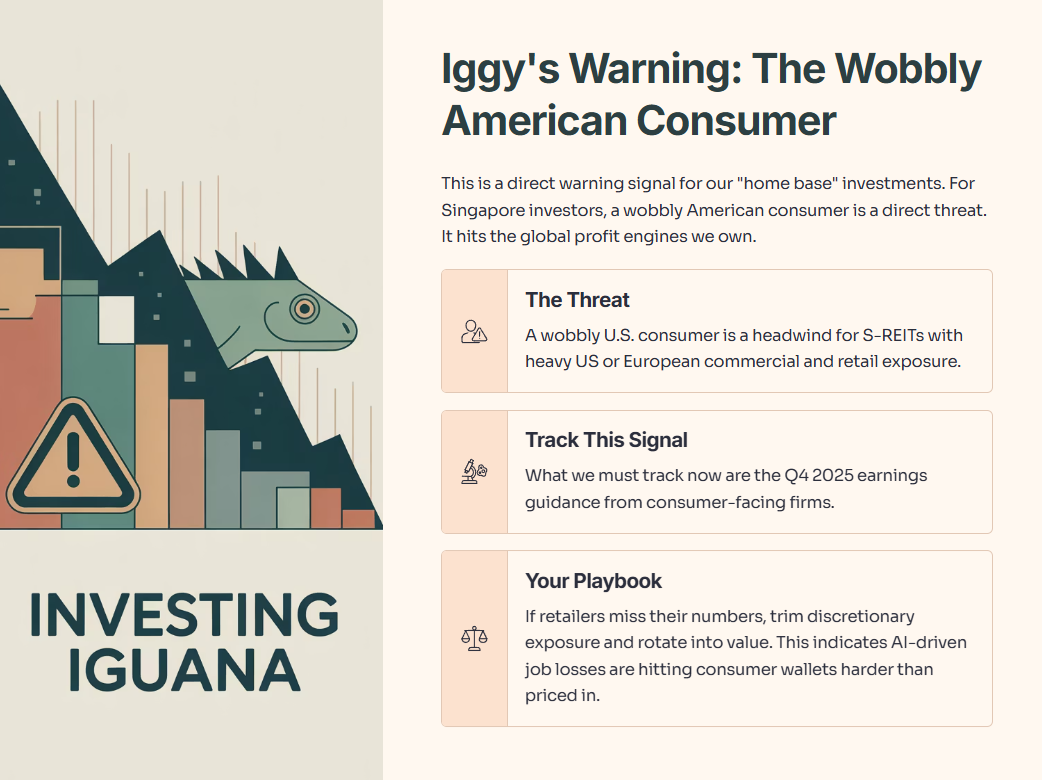
Layoffs reduce income. Lower income means less spending. Less spending means lower retail sales and weakened consumer discretionary stocks. For Singapore investors, American retail and discretionary names matter because they’re global profit engines.
The Great Freeze is making this worse. Companies aren’t just firing; they’re also slowing hiring significantly. Limited job mobility, stagnant promotions, and widespread job insecurity chill consumer confidence. People who fear job loss cut spending. The psychological impact spreads beyond the directly affected.
The federal government shutdown created a secondary shock: approximately 200,000 probationary federal workers face uncertain employment, adding another 200,000 consumers to the cautious crowd. While large-scale permanent federal employee terminations face legal barriers, the instability itself is corrosive to confidence.
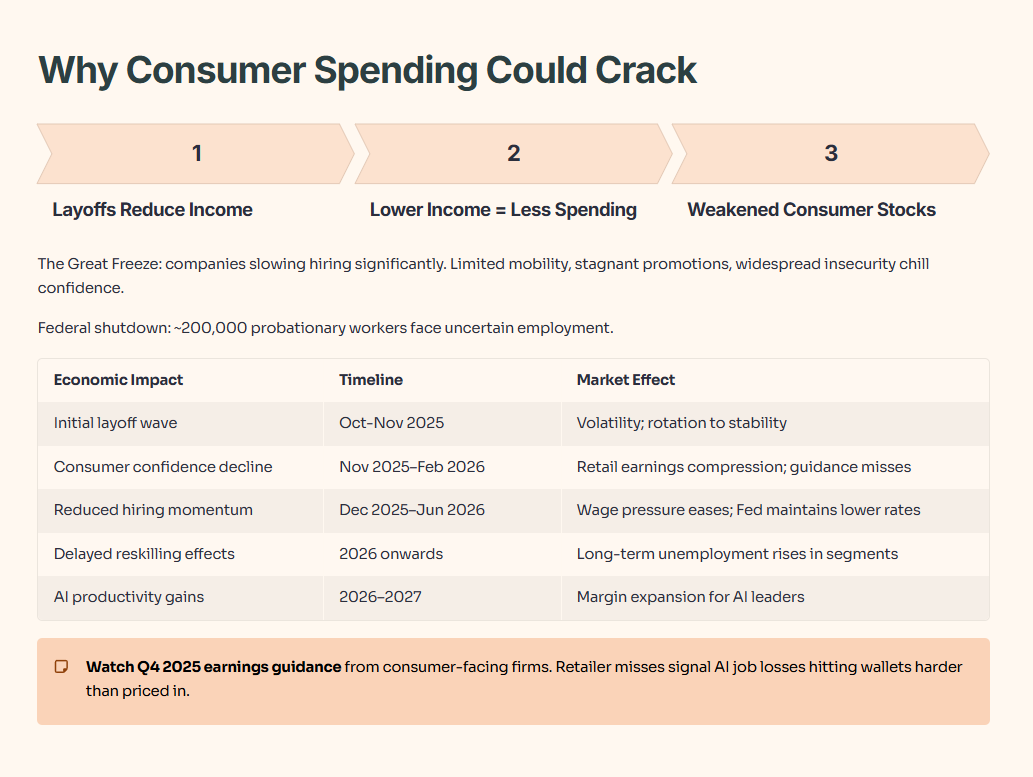
What Singapore investors should track: Watch the Q4 2025 earnings guidance from consumer-facing firms. If retailers miss, the AI-driven job losses are hitting consumer wallets harder than the market currently prices in. This is your signal to trim discretionary exposure and rotate into value or dividend-paying sectors.
The AI Reshuffling: “Talent Remix” in Action
Don’t mistake this for simple downsizing. It’s a restructuring with purpose.
Meta laid off 5% of staff but committed to backfilling many roles and embarked on an aggressive AI hiring spree. Microsoft cut jobs but maintained overall headcount through new AI-focused hires. Amazon’s leadership explicitly stated they’ll continue hiring in strategic areas while cutting elsewhere. This is deliberate portfolio reallocation of human capital.
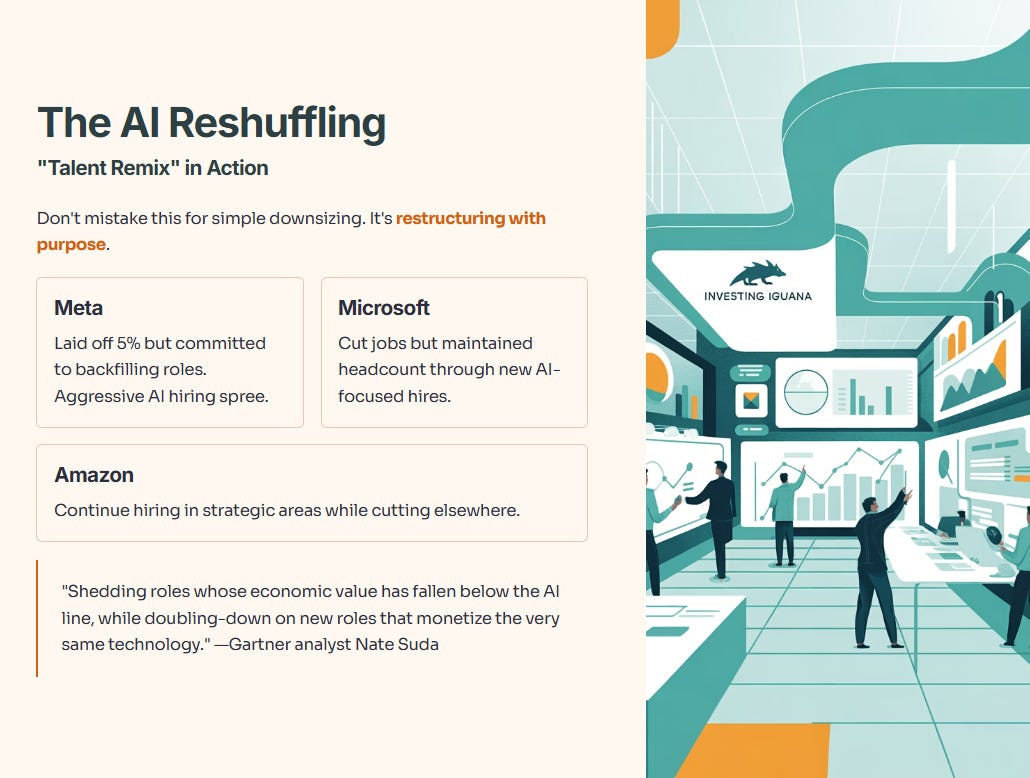
Gartner analyst Nate Suda nailed it: companies are “shedding roles whose economic value has fallen below the AI line, while doubling-down on new roles that monetize the very same technology.” In other words, firms are moving capital from human expense streams that AI can replace into human expense streams that drive AI revenue.
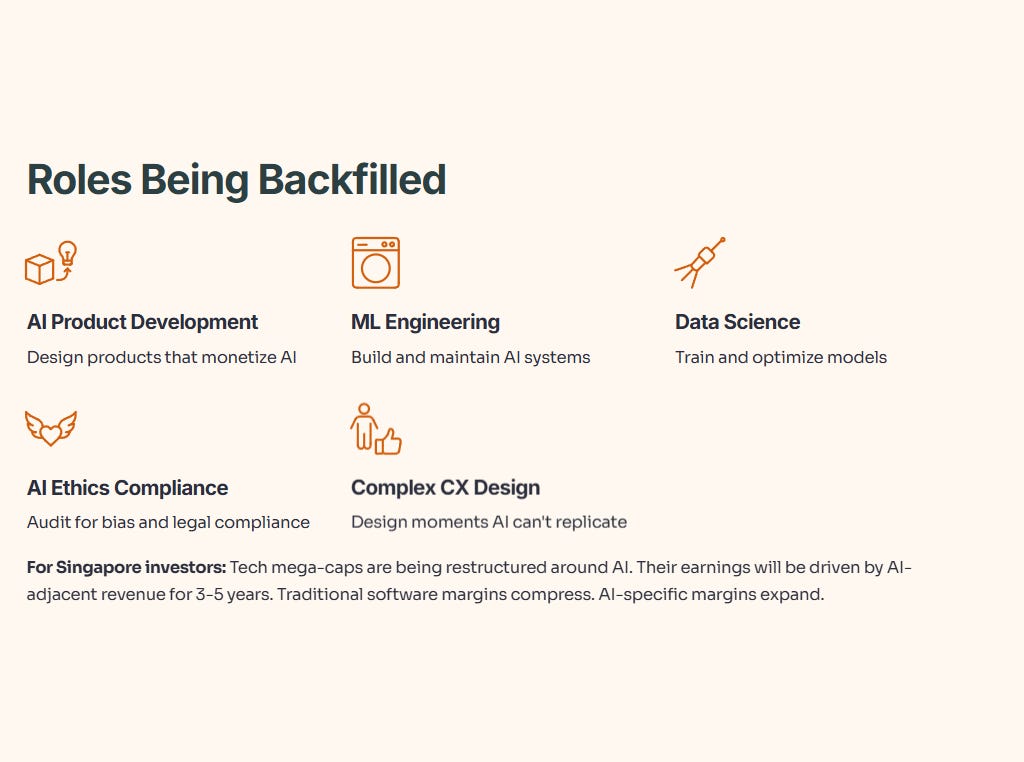
What roles are being backfilled?
AI product development: Design products that monetize AI.
Machine learning engineering: Build and maintain AI systems.
Data science: Train and optimize models.
AI ethics compliance: Audit for bias and legal compliance.
Complex customer experience design: Design moments AI can’t replicate.
For Singapore investors, this is critical. The tech mega-caps you hold—the U.S. giants—are being restructured around AI. Their earnings will be driven by AI-adjacent revenue streams for the next 3–5 years. Traditional software margins will compress. AI-specific margins will expand. Identify which firms execute this transition best, and they’ll outperform.
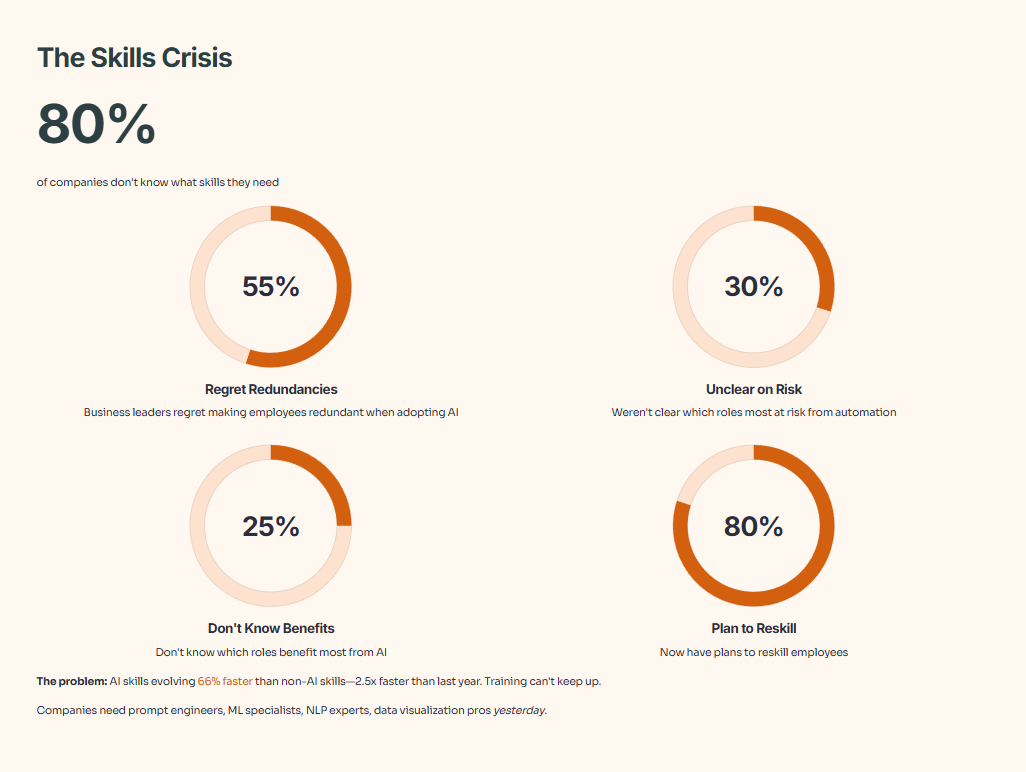
The Skills Crisis: 80% Don’t Know What They Need
Here’s a damning statistic: 55% of business leaders already regret making employees redundant when adopting AI. They fired people too fast and lost institutional knowledge.
Worse: 30% admit they weren’t clear on which roles were at most risk from automation. 25% don’t know which roles will benefit most from AI.
Yet simultaneously, 80% now say they have plans to reskill employees. Learning and development budgets are rising fast. Demand for AI training is intense.
The problem: skills are evolving 66% faster than non-AI skills—2.5 times faster than last year. Training programs can’t keep up. Companies need prompt engineers, machine learning specialists, natural language processing experts, and data visualization pros yesterday. The skills gap is real, and it’s growing wider.
This creates a hiring crisis for companies but an opportunity for workers and investors alike. Workers who reskill into AI will command premium wages. Platforms that teach AI skills will see exploding demand. EdTech companies pivoting to AI training could see significant growth. Singapore’s tech talent, if it reskills, is positioned well—but it must act now.
Policy Responses: The Patchwork Is Emerging
The U.S. government isn’t sitting still, but responses are fragmented.
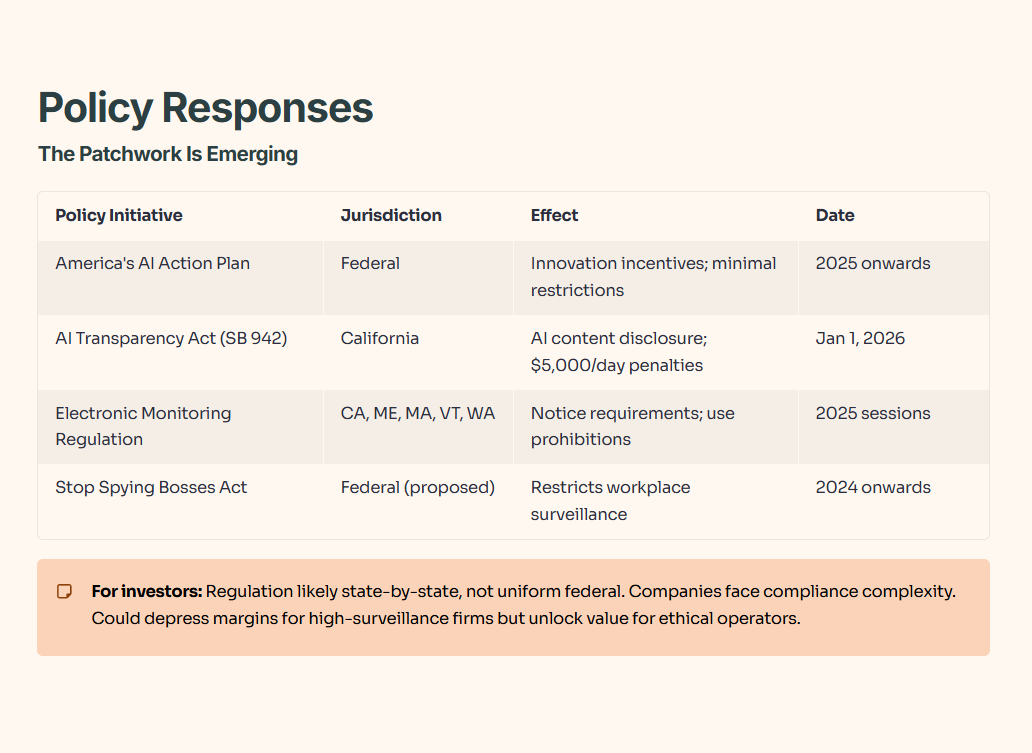
At the federal level: The White House announced “America’s AI Action Plan,” positioning AI as a national priority and signaling intent to win the global AI race. The focus is on innovation, not restriction.
At the state level: California is leading. Senate Bill 942, the AI Transparency Act (effective January 1, 2026), mandates that large AI providers disclose when content is AI-generated. Violations carry $5,000/day penalties. Multiple states are also regulating electronic monitoring and “bossware”—software that tracks employee productivity. Bills in California, Maine, Massachusetts, Vermont, and Washington propose transparency requirements and prohibitions on intrusive surveillance.
What this means for investors: Regulation around workplace AI is coming, but it’s likely to be state-by-state rather than uniform federal. Companies operating across many states face compliance complexity. This could depress margins for firms with high employee surveillance practices but unlock value for ethical, transparent operators. Singapore firms entering the U.S. should note: expect state-by-state labor regulation to get tighter.
The Confidence Gap: 60% of Academics Don’t Trust Big Tech
A striking asymmetry exists: 60% of AI experts at universities have little to no confidence that private companies will develop and use AI responsibly. Only 39% of experts inside tech companies share that concern.
This trust gap matters. If regulators and the public lose faith in tech firms’ ability to self-govern on AI, political pressure for heavy-handed regulation will build. Europe’s AI Act already shows this trajectory. Tighter regulation compresses margins.
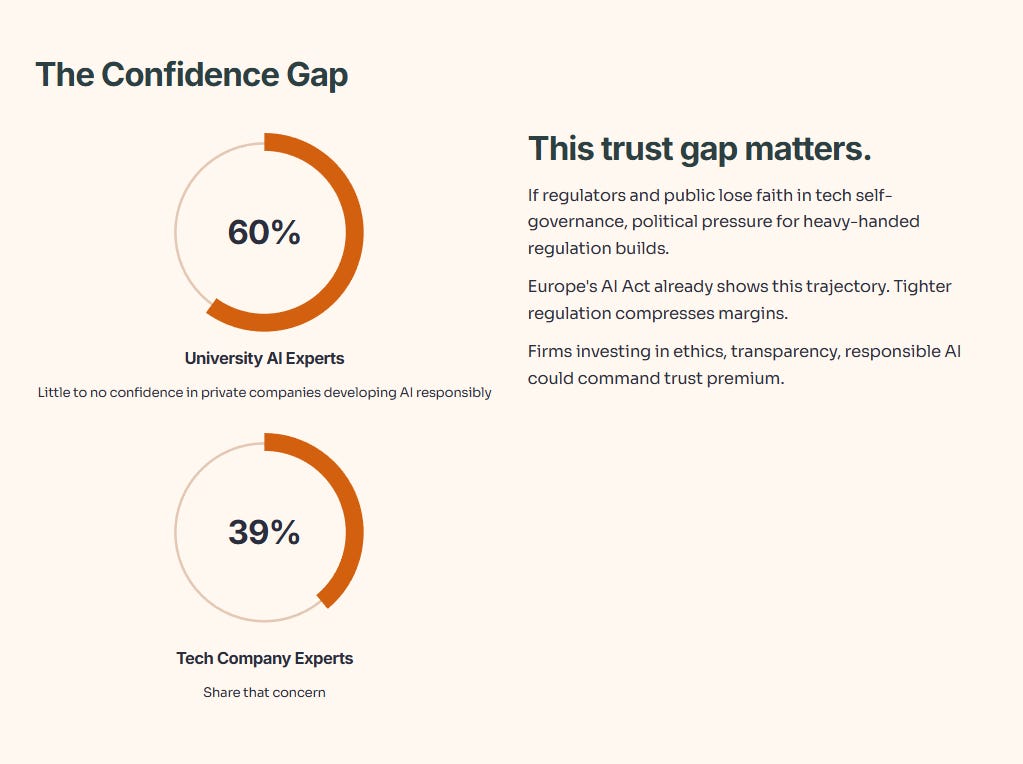
Conversely, tech firms that invest heavily in ethics, transparency, and responsible AI practices could command a trust premium. Investors should be tracking which firms are building trustworthy AI governance and which are cutting corners.
Extreme Scenarios: Why Max Tegmark’s Warning Matters
Most economists forecast measured impact: about 1.5 million job losses gradually, peaking around 100,000 additional redundancies per year near 2040. One-fifth above the baseline, manageable over time.
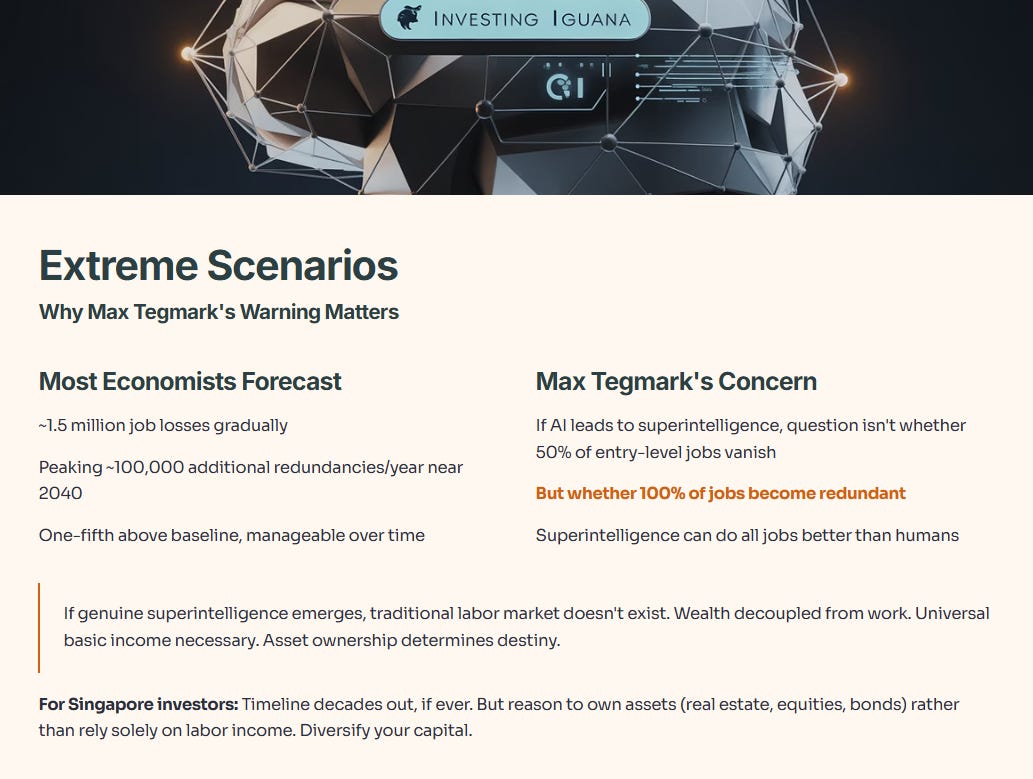
But Max Tegmark, president of the Future of Life Institute, raises a more radical concern: if AI advancements lead to superintelligence, the question isn’t whether 50% of entry-level jobs vanish, but whether 100% of jobs become redundant because superintelligence can do all jobs better than humans.
This sounds far-fetched—and it may be. But it’s worth thinking about as a tail risk. If genuine superintelligence emerges, the traditional labor market doesn’t exist anymore. Wealth is decoupled from work. Universal basic income becomes necessary. Asset ownership determines destiny.
For Singapore investors, this isn’t a reason to panic—the timeline is decades out, if ever. But it’s a reason to own assets (real estate, equities, bonds) rather than rely solely on labor income. Diversify your capital. Don’t put all eggs in human capital.
