




The 3-Bucket Rule Every Singaporean Over 50 Gets Wrong
Same three buckets, different split depending on whether you’re accumulating, transitioning, or already drawing down, with real CPF, T-bill, and SSB numbers for each stage.
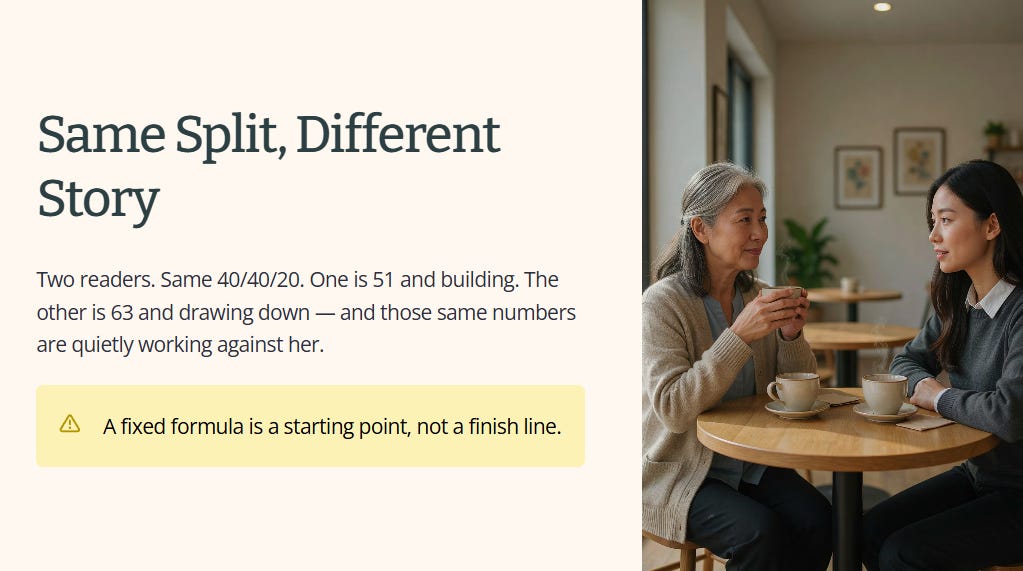
Two readers wrote in this month with the identical split: 40 percent safety, 40 percent growth, 20 percent cash. One is 51 and still building. The other is 63 and drawing down, and the same three numbers are quietly working against her.
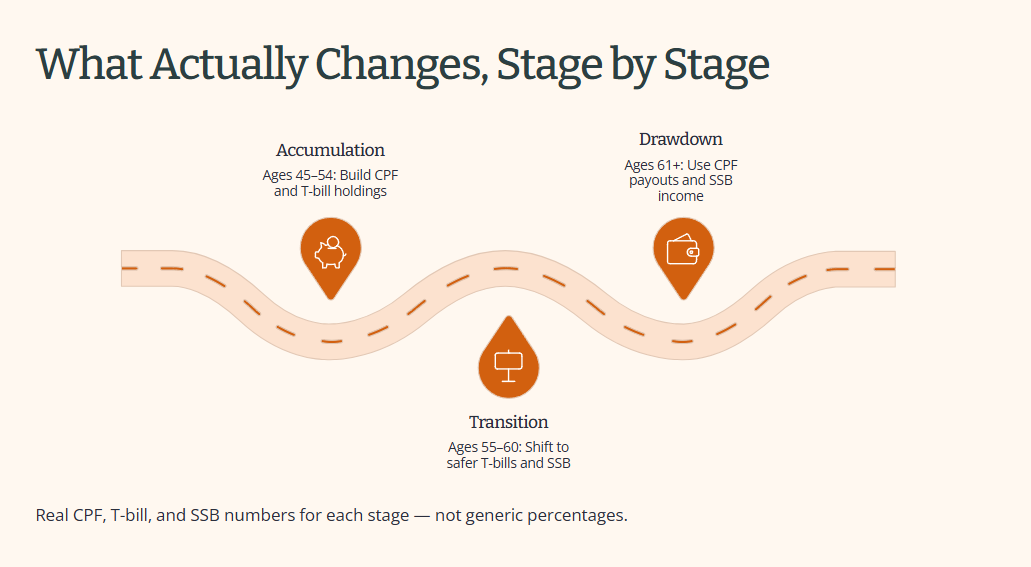
I get some version of that split in my inbox every week, always presented like a fixed formula rather than a starting point. It isn’t wrong, exactly. It’s incomplete, because the three buckets don’t stay the same size, or even mean the same thing, as you move from 45 to 65. Today I want to walk through what actually changes, stage by stage, using the real CPF, T-bill, and SSB numbers on the table right now.

The Three Buckets, Properly Defined
Stage One: Accumulation (45 to 54)
Iggy’s Insights
Stage Two: Transition (55 to 60)
Why This Is the Stage People Get Complacent
Stage Three: Drawdown (61 and beyond)
Iggy’s Insights
Iggy’s Elite Read
The Three Buckets, Properly Defined
Before the split, the definitions matter more than people give them credit for, because “safety” is not one number. It’s two.
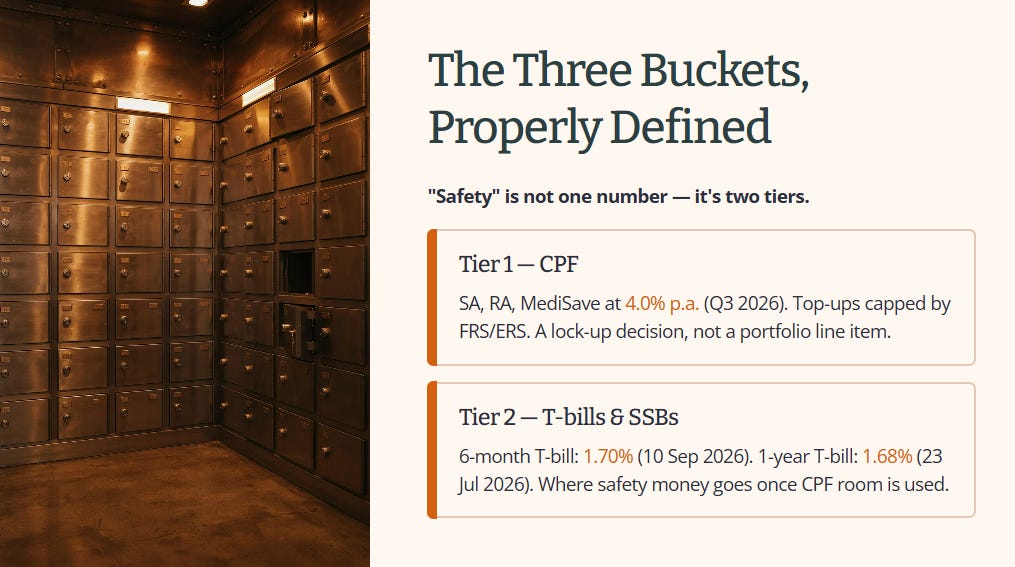
The first tier is CPF Special Account, Retirement Account, and MediSave, paying 4.0 percent per annum for Q3 2026. That’s attractive under my framework, but CPF isn’t a conventional bond fund you redirect capital into. Existing CPF balances already earn that rate automatically. Voluntary cash top-ups and CPF transfers are a separate decision, capped by the Full Retirement Sum before age 55 (S$220,400 for 2026) and the Enhanced Retirement Sum from 55 onward (S$440,800), and your own available room depends on your existing balance, not a fixed number I can quote for you. A top-up is also a lock-up, not a like-for-like swap for T-bills or SSBs sitting in your safety bucket, so treat it as its own retirement-planning decision, not a portfolio-allocation line item.
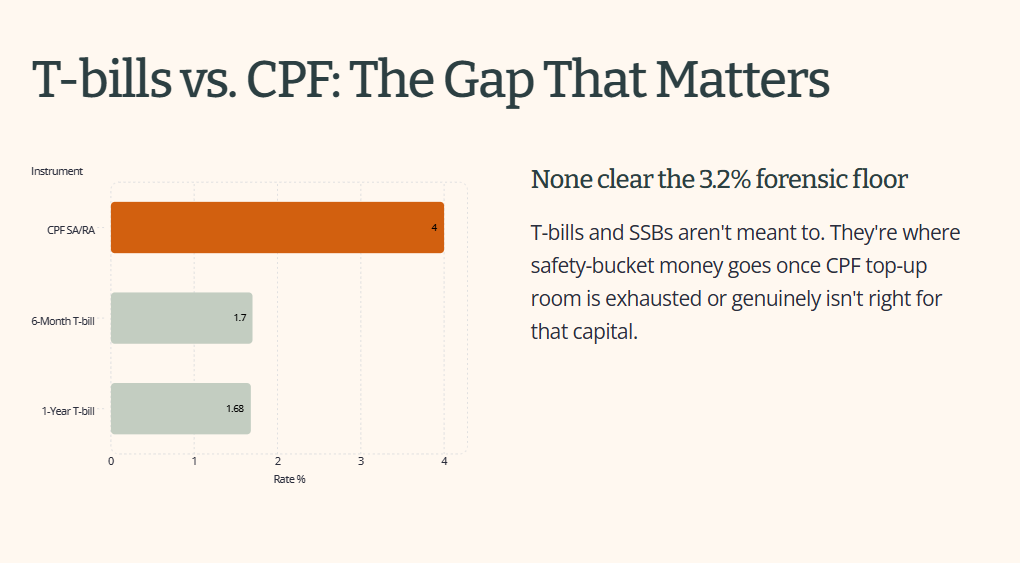
The second tier is everything else: 6-month T-bills, which cut off at 1.70 percent at the 10 September 2026 auction (BS26118E, the actual auction result, not the separate secondary-market benchmark yield MAS also publishes, which was running slightly lower around the same date), and the 1-year T-bill at 1.68 percent from the 23 July 2026 auction. None of these clear my 3.2 percent forensic floor. They’re not meant to. They’re where safety-bucket money goes once CPF top-up room is either used up or genuinely isn’t the right decision for that capital.
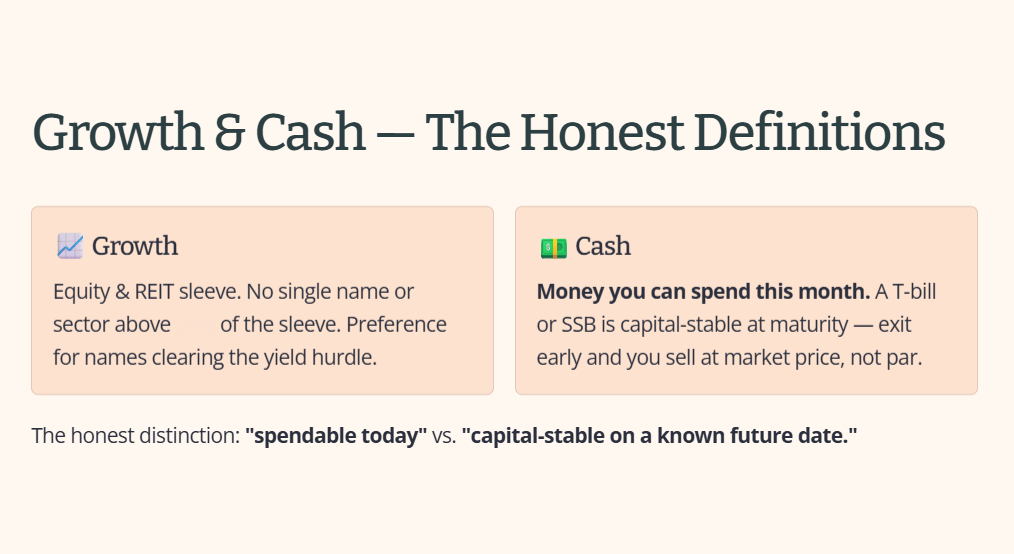
Growth is the equity and REIT sleeve, screened the same way I screen everything: no single name or sector above 25 percent of that sleeve, and a preference for names that would actually clear my yield hurdle rather than ones riding sentiment.
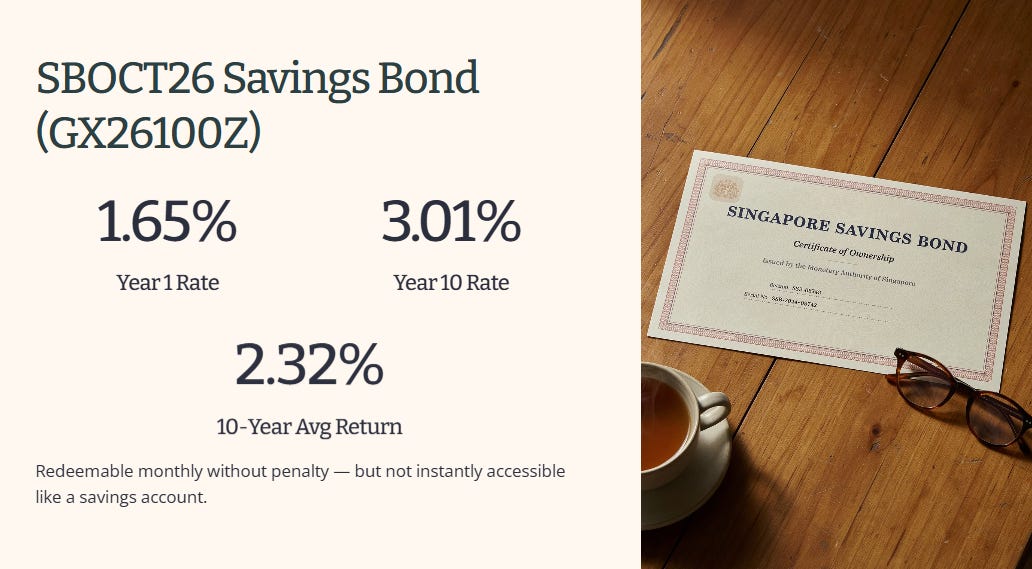
Cash is where the two remaining tiers get confused. A T-bill or SSB is capital-stable at maturity, not the same thing as cash available today. Exit one early and you’re selling into the secondary market, at whatever price that market offers, not withdrawing at par. So the honest distinction isn’t “safety versus cash,” it’s “money you can spend this month” versus “money that’s capital-stable on a known future date.” The current SBOCT26 Savings Bond (GX26100Z) illustrates the second kind well: 1.65 percent in year one, stepping up to 3.01 percent in year ten, a 2.32 percent average annual return if held the full ten years, redeemable monthly without penalty but not instantly accessible in the sense a savings account is.
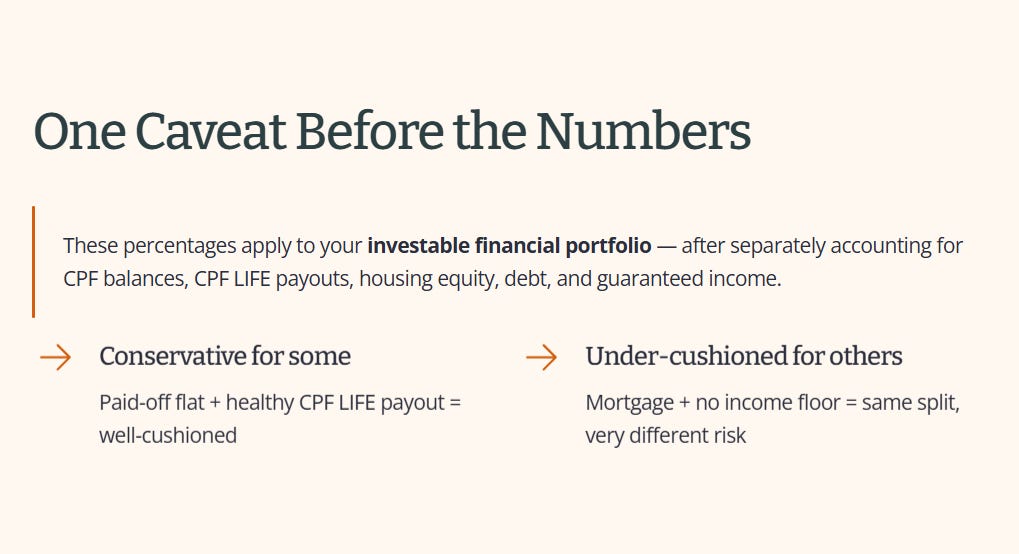
That’s the mechanism most 40/40/20 explainers skip. One caveat before the numbers: these percentages apply to your investable financial portfolio, after separately accounting for CPF balances, CPF LIFE payouts, housing equity, debt, and any other guaranteed income. They are not a universal split for everyone over 50. The same 20/40/40 that looks conservative for someone with a paid-off flat and a healthy CPF LIFE payout can be genuinely under-cushioned for someone with a mortgage and no other income floor. These are educational illustrations, not recommended allocations for your specific situation. Now here’s where the split itself changes.
You Don’t Need The Jargon To Get The Edge
Not Everyone Wants To Read Balance Sheets For Fun. Sometimes you just want to know what’s actually happening with your money, in plain English, before everyone else finds out. That’s the idea behind Iggy’s Elite Investors.

Members get the full report the moment it’s ready, not a week later when it’s old news. That means the complete watchlist, the practical cheatsheets, and every walkthrough, delivered while the information still matters.
For S$12/month, less than two kopi and kaya toast sets at Raffles Place, you get the same information everyone eventually sees, just earlier, and explained the way you’d want a friend to explain it.
Stage One: Accumulation (45 to 54)
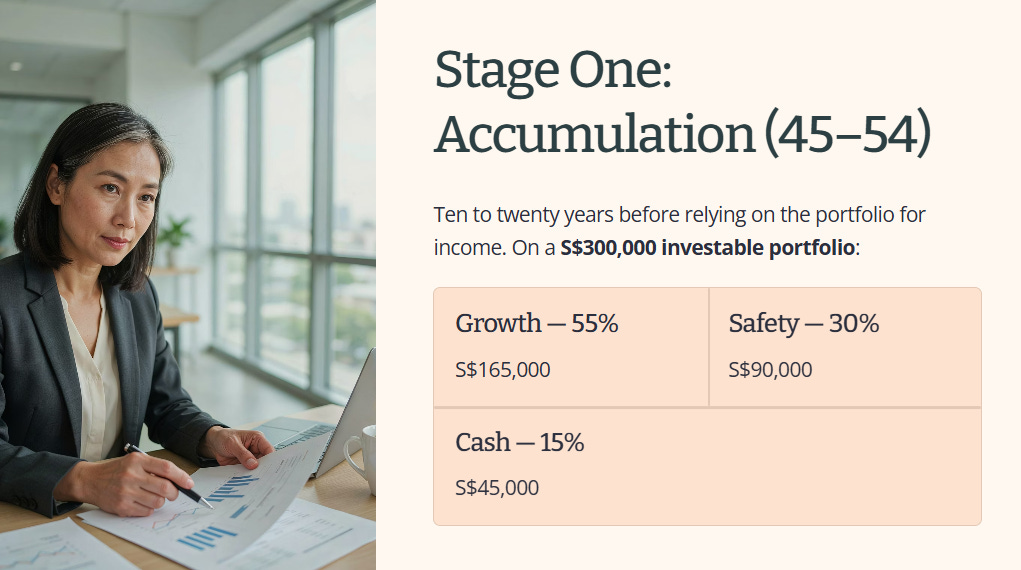
At this stage you still have ten to twenty years before you’re relying on the portfolio for income, which means you can absorb a downturn without needing to sell into it. On a S$300,000 investable portfolio (excluding CPF and home equity), a reasonable Accumulation illustration looks like growth 55 percent, safety 30 percent, cash 15 percent.
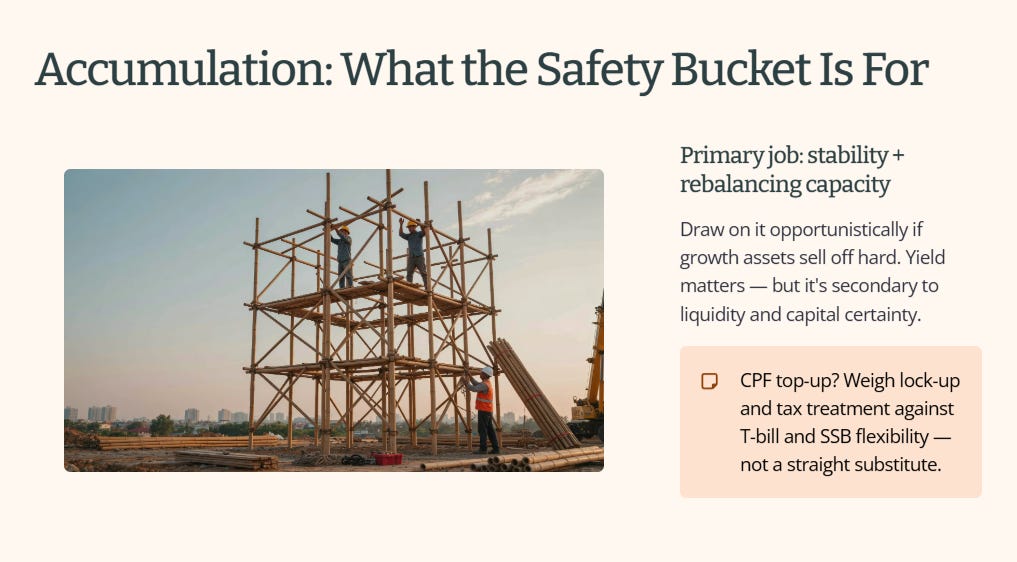
In accumulation, the safety bucket’s primary job is stability and rebalancing capacity, something to draw on opportunistically if growth assets sell off hard. Yield still matters, but it’s secondary to liquidity and capital certainty at this stage. If you’re considering a CPF cash top-up, weigh its retirement-income benefit, lock-up, and tax treatment against the flexibility of T-bills and SSBs rather than treating a top-up as a straight substitute for this bucket.
🟢Iggy’s Insights
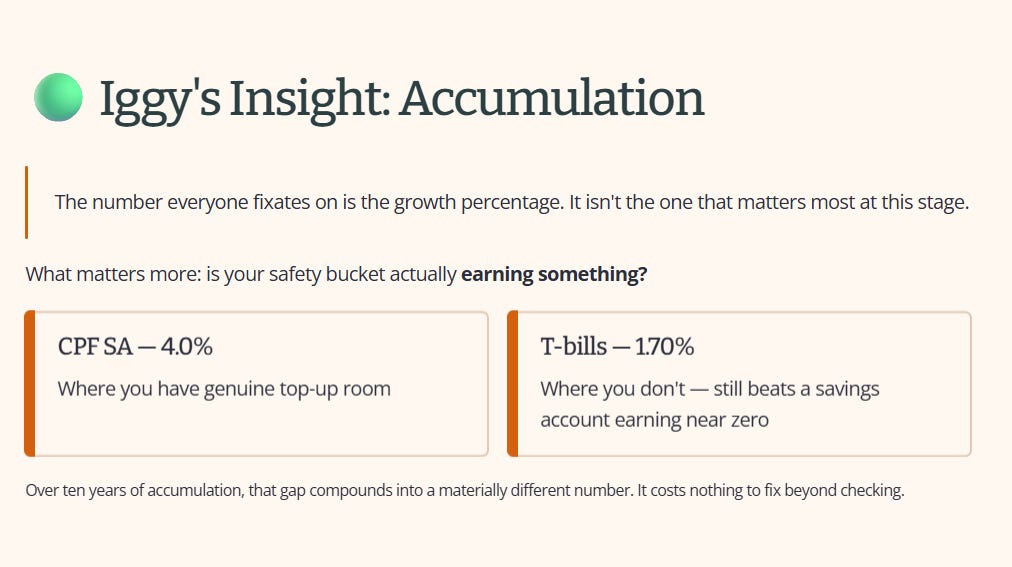
The number everyone fixates on in a bucket strategy is the growth percentage, because it feels like the exciting decision. It isn’t the one that matters most at this stage. What matters more is whether the safety bucket is sitting in an instrument that actually earns something, CPF SA at 4.0 percent where you have genuine top-up room, T-bills at 1.70 percent where you don’t, rather than a savings account earning close to nothing out of inertia. That’s a real gap on money doing the identical job of not being growth capital, and over ten years of accumulation it compounds into a materially different number. It costs nothing to fix beyond actually checking where your own top-up room and instrument choices sit.
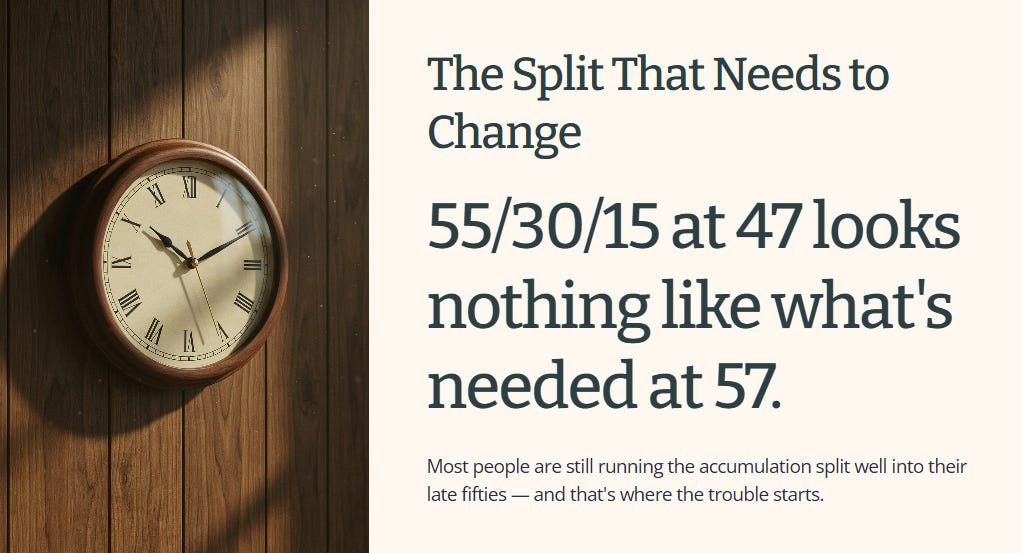
That’s the split most people are still running in their late forties. It looks nothing like the split that actually needs to be running by the late fifties.
🔒 What’s Next
The 4.0 percent CPF SA figure above is the best number in your entire safety bucket. Below the fold I’ll show you exactly what happens to that math once you can no longer afford to wait out a downturn, and why the textbook 40/40/20 split is really just one specific stage’s number wearing a universal label.
