
CPF LIFE & ERS | Is $440,800 Enough for a Fortress Retirement?
Stop treating your CPF and dividends like a spare ATM. Your million-dollar plan has a massive, hidden structural flaw.
The Bedok Interchange Anxiety: Why Your “Million‑Dollar” Nest Egg Is Leaking
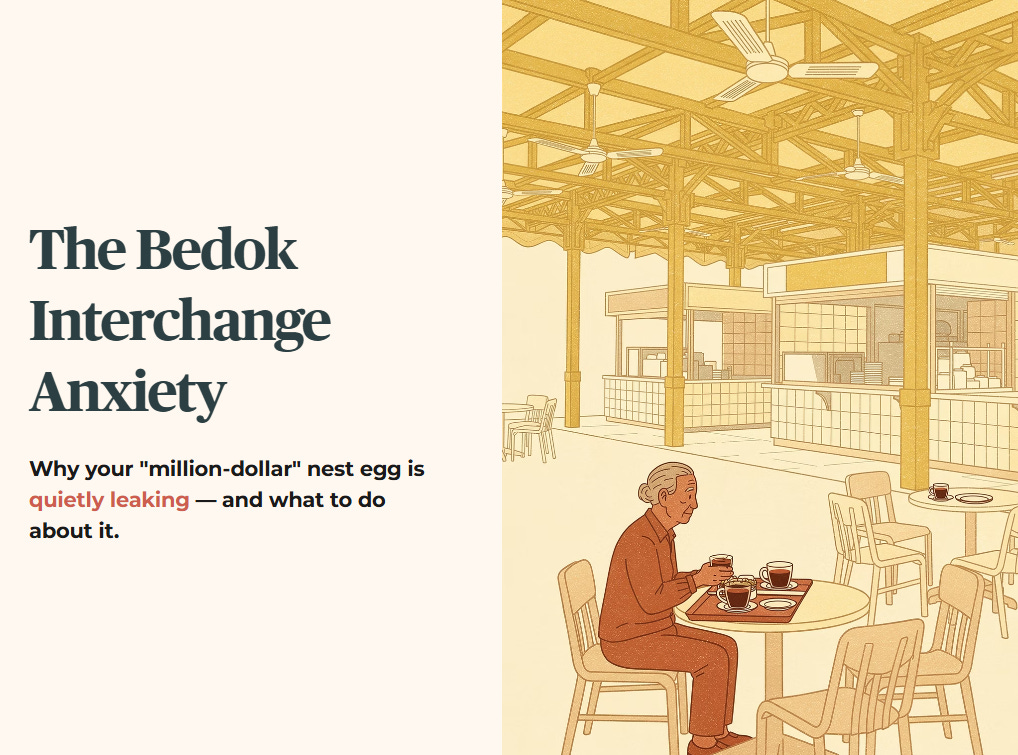
Imagine you are sitting at Bedok Interchange hawker centre, nursing a $1.80 kopi‑o. You look around at the retirees and wonder: who is actually comfortable, and who is just one MediShield Life premium hike away from a crisis?
Most 45‑year‑old Singaporeans are staring at a $1 million retirement “target” as if it were a fixed destination. But in March 2026, with the Straits Times Index (STI) hovering in the mid‑4,800s and recent 6‑month T‑bill cut‑off yields around 1.37% per year, that million dollars no longer buys the same sense of “Sanctuary” it once did.
The uncomfortable truth is that most retail investors are still measuring their retirement readiness using 2019 math in a 2026 world. They are ignoring the looming “2027 Debt Wall” in leveraged assets and the way CPF mechanics change at age 55, when the creation of the Retirement Account (RA) effectively drains most of the balances in the Special Account (SA). If you are not stress‑testing your plan against a conservative 3.2% “Forensic Floor,” you are not really planning for retirement — you are just hoping for the best.
In This Article:
The Life Stage Framework: Engineering the Iron Bastion
Stage 1 (Ages 30–54): The Compounding Engine
Stage 2 (Ages 55–64): RA Creation and the SA Drain
Stage 3 (Ages 65+): The Distribution Sequence
Stage 4: The Legacy (Nomination)
The Budget 2026 Radar: Policy Shifts That Matter
The Worked Example: The “Bedok Couple” Case Study
Strategic Considerations for Your Blueprint
Iggy’s Forensic Compliance Standards
The Verdict
About Iggy & the Elite Investors
A Quick Note Before the Verdict. You aren’t here for the kopi tips or the hype. You’re here because you want the forensic truth before you commit a single dollar of your capital. That tells me something about the kind of investor you are.
But here’s the uncomfortable truth about how independent publishing works. The algorithm doesn’t know you read every word. It doesn’t know you checked the gearing ratio twice. It only sees one signal — whether you’ve hit that subscribe button. Every forensic investor who reads without subscribing is invisible to the machine.
If this analysis has ever helped you identify a risk or calculate a margin of safety — subscribe for free now and share this with one person who needs to hear it. Not for me. To tell the algorithm that data-driven SGX analysis deserves a seat at the table alongside the noise.
The Silent Threat Inside CPF
Most Singaporeans under‑use their CPF because they treat it like a “black box” controlled by the government. In reality, CPF functions like a sovereign‑backed annuity system that currently pays 4.0% on SA and RA balances, a profile that is increasingly rare in a low‑yield world.
By failing to “shield” or top up strategically before age 55, many people leave more money sitting in the Ordinary Account (OA) at 2.5% instead of compounding at 4.0% in the SA or RA. That 1.5% yield gap, compounded over 20 years, is not just coffee money; it can be the difference between staying put in your current flat and being able to afford a meaningful HDB upgrade.
This is the real “Silent Threat” to heartland wealth: not dramatic market crashes, but quiet under‑compounding in what is supposed to be your safest bucket.
1. The Life Stage Framework: Engineering the Iron Bastion
To answer the question “how much is enough,” we break your journey into four checkpoints.
Stage 1 (Ages 30–54): The Compounding Engine
At this stage, your primary focus is compounding your SA. As of early 2026, SA and RA balances earn 4.0% a year, while recent 6‑month T‑bill cut‑off yields are around 1.37% a year. That gives you a spread of roughly 2.6 percentage points in your favour when you channel long‑term savings into SA or RA instead of constantly rolling short‑term T‑bills.
The strategy is simple: maximise voluntary top‑ups to at least the Full Retirement Sum (FRS) as early as you can reasonably afford.
The logic is powerful. Over 30 years, every dollar compounded at 4% grows to about 3.24 dollars, assuming the rate is maintained. For a 35‑year‑old planning towards age 65, that is a serious tailwind.
Stage 2 (Ages 55–64): RA Creation and the SA Drain
This is the critical zone. When you turn 55, CPF creates your Retirement Account. Savings from your SA, and then from your OA if needed, are transferred into the RA up to your applicable FRS, or up to the Enhanced Retirement Sum (ERS) if you decide to commit more.
In “kopitiam logic” terms, think of your SA as a high‑interest savings jar. At 55, CPF scoops money out of that jar to fill your RA payout pot, and any excess can end up back in OA earning 2.5%. The SA is not literally abolished, but for most members the bulk of their SA savings is effectively swept into the RA at that point.
The key adjustment here is this: if you want more of your wealth to earn 4.0% in retirement, you should aim to move as much as possible from OA into RA up to the ERS limit for your cohort, subject to official rules and your own cash‑flow needs. For the exact FRS and ERS figures that apply to you in 2026 and beyond, always refer to CPF’s latest published schedule.
Stage 3 (Ages 65+): The Distribution Sequence
This is where you turn on the taps, and the order in which you draw down your assets matters.
Your CPF LIFE payouts form your primary, government‑backed income floor based on your RA savings. On top of that, you draw down your SRS funds in a staggered, tax‑efficient way to keep your tax bracket manageable. Finally, you layer SGX dividends as your variable “inflation‑plus” buffer to sit above CPF LIFE and SRS.
A strong plan treats CPF LIFE as the non‑negotiable base layer, and market‑linked income as the flexible layer you can adjust through different market cycles.
Stage 4: The Legacy (Nomination)
Do not let the Public Trustee decide how your money is distributed. A valid CPF Nomination ensures your CPF savings go directly to your chosen beneficiaries instead of being tied up in probate and administrative processes for months.
This is not just about convenience. It is part of protecting the “Sanctuary” you are trying to build for your family, even after you are gone.
2. The Budget 2026 Radar: Policy Shifts That Matter
By early 2026, the Majulah Package enhancements and related schemes have started to flow through to older Singaporeans. The “Earn and Save Bonus” and other targeted top‑ups channel money directly into CPF for eligible cohorts, with some benefits flowing into RA balances for “young seniors” depending on age and income.
Many people shrug off these bonuses as “political chicken rice” — small treats to keep voters happy. But if you are a mid‑career professional whose take‑home pay is capped by the $8,000 CPF salary ceiling, these recurring CPF credits may be one of the few ways to boost your retirement momentum without taking on extra investment risk.
Ignoring free top‑ups into an instrument that currently earns 4.0% a year is essentially walking away from a high‑certainty boost to your future income.
3. The Worked Example: The “Bedok Couple” Case Study
Meet Tan (45) and Mei (45). They live in a 4‑room HDB flat and earn a combined $14,000 a month. Their goal is to retire at 65.
Here is their forensic audit:
They currently have a combined $400,000 in CPF across OA and SA. Their strategy is to reach the ERS for their cohort in their RAs by age 55 through a mix of mandatory contributions and voluntary top‑ups. To fund a “comfortable” lifestyle of $6,800 a month, they calculate that they will need an additional $3,400 a month from sources outside CPF.
Their retirement income projection at age 65, on illustrative assumptions, looks like this:
CPF LIFE at ERS level provides about $6,800 a month combined, forming their “Sanctuary Floor.” Actual payouts will depend on the CPF LIFE schedule and interest rates at the time they start payouts. Laddered SRS withdrawals add about $1,200 a month, structured to be tax‑efficient. A diversified SGX dividend portfolio of banks, REITs and blue chips adds about $2,500 a month as a variable inflation buffer, sized based on a conservative yield and capital preservation framework.
Altogether, that gives them about $10,500 in total monthly income. They project their monthly expenses, including a buffer for medical inflation, to be about $7,500. On these assumptions, their SAN (Sanctuary) score is 8.2 out of 10 — a “Fortress”‑level plan that should still hold up if market yields compress or expenses rise, because CPF LIFE carries the bulk of the load and the SGX income is sized with a conservative floor.
A crucial point in this projection is the stress‑test buffer. When estimating SGX dividend income against guaranteed CPF rates, the plan uses a conservative risk‑free floor of 3.2%. It does not assume that today’s 4% to 5% bank and REIT yields will last forever. The whole idea is to plan for storms, not just sunny days.
4. Strategic Considerations for Your Blueprint
If you want to move from “anxiety” to “Iron Bastion,” here are three concrete checks to run on your own situation.
First, audit your gearing. Go through your S‑REIT holdings one by one. Any REIT with aggregate leverage creeping well above the low‑30% range should not automatically be treated as a “Sanctuary” asset. It will be more exposed to refinancing risk as the 2027–2028 debt wall approaches. Check each REIT’s latest gearing and interest‑coverage numbers from its latest reports before you rely on its distributions as pension‑grade income.
Second, apply the SRS “FairPrice” test. If your SRS is sitting largely in cash at token interest — often only a fraction of a percent a year, depending on your bank — that is a warning sign. You would never leave $15,000 in a paper bag at the wet market; do not leave it idle in SRS either. Consider gradually deploying it into diversified, high‑quality investments, such as core STI blue chips with sustainable dividend track records, while staying within your own risk tolerance and time horizon.
Third, front‑load your BHS. Keep an eye on your MediSave balance relative to the Basic Healthcare Sum that applies to your cohort, and aim to hit it early. Once you reach BHS, mandatory CPF contributions that would have gone into MediSave can be redirected more into OA, SA or RA, and you reduce the “silent leak” of cash used for insurance premiums that might otherwise have been automatically covered from MediSave. Always use the official BHS figure from CPF for the year in question, not a rough estimate.
Handled together, these steps shift you from a passive, hope‑based retirement path to a deliberate, rules‑based blueprint.
For the rest of this piece, I’ll keep everything rules‑based and instrument‑agnostic. But for those asking, “I get this; how do I actually deploy SRS in practice without bleeding on fees?”, here’s where I’ve moved my own execution—and why.
— Partner Note —
For me, fixing the asset selection is the easy part. Fixing the execution cost is where most SRS investors quietly bleed.
The forensic irony is this: you’ve just done the work to identify assets that clear the 4.7% forensic floor — and then you hand back 2.5% of that yield on Day 1 to a minimum commission. For SRS investors deploying in S$500 tranches, that entry drag hits 5.0% before the market moves a single tick.
I’ve shifted my own deployment to Longbridge for one forensic reason: they are currently the only platform in Singapore offering Lifetime S$0 Commission on US, HK, and SG stocks. For a DCA investor running monthly SRS tranches, that single change eliminates the minimum commission drag entirely.
I’ve partnered with Longbridge on a specific pilot for this community. The first 10 readers to open and fund an account with a minimum of S$10,000 will receive a direct S$100 cash credit.
The forensic math: S$100 on a S$10,000 deployment is a 1.0% Day 1 Yield Boost — effectively neutralising your entry cost before you’ve bought a single share. For context, that’s better than the yield spread on several SGX names that fail our 4.7% floor.
This is strictly limited to 10 spots. Full terms and conditions are linked below — read them before committing, as standard platform fees apply.
— End Partner Note —
Iggy’s Forensic Compliance Standards
Importantly, this doesn’t change the rules‑based part of the blueprint: I still apply a 3.2% Forensic Floor to my CPF‑linked planning and a 4.7% signal for SRS‑linked assets. Longbridge just removes the fee drag that would otherwise eat into that target yield before you even start.
This analysis sets a personal forensic boundary for portfolio construction. It is not a recommendation to buy or sell any security.
For my own retirement architecture, I track a 3.2% Forensic Floor as the key signal for how I allocate capital between CPF, SRS and market assets. If a new idea does not clear this hurdle on a risk‑adjusted basis, I simply pass.
“Great investors don’t guess; they follow a system.” .....
Consider this infographic your instant blueprint. I’ve distilled hours of research into a single visual workflow to help you make smarter decisions in seconds. Print it out and keep it near your trading desk.
👇 Save the image or download the High-Res PDF below:
Iggy’s Forensic Compliance Standards — Standard Disclaimer
This content is produced for educational and informational purposes only. I am not a financial advisor — I am a retail investor who applies forensic analysis to my own portfolio and shares that process publicly. Nothing here constitutes a recommendation to buy, sell, or hold any security, and no specific target prices or personalised financial advice are offered. All data is sourced from public filings and verified sources; where data is unverified it is explicitly flagged. All investments carry risk, including the potential loss of principal, and past performance is not indicative of future results. If you are making investment decisions involving CPF, SRS, or personal capital, please conduct your own due diligence or consult a MAS-licensed financial adviser before committing funds.
Important Partner Disclosure
This content is a paid collaboration with Longbridge Singapore. It is intended for general awareness and does not constitute investment advice or a recommendation for any specific financial product.
Licensing Note: The presenter is not a licensed financial adviser. Views expressed are solely those of the presenter and do not necessarily reflect the position of Longbridge Singapore. Investments involve risk; you may lose your principal. This advertisement has not been reviewed by the Monetary Authority of Singapore. Always seek independent professional advice if unsure.


