


A regime shift, not a headline
H1 2025 broke a habit. Non‑US equities beat US peers by roughly double digits and did so from cheaper starting valuations. When leadership changes with policy and price on its side, it tends to last. Jackson Hole then shifted the stance. Powell called policy restrictive, flagged a softer labour market, and opened the door to cuts that futures put near 90% for September — a mix that weakens the dollar and broadens equity leadership. What next: treat this as a new regime, not a trade.
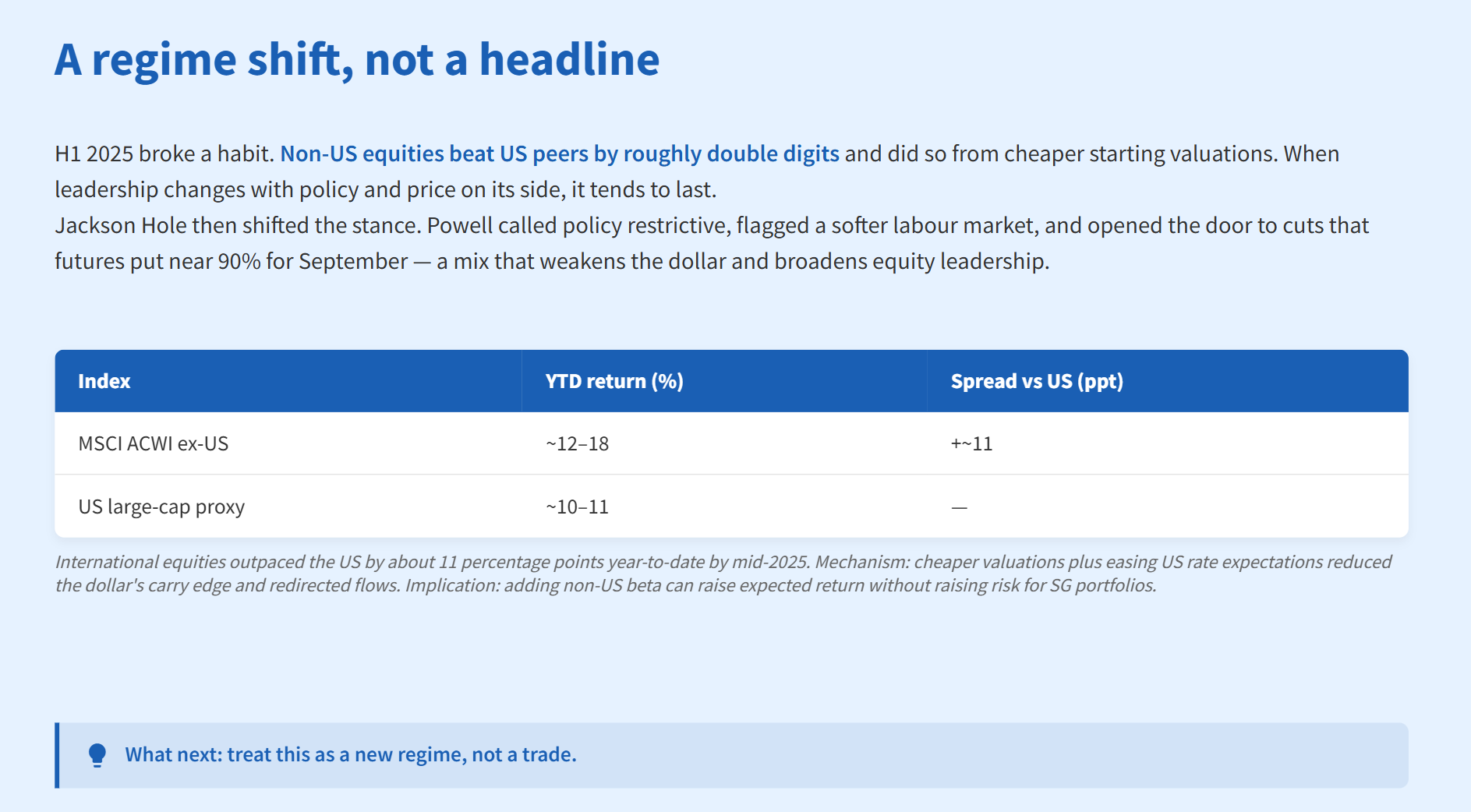
Caption: International stocks—meaning shares from countries outside the US—have grown about 11 percentage points more than US stocks during 2025 so far. This happened because stocks outside the US were cheaper to begin with, and people started expecting the US to lower interest rates soon. When US rates might go down, the US dollar becomes less attractive, so global investors look for better deals elsewhere and move their money out of the US.
For investors in Singapore, this is good news. By investing in international stocks (adding "non-US beta"), a portfolio can get higher potential returns without increasing the overall risk. In simpler terms: putting some money into stocks from other countries can help your investment grow faster, and it won’t necessarily make things riskier.
The data say leadership broadened
When people expected US interest rates to stop rising, the US dollar became less attractive to investors, so money started flowing out of the US and into other countries’ stock markets where companies pay better dividends and seem to be a better deal. Instead of just a few giant US companies dominating the market, lots of different stocks began to do well. This matters because it shows that spreading investments across more types of companies and countries can work out better when the rules and value of money change.
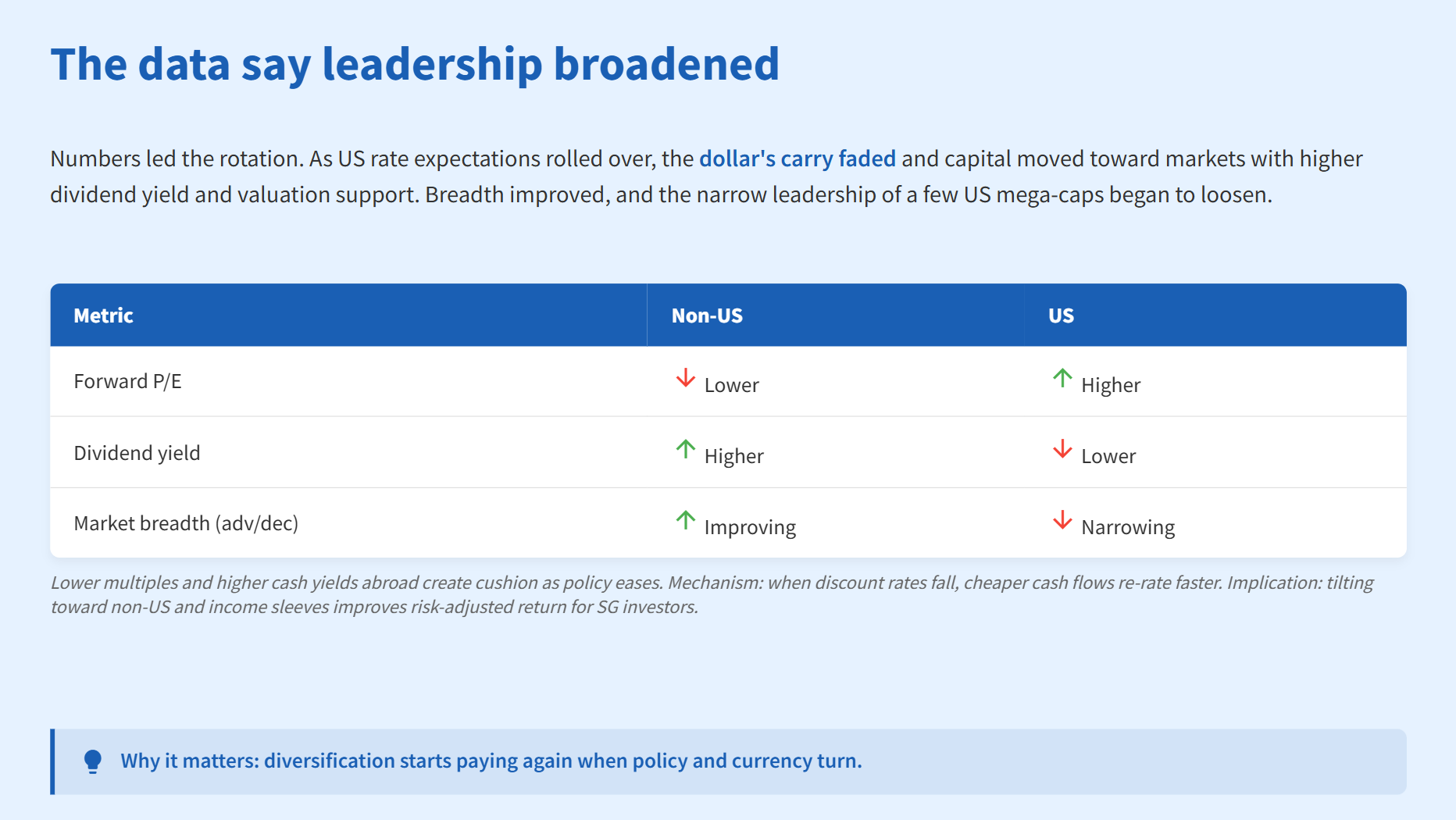
Caption: When people invest in other countries, they often find stocks that cost less and pay out more money to investors, such as through dividends, compared to American stocks. This gives some protection, or a "cushion," if rules for borrowing and lending money (like interest rates) are loosened. Here’s why: When interest rates go down, those cheaper stocks tend to go up in value faster, because the money they will earn in the future becomes more appealing.
For investors in Singapore, it can make sense to add more non-US stocks and investments that give regular cash payments. This can help lower risk and still aim for good returns. In simple terms, picking investments that pay you more and cost less up front can be a smart way to grow your money—especially when the financial world starts to make borrowing easier.
Powell’s pivot narrows US carry
Federal Reserve leader Jerome Powell didn’t say interest rates would be cut soon, but he made it easier for that to happen by highlighting two things: inflation isn’t rising as fast, and the job market is showing some weaknesses. Because of this, people now expect an interest rate cut as early as September, which led to the US dollar dropping at first, although it quickly rebounded.
The strong returns for the US dollar seen in 2023 and 2024 are becoming less reliable. When US interest rates fall, investments in emerging markets and real assets (like property or resources) often do better because money moves away from the US dollar to chase higher returns elsewhere. Over the next few weeks, expect economic data to be up and down, but overall, the move toward lower rates means it may be smart to shift investments away from US stocks and towards other opportunities.
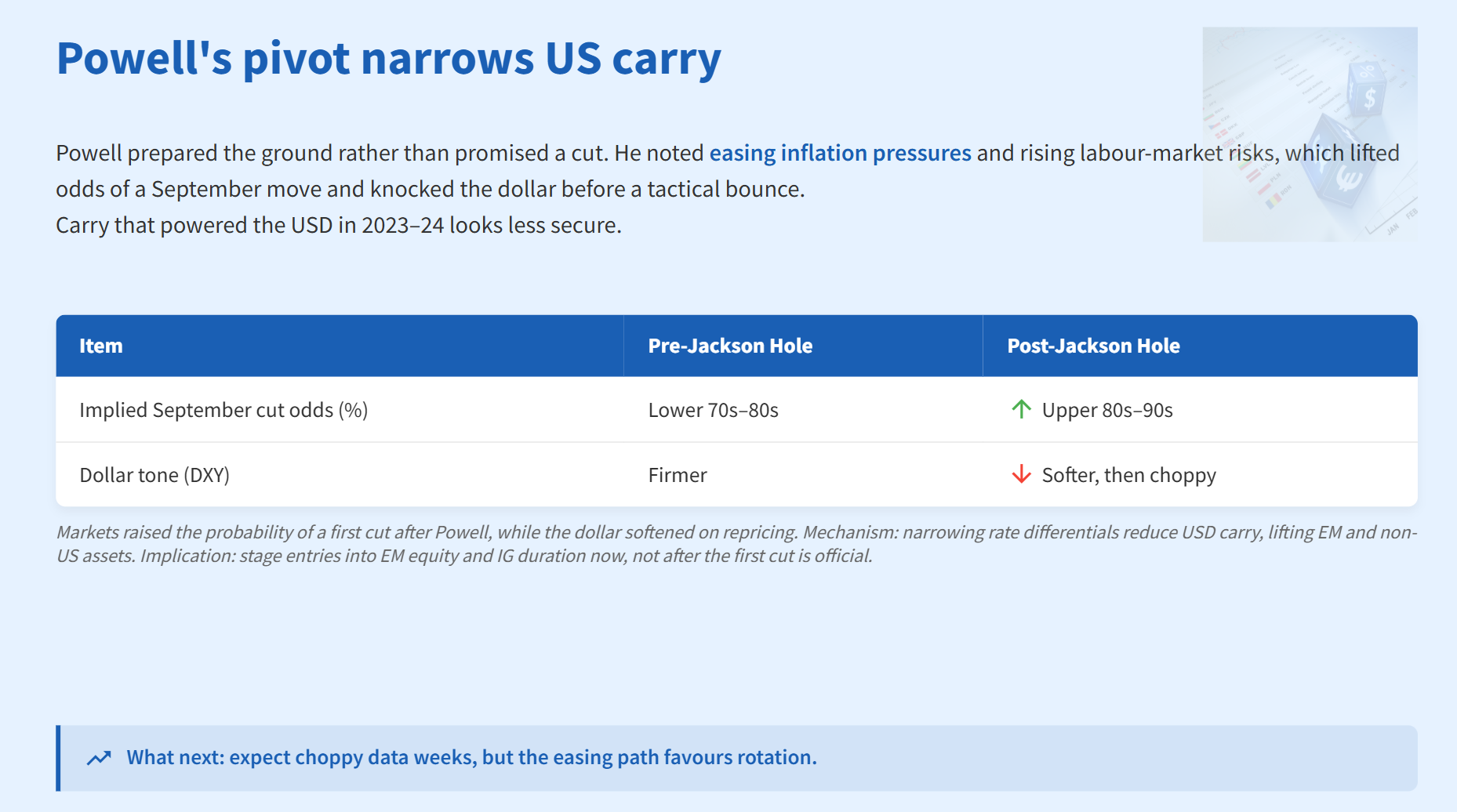
Caption: Markets raised the probability of a first cut after Powell, while the dollar softened on repricing. Mechanism: narrowing rate differentials reduce USD carry, lifting EM and non‑US assets. Implication: stage entries into EM equity and IG duration now, not after the first cut is official.
