



Introduction
The Forecast Has Been Raised Three Times
The Ministry of Trade and Industry raised Singapore’s 2026 growth forecast this week, from a range of 2 to 4 percent all the way up to 4.5 to 5.5 percent.
My first reaction was relief. A bigger number sounds like good news. My second reaction, the one that actually matters for a retiree’s portfolio, was to ask what is driving it, and whether that same thing is driving every part of the economy equally.
The Headline Number Needs Context
I am not the one who normally reads a Ministry of Trade and Industry release.
That is usually Iggy’s job, and he is very good at pulling apart a balance sheet in a way that would make my head spin if I tried it myself. But this number affects something closer to home for people like me, people managing CPF and SRS money and trying to figure out whether the economy around us is actually getting stronger, or whether one part of it is just getting stronger while everyone else quietly gets left behind. That question turned out to have a real answer, and I did not expect the answer to be as lopsided as it is.
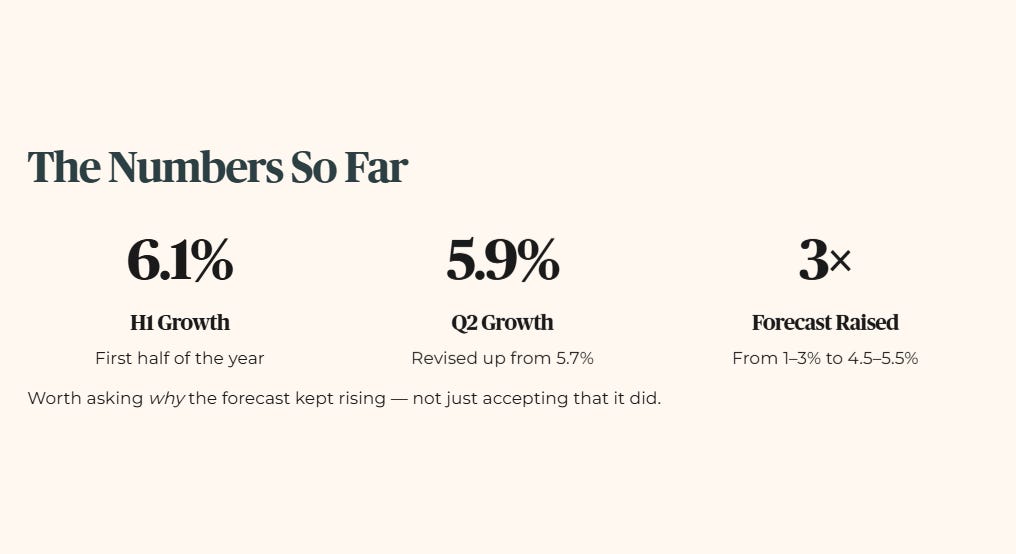
Singapore’s economy grew 6.1 percent in the first half of this year, and the second quarter alone came in at 5.9 percent, revised up from an earlier estimate of 5.7 percent. The Ministry has now raised its full year growth forecast twice this year, first from 1 to 3 percent, then to 2 to 4 percent, and now to 4.5 to 5.5 percent. That is a genuinely large jump within a single year, and it is worth asking why it kept happening rather than assuming the number simply speaks for itself.

The Forecast Has Been Raised Three Times
The Headline Number Needs Context
The Two Forces Pulling in Opposite Directions
AI Investment Is Doing the Heavy Lifting
The Energy Shock Was Less Severe Than Feared
🟠 Angela’s Observation: This Is Not Broad-Based Growth
The Part of the Story That Is Not Sharing in the Good News
Food and Beverage Is Still Contracting
A National Number Does Not Equal a Household Experience
Three Risks Could Still Derail the Upgrade
The Window Is Already Open
What This Actually Means for CPF and SRS Money
Broad Diversification Benefits More Than Sector Bets
Consumer-Facing Businesses Still Face Pressure
🟠 Angela’s Observation: Strong Growth Does Not Automatically Lower Living Costs
Where I Landed
The Question Every Investor Should Ask
The Two Forces Pulling in Opposite Directions
The honest answer is that two very different things are happening at the same time, and one of them is doing almost all the heavy lifting.
AI Investment Is Doing the Heavy Lifting
The first force is the artificial intelligence investment boom, and it is showing up in a very specific corner of the economy.
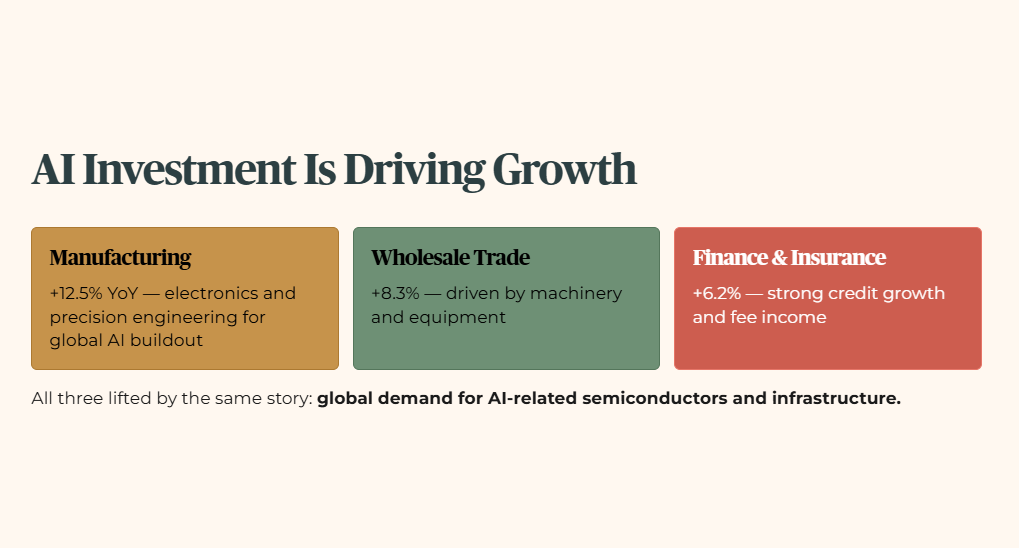
Manufacturing output surged 12.5 percent year on year, and the Ministry was explicit that this came largely from the electronics and precision engineering clusters. These are the parts of Singapore’s manufacturing base that make chips and components for the global AI buildout. Wholesale trade grew 8.3 percent, again driven by machinery and equipment. Finance and insurance grew 6.2 percent on strong credit growth and fee income. These are not small, isolated pockets. They are large sectors of the economy, and they are all being lifted by the same underlying story: global demand for AI-related semiconductors and infrastructure.
The Energy Shock Was Less Severe Than Feared
The second force is the one that was supposed to be dragging growth down earlier this year, and it turned out to be less severe than everyone feared.
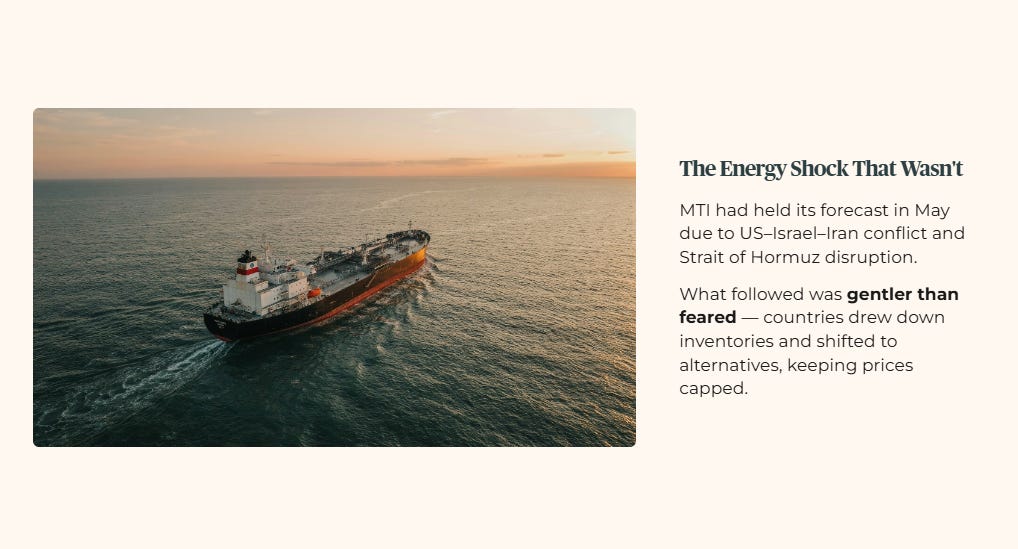
The Ministry had actually held its forecast steady back in May because of the conflict involving the United States, Israel, and Iran, and the disruption that followed to the Strait of Hormuz and global oil supply. What actually happened was gentler than the worst case. Countries drew down existing oil inventories and shifted toward alternative energy sources. That kept a lid on prices instead of letting them spike the way a full-blown energy shock usually does. So the upgrade is not just “things got better.” It is closer to “the thing we were most worried about turned out less bad than feared, at the same time as the thing that was already going well went even better than expected.”
Two separate pieces of good luck arriving together, not one steady improvement across the board.
🟠 Angela’s Observation: This Is Not Broad-Based Growth
When I read this, my first instinct was to think of it the way I think about grocery shopping. If the price of chicken drops but the price of vegetables goes up by the same amount, my total bill might look unchanged on paper, but my actual week looks completely different depending on what I am cooking. This growth number is a bit like that, except in reverse. The good news is real and it is large, but it is landing very unevenly.
Whether you personally feel the benefit of it seems to depend heavily on which part of the economy you or your household actually touches. I do not think that makes the upgrade fake. I think it means the upgrade needs a second question attached to it before anyone celebrates too early, which is exactly what I found when I looked at who is not sharing in this.
The 12.5 percent manufacturing surge explains the upgrade. The 1.5 percent contraction in food and beverage reveals which CPF and SRS exposures still fail the same growth test.
